The anniversary was celebrated in London with bonfires and bell-ringing. Lighted fire-barrels were rolled along Cheapside. It was, in a way, the precursor to Guy Fawkes Day (1605 onwards). Protestants celebrated it with such joy as it was the end of the reign of Elizabeth’s sister, Queen Mary I. ‘Bloody’ Mary, as she was named by Protestants, was the daughter of Katherine of Aragon. Her Government had 287 Protestants burnt at the stake, mostly relatively ordinary people: clergy, apprentices, artisans, and agricultural workers. 60 were women; 67 were Londoners: the majority were of the younger generation, and most from the South East of England.
The executions were overwhelmingly unpopular, ghastly exhibitions of brutality. In 1555 the weather was unusually wet, so the burnings were an even slower form of torture. The savagery was blamed by the Protestants on the Old Religion and particular the Spaniards who came over with Mary’s Spanish husband. Ironically, Philip, in fact, urged caution. When Mary refused to be as lenient to religious dissidents as she was to political ones, he suggested the executions should, at least, be in private. She refused, as the immortal souls of the population were put at risk by Protestant dogma. So the public nature of the deaths was a justifiable deterrent.
When, three years later, in 1558, in the early hours of the 17th November (6am) Queen Mary died, London rejoiced. An old regime, a foreign regime, a Catholic regime was swept away by a young Queen (Elizabeth was 25), with a young Court sworn to protect the new Protestant religion. (For my post on the nicknames for her courtiers look here.)
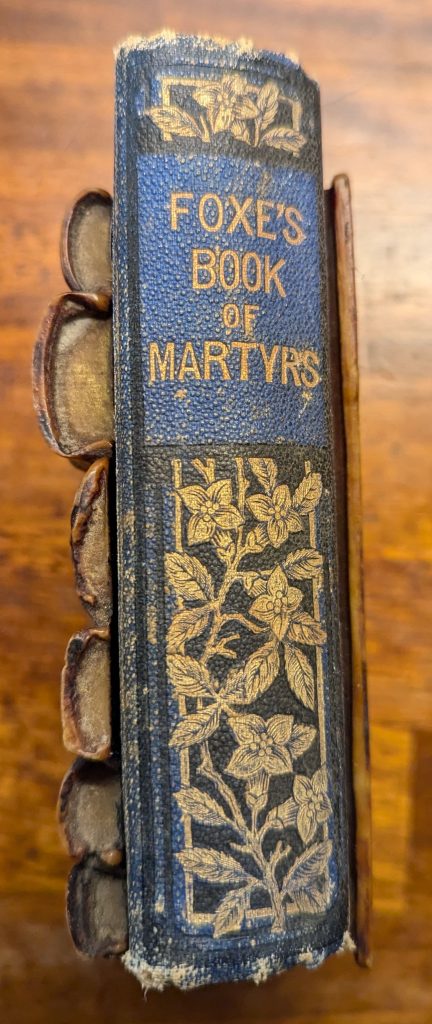
Soon, Foxe’s Book of Martyrs outsold all other books printed except the Bible, and enthusiasm for religious reform morphed into anti-Catholic intolerance.
The Author’s copy of Foxe’s Book of Martyrs
One of the martyrs in the book is Thomas Tomkins, a weaver and a Londoner from Shoreditch, a few hundred yards from where I live.
Tomkins was a humble but godly man who was kept imprisoned by Bishop Bonner, the Bishop of London, at his Palace at Fulham. Here he was beaten. The Bishop personally beat him around the face and ripped off part of his beard. The beatings continued for six months. Finally, exasperated at his failure to persuade the weaver of his error, Bonner burnt Tomkins hand with a lighted taper until ‘the veins shrunk and the sinews burst’. I assume Bonner would defend his action by saying he wanted to give the weaver Tomkins a foretaste not only of the burning he faced but of the very fires of Hell.
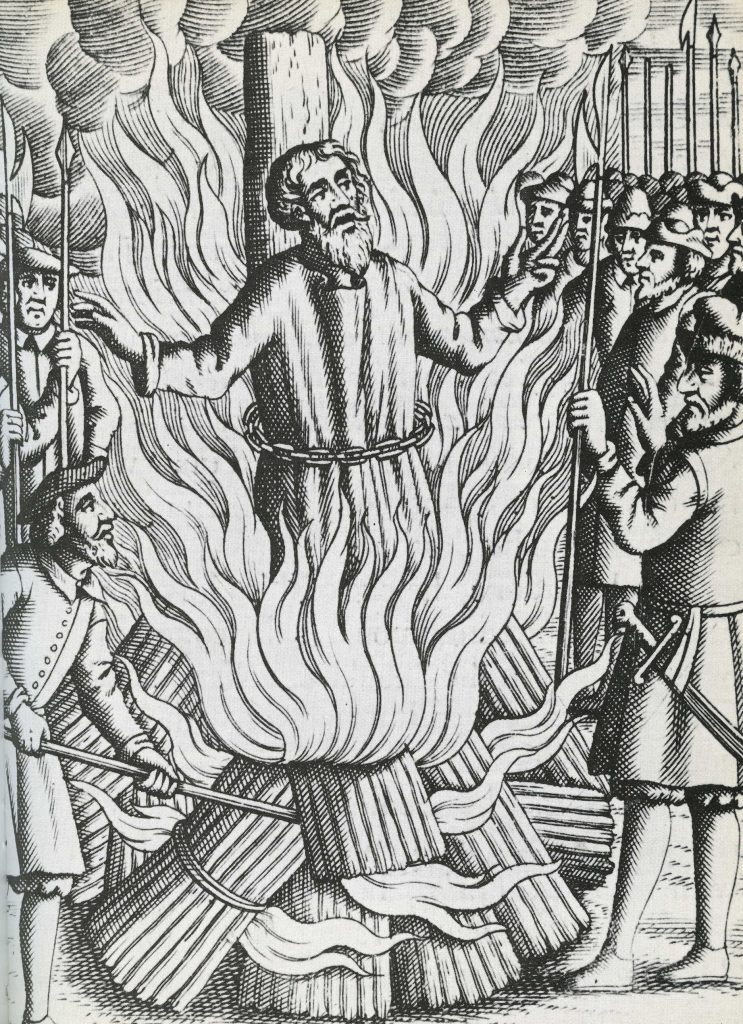
But nothing would avail; Tomkins, the simple man that he was, would not accept that bread was made into flesh. (Transubstantiation). He would not say that which he did not believe. So he met his end at Smithfield by fire with his bandaged hand in the reign of Queen Mary on 16th March 1555.
Thomas Bilney martyred in Smithfield.
First Published 17th November 2023, revised 2024,2025
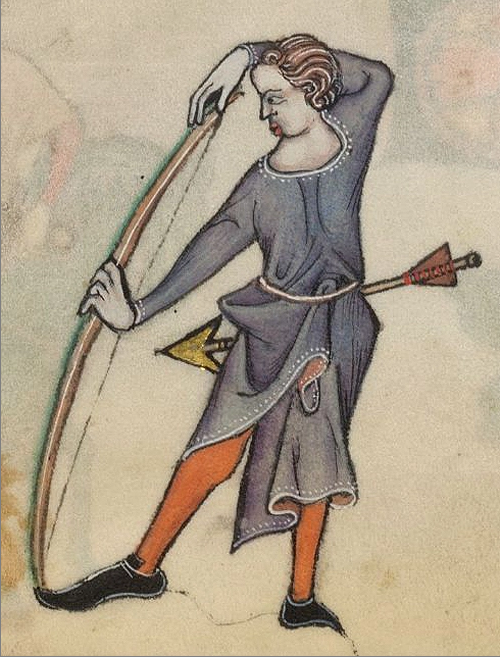
Medieval drawing of an archer. Good resistance exercise to get the muscle/fat ratio on the healthy side?
‘Leaping is an exercise very commendable and healthful for the body.’
The Compleat Gentleman 1634
Thomas Fuller in his book published in 1642 says:
Running, Leaping, and Dancing, the descants on the plain song of walking, are all excellent exercises. And yet those are the best recreations which besides refreshing enable, at least dispose, men to some other good ends. Bowling teaches mens hands and eyes Mathematicks, and the rules of Proportion: Swimming hath sav’d many a mans life, when himself hath been both the wares, and the ship: Tilting and Fencing is warre without anger; and manly sports are the Grammer of Military performance. But above all Shooting is a noble recreation…..
‘The Holy State’ by Thomas Fuller B.D. and Prebendarie of Sarum
Published St Pauls Churchyard 1642
The Holy State is a fascinating book – it provides instruction on how to be the Good Wife; the Good Advocate; the Good King; Bishop etc. etc.; has general rules of behaviour; some case studies of good lives to emulate and discussion of profane states not to emulate.
15th of November 1712 A Famous Duel between Lord Mohun and the Duke of Hamilton
‘In short, they fought at seven this morning. The dog Mohun was killed on the spot; and while the Duke was over him, Mohun shortening his sword, stabbed him in at the shoulder to the heart. The Duke was helped towards the Cake House by the Ring in Hyde Park (where they fought) and died on the grass, before he could reach the house; and was brought home in his coach by eight, while the poor Duchess was asleep.‘
Jonathan Swift ‘The Journal to Stella’ 1712
Lord Mohun seemed to be the villian, not only making the initial affront, but also issuing the challenge and stabbing his rival in such an underhand way! After the Duel there was fighting between the servants of the men, and the seconds had to flee to avoid arrest. Duels were illegal but remained a part of upperclass society into the 19th Century. Pehaps, Thomas Fuller’s advocacy of fencing as a good keep fit exercise is not such a great idea!
Text taken from ‘A London Year’ Compiled by Travis Elborough and Nick Rennison
To read my post on Jonathan Swift and Chelsea Buns see my post here.
It was a holiday in Germany, France, Holland, England and in Central Europe. People first went to Mass and observed the rest of the day with games, dances, parades, and a festive dinner, the main feature of the meal being the traditional roast goose (Martin’s goose). With the goose dinner, they drank “Saint Martin’s wine,” which was the first lot of wine made from the grapes of the recent harvest. Martinmas was the festival commemorating filled barns and stocked larders.
It was celebrated with Bonfires in Germany, and with St Martin’s Beef and Mumming plays in England. Following the Reformation, its place in the Calendar has been taken by Halloween and Bonfire Night.
St. Martin of Tours
St Martin of Tours, 20th Century Stained Glass, St James Church. Chipping Camden.Window 1925 Commemorating World War 1. St Martin’s Feast Day is Armistice Day.Photo K Flude
Martin was a soldier in the Roman Army who would not fight because of his Christian beliefs. When he met a beggar, he cut his cloak in half and shared his cloak. He rose in the hierarchy of the Gallic Church and became Bishop of Tours. According to legend, his funeral barge on the River Loire was accompanied by flowers and birds. He died in AD397. He is one of the few early saints not to be martyred. Martin is the saint of soldiers, beggars and the oppressed. Furthermore, he stands for holding beliefs steadfastly and helping those in need.
St Martin’s in the fields
Early 20th Century Image of Trafalgar Sq. St Martin’s is in the top right-hand corner.
There are two famous Churches dedicated to St Martin in Central London with possible early origins. St Martin’s in the Fields, near Trafalgar Square, has been the site of excavations where finds show a very early settlement, with early sarcophagi. It is the one place where a convincing case can be made for continuity between the Roman and the Anglo-Saxon period. It is possible, that the Church was founded soon after St Martin’s death (397AD). A kiln making Roman-style bricks was found. A settlement grew up near the Church and this expanded to become Lundenwic, the successor settlement to Londinium.
St Martin’s Within
Old Print of London c1540 showing St Pauls, with St Martin’s by the wall to the left of the photo
The other St Martins is St Martins Within, just inside the Roman Gate at Ludgate. Many early churches are found at or indeed above Gates. This one also has legendary links to burial places for King Lud, and for King Cadwallo. He. Cadwallon ap Cadfan, was the last British Kings to have any chance of recovering Britain from the Anglo-Saxons. Geoffrey of Monmouth says that Cadwallo was buried here in a statue of a Bronze Horseman. This was thereby a ‘Palladium’ – something which protects a place from invasion. (See my post about Palladiums of London). It has been suggested by John Clark, Emeritus Curator at the Museum of London, that Geoffrey of Monmouth might have used the discovery of a Roman Equestrian Statue as an inspiration for the story.
St Martin was also the saint of Travellers, and this might explain the location of the Church near the gate. Although there is nothing but legendary ‘evidence’, it would make sense for an early church to be built near Ludgate,. This is the Gate that leads to St Pauls which was founded in 604AD from Lundenwic which was booming in AD650.
Although the City seems to have mostly devoid of inhabitants from the end of the Roman period to the 9th Century, the presence of St Pauls Cathedral means that Ludgate was most likely still in use or at least restored around this period. It leads via Fleet Street and Whitehall, almost directly to the other St Martin.
St Martin and lime plaster
Michaelmas was also the time of year when lime plaster was renewed because lime needs to be kept moist when renewed. It takes three to four days to form the calcite crystals that make it waterproof. Lime plaster was used on most timber framed buildings.
On This Day
1100 – Matilda married King Henry I, thus united the English and Norman Royal Blood lines. The marriage nearly didn’t happen because she, originally called Edith, sheltered in Wilton Nunnery, as a teenager, fearful of kidnap and rape by Normans. Was she a Bride of Christ? or a visitor free to resume a normal life?
(Originally, posted 11 Nov 2021, revised 2022, 2023, 2024, 2025)
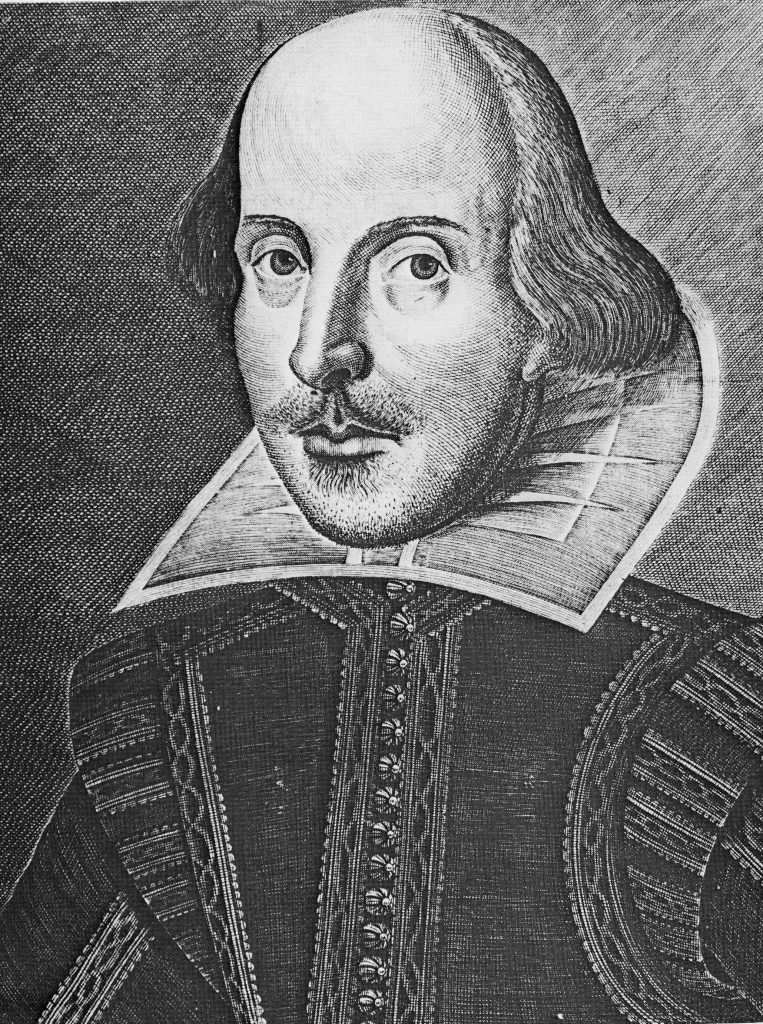
Droeshout Portrait of Shakespeare from the First Folio
On November 8th in 1623, the First Folio was registered at Stationer’s Hall near the publishing district around St Pauls Cathedral in London. It was actually called:
Mr. William Shakespeare’s Comedies, Histories, & Tragedies
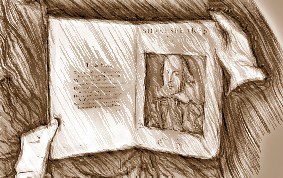
Sketch of the First Folio
It was put together by his actor friends, John Heminge and Henry Condell seven years after his death. They wanted to replace all the corrupt editions of his plays and poems that had been:
“stol’n and surreptitious copies, maimed and deformed by frauds and stealths of injurious impostors”
The true texts of his plays and poems “are now offer’d to your view cured, and perfect of their limbes; and all the rest, absolute in their numbers as he conceived them.” Wikipedia
Shakespeare at the Frankfurt Book Fair
In fact, the plays were ready earlier than 1623, as they entered into the catalogues for the Frankfurt Book festival to appear between April and October 1622. How amazing is it that the Frankfurt Book festival is still the dream of any aspirant writer? Wikipedia tells me that hand-written books were traded at the general trade fair in Frankfurt from the 12th Century. But 1462 is the date that appointed as being when the Book Fair was certainly established.
The First Folio offers plenty of proof that Shakespeare was the author of the plays. He left gold rings of remembrance to Heminge and Condell in his Will. They were part of his Players Company, and had worked together on many of the plays. The Folio has forewords by people extolling the virtues of the writer. Enough proof for any reasonable person.
Heminge and Condell
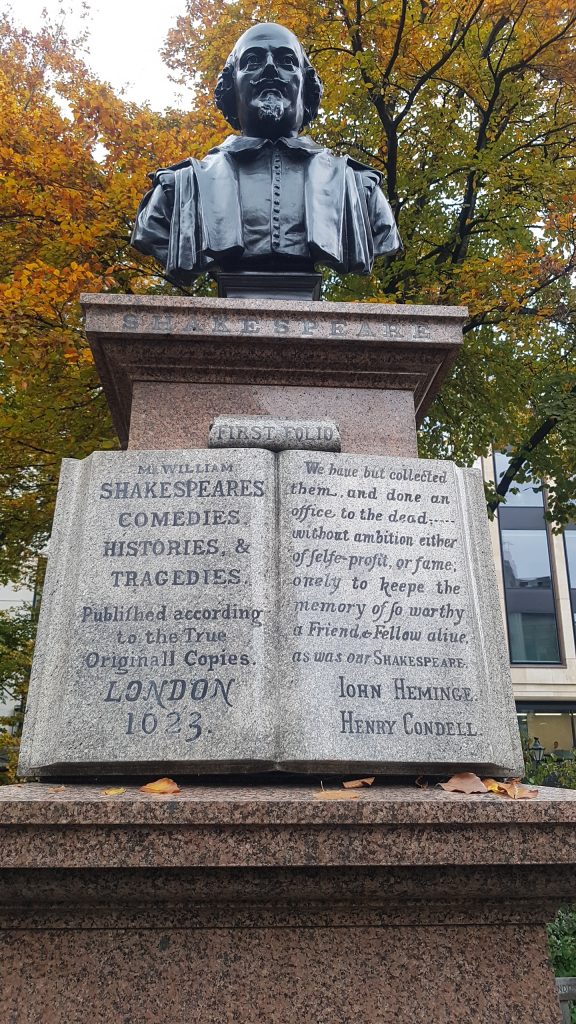
Heminge and Condell are commemorated in the Garden of St Mary Aldermary behind the Guildhall. They were Churchwardens of St Mary. A few streets away lived William Shakespeare in 1611. True friends, so don’t go telling me he didn’t write the plays!
St Mary Aldermany monument to Shakespeare, Heminge and Condell and the First Folio.
There was a wonderful BBC festival of Shakespeare on in 2023/24 to celebrate. If you look at this link, here. You will find great content. Much of it is available if you search BBC Sounds, or BBC iPlayer.
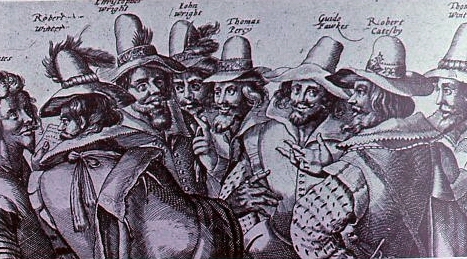
The Gunpowder Plotters, culminating on the 5th of November
Soon, after the discovery of the Gunpowder Plot, Parliament legislated for an annual commemoration of the Catholic Plot. The date they chose was the anniversary of finding Guy Fawkes with a lantern next to piles of barrels of Gunpowder underneath Parliament. This was the occasion of the State Opening of Parliament, 5th November 1605. The King, his Queen, the King’s children. The Lords from the House of Lords & MPs from the House of C would all have been blown up.
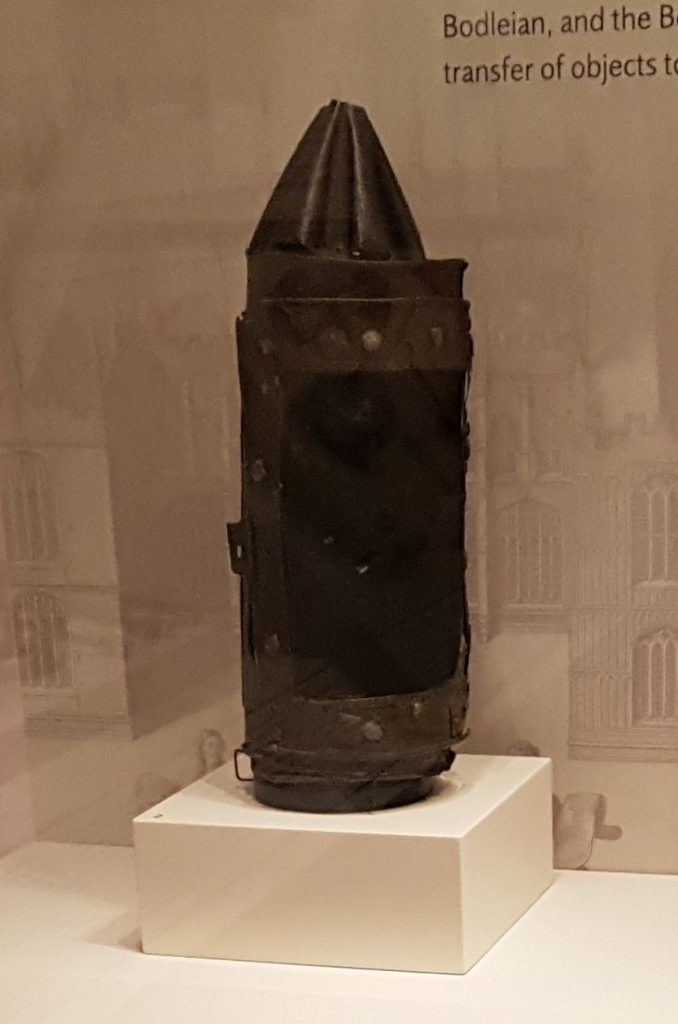
The Ashmolean Lantern
Guy Fawkes Lantern at the Ashmolean Museum
This was the one held by Fawkes. It was given the Museum by Robert Heywood in 1641. He got it from his brother, Peter, who was a Westminster Magistrate among the party who arrested Guy Fawkes in the cellar. Peter Heywood, took the lantern from Guy Fawkes to stop him setting fire to the pile of gunpowder barrels. Or at least that is the story Robert Heywood told.
A commemoration of fireworks and bonfires was clearly appropriate given that it has been estimated that the amount of gunpowder in the barrels would have killed the king, the Royal Family, the House of Lords and the House of Commons and devastated a huge area around Westminster. But some suggest that the nature of the commemoration draws some elements from Halloween – use of bonfires and dressing up. Halloween was frowned upon by puritans, but they supported Guy Fawkes Day as it was anti-catholic.
Banner in Lewes
The anti-catholic nature of the celebration is a fact, but it really isn’t something we think about today. There is little anti-Catholic prejudice in Britain (except in one or two very specific places). Irish friends are amazed we still celebrate it, but for the vast majority of people in Britain it is really just Fireworks night, nothing to do with anti-catholic sentiment.
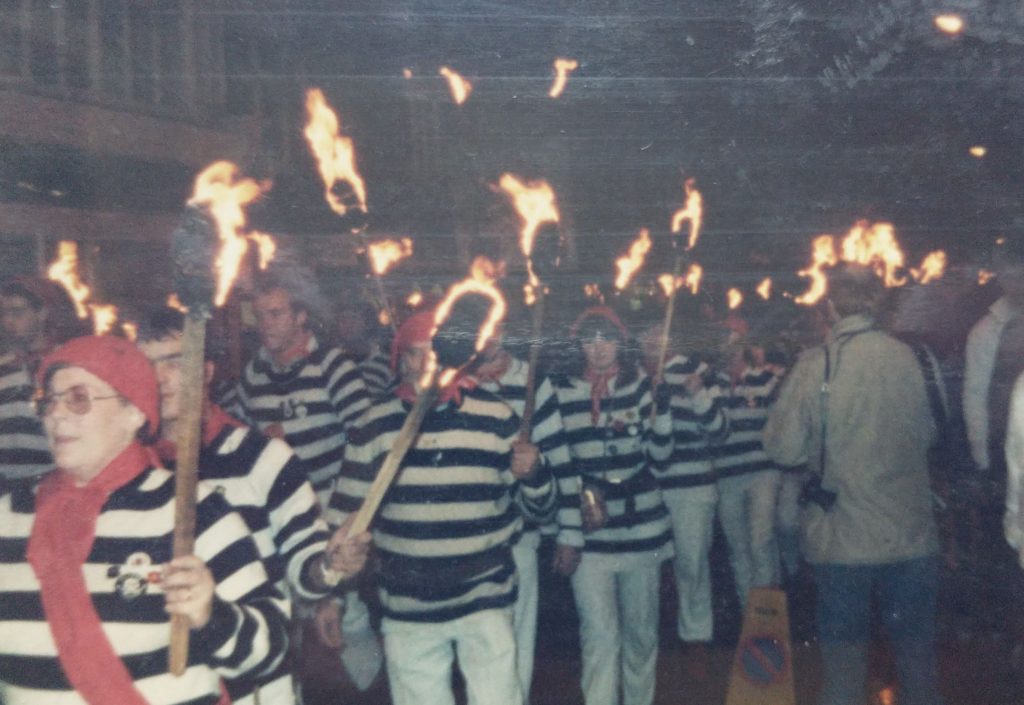
The Lewes Bonfire
Traces of the original anti-catholic nature of it do continue in places like Lewes, which is one of the most traditional Fireworks Nights. This consists of clubs who organise a parade through the town. Then it ends with the burning of an effigy of the Pope and, more recently, other unpopular figures on the contemporary scene. Click here for more on Lewes.
Procession in Lewes
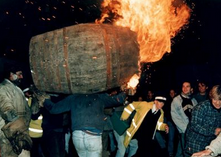
Tar Barrel Rolling
Ottery St Mary continues the tradition of using Tar Barrels. These are wooden barrels in which tar and tinder are set on fire. The Barrels are either rolled through the Town, or down a hill. But in Ottery they are carried on the shoulders of volunteers (see video below). This has a pedigree which goes back before 1605 as there are references to tar barrels and displays in Protestant processions to celebrate the accession to the throne of Edward VI and Elizabeth 1.
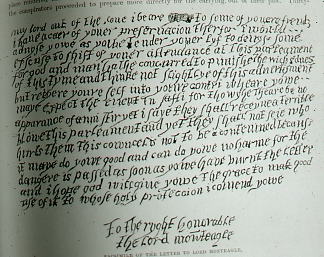
King James 1 took credit for discovering the plot as he is said to have deciphered the warning given in a letter, written to William Parker, 13th Baron Morley, 4th Baron Monteagle. Monteagle wrote the letter at his house in Hoxton, London (commemorated by a plaque in Hoxton Street near where I live) which warned against turning up at Parliament but was not explicit as to the nature of the threat.
Letter Lord Monteagle passed on to King James 1
My lord, out of the love I beare to some of youere frends, I have a care of youre preservacion, therefore I would aduyse you as you tender your life to devise some excuse to shift youer attendance at this parliament, for God and man hath concurred to punishe the wickedness of this tyme, and thinke not slightly of this advertisement, but retire yourself into your country, where you may expect the event in safety, for though there be no apparance of anni stir, yet I saye they shall receive a terrible blow this parliament and yet they shall not seie who hurts them this cowncel is not to be contemned because it may do yowe good and can do yowe no harme for the dangere is passed as soon as yowe have burnt the letter and i hope God will give yowe the grace to mak good use of it to whose holy proteccion i comend yowe.
James realised this sentence: ‘they shall receive a terrible blow this parliament and yet they shall not seie who hurts them‘ implied an explosion. His father, Lord Darnley, was killed in a Gunpowder Plot in Edinburgh, so perhaps he was particularly attuned to the threat. On the other hand, there is a possibility that the King’s Secret Service were aware of the plot and arranged matters, so the King could receive the credit for its discovery.
The Fifth of November
Remember, remember! The fifth of November, The Gunpowder treason and plot; I know of no reason Why the Gunpowder treason Should ever be forgot! Guy Fawkes and his companions Did the scheme contrive, To blow the King and Parliament All up alive. Threescore barrels, laid below, To prove old England’s overthrow. But, by God’s providence, him they catch, With a dark lantern, lighting a match! A stick and a stake For King James’s sake! If you won’t give me one, I’ll take two, The better for me, And the worse for you. A rope, a rope, to hang the Pope, A penn’orth of cheese to choke him, A pint of beer to wash it down, And a jolly good fire to burn him. Holloa, boys! holloa, boys! make the bells ring! Holloa, boys! holloa boys! God save the King! Hip, hip, hooor-r-r-ray!
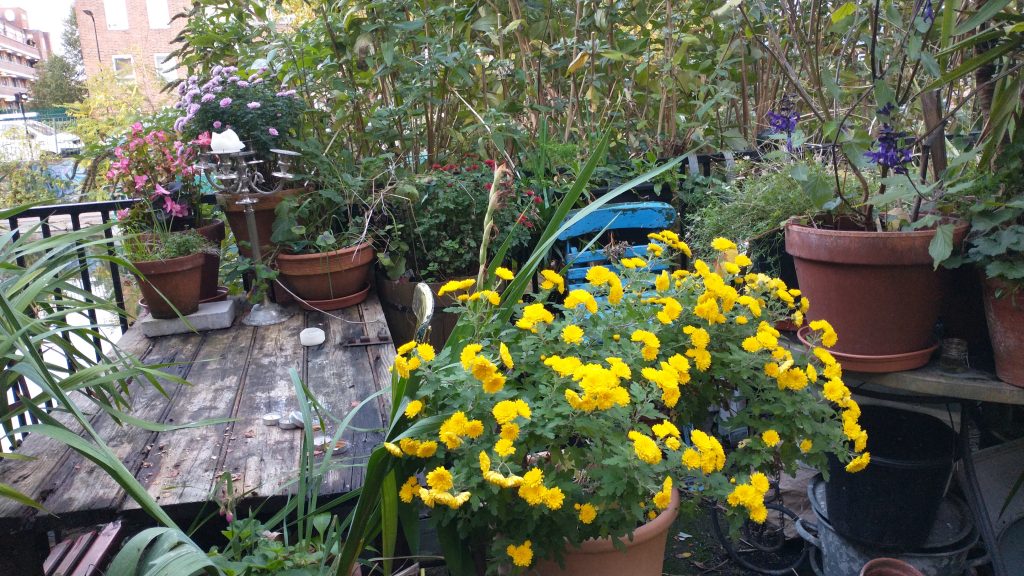
Chrysanthemums Flowers for the Dead (the author’s back garden)
How the Celtic festival that marked the beginning of Winter became All Hallows is not clear. Some say the Church set up its own festival independent of the Northern European traditions. But it is as likely that the Church adopted existing pagan festivals, and gave them a Christian spin.
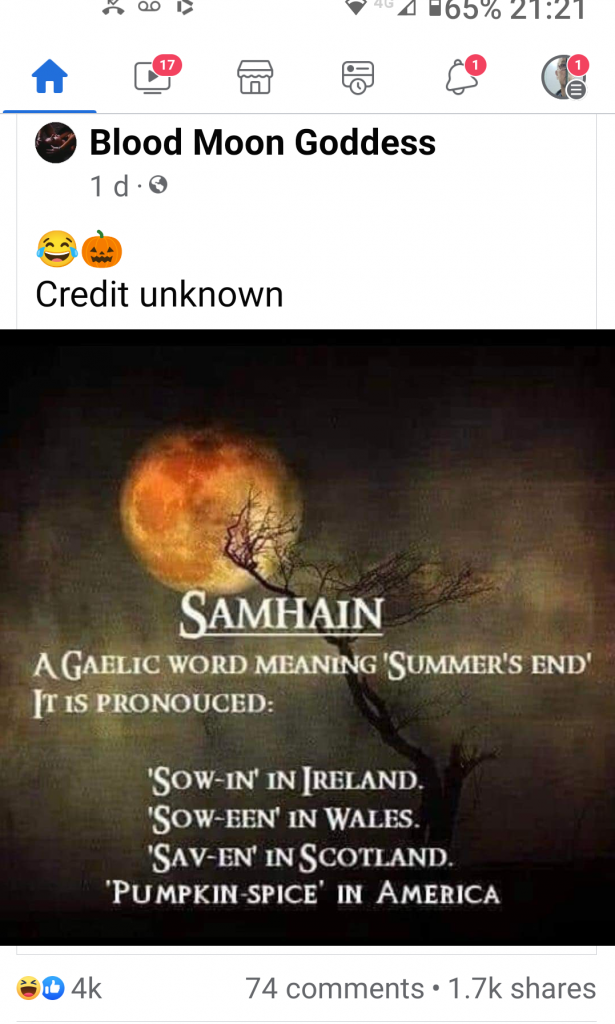
Samhain, on October 31st, was, for Celtic religions, not only the beginning of Winter but also the beginning of the Year. As I noted on my Halloween post the Festivities began in the evening before the day because Celtic and Germanic traditions began their day at Dusk. So Halloween is not, in fact, the evening before, it is the start of the day of the festival.
Facebook Image giving the words for Samhain in Celtic languages
The Church adopted the Roman tradition of the day beginning not at Dusk but at Midnight. So the festival of All Hallows is on November 1st not October 31st. But the Church mimicked the old ways of doing things by celebrating the evening before as the Vigil of All Hallows’ Day. This was called All Hallows Evening or Halloween.
All Hallows by the Tower, London
Engraving of All Hallows Barking
In London, there is a Church called All Hallows, on Tower Hill. It is associated with Barking Abbey, founded in the 9th Century. Therefore, it is known as All Hallows Barking or All Hallows by the Tower. The Church has a prominent position on Tower Hill, which would have been visible from boats coming up the Thames. Also in the Church is the earliest Post-Roman arch in a Church in the City of London. This is made of reused Roman bricks. Moreover, in the crypt are Roman tessellated floors.
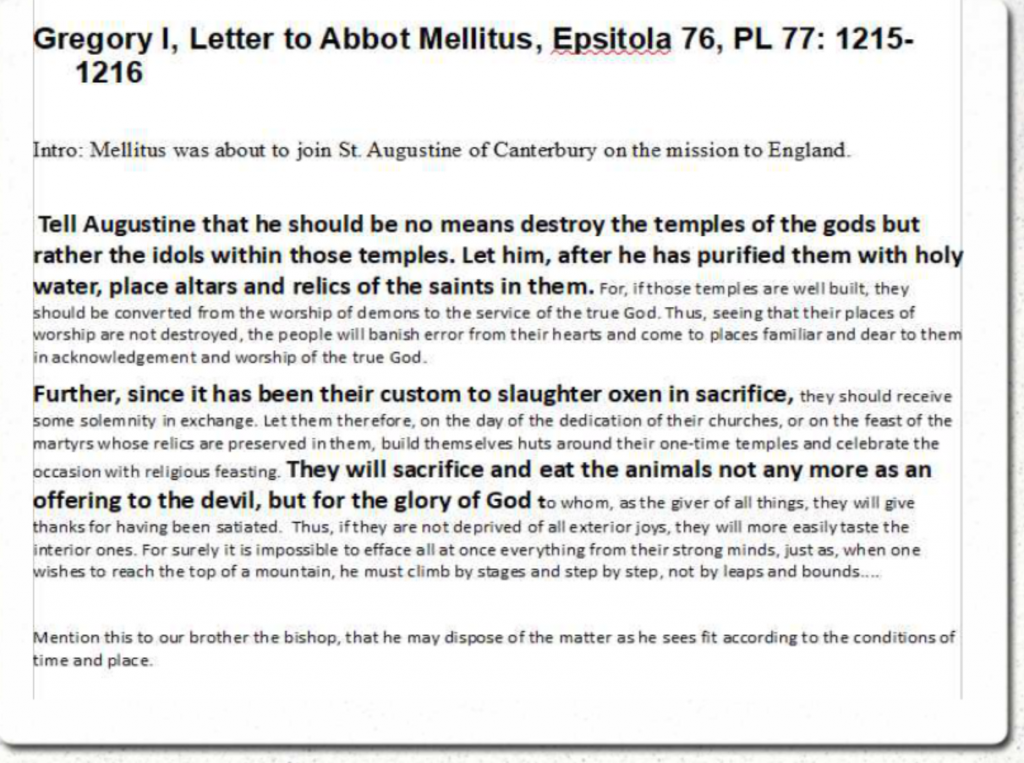
Letter from Pope Gregory to St Augustine
Now, I don’t want to be shot down in flames because there is no evidence that there was a Roman Temple here. Nor indeed a Roman or immediately Post-Roman Church. But it is one of the earliest Churches in the City of London. There must have been Christian Churches in Roman London, and this would be on my list of candidates. It is simply that the attribution to All Hallows provides a possible link to Celtic festivals. So speculation rather than anything else. The letter above, gives a context for the conversion of a pagan Temple to a Christian Place of Worship.
An Uncanny Day to Hallowed Day
For the Celts, Samhain was an uncanny day when all the sprites and spirits are alive and in the world. The Church took that, and span in on its head. So it became a ‘hallowed’ holy day when all Saints are celebrated and alive to us. Celebrated on October 31st and November 1st.
A celebration of All Saints was originally in May in the Church but was changed to the 1st November in the 7th Century by Pope Boniface. Later it was swapped back to May. But fixed again on the 1st November in the 9th Century. It is followed on the 2nd by All Souls’ Day. (see my post on All Souls Day here.
So on the 1st November, those celebrating the pagan festival would be in full swing after a hard night of celebration. The embers of the Fire would be still burning, stones left around the fire would be inspected for the prophecy they told of the future. Each person had a stone, and if it was still intact it was good luck, if it had disappeared the future was not good.
La Toussaint et Dia de Todo Los Santos
In France, All Hallows or All Saints is called La Toussaint, and flowers such as Chrysanthemums, which blossom in late October, were put on the graves. In Spain, it is Dia de Todo Los Santos and is a national holiday upon which people put flowers on the graves of the dead.
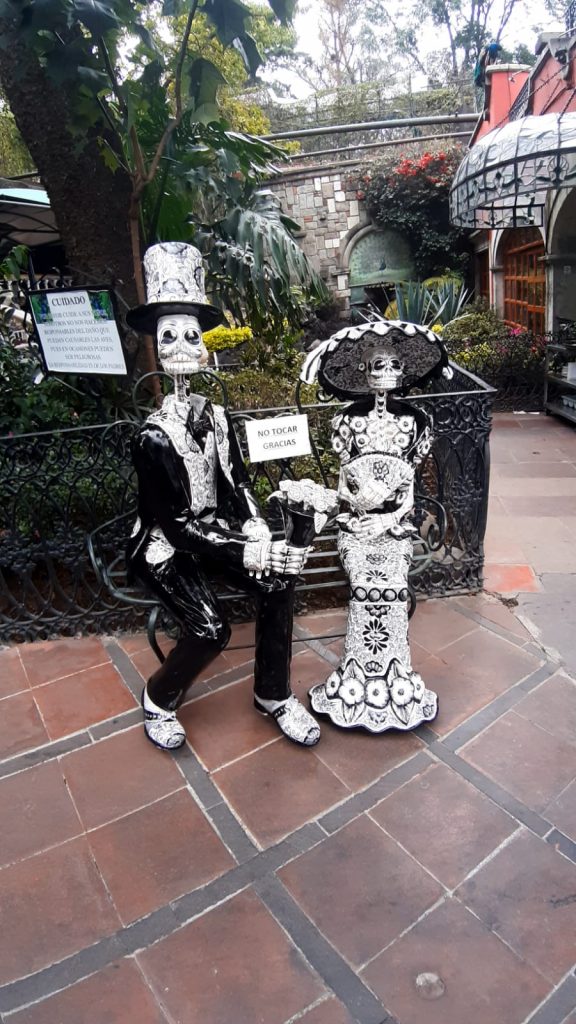
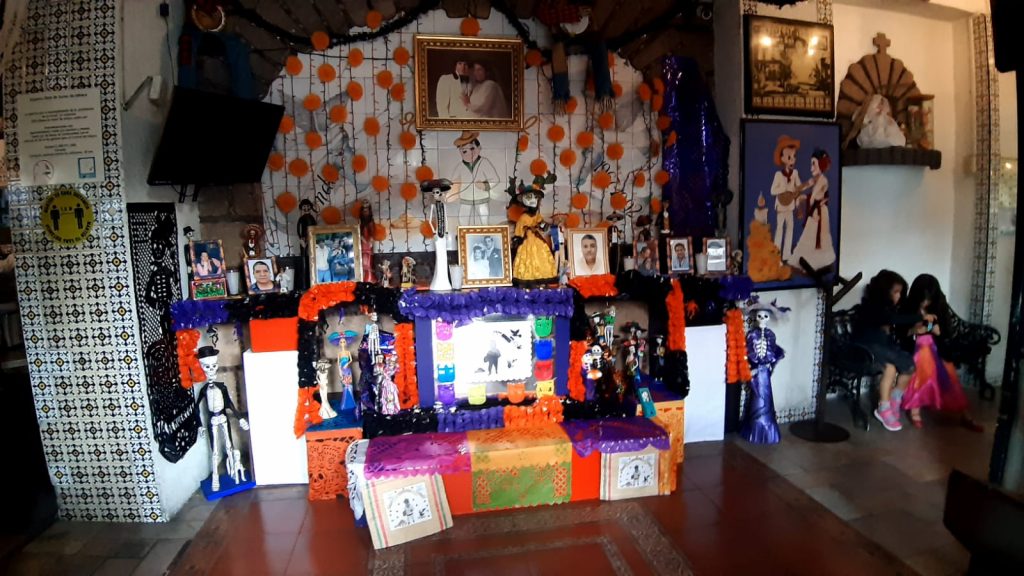
In Mexico, Dia de los Muertos celebrates Holy Innocents on the 1st. People create altars to the lost ones, with their favourite flowers, toys, food stuffs,, photographs. People argue about the pre-colombian aspects of the festival as there are similarities to European All Saints Days celebrations. But Quecholli, was a celebration of the dead that honoured Mixcóatl – the god of war. It was celebrated between October 20th and November 8th.
A correspondent in Mexico has sent back these pictures of the festivities in Mexico.
Day of the Dead in Mexico. Photos by S. Morice
The female figure to the left is La Catrina. This image was popularised by an early 20th Century design by José Guadalupe Posada and developed in a mural by Diego Rivera. For more details click here.
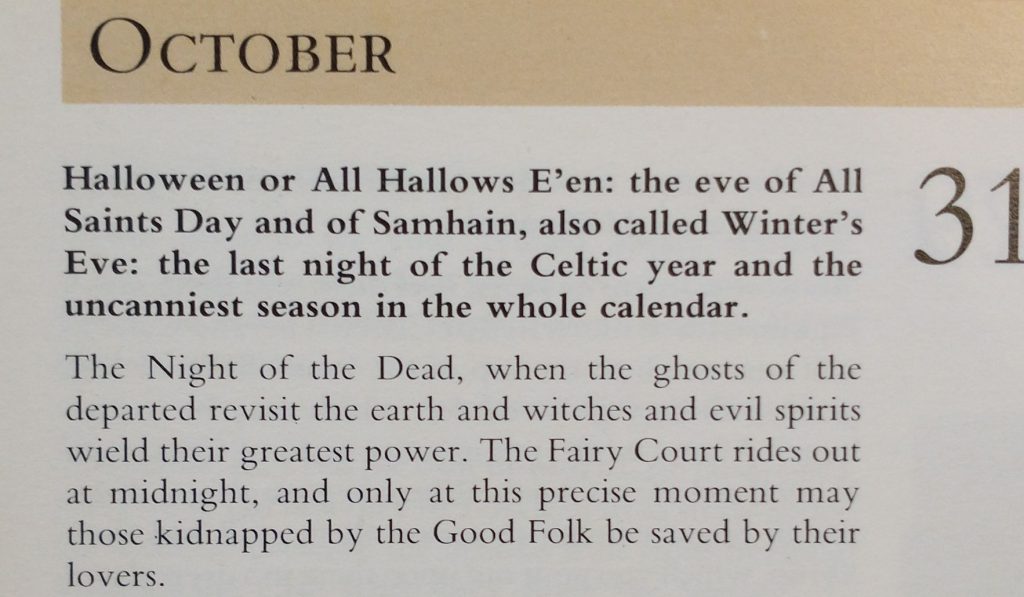
From the Perpetual Almanack of Folklore by Charles Kightly
I began my perpetual Almanac of the Past four years ago on the 31st October 2021. This was the first line:
‘This blog is to celebrate the Year. I will post, hopefully, once a day, so we can follow the seasons, as they happen naturally, and as people in Britain and Ireland have responded to the changes in the year.’
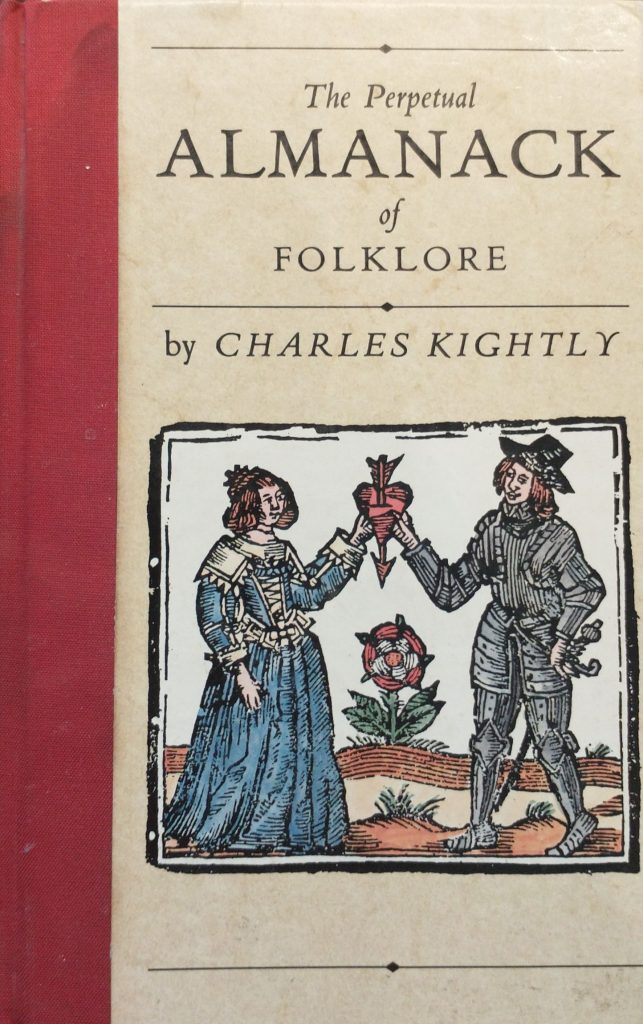
It was inspired by Charles Kightly’s book, which is a pot-pourri of folklore taken mostly from old Almanacs. I haven’t managed, yet to create a post for every day of the year, nearly managed it in the winter but falling behind in the Summer when I take Road Scholar groups around the UK. My plan is to fill in the gaps, improve posts and get rid of typos. Another aim is to add more London-specific content.
Cover of Charles Kightly’s Perpetual Almanac
I started on Halloween because Samhain (pronounced Sow-in) was the beginning of the year for the Celtic world. It may mean Summer’s End. In Wales, it is Calan Gaeaf (first day of winter) and Kala Goafiv (beginning of November in Brittany).
Why did the Celts start their year at such an unlikely time? A clue is that they began the next day at dusk. The Sun dies at dusk so it is the end of the day, and the next day begins with the death of the old day.
So the New Year begins with the Death of the Old Year. Now that might suggest the Winter Solstice as the best time to start the year as this celebrates the death of the old Sun. (see my winter solstice post here :) But, the end of October has, perhaps a better claim. The harvest is in, the fruits in the trees and the nuts are harvested, all the growth of the Summer is over and collected. Plants are mostly dead or dormant, except some evergreens. It is the end of the growing year. The seeds have fallen from the trees and shrubs and are nestling in the soil, ready to begin their cycle again. All is over and all is ready for the new year. Makes sense?
The Celtic way also explains eves; Christmas Eve, New Year’s Eve, May Eve, All Hallow’s Eve. They are not the night before the day, they are the beginning of the day. This is when you begin the celebration.
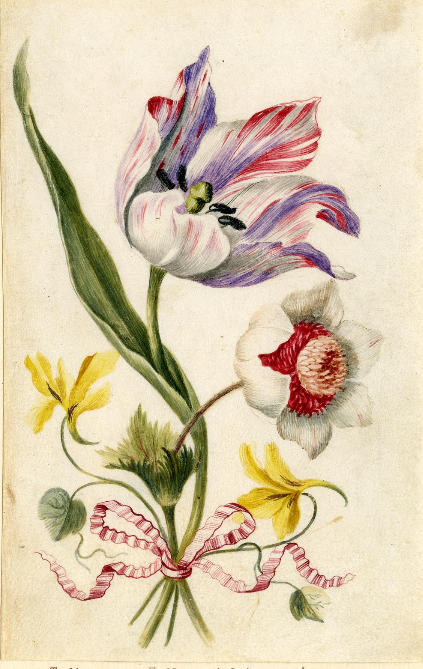
For the Romans, today is the day that Adonis is injured hunting a wild boar. Against his lover’s (Venus) advice, he descends to the underworld. Nature withers and dies until he returns from the underworld. His blood stains a flower and was transformed into the Crimson Anemone. There is a similar story in Babylon of Ishtar and Tammuz.
By Alexander Marshall, crimson and other anemones Binyon 1898-1907 / Catalogue of drawings by British artists, and artists of foreign origin working in Great Britain (5(c))
Adonis comes back on May Day when he meets Venus again, so the world flourishes and is bright and warm.
Julius Caesar says the Gauls venerated the God Dis Pater on this day – an aspect of Pluto, the God of the Underworld, ruler of the Dead. There was a Roman Festival on the Kalends of November dedicated to Pomona, the goddess of the fruit of trees. This may influence the use of Apples, which are prominent in Halloween festivities.
Today, is the feast day of 158 English Martyrs from the English School at Douai. They were killed by the English state between 1577 and 1680.
On the accession of the Protestant Queen Elizabeth, Catholics who preferred exile gathered in Douai (125 Kilometres South of Calais). An English School was set up, which was in essence a Catholic Oxford College in Exile. Its mission became to train priests to re-enter England and minister to the many Catholics who wanted to continue to practice their faith despite official intolerance.
Catholic worshippers were fined if they did not attend Church of England services in their local churches. Catholic Priests re-entering England could be charged with High Treason and, if found guilty, hanged, drawn and quartered. This was often at Tyburn (at the west end of Oxford Street in London).
In the short reign of Mary I, nicknamed ‘Bloody Mary’, over 250 protestants were burned at the stake for heresy. In the long reign of her sister, Elizabeth I, over 300 Catholics were executed for Treason by being Hanged, Drawn and Quartered. Elizabeth is known as ‘Good Queen Bess’. There is no value in balancing evil, but pro-rata Mary’s reign was much more bloody. Elizabeth would probably also suggest that she did not execute Catholics because of their belief, but because the policy of the Catholic Church was to destroy Elizabeth’s regime. So, the Priests were not executed for heresy but for treason. However, this is a fine distinction to be made, in such horrendous blood-letting.
The number of martyrdoms from one institution shows incredible bravery in the face of intolerance, and the Douai Martyrs were a remarkable group of people. Most have been beatified by the church, some have been made ‘venerable’, twenty have been canonised. A few remain simply as ‘martyrs’
In London in Ely Place is St Etheldreda’s Church, which has memorials to Catholic Martyrs, and no mention of Protestant Martyrs. A few hundred yards away in Smithfield is a plaque to the Protestant Martyrs under Queen Mary and no mention of the Catholic Martyrs. Personally, I think it is about time the two traditions made it clear that both groups of martyrs are worthy of equal distinction, and the authorities who allowed such toxic intolerance to triumph deserve our contempt.
Two examples of martyrs in Smithfield:
John Forest, a Franciscan Monk was burnt at the stake at Smithfield and commemorated in St Etheldreda’s Church. He was Catherine of Aragon’s Confessor, and refused to accept King Henry VIII as head of the Church of England.
John Rogers was a scholar and worked to continue William Tyndale’s work in translating the bible into English. He was the Vicar of the Holy Sepulchre Church, which is halfway between Smithfield and St Etheldreda. He was the first person to be burned during Queen Mary I’s reign, and mentioned on the memorial in Smithfield.
Thanks to my friend Derek, who suggested I cover this topic. His children went to a school in London named after the 158 English Martyrs,
For a longer look at the Protestant Martyrs at Smithfield have a look at my post which deals with the martyrdom of Thomas Thompkins a simple honest man burnt at the stake.
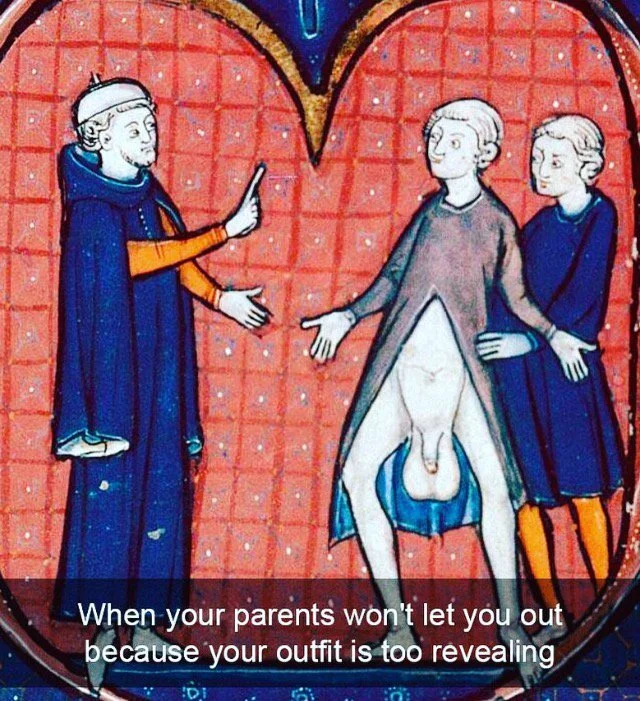
Image from Facebook, illustrating the miracle of the testicles
I’m having technicals problems, as well as being away from home. I posted this a few days ago but it doesn’t seem to have been posted to subscribers. So posting it again.
Today, almost my favourite of many bizarre tales of Saints. St Artemios is the patron saint of male genital disorders, more specifically, hernias and ruptures. His Saint’s Day is October 20th St. Artemios was Governor of Egypt during the reign of Julian the Apostate (331 – 26 June 363). Julian was a philosopher. Nephew to Constantine the Great, who tried to turn the tide and return to traditional Roman religious practices.
Artemios was called to a military meeting with Julian where he witnessed and objected to abuse of Christians. He was tortured with red hot irons, and miraculously cured. Then he was taken to the Amphitheatre where there was a big stone broken in half. He was put on half stone and the other half was raised above him and released, crushing Artemios. He was presumed dead, and left for a day. But he was still alive, broken boned, disembowelled, eyeless and remained unwilling to renounce his religion. Julian ordered his beheading.
A noble woman took his body to Constantinople where his shrine soon started attracting miracles. In the 7th Century, an anonymous author compiled a record of the miracles. St Artemios had become known for healing hernias and genital disorders ‘mostly in men.’ I’m not sure entirely why. Perhaps because of the red-hot pokers? The disembowelling? Maybe the stone that crushed him was round?
I first came across the Saint when I was given a wonderful book called ‘A Medieval Miscellany‘. Tales are selected by Judith Herrin and with an introduction by the great Emmanuel Le Roy Ladurie (see Jan 27th Post to read about Montaillou and Ladurie). It had a colourful spread called ‘The Miracle of the Testicles’. This was the story told by Stephen, a 7th Century deacon of St. Sophia in Constantinople who ‘suffered a rupture, whether from shouting acclamations or from a heavy weight, I cannot say.‘
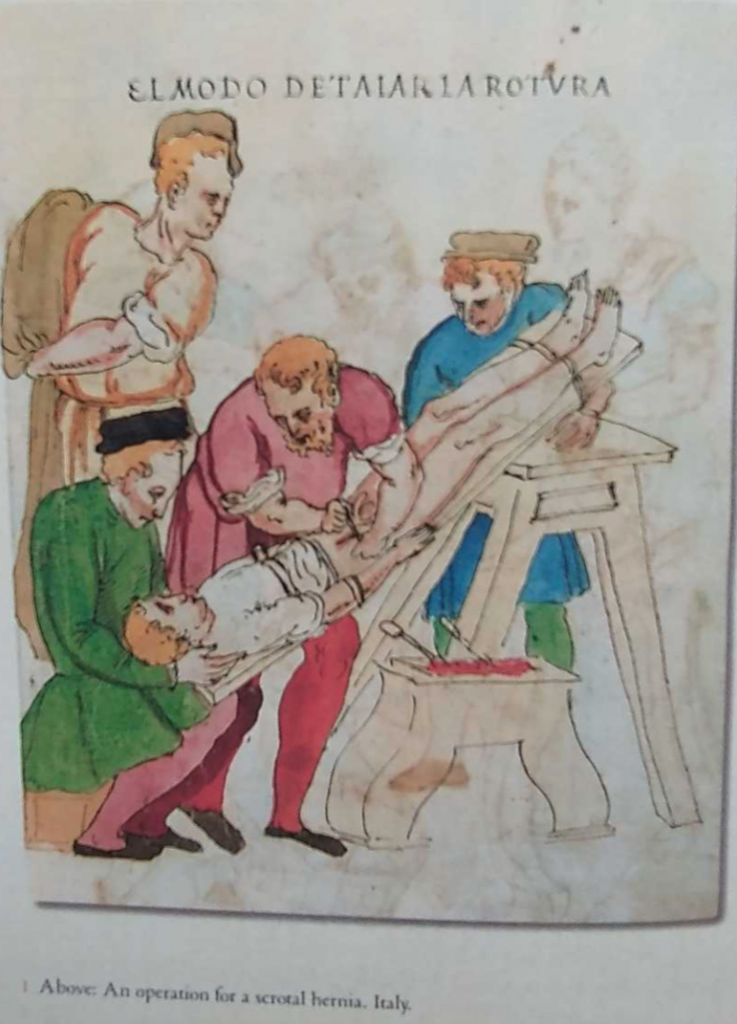
To cut a long story short, Stephen was very embarrassed by his condition. He tried many cures but finally undertook surgery. This was successful, but very soon the condition reoccurred which left him to despair.
Scrotal Hernia Operation, italy
So he planned to visit the shrine of, Artemios, the great healer of testicles. However, he was too embarrassed to stand in the Church, ashamed to be seen by friends. But passing by one day he nipped into the Tomb, descended to where the relics were and ‘cast’ some of the Saint’s holy oil on his testicles. He then found, much to his surprise, that the doors to the Coffin itself were open. Seeing this as a divine intervention he jumped onto the coffin, straddled it face down, so that the corner of the tomb was rubbing his testicles and prayed:
‘And with tears, I spoke again to the martyr: “St.Artemios, by God, Who has given you the gift of cures, no doctor on Earth will ever touch me again. So if you please, cure me. But if not, to your everlasting shame I will live thus without cure.‘
He was not cured immediately. Later he went to the Hot Baths and bathed, and on leaving the baths, thanks be to St Artemios, he was completely cured.
I have transcribed the translation of Stephen’s writings and place it here below as it has many fascinating aspects and remember it is a 7th Century account. But what an extraordinary tale: that it seems reasonable to steal into a tomb, take the holy oil, rub your genitals all over the shrine, and then tell the Saint that it will be to his everlasting shame if he does not make the cure!
For more on the Hospital of Sampson click here. Livanon is one of the Roman Baths in Constantinople and it is interesting that the cure follows bathing in them. The Oxeia is a neighbourhood in Constantinople connected with St Antemios. A cautery is a method to remove or close off a part of the body. It can be hot, cold or chemical.
At long last I disclosed the misfortune to my parents, and after many treatments, (how many!) had been performed on me. Finally, after taking counsel with them, I entrusted myself for surgery to the surgeons in the hospital Sampson, and I reclined in the hospital room near to the entrance to the area devoted to eyes.
After I had been treated all over for three days at night with cold cauteries, surgery was performed on the fourth day. I will omit to what horrible things I experienced while on my back.
To sum up everything, I state that I actually despaired of life itself at the hands of the physicians. After God, entreated by the tears of my parents, restored my life to me, and after the scar from the incision and the cautery had healed, and just as I was believing that I was healthy, a short time later, the same condition recurred and so I reverted to my former state…
I had a plan to approach the holy martyr, as I had heard of his many great miracles. Still, I was unwilling to wait in the venerable church feeling ashamed before friends and acquaintances to be seen by them in such condition. But I frequently used to pass by (for at that time, I was staying in the Oxeia). And so I descended to the holy tomb of his precious relics, and I cast some of his holy blessing, I. e. oil on my testicles, hoping to procure a cure in this manner. And frequently, I entreated him to deliver me from the troublesome condition…
After descending to the holy tomb, I found the doors in front open and I was astounded that they were opened at such an hour. This was the doing of the martyr, in his desire to pity me, Stretching out facedown on the holy coffin, I straddled it, and thus contrived to rub the corner of the same Holy tomb on the spot where I was ailing. And with tears, I spoke again to the martyr: “St.Artemios, by God, Who has given you the gift of cures, no doctor on earth will ever touch me again. So if you please, cure me. But if not, to your everlasting shame I will live thus without cure.’ And after some days I went to the bath in the court of Anthemios, the one called Livanon to bathe by myself at dawn in order not to be seen by anyone . And entering the hot chamber, I noticed that I still had the injury. But upon exiting, I had no injury, and recognising the act of kindness on the part of God and the martyr which is befallen me… in thanksgiving… I do now glorify them proclaiming their deeds of greatness throughout my whole life.
From Medieval Miscellany selected by Judith Herrin Pg 54 the Miracle of the Testicles
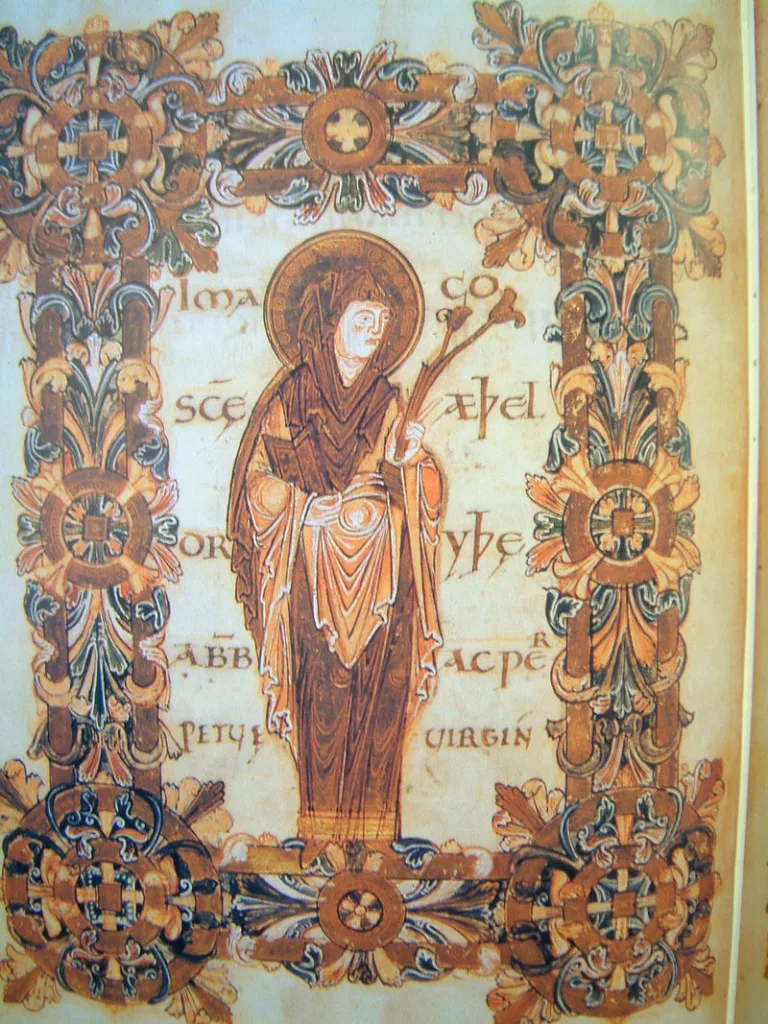
St Etheldreda or St Audrey By monk – [1], Public Domain, https://commons.wikimedia.org/w/index.php?curid=32907989
I’m republishing this post as I dated it to February 17th rather than October 17th and a few other egregious typos.
Etheldreda, also known as Audrey or Æthelthryth or Æðelþryð or Æþelðryþe is celebrated on October 17th, (the date her remains were ‘translated’ from her burial place to the Church at Ely) and on 23 June the date she died,
She lived from March 4th 636 to June 23rd 679. She is one of the well-born Saxon Virgin Saints of the 7th Century. This is when many royal Abbeys were founded by female members of the Anglo-Saxon Royal families, in the years following the conversion of the Anglo-Saxons to Christianity. She is the daughter of King Anna of East Anglia, and the sister of Saint Sexburga (widow of King Erconbert of Kent).
Etheldreda is said to be a Virgin despite being married twice. Etheldreda was widowed after three years of her first marriage. Then she married Egfrid, son of King Oswy of Northumbria. Egfrid got fed up with her virgin state. With the support of St Wilfrid, St Etheldreda was released to a Nunnery run by Wilfred’s aunt. In 672 she founded the famous double monastery at Ely, which is where the wondrous Cathedral of Ely still stands.
Here she died, and the many miracles that followed, led to Ely being one of the main destinations for Pilgrimages. St Sesxburga took over as Abbess after her death. By the number of Churches and holy days remembering Etheldreda show she was perhaps the most famous female saint of the era.
Tawrdy Audrey
Etheldreda died of a neck tumour, which she blamed on the heavy jewellery she wore around her neck before she became a nun. So she is a patron of those with neck or throat ailments. Accordingly, on February 3rd St Etheldreda’s Church in London holds the Blessing of the Throats ceremony. St Blaise is also a saint protecting the throat and you might like to read my post about him and throats here.
Pilgrims used to buy cheap, old-fashioned linen from the market at Ely, which they would wear around their neck to protect or cure them of throat illnesses. Puritans satirised the practice by coining the word Tawdry, from St Audrey, which came to represent cheap goods sold to gullible pilgrims.
Mopsa the shepherdess in Shakespeare’s Twelfth night says to her sweetheart:
“Come, you promised me a tawdry-lace and a pair of sweet gloves.
However, I thought something was amiss and searched for Tawdry in the excellent website SHAKESPEARE’S WORDS by DAVID CRYSTAL & BEN CRYSTAL (which I use all the time). And indeed Mopsa is not in Twelfth Night but in the Winter’s Tale which I saw recently at the RSC. Mopsa’s man can’t buy it for her as he has been cheated out of his money by the fey Autolycus.
St Etheldreda’s in London is in Ely Place, near Hatton Garden. There is a lovely old pub there called the ‘Ye Olde Mitre’ (which is a reference to a Bishop’s Mitre). The Church was founded (1250 and 1290) as the London residence of the Bishops of Ely. Inside are memorials to Catholic martyrs executed during the Reformation. (see my post on the Douai Martyrs here).
Ely place was lived in by John of Gaunt following the destruction of his Savoy Palace in the Peasants Revolt. Christopher Hatton rented parts of it in the reign of Queen Elizabeth II. During the Civil War it was used to hold Royalist Prisoners of War. Agnes Wicks fictionally lives at Ely Place. (Agnes is the woman David Copperfield should have married, rather than the ridiculous Dora).
In the 19th Century, the former Chapel was bought by the Catholic Church and restored by George Gilbert Scott.