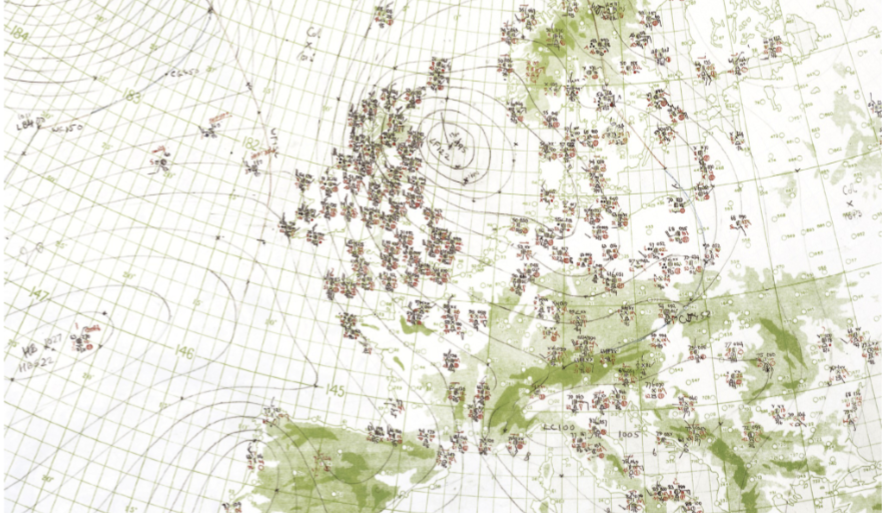
North Atlantic chart of weather for June 6th 1944. D Day. Showing occupied Europe with observations obtained from the enigma machine
In 2014 or thereabouts I went to a play by David Haig which was based on the true story of a weather forecaster’s role in D Day. James Stagg’s advice was that the weather on June 5th, the intended day, was too volatile. He suggested the 6th June 1944 instead.
The play was called Pressure and was great because it really conveyed the enormity of the decision that Ike, Churchill and others had to make. To go ahead in bad weather risked enormous casualties and the failure of the Landings. To postpone, might mean Hitler discovered the location of the invasions and might lead to disaster.
Major characters portrayed in the play included Ike and his driver, Kay Summersby with whom he was very close. Also depicted was an American forecaster who disagreed with the British meteorologist James Stagg. How much of the play was for dramatic effect and how much is true, I’m not entirely sure but it is a fascinating D Day story.
The maps were hand drawn and partially based on intercepted data decoded by the enigma machine. Stagg recommended postponing the landings one day from the 5th to the 6th of June, when it was hoped the ideal combination of calm seas, low water at first light and a full moon would occur.
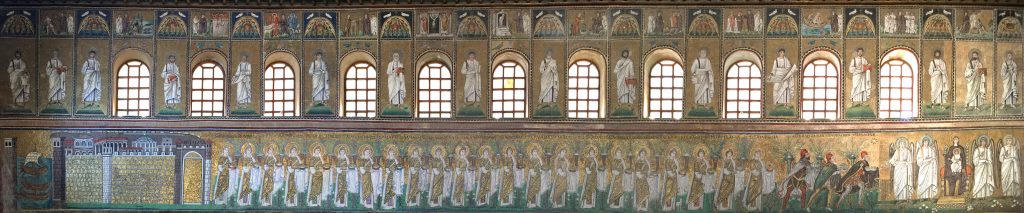
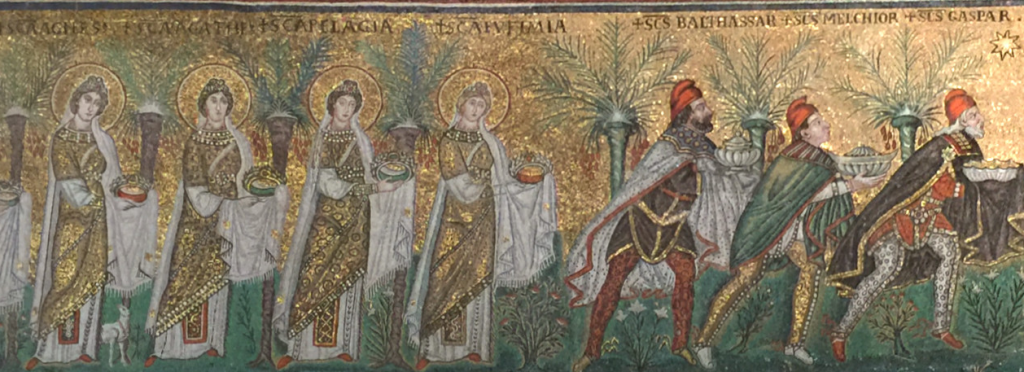
Procession of female saints leaving Classis (bottom left) behind the Three Kings heading to the Virgin Mary (bottom right between four angels). Basilica of Sant’Apollinare Nuovo (pic. Wikipedia)
Today, I am in Ravenna. One of those places where the history brings gasps of amazement. To honour my visit, I thought I should roll out last year’s post. This is what I said:
When I revised my Saint Agatha post (link see below), I felt I needed an early image of Agatha. After all, her cult spread early on, and therefore, was likely to be genuine.
As I started to track down her image I was led, with some joy, to one of the most amazing Churches in the wonderful town of Ravenna. I visited the Basilica of Sant’Apollinare Nuovo with some wonderment when working as an archaeologist at Ferrara, in Emilia-Romagna. Forty Years ago.
I found out that Agatha was one of 22 female Saints on one of the walls of the Church. I discovered a pretty comprehensive description of the Church. As I looked at it, I noticed the record was made by, or involved, Professor Bryan Ward-Perkins. He was the Director of the site my friends and I worked on in Ferrara! (And I met him again last night, 2025 for the first time in years! We had dinner with fellow archaeologists, and Bryan was talking about the work he did on the Saints of St Apollinaire.)
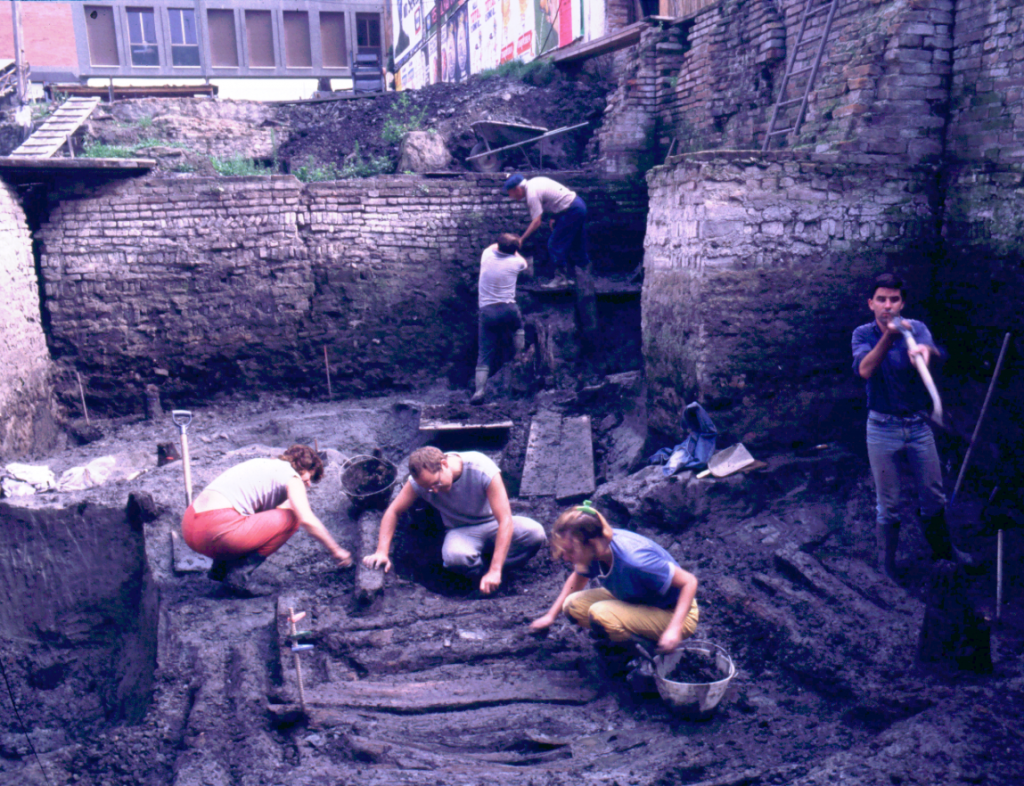
Medieval Excavation in Ferrara. The author is in the centre of the photo,
Ravenna
I’m guessing Bryan suggested we visit Ravenna on one of our trips to the beach at nearby Rimini. Ravenna was so awesome because the City became the capital of the Roman Empire in the West. It took over when Rome fell, then it was part of the Ostrogothic Kingdom, then of the Byzantine Empire. It spanned the period of the Arian Heresy.
And so, it was provided with some of the great glories of 5th and 6th Century Architecture. These include the Mausoleum of Galla Placidia, the Neronian Baptistery, the Basilica of Sant’Apollinare Nuovo, the Arian Baptistery, the Archiepiscopal Chapel, the Mausoleum of Theodoric, the Church of San Vitale and the Basilica of Sant’Apollinare in Classe. It’s hard to overestimate the impact on a young British archaeologist of seeing 5th Century buildings with roofs and astonishingly detailed mosaics still intact. Please visit!
Detail showing the first four female saints behind the Three Kings. Basilica of Sant’Apollinare Nuovo wikipedia
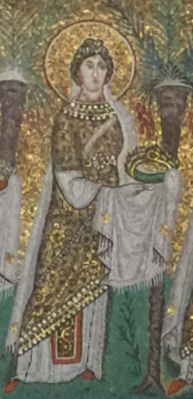
Bryan Ward-Perkins description says ‘All the saints are haloed, bear crowns and are dressed in elaborate court dress. Unlike the men …., all have essentially the same youthful features. The only saint with a distinguishing attribute is Agnes, who is accompanied by a lamb.’ The men are given some personality, some have white beards others are youthful. While all the female martyrs are, essentially young virgins, and cannot be distinguished from each other. St Agatha, the list says, is the Saint next to Agnes with her lamb; the third in precedent. You can see her above and in detail below.
St Agatha Basilica of Sant’Apollinare Nuovo wikipedia
Motorcycling from Ravenna to Inferno
Enough of the sublime! Now for the ridiculous. Whether on this visit or another, we decided to have a day at the beach at Rimini. After the day on the beach, a collective decision to stay over was made. The reason was to go to one of the big clubs (did we still call them discos?) probably to dance to ‘Frankie Goes to Hollywood’.
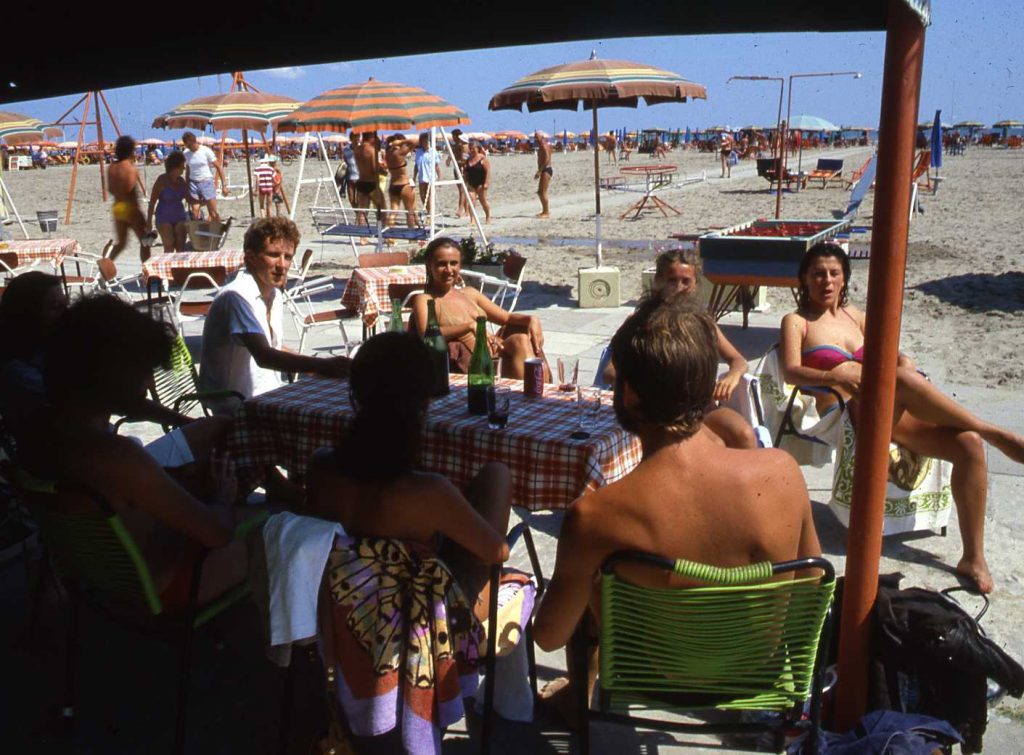
Archaeologists, Italian and English, on the beach at Lido di Spina
However, the hotels were all full. So I decided, late at night, to go back to Ferrara, on my own on my 175 cc Yamaha motorbike.
My Yamaha 175cc bike looked something like this but was red. A thing of underpowered beauty.
Thing was, I had started the day in Ferrara in the blazing Italian summer heat. So, I had hopped onto my bike dressed in shorts and t-shirt. Ferrara was 77 miles away (says google). One hour into the trip back, I was getting pretty cold, and really not enjoying driving through the lonely countryside. Therefore, I decided to pull off the main road to find a rural hostelry for what remained of the night.
Now, I remember this very vividly – the only likely road I could find was signposted to ‘Inferno’. I shrugged my shoulders, wondering what that was about, and drove towards it on a very deserted road. Eventually, I came to a sign which told me I was about to enter ‘Inferno’.
There was something very surreal about the situation. My courage failed me! I was not going to stay in a ‘motel’ in a place called ‘inferno’! I had seen too many horror films set in Motels and one in Inferno seemed madness. So, I turned round and continued my cold journey to Ferrara.
Inferno
Whenever I tell this story, I have some doubt about it. Did I really drive into a place called ‘Inferno’? But I have, for the first time, checked Google. It tells me that the road off the Rimini to Ferrara road goes through somewhere called: Vicolo Inferno, 40026 Imola BO, Italy.
Thank you very much to my subscriber for alerting me to St Kevin’s Day which is my Saint’s Day. I was aware of St Kev and that the name meant ‘of noble birth’ but that’s was the extent of my knowledge.
But a little research on Wikipedia while on the train to visit my Dad, revealed that Kev lived to the grand old age of 120, born in 498 and died in 628. As my Dad is 97 and still going strong, maybe he and St Kevin will inspire my longevity?
Briefly, St Kevin met the great St. Columba; had a poem written about him by the marvelous Seamus Heaney (https://poetryarchive.org/poem/st-kevin-and-blackbird/); a song by the Dubliners; several mentions by James Joyce and a long distance path, the St Kevin’s Way, part of the Camino de Santiago network, named after him. And St Kev can help us understand the weather for the rest of June :
‘The weather on St Kevin’s Day will last all month‘.
So that means uninterrupted sun. At least in Ravenna where I currently am.
Live recording of Dubliners’ Song about St Kevin
Coemgen, as he is known in Irish, was a hermit, living in a cave-like ledge above a lake. His piety attracted followers and a monastic settlement. He was known for his ascetic life and love for nature. So, a role model for all us Kevins?
His hagiography was written very late, so little of it can be confirmed. But, like other saintly hermits, he is associated with being tempted by women or the devil disguised as a woman. (St. Anthony the Great, St. Benedict of Nursia, Saint Chrysanthus, St. Vitus, St. Bernard of Clairvaux, St. Hilary etc.) Unfortunately, rather than just resisting his temptress, Coemgen is said to have drowned her. Not so good!
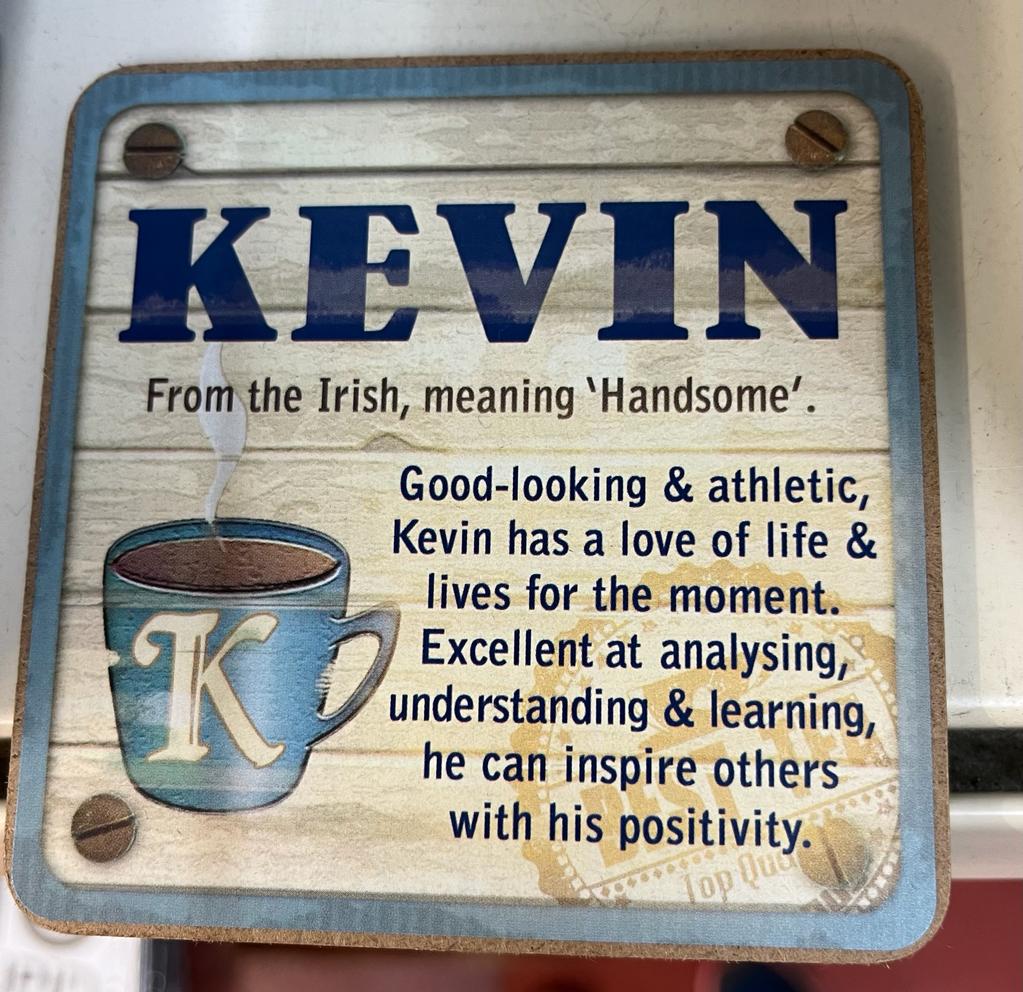
On the other hand, my sister sent me this photo of a souvenir from a shop in Northumberland.
That’s more like it! And oh so true! Clearly we, handsome, clever, positive, analytical Kevins have a lot going for us, despite the name.
For more on the Temptations of Hermits read this article:
Nechita, Andrea.“Offering Body, Pleasure, and Wealth: The Visual Representation of Women Tempting Saints (Fifteenth and Sixteenth Century).” Annual of Medieval Studies at CEU, 20 (2014): 96-112. For a summary, and some tempting illustrations, look here.
This post sprang from something that my grandson said to in the middle of the park. He was curious as to why I was concerned that the park toilets were out of action. He told me I could, like him, just pull down my trousers and wee, right here, right then, up against the tree in the park. My attempt at explanation drew a perplexed, ‘What?’ ‘What?’ is his new word. After an explanation, his next word is invariable another ‘What?’.Hopefully the relevance of this will become apparent.
May and June are the most prolific months for dandelions, which used to be known as ‘piss-a-beds’. They are diuretic and were often eaten, and so might well have consequences for the young trainee child.
John Hollybush in his 1561 ‘The Homish Apothecary’ says:
‘When a young body does piss in his bed either oft or seldom: if ye will help him take the bladder of a goat and dry it to powder, and get him to drink with wine, or else take the beans or hinder fallings of a goat, and give him of the powder in his meat morning and evening, a quarter ounce at every time.’
(quoted in ‘The Perpetual Almanac by Charles Kightley)
Hinder fallings are what falls out of the hind-quarters of a goat. I’m not sure even an indulgent Grandparent is allowed to give droppings and wine to the little ones. Nor can I find any mention of goat products in modern medical recommendations. So I won’t be recommending this as a practical aid.
Medically, dandelions were very well regarded. Mrs Grieve’s ‘Modern Herbal’ reports that it are diuretic and a general stimulant to the system but particularly the urinary system. They were good for liver and kidney complaints; gall-stones; and piles. They were considered excellent to eat and drink. Particularly, dandelion sandwiches using young leaves, with salt, pepper, and lemon juice. They were also taken in salads, teas, and beers.
We used to blow the seeds from the dandelion seed head saying ‘She loves me. She loves me not’ at each blow, until the truth was revealed.
First written in June 2023, revised june 2024,2025. Rewritten 2025
Of course, the real news today is a new Pope and the 80th Anniversary of Victory in Europe Day. But, I can let other media covers those stories. (But more on VE Day below.)
Helston Furry Dance
At the end of the May Day/Beltane Festival, Helston in Cornwall holds its Furry (or Floral) Dance. It is normally on the 8th May. But it changes date if the 8th is a Sunday or a Monday (Helston’s market day). But it isn’t. So the Floral Dance was held asusual on the 8th May.
Padstow holds, perhaps, the most famous May Day festival on May 1st. Padstow feels more of a ‘pagan’ festival, while Helston is a more sedate, gentlemanly, dance. Padstow is more fuelled by a belly full of ale, while Helston by a Pims No 1, or a Gin and Tonic?
Do, have a look at both youtube videos and watch the Padstow one until at least you see the ‘obby ‘orse and the teaser dancing.
Children born between the two days, May 1st and May 8th are considered to have been ‘born with the skill of man and beast and power over both.’
On This Day
1945 – Victory in Europe Day. Official end of the War in Europe with the definitive surrender of Nazi Germany to the Allies, signed by Field Marshal Wilhelm Keitel in Eisenhowers HQ on 8 May 1945 (VE Day). Churchill broadcast the official end of the war at 3pm. In 2025, it was the 80th Anniversary of the defeat of Fascism. A truly significant date with a diminishing number of veterans and eye witnesses surviving to carry the torch. My 97 year old Father is one and he went to London to celebrate that magical day when the war in the west was over. this is what my dad wrote in his recently publish autobiography ‘A Boy from Haggerston:
At last, the War in Europe was over. This day would forever be known as VE day. Both my grandparents had survived the Blitz and only Uncle Charlie’s (my dad’s elder brother) two sons had lost their lives – Charlie died at Salerno and is buried near the beach in the war grave, and Jimmie died, aged 18, at the battle of Reichwald Forest, and is buried in the war grave in the forest. According to David Warren, who is now a battlefield tour guide, received information that Jimmie was reported by the Commanding Office as a typical bright Cockney lad.
Following the end of the war, we were then introduced to images of the emaciated prisoners in the recently freed concentration camps in the newspapers, and in the Pathé news broadcast at the cinema. The terrible news that the Nazis killed millions of Jews in an attempt to wipe out the Jewish race in occupied Europe, spread to a horrified world. This vile campaign is now known as the Holocaust, but is more precisely described as ethnic cleansing.
Jean and I went up to London for VE Day and later also for the VJ Celebrations, where there was singing and dancing in the streets. We went by train to Waterloo, and then walked to Piccadilly. We went with our friends Esther and Bob. It was a great time.
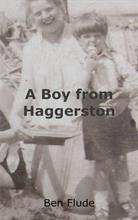
Front cover of ‘A Boy fomr Haggerston’ by Ben Flude
Now, it is up to us and the young to stop such a war ever starting again. What we know is that the vast majority of us don’t want war, but somehow we let it happen. That is our task how to create a world where war is unthinkable.
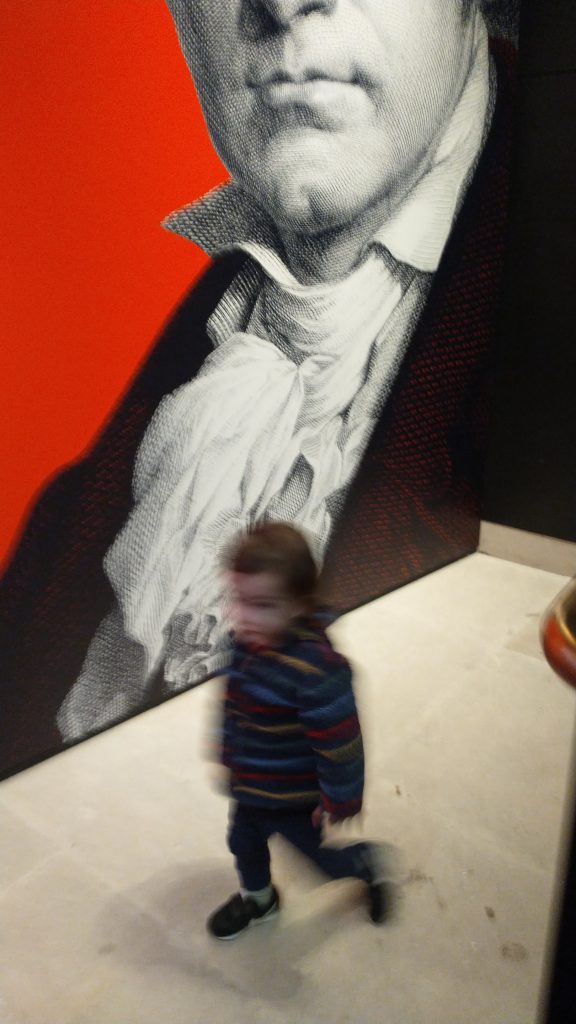
Grandson on a visit to the British Library and British Museum. Photo of the Beethoven Exhibition, British Library, March 2022
A visit to the Britsh Museum & British Library? I think this might be worth reposting in the absence of anything else compelling for the day!
So this was my outing with my grandson on March 9th 2022.
For our second museum outing we went to the British Library. He didn’t like the Beethoven exhibition. It was too dark and nothing to surreptitiously climb on. He definitely does not like dark exhibitions. This is a shame because it seems to be the design idea of the moment. The Nero and the Stonehenge exhibitions were also dark spaces. The desigers working on creating atmospheric views using bright colours, spot lighting and spectacular objects on a dark background. But it doesn’t work for a sensitive 20 month year old!
Nor did the largely text based Paul McCartney’s Lyrics exhibition attract a second of his attention. ‘Paul who?’ he seemed to be saying as we stumped past to the very quiet sound of ‘Hey Jude’.
What he did like was the escalators. We went up and down, and up and down, and then onto the second set where we repeated the repeat.
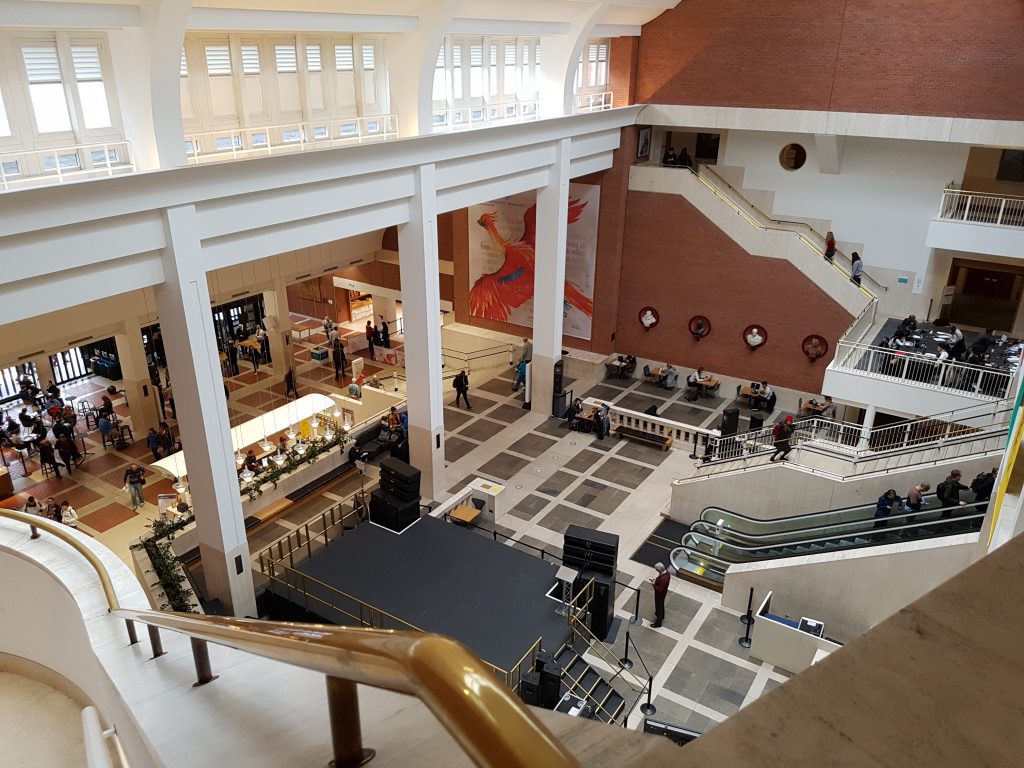
British Library – note the escalator to the right
And then we went down and back up again, and no time to see the enigma machine. We ate in the upstairs Restaurant, which is a really pleasant place to spend a lunch time.
Enigma Machine, British Library
Time for him to have a sleep so we walked to the British Museum through Bloomsbury. However, there was very little sign that he wanted to nod off. But we found a couple of interesting revolutionaries of the 19th Century en-route. The first was to Robert Owen, the founder of the Cooperative Movement, famous for his model factories in New Lanarkshire.
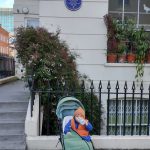
Plaque to Robert Owen ‘father of the Cooperative Movement’, Burton Street
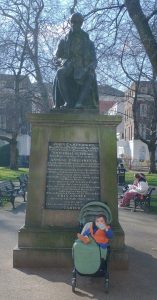
Then to Cartwright Gardens, named after John Cartwright, who was called ‘the Father of Reform’. He had quite an amazing life. He refused to serve in the Navy against the American Colonists in the War of Independence. Not only that, but he supported reform of Parliament, universal suffrage, annual Parliaments and secret ballots.
John Cartwright Statue Cartwright Gardens.
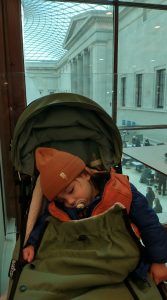
The milk soon did its job and my grandson was asleep. So I took him to the Member’s Room for a cup of tea.
Sleep in the Member’s Room overlooking the Great Court
When he woke we whizzed around the third Floor. But he was reluctant to leave his buggy because it was much more crowded than our last visit. Then he could run free around the almost empty galleries which he loved.
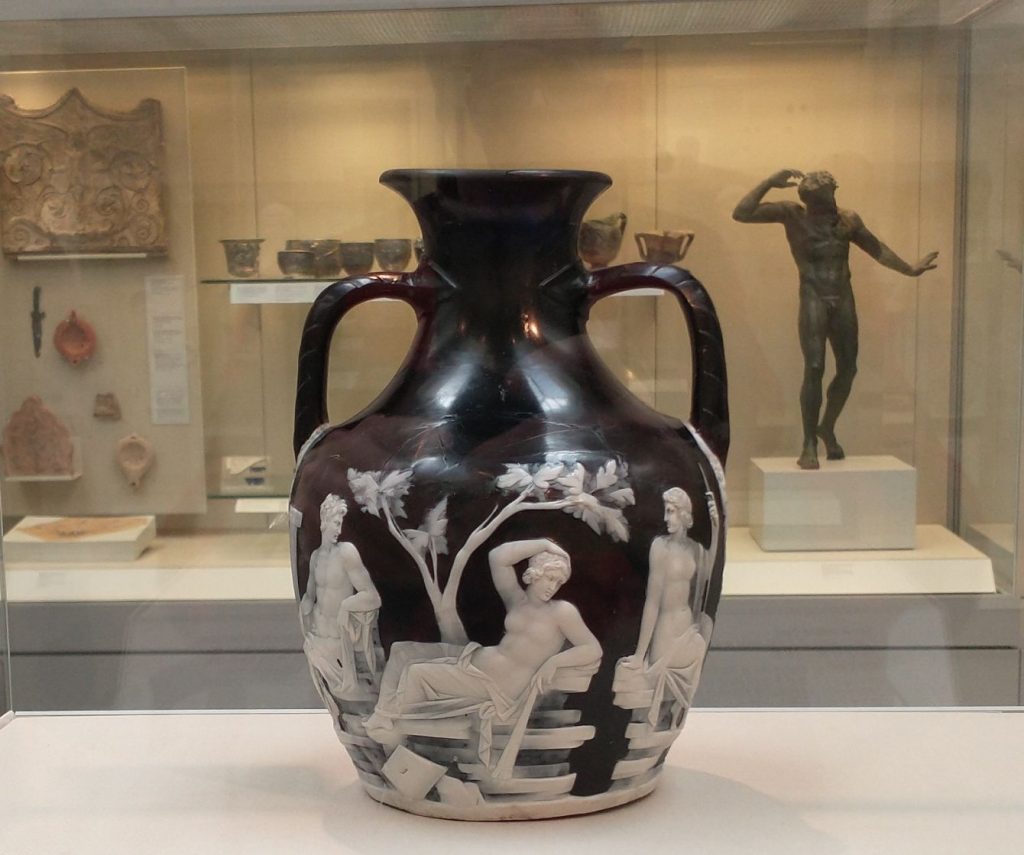
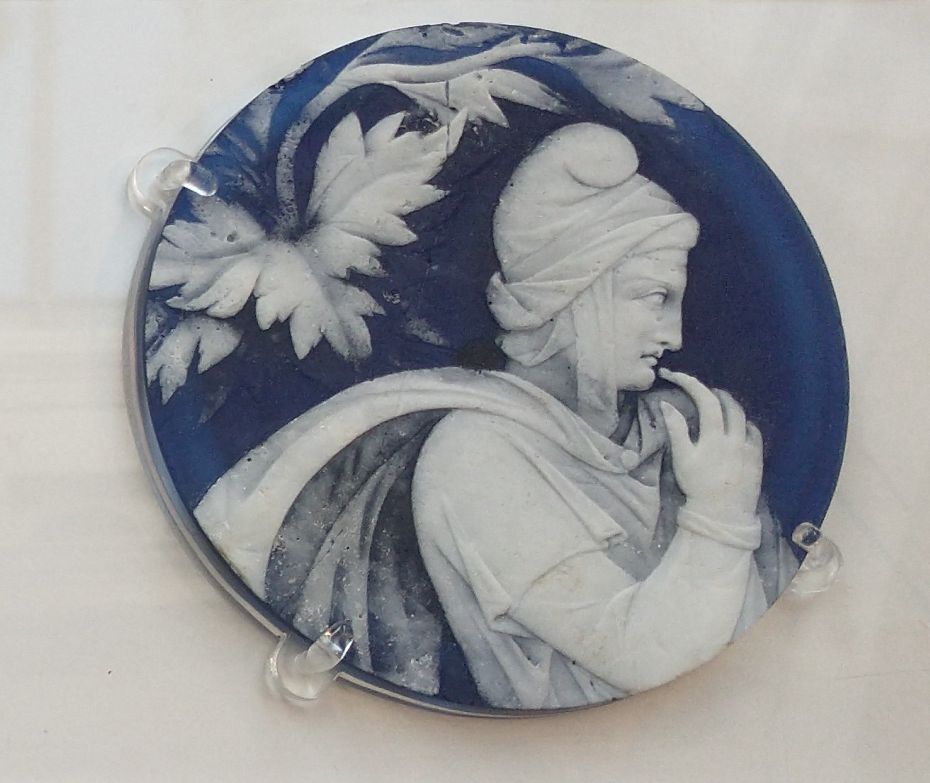
But, I was able to visit old favourites like the Portland Vase. This was smashed into hundreds of pieces, in 1848 by a drunken visitor. He threw a sculpture into the case and smashed the vase. It was restored, but 37 pieces were missing. In 1988 the vase was reunited with the missing pieces and expertly restored.
Screen shot from the Jorvik Viking Festival Site showing all the fun to be had if the Vikings invade your town!
The annual Jorvik Viking Festival is on from Monday 17th – Sunday 23rd February 2025 in York. The illustration above show there are Viking Trails, Feasts, Crafting, Berzerkering and encamping. And more! Visit the web site here.
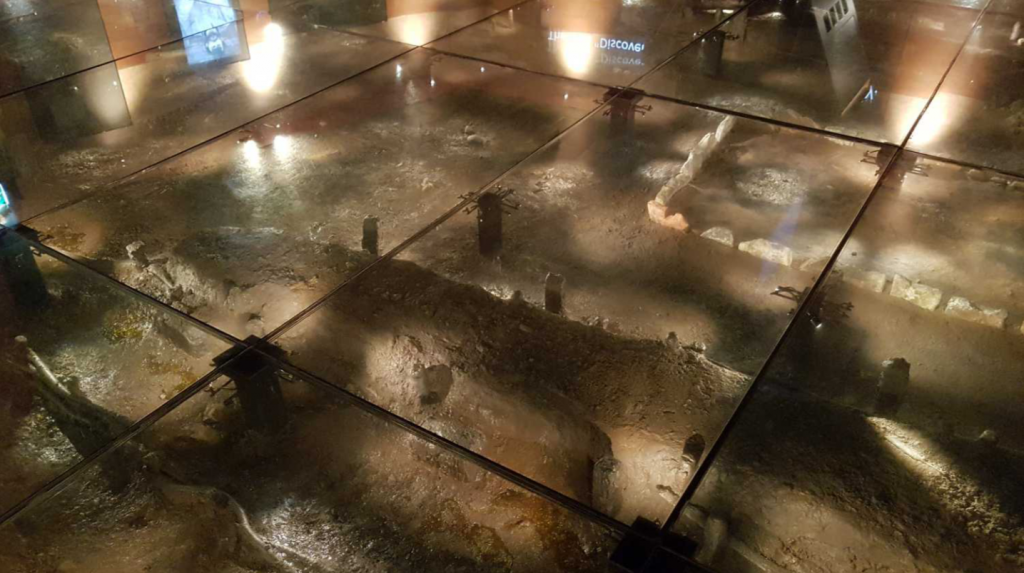
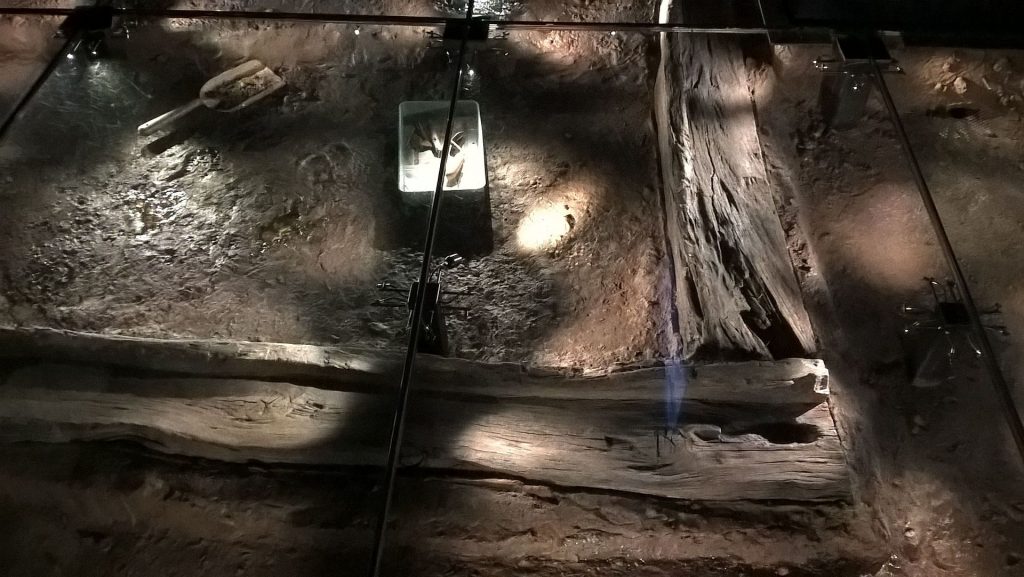
The excavations under the floor of the Jorvik Centre. Photo K. Flude
York or Jorvik as the Vikings knew it as, has become the centre of all things Viking in the UK. Viking York came to the fore with the Coppergate Excavations in the 1980s. Underneath what is now a shopping mall and Primark, were the streets of Viking York in all its waterlogged glory. The waterlogging allowed the survival of organic material that rarely survives.
Excavation of Jorvik visible under the floor of the Museum. Photo By Chemical Engineer – Own work, CC BY-SA 4.0, https://commons.wikimedia.org/w/index.php?curid=58524883
At the time, the excavations were a sensation. York Archaeological Trust made a bold decision to turn part of the site into a ‘Dark Ride Experience’. The remnants of the excavation were preserved under glass, and nearby a replica of the townscape was created. Tourists sat in ‘cars’ with an audio guide and given a guided tour. It was very successful. The extensive profits were used for other York Archaeological Trust projects such as the reconstruction of medieval Barley Hall. Other historic towns followed suit and soon there were Dark Rides in Canterbury, London, Oxford and others. All, as far as I know have died a death except for the Jorvik Centre which continues to enthral visitors to York.
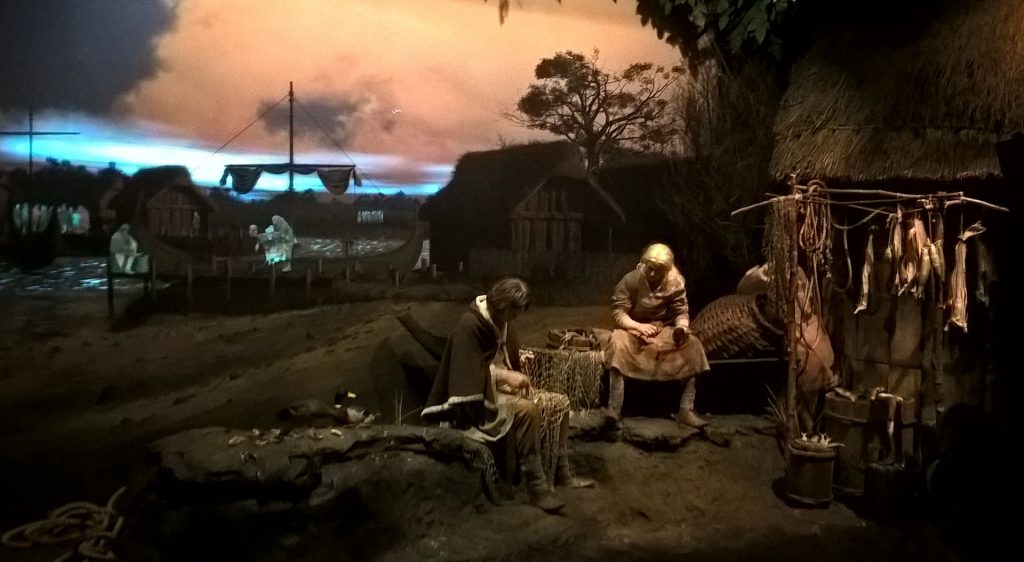
Tableau from the Jorvik Centre with Fishermen working. Photo By Chemical Engineer – Own work, CC BY-SA 4.0, https://commons.wikimedia.org/w/index.php?curid=58524883
The next best thing about Vikings are their colourfull names. Jorvik history vibrates with the deeds of ‘Ivan the Boneless’, Sihtric ‘the Squinty-eyed’and Erik Bloodaxe. For more on nicknames read my post!
Sorry to send an additional post but coming up are a couple of fascinating Virtual Tours which I would like to remind you of!
Tonight is an exploration of early 19th Century London. It is based on the 1809 Picture of London Guide book. An original copy was given to me by someone grateful to have attended one of my lectures at the Old Operating Theatre Museum. It is a tour of what Jane Austen could have visited on her walks around London. There are Austen associations, but mainly we are looking at London in 1809.
Jane Austen’s ‘A Picture of London in 1809’ Virtual Walk Mon 7.30 27th Jan25 To book
Yesterday, I was asked to give a Cromwell’s London walk as a 75th Birthday present. I haven’t done one for at least 25 years. But I really enjoyed the research. So added a guided walk and a virtual tour to my programme. This is the first time I have done this VT and it is a cracking story.
The Civil War, Restoration and the Great Fire of London Virtual Tour 7:30pm Thurs 30th Jan25To book
Finally, April is the month we go on pilgrimages, as Chaucer said (in Old English). So, in addition to my Chaucer Walks, I have added a Virtual tour so we can go all the way to Canterbury.
Chaucer’s London To Canterbury Virtual Pilgrimage 7.30pm Friday 18th April 25 To book
I may add one or two more before the Sun comes back
Sementivae, was a festival dedicated to seed and to Ceres. Ceres is an Earth Goddess who gives her name to our word cereal. The festival was also called. Paganalia. The Mediterranean world had many names for the Earth Goddess. Tellus, Demeter, Cybele, Gaia, Rhea etc..
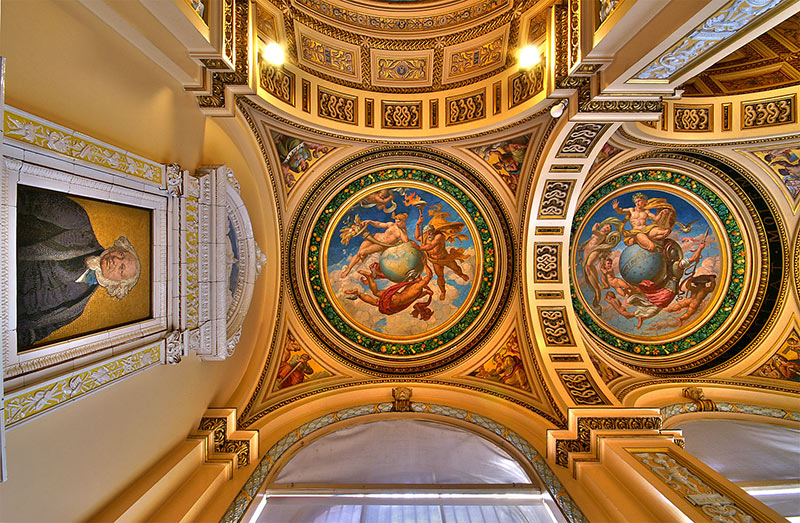
Ceres can be seen on the top left roundel resting on the Globe on the marvellous Ceramic Staircase at the V&A (photo above). And in my slightly out of focus photograph below. (To be honest, in real life, it looks a little more like my photo than the gorgeous photo above!)
Ceres represented Agriculture, Mercury Commerce, and Vulcan Industry. Old Photo by the Author.
Sementivae Dies – a moveable feast.
To create life, we need earth and water to nurture and seeds for fertility. And so into the cold dead world of January the Romans created a festival of sowing. It had two parts, one presided over by Mother Earth (Tellus) and the other by Ceres, the Goddess of Corn. The actual day of the festival was chosen not by rote on a set day of the calendar but by the priests, in accordance with the weather. This seems very sensible, as there is no point sowing seeds in terrible weather conditions. I’m assuming the Priests took professional advice!
On the 24th-26th January Tellus prepared the soil, and in early February seeds were sown under the aegis of Ceres. Tellus Mater (also Terra Mater) was known as Gaia to the Greeks.
Gaia
Gaia was selected by James Lovelock & Lynn Margulis in the 1970s as the face of their Gaia hypothesis. To me, the importance of the idea is not the scientific principle that environments co-evolve with the organisms within them. But, rather in Gaia as a personification of our world as a complex living ecosystem. One that we have to care for. Gaia exists as a series of feedback loops. Lovelock hypotheses that she will spit us out unless we can live in balance with our alma mater.
Ovid and Sementivae
This is what the Roman Poet Ovid has to say in his poetic Almanac known as ‘Fasti’ (www.poetryintranslation.com)
Book I: January 24
I have searched the calendar three or four times, But nowhere found the Day of Sowing: Seeing this, the Muse said: That day is set by the priests, Why are you looking for moveable days in the calendar? Though the day of the feast ís uncertain, its time is known, When the seed has been sown and the land ís productive. You bullocks, crowned with garlands, stand at the full trough, Your labour will return with the warmth of spring. Let the farmer hang the toil-worn plough on its post: The wintry earth dreaded its every wound.
Steward, let the soil rest when the sowing is done, And let the men who worked the soil rest too. Let the village keep festival: farmers, purify the village, And offer the yearly cakes on the village hearths. Propitiate Earth and Ceres, the mothers of the crops, With their own corn, and a pregnant sow ís entrails. Ceres and Earth fulfil a common function: One supplies the chance to bear, the other the soil. Partners in toil, you who improved on ancient days Replacing acorns with more useful foods, Satisfy the eager farmers with full harvest, So they reap a worthy prize from their efforts. Grant the tender seeds perpetual fruitfulness, Don’t let new shoots be scorched by cold snows. When we sow, let the sky be clear with calm breezes, Sprinkle the buried seed with heavenly rain. Forbid the birds, that prey on cultivated land, To ruin the cornfields in destructive crowds. You too, spare the sown seed, you ants, So you’ll win a greater prize from the harvest.