John Stow reports on the Lord of Misrule. Memorial in St Andrew’s Church
On the sixth day of Christmas
My true love sent to me 6 Geese a Laying; 5 Golden Rings. 4 Calling Birds; 3 French Hens; 2 Turtle Doves and a Partridge in a Pear Tree
The Lord of Misrule, Masters of the Revels, and Boy Bishops
The Roman festival of Saturnalia reversed the rules so that slaves, ruled and masters served. It was held between 7th and 23rd of December. It also included giving gifts. In the medieval period, the disorders of Saturnalia was continued. Monarchs, Lords and Gentlemen, City Institutions elected Lords of Misrule, Masters of the Revels, and Boy Bishops. John Stow was London’s first great historian. In his Survey of London, he wrote of the Lords of Misrule in London. They were chooses at Halloween and continued until Candlemas, in early February. See my post here for more details on Candlemas.
From John Stow’s Survey of London
This is what Stow says:
Now for sports and pastimes yearly used.
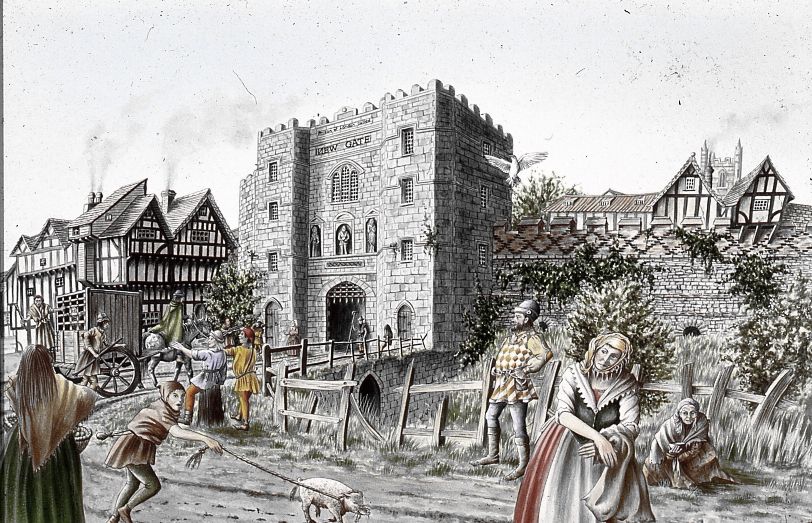
First, in the feast of Christmas, there was in the king’s house, wheresoever he was lodged, a lord of misrule, or master of merry disports, and the like had ye in the house of every nobleman of honour or good worship, were he spiritual or temporal. Amongst the which the mayor of London, and either of the sheriffs, had their several lords of misrule, ever contending, without quarrel or offence, who should make the rarest pastimes to delight the beholders.
These lords beginning their rule on Alhollon eve, continued the same till the morrow after the Feast of the Purification, commonly called Candlemas day. In all which space there were fine and subtle disguisings, masks, and mummeries, with playing at cards for counters, nails, and points, in every house, more for pastime than for gain.
Against the feast of Christmas every man’s house, as also the parish churches, were decked with holm, ivy, bays, and whatsoever the season of the year afforded to be green. The conduits and standards in the streets were likewise garnished; (…) , at the Leaden hall in Cornhill, a standard of tree being set up in midst of the pavement, fast in the ground, nailed full of holm and ivy, for disport of Christmas to the people…
Holm is an evergreen oak. Its Latin name is Quercus ilex. The Tree in Leadenhall Street was also used as the Maypole. And he tells us it was destroyed in the great wind of 1444. You can read all about that here. You might also like to see my posts. These include information about John Stoww and midsummer celebrations and Boy Bishops, and l Stow’s Memorial.
On the fourth day of Christmas My true love sent to me Four calling birds, Three French hens, Two turtle-doves And a partridge in a pear tree.
Holy Innocents Day or Childermas is dedicated to children on the day Herod ordered the slaughter of children aged two or under, in an attempt to kill the prophesied Messiah. However, the massacre is only mentioned by Matthew, and other classical sources, despite being anti-Herod, don’t mention it. It is thought to be ‘modelled’ on the massacre of young children mentioned in Exodus when the Pharoah hears about the birth of Moses.
It is, therefore, as far as folklore is concerned, an ill-omened day so don’t begin any new enterprise or, indeed, attempt to go back to work. And remember, as Childermas falls on a Sunday this year, Sundays throughout the year are all ill-omened days. There was a medieval tradition that people should avoid work on the day of the week that Childermas fell until the next childermas. Bad luck this year as it’s a Sunday!
Weather wise, according to a 17th formulae, as the fourth day of Christmas is warm, expect the fourth month, April to be similarly warm.
Christmas Games
So, no sloping off to the Study, it’s best to spend the time playing Christmas Games. The one I remember, most fondly, is pick-up-sticks or spillikins. You drop a pile of sticks onto a table-top or the floor. Then have to pick up as many sticks as you can without disturbing any others. Your turn ends when you move a stick. Different sticks have different values. We also played Dominoes, Ludo and Snakes and Ladders.
But, to get the whole room joining in, we played two card games. Participants could sit in their comfy armchairs rather than at a table. Chase the Ace. Newmarket.
Chase the Ace is, apparently, also, rather unpleasantly, called Screw Your Neighbour in the US! Each person is dealt a card. In turn, they choose to swap it with their neighbour. At the end of the round, the lowest cardholder (ace is low) loses a life. A player is excluded after losing 3 lives. Last one standing is the winner.
Newmarket (or Michigan) is a gambling game in which everyone places a stake on 4 picture cards. Theare are placed in the centre of the room. If your cards comes out in the play, you win the money staked on the card. The point of both these games is that any number of people can play, and they are simple and fast.
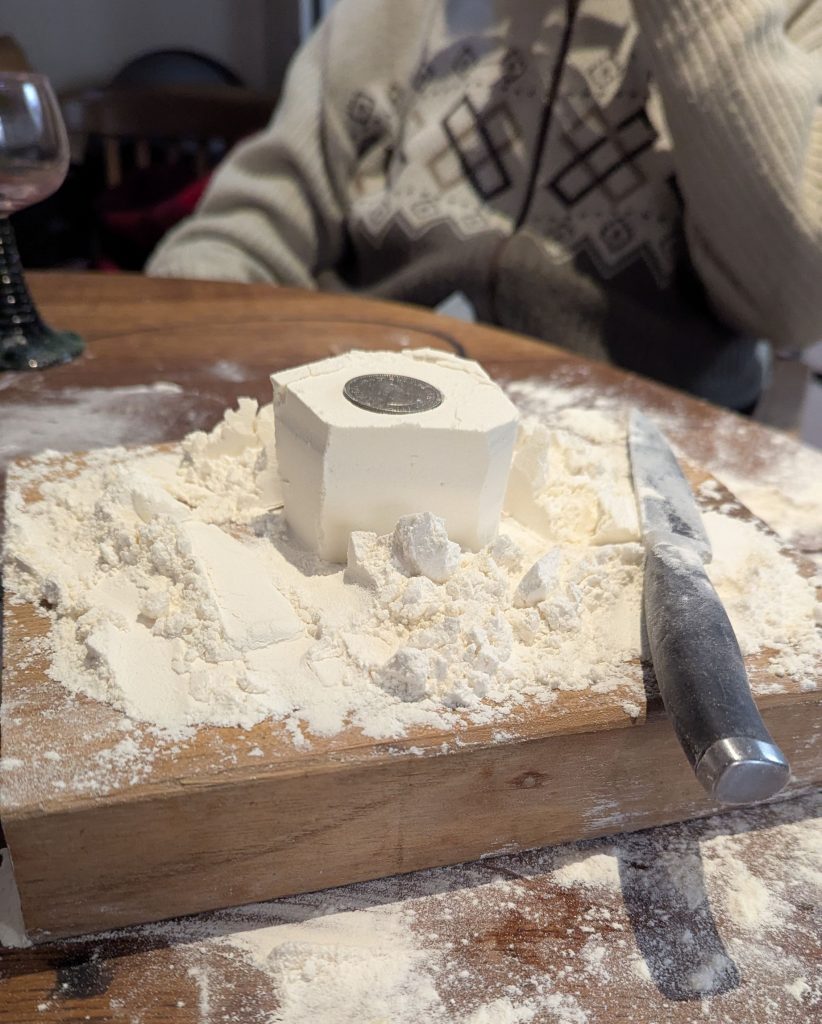
Another game we played at parties was Bullet Pudding. Players cut off bits of a flour pudding until the coin or bullet falls into the basin. The unlucky player (me last time I played) has to pick it up with his teeth.
Here is a photo of the one we played on 24th December,2024. My 97-year-old dad is in the background. You can see what a messy game it can be!
Apparently, the development of the American Santa Klaus was a way for the elite to keep control of the rowdy working class in New York. The argument, in a nutshell, is that the folk Christmas was outside and rowdy. Then Clement Moore wrote “A Visit from St. Nicholas”. This introduced a domesticated indoor middle-class version of Father Christmas. It’s a fascinating spin on the traditional story.
The First Day of Christmas, my true love sent to me a Partridge in a Pear Tree
Nebra Sun disc. Photo from Stonehenge Exhibition British Museum (photo Kevin Flude) The Disc shows the Sun, the Moon, the Pleides, and illustrates the Summer and Winter Solstice movements of the Sun.
On the 25th December were born Jesus, Mithras, Attis, Saturn, Apollo, and the Invincible Sun.
The Sun Gods have quite a complicated interrelationship. Zeus, and Apollo are both also considered to be Sun Gods. Apollo is particularly interrelated to Helios, the Greek God who drives the Chariot that carries the Sun across the skies every day. The Romans had a God called Sol who some say was a deity but who declined to be of minor importance. Then Sol was championed by the transexual Emperor Elagabalas. Aurelian revived the cult in 274 AD. Sol Invictus was the focus of Constantine the Great. Sol has been suggested as a response of the Romans to a trend towards monotheism in the later Roman period. Sol for Constantine was a gateway God to Christianity.
It is also notable that early worship of Jesus is full of solar metaphors, Jesus being, for example, the light of the world. Churches are also virtually all orientated East West, aligned with the rising and setting suns. The Altar is always at the East End, and effigies on tombs face the rising sun.
First Christmas?
The first recorded Christmas Day is in AD336. It was in an almanac that lists Roman Holidays, officials and martyrs. The entry for December 25th says: ‘natus Christus in Betleem Judeae’. For more early Christian Dates have a look here.
Celtic Sun Gods?
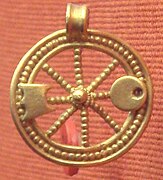
The Golden Wheel from Haute Marne in France, (Public Domain, Wikipedia)
Did the Celts have a sun-god? Belenos is a contender, but linguists are proposing his name does not come from words meaning bright but from strong. The God Lugh’s name is suggested to mean ‘shining’ but his attributes are more of a warrior than a sun god. Taranis is probably the best candidate, but he is more of a sky or thunder god than specifically a sun god. However, his symbol is a 8 spoked wheel is said to be symbolic of the Sun. It also represents the division of the year by the 4 quarterly sun festivals (Winter Solstice, Spring Equinox, Summer Solstice and Autumn Equinox) and the 4 cross-quarter festivals, (Samhain or Halloween, Imbolc or Candlemas, Beltane or May Day, Lughnasa or Harvest Festival).
December 25th is a few days after our reckoning of the Solstice. But, as we have previously seen, Christians believed the world was created on the Spring Equinox, and humans on the 4th day, so Adam was created on March 25th. Mary conceived on the same day, and therefore Jesus, after a perfect labour was born 9 Months later on December 25th. (See my post on March 25th and the Creation)
Christmas Cake
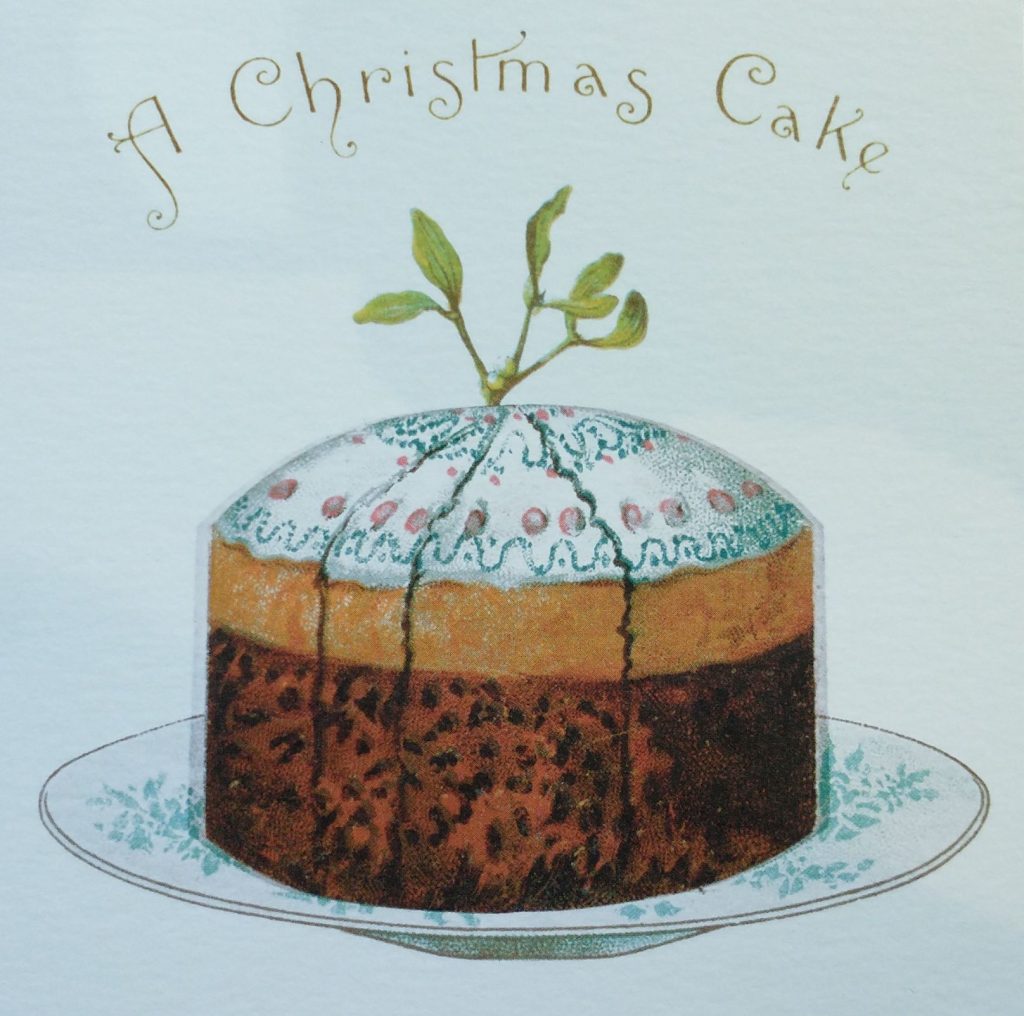
Today, you might be tucking into a Christmas Cake (originally eaten on Twelfth Night). Now, I know many Americans have a bizarre belief that fruit cake is the cake of the devil. Something you receive as a gift and give away to someone else, as most Americans hate it. More fool them for missing out on one of the delights of the Christmas period, that and cold turkey sandwiches. Christmas Cake is made on stir up Sunday, the last Sunday in November, to let the ingredients develop their flavour. They are then covered with marzipan and decorative icing.
19th Century Christmas Cake, generally now the icing continues down the side of the cake.
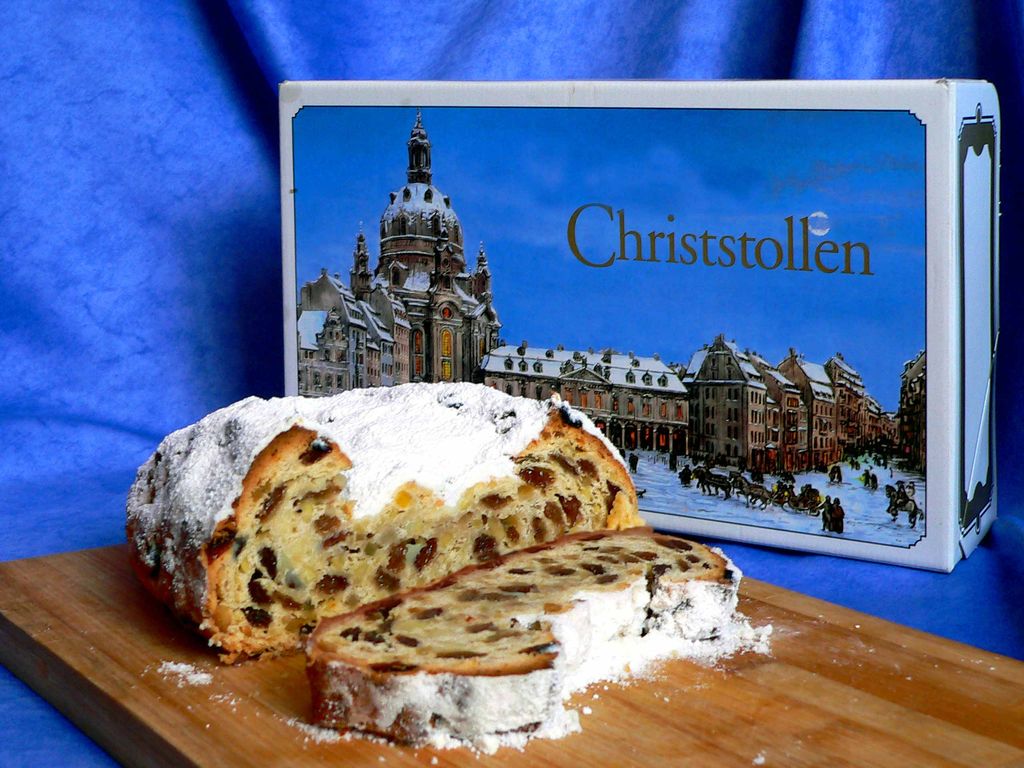
In Germany, they also eat a fruit bread called Stollen or Weihnachtsstollen. The tradition is said to have been started in the 15th Century, when the Pope gave dispensation to allow the use of butter in the fasting period of Advent. Previously, the Germans had to use oil to replace the banned butter, but they could only make oil from turnips, so eventually the Pope allowed the use of butter, with which they made bread with added dried fruits.
Stollen By Gürgi – Own work, Public Domain, https://commons.wikimedia.org/w/index.php?curid=3720379
In Italy, they eat Panettone, a fruit bread/cake. It is a sourdough, and a cross between a brioche and a cake. It often comes in a beautiful decorative tin, and is delicious. The centre of panettone production is Milan. Last year was the 200th Anniversary of Milan’s famous Marchesi 1824 which makes artisanal Panettone. It used ‘fine ingredients such as six-crown sultan as, naturally candied fruit, Bourbon vanilla from Madagascar, Italian honey and eggs from free-range hens, blended in a slow-rising dough with the exclusive use of Marchesi 1824 sourdough starter‘. Thank you, Mara from Milan, for the heads-up.
Screen shot from website – does not click through to sales!
Which is best? The only way to find out is to eat several slices of each. America, you don’t know what you are missing.
For stir up sunday see the second half of this post of mine.
Helios Colossus of Rhodes, artist’s impression, 1880
The Eve of the Day
Tomorrow is the Dies Natalis Solis Invicti – the birth of the Invincible Sun. In some calendars, such as the Celtic & the Anglo Saxon, the day begins at dusk. So Christmas Eve is not the evening before Christmas Day. It is the beginning of Christmas Day itself.
So some countries celebrate the eve as much or more than the day. The Church would have encouraged this to accommodate former pagan belief into newly converted societies. (the most obvious example is Halloween see my post here).
But the Church also suggests celebration of the Eve derives from the Jewish tradition of the beginning of the day at dusk. In Genesis are the words;
‘And there was evening, and there was morning—the first day.’
Christian tradition holds that Jesus was born on the holy night and thus is celebrated by the midnight mass.
When does the day begin?
This seems a silly question. In our society, the day officially begins at midnight. But it clearly begins at dawn. This was the normal start of day for Ancient Egypt, Republican Romans, and Western Europe till the coming of clocks in about 1400. We have already seen there are calendars that start the day at Sunset: Muslim, Jews, Celts, and the Saxons. In Britain, astronomers started the day at midday until an Act of Parliament reset it to midnight as recently as 1925.
Dawn seems the obvious choice, it’s called daybreak after all. But the problem is that the first light is so variable. It is an opinion when the light arrives and will vary depending on clouds, hills and height above sea level etc. Midnight is halfway between dawn and dusk, and I assume can be determined mathematically and astronomically. So Julius Caesar changed the Roman start of day to midnight when he reformed the Roman Calendar. (See my post on the Julian Calendar here).
Dusk is a counterintuitive choice, I think. The reasoning is that the Sun has gone down. It is finished for the day. Sunset is the end of the day. So it is also the start of the next daily cycle.
The Celts started their year at Halloween for similar reasons. In autumn, the various harvests have been collected. Most plants have ended their growing cycle and shed their leaves. Therefore, November 1st (or its eve) is the end of the growing year. On the ground, the seeds are ready and waiting to begin sprouting to bring new life. So, this is the new year. Sort of makes sense?
Christmas Eve Celebrations
In Britain, among the general population, there are no special customs except for preparing for the arrival of Father Christmas, and perhaps going to Midnight Mass. In Germany, Heiliger Abend is when Gifts are exchanged. Afterwards, is a relatively light dinner, often consisting of potato salad and sausages.
In my experience, Christmas Eve is a relaxing evening in front of the TV while wrapping presents. (After the children have gone to bed of course). Sometimes in front of the first roaring fire of the winter.
Then the filling of pillow cases or stockings full of presents. Last thing is tip-toeing upstairs placing a plate in the hall upstairs with a mince pie, shot of brandy for Father Christmas and a carrot for the reindeer. Then the crinkle of the wrapping paper as the presents are placed on the children’s bed. Now, the little darlings are finally fast asleep after an overexcited bedtime. These are the precious moments of family life.
Mothers of God’s Eve
December 24th is a day for Mothers, as tomorrow, the 25th, will be born Jesus, Mithras, Attis, Saturn, Apollo, and the Day of the Birth of the Invincible Sun, Solis Invictus. And so we think of Mary, Isis, Theia, the Three Mother Goddesses and mothers everywhere.
First Published 24th December 2022, Republished 2023,2024,2025
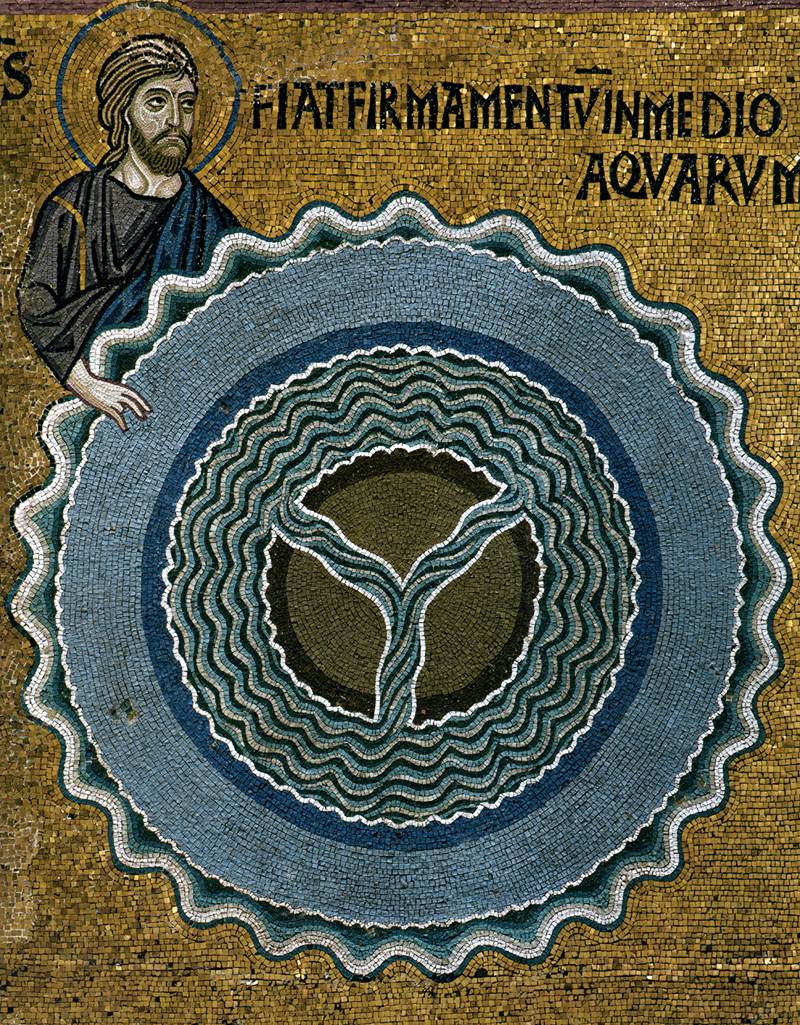
Capella Palatina Palermo 12th Century Mosaics God is shown creating the firmament. ‘And God said, Let there be a firmament in the midst of the waters, and let it divide the waters from the waters’
We are coming up to the key days in the year. And so will be looking at calendars and counting days. But what about ages, epochs and aeons?
‘Practical Magic in the Northern Tradition’ reports that there are seven ages of the world:
This is how they calculate it: the life of a yew tree is 729 years, and there are seven ages from the creation of the world until its doom. So the world will last 5103 years.
‘Practical Magic’ divides ages up as follows:
A wattle has a life of 3 years (1*3) Three wattles are the life of a hound – 9 years (3*3) Three hounds are the life of a steed – 27 years (9*3) Three steeds are the life of a man – 81 years (27*3) Three men are the life of an eagle – 243 years (81*3) Three Eagles are the life of a yew. – 729 years (243*3)
How Old is a Yew Tree/Eagle
A comment by a reader has prompted me to write the following about the ages given above:
‘Practical magic’ says the poem is ‘Ancient’. So it’s folklore and not science, and the ages are opinion not scientific fact.
As I understand it Yew trees live a long time but not quite as long as many people think. I base this on the Yew Tree at Steventon, Hampshire where Jane Austen was born. The tree has/had a plague on it saying it was 1200 years old. I used to visit it regularly. On one visit, I was told that an expert opinion suggested it was more like 700 years old. (ifmy memory serves). I do not have the details, but my source would have been one of the people associated with the Church.
The Woodland Trust (says Yew Trees get old at 900 years. They cite a few which are ‘said to be’ over 2000 years old. But are they? The scientific sites I have looked at suggest that Yew Trees should be described as ‘ancient’ from 400 not 900 years. There are problems with dendrochronology dating of yew trees, and so most methods depend upon an estimation from the width of the tree trunk. But that, itself, depends upon how much you believe in the claims of the ancient trees. So, I think it’s best to take the extreme cases with a very large pitch of salt. So 729 years is probably not so far off the mark for a Yew tree.
As to Eagles, this website on eagles says they can live to 30ish in the wild and 68 years in captivity. So the claim for 243 years is way off the mark! Wattles what are they? I have searched, but not found any reference. My guess is a short-lived bird.
The End Was Nigh
Archbishop Usher of Armagh (1581 – 1656) calculated that the world was created in 4004 BC. He counted the begettings in the Bible. If we accept his date, and apply the seven yew tree ages rule (5,103), then the world should have ended in AD 1099 (give or take a year). But it didn’t end then, did it? We are in the 9th Age and counting.
It doesn’t make sense to me to have a factor of 3 for the smaller divisions, and then to switch to a factor of seven. Surely, far more logical is to have a factor of 3*3 years. So, if there were nine ages of the world, then it would survive for 6561 years, which will end in approx. 535 years time (cAD2557). This calculation has the massive advantage of not yet being proved wrong! (Please note, cult owners, I have copyright on this date).
It’s notable that when a Cult declares the imminent end of the world, and they trudge up to the top of a high eminence to observe it (normally by Hampstead Pond in London). They seem quite happy to trudge back down again. Soon they are up and running again with the same enthusiasm for the next ‘end of the world’ date.
Of course, the world was created around 4.54 ± 0.05 billion years ago according to Wikipedia. According to the Doomsday Clock the world will end at 12 O’clock and we are 89 seconds away from it. This is based on a catastrophic end for our civilisation. If we avoid this then other scientists have suggested mammals will be wiped out in approximately 250 million years.
Abrahamic Ages
The Jewish tradition was for six or seven ages of 1000 years. The seventh didn’t really count because it was the age of the messiah when there was a 1000-year sort of super sabbath. Or another idea is that it was an age that ran parallel with the other six. So the world was to be 6000 years long.
With the coming of Christianity, dating the Creation, and (therefore the Day of Judgement) became more important. The Romans dated from the foundation of Rome, and the Greeks from the First Olympiad. But beyond that they had a whole mythology and creation myths about an Age of Gold. Followed by a Bronze Age (Troy and all that) followed by their very own base Iron age. You can read about this in my post about Hesiod.
An early Christian attempt to tell the age of creation was the Anno Munda‘s arrangement of the Year. This is pretty complicated and is based on a Talmudic tradition. A late Roman version uses ‘the Diocletian Years’, which is when the persecution of Christians began. It held that the world was created 5500 years before the Birth of Christ. So we are 5500BC plus 2025 years since the date of the creation. And it was supposed to have ended in 500AD. 6000 years after the Creation. so we have outlived Creation by 1525 years.
St Augustine of Hippo took the tradition of six ages and brought it into the Christian canon. These are the six ages:
The First Age “is from the beginning of the human race. That is, from Adam, who was the first man that was made. Down to Noah, who constructed the ark at the time of the flood“, i.e. the Antediluvian period.
The Second Age “extends from that period on to Abraham, who was called the father indeed of all nations”.
The Third Age “extends from Abraham on to David the king”.
The Fourth Age is “from David on to that captivity whereby the people of God passed over into Babylonia”.
The Fifth Age is “from that transmigration down to the advent of our Lord Jesus Christ“
The Sixth Age: “With His [Jesus Christ’s] coming, the sixth age has entered on its process.”
As each age is 1000 years, then you can see why so many people were worried as 1000 AD approached.
The Seven Ages of Man
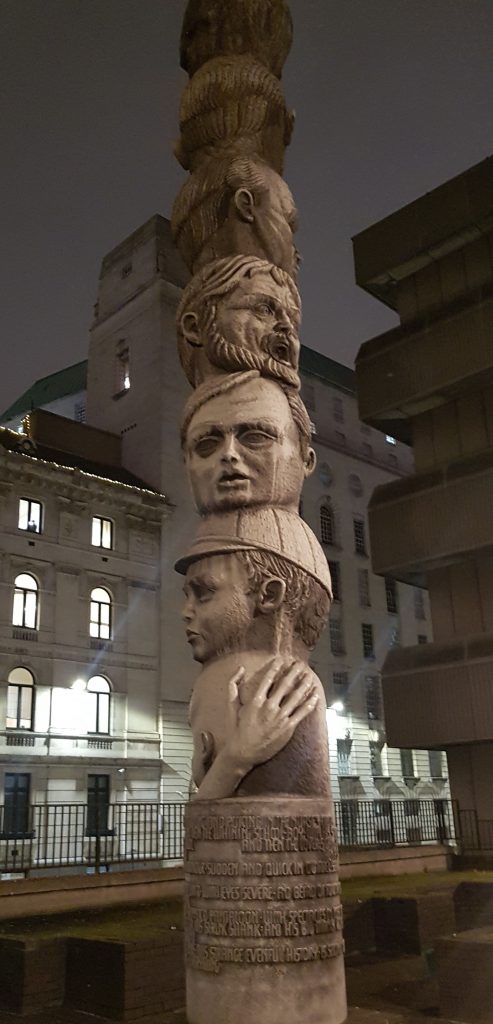
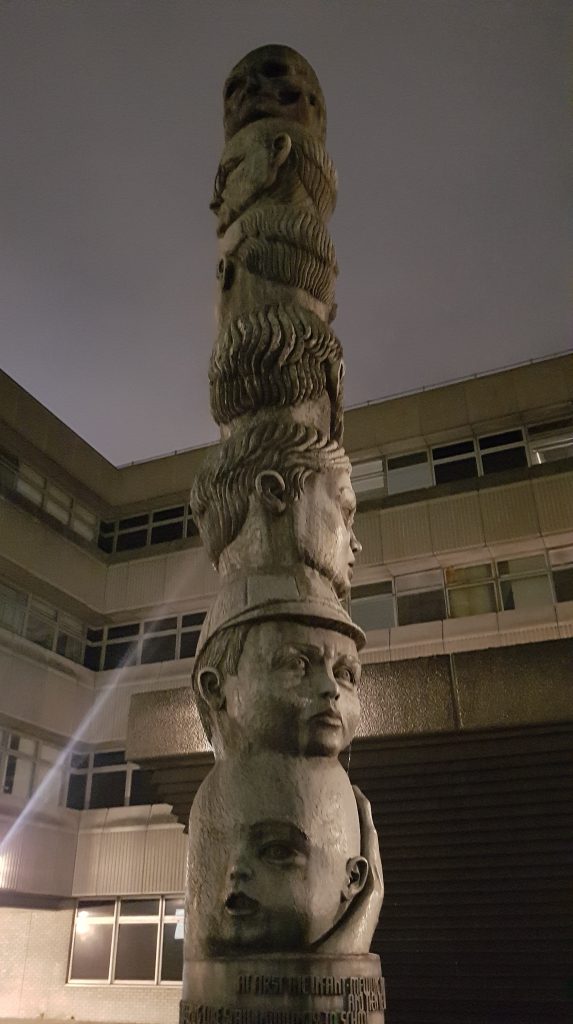
The Age of Man can also relate to the average age of a human lifespan. Of course, six is not such a magical number as seven, and so Shakespeare ran with the idea in the Seven Ages of Man spoken by Jacques in ‘As you like it’. If there are seven ages of human life, and we have a span of six score and ten, then each age is ten years.
All the world’s a stage, And all the men and women merely players; They have their exits and their entrances, And one man in his time plays many parts, His acts being seven ages. At first, the infant, Mewling and puking in the nurse’s arms. Then, the whining school-boy with his satchel And shining morning face, creeping like snail Unwillingly to school. And then the lover, Sighing like furnace, with a woeful ballad Made to his mistress’ eyebrow. Then, a soldier, Full of strange oaths, and bearded like the pard, Jealous in honour, sudden, and quick in quarrel, Seeking the bubble reputation Even in the cannon’s mouth.
And then, the justice, In fair round belly, with a good capon lined, With eyes severe, and beard of formal cut, Full of wise saws, and modern instances, And so he plays his part. The sixth age shifts Into the lean and slippered pantaloon, With spectacles on nose and pouch on side, His youthful hose, well saved, a world too wide For his shrunk shank, and his big manly voice, Turning again toward childish treble, pipes And whistles in his sound. Last scene of all, That ends this strange eventful history, Is second childishness and mere oblivion, Sans teeth, sans eyes, sans taste, sans everything.
(Jacques, Act 2, Scene 7)
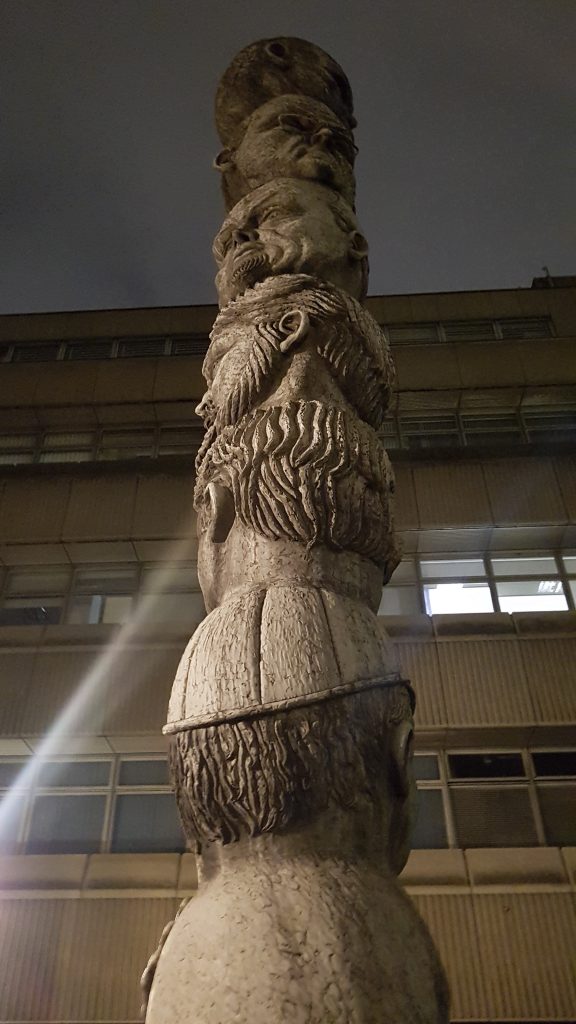
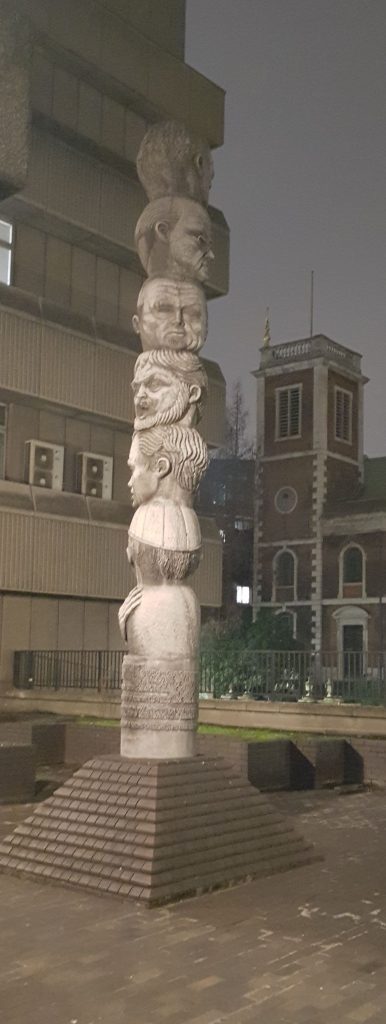
Seven Ages of Man Statue 22-foot high cast aluminium Sculpture by Richard Kindersley, located on Queen Victoria Street, Blackfriars, near the Blackfriars. St Andrew’s by the Wardrobe in the background. Photos k. Flude
The Kalendar of Shepherds
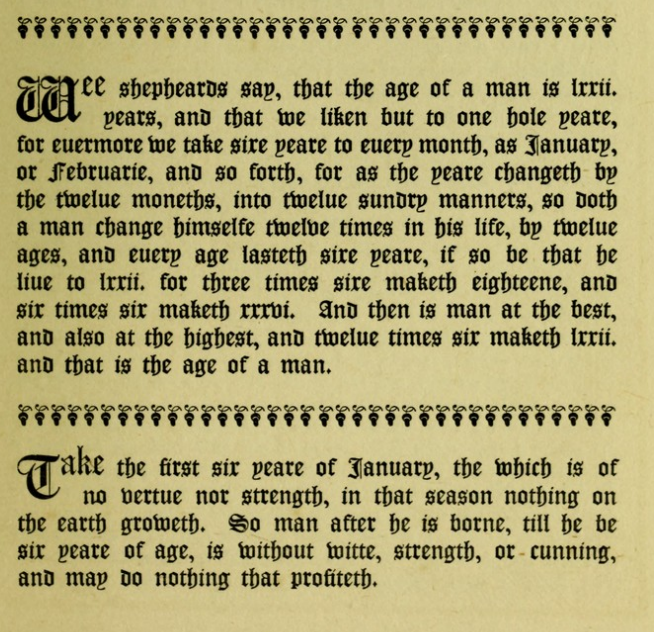
Now, the Kalendar of Shepherds has a similar idea, but it calculates it differently. The Kalendar, based on a 15th Century French original, says there are 12 ages of man, corresponding with the 12 months of the year. Each age is 6 years long, and so our likely lifespan is 72.
Kalendar of Shepherds
Each month is allocated to one of the ages, and has an insight into human life for that span. In January, the first 6 years of a human life are mapped out. If you read above you will see we have no ‘wit, strength or cunning. Nor ‘may do nothing that profiteth’ in those first years. A little harsh, and as a fond grandfather, it, I refute it. In December, the last 6 years are prefigured.
Our alloted span, says Practical Magic is 81 years, Kalendar of Shepherds say 72, and Shakespeare offers us 70.
Life expectancy at birth in the UK was 83.0 years for females and 79.1 years for males. This is an increase of 18 weeks from 82.7 years for females and 21 weeks from 78.7 years for males since 2019 to 2021.‘
Capella Palatina, Sicily
By the way, the Capella Palatina, illustrated at the top of this post, is a marvel of gold mosaics. It is absolutely stunning. It makes a trip to Palermo a must.
On This Day
1843 – Charles Dickens published ‘A Christmas Carol’
First Published on December 18th 2022, revised and republished in December 2023, 2024,2025
So, the old Sun is dying, and if the Sun keeps going down we are all going to die. With all of nature dying or hibernating, evergreens are a symbol of a promise/proof that life will continue through the dark days. So, with its bright-green leaves and its luminous berries, Holly is the ideal evergreen for the Solstice. And as the prickles symbolise Christ’s Crown of Thorns, and the berries the red blood of Jesus, the symbolism works, too, for Christians.
Henry Mayhew (editor of Punch) in his ‘London Labour and London Poor’ (1851–62) talks of Christmasing for Laurel, Ivy, Holly, and Mistletoe. He calculated that 250,000 branches of Holly were purchased from street coster mongers every Christmas. He says that every housekeeper will expend something from 2d to 1s 6d, while the poor buy a pennyworth or halfpennyworth each. He says that every room will have the cheery decoration of holly. St Pauls Cathedral would take 50 to a 100 shillings worth.
He also calculates that 100,000 plum puddings are eaten. Mistletoe he believes is less often used than it used to be, and he hopes that ‘No Popery’ campaigners will not attack Christmassing again.
Hot plum pudding seller from Sam Syntax Cries of London, 1820s from the Gentle Author Spitalfields Life website
Culpeper on Ivy (1814 edition):
‘Ivy’ says Culpeper in his Herbal of 1653, its winter-ripening berries are useful to drink before you ‘set to drink hard’ because it will ‘preserve from drunkenness’. And, moreover, the leaves (bruised and boiled) and dropped into the same wine you had a ‘surfeit’ of the night before provides the ‘speediest cure’. (The Perpetual Almanac of Charles Kightly)
It is so well known to every child almost, to grow in woods upon the trees, and upon the stone walls of churches, houses, &c. and sometimes to grow alone of itself, though but seldom.
Time. It flowers not until July, and the berries are not ripe until Christmas, when they have felt Winter frosts.
Government and virtues. It is under the dominion of Saturn. A pugil of the flowers, which may be about a dram, (saith Dioscorides) drank twice a day in red wine, helps the lask, and bloody flux. It is an enemy to the nerves and sinews, being much taken inwardly, out very helpful to them, being outwardly applied. Pliny saith, the yellow berries are good against the jaundice; and taken before one be set to drink hard, preserves from drunkenness, and helps those that spit blood; and that the white berries being taken inwardly, or applied outwardly, kills the worms in the belly. The berries are a singular remedy to prevent the plague, as also to free them from it that have got it, by drinking the berries thereof made into a powder, for two or three days together. They being taken in wine, do certainly help to break the stone, provoke urine, and women’s courses. The fresh leaves of Ivy, boiled in vinegar, and applied warm to the sides of those that are troubled with the spleen, ache, or stitch in the sides, do give much ease. The same applied with some Rosewater, and oil of Roses, to the temples and forehead, eases the head-ache, though it be of long continuance. The fresh leaves boiled in wine, and old filthy ulcers hard to be cured washed therewith, do wonderfully help to cleanse them. It also quickly heals green wounds, and is effectual to heal all burnings and scaldings, and all kinds of exulcerations coming thereby, or by salt phlegm or humours in other parts of the body. The juice of the berries or leaves snuffed up into the nose, purges the head and brain of thin rheum that makes defluxions into the eyes and nose, and curing the ulcers and stench therein; the same dropped into the ears helps the old and running sores of them; those that are troubled with the spleen shall find much ease by continual drinking out of a cup made of Ivy, so as the drink may stand some small time therein before it be drank. Cato saith, That wine put into such a cup, will soak through it, by reason of the antipathy that is between them.
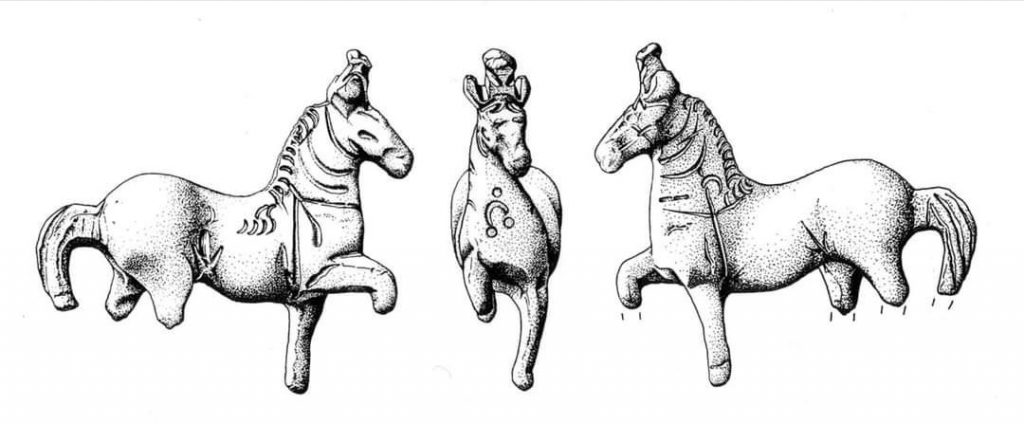
Roman Horse from Bunwell, Norfolk. Illustration by Sue Walker.
In 2021 I posted about Eponalia for the 18th Dec but I have now added the text to this page.
I’ve been too busy working on my Jane Austen and Christmas Virtual Tour ) to post over the last few days. And I have, therefore, shamelessly stolen this post off my Facebook friend Sue Walker, who is a talented archaeological illustrator, artist and a very good photographer.
She wrote: ‘the 18th December is the festival of the Celtic goddess Epona, the protector of horses, she was adopted by the Romans and became a favourite with the cavalry. This finely sculpted bronze horse with a head dress and symbol on its chest is 37mm high – found in Bunwell #Norfolk #Archaeology’
First published on December 17th 2022, Revised and republished December 2023
Medieval Cataract Surgery – calling couching Eye Care through the Ages .
So, on St Lucy’s Day, you, being someone worried about your eyes, might have sought an altar dedicated to St Lucy, the patron saint of eye health. (see December 13th’s Post on St Lucy). Although you may be disappointed that there has been no miraculous cure for you, you might have been encouraged to do something about it. So that’s what this post is about.
There are only two churches in the UK dedicated to St Lucy or St Lucia. One run by the National Trust in Upton Magna, Shropshire, but there must have been a few chapels in Cathedrals and Abbeys dedicated to her. I have my eyes open for them!
For Redness of the Eye or Pink Eye
There are many household books still, existing. These show that much of medical practice was carried out in the home, by ordinary men and women. More often women, actively not only collected useful recipes and cures, but also tested them out and improved them. Here is an example:
For the redness of eyes, or bloodshot. Take red wine, rosewater, and women’s milk, and mingle all these together: and put a piece of wheaten bread leavened, as much as will cover the eye, and lay it in the mixture. When you go to bed, lay the bread upon your eyes calmer and it will help them.
Fairfax Household book, 17th/ 18th century. (Reported in The Perpetual Calendar of Folklore by Charles Kightly)
‘Pink eye’ is mentioned in a document unearthed at the Roman Fort of Vindolanda. It lists the troops of the Cohort in occupation. We read that of the garrison of 750, 474 are absent with 276 in the fort of which 38 are sick, 10 with ‘pink eye’. This is probably conjunctivitis.
Prevention is better than cure
Things hurtful to the eyes. Garlic, onions, radish, drunkenness, lechery, sweet wines, salt meats, coleworts, dust, smoke, and reading presently after supper.
Good for the eyes. fennel, celandine, eyebright, vervain, roses, cloves and cold water.
Whites Almanack 1627
Cataract operations
Cataract operations have been carried out since 800 BC using a method called ‘couching’.
This was a last resort when the cataract was opaque and the patients nearly blind. It would mean they would need very thick lenses to see well again but, crude as it seems, it worked.
But the operation, without anaesthetics must have been a considerable ordeal. The recovery (still required today for those suffering from a displaced retina) means that the patient has to lie on their back for a week with supports on either side of the head to prevent movement. Of course, there was a serious risk of infection, so prophylactic visits to a chapel of St Lucy might be called for.
The modern treatment for cataracts was established in the 1940s and offers a great solution in 15 minutes surgery. Currently, the NHS has been having trouble dealing with all the cases required, (6% of surgery is for cataract operations). Before COVID-19, there was some talk about cataracts being, in practice, not readily available on the NHS. The waiting time is supposed to be 18 weeks but, for example, at NHS Chesterfield Royal Hospital the waiting time approaches almost 10 months. But waiting times around the country vary from 10 weeks to over a year.
Patrick Brontë’s Eye
On 26th August 1846 Charlotte Brontë took her father to Manchester from Haworth for Cataract surgery. The operation took 15 minutes but without anaesthesia. He was very calm and said the pain was ‘a burning pain.’ It was vital he stay still through the pain. Then, he had to remain in bed for a month in the dark, minimising movement. Leeches were applied to his face, to reduce the inflammation of the wound. He was looked after by a nurse 24 hours a day, supervised by Charlotte. She used the time she spent waiting in writing Jane Eyre. Her Father’s vision was significantly improved and he was able to resume his Parish duties.
You will note, above, that it was considered bad for the eyes to read in low light. It is a myth and not true. Poor Samuel Pepys was continually worried about his reading and writing habits ruining his eyesight. This is an extract from the poignant last entry in his famous diary:
And thus ends all that I doubt I should ever be able to do with my own eyes in the keeping of my journal, I being not able to do it any longer, having done now so long as to undo my eyes almost every time that I take a pen in my hand; and therefore, whatever comes of it, I must forbear: and therefore resolve from this time forward to have it kept by my people in long-hand. I must be consented to sit down no more than is fit for them and all the world to know; or, if they be anything, which cannot be much now my amores are past and my eyes hindering me almost all other pleasures. I must endeavour to keep a margin in my book open, to add, here and there, a note in shorthand with my own hand.
Samuel Pepys Diary, May 31st
The sad thing is that Pepys had another 38 years before he went blind, and what glorious diary entries have we missed because of his false fears of the effect of eye strain?
First published in 2022, updates 2023, 2024 and 2025
St Lucy, by Francesco del Cossa (c. 1430 – c. 1477) (Wikipedia User:Postdlf)
I reposted my two posts on St Lucy, and the follow-up email on eye-care, on the appropriate days. But the email to subscribers was not sent. So here it is again. The name Lucy is from the same Latin origin (Lucidus) as lucent, lux, and lucid. It means to be bright, to shine or be clear. It is similar to the Ancient Greek λευκός (leukós, “white, blank, light, bright, clear”. Luke has the same origins (bright one, bringer of light and light of the sacred flame) and is very appropriate for the most literate of the evangelists.
St Lucy of Syracuse
St Lucy is from Syracuse in Sicily. She was a victim of the Diocletian Persecution of Christians in the early 4th Century. She is an authentic early martyr. But details of her story cannot be relied upon as true. She was a virgin, denounced as a Christian by her rejected suitor. Then, miraculously saved from serving in a brothel.; destruction by fire, but did not escape having her eyes gouged out. Finally, her throat was cut with a sword.
Her connection to light (and the eye gouging) makes her the protectress against eye disease. So she is depicted holding two eyes as you can see in the picture at the top of the page. Other symbols include a palm branch which represents martyrdom and victory over evil. Other symbols are lamp, dagger, sword or two oxen.
She appears in Dante’s Divine Comedy, as the messenger to Beatrice whose job is to get Virgil to help Dante explore Heaven, Hell and Heaven.
St. Aldhelm (died in 709) puts St Lucy in the list of the main venerated saints of the early English Church, confirmed by the Venerable Bede (died in 735). Her festival was an important celebration one in England. It was views ‘as a holy day of the second rank in which no work but tillage or the like was allowed’.
Dimming of the Light
This year is a glorious sunny St Lucy’s Day. But, the afternoons soon dim. So, at this time of the year, we are in need of a festival with bright lights to cheer us up! And St Lucy’s Day is the beginning of the winter festival that culminates with the Solstice, where the old sun dies, and the new one is born. December the 13th was the Solstice until Pope Gregory reformed the Calendar in the 16th Century, as nine days were lopped off the year of transition.
Sankta Lucia in Sweden
The festival of Sankta Lucia is particularly popular in Sweden, where December 13th is thought to be the darkest night. In recent years, the Swedish community in the UK has had a service to Lucia in St Pauls. But the last couple of years has been in Westminster Cathedral. This year on the 5th December. And a Santa Lucia Carol Concert on 12 December at St Paul’s. But every year it has either been and gone or sold out by the time I get around to thinking of going!
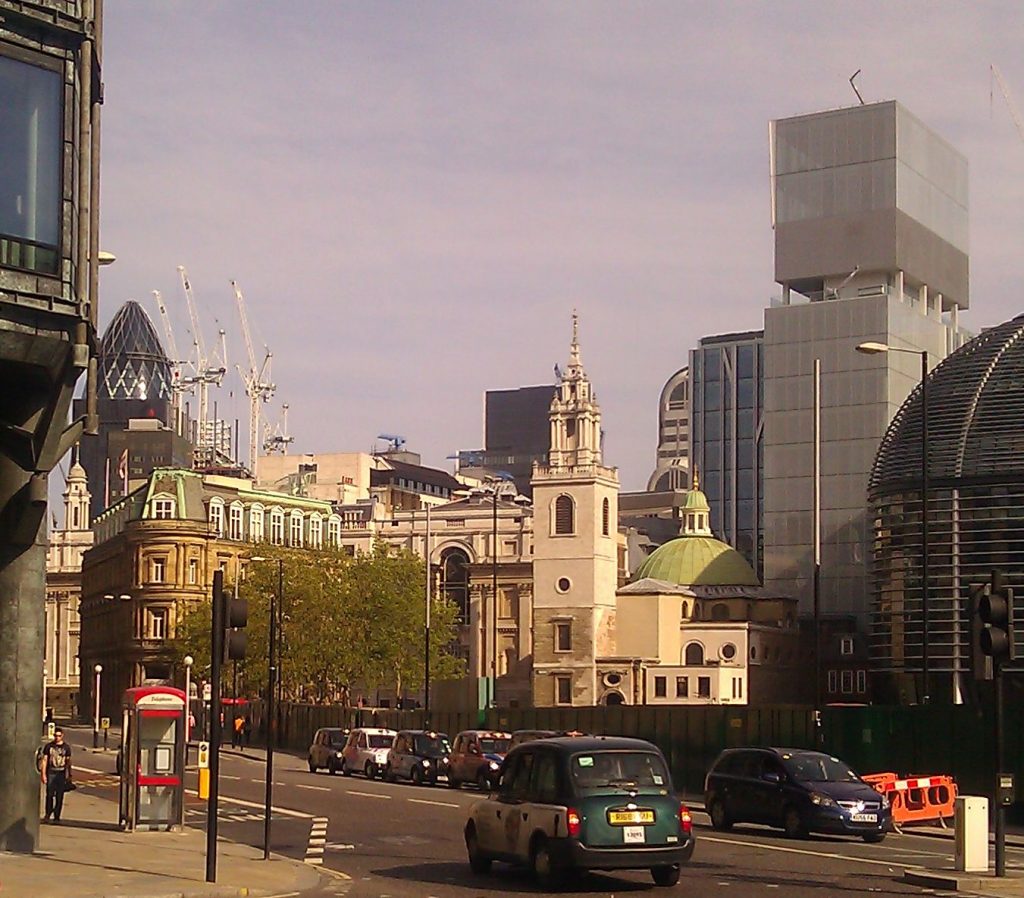
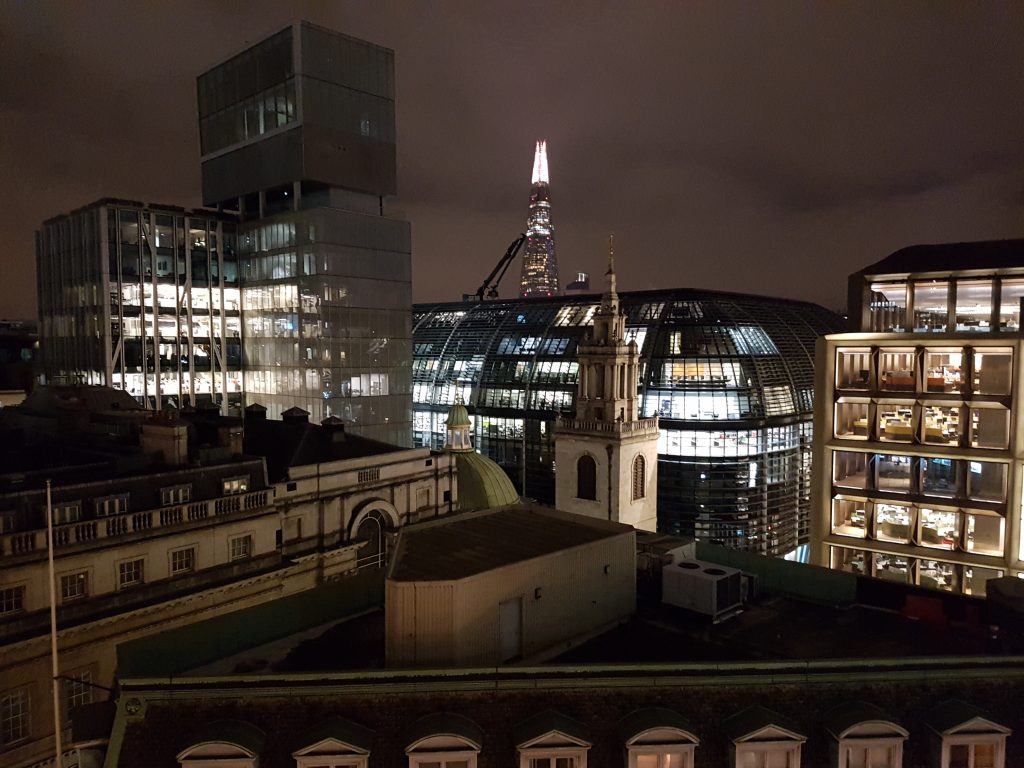
St Stephens Church by Christopher Wren (Photo K Flude) a rare view during building work.
I found out about Sankta Lucia from a Swedish choir who hired me to do a tour of the City of London some years ago. We went into Christopher Wren’s marvellous St Stephen’s Church. Under the magnificent Dome, the choir fancied the acoustics and spontaneously sang. I recorded a snatch of it, which you can hear below
Swedish Choir singing in St Stephen’s London St Stephens Church in the middle foreground of the photo. (Photo K Flude)
You can watch the Sankta Lucia service in Westminster Cathedral below:
The Importance of Light
Recent medical research has shown the importance of light, not only to our mental health but to our sleep health. Work places need to have a decent light level with ‘blue light’ as a component of the lighting. It is also an excellent idea to help your circadian rhymes by going for a morning walk, or morning sun bathing, even on cloudy days. This will help you sleep better. And so St Lucy remains relevant as an inspiration
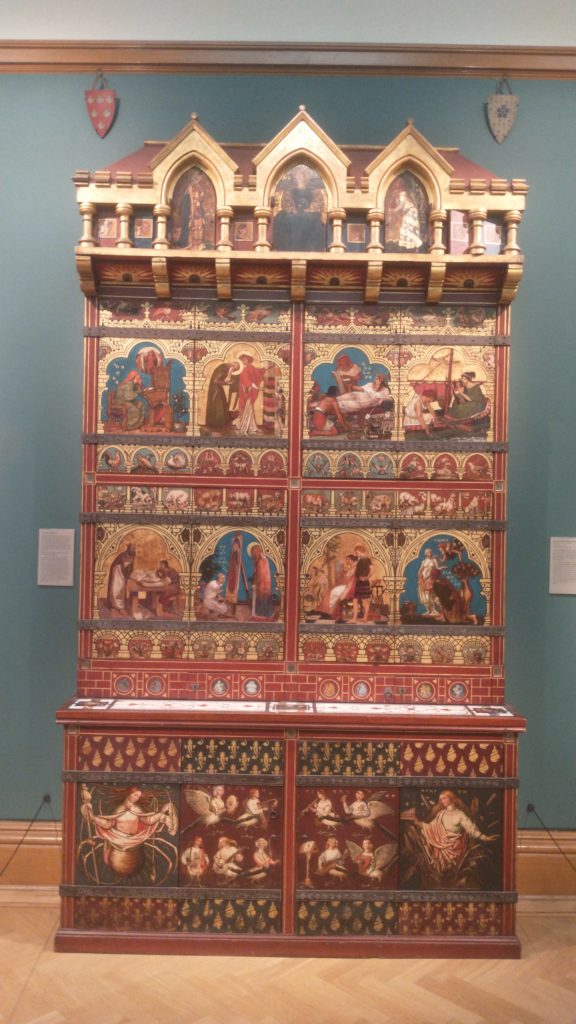
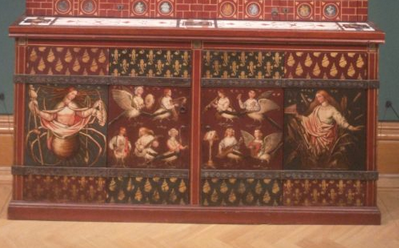
The Great Bookcase by William Burges Ashmolean Museum (Photo K. Flude)
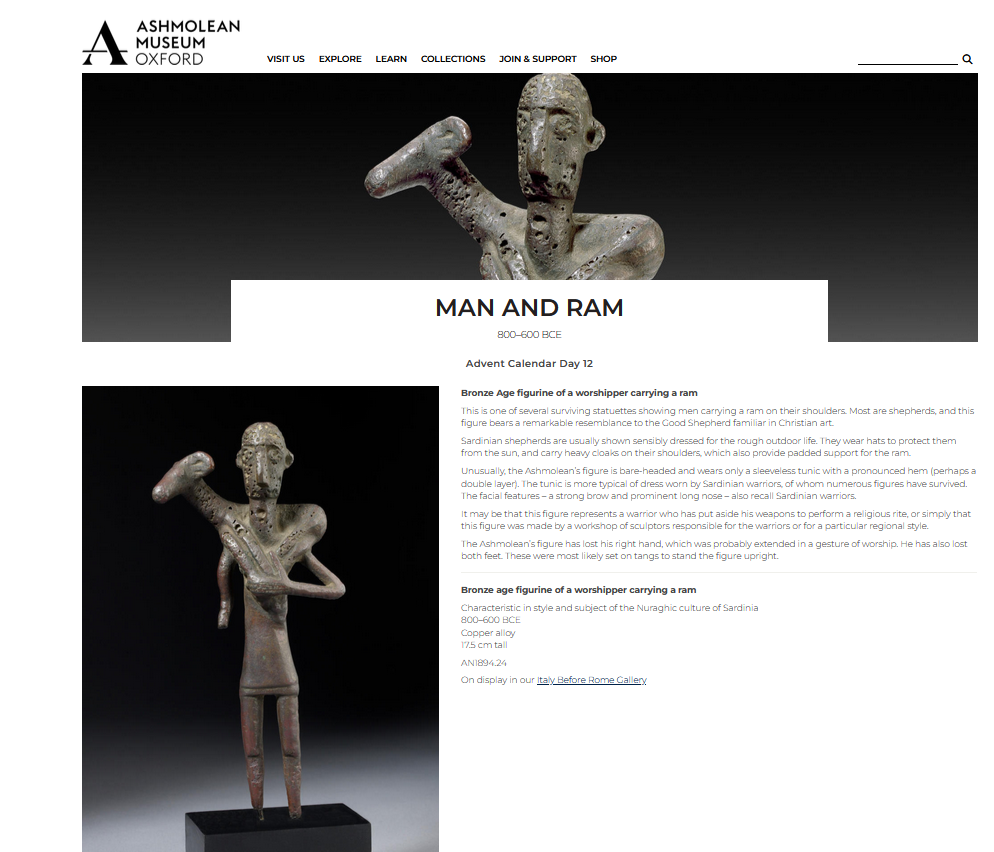
The Ashmolean posts, every year, an online Advent Calendar with gorgeous items behind each ‘flap’. The choice seems to be, mostly, a random selection. But their collection is so wonderful, they are all interesting.
The Great Bookcase by William Burges & the Singing Pierides
In 2022 The Ashmolean featured the Great Bookcase by William Burges. Burges is one of the great Gothic Revival architects and a designer in the Arts & Crafts Movement with an affinity for Pre-Raphaelite painters. He asked 14 of them to paint panels on his bookcase. The decorative scheme was to represent the Pagan and Christian Arts (Museum label).At the bottom of the Wardrobe are the Singing Pierides painted by Henry Stacy Marks. The Pierides were a sort of classical Greek Von Trapp singers, 9 daughters who foolishly challenged the Muses to a singing competition. Of course, the Goddesses of the Arts — the Muses won., As punishment for their vanity, they turned the Pierides into songbirds. Let this be a warning to all those who overrate their own talents!
‘Whenever the daughters of Pierus began to sing, all creation went dark and no one would give an ear to their choral performance. But when the Muses sang, heaven, the stars, the sea and rivers stood still, while Mount Helicon, beguiled by the pleasure of it all, swelled skywards tilI, by the will of Poseidon, Pegasus checked it by striking the summit with his hoof.
Since these mortals had taken upon themselves to strive with goddesses, the Muses changed them into nine birds. To this day people refer to them as the grebe, the wryneck, the ortolan, the jay, the greenfinch, the goldfinch, the duck, the woodpecker and the dracontis pigeon.’
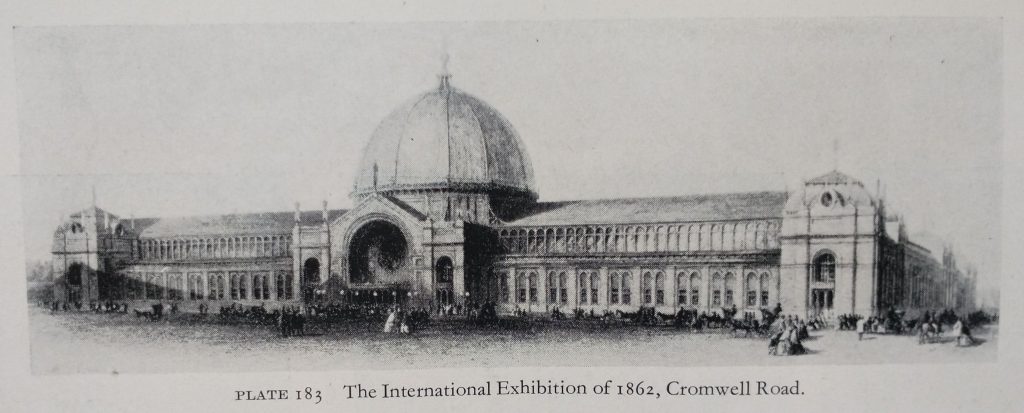
Print of the International Exhibition of 1862, South Kensington
The bookcase by William Burges was originally displayed as the centre point of the ‘Medieval Court’ of the 1862 International Exhibition, South Kensington, London. The Exhibition was almost as successful as the more famous Great Exhibition of 1851. Both got about 6m visitors. The 1862 Exhibition was just south of the site of the 1851 (on the south side of Hyde Park) and in what were then the Royal Horticultural Society’s gardens (now the Science, Natural History Museum, Imperial College etc.)
Raphael
This year, they posted a Raphael drawing of an angle. I show a screen shot below. But to have a real look click here.
I discovered the Nuragi on a University Field trip, with my students, to the Capital of Sardinia, Cagliari. The Nuragic culture is not well known. However they have amazing Bronze sculptures which give the viewer a really vivid view of their lives and fashions in the Bronze Age. They lived in round towers called nuraghe, which are a little like the Brochs of Scotland. They were around during the time of the Mycenaean Culture in Greece. But their origins and indeed their history are argued about. They may be part of the ‘Sea People’ who brought the end to the Bronze Age cultures of the Eastern Mediterranean, or they may not.
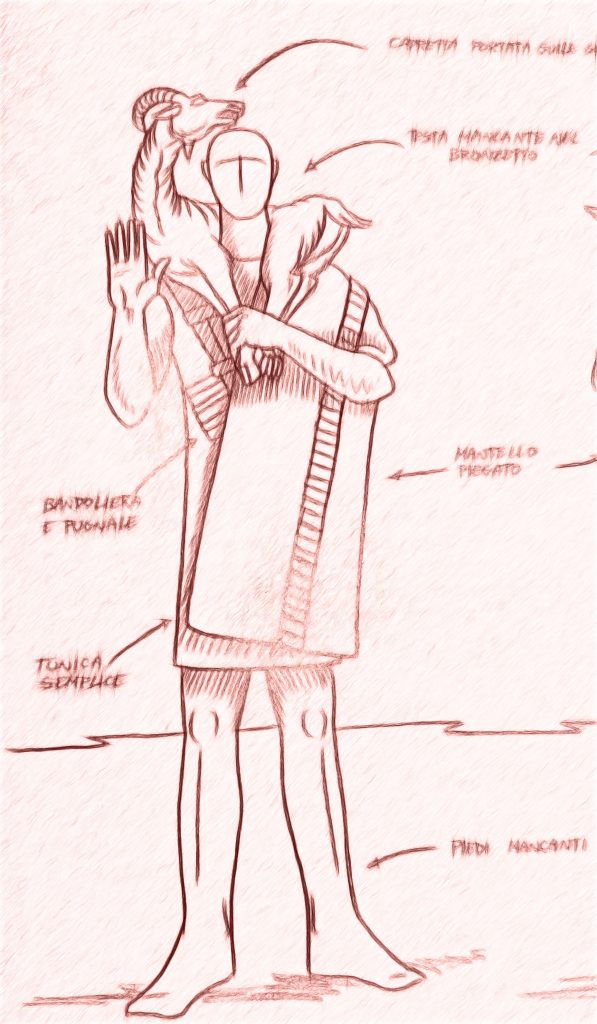
Here, in Britain, the Bronze Age is dominated by discussions of henges, barrows, metal axes and swords. But with very little sense of what life was like to live in those days. However, go to the Cagliari Museum, look at these wonderful statues, and it becomes possible to picture the people. Particularly with a copy of ‘Il Popolo di Bronzo’ by Angela Demontis to hand. It is a catalogue of Nuragi statures with interpretative drawings. It really brings the people to life depicted in the statues. They are mostly warriors, but also there are ‘normal trades’ such as shepherds and bakers which are depicted as well.
Here is my slight adaption of one of the drawings. It is of a shepherd similar to the one photo’d above.
A sketch drawing of a Nuragi sculpture derived from ‘Il Popolo di bronzo’ by Angela Demontis
What you can see is some detail of the clothes and the knife belt around the torso. Not to mention the sheep around his neck! The drawing brings a living person from the Bronze Age before you, not just a lump of bronze. Wikipedia has a long article on the nuragic culture. You can see a wonderful collection of nuragi bronzes and their homes on this website.here.
Originally written for December 12, 2022, revised and republished December 2023, and the Nuragi added in 2024 and Raphael added in 2025
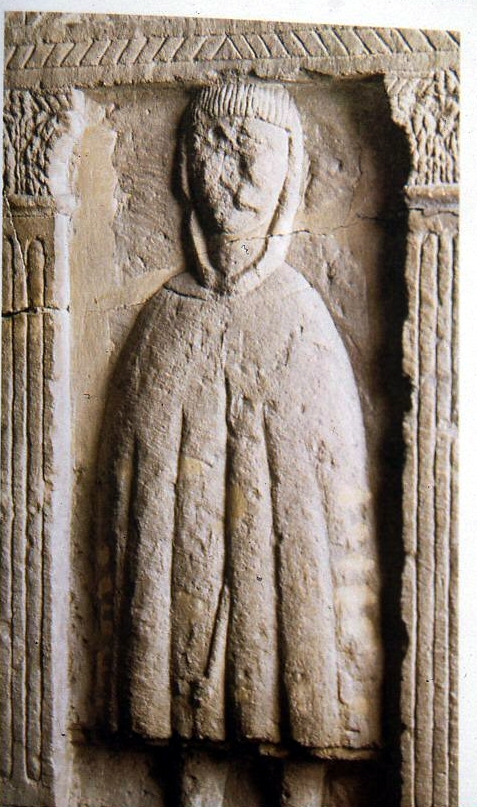
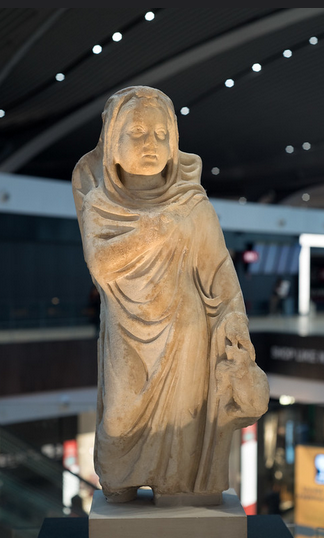
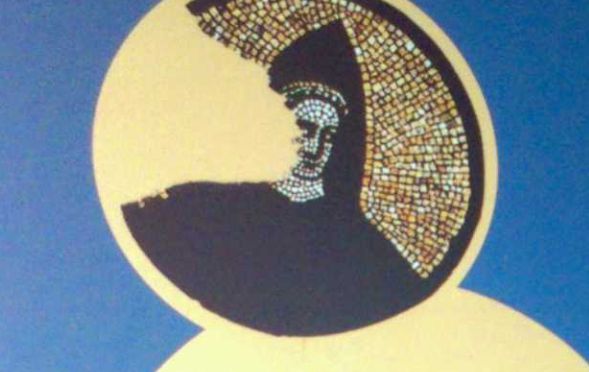
Tombstone of Philus from Corinium DobunnorumWinter from Ostia AnticaMosaic from Lullingstone Villa, Kent, representing winter.
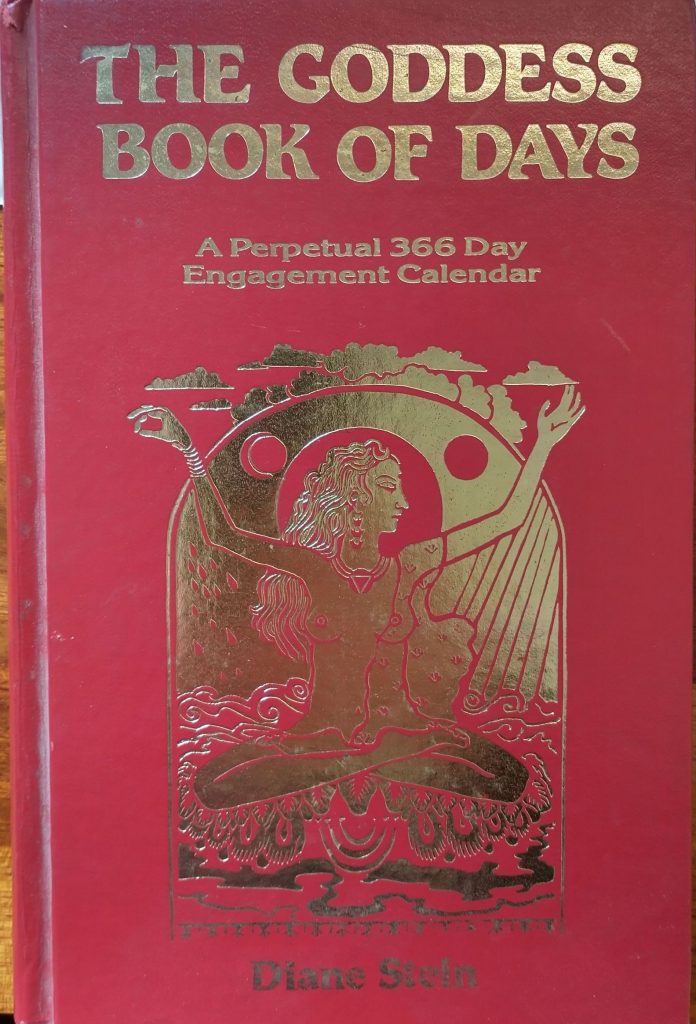
December 11th is dedicated to Bruma the Roman Goddess of Winter or so says my Goddess Book of Days,. However, I’m not having much luck tracking her down. Elsewhere, I find reference to a Greek or Roman festival of Winter called Brumalia. It starts in late November and ends on the 25th December, the Roman Solstice. Or so they say. But, only the Goddess Book of Days has it on December 11th.
Cover of the Goddess Book of days
However, there is more evidence for the Brumalia festival in the Eastern Roman Empire. So, let’s imagine a Winter Goddess beginning her reign on November 24th. Then, Saturnalia took place from 17th – 24th December and the climax of the reign of the Winter Goddess was Brumalia on the 25th December. The festival was celebrating the seeds in the ground, necessary for a good harvest. To ensure a good harvest Civic officials delivered gifts of wine, olive oil, grain, and honey to the Priests and Priestesses of the Goddess Ceres. Farmers sacrificed sheep and pigs to Saturn and Ceres. They inflated sheep bladders with air and jumped upon them as part of the celebration!
December 25th
Aurelian in 274 AD fixed December 25th by as the day to celebrate Sol Invictus. The worship of the Unconquered Sun was the Roman attempt to have a monotheistic element to their religion. December 25th was also chosen by Mithras, Saturn, and Christians. For more about December 25th see my post here.
Underlying this confusion of dates is the difficulty of aligning the solar year to the calendar year, and in the Roman period it was all over the place until Julius Caesar fixed the Calendar. (for more on that, see my post here)
Roman Hoodie
The picture of the tombstone, above, comes from Cirencester, and the inscription says:
Philus, son of Cassavus, a Sequanian, aged 45, lies buried here.
For details look at the ‘Roman Inscriptions of Britain.org’ here:
Philus’ cloak is very interesting. Similar Hoodies are found in other places in Roman Britain, for example, on a mosaic at Chedworth. They are called the Birrus Britannicus. And were famous throughout the Empire. It was a hunting cloak made of wool. I imagine it was a sort of ‘thorn proof’ woollen garment that was warm, rugged, and waterproof. Britain was exported hunting dogs and slaves. The Cotswold wool was also famous in medieval Europe. It was made from Cotswold Lion sheep which were introduced first during the Roman period into the local sheep stock. The large number of rich Roman villas in the area suggest that the wool made the local economy strong.
The British Hoodie, and Inflation.
In AD 301, the emperor Diocletian issued his Edict of Maximum Prices. In it, the Emperor rages against inflation:
Greed raves and burns and sets no limit on itself. Without regard for the human race, it rushes to increase and augment itself, not by years or months or else days, but almost by hours and very moments. Diocletian Maximum Prices Edict(click here for Pdf)
The Edict then lists maximum wages and prices. The birrus listing says that the Tailor,
‘cutting and finishing a hooded cloak (birrus) of the finest quality shall have a maximum wage of 60 denarii. ‘
The sanctions against breaking the Edict were terrifying. This suggests the difficulty of enforcement was compensated for by extreme punishment. Diocletian also insisted that labour shortages were addressed by making children follow the same profession as fathers. Interesting how familiar rampaging inflation and severe staff shortages seems to a post.
Reorganisation of the Roman World
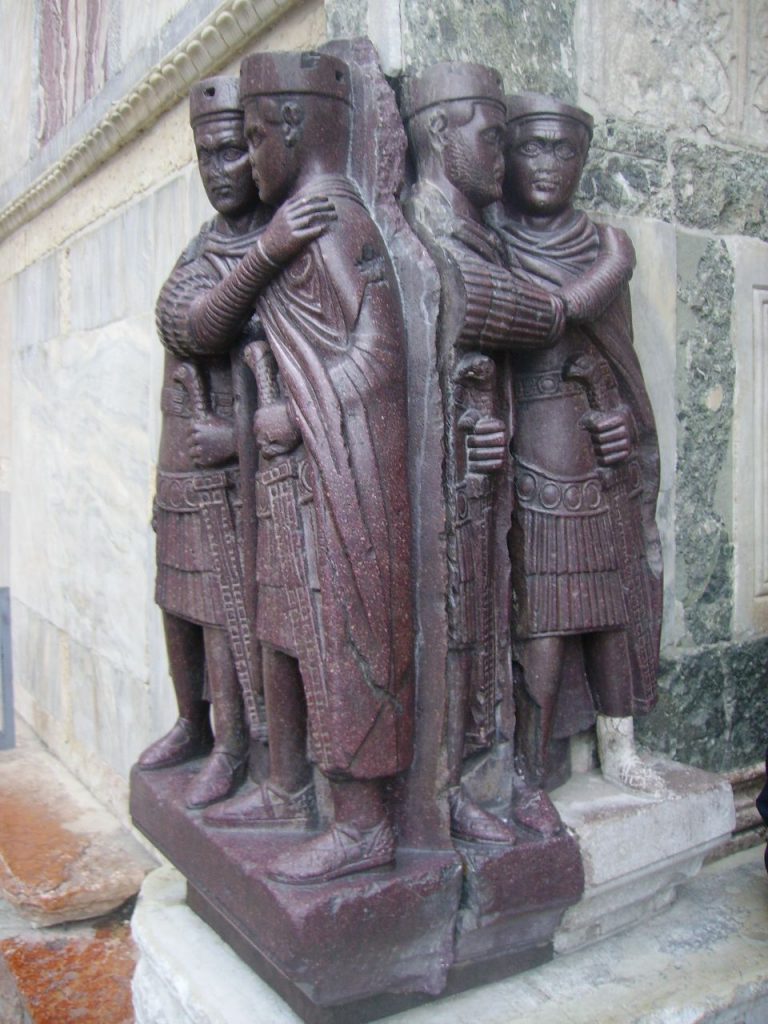
Diocletian, having a hug in with his junior Augustus and 2 Caesars, Venice
Diocletian was obviously a very logical man, looking for structural fixes to society’s problems. His analysis of the Roman Empire and its frequent Civil Wars/Coup D’Etats/Usurpers was that there was a deficiency in the career ladder for megalomaniacs. So to stop them usurping the Emperorship, he set up a rational career progression and divided up the Empire as follows:
1 Augustus for the Eastern (Greek speaking) Empire 1 Augustus for the Western (Latin speaking) Empire 2 Caesars for each Augustus Prefects reporting to the Caesars Vicari reporting to the Prefects Governors reporting to the Vicarius.
So you could begin your career in charge of a Province, then progress to the Diocese, then to the Prefecture, then to a quarter of the Empire, then to the Western Empire and finally to be the top dog in the richest Greek-speaking part of the Empire – the supreme Augustus. Brittania was divided up into 4 provinces, each controlled by a non-military Governor. They reported to the Vicarius in London, who reported to the praetorian prefecture of the Gallic region, which was based at Trier, who reported to Rome. They copied in the supreme Emperor who normally hung out in the East of the Empire. (the rich bit).
Did it work? Well, while Diocletian was alive maybe. When his Augustus of the West Constantius Chlorus died, his troops, in York, declared his son Constantine to be Augustus. Thus, bypassing the peaceful progression from Governor to Augustus. The system reverted to the usual tactic of wiping out your fellow Prefects, Caesars and Augustii. After his victory at the Battle of Milvian Bridge, Constantine was universally recognised as the supreme Augustus. He moved the Eastern Capital from Nicosia to Byzantium and renamed it Constantinople.
More on the Sequani
The Sequani were from the upper Saône Valley, near Besançon.
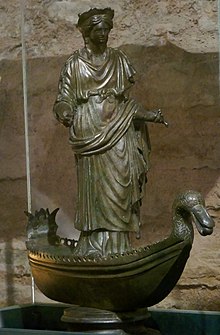
One of our readers alerted me to the Wikipedia page on the Sequani which explains that the name comes from the Goddess Sequana who is a water goddess. The centre of the territory is Besançon which is on the Doubs River. part of the Haute Saône Doubs and near to the springs that are the source of the Seine (west of Dijon). The Fontes Sequanae (“The Springs of Sequana”) gave her name to the River Seine, and a healing spring was established in the 2nd/1st BC. Enlarged by the Romans, it became a significant health centre. as Wikipedia explains in the clip below:
Image of Sequana in a duck boat by Wikipedia FULBERT • CC BY-SA 4.0
‘Many dedications were made to Sequana at her temple, including a large pot inscribed with her name and filled with bronze and silver models of parts of human bodies to be cured by her. Wooden and stone images of limbs, internal organs, heads, and complete bodies were offered to her in the hope of a cure, as well as numerous coins and items of jewellery. Respiratory illnesses and eye diseases were common. Pilgrims were frequently depicted as carrying offerings to the goddess, including money, fruit, or a favourite pet dog or bird.’