September – ‘Winter’s Forewarning and Summer’s Farewell’

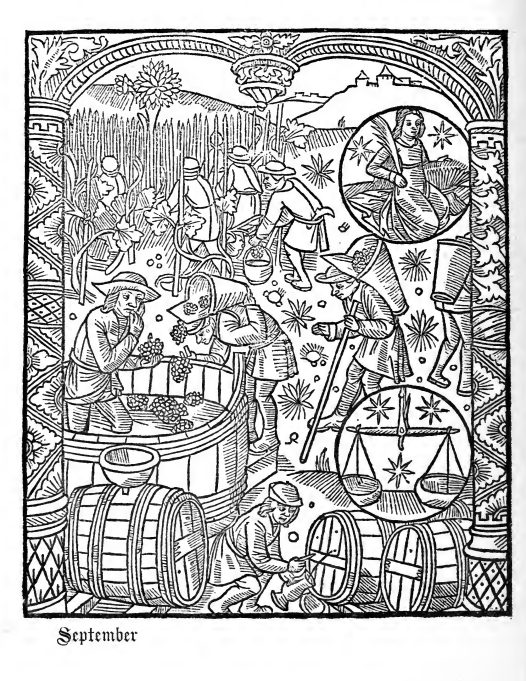
Kalendar of Shepherds illustration of September showing harvesting grapes and the astrological signs for Virgo (August 23 – September 22) and Libra (September 23 – October 22)

It is that time of the year when you say ‘Where has the Summer gone? It can’t be September already?’ But, meteorology, speaking, Autumn starts today. September 1st was chosen on a numerical basis for ease of measuring rather than any profound floral, agricultural or solar reason. So, there are three Gregorian Calendar months for each season, and each season starts on the first of the month. Autumn: September, November and December.

Autumn, Harvest, Fall

Autumn comes from Latin (autumnus) which went into French and then into English. The season was also called Harvest (which went into Dutch herfst, German Herbst, and Scots hairst -Wikipedia) or from the 16th Century: the ‘fall of the year’ or ‘fall of the leaf’ which spread to America as Fall.

Summer’s Ending

It still feels like summer. In England, we often have a glorious September, and what we can an ‘Indian’ Summer, an unexpectedly warm period in mid-September to October.

Solar Autumn

Of course, for the real Autumn, we have to wait for the Equinox, the beginning of Astronomical or Solar Autumn. This year, it is on Monday, September 22nd, 2025, 7:19 pm.

Astrological September

The star signs for astrological September are: Virgo which is linked to Aphrodite (Venus) the Goddess of Love and Libra which is linked to Artemis (Diana), virgin goddess of many things, including hunting, wild animals, children, and birth.
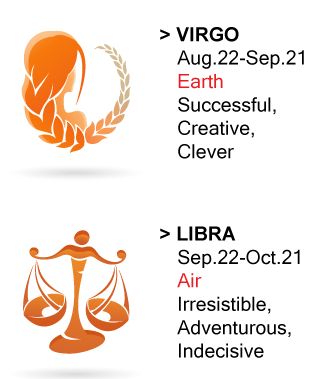
Star signs for September

September

September gets its name from the Romans, for whom it was the 7th Month of the year (septem is Latin for seven). Later, they added two new months so it became our 9th Month. (For more on the Roman year, look at my post here).

It is called Halegmonath in the early English language, or the holy month, named because it is the month of offerings, because of the harvest, and the mellow fruitfulness of September? Medi in Welsh is the month of reaping, and An Sultuine in Gaelic which means the month of plenty.
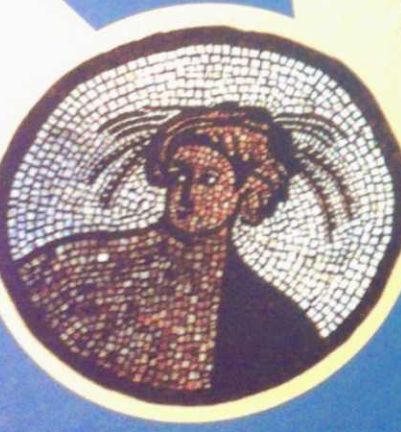
Roman personification of Autumn from Lullingstone mosaic

Early Modern September and the autumn of Life

Here is an early 17th Century look at September from the Kalendar of Shepherds – for more on the Kalendar, look at my post here.
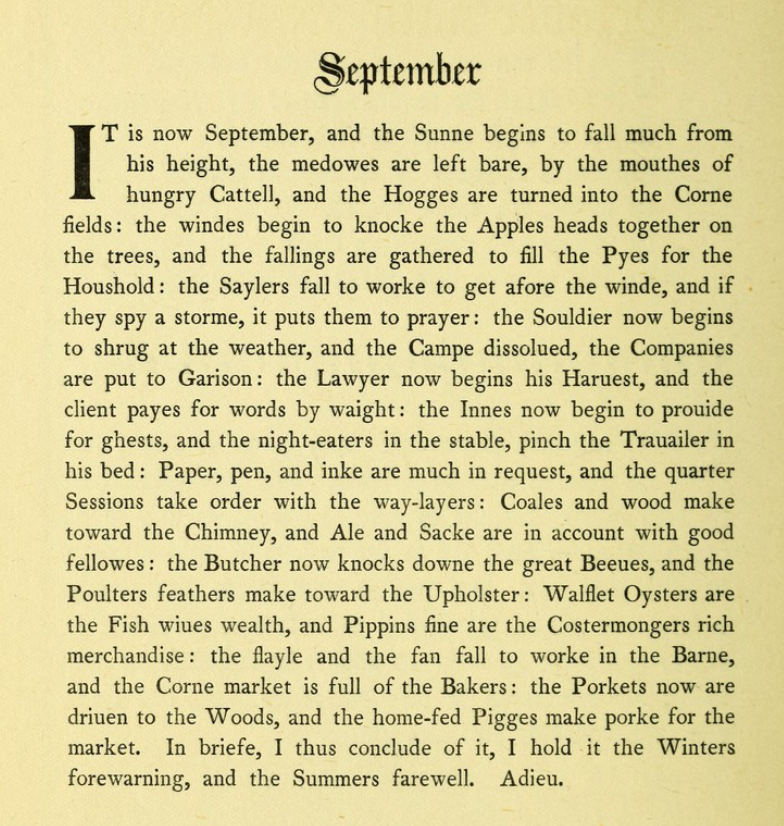
From the Kalendar of Shepherds

The Kalendar has an additional shorter look at September (see below). And it continues with its theme, linking the 12 months of the year with the lifespan of a man – 6 years for each month. So September is a metaphor for man at 56 years of age, in their prime and preparing for old age.
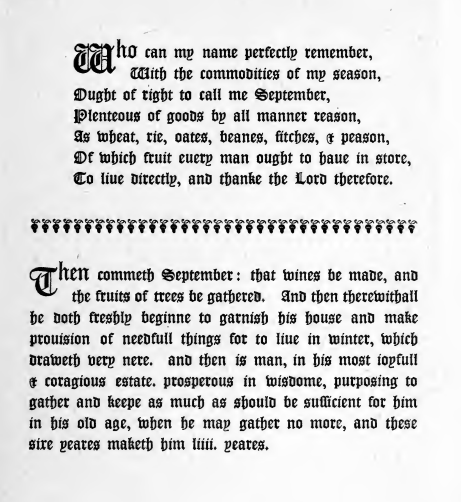
September from the Kalendar of Shepherds. The last sentence beginning ‘and then is man’ shows the link between September and the beginning of the autumn of life.

Season of ‘mists and mellow fruitfulness

John Keats (1795 – 1821) wrote a great poem called ‘To Autumn’:

Season of mists and mellow fruitfulness,
  Close bosom-friend of the maturing sun;
Conspiring with him how to load and bless
  With fruit the vines that round the thatch-eves run;
To bend with apples the moss’d cottage-trees,
  And fill all fruit with ripeness to the core;
    To swell the gourd, and plump the hazel shells
  With a sweet kernel; to set budding more,
And still more, later flowers for the bees,
Until they think warm days will never cease,
    For summer has o’er-brimm’d their clammy cells.

Who hath not seen thee oft amid thy store?
  Sometimes whoever seeks abroad may find
Thee sitting careless on a granary floor,
  Thy hair soft-lifted by the winnowing wind;
Or on a half-reap’d furrow sound asleep,
  Drowsed with the fume of poppies, while thy hook
    Spares the next swath and all its twined flowers:
And sometimes like a gleaner thou dost keep
  Steady thy laden head across a brook;
  Or by a cider-press, with patient look,
    Thou watchest the last oozings, hours by hours.

Where are the songs of Spring? Ay, where are they?
  Think not of them, thou hast thy music too,—
While barred clouds bloom the soft-dying day,
  And touch the stubble-plains with rosy hue;
Then in a wailful choir the small gnats mourn
  Among the river sallows, borne aloft
    Or sinking as the light wind lives or dies;
And full-grown lambs loud bleat from hilly bourn;
  Hedge-crickets sing; and now with treble soft
  The redbreast whistles from a garden-croft,
    And gathering swallows twitter in the skies.

Written September 19, 1819; first published in 1820. This poem is in the public domain and available here:

First published September 2024, revised 2025
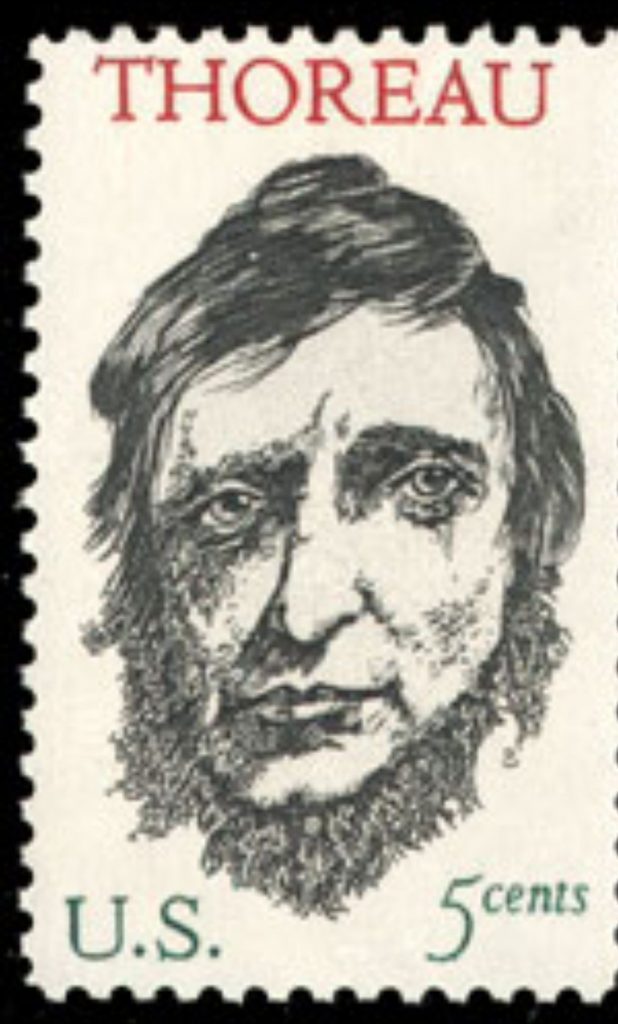
Thoreau moves to Walden Pond July 4th 1845

1967 postage stamp of Thoreau

Today, is Independence Day. The day that a great democracy came into being and established a rational system of Government, designed to stop autocracy. One of the great thinkers of the US was Henry David Thoreau. He moved into his hut on Waldon Pond on 4th July 1845. He wanted to experience life to the full. He thought he could best do that by living a simple life in the wild. 

Some think he was autistic, but his journals and publications show he lived a rich life.  His work links observations of nature with philosophic meditations and folk lore. His interest in ecology and avoidance of waste are forerunners of modern environmentalism. 

‘Walden’ his book about life in his hut near Concord, Massachusetts is his best known work. 

I began to occupy my house on the 4th of July, as soon as it was
boarded and roofed, for the boards were carefully feather-edged and
lapped, so that it was perfectly impervious to rain; but before
boarding I laid the foundation of a chimney at one end, bringing two
cartloads of stones up the hill from the pond in my arms. I built the
chimney after my hoeing in the fall, before a fire became necessary for warmth, doing my cooking in the mean while out of doors on the ground, early in the morning: which mode I still think is in some respects more convenient and agreeable than the usual one. When it stormed before my bread was baked, I fixed a few boards over the fire, and sat under them to watch my loaf, and passed some pleasant hours in that way. In those days, when my hands were much employed, I read but little, but the least scraps of paper which lay on the ground, my holder, or tablecloth, afforded me as much entertainment, in fact answered the same purpose as the Iliad.

Thoreau and Civil Disobedience.

From Project Gutenberg. Thoreau was also a principled opponent of unjust laws. He inspired Gandhi, amongst others, in the principles of Civil Disobedience.  He was imprisoned for refusing to pay tax to the American state in protest at the African-American War and Slavery.  He supported John Brown. 

Project Gutenberg page of Thoreau’s ebook.

John Brown’s Body lies a mouldering in his grave.

Brown believed that slavery would only be ended by fighting to liberate the slaves.  He was involved in the State Civil War in Kansas. Subsequently, he then launched a raid on Harper’s Ford, which caused several deaths.  Brown was found guilty of Treason against the Commonwealth of Virginia and executed. He was the first American to be found guilty of Treason. But Thoreau supported him, while other Abolitionists took a more pacifist position.

All in all, he is therefore an inspiring character. His life can inform that still tricky debate about challenging injustice in the modern world. Attitudes to ‘Just Stop Oil’ and the war in Gaza are causes where the same issues are still open to debate.

First published July 2025

January & Rabbiting January 19th

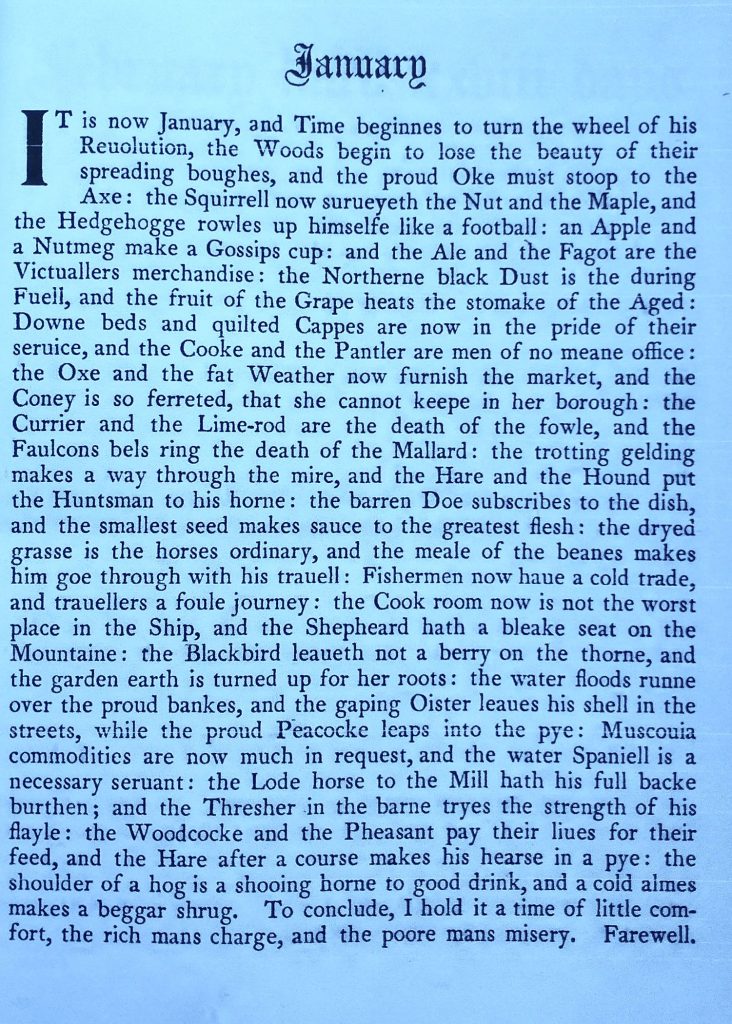
January from Nicholas Breton’s ‘Fantasticks 1626 from the Kalendar of Shepherds (digitised by Internet Archive)

The Kalendar of Shepherds was printed in 1493 in Paris and provided ‘Devices for the 12 Months.’ I use a modern (1908) reconstruction of it using wood cuts from the original French and adding various text from English 16th and 17th Century sources. The text of the month (as shown above) is provided from a 17th Century source. It gives an interesting view of the countryside in January. To see the full Kalendar, look here:

Nicholas Breton, the writer of the text above, concludes that January:

‘is a time of little comfort, the rich man’s charge, and the poore man’s misery.’

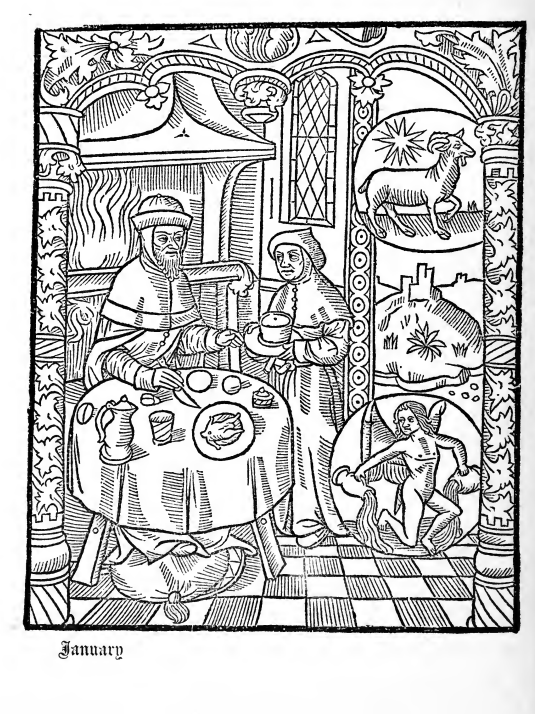
The rich man is burdened by having to help out all the poor people who depending upon him to get through the shortages of winter. The image for January shows that January is best spent indoors by a roaring fire, eating pies.

January from the Kalendar of Shepherds 15th Century French

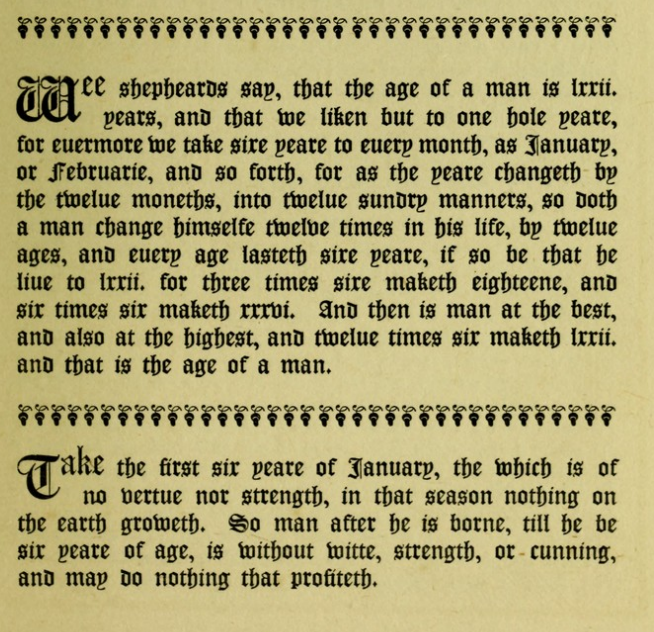
The Kalendar introduces a ‘conceit’ which is that the year mirrors our lives, and we can forecast what will happen in our lives by looking at the months.

Kalendar of Shepherds January text
Kalendar of Shepherds, January text

So our lives, which are of 72 years, can be divided into 12 ages of man, each of 6 years. So, January represents the first 6 years of a person’s life. And as you can see, that during these first 6 years, the child is ‘without witte, strength, or cunning, and may do nothing that profiteth‘. As the year changes every month, so, ‘a man change himself twelve times in his life’. At three times 6 (18 or March) a child becomes a man, and 6 times 6 (36 or June) man is at his best and highest. And at 12 times 6 (72 or December) man is at the end of his allotted span.

Shakespeare numbered the Ages of Man as seven, in the great speech of Jacques in ‘As You Like it’ I dealt with this and other Ages of the World in my post:

January & Rabbits

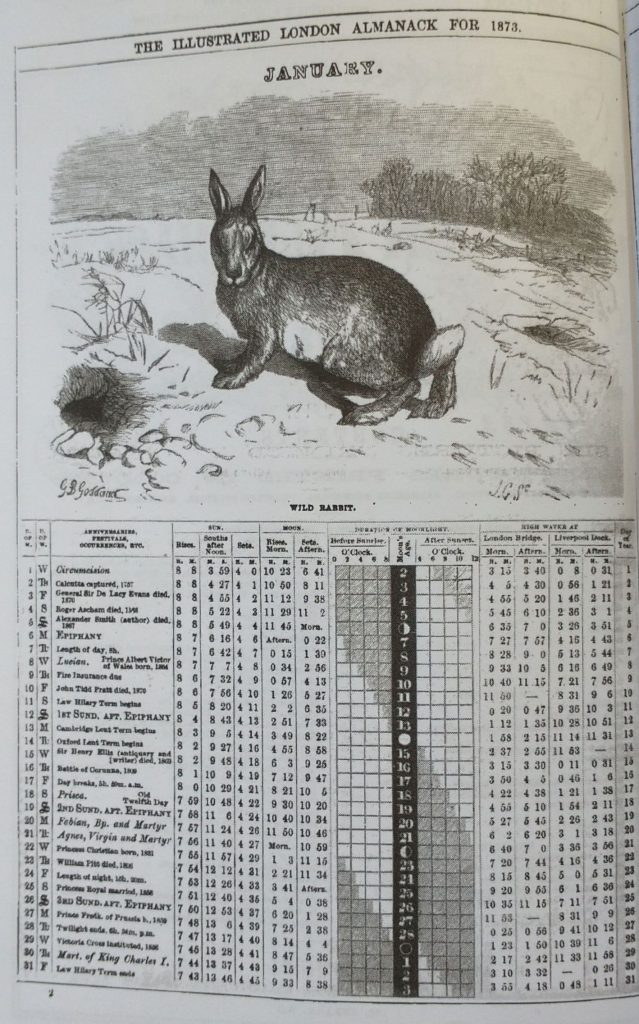
Bereton tells us that, in January, the ‘coney is so ferreted that she cannot keep in her borough’. To put that is modern speech, ‘the rabbit is so hunted with the aid of ferrets that she cannot keep in her burrow’. The London Illustrated Almanac of 1873 chose the Rabbit as its wild animal of the month.

London Illustrated Almanac of 1873
January from London Illustrated Almanac of 1873

To have luck for a month, you are supposed to say ‘Rabbit, Rabbit’. No less a person than FD Roosevelt used to say this. No one knows why. Rabbit’s feet are lucky too. I remember some of my friends had them in our Surrey village in the early 60s. Some of Dad’s nieghbours kept ferrets, and I remember dead Rabbits hanging from walls. The history.com website gives an idea, possibly exaggerated view, of the merits of the feet which depended upon how they were collected:

“A 1908 British account reports rabbits’ feet imported from America being advertised as ‘the left hind foot of a rabbit killed in a country churchyard at midnight, during the dark of the moon, on Friday the 13th of the month, by a cross-eyed, left-handed, red-headed bow-legged Negro riding a white horse,’

https://www.history.com/news/

As to why, no one really knows. But Pliny the Elder in 71AD reported that cutting off the foot of a live hare could cure gout. There are European traditions of rabbit and other animal’s feet amulets curing all sorts of ailments. There are associations with witches, who could shape-shift into a rabbit. So a rabbit’s foot would be witchy and therefore powerful. In March, I reported on the Hare, and their, similar, associations with witches:

Rabbit, Rabbit

For lovers of Music, Chas and Dave’s hit song ‘Rabbit’ has a chorus of ‘Rabbit, Rabbit’.According to the Cockney’s singers (they do love a Knee’s Up) it comes from the Cockney Rhyming Slang expression: Rabbit and Pork. This means ‘Talk’ because it rhymes with ‘Talk’. To hear the song, its gestation and Royal connections, click here.

Now, I must stop rabbiting on. Time to get things done.

First, published in 2023, revised in January 2024, 2025

Tree of the Year Competition Shortlist 2024

Screenshot of the Woodland Trust ‘Tree of the Year’ Competition.

To see the magnificent twelve, click here!

(We know it will be an Oak.)

Results on October 29th