Winter. Photo by Harriet Salisbury of Abney Park Cemetary, Hackney, London
When icicles hang by the wall,
    And Dick the shepherd blows his nail,
And Tom bears logs into the hall,
    And milk comes frozen home in pail,
When blood is nipp’d and ways be foul,
Then nightly sings the staring owl,
                Tu-whit;
Tu-who, a merry note,
While greasy Joan doth keel the pot.

When all aloud the wind doth blow,
    And coughing drowns the parson’s saw,
And birds sit brooding in the snow,
    And Marion’s nose looks red and raw,
When roasted crabs hiss in the bowl,
Then nightly sings the staring owl,
                Tu-whit;
Tu-who, a merry note,
While greasy Joan doth keel the pot.

William Shakespeare - Love's Labours Lost
Winter Song by William Shakespeare – Love’s Labours Lost (LLL V.ii.901)
Winter Song is near the end of the play. By way of the conclusion, two works are composed for the King of Navarro in praise of the Cuckoo and the Owl. One read by a representation of the Spring and the other, shown above, by ‘Hiems’ the representation of winter.
Is it very Shakespearean? No, not if you are expecting ‘sweet and honeyed words’ but it brings us deep into the heart of cold winter. With the icicles on the wall, the fouled muddy roads, the cold wind, the nip in the air, and the outbreak of winter colds.
The focus is either from a working-class perspective or from a member of the gentry looking at his servants. The owl and Greasy Joan stirring the food ends each verse. Roasted crabs are crab apples. The apples were heated in the oven then thrown into a dish of beer where they would hiss. So there is a hint of winter conviviality.
The nail means warming your fingers by blowing on them. Alternatively, it means twiddling your fingers. Greasy Joan is probably a cook or kitchen maid, and she is cooling the pot by stirring it. But some suggest that ‘Greasy Joan’ might refer to a prostitute. But it doesn’t really fit the poem? Although the spring part of the poem, narrated by Cuckoo refers to cuckolding. Tu-whit, tu-whoo is, in fact, two tawny owls calling to each other, the female calling first and the male answering. John Lyly first used the call in 1595. Some suggested it can also be read ‘To it, to who?’ In Shakespeare’s day. To go ‘to it’ was a sexual reference, but then he also uses that phrase mostly innocently. The parson’s saw is a reference to the the parson’s sermon. The coughing in the cold nave of the Parish Church makes it difficult to hear.
This is a YouTube piece setting the poem to music by Ralph Vaughan Williams
‘Rowena rings to say in a dead, sort of voice, ‘The worst has happened. Billy Bolitho says I’m definitely pregnant. Can you lend me 15 quid to Saturday?’ I said I could give her six, which is all I had because I know just how she feels, and if she doesn’t have an abortion before Saturday, it will be too late. I meet her in Dean Street, and we wandered down to Duran’s in the icy cold for a delicious lunch. Christ, their pastries are good! Poor Rowena couldn’t eat anything. She says her only chance is to put lots of ether soap up her bottom for 10 days. Billy Bolitho says, it’s tough going, but infallible. But R says, How will I keep it from my mum if I go around smelling like an operating theatre?’
Reported in ‘A London Year’ Compiled by Elborough and Rennison. Needless to say, this could be dangerous and it is better to seek advice from a Doctor.
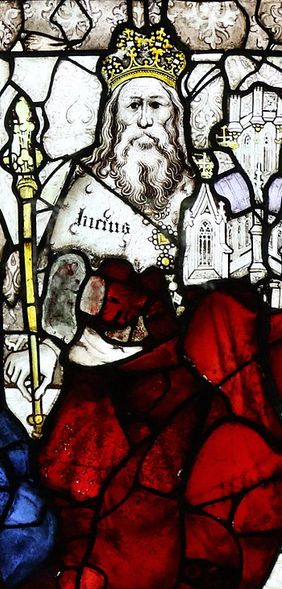
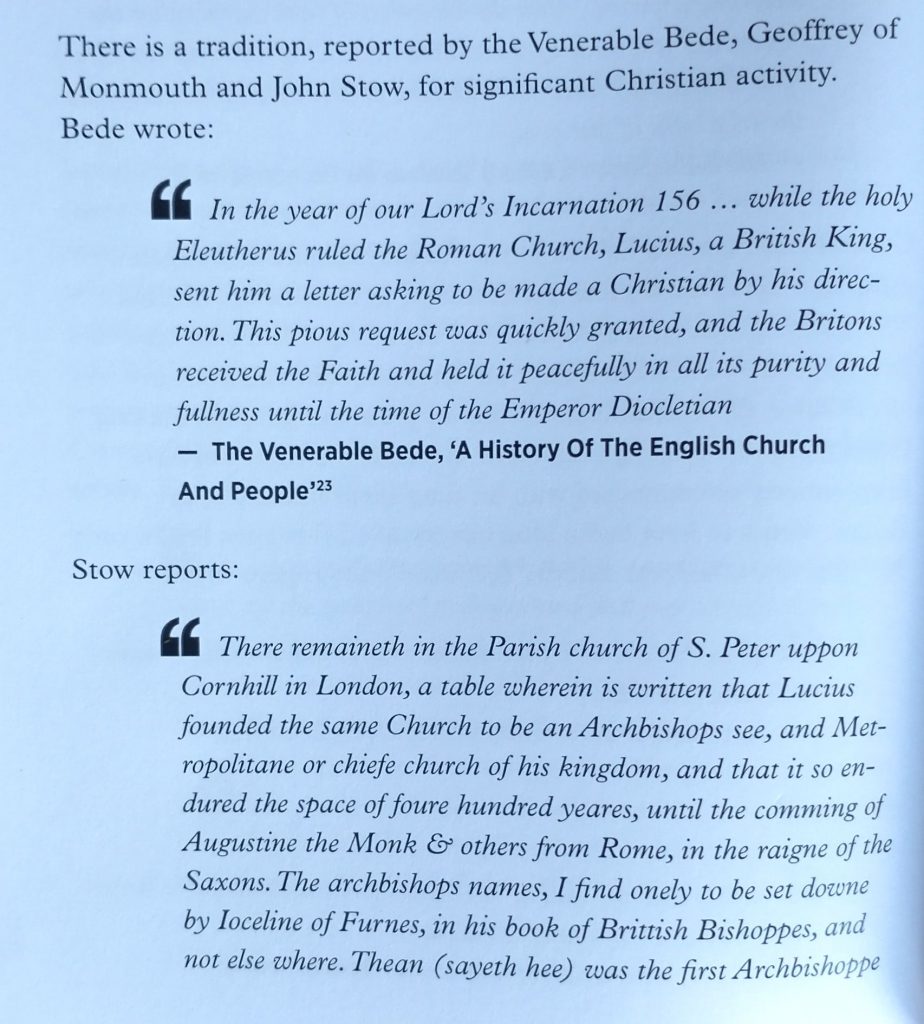
The Venerable Bede tells us that King Lucius converted to Christianity in around 180AD. He says that the King asked Pope Eleutherius to send teachers to instruct him. The Venerable Bede (died 735 AD) got this from the Liber Pontificalis of c 590. There is also a tradition that St Peter’s Cornhill in London was set up by King Lucius, and that St Peter’s is the oldest Church in London.
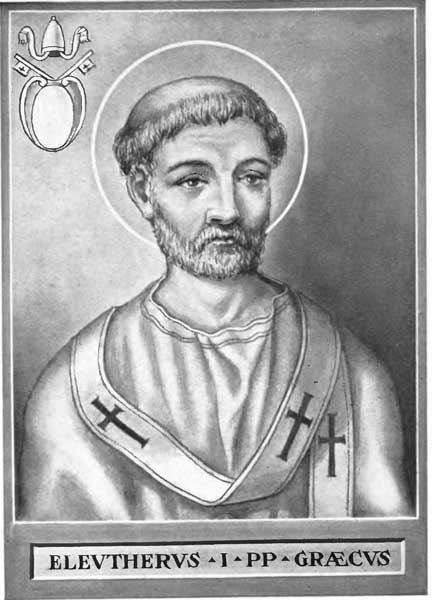
13th Pope Eleutherius
What to make of this? Bede is considered to be a reliable historian and got his information, in this case, from the Vatican. Pope Eleutherius is held to be a real Pope. He reigned at the right time, from perhaps as early as c. 171, and to his death which may be as late as AD 193. (Wikipedia). But the tradition of Lucius has been written off as a legend.
But to my mind there are questions that need asking. Not the least of the questions to ask about the veracity of this legend is: ‘What does it mean to be called the King of Britain in the middle of the Roman occupation?’
St Peters Church First Cathedral in Britain?
As to the early origin of St Peters Church, archaeologists dismissed the tradition of a Roman St Peters Church because it is built over the Roman Forum. So how can it have been the site of a Christian Church?
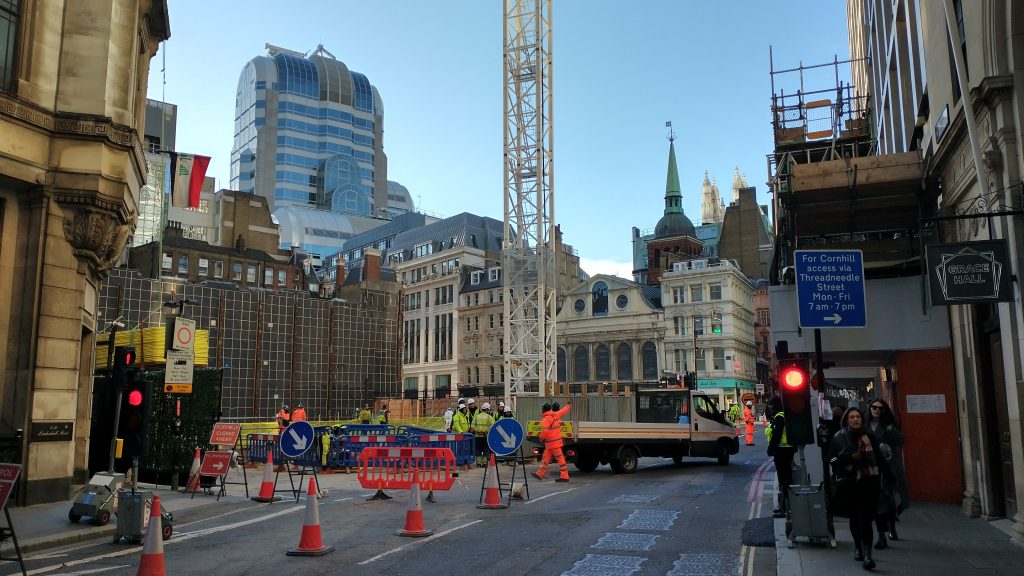
St. Peter’s seen from Cornhill in a rarely seen view as there is normally a building in the way. (Photo K Flude)
But the balance of possibilities, arguably, changed in the 1980s, when archaeologists led by Gustav Milne showed that the Basilica of the Forum was pulled down in about 300AD. So from being practically an impossibility, there is now a possibility that this subsequently became the site of a Roman Church. It doesn’t make it true but it makes it more of a possibility.
We know London sent at least one Bishop to Constantine the Great’s Council of Arles in AD 314. So a Christian community in London must have predated this time. There must have been Churches, here. And a site at the prestigious centre of the Capital of Londinium, makes a lot of sense. There are, in fact, three Churches on the site of the Roman Forum: St Peters, St Michael and St Edmund the Martyr.
Constantine the Great
In AD 306, Constantine was acclaimed Emperor on the death of his Father, Constantius Chlorus. Constantius’s wife was Helena, a Christian. He and his mother were in York when his father died. He was recognised as Caesar, (but not Augustus) by Emperor Galerius and ruled the province for a while. Then he moved to Trier, then moved on Rome, where he accepted the Christian God’s help to win the Battle of Milvian Bridge. This led him to supreme power in the Roman Empire. And might give a context for the demolished Basilica to be replaced by a Church.
There is, however, no archaeological evidence for St Peters being Roman in origin apart from the demolition of the Basilica and the legends. And there is certainly no evidence of the Basilica being turned into a Church as early as the 2nd Century.
Early Christianity in Britain
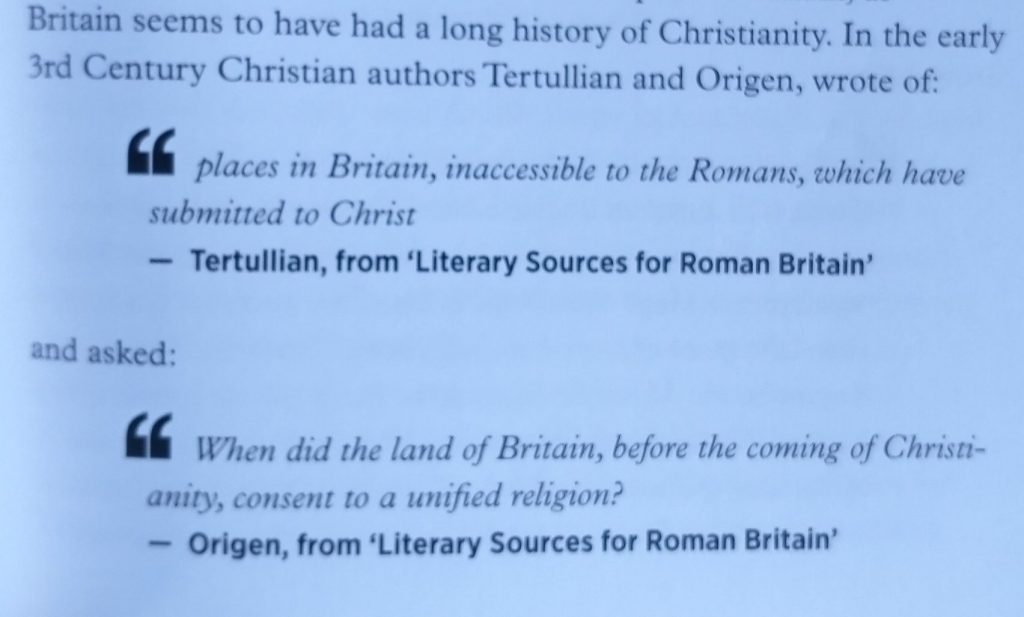
Where does that leave King Lucius? There are well attested Christian traditions that Britain was an early convert to Christianity. (The following quotes are from my book ‘In Their Own Words – A Literary Companion To The Origins Of London‘ D A Horizons, 2009 by Kevin Flude and available here.)
‘In Their Own Words – A Literary Companion To The Origins Of London‘ D A Horizons, 2009
So, an early date for an active Christian community is likely. A Church, replacing the Basilica, is plausible, particularly, after Constantine the Great probably passed through London on his way to seize the Roman Empire. So an early date for St Peters in possible. But there is no evidence for its origin as early as the late 2nd Century, the time of King Lucius.
A King of Britain in the Roman Era?
And could anyone, claim to be the ‘King of Britain’ at this date? We do know that King Togidubnus was called Great King of Britain in a Roman Temple inscription in Chichester in the First Century.
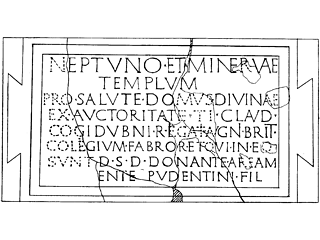
Altar Dedication, Chichester
To Neptune and Minerva, for the welfare of the Divine House by the authority of Tiberius Claudius Togidubnus, Great King of Britain, the Guild of Smiths and those therein gave this Temple from their resources, Pudens, son of Pudentinus, presenting the site.
Togidubnos seems to have been placed in control of a large part of Southern England, centred around Chichester, after the invasion of 43AD. He is thought to have been the successor to Verica, who was exiled and called on the Romans to restore his throne. Tactitus says that Togidubnos remained loyal down ‘to our own times’ that is to the 70s AD. So he presumably held the line for the Romans against the Boudiccan revolt in 60AD.
The Romans had used Verica’s fall as their excuse for invasion, and so an honorific of Great King to him and his successors makes sense. It is assumed that after Togidubnos’s death after 80AD, the title lapsed. But it might have stayed with the family as an empty honour? Furthermore, we know that Britain had a plethora of Kings and Queens before the Roman period. Also, the Romans never conquered the whole of Britain. There were, therefore, many British Kings all the way through the period of Roman control, not least beyond Hadrian’s Wall.
So, it is possible there was someone in Britain who had, or made, a claim to be ‘King’. Whether he was ‘a’ or ‘the’ or merely descended from a King of Britain, we don’t know. And that that someone, perhaps converted to Christianity, possibly in the time of Pope Eleutherius. He may have taken the Roman name Lucius. Who knows? Its possible.
Confusing Luci?
It has been suggested that King Lucius of Britain was confused with King Lucius of Edessa, but this is considered unsatisfactory. Also, the link to London and St Peters, need not be a contemporary one. It might be two traditions that are linked together at a later period. But, of course, there is a faint possibility that the Basilica shrine room, above which St Peter’s is built, was converted for Christian use at the earlier time necessary to make sense of the King Lucius story.
King Lucius may not be a proper saint, but he has a feast day. This is because of his connections to Chur in Switzerland. There is a tradition that Lucius was martyred here. This got him an entry in the Roman Martyrology. David Knight proposes that the Chur connection comes from the transplanting of rebellious Brigantes to the Raetia frontier in the 2nd Century AD. He suggests that the Brigantes brought the story of Lucius to Chur. At the end of the King’s life, is it possible he travelled to join his people in exile in Switzerland. Here he met his unknown end. If true, this would base the story of Lucius in the North rather than London. For further reading, see ‘King Lucius of Britain’ by David J Knight.
Early Bishops of London
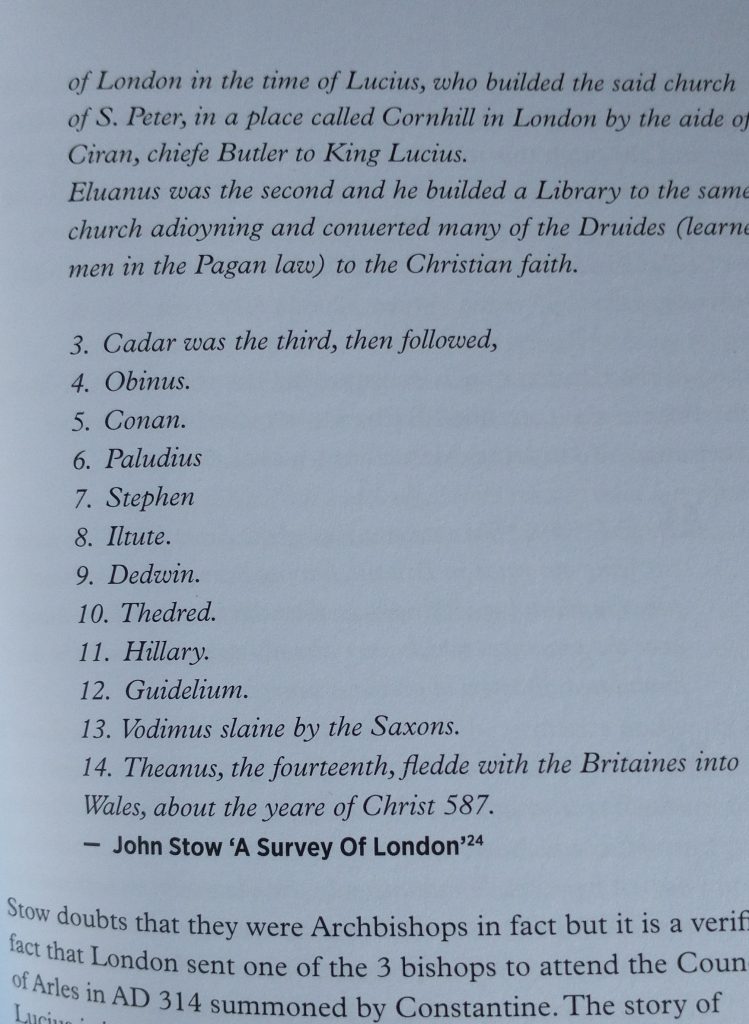
John Stow in the 16th Century records the tradition of King Lucius, which comes with a list of early British Bishops of London. These he finds are recorded in Jocelin of Furness’s ‘Book of British Bishops’. This book is discussed by Helen Birkett ‘Plausible Fictions: John Stow, Jocelin of Furness and the Book of British Bishops’. In Downham C (ed) /Medieval Furness: Texts and Contexts/, Stamford: Paul Watkins, 2013.
Her analysis concludes that the book is a ’12th-century confection in support of moving the archbishopric from Canterbury ‘back’ to its proper place in London. (This information was included in a comment to the original post by John Clark, Emeritus Curator of the Museum of London.)
To sum up. We can’t bring King Lucius out of legend, nor find any credible source linking him him with St Peters Cornhill. But the site of St Peters is a plausible, though unproven, location for a Roman Church from the 4th Century onwards. It also makes sense of the choice of the Saxons, to name their Church St Pauls. St Peter is more common as a dedication for important Churches and perhaps they chose St Paul as they knew of the ruins of St Peters the old Cathedral.
Any other early Cathedrals?
Archaeologists have also tentatively identified a masonry building in Pepys Street on Tower Hill as the Episcopal Church of late Roman London. The foundations suggest a large aisled building. Its identification as a Cathedral springs from multiplying the found foundations symmetrically by a factor of four and comparing the result to Santa Tecla in Milan. The discovery of Marble and window glass doesn’t sit so well with the alternative suggestion that it is a granary. But, to my mind, it’s not very convincing, although Dominic Perring in his recent book ”London in the Roman World’ makes the most of the case for it being a Cathedral.
And Finally?
Roman ForumSite of Roman Forum Google Maps
If you look at the two maps above. The one on the left shows the Forum, the white lines are the Roman Road system. You might just be able to see the modern road system super-imposed. What this shows is that the Forum is on a different axis than the modern day road system. Cornhill cuts right across the North Western corner of the Forum. Where the letter L is, and to the left is under the modern road. So, that shows that this part of the Forum must have been knocked down before Cornhill was built. On the right hand side you can see the dark grey east-west road which is Cornhill. To the South of it you can see a dark area (above the green of St Peter’s Churchyard). This grey area is St Peters. What the Google map shows clearly, is that the orientation of St Peters, is clearly on a different orientation to that of the modern road of Cornhill. And that orientation is closer to the orientation of the Roman Forum. This makes it more likely that the axis upon which St Peters was originally built (assuming Wren followed the original axis when he rebuilt it after the Great Fire) conformed to the Roman grid pattern. This is by no means proof, and can only be proved by excavation. But, its interesting.
On This Day
1660 – Margaret Hughes became the first woman (we know about) to act on the English Stage. She played Desdemona in Shakespeare’s Othello. It was staged in a converted tennis court called the Vere Street Theatre, which was in Lincoln’s Inn Fields. In 1660 Charles II was restored to the throne, and had got used to watching female actors perform while he was in exile in France. So when he returned, he licensed two theatre managers, Thomas Killigrew and Sir William Davenant to run theatre. Davenant claimed to be the natural son of William Shakespeare, suggesting that Shakespeare stayed in his parents’ Inn, the Crown, in Cornmarket, Oxford on his way home to Stratford-upon-Avon.
First Published on December 3rd, 2022. Revised in December, 2023, 2024 and 2025
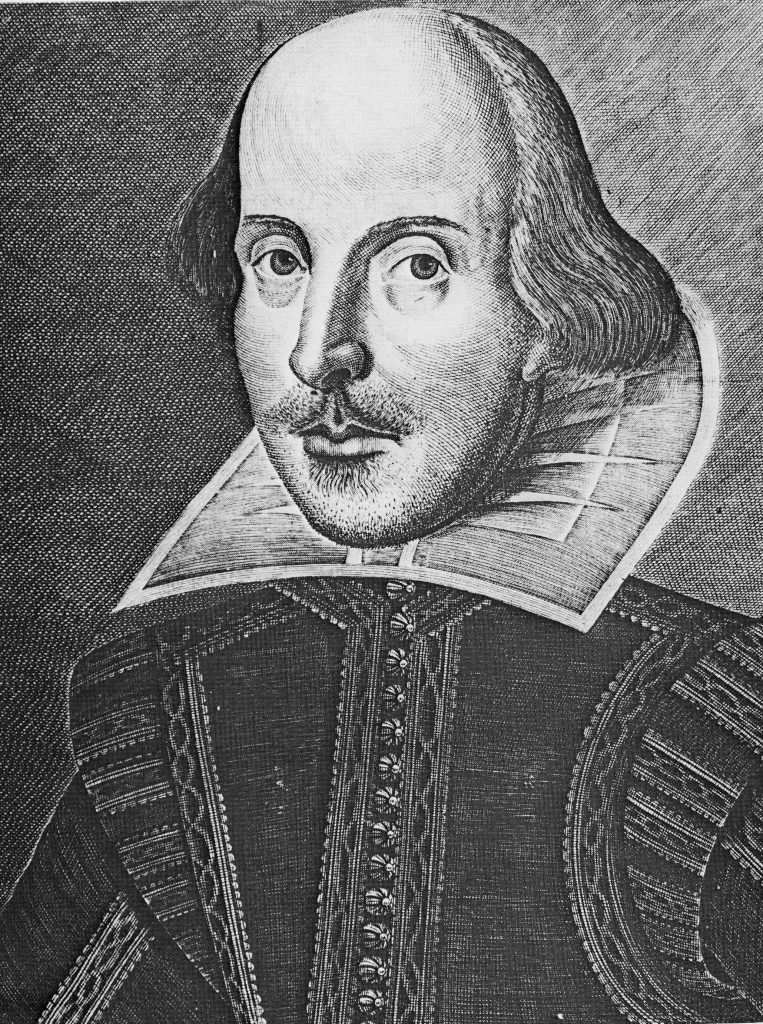
Droeshout Portrait of Shakespeare from the First Folio
Shakespeare was married at 18 years old. This was unusually young for the age. Young men generally entered into a 7-year apprenticeship followed by several years of wage labour as a journey man (from the french, jour, to denote being paid by the day.) At 18, he would have been unusual if he could afford a wife and household at this tender age. His wife was 26-year-old Anne Hathaway. This is slightly late for a woman to be married in the 16th Century, 22-23 would be more usual. Susanna, their daughter was baptised 26 May 1583, 6 months later. Twins, Hamnet and Judith, were baptised 2 February 1585.
The fact that Shakespeare was younger than Anne Hathaway, and that the baby was premature, has led many Shakespeare scholars to believe Shakespeare may have left Stratford to escape an unhappy marriage. This is often expressed in misogynist terms. But, there is an unstated assumption that Mrs Shakespeare stayed in Stratford while Shakespeare spent most of his life in London.
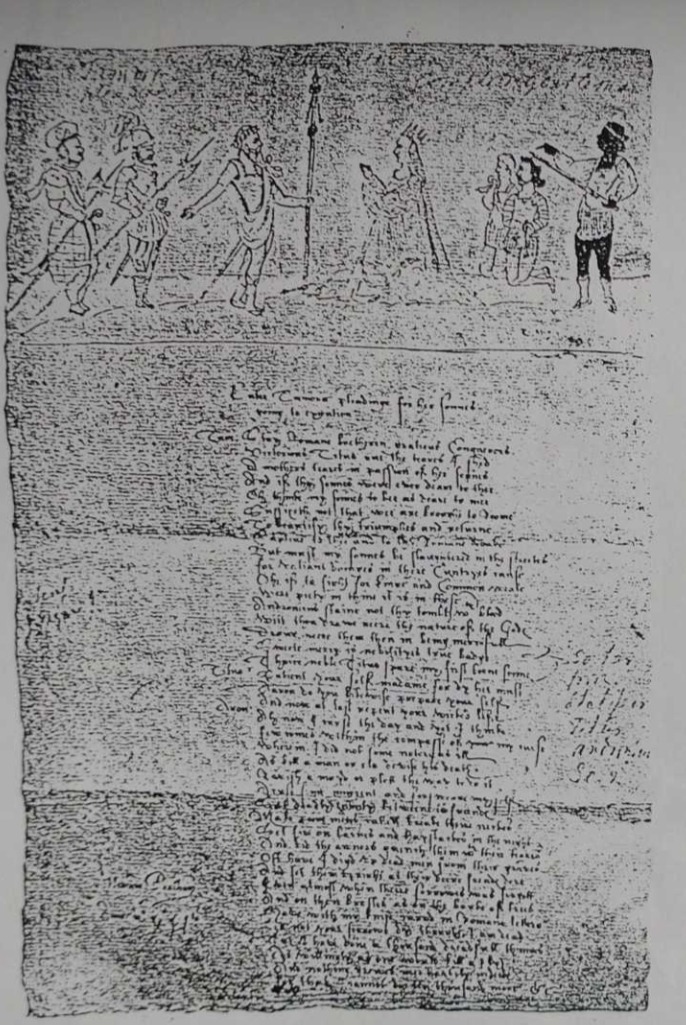
However, a new interpretation of a 1978 fragment has, for the first time, revealed evidence that, Mrs Shakespeare stayed with her husband in London. The piece is a request to Mrs Shakespeare in Trinity Lane (Little Trinity Lane today see map below) to pay the money her husband was holding on behalf of a young apprentice. Why Shakespeare was unable or unwilling to pay we have no idea. But perhaps the fact that it reveals that his wife was in London and seems to have independent means is more important.
How do we know this anything to do with our William Shakespeare? The answer is that the fragment was found in Hereford Cathedral’s Library as part of a binding of a book published by Richard Field. Field was from Stratford on Avon, and it was he who published Shakespeare’s ‘Venus and Adonis’ and ‘the Rape of Lucrece’. It seems unlikely it is about another couple of Shakespeares.
So, it really does change the view of the relationship. Little Trinity Lane is shown on the map below. It is near Southwark Bridge, and Mansion House Underground Station.
Map of the part of the City of London, Little Trinity Lane is in the ventre with an orange boomerang shape below it. Southwark and the Millenium Bridges can be seen at the bottom, and St Pauls top left corner.
I would recommend you read the original article, which discusses in detail all the evidence pertaining to these fragments. Here it is online for you to peruse.
On This Day
2003 My first edit on Wikipedia. As Director of the Old Operating Theatre Museum, I set about making sure the pages associated with the Museum, St Thomas Hospital and Guy’s Hospital were up to date. This is the latest version of the page I first updated. I updated the history of the Hospital. The earliest recovered wikipedia page was on January 15th 2001.
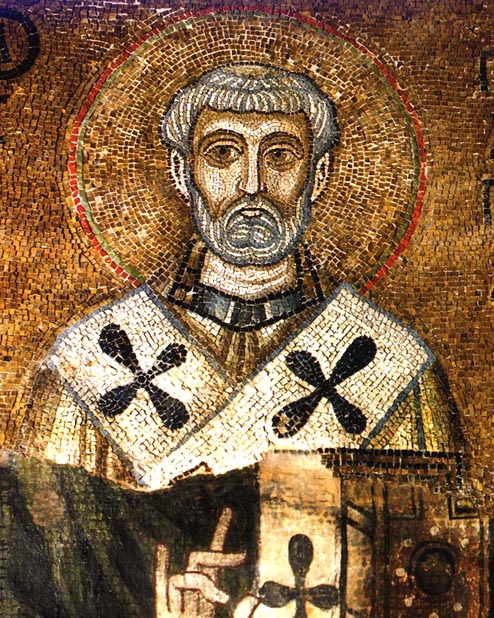
Clemens I, the Pope of Rome. Mosaic from St. Sophia of Kyiv, 11th c. In places of loss (lower part of the composition) — oil painting of the 18th c. (Wikipedia) for St Clements Day
St Clement was a very early Bishop of Rome, shortly after St Peter. Although thought to be a historical and therefore a very important peron in the history of Christianity, his mode of martyrdom is a matter of legend. He is supposed to have been tied to an anchor and thrown in the Black Sea in around AD 99. He is, therefore, particularly venerated by Blacksmiths and Sailors. Some believe he is earlier than AD99 and place his letter as early as AD60.
St Clements and the Early Church
A letter of St Clements survives and is addressed to the Christians of Corinth. This letter is of fundamental importance, as it appears to have been written when the martyrdoms of St Peter and St Paul were relatively recent memories. The letter is also important as a counterargument to the Protestant view that there is no evidence that Peter was ‘Pope’. In this letter, St Clement is giving advice to the Church of Corinth as a Pope would. This can be used as early proof of Papal supervision of the early Church.
The letter is therefore worth reading, and you can read a version of it here. . I have chosen two extracts from a long letter. The first illustrates how close to the deaths of Peter and Paul it was. The second extract gives a great insight into an early Christian World view. I think there is also very little here that a Pagan would object to? The main message of the letter is to follow the example of Jesus and adopt humility.
Chapter 5. No Less Evils Have Arisen from the Same Source in the Most Recent Times. The Martyrdom of Peter and Paul.
But not to dwell upon ancient examples, let us come to the most recent spiritual heroes. Let us take the noble examples furnished in our own generation. Through envy and jealousy the greatest and most righteous pillars [of the church] have been persecuted and put to death. Let us set before our eyes the illustrious apostles. Peter, through unrighteous envy, endured not one or two, but numerous labours; and when he had at length suffered martyrdom, departed to the place of glory due to him. Owing to envy, Paul also obtained the reward of patient endurance, after being seven times thrown into captivity, compelled to flee, and stoned. After preaching both in the east and west, he gained the illustrious reputation due to his faith, having taught righteousness to the whole world, and come to the extreme limit of the west, and suffered martyrdom under the prefects. Thus was he removed from the world, and went into the holy place, having proved himself a striking example of patience.
Chapter 20. The Peace and Harmony of the Universe.
The heavens, revolving under His government, are subject to Him in peace. Day and night run the course appointed by Him, in no wise hindering each other. The sun and moon, with the companies of the stars, roll on in harmony according to His command, within their prescribed limits, and without any deviation. The fruitful earth, according to His will, brings forth food in abundance, at the proper seasons, for man and beast and all the living beings upon it, never hesitating, nor changing any of the ordinances which He has fixed. The unsearchable places of abysses, and the indescribable arrangements of the lower world, are restrained by the same laws. The vast unmeasurable sea, gathered together by His working into various basins, never passes beyond the bounds placed around it, but does as He has commanded. For He said, Thus far shall you come, and your waves shall be broken within you.Job 38:11 The ocean, impassable to man and the worlds beyond it, are regulated by the same enactments of the Lord. The seasons of spring, summer, autumn, and winter, peacefully give place to one another. The winds in their several quarters fulfil, at the proper time, their service without hindrance. The ever-flowing fountains, formed both for enjoyment and health, furnish without fail their breasts for the life of men. The very smallest of living beings meet together in peace and concord. All these the great Creator and Lord of all has appointed to exist in peace and harmony; while He does good to all, but most abundantly to us who have fled for refuge to His compassions through Jesus Christ our Lord, to whom be glory and majesty for ever and ever. Amen.
https://www.newadvent.org/fathers/1010.htm (Translated by John Keith. From Ante-Nicene Fathers, Vol. 9. Edited by Allan Menzies. Revised and edited for New Advent by Kevin Knight. )
Towards the bottom of this post you will find out more about St Clements place in Christian History, but first, lets find out his associations with London.
London & St Clements
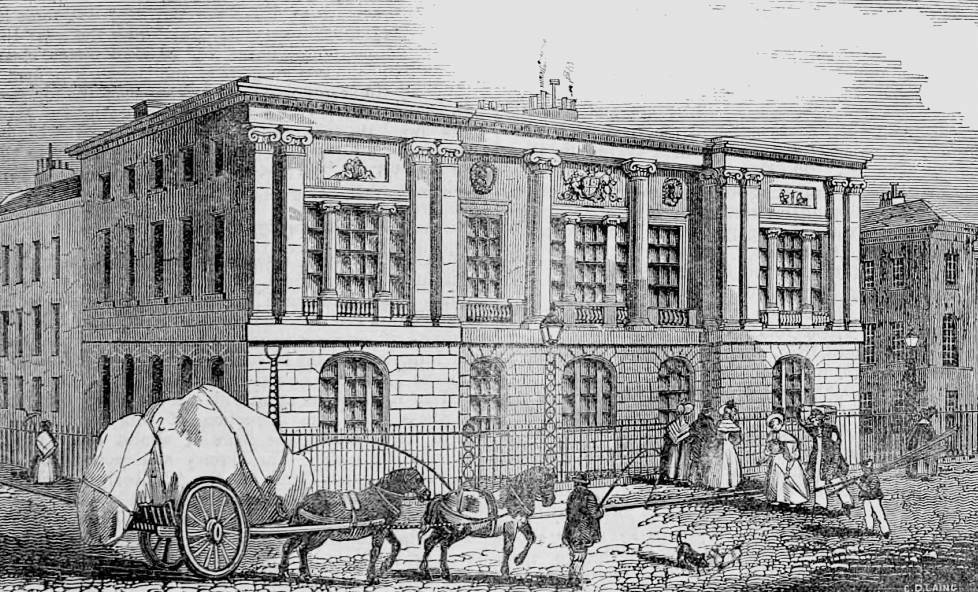
Trinity House. Designed by Samuel Wyatt (1737-1807) Engraving 1834
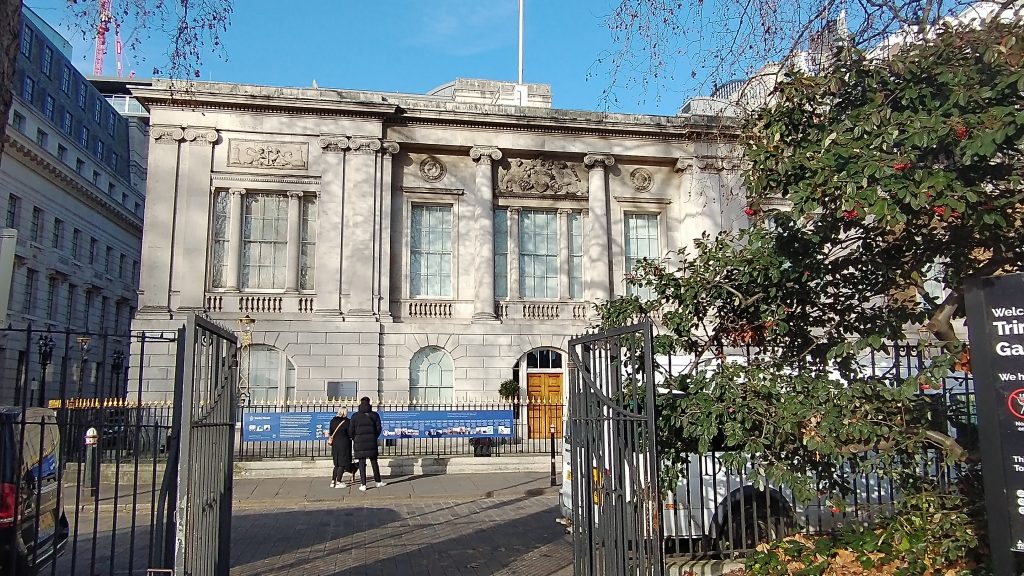
The maritime connection may explain the three St Clements connections in London. Trinity House On Tower Hill has been working to keep shipping safe since being founded in Deptford in the 16th Century as:
‘The Master, Wardens and Assistants of the Guild Fraternity or Brotherhood of the most glorious and undivided Trinity and of St Clement in the Parish of Deptford Strond in the County of Kent.
They look after light ships, lighthouses, navigation buoys and licence Deep Sea Pilots. The HQ moved to Tower Hill in 1796.
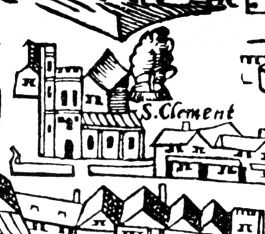
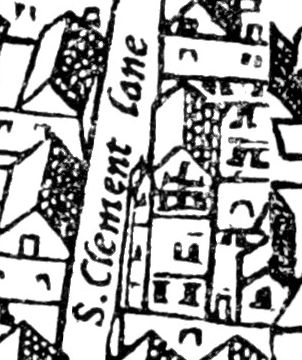
St Clements Danes (left) St Clements Eastcheap (right) from Agas Map (1561)
London has two churches dedicated to St Clements. Both are by early London waterfronts and rebuilt by Christopher Wren and his team.
St Clement’s Eastcheap is on the terrace above the Roman port of London, near London Bridge (which leads to Wikipedia speculation that it might have been an early Roman foundation). And St Clements Danes is where the Strand meets Fleet Street on the terrace above the Lundenwic Saxon waterfront.
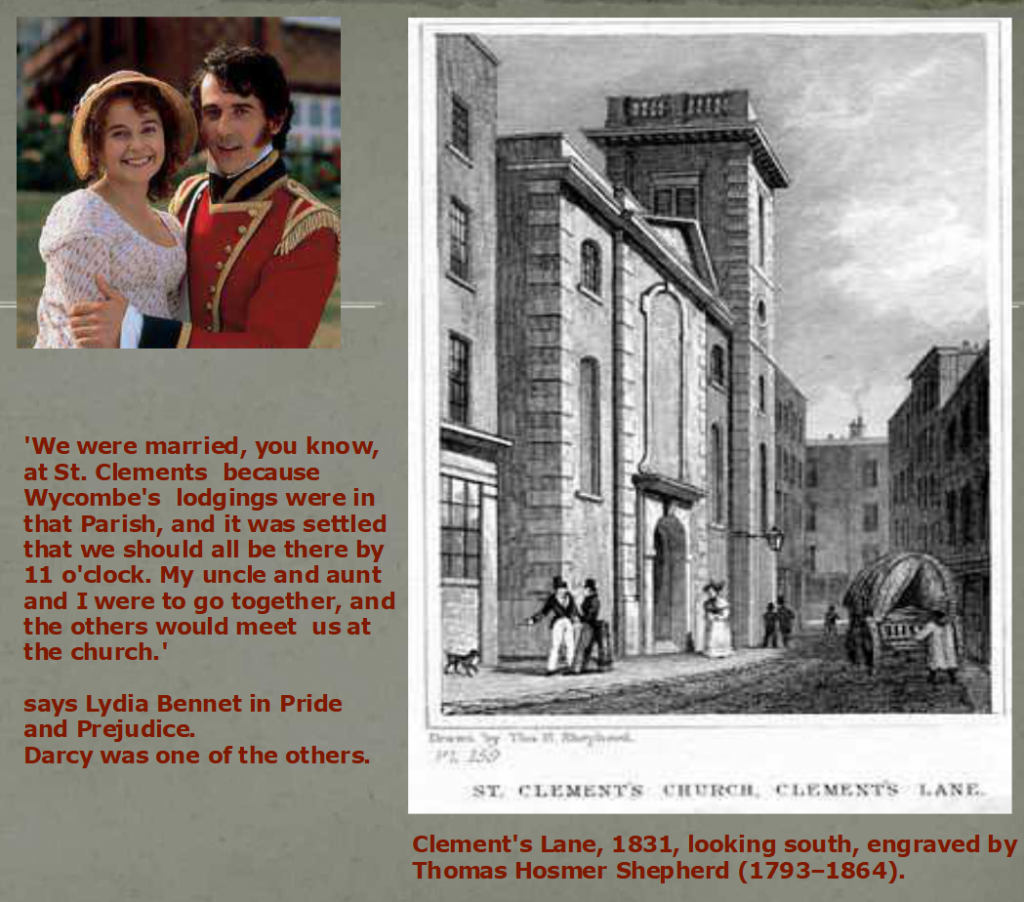
Lydia and Wickham get married
St Clements is where Lydia and Wickham finally get married in Jane Austen’s Pride and Prejudice. But which of the two St Clements? Wickham had lodgings in the East Cheap area. The Gardiners, Lydia’sUncle and Aunt were the only people at the wedding except Darcy. They lived in nearby Gracechurch Street. But perhaps St Clements Dane was more fashionable and might be more the raffish Mr Wickham’s cup of tea? (Jane Austen bought her family’s tea from Twinings, just off Fleet Street, where you can still buy it today )
Slide from my ‘Jane Austen’s 1809 Virtual Tour of London’
Oranges & Lemons
St Clements appears in the nursery rhyme/game Oranges and Lemons and both churches claim it refers to them, but as both are by the waterfront, either will do.
Here comes a candle to light you to bed, And here comes a chopper to chop off your head! Chip chop chip chop the last man is dead
I remember playing this as a child. Two children form an arch with their hands. The other children go through the arch reciting the rhyme until the chopper comes down when the hands forming the arch traps one of the children. The trapped child then whispers which side they want to be join, and they leave the procession to stand behind one or other of the arch-makers. I seem to remember we ended it off by having a tug of war between the two teams.
Alternatively, the trapped/chopped children make an additional arch and the remaining kids have to rush through a large space, fearing the chop.
On this day:
1963 the first episode of Dr Who was broadcast on the BBC, starring William Hartnell and his assistants played by William Russell;Jacqueline Hill; and Carole Ann Ford. The ‘An Unearthly Child’ episode may be responsible for me becoming an archaeologist. It begins in London and the Tardis is transported 100,000 years into the past where stone-age humans are fighting over lost fire-lighting skills. I don’t remember hiding behind a sofa but I do remember being gripped by it. This is now 62 years of Doctor Who.
Originally published Nov 23rd, 2022. Revised & Rewritten on Nov 23rd 2023, 2024 and 2025
Droeshout Portrait of Shakespeare from the First Folio
On November 8th in 1623, the First Folio was registered at Stationer’s Hall near the publishing district around St Pauls Cathedral in London. It was actually called:
Mr. William Shakespeare’s Comedies, Histories, & Tragedies
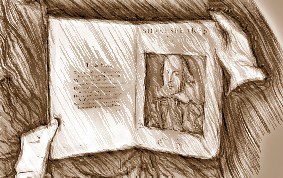
Sketch of the First Folio
It was put together by his actor friends, John Heminge and Henry Condell seven years after his death. They wanted to replace all the corrupt editions of his plays and poems that had been:
“stol’n and surreptitious copies, maimed and deformed by frauds and stealths of injurious impostors”
The true texts of his plays and poems “are now offer’d to your view cured, and perfect of their limbes; and all the rest, absolute in their numbers as he conceived them.” Wikipedia
Shakespeare at the Frankfurt Book Fair
In fact, the plays were ready earlier than 1623, as they entered into the catalogues for the Frankfurt Book festival to appear between April and October 1622. How amazing is it that the Frankfurt Book festival is still the dream of any aspirant writer? Wikipedia tells me that hand-written books were traded at the general trade fair in Frankfurt from the 12th Century. But 1462 is the date that appointed as being when the Book Fair was certainly established.
The First Folio offers plenty of proof that Shakespeare was the author of the plays. He left gold rings of remembrance to Heminge and Condell in his Will. They were part of his Players Company, and had worked together on many of the plays. The Folio has forewords by people extolling the virtues of the writer. Enough proof for any reasonable person.
Heminge and Condell
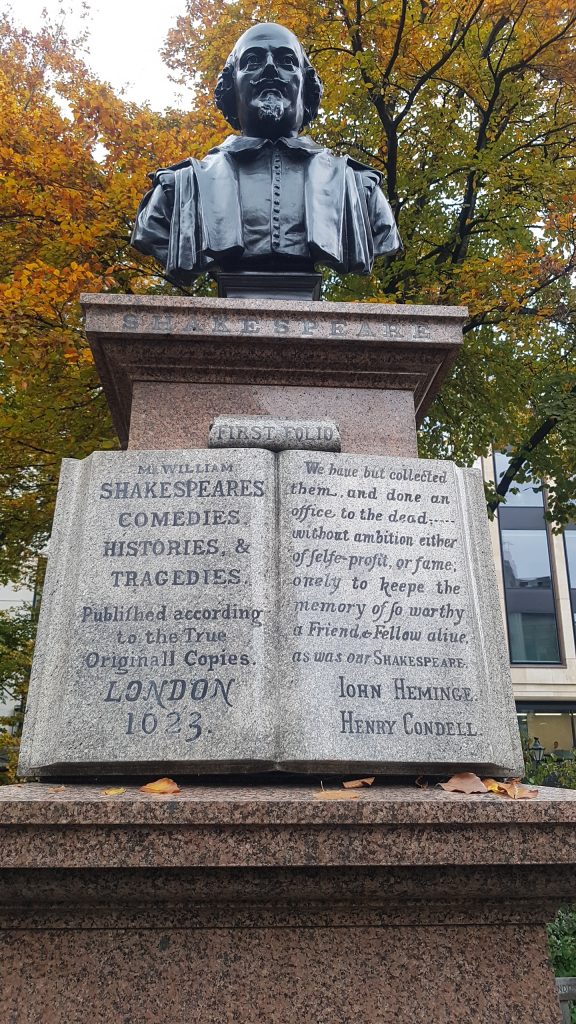
Heminge and Condell are commemorated in the Garden of St Mary Aldermary behind the Guildhall. They were Churchwardens of St Mary. A few streets away lived William Shakespeare in 1611. True friends, so don’t go telling me he didn’t write the plays!
St Mary Aldermany monument to Shakespeare, Heminge and Condell and the First Folio.
There was a wonderful BBC festival of Shakespeare on in 2023/24 to celebrate. If you look at this link, here. You will find great content. Much of it is available if you search BBC Sounds, or BBC iPlayer.
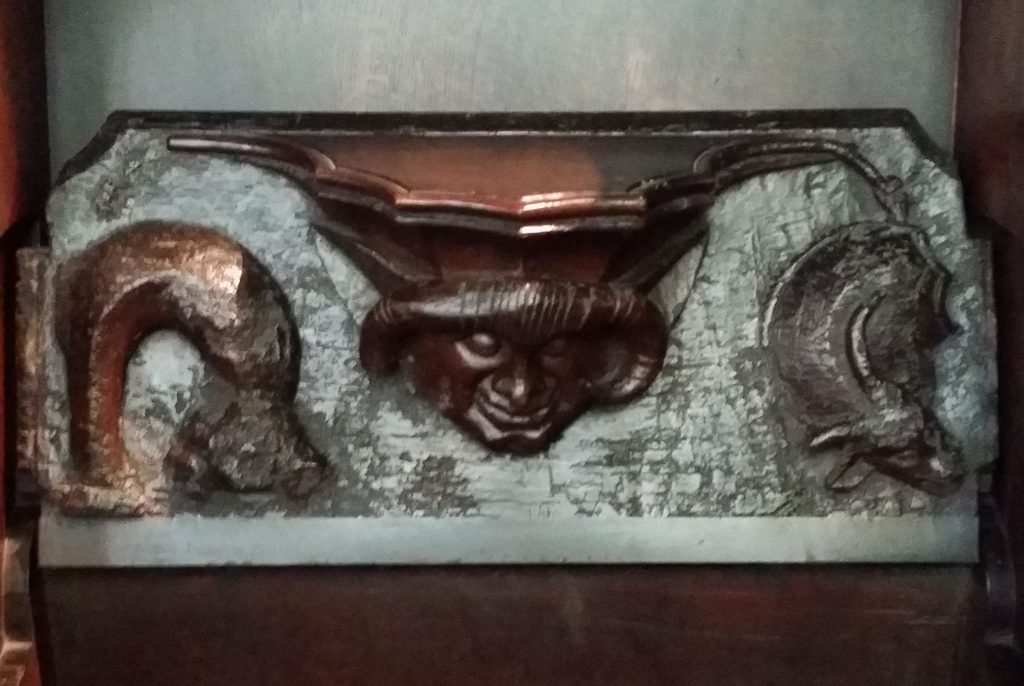
Horned God (with Ram’s Horn) at Stratford on Avon Holy Trinity Church) Photo: K Flude. Carving of a dolphin to the left (symbol of Christ) a goat to the right (symbol of the damned – as Christ divides the sheep from the goats who are going to hell)
Horned Gods
November 4th is dedicated to hunting gods such as Herne, the Horned God, Cernunnos, The Green Man and Pan.
Herne the Hunter appears in Shakespeare:
There is an old tale goes, that Herne the Hunter (sometime a keeper here in Windsor Forest) Doth all the winter-time, at still midnight Walk round about an oak, with great ragg’d horns; And there he blasts the tree, and takes the cattle, And makes milch-kine yield blood, and shakes a chain In a most hideous and dreadful manner. You have heard of such a spirit, and well you know The superstitious idle-headed eld Receiv’d, and did deliver to our age This tale of Herne the Hunter for a truth.
William Shakespeare, The Merry Wives of Windsor, Act 4, scene 4
I have recently seen a brilliant staging of the Merry Wives of Windsor at the Royal Shakespeare Company in Stratford. I saw it three times and think it one of the best Shakespeare productions I have seen. The lead actor, John Hodgkinson, with whom I used to play cricket, was a fantastic Falstaff.
Cernunnos
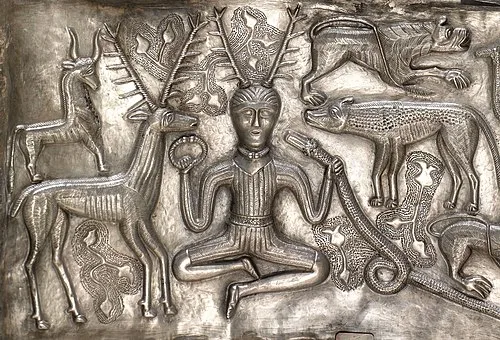
Cernunnos comes from karnon which means “horn” or “antler”. This may be the source of the name ‘Cerne’. (Please note that the Cerne Abbas Giant has just been redated from the Celtic to the Anglo-Saxon period.) Cerney and Cirencester in Gloucestershire might have similar origins for their names. The Cornovii is the name of three tribes in Britain. Cornwall, Shropshire and Caithness. It seems to mean people of the Horn, and the Horn thought to be stag’s horns. He is most often found in statues in the area around Paris, with an antler on his head, cross-legged and with a snake with him. He may be the god of the celtic underworld.
A Cernunnos-type figure on the Gundestrup cauldron (plate A). He sits cross-legged, wielding a torc in one hand and a ram-horned serpent in the other. Public Domain Wikipedia
Ginger cake is the traditional accompaniment to a cold night watching the Fireworks. There is a good recipe in Markham’s The English Housewife of 1683. But I’m suggesting you use this recipe from the Guardian for Parkin Cake. ‘Parkin is a gingerbread cake traditionally made with oatmeal and black treacle, which originated in Northern England.’ (Wikipedia).
London picture Penny for the Guy on Guy Fawkes Day
I haven’t seen children asking for ‘a penny for the Guy’ for a while. But it was part of my childhood. We would create a ‘Guy’ out of old clothes and take it into the streets to raise money. The Guy is named after Guy Fawkes, who was discovered on 5th November 1605 in a cellar under Parliament. He was by a pile of barrels of gunpowder with a slow match. The plan was to blow up the King and Parliament, on the occasion of the Opening of Parliament on the 5th of November.
Once the plot had been broken and the plotters hanged, drawn and quartered, the King ordered that November 5th should be commemorated throughout the Country. Bonfires were a part of the seasonal celebrations at the time, used at Halloween, but this aspect was transferred to November 5th and continues as a major British event every year.
The money we raised, we spent exclusively on ‘bangers’ loud explosive fireworks not pretty fountains, Roman candles nor rockets. The bangers just made a horrendously loud bang. One stunt we experimented with was to cycle through the streets and to put a lit banger into the handle bars, which would act as a rocket launcher! Don’t try this at home.
Meanwhile, we would collect wood for the village bonfire:
A stick and a stake For King George’s sake Will you please to give us a faggot If you won’t give us one, we’ll steal you two The better for we and the worse for you.
Sliding Ducks? or Swimming Ducks? Timur Romanov, Photo from Unsplash
Folklore is full of ways of predicting the future – mostly about the weather or love. The Perpetual Almanac by Charles Kightly features many of these in rhyme form of the ‘Sky at Night Shepherd’s Delight’ type. Here is a seasonal one.
If ducks do slide at Hallowentide At Christmas they will swim If ducks do swim at Hallowentide At Christmas they will slide
From my experience, in the south of the UK, this is simply not true as we very rarely get ice in early November. Nor do we get snow at Christmas that often. But maybe, the further north you go, the truer this becomes.
Macbeth & Prophecy
But, as far as taking prophecy seriously, it’s good to remember what Macbeth said on seeing the wood moving to Dunsinane.
‘(I) begin to doubt the equivocation of the fiend, that lies like truth.’
He has just realised that prophecy is a double-edged sword which has led him to his doom. He had been told by the Three Witches that he:
‘shall never vanquish’d be until Great Birnam Wood to high Dunsinane Hill shall come against him’
Still, as he heads to the final battle, Macbeth knows he is invincible and that
‘none of woman born shall harm Macbeth’.
But in his savage fight with Macduff, he is told that Macduff was not of woman born, but was:
‘from his mother’s womb / Untimely ripped’.
So Macbeth is killed.
Google Map showing Birnam (Scotland), top left, and Dunsinane Hillwith red markers in the middle. Note Scone is where Macbeth is Macbeth was crowned
King Macbeth (Mac Bethad mac Findlaích) 1040 – 1057
In reality, Macbeth, was a successful King who reigned for 17 years. He was one of the last Gaelic Kings as Scottish society was changing with contact with England.
This is a draft of the text that (edited) forms part of my best-selling book ‘Divorced, Beheaded, Died’ The Kings and Queens of Britain in Bite-sized Chunks’
Macbeth was nicknamed the Red King. He was a Gaelic speaker, descended from the Kings of Dal Riata. Macbeth’s father, Finlay MacRory, was Mormaer (Grand Steward) of Moray and was was murdered by Gillacomgain. He took MacRory’s title. Gillacomgain was burnt to death with 50 of his followers, probably by Macbeth, who thus not only regained the title as ruler of Moray but married his dead rival’s widow, Gruoch. She was the granddaughter of Kenneth II. Macbeth was also himself descended from the Kings of Scotland via his mother Donada probably daughter of Malcolm II.
His claim to the throne was therefore strong, and following the disasters of King Duncan’s reign, Macbeth seized the opportunity to take the throne for himself.
He ruled well for nearly 2 decades imposing a strong sense of law and order, encouraging Christianity and leading successful raids across the border into England. In 1050 he went on pilgrimage to Rome. Exiled Normans, supporters of Edward the Confessor were settled in Scotland in Macbeth’s reign. There is no evidence that Macbeth was any more evil then the rest of the early Scottish Kings.
In 1057 Macbeth was killed in battle against Duncan I’s son who became Malcolm III. Macbeth is buried on Iona. He and Gruoch had no children but Guoch’s son, Lulach, son of Gillacomgain briefly followed Macbeth as king before being assassinated by Malcolm III
‘Divorced, Beheaded, Died’ The Kings and Queens of Britain in Bite-sized Chunks’ for more details look here.
Prophecy ‘lies like the truth’ a trope that is used in many ancient tales such as Oedipus Rex.
On this Day
Hilaria
The 3rd of November is also the Hilaria, the last day of the festival of Isis/Osiris. This is the day of the rebirth of Osiris. He was ‘the god of fertility, agriculture, the afterlife, the dead, resurrection, life, and vegetation.’ Isis was the wife (and sister) of Osiris God-King of Egypt. Osiris was killed by his brother. Set. Isis restored his body to life for long enough to conceive their son Horus.
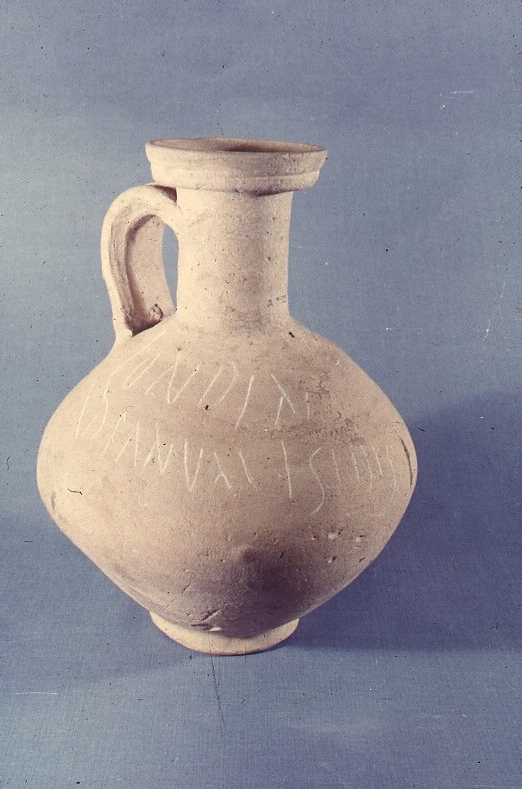
Horus revenged his father, regained the throne, restored Cosmic Order and completed the resurrection of Osiris. Isis is normally shown holding the baby Horus in a pose that may have influenced images of the Virgin Mary. Londinium would have had a celebration on this day as there is a pot found near London Bridge inscribed ‘At London, at the Temple of Isis).
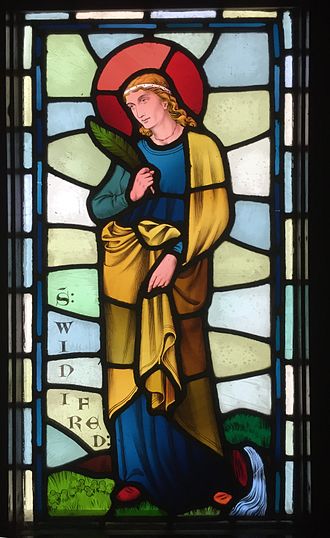
St Winifred’s Day She was beheaded by Caradog who would not accept her refusal to have him because of her religious views. She was restored to life by St Beuno, or St Bono. Head and all. Where her head fell their slowed a spring. This is on the North Welsh Coast, and called Holywell. It was one of the Seven Wonders of Wales, and called the Lourdes of Wales.
First Posted on 3 November 2021. Revised 3 November 2023 & 2024 & 2025
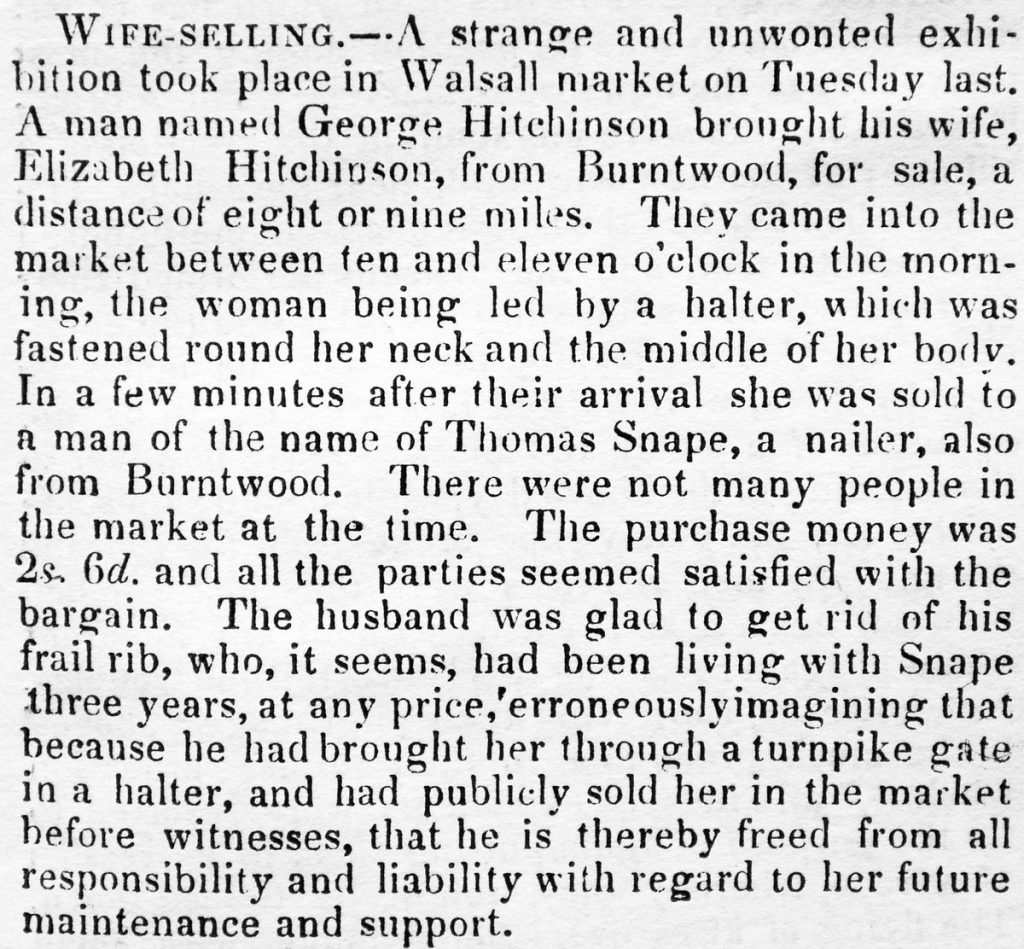
October 1837, Wolverhampton Chronicle. A case of wife-selling
A strange and unwonted exhibition took place in Walsall market on Tuesday last,” the Wolverhampton Chronicle said about a case of wife-selling.
“A man named George Hitchinson brought his wife, Elizabeth Hitchinson, from Burntwood, for sale, a distance of eight or nine miles. They came into the market between ten and eleven o’clock in the morning, the woman being led by a halter, which was fastened round her neck and the middle of her body. “
“In a few minutes after their arrival she was sold to a man of the name of Thomas Snape, a nailer, also from Burntwood. There were not many people in the market at the time. “
“The purchase money was 2s 6d [about 13p today] and all the parties seemed satisfied with the bargain. The husband was glad to get rid of his frail rib, who, it seems, had been living with Snape three years, at any price, erroneously imagining that because he had brought her through a turnpike gate in a halter, and had publicly sold her in the market before witnesses, that he is thereby freed from all responsibility and liability with regard to her future maintenance and support.”
Wife-selling and the Mayor of Casterbridge
Readers will note the similarity of this to the plot of the Mayor of Casterbridge by Thomas Hardy, published in 1886. Michael Henchard, gets drunk on spiked Furmity. This is also known as frumenty – a mixture of Corn, milk, raisins and currents. The Furmity Woman at Weydon-Priors Fair adds Rum. Henchard, in a drunken rage, offers his wife for safe. She is purchased by Richard Newson, a sailor who goes on to have a successful relationship with Henchard’s wife until the sailor is drowned.
A cruel humiliation or a practical solution?
While not exactly legal, records show that wife-selling at markets happened occasionally from the 17th Century onwards. As in the case at Walsall Market, it seems to have been a recognised mechanism to end an unsuccessful marriage. In both factual and fictional cases, the wife accepts the sale to rid herself of a difficult husband. The husband is relieved of his lifelong duty to be financially responsible for his wife, and, for a fee, he passes that duty on to the buyer.
The sale seems to a modern onlooker to be a humiliation. But the public nature of it might be rather a public acknowledgement that the marriage has irrevocably broken down, and that another union has superseded the failed marriage. In the Walsall case, the new husband has, in fact, been living with the wife for some years.
At this time, there was no legal way to divorce except by the means of an expensive private Act of Parliament, far beyond the reach of any but the richest. Marriage itself was also a looser institution than we think. Hand-fasting and common-law marriages were very common in pre-Victorian times. The difficulty of divorce is also a theme in Hardy’s ‘The Woodlanders’.
A recipe for frumenty:
To make a rich frumenty for 10 people. Steep 1 lb of whole grain of wheat in water overnight, and then boil the steeped grains in one pint of milk until the whole be soft. Add thereto raisins and sultanas, honey a nutmeg freshly grated, a little cinnamon, brandy and cream: and serve it forty hot or cold.
Mistress Bartons Cookery book c1680. quoted in Charles Kightly’s Perpetual Almanac of Folklore
You might like to also see my post on the shaming skimmity ride, which also appears in the Mayor of Casterbridge.
1415 St Crispin’s Day and the Battle of Agincourt.
This is part of the famous speech by Henry V, put in his mouth by William Shakespeare.
He that outlives this day, and comes safe home, Will stand a tip-toe when this day is nam’d, And rouse him at the name of Crispian. He that shall live this day, and see old age, Will yearly on the vigil feast his neighbours, And say “To-morrow is Saint Crispian.” Then will he strip his sleeve and show his scars, And say “These wounds I had on Crispin’s day.” Old men forget; yet all shall be forgot, But he’ll remember, with advantages, What feats he did that day. Then shall our names, Familiar in his mouth as household words— Harry the King, Bedford and Exeter, Warwick and Talbot, Salisbury and Gloucester— Be in their flowing cups freshly rememb’red. This story shall the good man teach his son; And Crispin Crispian shall ne’er go by, From this day to the ending of the world, But we in it shall be rememberèd— We few, we happy few, we band of brothers; For he to-day that sheds his blood with me Shall be my brother; be he ne’er so vile, This day shall gentle his condition; And gentlemen in England now a-bed Shall think themselves accurs’d they were not here, And hold their manhoods cheap whiles any speaks That fought with us upon Saint Crispin’s day.
First published in July 2022, revised and reposted October 2024 and 2025
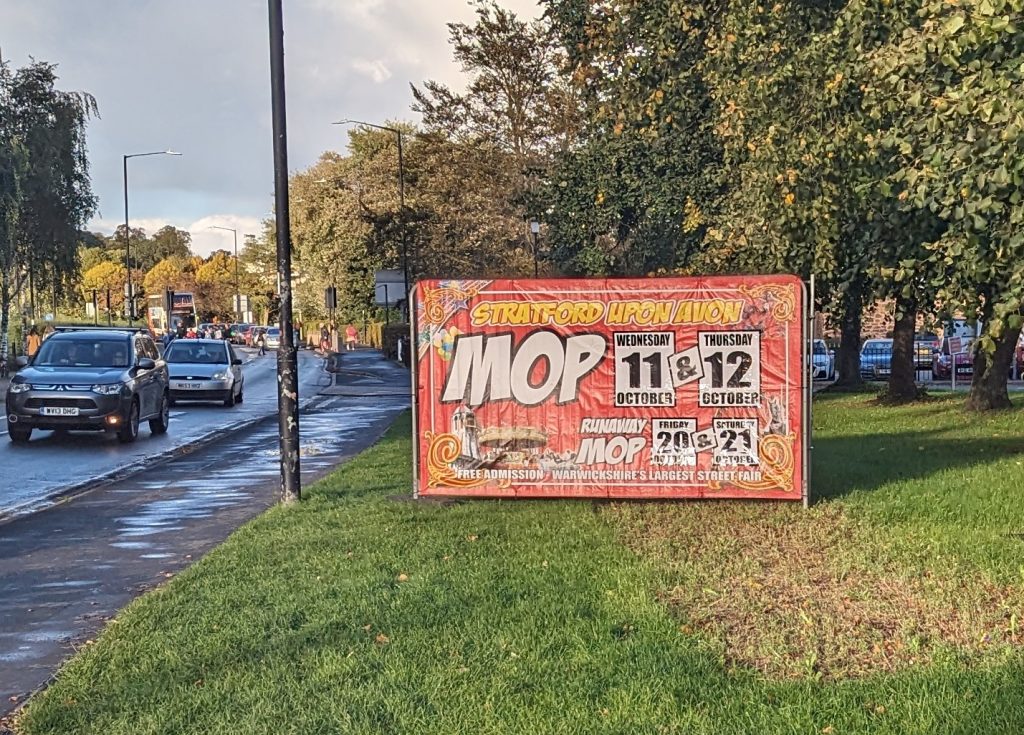
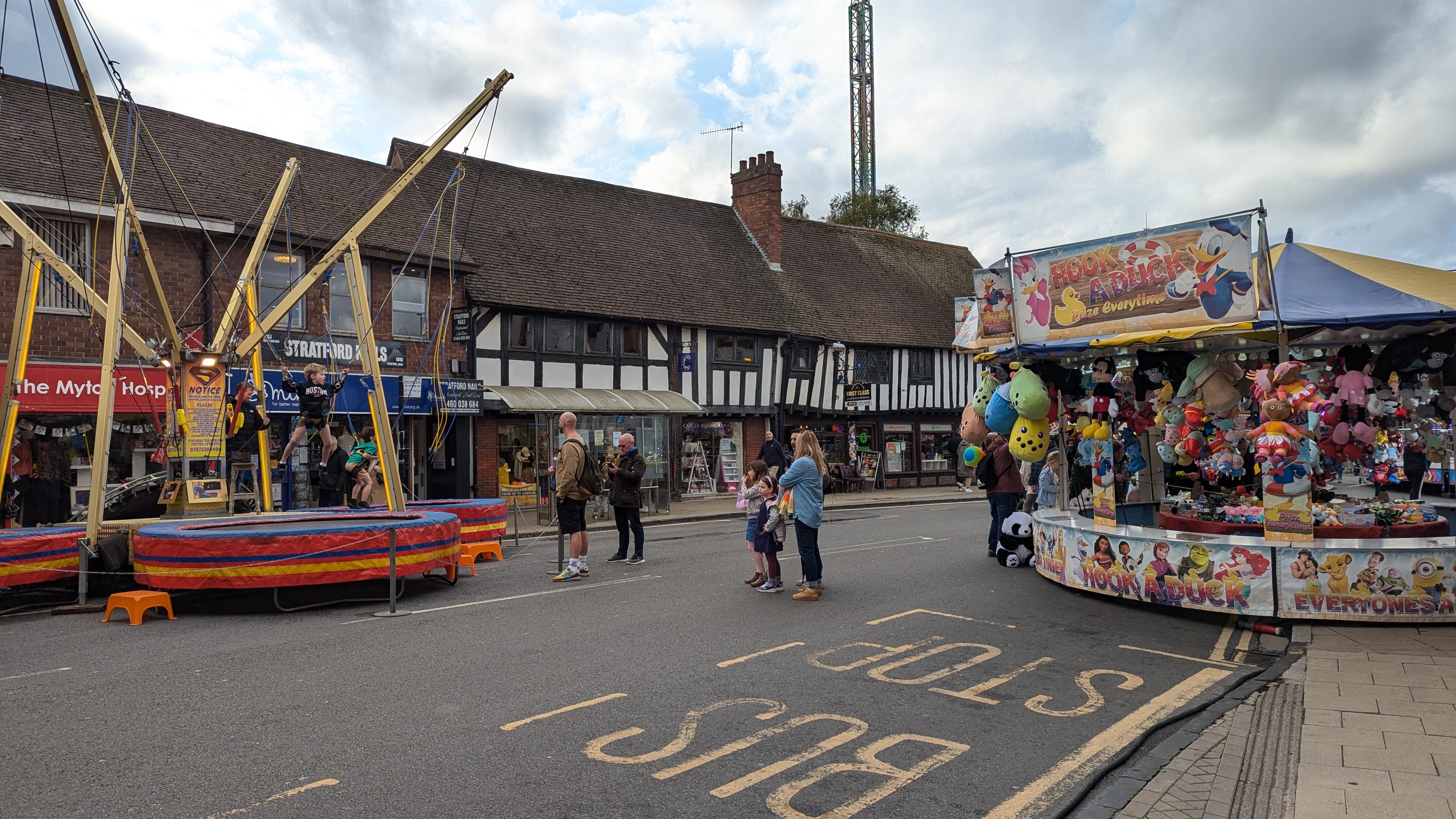
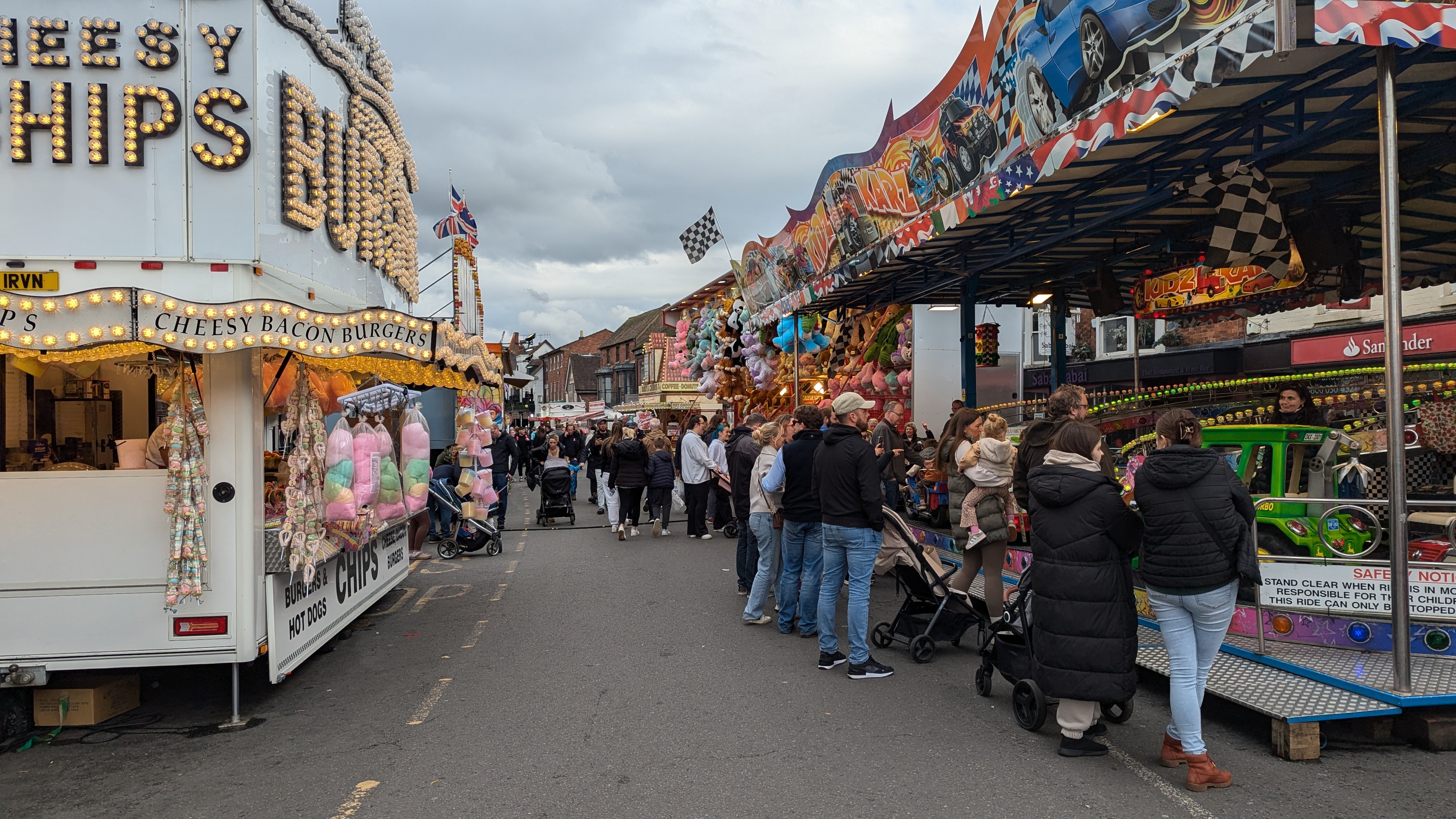
This year the Stratford mop festival was on the 11th and 12th October. I am in Stratford. The the centre of town is a cacophany of shooting galleries, stalls selling toffee apples, candy floss, burgers and all things bad for you. And a fun fair.Nothing at all sophisticated, or literary or dramatic, or folkloric. Just a good old-fashioned fun fair in the middle of the town. Quite raucous, but they leave Henley Street, and Shakespeare’s’ Birthplace, free of it. Below I tell the story of my discovery of the Mop.
2024 Statford-upon-Avon Mop. Photo Kevin Flude2024 Stratford on Avon Mop. Photo Kevin Flude
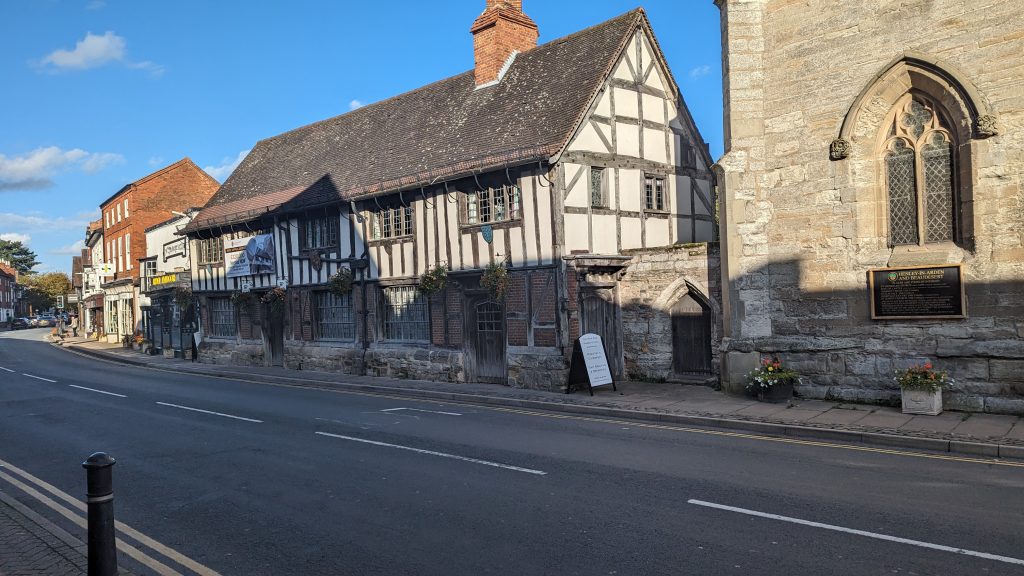
In 2023, I was on my way to Stratford-upon-Avon Railway station, I saw the sign at the top of this page, but had no idea what on earth a Mop was. I put it to the back of my mind as I took the train to Henley-in-Arden. My interest in the town was that Shakespeare was born in Henley St. And his mother was called Mary of Arden. So, naturally, I wanted to find out about Henley-in-Arden. To turn curiosity to action, it took our Tour Coach Driver telling me he lived there and that it was a pretty but small town.
Mary Arden doesn’t live here any more!
I had a free afternoon from my duties as Course Director on the ‘Best of England’ Road Scholar trip. I got on the very slow train to Henley-in-Arden. One of the first stops was Wilmcote, where Mary Arden’s House is. I visited two years ago, when I was astonished to find it was a different building to the one I had visited in the 1990s! In 2000, they discovered they had been showing the wrong building to visitors for years! Mary Arden’s House was, in fact, her neighbour Adam Palmer’s. And her house was Glebe Farm.
On that visit, I walked from Stratford-upon-Avon to Anne Hathaway’s Cottage. Then to Mary Arden’s House and back to Stratford along the Stratford Canal. It is a lovely country walk if you are ever in the area.
The Forest of Arden
The train route to Henley is through what remains of the ancient forest of Arden. The forest features in, or inspired, the woody Arcadian idylls which feature in several of Shakespeare’s plays, particularly the Comedies. ‘As You Like It’, for example, is explicitly set in the Forest of Arden, as this quotation from AYL I.i.107 makes clear:
Oliver: Where will the old Duke live?
Charles. They say he is already in the Forest of Arden, and a many merry men with him; and there they live like the old Robin Hood of England: they say many young gentlemen flock to him every day, and fleet the time carelessly as they did in the golden world.
Guildhall, Henley-in-Arden
Henley-in-Arden
Not much remains of the old Forest. It was cut down to make timber-framed buildings and ships for the British Navy – the so-called Wooden Walls. Henley has a beautiful high street. Further down the road is a lovely Heritage Centre full of old-fashioned and DIY Information panels. And that is not a criticism, it provided a very enjoyable visit full of interesting stuff. And gave me a couple of snippets of information I have not seen anywhere else.
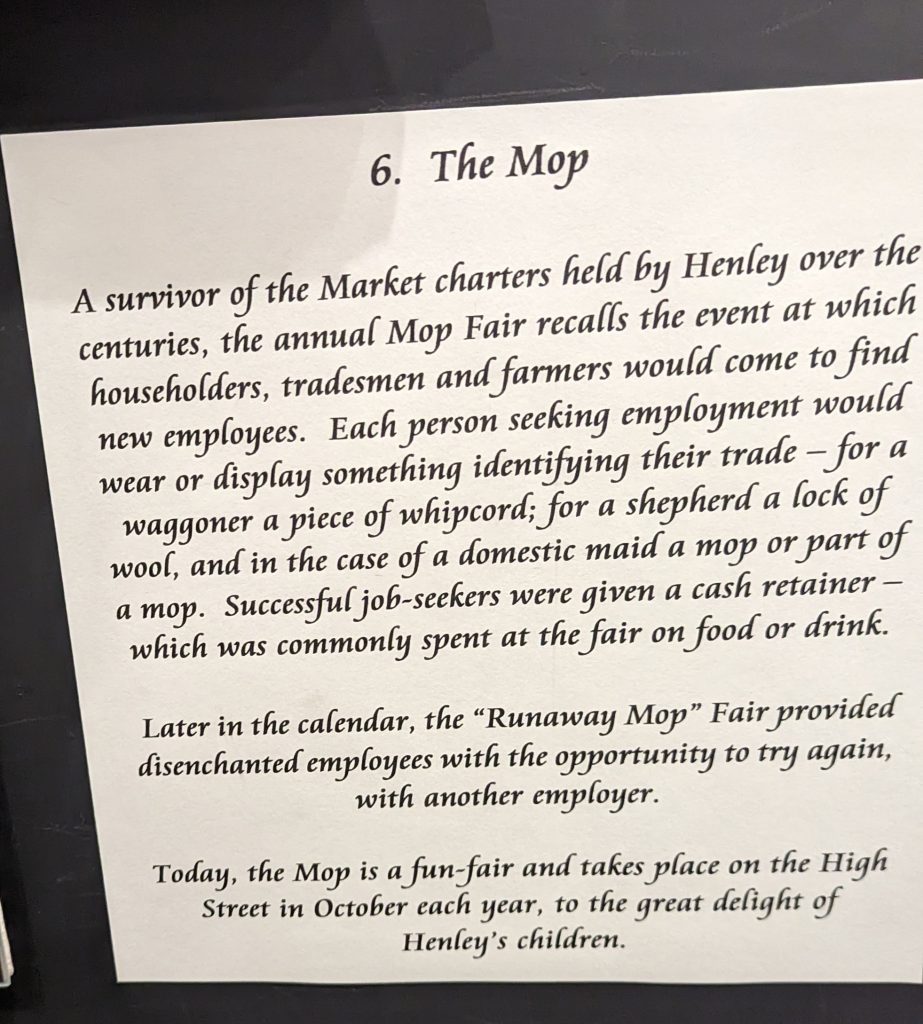
One, was a panel dedicated to the Henley Mop. A mop turns out to be a hiring fair. Think of Gabriel Oak in Hardy’s ‘Far from the Madding Crowd’. His attempt to become an independent farmer destroyed when his sheepdog runs amok. The dog sends his sheep over a cliff to their doom. So he takes his shepherd’s crock to the hiring fair or Mop as they are known in the Midlands. There, potential employers can size up possible employees and strike mutually agreeable terms and conditions. And Gabriel becomes the shepherd for the delightful and wilful Bathsheba Everdene.
So, a shepherd would take his staff, or a loop of wool. A cleaner her mop (hence the name of the fair). A waggoner a piece of whipcord. A shearer their shears etc. Similarly, in the Woodlanders (by Thomas Hardy) the cider-maker, Giles Winterborne, brings an apple tree in a tub to Sherborne, to advertise his wares.
The retainers thus employed would be given an advance and would be engaged, normally, for the year. So there was quite a widespread moving around of working people to new jobs and often new housing. Not quite how we imagine the past?
The perceptive among you will have noted the bottom of the sign in Stratford which advertised the ‘Runaway Mop’. This was held later in the year, so that employers could replace those who ran away from their contracts. And those who ran away could find a better, kinder or more generous boss. See also my post of Gabriel Oak and Pack Rag Day which is another hiring fair which was help on Martinmas Old Style.
Henley Mop – panel from the heritage centre
Court Leets and Barons
Also of interest to me was the panel about Court Leets and Barons. These were the ancient courts which dealt with, respectively, crime and disorder, and property and neighbourhood disputes. Henley still has its ancient manorial systems in use, at least ceremonially. The Centre shows a video of the installation of a new Lord of the Manor at the Guildhall. The title had been purchased by a cigar-smoking Stetson-wearing large rich American.
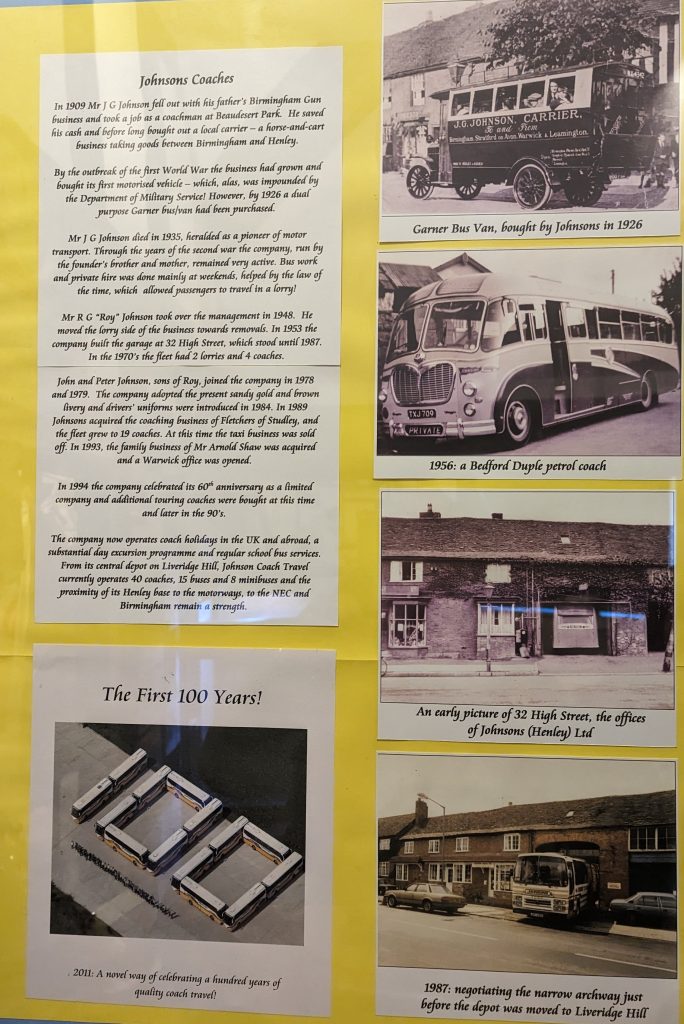
Johnson’s Coaches
Another panel was the story of a Coaching Company. When I lead the Best of England programme we are driven around by Johnson’s Coach Company. It was a delight to discover that it has a history that can be traced back to 1909 in Henley. I conveyed this information to our group on the next day as we toured the Cotswolds. Curtis, our driver, was able to update the panel. He told us that the family were still involved with the firm, which is still operating from the area. He said the two brothers who run the company come in every working day. They do everything they require of their drivers to do; i.e. they drive coaches, clean coaches, sweep the floors and generally treat their staff like part of a big family. I should have asked him whether he got his job at the Mop, while holding a steering wheel in his hands!
Johnson’s Coach Company -Panel from Henley Heritage Centre
Note: It seems that Johnson has now merged with another company. But it keeps its depot in Henley and maintains its connection with the town.
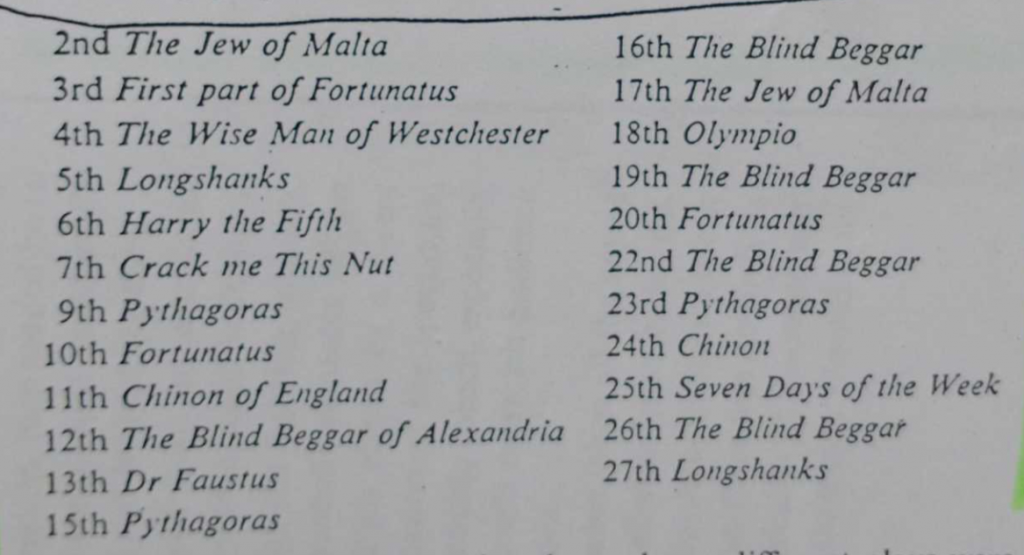
List of plays performed in February 1596 by the Admiral’s Men
‘Crack me this Nut’ was performed by the Admiral’s Men at the Rose Theatre in Southwark, London. One of the dates it was performed was on September 25th 1595. As you can see, above, it was also performed on February 7th 1596. You can find the other dates it was performed, and the income generated in this blog from Henslowe’s papers. In fact, the play was performed 16 times in all, then sold by Edward Alleyn. Sadly, no one knows what it was about. It might relate to the sense of our phrase ‘a tough nut to crack.’
The list of February dates for the Admiral’s Men is from my dossier for my Shakespeare’s London walks. I’m not entirely sure of the book I photocopied it from, but it derives from the wonderful archive of Philip Henslowe and his leading actor, Edward Alleyn. Henslowe’s records were stored in a locked trunk for 260 years.
2023 marked the completion of the project to bring this archive to the public. And here is the Henslowe-Alleyn Digitisation project. As well as digitising the Archive, elements that had been separated from the original archive have been brought back, so the greatest archive of information on the Shakespearean theatre is now unified and available. It is an immense benefit for the Shakespeare industry.
I searched the archive for ‘Crack me this nut’ but their search engine searches for anything that mentions ANY of the words, and as the word ‘this’ is in virtually everything in the archive, the search is effectively useless. Putting ‘Crack me this nut’ in quotes does not help. I have emailed them!
A subscriber sent me another link which has various speculations, and the following entry.
Master Ponsonby. Entred for his copie vnder the hands of the Wardens A booke Intitled The Paragon of pleasaunt histories . . . vjd Or this Nutt was neuer Cracked Contayninge a Discourse of a nobl[e] kinge and his Three sonnes (S.R.1, 3.57 / Fol. 7)
I often use this list of plays performed in February 1596 in the walks and lectures I give on Shakespeare. It shows you how hard-working Shakespeare’s contemporaries were. The actors’ companies were essentially small repertory companies. This list shows that the Admiral’s Men performed 14 different plays, on 23 days, if I count correctly, in the short month of February. This is in a winter month. Now, the guides at the rebuilt Globe tell you the Shakespearian Playhouses were used in the Summer. No! This was deep winter and 23 performances in an outdoor theatre in February! Imagine what a modern actor would think of that work load.
A badly photocopied page of the archive.
First published on February 7th 2023, and revised and republished on September 25th 2024, and 2025