Subscribe to continue reading
Subscribe to get access to the rest of this post and other subscriber-only content.

The Past brought to Life
Subscribe to get access to the rest of this post and other subscriber-only content.

St Valentine’s Day in a Poem by Chaucer
| For this was on Seynt Valentynes day, | |
| Whan every foul cometh ther to chese his make, | |
| Of every kinde, that men thynke may; | |
| And that so huge a noyse gan they make, | |
| That erthe and see, and tree, and every lake | |
| So ful was, that unnethe was ther space | |
| For me to stonde, so ful was al the place. |
This is my ‘translation’
For this was St. Valentine’s Day
When every bird came there to chose their mate.
Of every type, that men think may
And that so huge a noise did they make
That earth and sea and tree and every lake
So full was, that hardly was there space
For to stand so full was the place.
This is the first reference to St Valentine’s as a romantic day. And some people charge Chaucer with making the whole thing up! St Valentine, is supposed to have been martyred in the 3rd Century (290AD) on the Via Flaminia on February 14. He refused to stop marrying people in the Christian rites. Therefore, he is the patron Saint of lovers. Valentine is also the patron Saint of epileptics, fainting and beekeepers. According to legend, he taught a young blind girl how to look after Bees, and, sometime later, her eyesight was restored. He also is said to have treated a young man of epilepsy. Epilepsy was sometimes called the Falling Sickness, and so he is also the Saint of Fainting.
But until Chaucer, there was no particular link with romance. In fact, there are at least three Saint Valentines who were martyred in the Roman period. Their relics are scattered around Europe (have a look at this National Geographic article for the full S.P.). These include bones in Glasgow and his heart in Dublin. There are in total 11 Saints called Valentine in the list of Catholic Saints.
Another theory is that St Valentine has taken over the aspect of the God Cupid, as a Christian attempt to create a holy festival to replace the Lupercalia. See my post on the Lupercalia here.
Chaucer’s poem suggests one possible route to the link with romance. Early February is about the time when birds pair off. If they want to have their chicks at the optimal time, then they need to get going before spring has really sprung.
When I think of love, I don’t think of birds. Maybe, this is because I live by a Canal. Outside my garden, I frequently see and hear a Coot chasing his pair across the water before violently mounting her. But then they are fiercely monogamous and defend their nest, fearlessly, against much bigger birds. And swans glide by in beautiful family groups. But Magpies are my favourite lovebird because you see one, and then look around, and you very often see the partner. I have adopted an old tradition that you are supposed to say:
And look for the mate. It is good luck if you see her and bad luck if you don’t. (Please feel free to assign your own favourite gender!)
‘One for Sorrow’ is a well-known nursery rhyme found in many variations, and is an example of ‘ornithomancy superstition’ whereby the number of Magpies you see determines some aspect of your future. Magpies normally mate for life, and are not gregarious during the nesting season, but thereafter, they ‘join together in large wintering flocks of more than 20 or so birds.‘. So, perhaps we need at least another seven lines for the rhyme? So, far I have never seen a flock of them. If you have a photo of a flock, please send it to me!
One for sorrow,
Two for joy,
Three for a girl,
Four for a boy,
Five for silver,
Six for gold,
Seven for a secret,
Never to be told.
Eight for a wish,
Nine for a kiss,
Ten a surprise you should be careful not to miss,
Eleven for health,
Twelve for wealth,
Thirteen beware it’s the devil himself.
As to the likelihood of seeing thirteen magpies together – well I have seen them often in pairs, occasionally in threes and often alone.
Here is another, more dangerous version of the rhyme (you are more likely to see the Devil)
One for sorrow,
Two for mirth
Three for a funeral,
Four for birth
Five for heaven
Six for hell
Seven for the devil, his own self
For details of the history of versions of this poem, click here:
Magpies don’t have a good reputation, traditionally being regarded as thieves and scavengers with untidy nests and eating habits. They are supposed to be attracted to shiny things, but Exeter University did some research which found that they have the normal Corvid’s curiosity for objects. But they are as happy to snatch a dull object as a shiny one. So, we can see they are very intelligent as well as faithful lovers. For me, a good-omened bird (as long as I see the two of them).
More on Chaucer in my post for April 18th. For my post on Blackbirds see here.
44BC – Julius Caesar was appointed dictator in perpetuum. Or perpetual dictator of the Roman Republic. Coins were issued with the phrase DICT PERPETVO.
1400 -Richard II died shortly after Epiphany Rising, a failed plot to restore him to the throne. Some think he was starved to death in captivity in Pontefract Castle. Or he starved himself. His body was taken to London and put on display in St Paul’s Cathedral on 17 February. His remains were taken to one of his favourite palaces at King’s Langley Priory on 6 March. Henry V had his remains ‘translated’ to Westminster Abbey. King’s Langley was a Royal Palace lived in by Eleanor of Aquitaine and Edward II, as well as Richard II. It is near Slough.
Jan-Marie Knights author of The Plantagenet Socialite lists possible scenarios:
‘The accepted tale of the king’s death is that in despair and grief at the death of his friends, King Richard refused to eat or drink, although a few say he was purposely starved to ensure he died as if from a natural death. Another rumour is that when an esquire mentioned the words ‘King Henry’ while he was eating dinner, Richard struck him with the knife he was using. Guards charged in and the king, pushing the table away, took a bill out of one man’s hand and managed to slay four of them but one leapt onto the chair he had vacated and felled him with a stroke of his poleaxe.’
1876 – Alexander Graham Bell applies for a patent for the telephone
1895 – The Importance of Being Earnest, first produced at the St James’s Theatre, London
1918 – Russia finally adopts the Gregorian calendar. see my post here.
First Published in February 2023, revised and updated in February 2024, 2025 On This Day added 2026

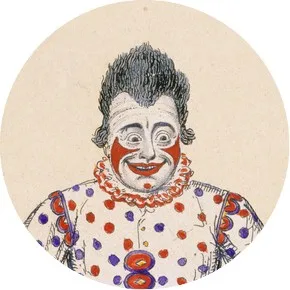
Today, was the Annual Grimaldi Memorial Service in Haggerston, Hackney, London. It began as a memorial service for the famous Regency Clown Joseph Grimaldi. But it has become a service to celebrate Clowns. The service takes place on the first Sunday in February. The service used to be at Holy Trinity Church, but has switched to Haggerston.

Grimaldi was born on 18 December 1778. He died in poverty on 31 May 1837. In between, he was the most famous clown. He transformed the Harlequin role and made the white-faced clown the central part of the British Pantomime. The part became known as a Joey after Grimaldi. He performed at the Theatre Royal, Drury Lane, the Sadler’s Wells and Covent Garden theatres.
All Saints Church, Haggerston is 5 minutes walk from where I live and 2 minutes from where my Dad was born. (see my post here). So I popped in today and took this video. The service, which has been held since the 1940s, attracts clown performers from all over the world who attend the service in full clown costume. The Spitalfield’s Life blog has a very full description of the service, and lots of very good pictures. Follow the link below:
First Published February 1st 2026

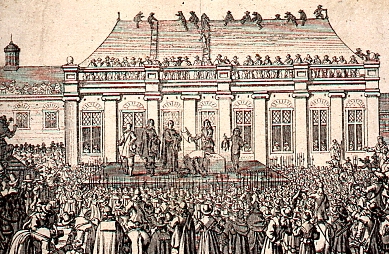
January 30th is the anniversary of the execution of King Charles I. Today, he was beheaded as a murderer and traitor. Or as a Royalist would see it, it is the anniversary of the Martyrdom of Charles I.
Thousands came to see the execution, amongst them Samuel Pepys. They crowded around the scaffold outside a window of Inigo Jones’s magnificent Banqueting Hall, in Whitehall, London. Charles was brought into the Banqueting House. There he must have looked up at the magnificent Peter Paul Reubens’ ceiling. Charles had commissioned the painting to depict of the Apotheosis of his father, James I. It was the symbol of the Divine Right of the King to rule.
I doubt he saw the irony. I suspect he thought he was going to heaven to join his father, in glory as a Martyr to his religion. He walked outside, through the window, into the cold January air. Two of his bloodstained shirts still exist, probably to stop him shivering. He wanted to be seen as going fearless to his death not shivering with fear. Then, he made a short speech exonerating himself. He spoke without stammering for the first time in his public life. The Rooftops around were lined with spectators. Black cloth framed the scaffold. As the executioner axe fell, there was a dull grown from the crowd (most could not see the axe falling).
This was on January 30th, 1648. But, if you look at a history book, it will tell you it was in 1649. This was before our conversation to the Gregorian calendar. Then the year number changed not as we do on January 1st but on March 25th. This was the day the Archangel Gabriel revealed to the Virgin Mary that she was pregnant. For more on the importance of March 25th look at my Almanac entry here:
On the same day, twelve years later, in 1661 Oliver Cromwell and his chief henchmen were dug up from their splendid Westminster Abbey tombs. Their bodies were abused by official command. Cromwell’s head was stuck on the top of Westminster Hall. There it remained until blown off in the Great Fire of 1703 (or 1672, or 1684). Then, it taken to Cambridge, Sidney Sussex College, which Cromwell attended. Only the Head Porter knew where. (According to someone who came on my Oliver Cromwell Walk last year.) Whether it is his head or not is disputed. The tale of the head is told in detail here.
The Royalist, John Evelyn, said in his diary:
This day (oh the stupendous, and inscrutable Judgements of God) were the Carkasses of that arch-rebel Cromwel1, Bradshaw, the Judge who condemned his Majestie and Ireton, sonn in law to the usurper, dragged out of their superb Tombs (in Westminster among the Kings) to Tybourne, and hanged on the Gallows there from 9 in the morning till 6 at night, and then buried under that fatal and ignominious Monument in a deep pit. Thousands of people (who had seen them in all their pride and pompous insults) being spectators .
Samuel Pepys records by contrast:
…do trouble me that a man of so great courage as he was should have that dishonour, though otherwise he might deserve it enough…
Pepys served the Parliamentary side before the restoration of Charles II, when he adroitly, swapped over to the Royalist side.
Every year, I do a Guided Walk and a Virtual Tour on Charles I and the Civil War on this day or the last Sunday in January. Look here for details.
1661 – Oliver Cromwell’s corpse disinterred and ritually executed
1826 – The Menai Suspension Bridge, is opened. Designed byThomas Telford. It is considered the world’s first modern suspension bridge.
1933 – Hitler appointed Chancellor of Germany
1969 – Get Back to Where you Once Belonged – the anniversary of the rooftop concert in Saville Row where the Beatles played ‘Get Back’.
First published in 2023, revised on January 29th 2024,2025, 2026

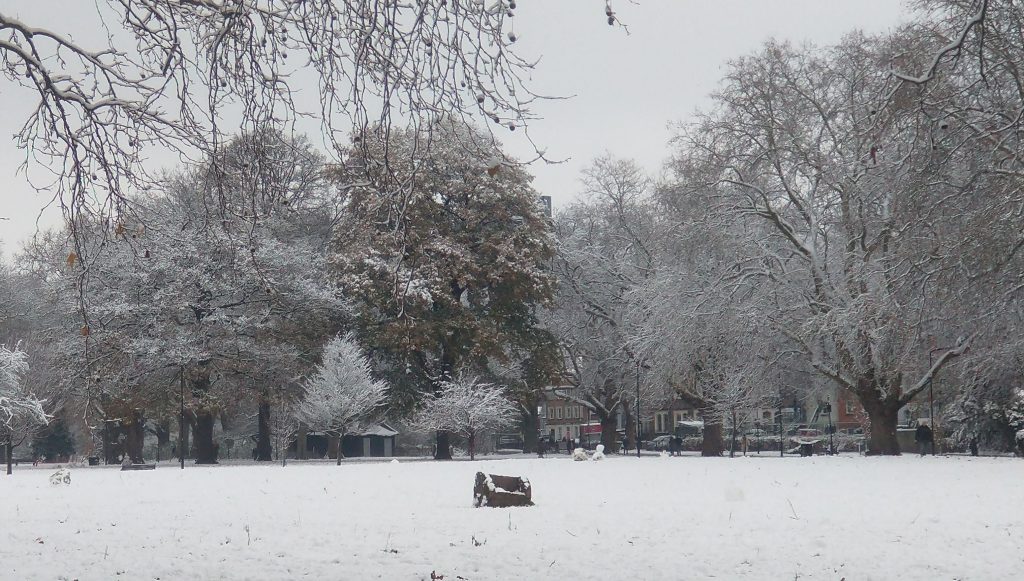
‘On the 27th much snow fell all day, and in the evening the frost became very intense. At South Lambeth, for the four following nights, the thermometer fell to 7, 6, 6, and at Selborne to 7, 6, 10, and on the 3ist of January , just before sunrise, with rime on the trees and on the tube of the glass, the quicksilver sunk exactly to zero, being 32 degrees below the freezing point’ Gilbert White

He, of course, is talking Fahrenheit, so well below zero. If there was a Giant upon whose shoulders Charles Darwin climbed, then Gilbert White owned one pair.. He was one of many churchmen of the 18th and 19th Century who spent their extensive leisure time, on observing God’s wonderful creation in their gardens and parishes. What made White so important was that his practice was ‘observing narrowly’ and regularly. For example, his observations of the importance of earth worms were fundamental to Charles Darwin’s own studies. When Darwin came back from his travels on the Beagle, he settled in a country property in Orpington. Like White, he used his garden and the local area as his laboratory. Here he worked to prove his theory of evolution.
Earth worms were one of Darwin’s passions. This is what Gilbert White wrote about their contribution to nature:
“Earth-worms, though in appearance a small and despicable link in the chain of Nature, yet, if lost, would make a lamentable chasm. For, to say nothing of half the birds, and some quadrupeds which are almost entirely supported by them, worms seem to be the great promoters of vegetation, by boring, perforating, and loosening the soil, and rendering it pervious to rains and the fibres of plants, and, most of all, by throwing up such infinite numbers of lumps of earth called worm-casts, which, being their excrement, is a fine manure for grain and grass.”
(Quoted from https://gilbertwhiteshouse.org.uk)
By such minute and repeated observations, Gilbert White investigated the food chain, and the migration of birds (which was at the time disputed). He laid the foundations of what we now call ecology.
He became Dean of Oriel College in Oxford. But chose to spend his career in the relatively humble occupation of Curate. A Curate is the bottom-feeder in the Anglican Church food chain. A Curate hardly earned enough to maintain a position in the Gentry (£50 p.a.). Although, White was upgraded to the title of Perpetual Curate. He still would only be pulling in, I guess, something like £200 p.a. (Patrick Bronte was also a Perpetual Curate). Essentially, it is Vicar looking after a part of a too large Parish.
Financially, White didn’t need much, he inherited his father’s property at Shelborne, Hampshire. White’s grandfather was the Vicar at Shelborne. But Gilbert could not inherit the title because he went to Oriel College. The ‘living’ of the Parish of Shelborne was ‘in the gift of’ Magdalen College. And they were not going to give the role to an alumnus of a rival college.
The house, now open to the public, is just around the corner from Chawton. This is where Jane Austen spent her last years. He was born in 1720; was 55 when Austen was born, and he died in 1793, when she was 18. He lived 4 miles away, so the families knew of each other. We know Jane Austen’s brother wrote a poem about Gilbert White and his natural history observations, particularly on birds.
From ‘Selbourne Hanger’ by James Austen
Who talks of rational delight }
When Selbourne’s Hill appears in sight }
And does not think of Gilbert White? }
Such sure he was – by Nature grac’d
With her best gift of genuine taste;
And Providence – which cast his lot
Within this calm, secluded spot,
Plac’d him where best th’enquiring mind
Might study Nature’s works, and find
Within her ever open book
Beauties which others overlook.
Enthusiast sweet! Your vivid style
The attentive reader can beguile
Through many a page, and still excite
An Interest in what you write!
For whilst observant you describe
The habits of the feathery tribe
Their Loves and Wars – their nest and Song,
We never think the tale too long.
For more information on White and Austen, go to Gilbert White’s House’s web page here:
Here is more of that epic cold January 1776
‘… but by eleven in the morning, though in the shade, it sprang up to I6J,1 — a most unusual degree of cold this for the south of England. During these four nights the cold was so penetrating that it occasioned ice in warm chambers and under beds ; and in the day the wind was so keen that persons of robust constitutions could scarcely endure to face it. The Thames was at once so frozen over both above and below bridge that crowds ran about on the ice. The streets were now strangely encumbered with snow, which crumbled and trod dusty ; and, turning grey, resembled bay-salt : what had fallen on the roofs was so perfectly dry that, from first to last, it lay twenty-six days on the houses in the city ; a longer time than had been remembered by the oldest housekeepers living…..’
‘The consequences of this severity were, that in Hampshire, at the melting of the snow, the wheat looked well, and the turnips came forth little injured. The laurels and laurustines were somewhat damaged, but only in hot aspects. No evergreens were quite destroyed ; and not half the damage sustained that befell in January, 1768. Those laurels that were a little scorched on the south-sides were perfectly untouched on their north-sides. The care taken to shake the snow day by day from the branches seemed greatly to avail the author’s evergreens. A neighbour’s laurel-hedge, in a high situation, and facing to the north, was perfectly green and vigorous ; and the Portugal laurels remained unhurt.’
‘We had steady frost on to the 25th, when the thermometer in the morning was down to 10 with us, and at Newton only to 21. Strong frost continued till the 31st, when some tendency to thaw was observed ; and, by January the 3d, 1785, the thaw was confirmed, and some rain fell.’

Gilbert White’s House is open to the public and also contains a display on Lawrence Oates, who died on Scots Antarctic expedition. For more information look at my post here.
There is another mention of Gilbert White in the Almanac of the Past here.
Here are food stuffs that are in season now.
Wild Greens: Chickweed, hairy bittercress, dandelion leaves, sow thistle, winter cress
Vegetables: Forced Rhubarb, purple sprouting broccoli, carrots, brussels sprouts, turnips, beetroot, spinach, kale, chard, leeks, Jerusalem artichokes, lettuces, chicory, cauliflowers, cabbages, celeriac, swedes
Herbs: Winter savory, parsley, chervil, coriander, rosemary, bay, sage
Cheeses: Stilton, Lanark Blue
(from the Almanac by Lia Leendertz)
1754 – Horace Walpole coined the new word ‘serendipity’ from the ‘Three Princes of Serendip’ fairy tale. The Princes ‘ere always making discoveries, by accidents and sagacity, of things they were not in quest of.’
1898 – Walter Arnold became the first motorist to be fined for speeding. He was going 8 miles an hour in a 2 mile an hour area in Kent
1986 – Explosion of US Space Shuttle Challenger. All 7 astronauts killed, including teacher Christa McAuliffe who would have been the first civilian in space.
The food section posted originally in 2023, the part on Gilbert White written on 28th January 2024, revised 2025, On This Day added 2026

Every year the English Civil War Society commemorates the execution of King Charles I, Martyr, on the last Sunday in January. Charles was executed on January 30th. Please look at my post about the execution here.
This year, I went to the Parade for the second time, and include some photos below. The reenactors met at St James Palace and marched along the Mall to Horseguards Parade. There they assembled, and then a detachment went to the Banqueting House where Charles was lawfully executed/murdered/martyred, depending upon your attitude. Here they lay a wreath.
He was a tyrant who tried to subvert the rule of Magna Carta and undermined Parliament. Then started a Civil War which killed 85,000. For the numbers behind the Civil War look here. So I’m going for lawfully executed, and I might say good riddance, but I don’t believe in the death penalty. By the way, the legal arrangements made for the unprecedented trial of the Head of State, laid the foundations for trials such as those at Nuremberg, and Kosovo. The Prosecutor was a lawyer called John Cook. Please read about him in this excellent book . The Tyrannicide Brief: The story of the man who sent Charles I to the scaffold. By Robertson, Geoffrey (2005). Chatto & Windus/Vintage. ISBN 978-0-09-945919-4. Cook is remembered on Wikipedia as ‘Regicide’. But he was a pioneer of legal action against Tyranny. Another hero.
Here is the official publicity for Sunday’s Parade, followed by some of my photos.
January 25th 2026 Reenactors commemorating the execution of Charles I in Westminster


If you are interested, then you must either come to my walk, this Friday or attend my Virtual Tour, on Friday 30th January, evening. And you will find I am far more even-handed that this post suggests!
Charles I and the Civil War. Martyrdom Anniversary Walk 2.30pm Jan 30th 26 To book
The Civil War, Restoration, and the Great Fire of London Virtual Tour 7:30pm Fri 30th Jan26 To book
First written on January 26th January 2026

Burn’s Night is an increasingly important date on the calendar of Scotland’s Cultural Heritage. Wikipedia says it began:
‘at Burn’s Cottage in Ayrshire by Burns’s friends, on 21 July 1801‘
This was 5 years after his death. It is now celebrated around the world, making clear the importance of Robert Burns. Burns himself would have been astonished at the spread of Burn’s Night. He was modest about his attainments, saying, in his introduction to the Commonplace Book:
‘As he was but little indebted to scholastic education, and bred at a plough-tail, his performance must be strongly tinctured with his unpolished rustic way of life. ‘
To celebrate Burn’s Night here is one of his most famous works. Also have a look at my post on his great narrative poem, Tam O’Shanter and the Cutty Shark.
Fair fa’ your honest, sonsie face,
Great Chieftain o’ the Puddin-race!
Aboon them a’ ye tak your place,
Painch, tripe, or thairm:
Weel are ye wordy of a grace
As lang ‘s my arm.
The groaning trencher there ye fill,
Your hurdies like a distant hill,
Your pin wad help to mend a mill
In time o’ need,
While thro’ your pores the dews distil
Like amber bead.
His knife see Rustic-labour dight,
An’ cut ye up wi’ ready slight,
Trenching your gushing entrails bright,
Like onie ditch;
And then, O what a glorious sight,
Warm-reekin, rich!
(for the other five verses have a wee lookie here)
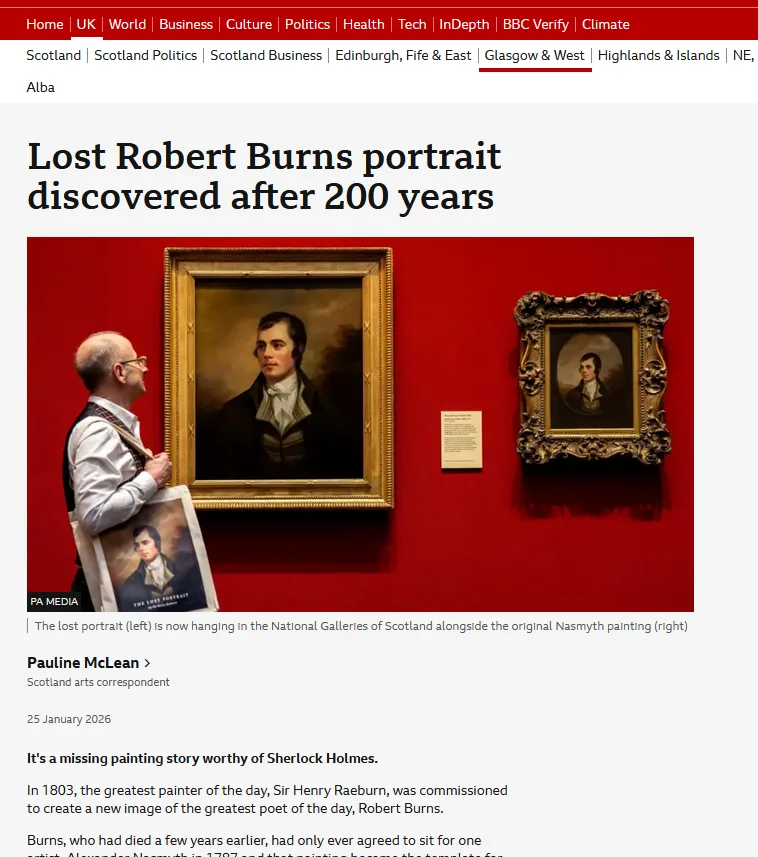
Recently, a long lost portrait of Burns turned up and it provides an image of the poet as a young man. The story is interesting and worth reading here:


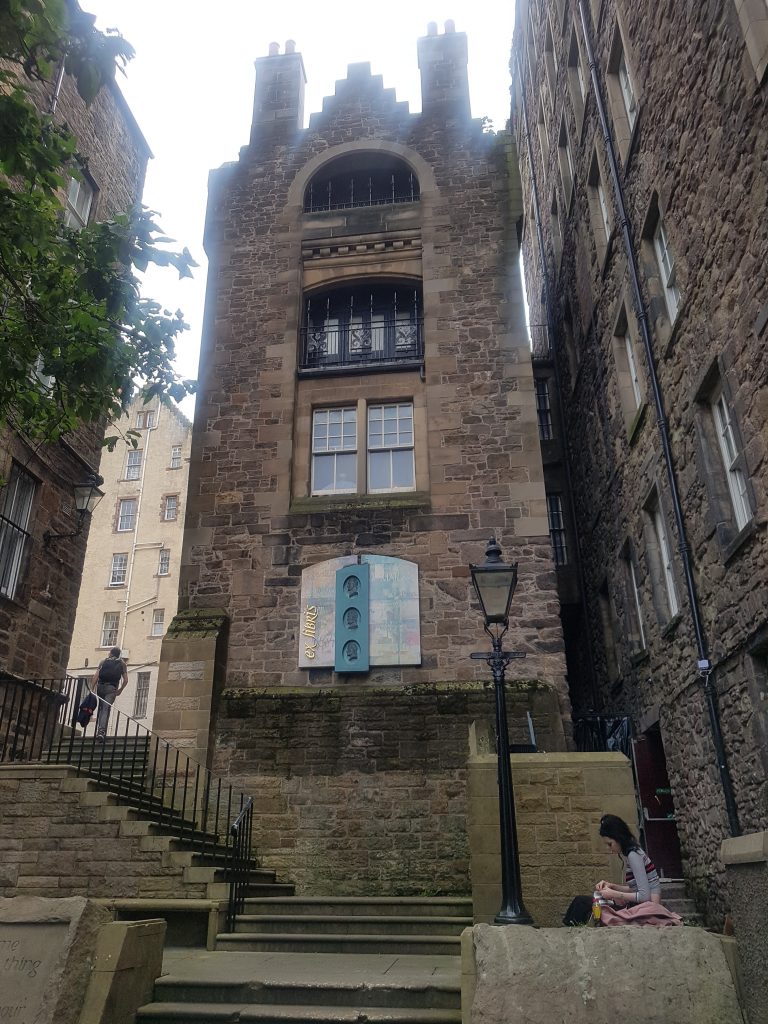
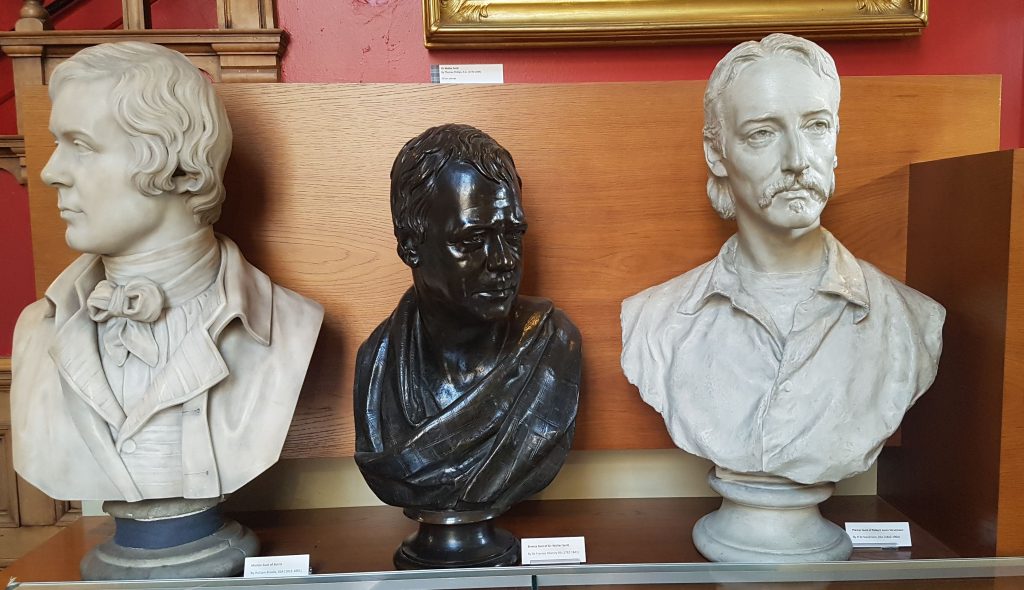
Often bypassed by the tourists on a visit to the wonderful City of Edinburgh is the Writer’s Museum. It is in one of those remarkable Tower houses which seem unique to the High Street in Edinburgh. Inside, it gives a great introduction to the great writers of Scotland.
‘Is it not strange’ wrote philosopher David Hume in 1757 ‘that a time when we have lost our Princes, our Parliament, Independent Government …..that we shou’d really be the people most distinguish’d for literature in Europe?’ (source: Museum display panel)


See my post on Literary Edinburgh here
1759 – The birth of Robert Burns.
1784 – The death in Edinburgh of Alexander Webster, a writer and church minister who is best remembered for the country’s first census. The first UK census was in 1801.
1817 – The Scotsman newspaper publishes its first edition in Edinburgh.
2012 – First Minister Alex Salmond launches a consultation on the SNP Government’s proposals for a referendum on Scottish independence. on the question “Should Scotland be an independent country?”. The voters answered “No” 55.3% and 44.7% voting in favour. (for more on Scottish Independence, see my post here.)
Source www.undiscoveredscotland.co.uk/
First published Jan 2023, republished Jan 2024, 2025, 2026

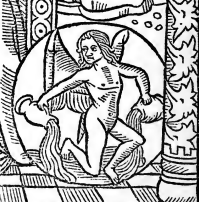
‘The man born under Aquarius shall be lonely and ireful; he shall have silver at 32 years; he shall win wherever he goeth, or he shall be sore sick. He shall have fear on the water, and afterwards have good fortune, and shall go into divers strange countries. He shall live to be 75 years after nature.’
‘The woman shall be delicious, and have many noises for her children; she shall be in great peril at 24 years and thereafter in felicity. She shall have damage by beasts with four feet and shall live 77 years after nature.
The Kalendar of Shepherds, 1604 (quoted in the Perpetual Almanac by Charles Kightly)

The Kalendar of Shepherds predictions for those born in Aquarius, (see above) are so specific they cannot help but be wrong for most people. Surely, the art of the prophecy, is to be vague, be general and to know human nature.
By the 21st of January, we should have an idea of whether we are going to keep to your resolutions or not. And perhaps we should now be tuning them or adapting them to fit our lives as actually lived, rather than on our pious hopes. (for more on prophecy, see my post here).
In 2023, on January 21st after my Uncle Brian’s Funeral. I had a chat with a taxi driver on the way to the railway station . He told me that funerals make him wonder how his behaviour might influence those the people who will, one day, make that special effort to turn up at his funeral. As a young Asian guy, he was thinking ahead quite some way.
I replied that ‘Funerals make me reflect on how much time I have spoiled by not being fully engaged in the moment’. All those conversations where my mind wandered. Those radio programmes I only half heard as I tried to read a book at the same time. All those train journeys, walks in the woods or along the canal while listening to headphones. My visits to relatives where I rushed back to get home as quickly as possible. Being present in the moment was, maybe, the key to improving the quality of life and interactions with others.
We continued chatting through the short journey. As we arrived in the forecourt of the station he suggested we exchange a final word of wisdom. As we had been talking about history, I turned to Charles Dickens. I told him Betsy Trotwood’s words to David Copperfield:
“Never,” said my aunt, “be mean in anything; never be false; never be cruel. Avoid those three vices, Trot, and I can always be hopeful of you.”
Charles Dickens, David Copperfield
I said that Betsy’s words stem from Charles Dickens’ belief that the key to progress in the world was to ignore the dogma of religion but to live by just one tenet.
‘Treat people as you want to be treated by others.’
In return, he told me of an Islamic teacher who responded to his enquiry. ‘How to ensure salvation given all the many (possibly conflicting) moral teachings and texts there were’. The answer was, if he lived wisely and considered his impact on others, he could be sure of salvation.
By this time, I had missed my train. But the two of us had had a moment of connection. There are plenty of trains from Guildford to Waterloo.
Dickens was a brilliant propagandist against the evils that are endemic in society. And yet, he was no socialist. He wrote ‘Hard Times’ which is a virulently anti-trade union story. But his recipe for improvement in society was based on implementing the broad understanding of religion, as expressed in these two quotations:
“Thou shalt love thy neighbour as thyself” (Matthew 22:37–39).
“Do to others as you would have them do to you” (Luke 6:31).

I have a lot of t-shirts with quotations from history on them. I suspect I am one of the very few people who store his t-shirts in chronological order. The selfie shows chronologically, the first, and the last is:
“You can’t always get what you want
But if you try sometime you’ll find
You get what you need”
by Mick Jagger and Keith Richards of The Rolling Stones.
As the Rolling Stones have a big part to play in the musical history of Lindon, here are the lyrics in full and a youtube video.
I saw her today at the reception
A glass of wine in her hand
I knew she would meet her connection
At her feet was her footloose man
No, you can’t always get what you want
You can’t always get what you want
But if you try sometime you’ll find
You get what you need
repeat above
And I went down to the demonstration
To get my fair share of abuse
Singing, “We’re gonna vent our frustration
If we don’t we’re gonna blow a fifty-amp fuse”
Sing it to me, honey
You can’t always get what you want
But if you try sometimes, well, you just might find
You get what you need
Ah baby, yeah
Ah
I went down to the Chelsea drugstore
To get your prescription filled
I was standing in line with Mr. Jimmy
And, man, did he look pretty ill
We decided that we would have a soda
My favorite flavor, cherry red
I sung my song to Mr. Jimmy
Yeah, and he said one word to me, and that was “dead”
I said to him
You can’t always get what you want, well no
You can’t always get what you want. I tell you, baby
You can’t always get what you want, no
But if you try sometimes you just might find, uh, mm
You get what you need, oh yeah, woo!
Ah, woo!
You get what you need, yeah, oh baby
Ah yeah
I saw her today at the reception
In her glass was a bleeding man
She was practiced at the art of deception
Well, I could tell by her blood-stained hands, sing it
You can’t always get what you want, yeah
You can’t always get what you want, ooh yeah, child
You can’t always get what you want
But if you try sometimes you just might find
You just might find
You get what you need, ah yeah
Ah baby, woo!
Ah, you can’t always get what you want, no, no, baby
You can’t always get what you want, you can’t now, now
You can’t always get what you want
But if you try sometimes you just might find
You just might find that you
You get what you need, oh yeah
Ah yeah, do that
source: https://www.lyricsondemand.com/rolling_stones/you_cant_always_get_what_you_want
And here is an early video of the band, with Brian Jones, playing the song. Sadly, it doesn’t have the sublime choir singing the chorus. Youtube will probably play an ad. I don’t make any money from that by the way!
First written on 21st January 2023, revised January 2024, and republished 2026
1793 Louis XVI of France was guillotined at the Place de la Révolution in Paris. The National Convention convicted him of high treason 4 days earlier

January 20th is the Eve of St Agnes & Keats wrote a poem on the subject. The poem is one of his most important and was written in 1819, published in 1820. Folklore held that a maid would dream of her future lover on St Agnes Eve if she took certain precautions. In particular, they had to go to bed without supper, and transfers pins from a pincushion to their sleeve while reciting the Lord’s Prayer. John Keats used this tradition in his epic poem.
St Agnes was a martyr who, at 13 years old, refused to marry a pagan. She was martyred by being stabbed in the throat. Agnes is well attested and on a list of martyrs dating to AD345. She is the patroness of young women and of chastity. Her feast day is January 21st. I wrote about St Agnes and the Fraternity of St Anne and St Agnes on Distaff Sunday.
The poem begins with a great description of winter.
St. Agnes’ Eve—Ah, bitter chill it was!
The owl, for all his feathers, was a-cold;
The hare limp’d trembling through the frozen grass,
And silent was the flock in woolly fold:
Numb were the Beadsman’s fingers, while he told
His rosary, and while his frosted breath,
Like pious incense from a censer old,
Seem’d taking flight for heaven, without a death,
Past the sweet Virgin’s picture, while his prayer he saith.
Keats sets up the drama with a poetic description of the folklore:
They told her how, upon St. Agnes’ Eve,
https://www.poetryfoundation.org
Young virgins might have visions of delight,
And soft adorings from their loves receive
Upon the honey’d middle of the night,
If ceremonies due they did aright;
As, supperless to bed they must retire,
And couch supine their beauties, lily white;
Nor look behind, nor sideways, but require
Of Heaven with upward eyes for all that they desire.
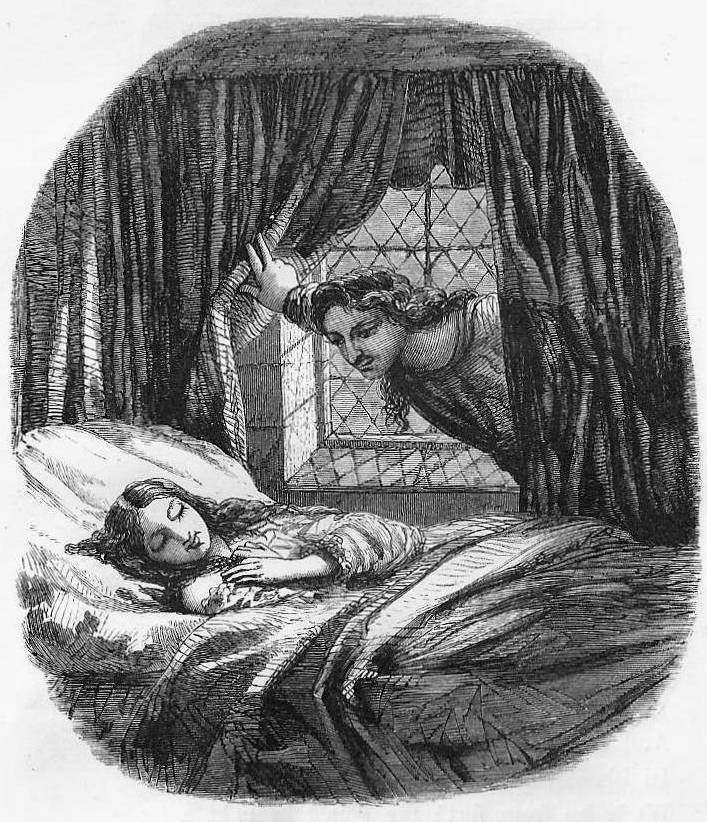
In the poem, the maid Madelaine goes to sleep to dream of her love Porphyro. He risks everything to visit the young girl, and watches her while she sleeps. She dreams of him. Waking up and seeing him, Madelaine lets him into her bed thinking she is still dreaming.
She realises her mistake and tells him she cannot blame him for taking advantage as she loves him so much. But if he leaves her, she will be like “A dove forlorn and lost / With sick unpruned wing”.
The two lovers escape and run away together.
Keats was born in a livery inn in Moorgate, in the City of London. He lived in Cheapside, later in Hampstead, and was published in Welbeck Street in the West End. As a young man he trained as a surgeon at Guys Hospital, Southwark. But he never practised, although he did consider a post as a Ship’s Surgeon.
One wet, cold February he went home to Hampstead on the roof of a stage coach. But. he had forgotten his coat, so he got soaked and chilled to the bone. That night, he coughed up blood. His medical and family experience led him to believe it was a fatal sign of consumption. He had lived in a small house with his brother and mother, who both died of TB. Keats had helped nurse them.
Later on, however, he consulted a doctor. He was told his illness was psychosomatic. And his thwarted love for his next door neighbour, Fanny Brawne, was contributing to his illness. As his consumption advanced, he was advised to go to a warmer climate. So, he embarked at Tower Pier by the Tower of London. He transferred to a small sailing ship at Gravesend called the Maria Crowther. On the ship to Italy, he shared a cabin with another consumptive. The two consumptives, had opposite ideas as to whether the portholes needed to be open or closed for their health. Letters he wrote makes it clear he was desperate to stop himself thinking about Fanny Brawne. He got to Rome where he died, achieving, he felt, nothing worthwhile in his life. His memorial stone proclaimed:
“Here lies One Whose Name was writ in Water.”
1265 – The first English parliament to include not only Lords but also representatives of the Commons holds its first meeting in the Palace of Westminster.
1649 – The High Court of Justice for the trial of Charles I begins its proceedings. The Solicitor General John Cook was appointed prosecutor, presided over by John Bradshaw
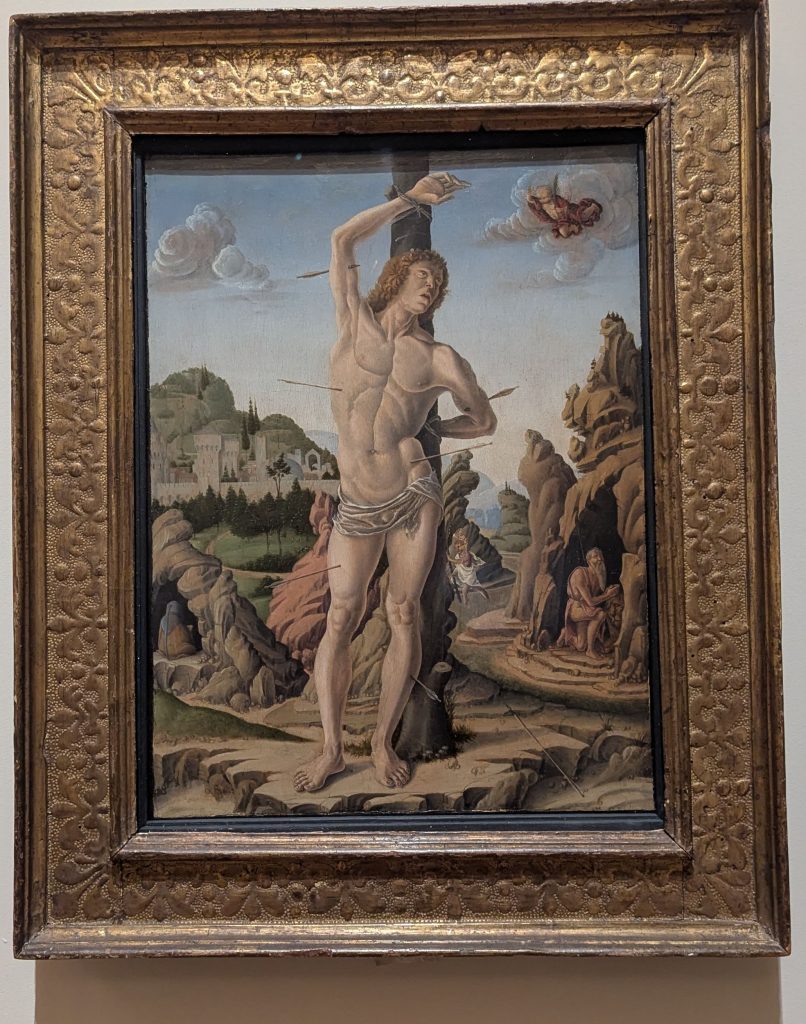
Today is also St Sebastian’s Feast Day. He has become a gay icon, and was celebrated in a Latin language film by Derek Jarman from 1976. (https://en.wikipedia.org/wiki/Sebastiane)

A full version of the film is available on Youtube, but here are some scenes:
January 25th 2026 Reenactors commemorating the execution of Charles I in Westminster
Charles I and the Civil War. Martyrdom Anniversary Walk 2.30pm Jan 30th 26 To book
The Civil War, Restoration, and the Great Fire of London Virtual Tour 7:30pm Fri 30th Jan26 To book
First written on January 23, republished on January 20th 2024, 2025,2026

Lambing
You are getting another copy of this because it was published without additions I made to the On This Day section.
If a lamb be born sick and weak, the Shepherd shall fold it in his cloak, blow into the mouth of it and then, drawing the Dam’s dog, shall squirt milk into the mouth of it. If an Ewe grow unnatural, and will not take her Lamb after she has yeaned it, you shall take a little of the Clean of the Ewe (which is the bed in which the Lamb lay) and force the Ewe to eat it, or at least chew it in her mouth and she will fall to love a Lamb naturally. But if an Ewe have cast her Lamb, and you would have her take to another Ewe’s Lamb, you shall take the Lamb which is dead, and with it rub and daub the live Lamb all over, and so put it to the Ewe, and she will take to it as naturally as if it were her own.
Gervase Markham, ‘Cheap and Good Husbandry’ 1613 (quoted in the Perpetual Almanac by Charles Kightly).
Lambing can begin in the second part of Janauary in the south-west of the UK. But it gets progressively later as you travel north. Itinerant shearers, now often from New Zealand, travel the country shearing sheep. They will begin in the south and then progress north.
March and April are peak lambing time in the UK. But the season runs from February to April. Some farmers even lamb before Christmas (and it is not unknown to lamb in November).
The country expression is ‘in with a bang and out with the fool’ which suggests an ideal time to tup, is November 5th, on Fireworks Night. So that the lambs will be born, 5 months later, around the 1st of April. A litter is normally one or two but occasionally more. Ewe’s get fed depending on how many lambs they will be having.
In the ‘Return of the Native’, Thomas Hardy has a character called Diggory Venn, he is a reddle man. He travels the country in a little pony and trap selling reddle. This is a red ochre dye with which shepherds mark their flock. Part of the plot is about the reluctance of women to marry a man whose red, reddle-stained face, makes him look like a devil.
The reddle is used to mark sheep, particularly before lambing. The ram is given a collar or girdle with a marker full of reddle in it. When he mounts the ewe, she will have a red mark on her back. When she has been tupped twice, she will have two red marks on her back. She will then be taken out of the field, to encourage the ram to impregnate the others. Reddle and other dyes can be used to mark lambs chosen for slaughter, or dipping, or weighing etc
(Tup is a country verb: I tup. You tup. We are tupping etc., and means what happens when the ram ‘covers’ the ewe).
For more on Thomas Hardy see my posts:
Hardy’s Henge
The End of Hardy;s Tree
And about the Mayor of Casterbridge:
Wife selling
Failed Weather Forecasting
And the most popular of all my posts: The Skimmity Ride
1486 – Dynastic marriage of King Henry of Lancaster (Henry VII) to Elizabeth of York, daughter of Edward IV, ends rivalry that led to the War of the Roses
1779 – Peter Mark Roget, physician, scholar, thesaurus creator was born, brought into this world, delivered, popped out, brought forth, sprogged, engendered, begat, birthed.
1896 – First xray generating machine displayed to the public by American H L Smith, but building on the work of English physicist William Crookes and German, Wilhelm Röntgen. Portable machines, designed for hospital use on the Battlefields were developed by Spaniard Mónico Sánchez Moreno and the Polish/French scientist Marie Curie.
First Published 2023, revised 24,25,26