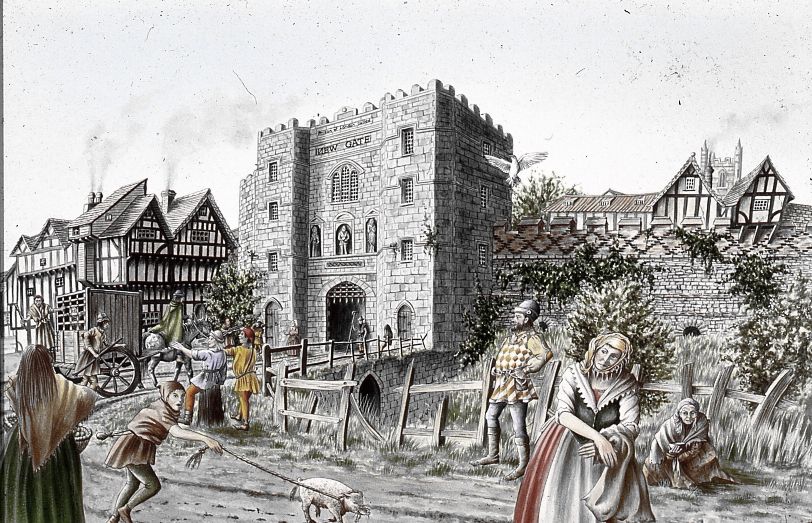
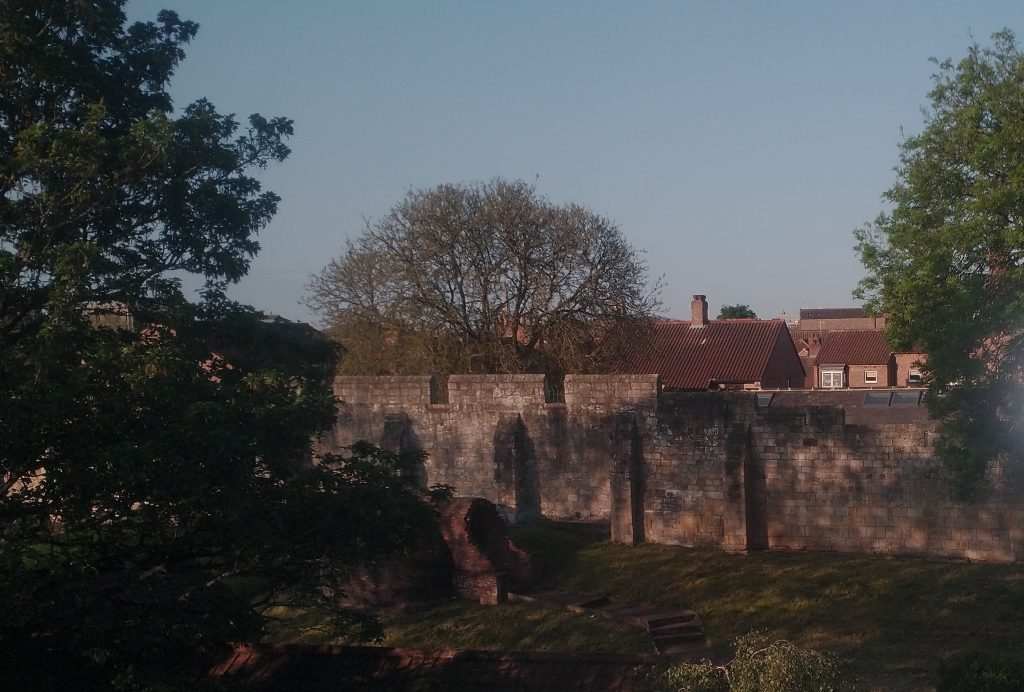
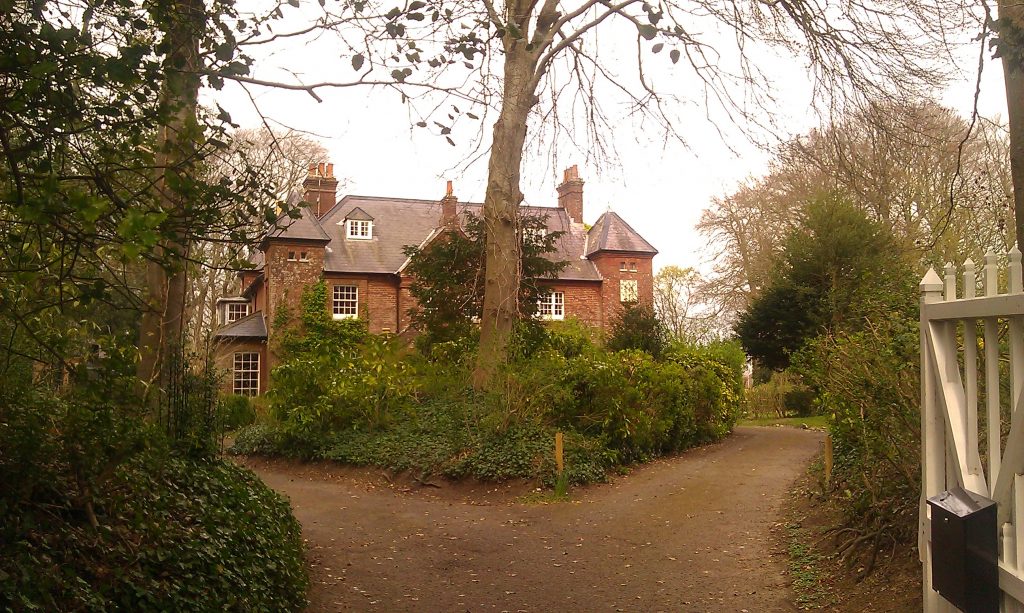
Ice House in grounds of Keystone Pub, York, from Doubletree Hilton Photo K Flude
In 2023 I noticed a strange brick building dug into the bank in front of the City Wall. I could only see it from my Hotel Window, near Monk Bar. ‘Very curious.’ I thought, as I looked, ‘It’s either a kiln or an Icehouse. ‘ A ridiculous place for a kiln, I concluded, and as the weather was nice, I went out to explore.
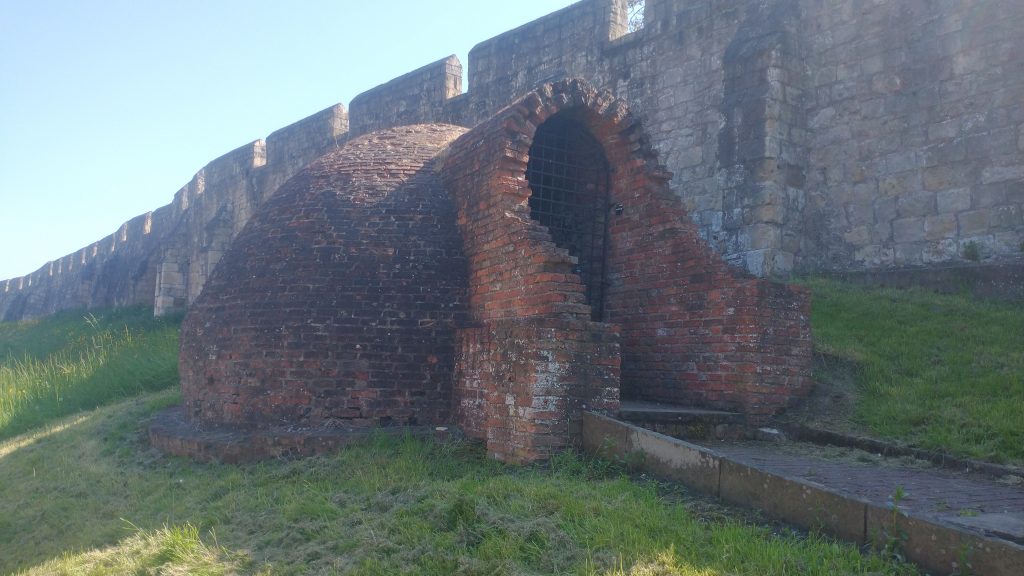
By Monk Bar (Bar means Gate in York) I found a pub called the Keystones. Through its yard I could see the round brick structure, in the photo below.
Ice House in grounds of Keystone Pub, York Photo K Flude
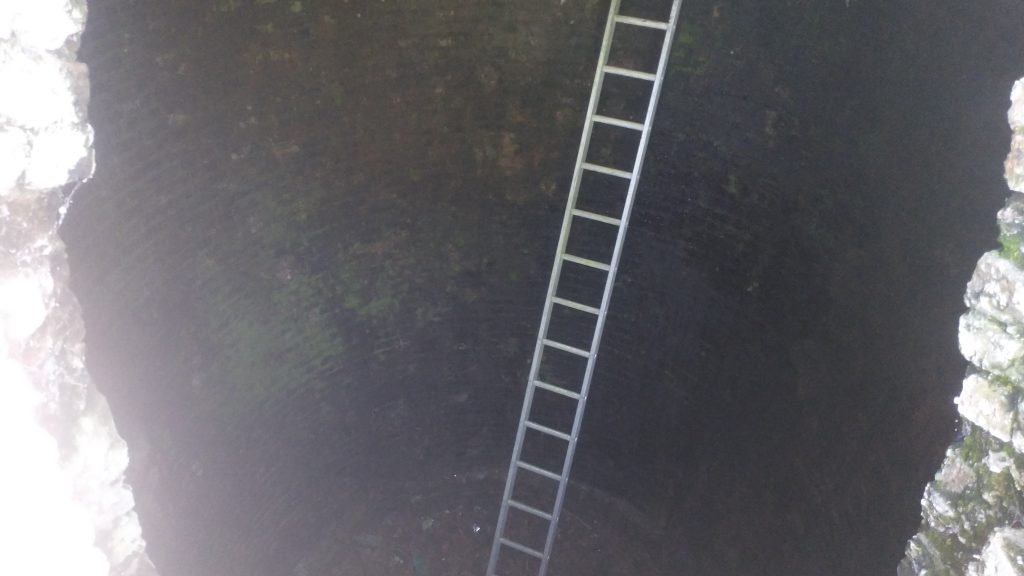
‘Icehouse!’ I thought to myself with increasing confidence. The ladder to the cavernous conical hole beneath it proved the point. It dates to about 1800.
Detail of Ice House in grounds of Keystone Pub, York Photo K Flude
I wrote a brief history of Ice Houses in November 2022. This you can read in my post ‘How to Make a Dish of Snow’ here. But it doesn’t say much about ice cream. I have been meaning to write a piece on that subject since I read an article on the history of Ice Cream. It was in the Friends of the British Museum magazine. I intended to précis it and do a little research and include here. But, in the meantime, I received an email from ‘Jetpack’, a plugin for WordPress users, that offered me an AI plugin, which I wanted to try. So this is the first AI generated piece of information I have ever used (Aug 2023).
WARNING AI GENERATED TEXT!
Ice cream has a long and fascinating history. It’s believed that the ancient Chinese were the first people to eat a form of ice cream, flavoured with fruit and honey. The Persians also had a version of ice cream using ice and grape syrup. In the 13th century, Marco Polo brought the idea of ice cream to Europe from China. The dessert became popular in Italy, where early recipes called for flavoured snow and ice. By the 18th century, ice cream was regularly served in English and American households. Today, ice cream is enjoyed all over the world in many variations and with a plethora of flavours.
JetPack AI Generated (I’ve improved spelling and grammar.)
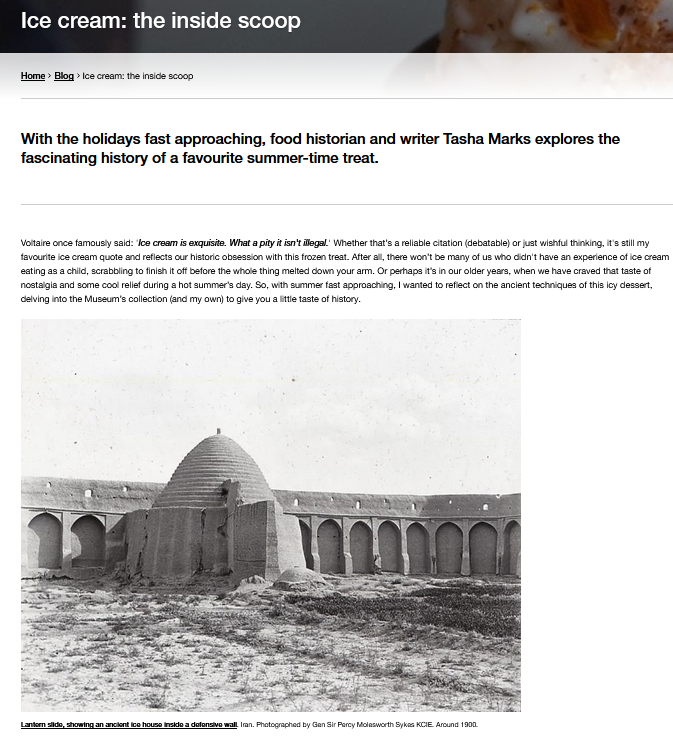
Now, settle yourself down with that pistachio and ciocolata gelato and read real writing on the subject. This from the British Museum. Please note that the ice house pictured below is also, weirdly, just by a City Wall. But this time in Mesopotamia.
Blog Page from British Museum showing picture of an ancient Mesopotamian Ice House by a defensive wall.
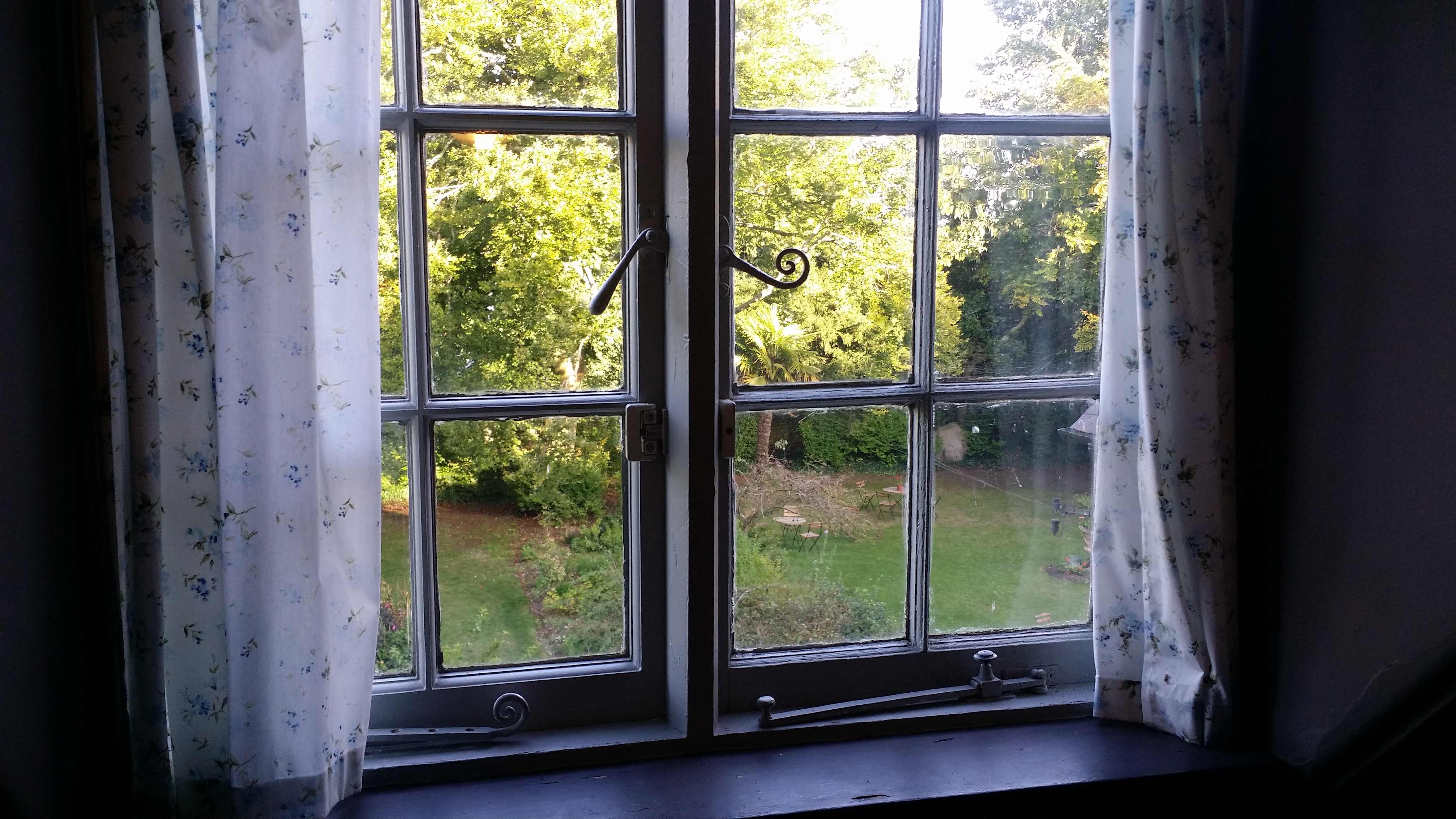
Through the window of Hardy’s Max Gate house, you can see a Prehistoric Sarsen Stone, originally part of a neolithic stone circle or henge. (bottom right window pane, top left corner). Photo: Kevin Flude of Hardy’s Henge
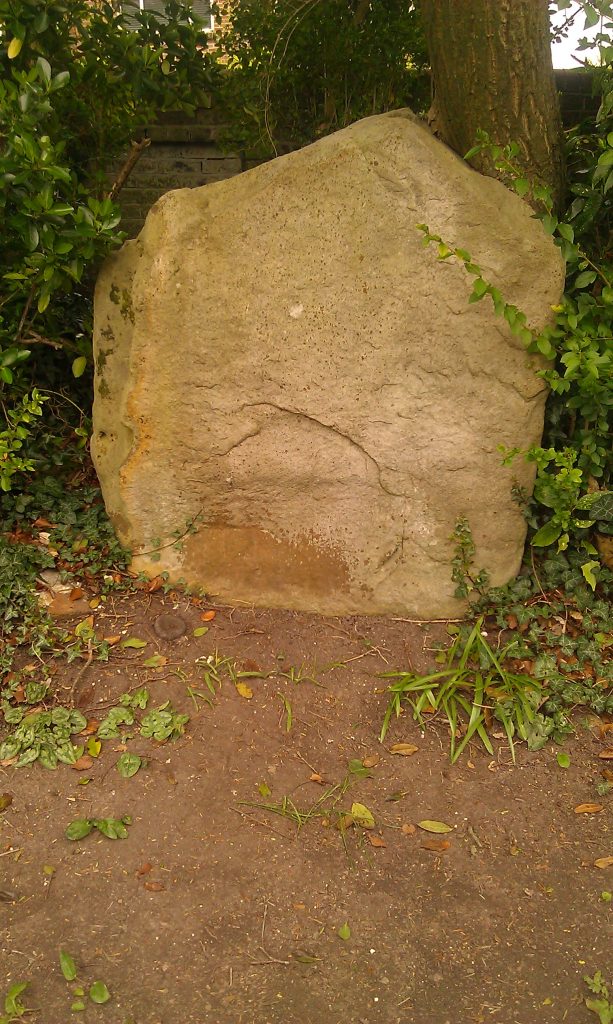
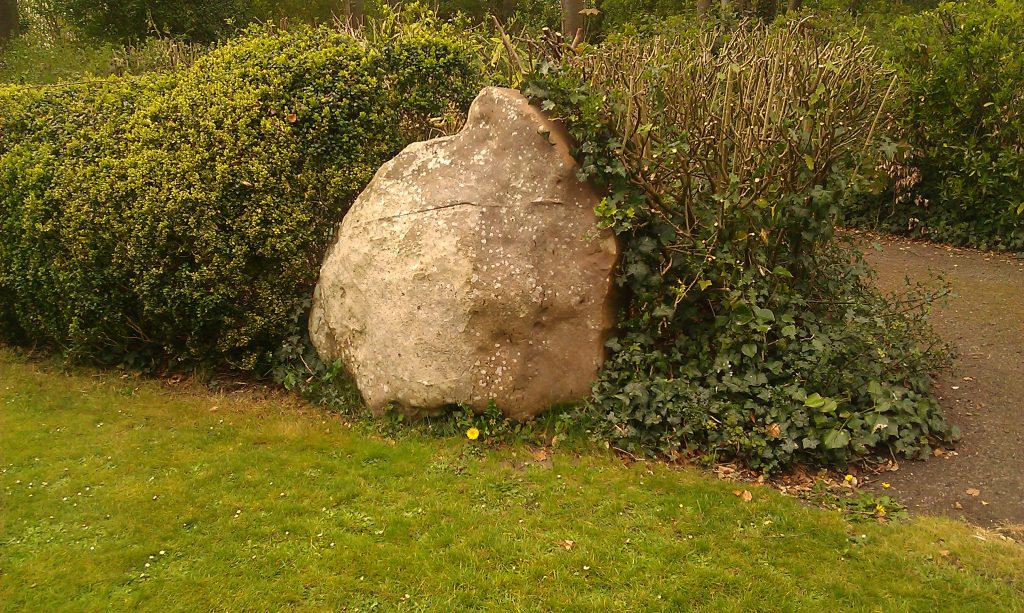
Author of ‘Tess of the d’Urbervilles’ Thomas Hardy was an architect and designed his own house. During the work on Max Gate, the builders came across a large block of sandstone. The stone is of a type called ‘Sarsen’ at Stonehenge. it is ‘a type of silcrete, a rock formed when sand is cemented by silica (quartz)‘. It is a hard sandstone.
Hardy, who loved history, had it relocated into his garden and called it his ‘druid stone’. This recalls one of the most famous scenes in ‘Tess’. She is sleeping on the Altar Stone at Stonehenge as the Police move in to arrest her for murder. Angel, her lover, persuades the Police to let her enjoy a few more minutes of peaceful sleep. After which they arrest her, try her, find her guilty and hang her at Winchester. Spoiler alert?
The Altar Stone at Stonehenge, by the way, has very recently been discovered to be from Scotland. A discovery that confirms that Stonehenge was an immensely important site in the Neolithic and Bronze Age.
Sarsen stone at Max Gate (photo Kevin Flude)Sarsen stone at Max Gate (Photo Kevin Flude
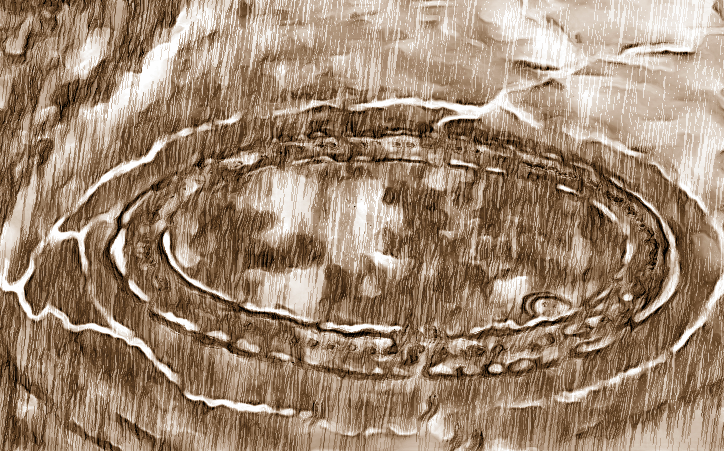
Hardy loved history. How glad he would have been to know his house was in the middle of an important Henge. Hardy’s Henge (aka Flagstones) turns out to be older than Stonehenge. In the 1982. a geophysical survey in advance of the Dorchester Bypass was undertaken. It found evidence of a circular enclosure outside Hardy’s house. This was followed by an excavation in 1987-8. This discovered a large circular bank 100m in diameter, from the Neolithic period.
Half of Flagstones, is largely preserved beneath Max Gate, and has now been officially listed and protected. The excavations suggested a date of construction of 3,000 BC, about the time of Stonehenge’s first construction. But it has just been redated to 3,200BC making Flagstones older than Stonehenge!
Max Gate, Hardy’s House on the outskirts of Dorchester, Dorset. Photo Kevin Flude
In 2022, targeted excavation designed to explore the other half of the circle revealed further dating evidence. This suggests it was built 500 years before Stonehenge, earlier than 3,500BC. The suggested date of 3650BC makes it one of the earliest in the South West. It was giving listed protection on the August 19th, 2024. (redated to 3650BC)
Susan Greaney – Greaney, S. et al. (2025) “Beginning of the circle? Revised chronologies for Flagstones and Alington Avenue, Dorchester, Dorset”. Antiquity, First View (28). Cambridge University Press: 1-17. (Source Wikipedia)
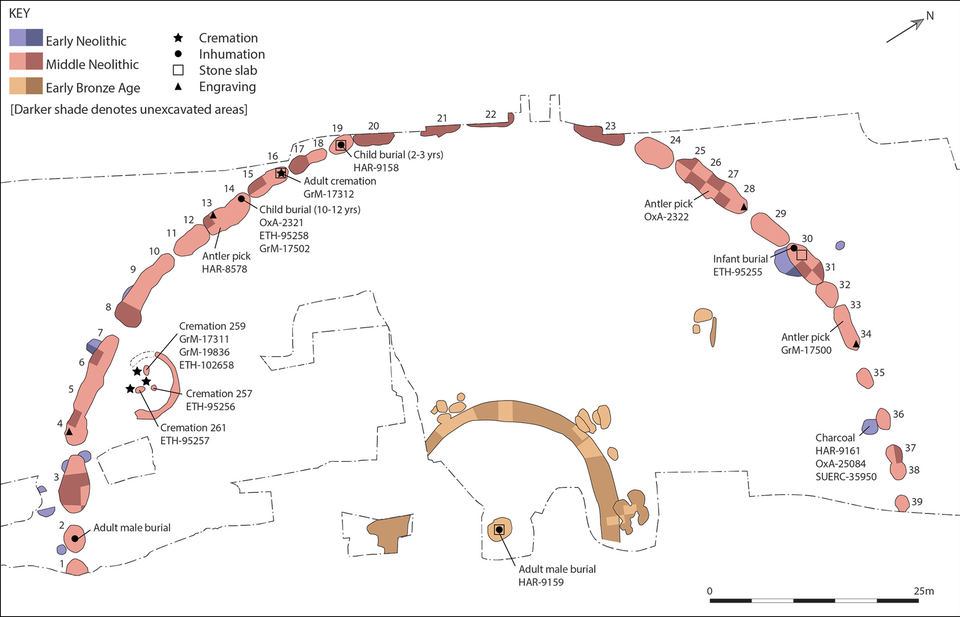
The enclosure consists of a single ring of unevenly spaced pits, forming an interrupted ditch system roughly circular. The dating evidence does not prove that this circuit was built before 3,500 BC. But it does show there was a neolithic presence on the site at this early date. Burials were found in the bottom of the pits forming the enclosure. Four of these pits were had markings on the lower pit walls. These were cut by flint forming pictograms of varying forms from curvilinear, to linear. There was little activity in the Late Neolithic. The site seems to have been reused for funerary and ‘other practices’ during the Bronze, Iron Ages and Roman period.
Flagstones sketchup sketch from original by Jennie Anderson (https://www.bbc.co.uk/news/articles/cge12yeqv43o)
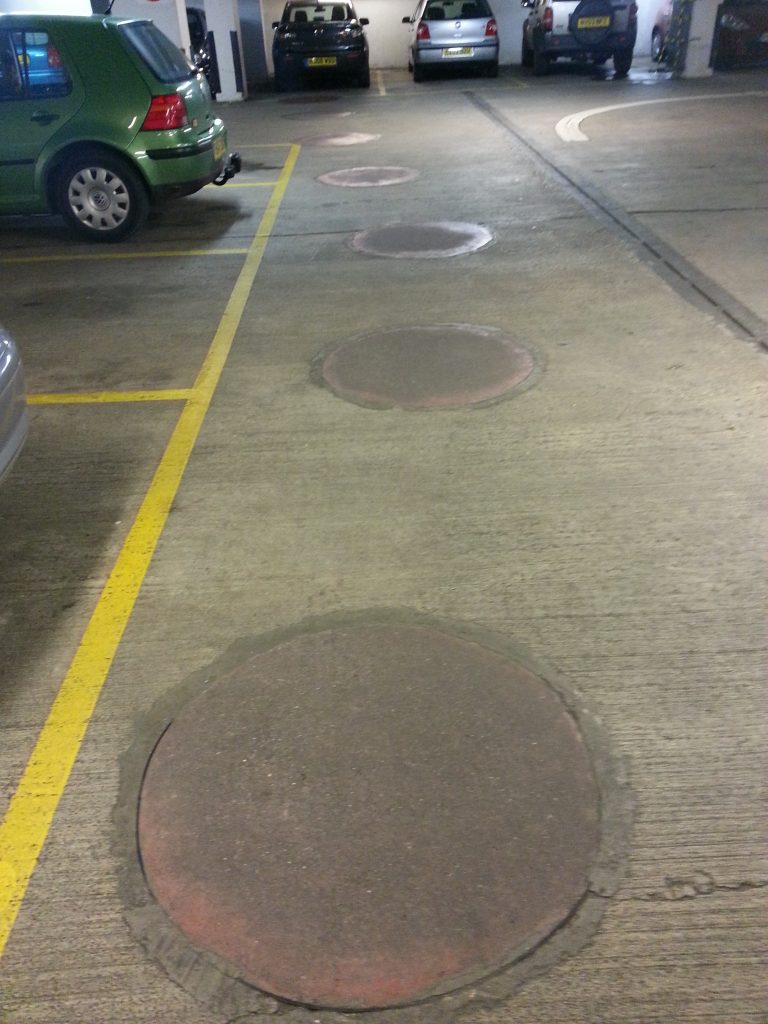
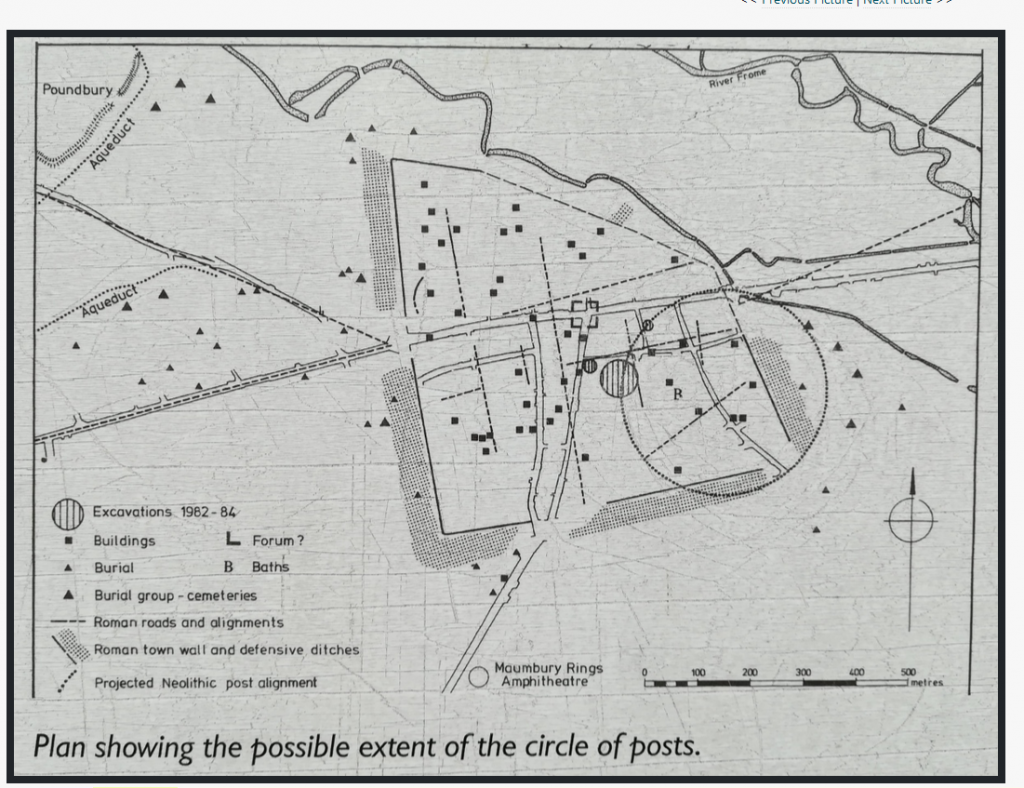
These recent finds make Hardy’s Henge an important precursor to Stonehenge. The site is built on a ridge parallel with the River Frome. Dorchester, a couple of miles from Max Gate, is another ‘ritual landscape’ like Stonehenge. Here are a cluster of important Neolithic and Bronze Age monuments. In the centre of the Town, was found evidence of a massive wooden circle. The postholes are found marked on the floor of the town centre car-park as shown below. The Great Henge is a massive 360m in diameter, covering much of the much later Town Centre. It was built in around 2100 BC.
Neolithic Circle in Dorcester (photo Kevin Flude)
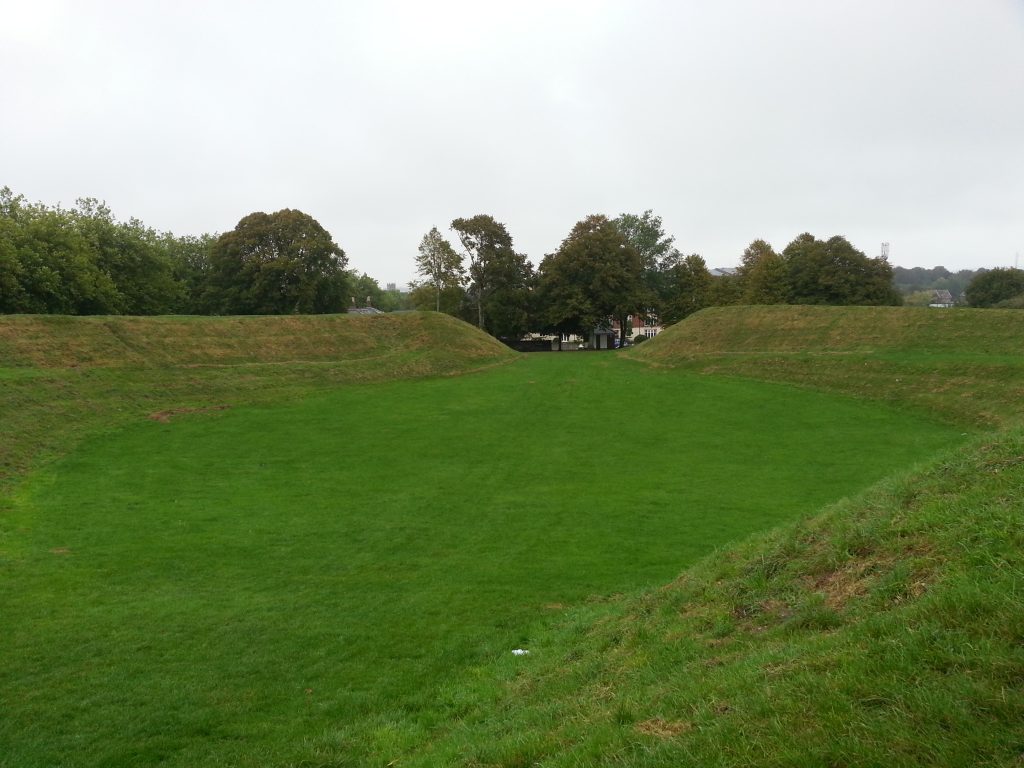
Just outside of Dorchester is a Roman Amphitheatre. This is where Hardy sets the reunion of the Mayor of Casterbridge and Susan Newson. She was the wife he sold at a county fair, years ago when he was a young man. But it began life as another Neolithic circular enclosure. This had an external bank, and an inner Ditch in which were dug 44 tapering pits, up to 10m in depth. Antler picks, chalk objects, including chalk phalluses, were found. The disused amphitheatre was used for executions in the early modern period.
Maumbury Rings – Neolithic Enclosure, Roman Amphitheatre, place of execution, Civil War defense, and fictional meeting place of the Mayor of Casterbridge and his estranged wife, Susan Newson (or Henchard!)
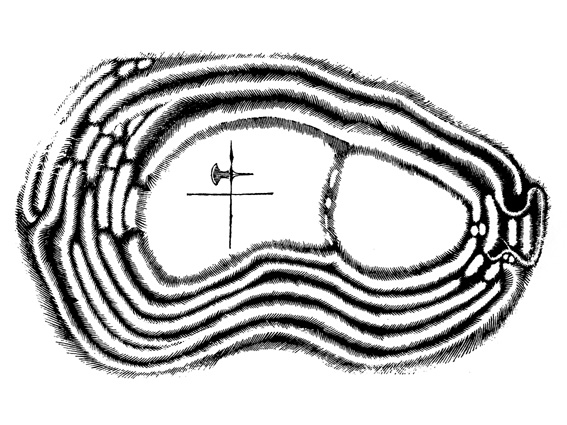
A few miles away, at the Iron Age Hill Fort of Maiden Castle, is a Neolithic Causewayed Enclosure. Hardy also wrote about Maiden Castle, and an excavation.
Maiden Castle. Iron Age Hillfort. the East End was originally a Neolithic Causewayed Enclosure
These ritual landscapes, such as Dorchester, Stonehenge, Avebury, Heathrow and elsewhere shows a clustering of ritual places in important landscapes. It suggests evidence of regional organisation. Stonehenge, however, continues to lead the way for evidence of not only regional but international importance. It drew people, and objects from not only England, Scotland and Wales, but also from the continent.
For further details of the Flagstones listing and excavation, here is the official listing document:
August was originally ‘sextilis’ or the 6th Month of the ten-month Roman Calendar. It became the 8th Month when January and February were added to the calendar to make a 12 month year. By tradition, this happened during the reign of King Numa Pompilius. Originally set as a 29-day month but changed to a 31-day month in the reforms of Julius Caesar. It was subsequently renamed August by a sycophantic Senate trying to flatter the divine Octavian, Emperor Augustus. (more of my posts about the Roman Calendar here and here)
The Celtic August
In modern Irish, it is Lúnasa, which means the month of the festival of Lughnasa. It is a harvest festival, celebrating the ripening of wheat, barley, rye, and potatoes. In Ireland, it is the festival of the God Lugh, celebrated with games, fairs, and ceremonies. Lughnasa is 6 months after Imbolc. It marks the ending of lactation of lambs and the beginning of the tupping season. (impregnation of the ewes). It can be celebrated by climbing hills, visiting springs, wells, lakes and eating bilberries. (Myths and Legends of the Celts. James MacKillop).
In Welsh, it is Awst which comes from the Latin. Called Calan Awst in Wales, it is the festival of August. In Gaelic Scotland it is called Lunasuinn, and Laa Luanistyn in the Isle of Man.
Lughnasa is one of the Celtic quarter days,. They are halfway between the Solstices and Equinoxes. They are: Samhain (1 Nov) Imbolc (1 Feb), Beltane (1 May) and Lughnasa (1 Aug). All are, or can be seen to be, a turning point in the farming year.
The Gallic Coligny ‘Celtic’ Calendar records August as a ‘great festival month’. The stone-carved Calendar was found near Lyon, whose Roman name was Lugodunum. The town is named after the Gaulish God Lugos. It is thought he is related to the Irish God, Lugh and the Welsh Llew Llaw Gyffes. He has an unstoppable fiery spear, a sling stone, and a hound called Failinis. The Romans associate Lugos with Mercury, and the Church associated Lugh with St Michael.
Lughnasa was founded by Lugh himself to honour his foster mother Tailtiu at Brega Co. Meath. Tailtiu became one of Ireland’s greatest festivals, springing from the horse races and marital contests set up by Lugh.
Anglo Saxon August
In Anglo-Saxon: the Venerable Bede, writing in the 8th Century, says August is Wēodmōnaþ or the Weed Month. Named because of the proliferation of weeds. Why does that seem such an unsatisfactory name for August? An early Kentish source calls the month Rugern – perhaps the month of the harvest of Rye? (Winters in the World by Eleanor Parker).
Lammas
For the Anglo-Saxons, August brings in the harvest period. This is the most important months of the year. The Harvest brings in the bounty of the earth. It needs to be carefully collected, enjoyed but not wasted. It begins with the festival of Lammas, which derives from the English words for bread and mass. The Bread Mass when bread made from the first fruits of the harvest is blessed.
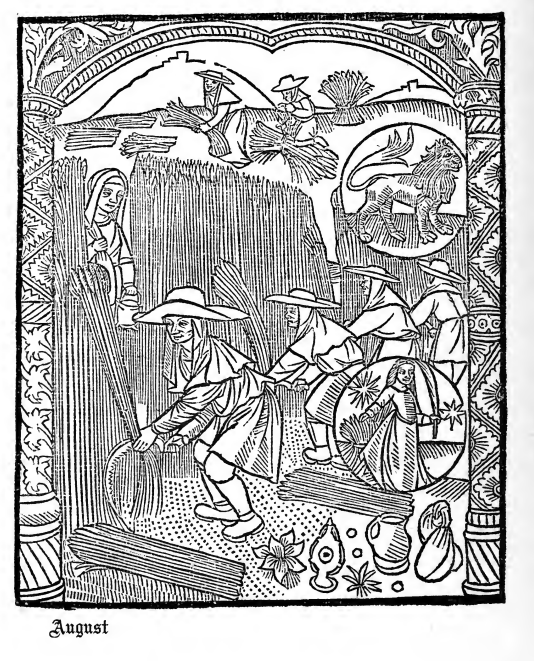
Kalendar of Shepherds
Kalendar of Shepherds, August
The 15th Century illustration in the Kalendar of Shepherds, above, shows that the Harvest is the main attribute of the Month, and the star signs, Leo and Virgo.
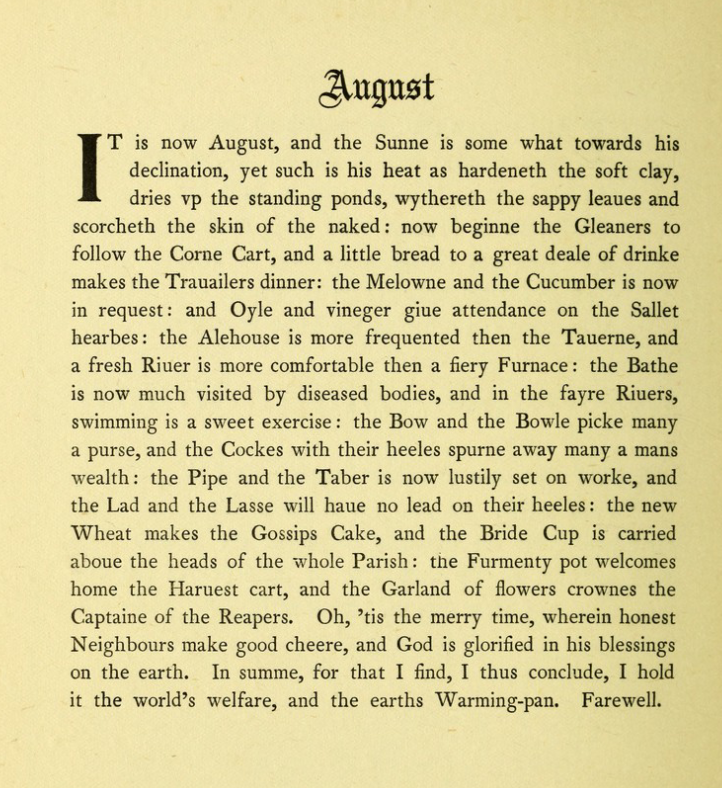
The 16th/17th Century text in the Kalendar of Shepherds gives an evocative insight into the month.
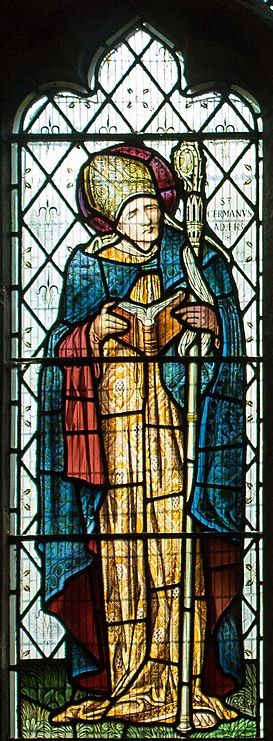
St Germanus of Auxerre, Window in St Paul’s parish church, Morton, Lincolnshire, made by Sir Edward Burne-Jones and William Morris in 1914. Photo by Jenny of Jules & Jenny from Lincoln, UK (CC BY 2.0 Wikimedia Photo by Jenny of Jules & Jenny from Lincoln, UK)
St Germanus is the source of one of the few contemporary references to Britain in the 5th Century (the Dark Ages). One of his followers wrote his life story. The Saint, a Bishop in France, was sent to Britain because the Pelagian Heresy was endangering the Catholic version of Christianity. Pelagius was a highly educated British (or possibly Irish) priest who moved to Rome in the late 4th Century. He lived by a strict moral code, attacking Catholic laxity and opposing St Augustine of Hippo’s theory of Divine Grace. By contrast, Pelagius promoted human choice in salvation and denied the doctrine of original sin. Wikipedia tells us that he:
considered it an insult to God that humans could be born inherently sinful or biased towards sin, and Pelagius believed that the soul was created by God at conception, and therefore could not be imbued with sin as it was solely the product of God’s creative agency.
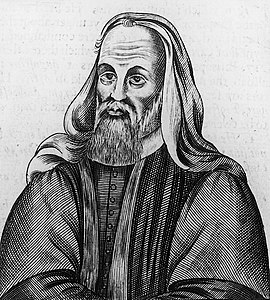
17th Century print of Pelagius
Germanus was sent to Britain, where he confronted Pelagian converts in a public debate which is thought to have taken place in a disused Roman amphitheatre. The author is not interested in Britain, per se, so does not tell us which town it was, but, it is mostly assumed to be St Albans, although London is possible.
In the stadium, the Saint and his acolytes confound the heretics and, so, convert the town’s people sitting watching the debate. St Germanus goes to a nearby shrine of St Alban to thank God, falls asleep in a hut, and is miraculously saved from a fire. He then comes across a man called a Tribune, and helps defeat a Saxon army in the ‘Alleluia’ victory. The importance of all this is that it gives us a few glimpses of Britain, in about 429AD, two decades after the Romans have left.
The British Bishops were led in their heresy by someone called Agricola. The writer describes these bishops as ‘conspicuous for riches, brilliant in dress and surrounded by a fawning multitude’. The use of the title ‘Tribune’ in the story suggests Roman administrative titles are still in use 19 years after the date of the ‘formal’ end of Roman Britain, 410AD. The Alleluia victory over the Saxons also gives us an early date for Saxon presence in the country as an enemy.
St Albans is the favoured choice for the location of the event because, Bede tells us St Albans was born, martyred and commemorated in Verulamium, now called St Albans. Archaeology shows possible post Roman occupation of the town. And it has a famous Amphitheatre.
However, Gildas, who is writing 200 years or more before Bede, tells us St Alban was born in Verulamium but martyred in London. This makes sense as London was the late Roman Capital and more likely to be the site of a martyrdom. There is also a church dedicated to St Albans close to the Roman Amphitheatre, where Gildas tells us the execution took place. Unfortunately, the Church cannot be, archaeologically dated back to 429AD.
Bede’s account of the martyrdom of St Albans is also somewhat farcical, as God divides the waters of the River Ver for Alban to get to his martyrdom more quickly. The bridge was said to be full of people walking to witness Alban’s execution, and blocking Alban’s path to Heaven. But the Ver is but a piddle, and it would be easy to walk across without even needing wellington boats, let along a miracle. This story is much more impressive, in Gildas’ version who has the miraculous crossing over the River Thames.
Had Pelegius won, and the Roman Church had a more optimistic view of the human spirit, would it have made any difference? It’s a big question, but maybe it would have left less room for pessimism and guilt?
What were the effects of original sin? …. it damaged our relationship with God. He seemed distant, we became mistrustful. We lost sanctifying grace. The weakening of the will, making us more prone to temptation. The darkening of the intellect. Increased vulnerability to sickness and disease. Spiritual death.
Germanus died in Ravenna. The story of his life by The Life of St. Germanus, Bishop of Auxerre by Constantius of Lyon written shortly after his death is a crucial source for the study of the 5th Century in Western Europe. It is an epic period where Imperial and Barbarian groups are fighting for control of Britain, France, Spain, Africa and Italy. There are competing views of what Christianity is and should be. not only the heresy of Pelagians but also the Arian Heresy which the German people tended to support. There were also the Nestorian and Eutychian heresy. I’ve just read a 2020 article about the Life of St Germanus by Leon Mintz which you can read here:
For more on Nick Fuentes and his theories on St Germanus, St Patrick and King Arthur read my post here:
Screenshot of BBC Webpage annoucing the attack on the Stone of Destiny
I just tried to book a visit to see the Stone of Destiny, at Perth Museum. But I was told it was closed until at least the end of August. The reason being that a case had been damaged. A quick search revealed this notice that an Australian had attacked the case containing the Stone with a hammer. They are now repairing the Case, and double checking the condition of the stone, which is thought to be undamaged. The Stone is well protected in a special room of the Museum. But, until now, those booking to see it are not searched. So I imagine that this will become more formal in future.
Below is my post of 2024, updated on March 30th 2025.
New Home for the Stone of Destiny
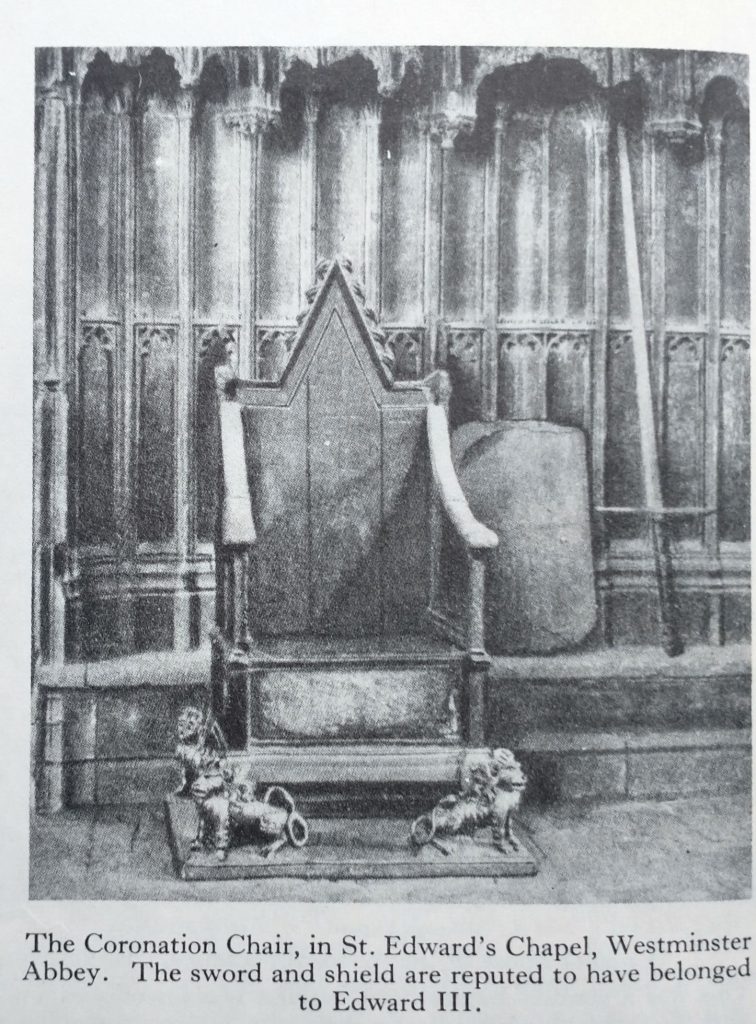
Old Photograph of the Stone of Destiny beneath the Coronation Chair.
Last year, the Stone of Destiny was set up in its new permanent place. The Stone was unveiled in a room at the centre of the redeveloped Perth Museum, in Scotland. This is near to its ‘original’ home at the Palace of Scone.
‘£27m development project ….funded by £10m UK government investment from the £700m Tay Cities Deal and by Perth & Kinross Council, the museum is a transformation of Perth’s former city hall by architects Mecanoo.’
As well as the Stone of Destiny, the Museum has Bonnie Prince Charlie’s sword and a rare Jacobite wine glass. Both on public display for the first time. This is the first time the sword has been in Scotland since it was made in Perth in 1739. https://perthmuseum.co.uk/the-stone-of-destiny/. Since I first wrote this I have visited about 5 times. Entry is free but needs to be booked. It is held in a separate structure in the open space at the heart of the Perth Museum. There is an excellent-animated introduction, and then the doors open and the Stone is revealed in a glass cabinet. It is very effective.
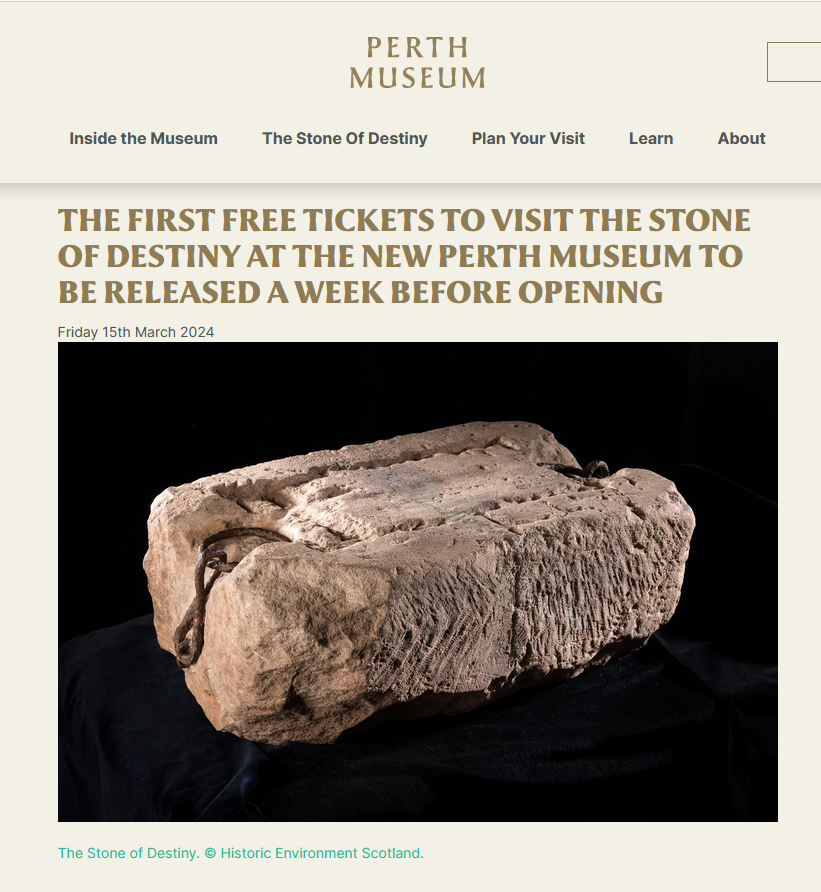
Webpage of the Perth Museum show a photo of the Stone of Destiny
The Stone of Destiny in the Modern Era
Before Perth, the Stone was in London for a brief visit for the Coronation of King Charles III (6 May 2023) . It was put back, temporarily under the Coronation Chair. Before that it was on display in Edinburgh Castle. Tony Blair’s Labour Government sent it back to Scotland as a symbol of the devolution of power from Westminster. This was on the occasion of the restoration of the Scottish Parliament in Edinburgh in November 1996. Until then the Stone was under the Coronation Chair, where Edward I put it after he stole it (1296) from Scone. Virtually every English and British King has been crowned upon the Stone of Scone.
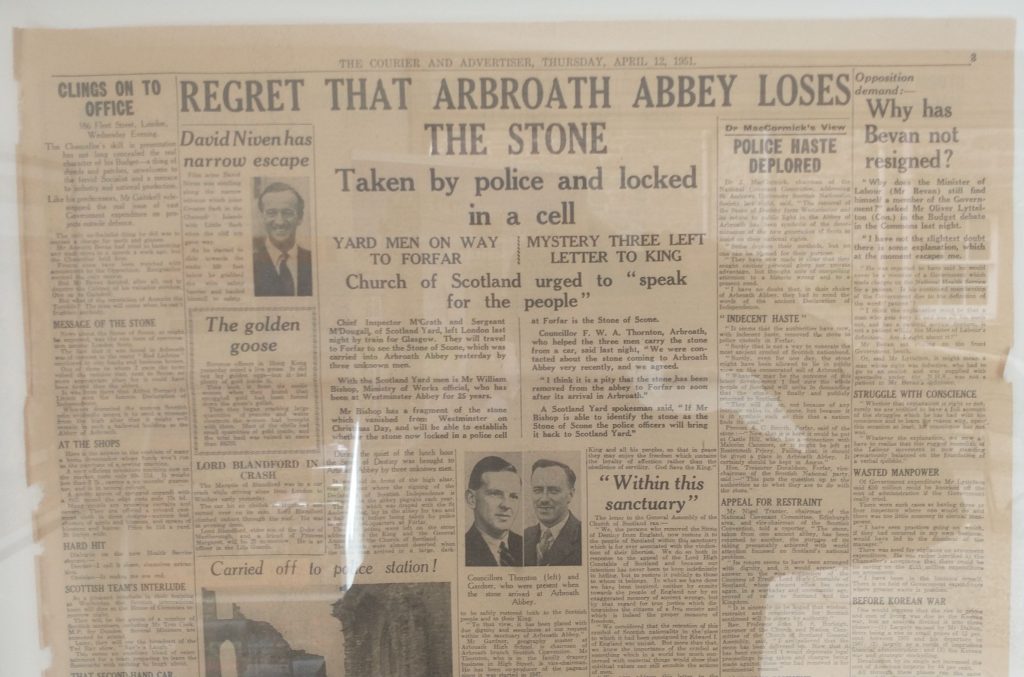
However, the Stone had a brief holiday in Scotland in 1950/51. Four Scottish students removed it from Westminster Abbey on Christmas Day 1950. After three months, it turned up at the high altar of Arbroath Abbey. It was briefly in a Prison Cell, then returned to Westminster for the Coronation of Elizabeth II.
Poor photograph of a press cutting on display at the Palace of Scone (Photo by me!)
Declaration of Arbroath
I’m guessing the-would-be liberators of the Stone, thought Arbroath was the most suitable place to return it. For it was the Declaration of Arbroath which is the supreme declaration of Scottish Independence from England.
Following the Battle of Bannockburn the Scots wrote to the Pope of their commitment to Scotland as an independent nation. They said:
“As long as a hundred of us remain alive, never will we on any conditions be subjected to the lordship of the English. It is in truth not for glory, nor riches, nor honours that we are fighting, but for freedom alone, which no honest man gives up but with life itself”
The Pope agreed and Scotland remained independent until voluntarily joining England in the United Kingdom in 1707.
Before Edward 1 stole the Stone, it was at Scone Palace. Here most of the Kings of Scotland were crowned, including Macbeth (August 14, 1040).
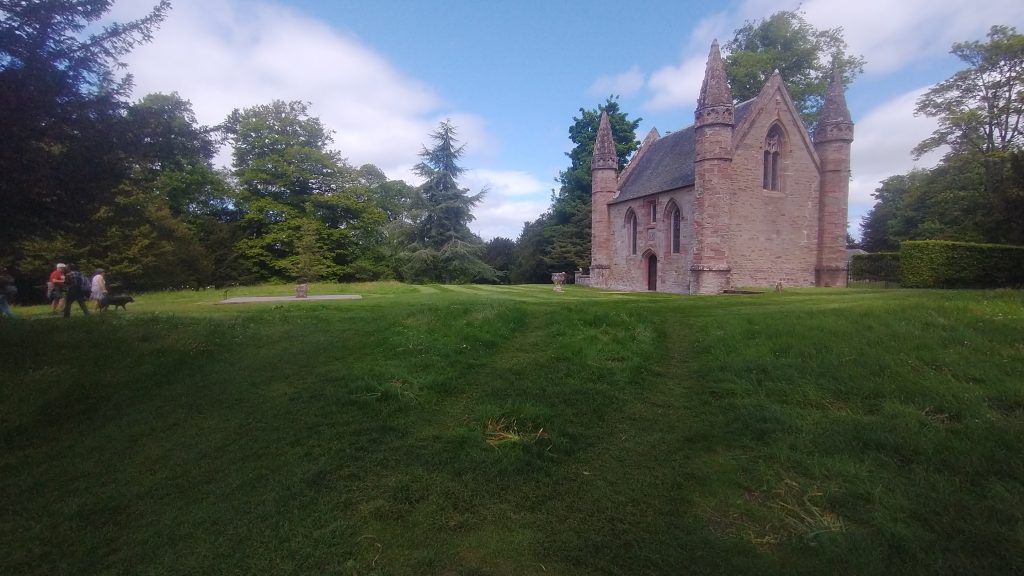
Moot or Boot Hill where Scottish Kings were crowned. Palace of Scone Photo Kevin Flude)
Those who attended the coronation traditionally shook their feet of all the earth they had brought from their homelands. This over the centuries, grew into Boot Hill, aka Moot Hill. So the mound represents the sacred land of Scotland. 42 Kings were crowned upon its soil on its Stone. (but not Mary Queen of Scots she and her son were crowned at the Chapel Royal of Stirling Castle).
Where was the Stone of Destiny before Scone?
Before Scone, it was, possibly, in Argyllshire where the Gaelic Kings were crowned. Their most famous King was Kenneth MacAlpin. He united the Scots, Gaelic people originally from Ireland, the Picts, and the British. And created a new Kingdom which was originally called Alba, but became Scotland.
MacAlpin was the first king to be crowned on the Stone at Scone in 841 or so. He made Scone the capital of his new Kingdom because it was a famous Monastery, associated with the Culdees, an early sect of monks. MacAlpin brought sacred relics from Iona to sanctify the new capital. And Scottish Kings were by tradition crowned at Scone and buried on the holy Island of Iona.
Legend has it that the Scots bought the Stone from Ireland when they began to settle in Western Scotland (c500AD). The Scots, it is said, got the Stone from the Holy Land. Jacob lay his head on the stone to sleep. He had a dream of Angels ascending and descending a ladder to Heaven. Jacob used the stone as a memorial, which was called Jacob’s Pillow (c1652 years BC).
Fake, Copy or Genuine?
But, questions about the Stone remain. Firstly, would the Monks of the Abbey meekly hand over the stone to a raging King Edward I? Sacking the Abbey was one of the last events of Edward’s failed attempt to unite the two countries. Isn’t it more likely that they hide the original and gave him a fake?
Secondly, was the Stone brought to Scone from Western Scotland in the 9th Century? Or was it made in Scone?
These questions of doubt are based on the assumption that the Stone is made of the local Scone sandstone. If it were brought to Scone from somewhere else, it would be in a different type of stone, surely? So, either it was made in Scone, possibly for MacAlpin’s Coronation or the Monks fooled the English into taking a copy. The English would then have been crowning their Monarchs on a forgery.
Ha! Silly English but then the Scots have spent £27m on the same forgery.
Before bringing the stone to Scone, Historic Environment Scotland undertook a new analysis of the stone. This confirmed:
‘the Stone as being indistinguishable from sandstones of the Scone Sandstone Formation, which outcrop in the area around Scone Palace, near Perth‘.
It also found that different stone workers had worked on the stone in the past. It bore traces of a plaster cast being made. It had markings which have not yet been deciphered. There was copper staining suggesting something copper or bronze was put on the top of it at some point in its life.
So it seems the Stone of Destiny was made in Scone. The simplest explanation is that it was made for MacAlpin in the 9th Century. But it does not rule out that it is a copy given to Edward I. But if this is the case it is still an awesome relic of history as so many Kings and Queens, Scottish and English, have been crowned upon it.
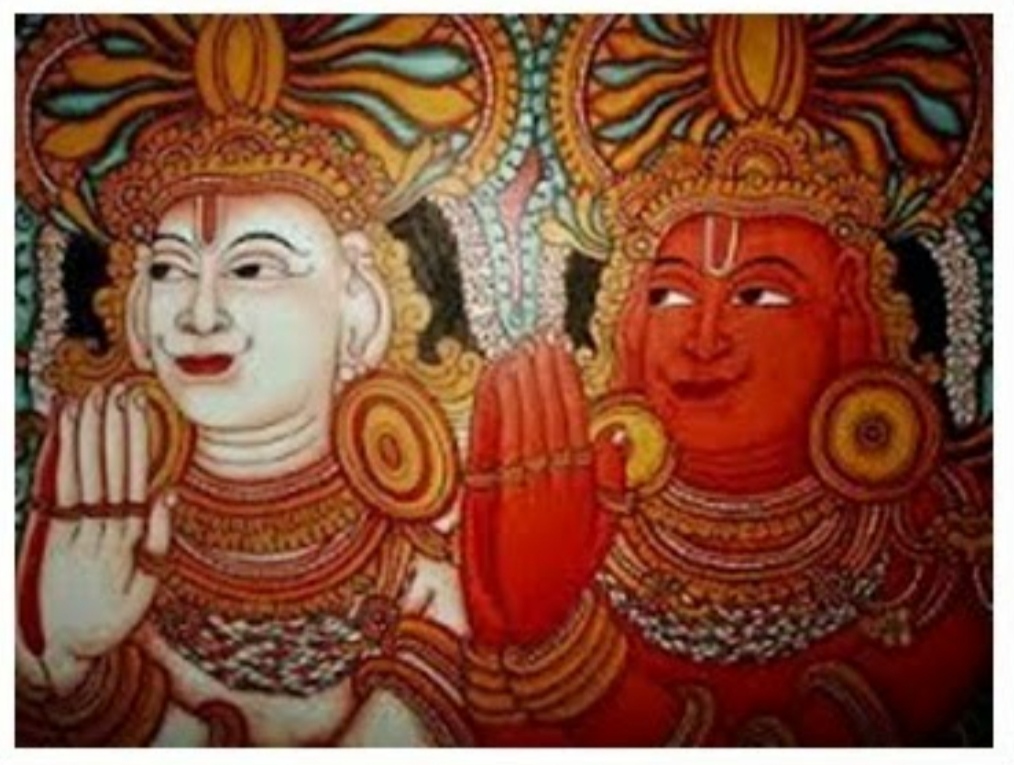
The Ashwini kumaras twins, sons of the sun god Surya. Vedic gods representing the brightness of sunrise and sunset Wikipedia
The Divine Twins, aka the Dioscuri, were horsemen. Patrons of calvary, athletes and sailors, one of many Indo-European twin gods. They had many adventures including sailing with Jason and the Argonauts.
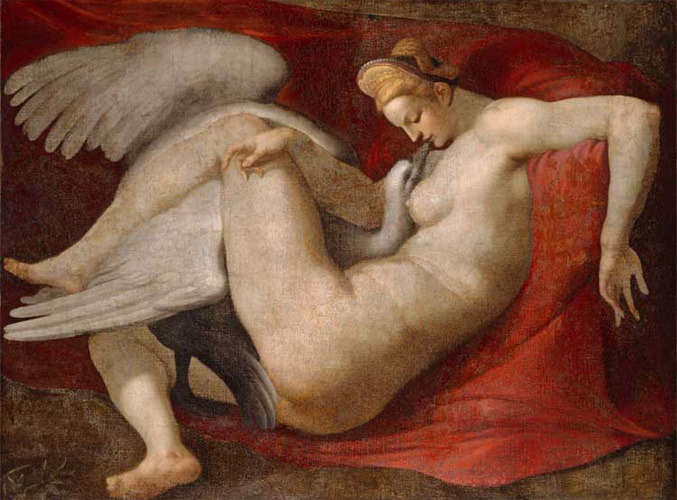
And are they well connected?! Pollux is the son of Zeus His twin brother has a different and mortal father, the King of Sparta. But the boys share the same mother, Leda. She was raped by Zeus in the guise of a swan.
This makes them examples of heteropaternal superfecundation as Mary Poppins didn’t sing. But their different paternity had consequences. The most important is that one was (is?) therefore immortal and the other wasn’t.
According to some version of the story, Castor (the mortal one) was mortally wounded. Zeus gave Pollux the option of letting his brother die while Pollux could spend eternity on Mount Olympus. The alternative was to share his immortality with his brother. Pollux did the good thing. So the twins spend half their year as the Constellation of Gemini and the rest, immortal, on Mount Olympus. Thus, they are the epitome of brotherly love.
Divine Twins or Sisters from Hell?
The Dioscuri’s sisters were no less than Helen of Troy and Clytemnestra. Never mind the Brothers, what Sisters! Helen of Troy you know. And Clytemnestra! They were also twins, Helen the divine daughter of Zeus, husband of Menelaus, lover of Paris. Sister, Clytemnestra, mortal daughter of the King of Sparta, husband of Agamemnon (brother of Menelaus).
It happened like this. The Swan was being pursued by an eagle, so Leda protected the Swan and took it to bed. On the same night she slept with her husband Tyndareus of Sparta. Two eggs were fertilised, each split in two to give two sets of twins.
She was the wife of Agamemnon, the arrogant leader of the Greeks. On the way to retrieve Helen from Troy, the Greek Fleet was becalmed. So, following his seers’ advice, Agamemnon sacrificed his own daughter, Iphigenia, on the island of Aulis. The Gods then set the winds fair to Troy. (Read Iphigenia at Aulis by Aeschylus, a great play which I studied in Classical Studies at University).
Meanwhile, Queen Clytemnestra, abandoned at home, broods on her husband’s heartless fillicide. She takes a lover. After 10 years of war, Agamemnon comes back, in triumph, from the destruction of Troy. He brings with him his prize, the Trojan Princess, Cassandra, sister of Hector.
Cassandra has been gifted with the ability of accurate prophecy. But, as often in the case of prophecy stories, the gift came with a sting in its tale. She was also cursed with the inability to get anyone to believe her! She prophesies disaster and that she too will be a victim.
Strutting with arrogance, Agamemnon demands Clytemnestra prepare him a bath. And, so she runs it for him, and she gives him the hottest bath possible. With the help of her lover, she hacks Agamemnon to pieces with an axe. Cassandra is butchered.
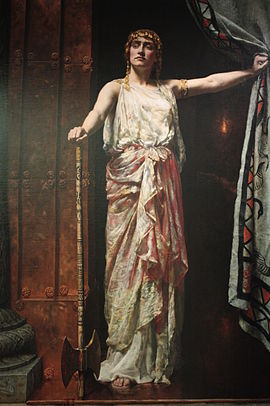
Clytemnestra by John Collier,_1882 (Wikipedia Guildhall Museum)
Attitudes
I visit John Collier’s painting of Clytemnestra at the Guildhall, in London, regularly. I am fascinated by her grim, yet satisfied, expression.
In the 18th/19th Century, rich people were into ‘attitudes’. For example, Emma Hart, later Lady Hamilton, would be invited to present an attitude in front of a dinner party of mostly male aristocrats. She would dress up in a flowing, revealing unstructured classical gown. Then she would stand on a table or pedestal, and present herself as Helen or Andromache or any other classical beauty guests might fancy an eyeful of. She would assume an appropriate facial expression and posture for everyone’s pleasure.
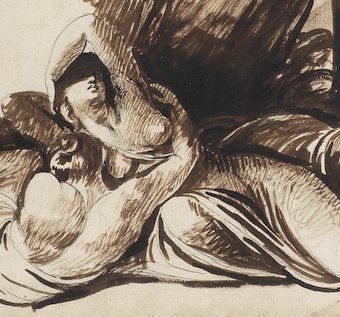
Detail of Emma Hart modelling as Iphigenia by George Romney in ‘Cimon and Iphigenia’
Being Clytemnestra is, surely, the most difficult? I imagine Collier’s model being prompted to look both sad at the loss of the daughter. Outraged at the arrogance of the husband. Horrified at the gore of the murder. But, overall, she has to portray a grim satisfaction that the bastard got exactly what he deserved.
Dorothy Dene
Lord Leighton had a famous model who was exceptionally skilled at adopting poses for his paintings. He determined to help her with an acting career. As part of the plan he helped improve her cockney accent. It is said this inspired Bernard Shaw’s story Pygmalion, which, in turn, inspired My Fair Lady and Eliza Doolittle.
Leighton’s model was Dorothy Dene. She became a famous actress, outstripping the fame of Ellen Terry and Lily Langtry. For more on Leighton and Dene look at my post here.
John Collier
Before we finish, do have a look at John Collier’s Wikipedia because he is the most ridiculously well-connected painter you can imagine! Related to half the Cabinet and married to TWO daughters of Darwin’s Bulldog, T.H. Huxley (grandfather of Aldous Huxley).
For more on Flaming June see my blog post of 12 July 2024
European Twin Gods
It is suggested that twin male gods are a feature of Indo-European religions. The divine Twins are associated with horses/chariots and are responsible for moving the Sun and the Moon. Their use of a horse above the water means that they can rescue people lost at sea.
St Elmo’s fire was said to be the way they manifested their divinity to sailors. Diodorus Siculus records that the Twins were Argonauts with Heracles, Telamon, and Orpheus. Further, he tells us, in the fourth book of Bibliotheca historica, that the Celts who dwelt along the ocean worshipped the Dioscuroi “more than the other gods”.
July is named for Julius Caesar. Originally, the Roman Month was called Quintilis, as it was the fifth month of the Roman calendar, which originally started in March. Caesar reformed the calendar in 44BC and the Senate renamed the month after him. For more on Roman Months, see my post here.
The 7th month is called Lúil in Irish and Gorffennaf in Welsh. In Anglo Saxon it was Æfteraliða, or “after-mild;”, Liða, means “mild” or “gentle,” or the period of warm weather around Midsummer. June is Arraliða, or “before-mild”.
It is on average the warmest month in most of the Northern Hemisphere, where it is the second month of summer. The star signs are: Cancer (until July 22) and Leo (July 23 onwards),
‘
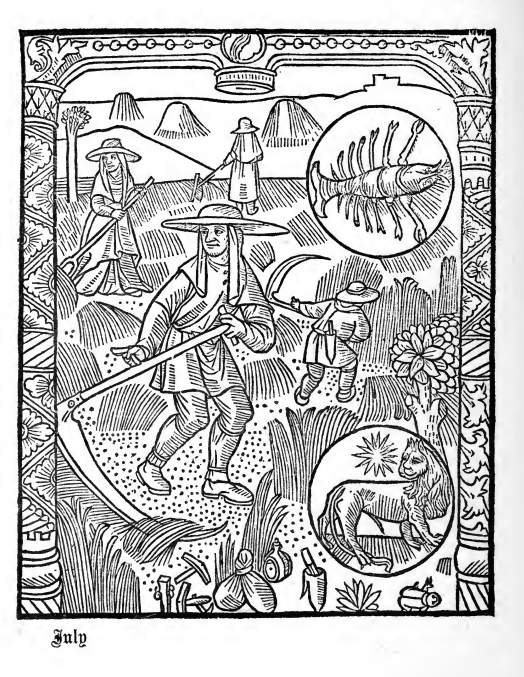
July is the month of Haymaking, as you can see from the image (above from Kalendar of Shepherds). To find out more about haymaking, wait for the next post.
From the Kalendar of Shepherds comes this description of the month.
First published, in 2023 and republished in 2024, 2025
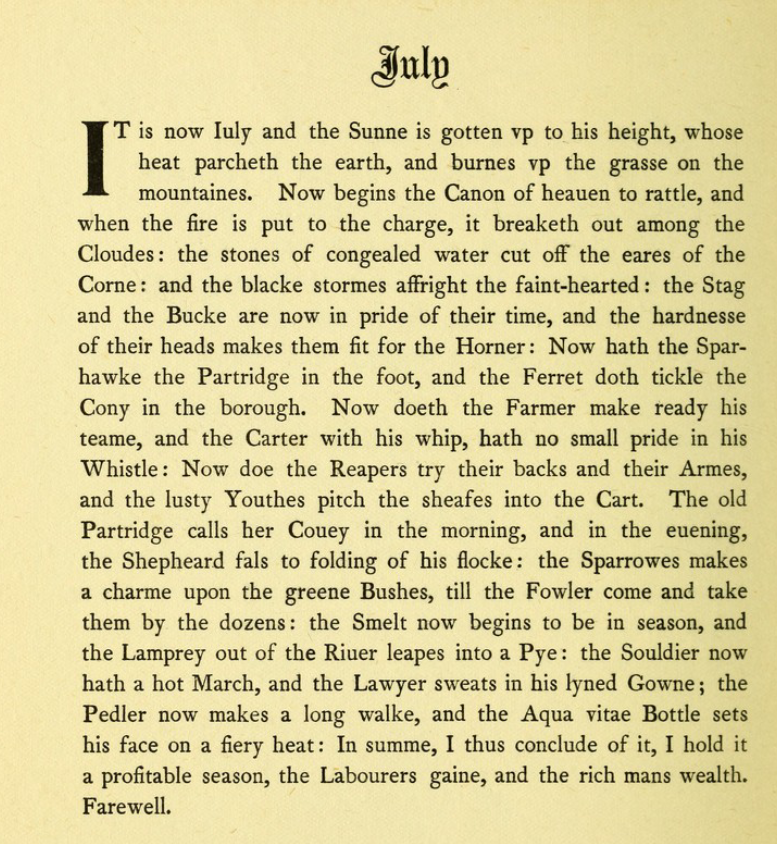
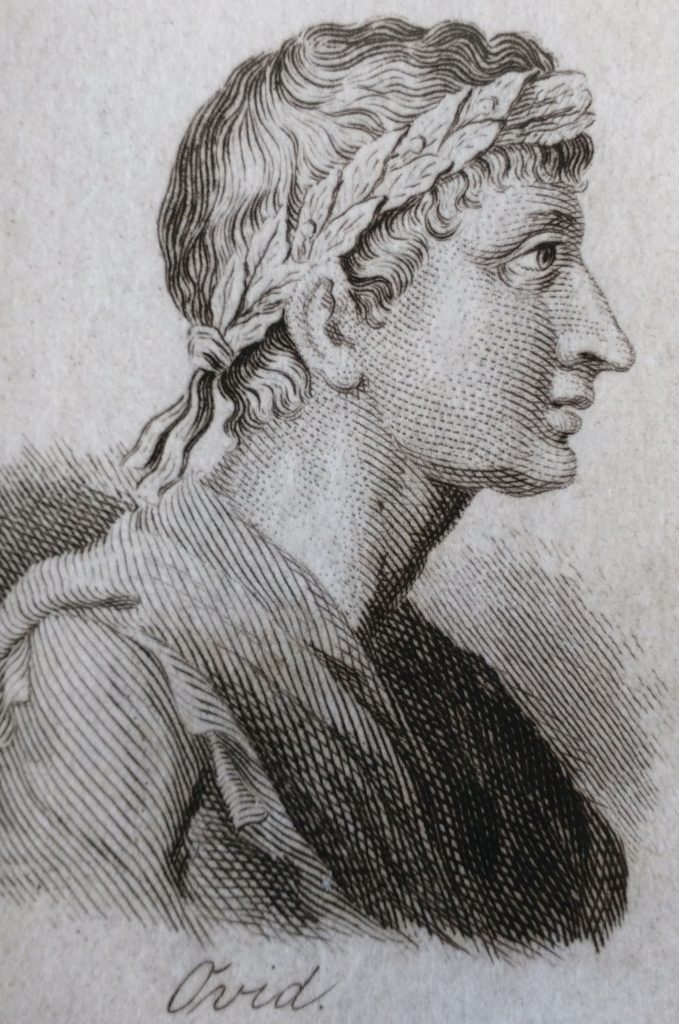
If you want to read Ovid’s almanac of the year, the ‘Fasti’, for yourself, this is the translation I am using. Fasti is very valuable because it tells the stories of the main religious and folk festivals of the Roman year. It also tells the story of the Gods and Goddesses behind the festivals,
Fasti is sadly unfinished because Pūblius Ovidius Nāsō was exiled by the Emperor Augustus. The last entry is for 30th June where Ovid writes: ‘put the last touches to my undertaking’. It suggests he knew he was finished, despite only being halfway through the year.
He was exiled to the Black Sea at Tomis where he died ten years later. It is not clear exactly why he was exiled. Ostensibly it was for the immorality of his book ‘The Art of Love’. But that was published almost a decade earlier. So, it seems a strange, delayed, cause for exile.
Was he involved with a plot against Augustus that saw the Emperor’s own daughter exiled? Her lover was Lullus Antonius, son of Mark Antony. Unlike Julia’s other lovers, he was forced to commit suicide.
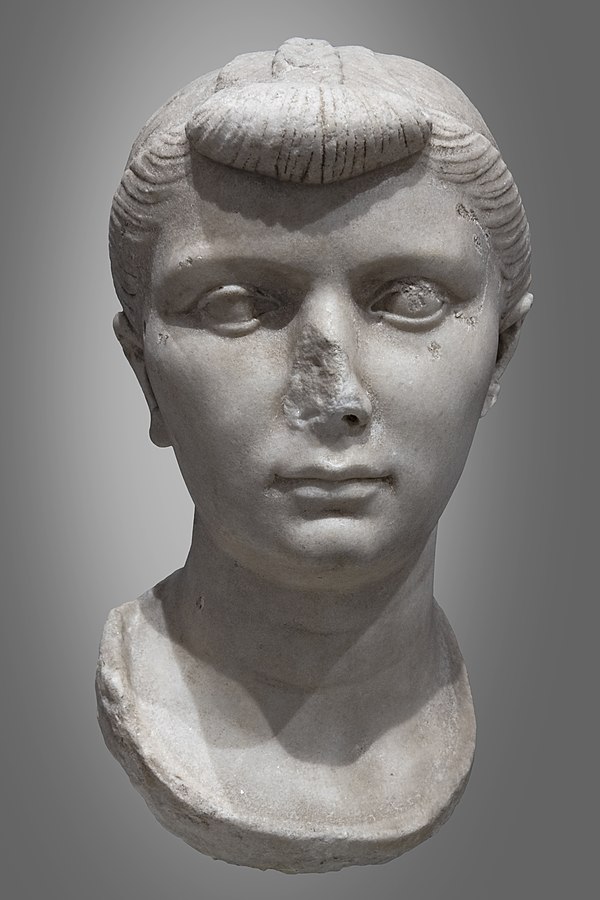
Sculpture of Julia the Elder, daughter of Augustus, divorced wife of Tiberius Public Domain . Musée Saint-Raymond in Béziers
But this also happened years before Ovid’s exile. Julia’s daughter, Julia the Younger, was herself exiled closer to the time of Ovid’s exile. Her husband, Lucius Aemilius Paullus, was executed for treason. So, might this be the context of his exile? No one knows. Ovid said the reason for his exile was a ‘poem and a mistake’. The nature of that mistake is not recorded, but he said the crime was worse than murder and more harmful than poetry.
Here is one of my favourite Ovid quotations. Here he recommends how the aspiring male should dress for a night out on the town:
Don’t torture your hair, though, with curling-iron: don’t pumice Your legs into smoothness. Leave that To Mother Cybele’s votaries, ululating in chorus With their Phrygian modes. Real men Shouldn’t primp their good looks …
… Keep pleasantly clean, take exercise, work up an outdoor Tan; make quite sure that your toga fits And doesn’t show spots; don’t lace your shoes too tightly, Or ignore any rusty buckles, or slop Around in too large a fitting. Don’t let some incompetent barber Ruin you looks: both hair and beard demand Expert attention. Keep your nails pared, and dirt-free; Don’t let those long hairs sprout In your nostrils, make sure your breath is never offensive.
Avoid the rank male stench That wrinkles noses. Beyond this is for wanton women – Or any half-man who wants to attract men.
The translation is from Green, Peter (Trans) ‘Ovid The Erotic Poems’ Penguin Classics, London 1982‘
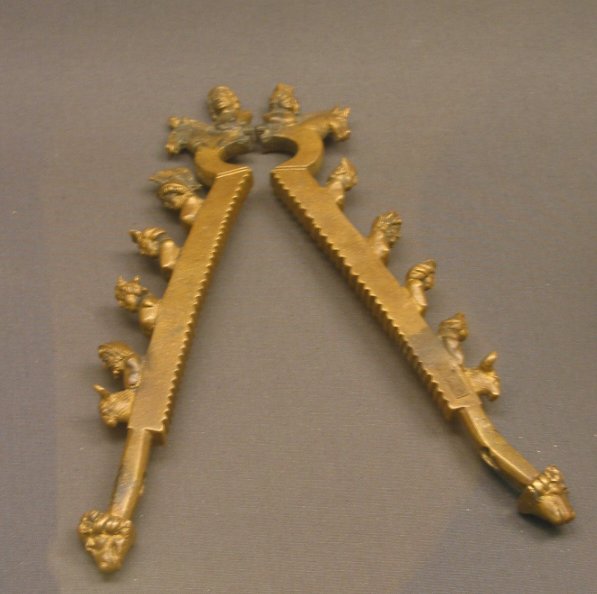
Mother Cybele’s votaries were castrati, hence their high-pitched voices. The Cybele, the Mother Goddess, fell in love with Attys, who made her jealous. She made him mad, whereupon he castrated himself and bled to death. The Goddess had him resurrected body and soul. They enjoyed divine bliss ever after. A Cybelian castration device, dredged out of the Thames, can be seen in the Roman Gallery of the British Museum.
British Museum Castration Device from the River Thames at London Bridge Photo: K Flude
The paragraph above is a quotation from In Their Own Words – A Literary Companion To The Origins Of London‘ D A Horizons, 2009. by Kevin Flude. To buy the Kindle or Paperback version click here.
1381 – King revokes abolition of Serfdom. This had been ‘forced’ upon the Government at Mile End during the Peasants Revolt. The royal charter was revoked July 2nd
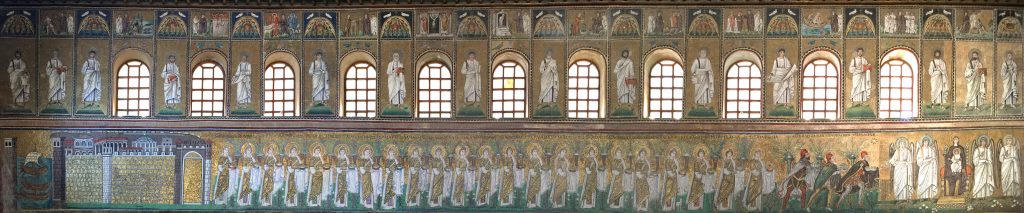
Procession of female saints leaving Classis (bottom left) behind the Three Kings heading to the Virgin Mary (bottom right between four angels). Basilica of Sant’Apollinare Nuovo (pic. Wikipedia)
Today, I am in Ravenna. One of those places where the history brings gasps of amazement. To honour my visit, I thought I should roll out last year’s post. This is what I said:
When I revised my Saint Agatha post (link see below), I felt I needed an early image of Agatha. After all, her cult spread early on, and therefore, was likely to be genuine.
As I started to track down her image I was led, with some joy, to one of the most amazing Churches in the wonderful town of Ravenna. I visited the Basilica of Sant’Apollinare Nuovo with some wonderment when working as an archaeologist at Ferrara, in Emilia-Romagna. Forty Years ago.
I found out that Agatha was one of 22 female Saints on one of the walls of the Church. I discovered a pretty comprehensive description of the Church. As I looked at it, I noticed the record was made by, or involved, Professor Bryan Ward-Perkins. He was the Director of the site my friends and I worked on in Ferrara! (And I met him again last night, 2025 for the first time in years! We had dinner with fellow archaeologists, and Bryan was talking about the work he did on the Saints of St Apollinaire.)
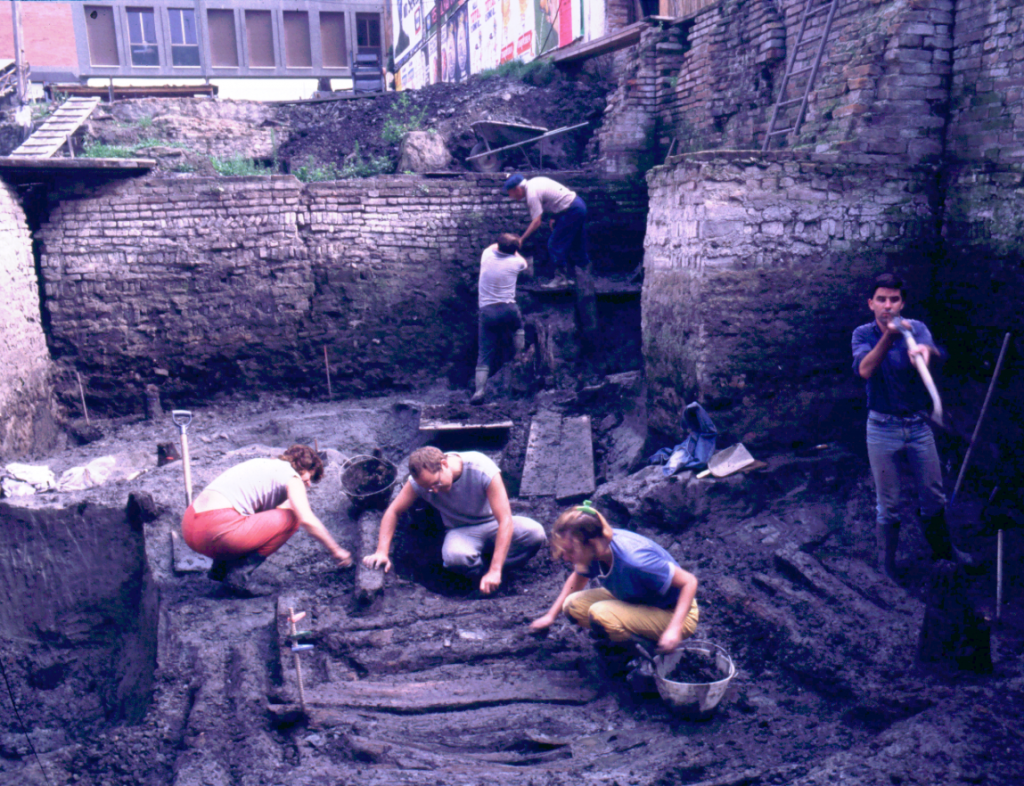
Medieval Excavation in Ferrara. The author is in the centre of the photo,
Ravenna
I’m guessing Bryan suggested we visit Ravenna on one of our trips to the beach at nearby Rimini. Ravenna was so awesome because the City became the capital of the Roman Empire in the West. It took over when Rome fell, then it was part of the Ostrogothic Kingdom, then of the Byzantine Empire. It spanned the period of the Arian Heresy.
And so, it was provided with some of the great glories of 5th and 6th Century Architecture. These include the Mausoleum of Galla Placidia, the Neronian Baptistery, the Basilica of Sant’Apollinare Nuovo, the Arian Baptistery, the Archiepiscopal Chapel, the Mausoleum of Theodoric, the Church of San Vitale and the Basilica of Sant’Apollinare in Classe. It’s hard to overestimate the impact on a young British archaeologist of seeing 5th Century buildings with roofs and astonishingly detailed mosaics still intact. Please visit!
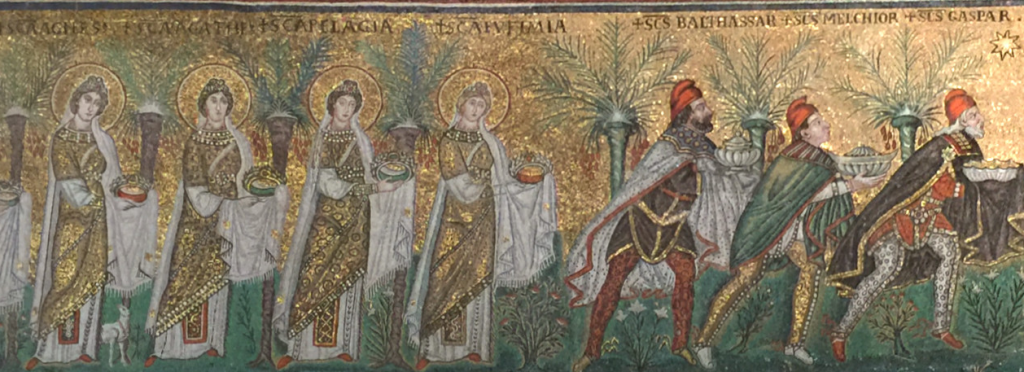
Detail showing the first four female saints behind the Three Kings. Basilica of Sant’Apollinare Nuovo wikipedia
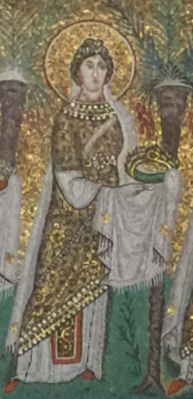
Bryan Ward-Perkins description says ‘All the saints are haloed, bear crowns and are dressed in elaborate court dress. Unlike the men …., all have essentially the same youthful features. The only saint with a distinguishing attribute is Agnes, who is accompanied by a lamb.’ The men are given some personality, some have white beards others are youthful. While all the female martyrs are, essentially young virgins, and cannot be distinguished from each other. St Agatha, the list says, is the Saint next to Agnes with her lamb; the third in precedent. You can see her above and in detail below.
St Agatha Basilica of Sant’Apollinare Nuovo wikipedia
Motorcycling from Ravenna to Inferno
Enough of the sublime! Now for the ridiculous. Whether on this visit or another, we decided to have a day at the beach at Rimini. After the day on the beach, a collective decision to stay over was made. The reason was to go to one of the big clubs (did we still call them discos?) probably to dance to ‘Frankie Goes to Hollywood’.
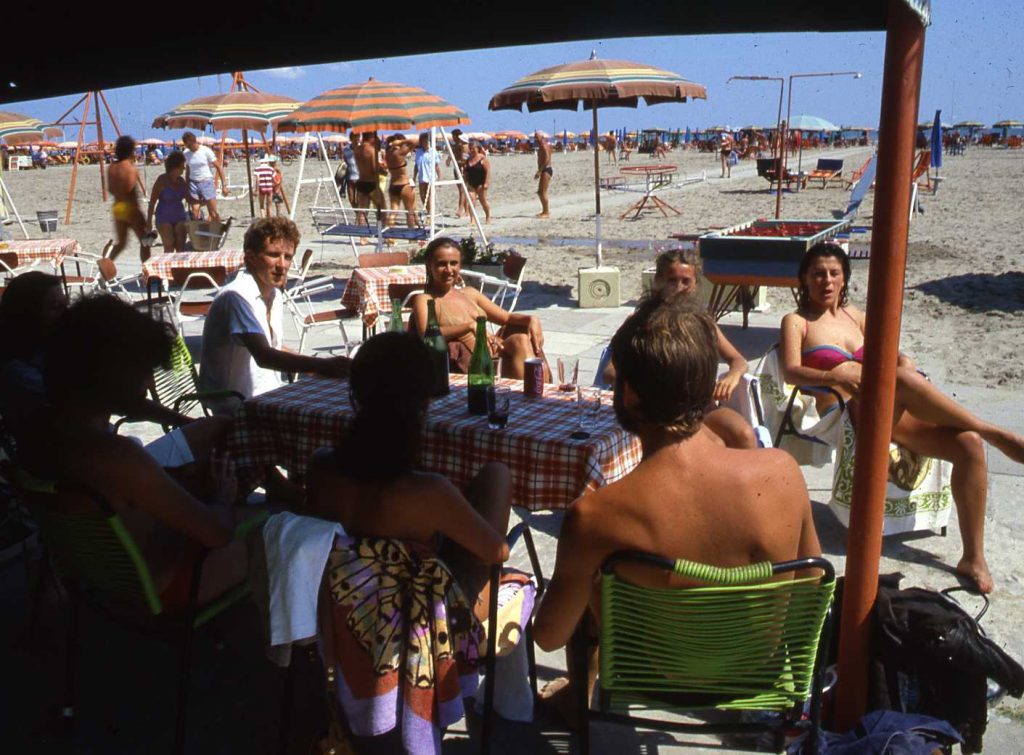
Archaeologists, Italian and English, on the beach at Lido di Spina
However, the hotels were all full. So I decided, late at night, to go back to Ferrara, on my own on my 175 cc Yamaha motorbike.
My Yamaha 175cc bike looked something like this but was red. A thing of underpowered beauty.
Thing was, I had started the day in Ferrara in the blazing Italian summer heat. So, I had hopped onto my bike dressed in shorts and t-shirt. Ferrara was 77 miles away (says google). One hour into the trip back, I was getting pretty cold, and really not enjoying driving through the lonely countryside. Therefore, I decided to pull off the main road to find a rural hostelry for what remained of the night.
Now, I remember this very vividly – the only likely road I could find was signposted to ‘Inferno’. I shrugged my shoulders, wondering what that was about, and drove towards it on a very deserted road. Eventually, I came to a sign which told me I was about to enter ‘Inferno’.
There was something very surreal about the situation. My courage failed me! I was not going to stay in a ‘motel’ in a place called ‘inferno’! I had seen too many horror films set in Motels and one in Inferno seemed madness. So, I turned round and continued my cold journey to Ferrara.
Inferno
Whenever I tell this story, I have some doubt about it. Did I really drive into a place called ‘Inferno’? But I have, for the first time, checked Google. It tells me that the road off the Rimini to Ferrara road goes through somewhere called: Vicolo Inferno, 40026 Imola BO, Italy.