My true love sent to me 6 Geese a Laying; 5 Golden Rings; 4 Calling Birds; 3 French Hens; 2 Turtle Doves and a Partridge in a Pear Tree
The Lord of Misrule, Masters of the Revels, and Boy Bishops
The Roman festival of Saturnalia, held between 17th and 23rd of December, included reversing rules so that slaves, ruled and masters served. In the medieval period, the disorder of Christmas was continued with the election of Lords of Misrule, Masters of the Revels, and Boy Bishops.
John Stow’s, Survey of London
He was London’s first great historian, wrote of the Lord of Misrule in London. In this section, Stow begins the role of the Lords of Misrule at Halloween and continues it until Candlemas, in erly February. See my post here for more details on Candlemas. This is what Stow says:
Now for sports and pastimes yearly used.
First, in the feast of Christmas, there was in the king’s house, wheresoever he was lodged, a lord of misrule, or master of merry disports, and the like had ye in the house of every nobleman of honour or good worship, were he spiritual or temporal. Amongst the which the mayor of London, and either of the sheriffs, had their several lords of misrule, ever contending, without quarrel or offence, who should make the rarest pastimes to delight the beholders.
These lords beginning their rule on Alhollon eve, continued the same till the morrow after the Feast of the Purification, commonly called Candlemas day. In all which space there were fine and subtle disguisings, masks, and mummeries, with playing at cards for counters, nails, and points, in every house, more for pastime than for gain.
Against the feast of Christmas every man’s house, as also the parish churches, were decked with holm, ivy, bays, and whatsoever the season of the year afforded to be green. The conduits and standards in the streets were likewise garnished; (…) , at the Leaden hall in Cornhill, a standard of tree being set up in midst of the pavement, fast in the ground, nailed full of holm and ivy, for disport of Christmas to the people…
Holm is an evergreen oak called Quercus ilex. John Stow talks about the Tree in Leadenhall Street being destroyed in the great wind of 1444 which you can read about here. You might also like to see the following posts, which include information about John Stow and London’s customs, and churches.
The Solstice and the East Pediment of the Parthenon
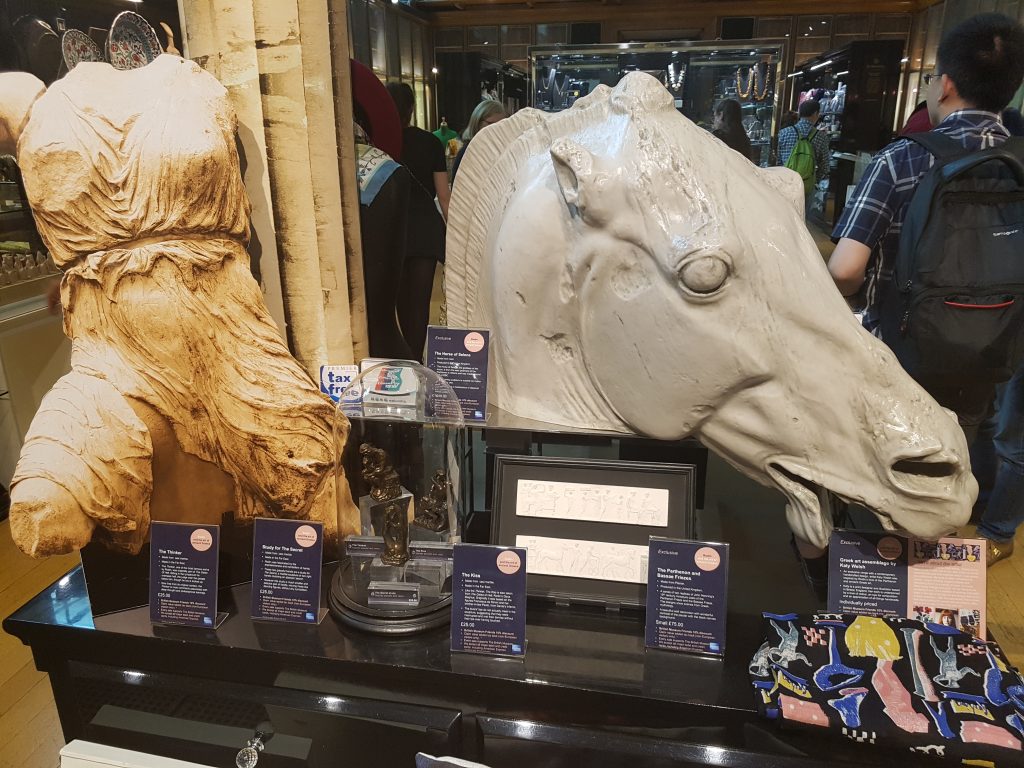
British Museum Shop, reproductions of Hestia and Selene’s Horse from the Parthenon Marbles
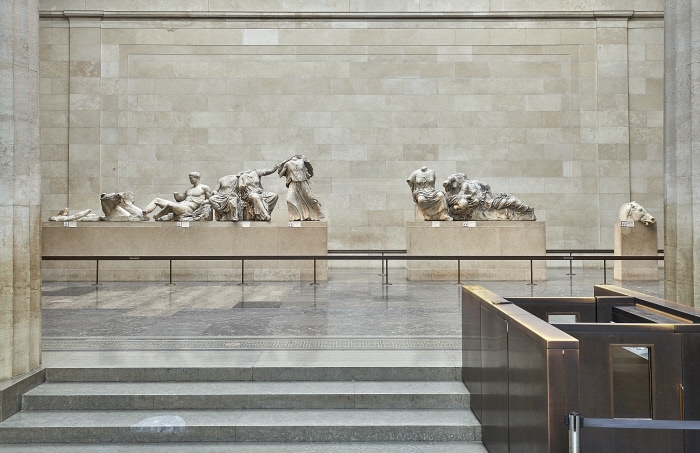
At the Summer Solstice, I took a group to the British Museum and, a few days later, to Stonehenge, and managed to ‘integrate’ the two into a solstice narrative. At the BM, over years of trying to explain the sculptures, I have been building in my mind an interpretation of the Pediment that gives, I hope, an original insight into the possible intentions of the sculptors. I don’t know how ‘true’ it is, but I do think it gives an insight into metaphor and symbolism in great works of art. Bear in mind that there is a lot of uncertainty about some of the attributions, and, that the male and female virtues that I am talking about are traditional ones, not necessarily how we would express it in the modern world.
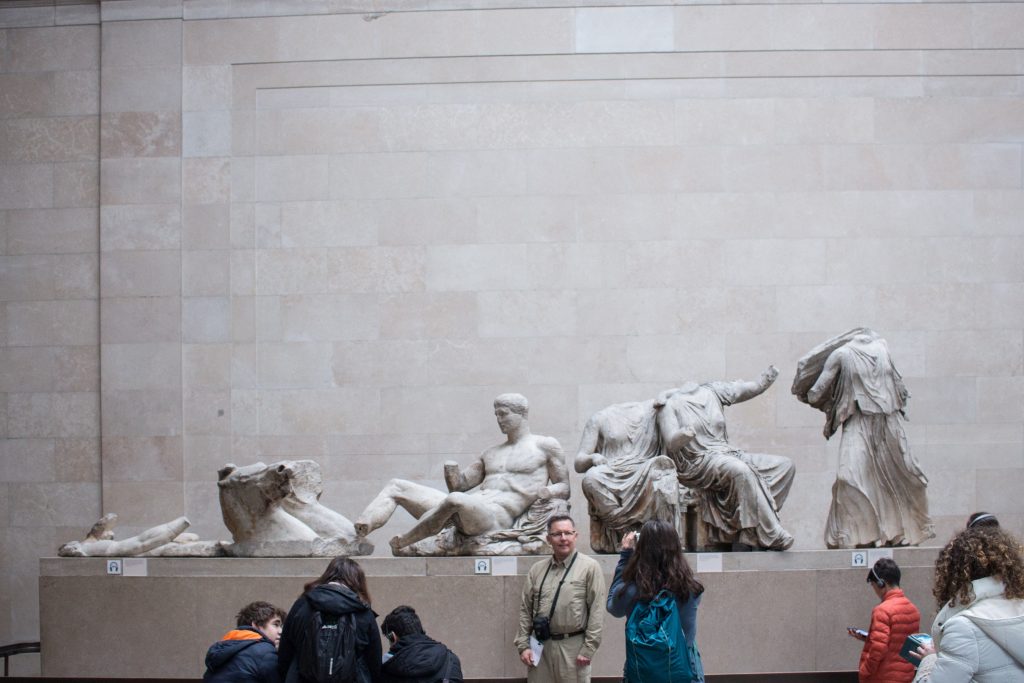
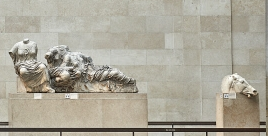
At the left of the above photography, you see the horses that take Helios chariot into the sky to bring up the sun to light the world every day. Most sun deities are male, and the Sun gives light and life to the world, without it this earth is an inert block of ice cold stone. The next statue is casually laying back and looking fit, relaxed and not looking as if he is in that position because of the impossible triangular Pediment space he inhabits. He is the epitome of male strength, usually identified with Hercules but other people have other ideas and a young Dionysus is another suggestion. Whoever he is he represents male beauty and strength. So this end of the pediment represents the Sun and male virtues. This is the East Pediment of the Parthenon which is orientated to the rising sun, a little north of east.
Next are Demeter, the goddess of fertility, the goddess of the earth. Placed here to remind us that the Sun needs the Earth to create life and sustenance. It reminds us that the universe is not male, the male only works in conjunction with the female. Demeter is cuddling her daughter Persephone, the Goddess of Hades. She reminds us that life is a cycle of death and life. Plants die, turn into soil and create the conditions for future life.
Next is Hebe, daughter of Zeus and Hera, wife of Heracles (Hercules). She is the cupbearer to the Gods and gives them the ambrosia that keeps them forever young. She is the Goddess of Immortality, a reminder that the universe is eternal.
Next to Hebe is a void where there was the central statue of the east pediment depicting the Birth of Athena (according to Pausanias who wrote a guide in the 2nd Century BC to the Temple). Athena was born from the head of her father Zeus- a virgin birth. Athena therefore is, in some ways, the greatest of the Olympians, as she has the virtues of her female sex and the virtues of her father’s masculinity (and, dear Gods, hopefully not the massive ‘Me Too’ vices of her father). She is therefore, wise, nurturing, just, intuitive, decisive, a leader; an ideal combination of male and female.
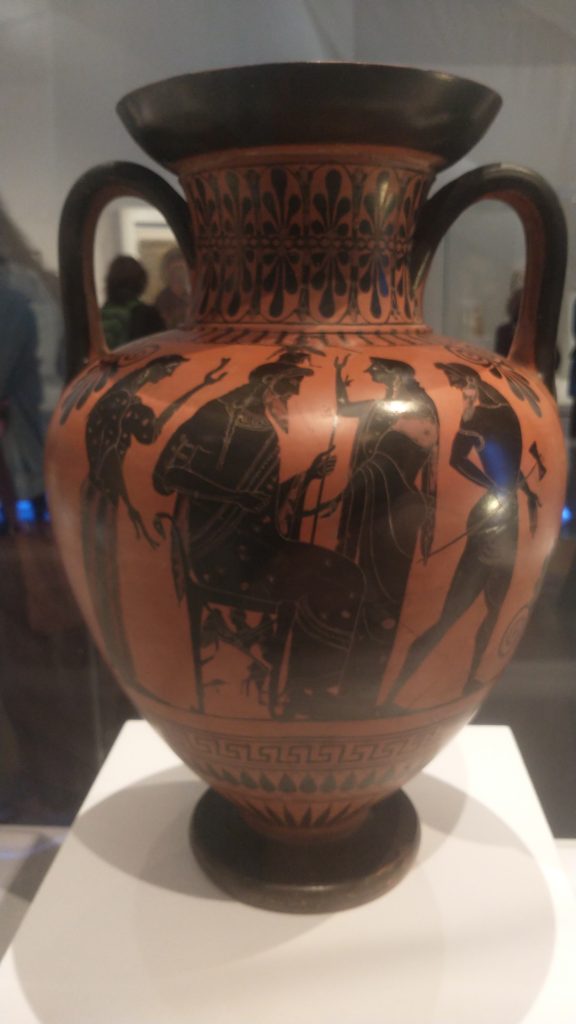
Zeus (sitting) Hephastus to right (looking back with Axe) Athena just visible above Zeus’s head
So Zeus eats Athena’s mum, Metis, who is pregnant with her. Sometime later he has a cracking headache. Hephaestus, the disabled artificer God hits Zeus over the head to clear the headache. Zeus gives birth to a fully formed Athena from the split in his head. She was known as Athena Parthenos, Athena the Virgin. Her name is originally Athene but it got changed to Athena in 500 BC.
Hestia, Dione, Aphrodite, Horse of Selene’s chariot
To Athene’s left is Hestia (Vesta for the Romans). Her name means “hearth, fireplace, altar” and she is the goddess of the domestic sphere, of the comforts of home, of a warm fire enjoyed by a loving family.
The next set are two beautifully draped women languidly leaning on each other, and these are Dione, with her daughter Aphrodite – the Goddess of Love. Dione is the daughter of Gaia and Uranus daughter of earth and sky. So, here, counterpoised to Hercules, are epitomes of women. Women of power, creation, and love.
Finally, we have the exhausted horse of Selene. Her chariot takes the moon into the sky, positioned opposite to Helios and the Sun. Selene is the Moon goddess, and the Moon is beautiful, powerful as it gives us the tides and fundamental to the life of humans as she presides over the menstrual cycle. Compared to the movements of the Sun which any fool can work out, and which are relentless (symbolising Justice) the movements of the Moon are mysterious to most of us. So Selene is beautiful, powerful, creative and the Goddess of Intuition.
So, if you put it all together, the East Pediment of the Parthenon shows that the world is a union of the male and the female, balanced between the two with Zeus and Athene in the middle, with Athene holding the main part because she, in her person, represents both the male and the female.
Of course, we know that the Athenian society was a patriarchal one with women mostly kept in the domestic sphere. But here, at least, women were given an equal billing in the organisation of the Cosmos.
Sculptures from the east pediment of the Parthenon
I must end by warning the reader that this is only my interpretation. I am not a scholar of Ancient Greece. I have come to my own conclusion based on spending a lot of time looking at the marbles, doing Solstice Virtual Tours, and mostly informed by the labels in the gallery, with of course, some reading including Mary Beard’s book entitled ‘Parthenon’ and the BM’s guidebook. In particular, I have not incorporated into my ‘story’ the sculptures that were in the gaps that do not survive or only in fragments scattered throughout the Museum world. Mary Beard was cleverer than I, not reaching conclusions on the basis that we don’t know. But what we do know is that in the centre is Zeus and Athene and at the edges are the chariots of the Sun and the Moon. And so fitting to celebrate the Solstice.
This post failed to publish on the 7th November, so here it is:
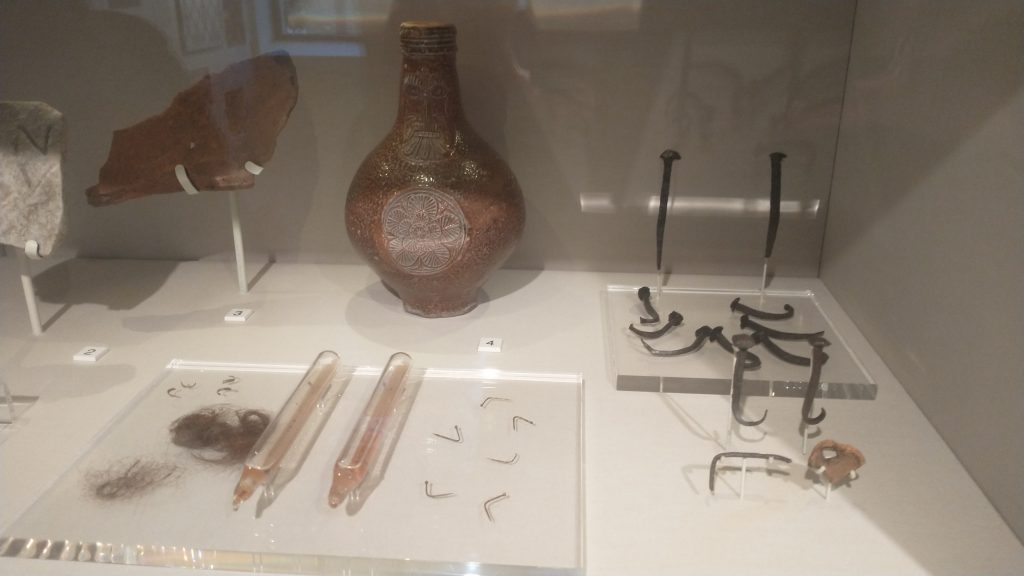
As we are between Halloween, and Halloween Old Style the chances of bewitchment are high what with all those spirits being out and about on this – the most uncanny of all times. So, you might want to look at ‘Doctor Lilly’s Last Legacy’ of 1683 which gives a cure for those who have been bewitched at Halloween.
Take two horseshoes, beat them red-hot and nail one on the threshold of the door, but Quench the other in the Urine of the party bewitched: then set the urine over the fire in a pot or Pipkin and put the horseshoe into it. Make the urine boil with a little salt put onto it, and three horseshoe nails until it is almost all consumed: what is not boiled away cast into the fire. Keep then your horseshoes and nails in a clean paper or cloth and use the same manner three times. It will be the more effectual if is done at the change or full of the Moon.
Doctor Lilly’s Last Legacy, Online at the Wellcome Collection, although you will need a login to view it. I found it first in my favourite source, Perpetual Almanac of the Year by Charles Kightly.
Doctor Lilly’s Last legacy ‘Being the poor man’s physician, the sick man’s friend, and the country-man’s doctor’.
Items like this make me wonder about the gullibility of the human being, but I guess we are surrounded by examples of the lack of sense of a large proportion of our species. Perhaps I should rephrase this, I think most people make sensible decisions about their day-to-day life, but many do not have the critical thinking skills to evaluate the bigger issues.
For more on keeping witches away, witches’ marks etc. have a look at this post of mine.
A day when it is ‘certain to rain heavily’. Well, that wasn’t true last year. On this day you, supposing you want to find who your true lover is, must:
Carefully peel an apple in one piece. Turn round three times with the peel in your right hand Drop the peel over your left shoulder See what shape letter the peel forms on the ground, and this will be the first letter of your true love’s name. And if it breaks into pieces, you are doomed, probably, to never finding your true love. To make this work, you also have to recite:
St Simon and St Jude, on you I intrude By this paring I hold to discover Without any delay, to tell me this day The first letter of my own true love.
Jude is the Saint of:
Lost Causes Desperate causes Hopeless causes And if that is not enough also the Hopeless and the Despairing.
So maybe the apple peel isn’t going to work for you (although Jude is also the Patron Saint of the Impossible!)
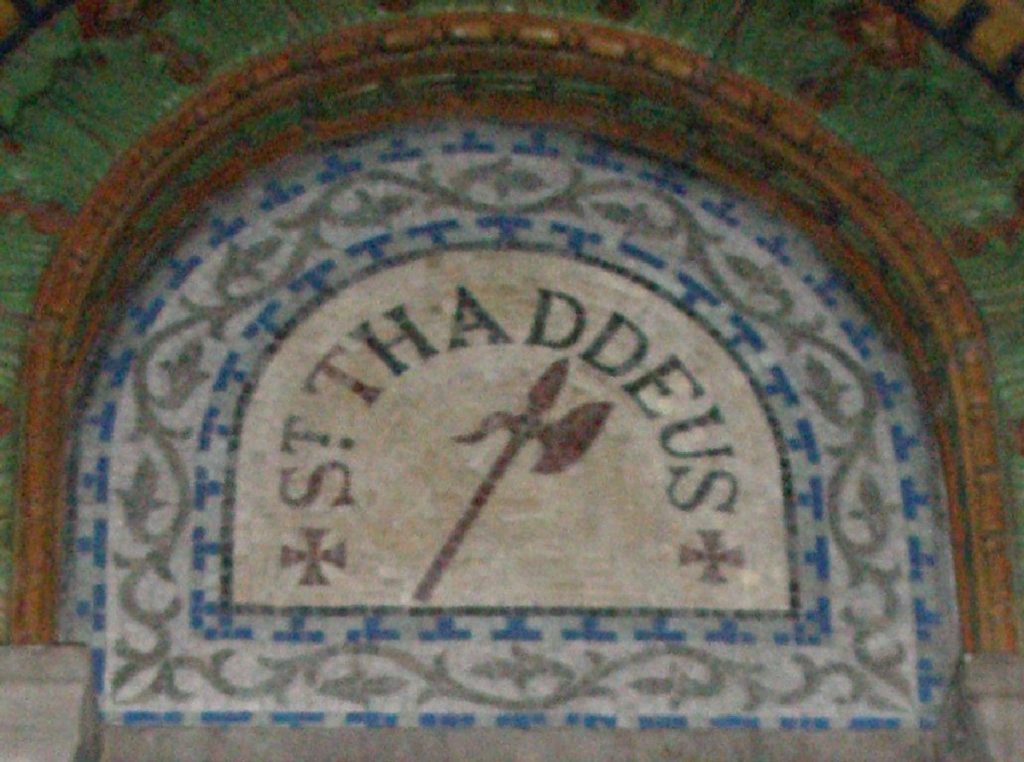
Jude aka Thaddeus was martyred with an axe. Simon the Zealous was martyred by being sawn in half, and is, of course, therefore, the patron saint of woodcutters and lumberjacks. They are linked by the same Saint’s day because they went to Syria together to preach where they were met their fates, and they are also associated with woodworking.
WikipediaBy Bruce Andersen – Own work, CC BY-SA 2.5, https://commons.wikimedia.org/w/index.php?curid=1855844
There are at least four Judes. One of them may have been Jesus’ brother. He or another Jude wrote the Epistle of St. Jude.
I am finishing my post on September, and using the Kalendar of Shepherds. As you may have noticed, I often use the Kalendar of Shepherds to provide an insight into how the seasons were seen in the past. Mostly, I use it for the posts at the beginning of each month. I have created this page as a placeholder to put information on the Kalendar for anyone who is eager to explore it more or to make use of it. Each month I will link to it, so I do not have to repeat the basic information about the Kalendar. Much of this text was contained in the December post, and I have used this month as my example. Tomorrow, you will get the September version.
About the Kalendar of Shepherds.
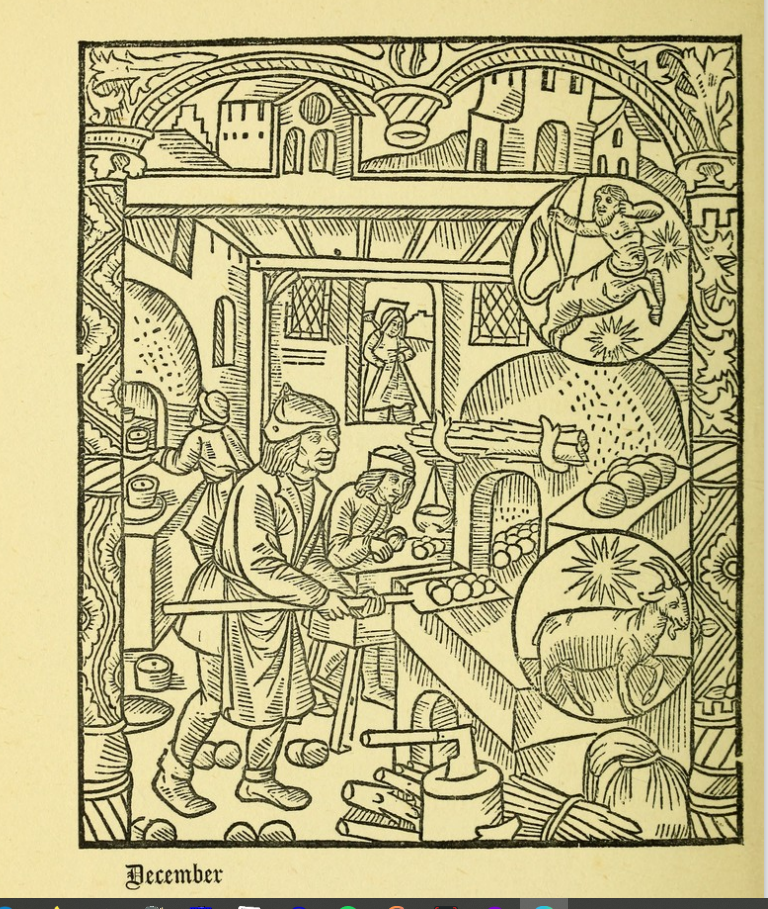
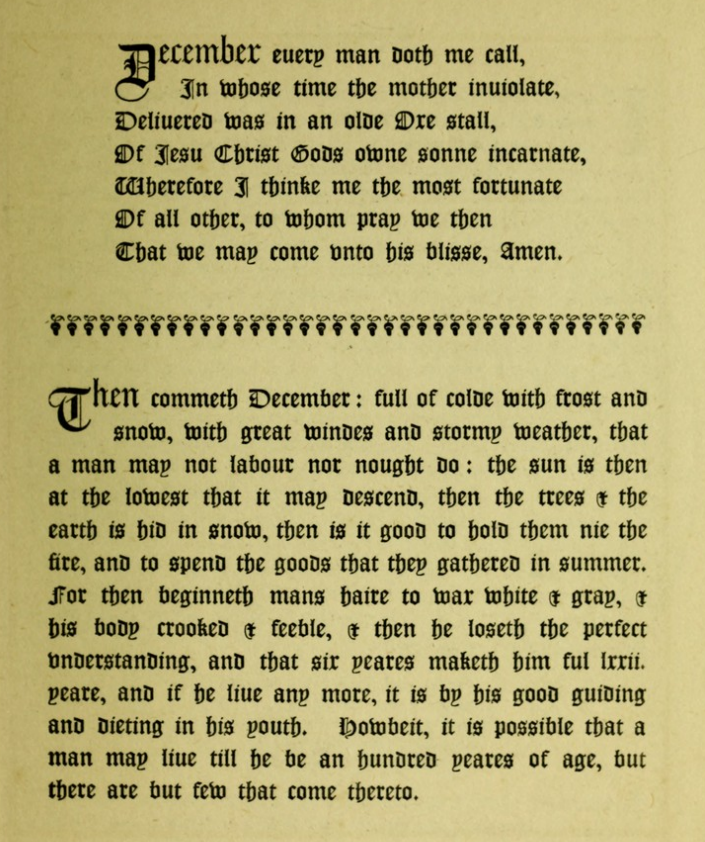
The Kalendar was printed in 1493 in Paris and provided ‘Devices for the 12 Months.’ The version I’m using is a modern (1908) reconstruction of it. It uses wood cuts from the original 15th Century version and adds various texts from 16th and 17th Century sources. (Couplets by Tusser ‘Five Hundred Parts of Good Husbandrie 1599. Text descriptions of the month from Nicholas Breton’s ‘Fantasticks of 1626.) This provides an interesting view of what was going on in the countryside every month.
The Kalendar of Shepherds has an illustration for each month (December above) which shows typical activities for the time of year, and has inserts to identify the astrological signs of the month. So, in December they are baking and collecting firewood. The star signs are Sagittarius (November 22 – December 21) and Capricorn(December 22 – January 19).
The text below gives a vivid description of December weather and then elaborates on the last six years of a man’s life, with hair going white, body ‘crooked and feeble’. The conceit here is that there are twelve months of the year, and a man’s lot of ‘Six score years and ten’ is allocated six years to each month. So December is not just about the 12th months of the Year but also the last six years of a person’s allotted span. The piece allows the option of living beyond 72, ‘and if he lives any more, it is by his good guiding and dieting in his youth.’ Good advice, as we now know. But living to 100 is open to but few.
Kalendar of Shepherds
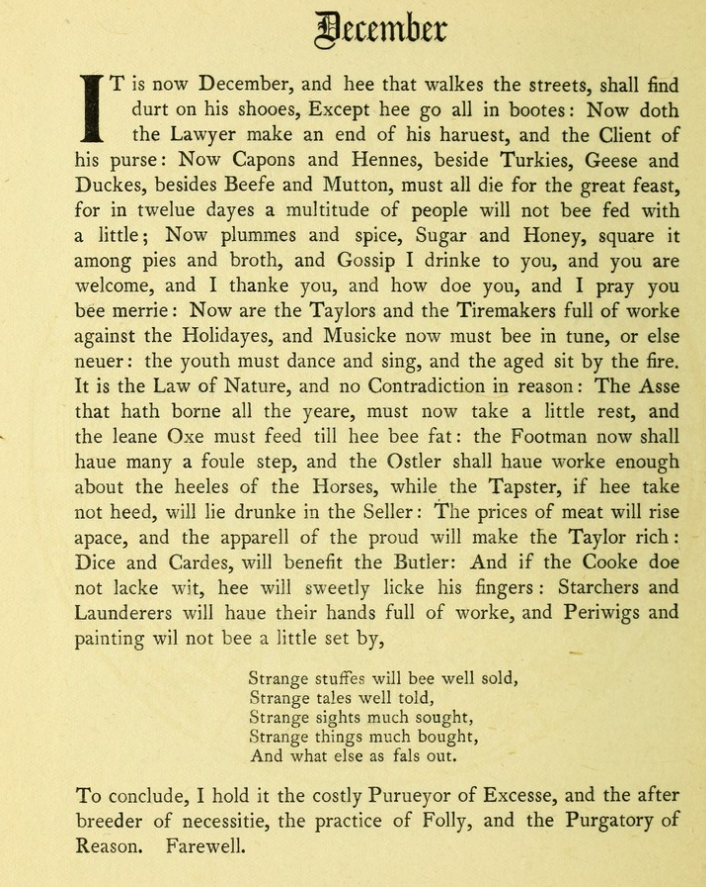
The longer description of December (shown below) is by Breton (1626) and gives a detailed look at the excesses of Christmas, who is on holiday, and who working particularly hard. But it concludes it is a costly month.
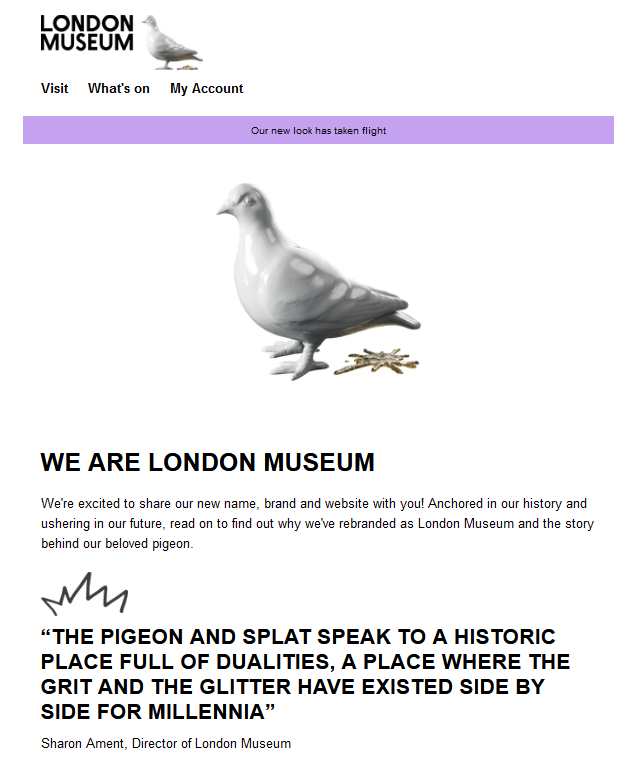
Screenshot concerning the new Logo of the Museum of London
I was quite surprised to see the image above appear in an email to my inbox. The London Museum (was the Museum of London) announced the Pigeon and Splat as the new logo to replace the old Dick Whittington one. I received the email on the 27th July 2024.
Is this a breath of fresh air? An unfussy humourous joke which 5 year old will love? Is a Pigeon uniquely London? Is the Splat too clever by half, or is it completely daft?
I’ll leave it to you to decide. However, a visit to the London Museum Website on 15/08/24 reveals the Pigeon logo displayed without the Splat!
Screenshot of London Museum’s new logo without the Splat!
Further down the page, is an article on the history of Pigeons and London, where there is a vestigial splat!
It seems to me there has been a climb down since I received the email on 27th July. Or are they phasing the Splat! in? Comments please.
For more on the new logo look at the Museums Associations’s Web site here. ‘The pigeon was chosen to symbolise the brand as “an impartial and humble observer of London life”, the museum said in a blog post on the redesign.’
Screenshot from the London Museum Web site with image of a Pigeon with a vestigial Splat!
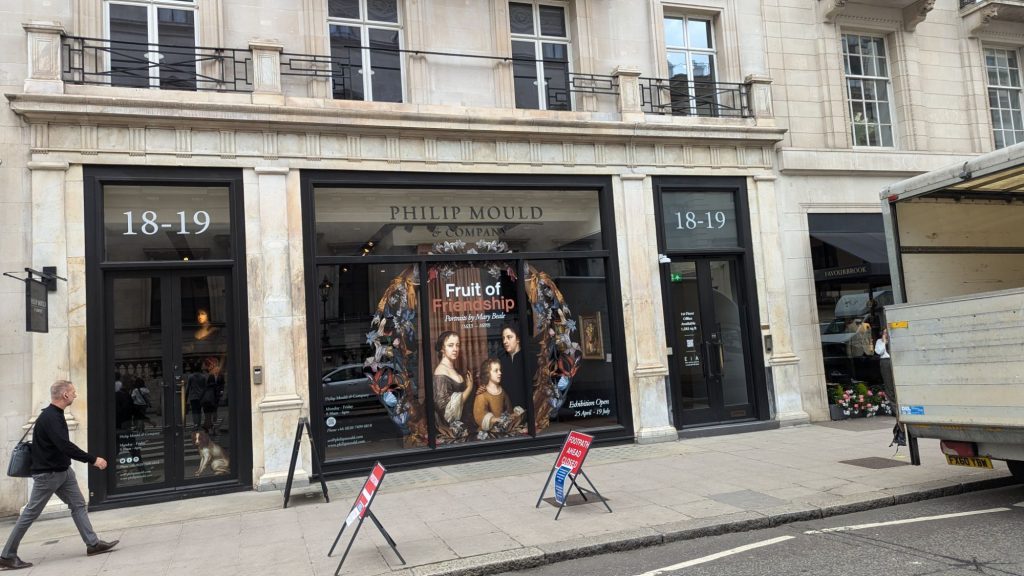
Philip Mould Galley,Bond Street.The home of painter Mary Beale
The painter Mary Beale was born on March 26th 1633 in Barrow.
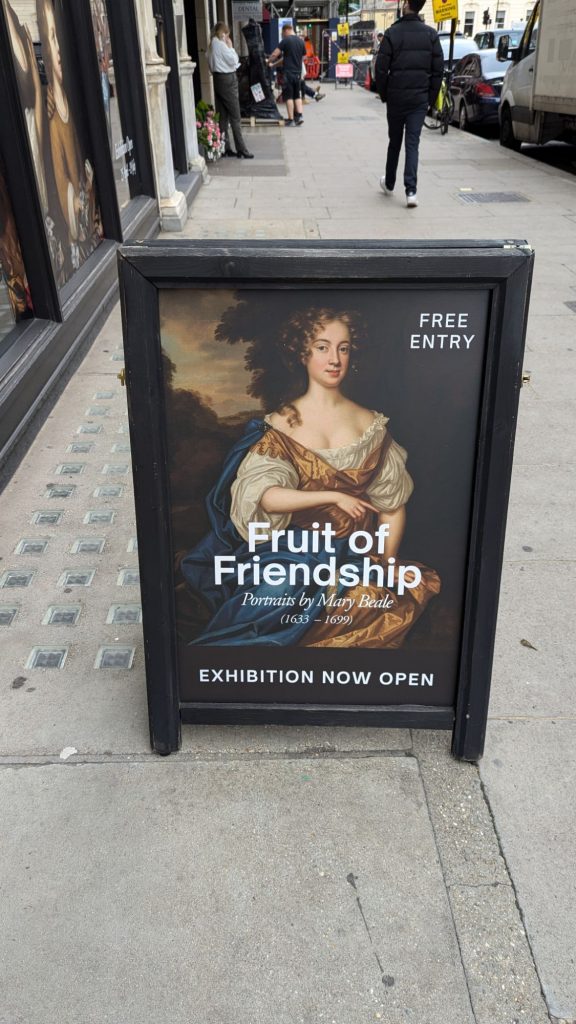
Last year, I was asked to do two Jane Austen’s London walks. The walk explores Mayfair, where her brother, Henry lived and had his Bank, and where Austen placed the central drama of Sense and Sensibility. I decided to use the time between the walks to look for a shopping mall which dates back to Jane Austen’s time, but I got diverted as I saw a sign for a free exhibition on Mary Beale in Pall Mall.
Mary Beale is that rare beast; a professional female artist of the 17th Century (1633-1699). So, I double-checked the ‘free entry’ notice because this was a posh West End private art gallery and the name Philip Mould was familiar. I went in and realised that this was something special. I returned to the entrance to ask the very friendly staff whether I could take photographs. ‘Yes, of course, they said.’ much to my surprise.
Mary Beale Exhibition sign.
Downstairs, the art of Mary Beale was beautifully displayed, and the exhibition had a very interesting story to tell, which was well-told, using excellent labels and a film narrated by Philip Mould. He was, as I thought, the co-presenter of ‘Fake or Fortune’ (with Fiona Bruce, newsreader and anchor of the BBC’s Antiques Roadshow). This is a BBC art programme which is in its 12th Series. The conceit of the show is that they investigate dubious paintings to find out whether they are genuine or not.
The film revealed that Philip Mould opened his Art Gallery here over a decade ago, but research has recently discovered that this is the very address where Mary Beale had her studio.
Scene shot of Philip Mould in the Mary Beale Exhibition in his short film shot in his Art Gallery.
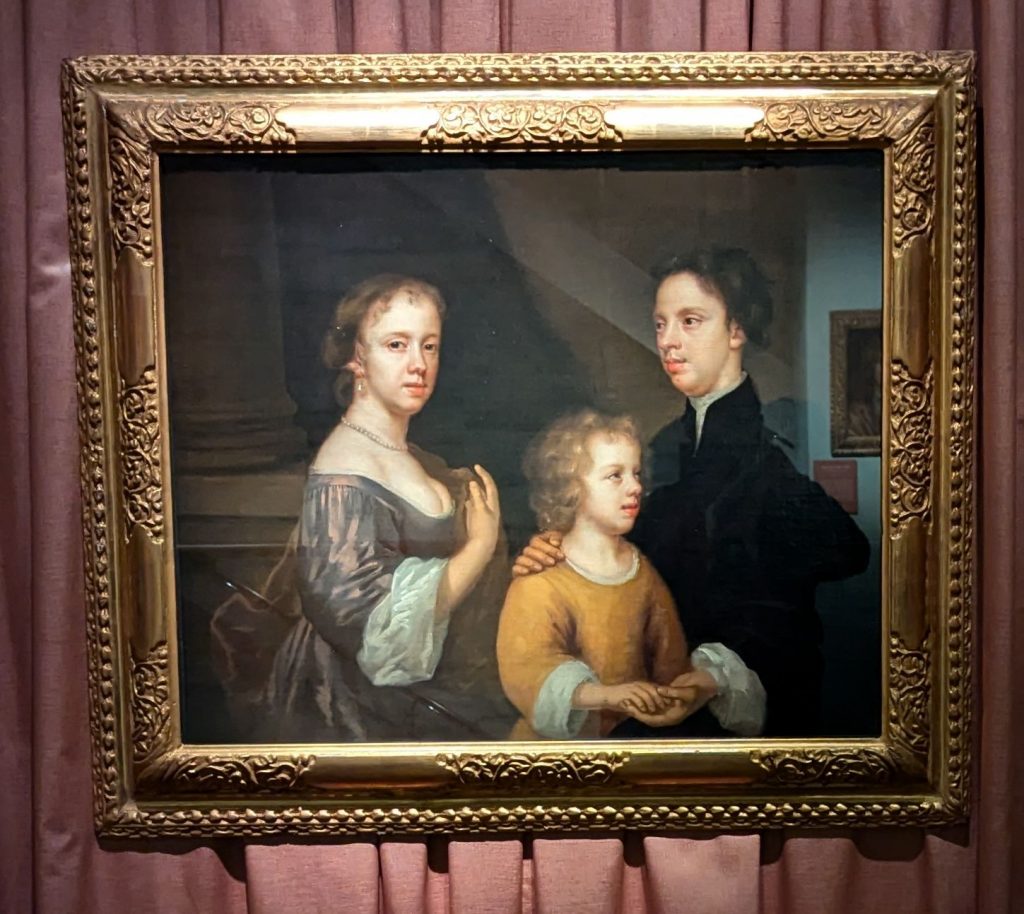
Her career is not only remarkable in itself, but it was recorded in great detail by her husband. She was the bread winner. He was her partner, and in effect the studio manager. In correspondence, he describes her as his ‘dearest heart’.
Self-Portrait of Mary, with her husband and son
It was a family business and their children also worked as painting assistants, doing draperies and other background details. Her paintings gave them an income of around £200 a year, which is not riches but, by comparison, a labourer got about £30 a year.
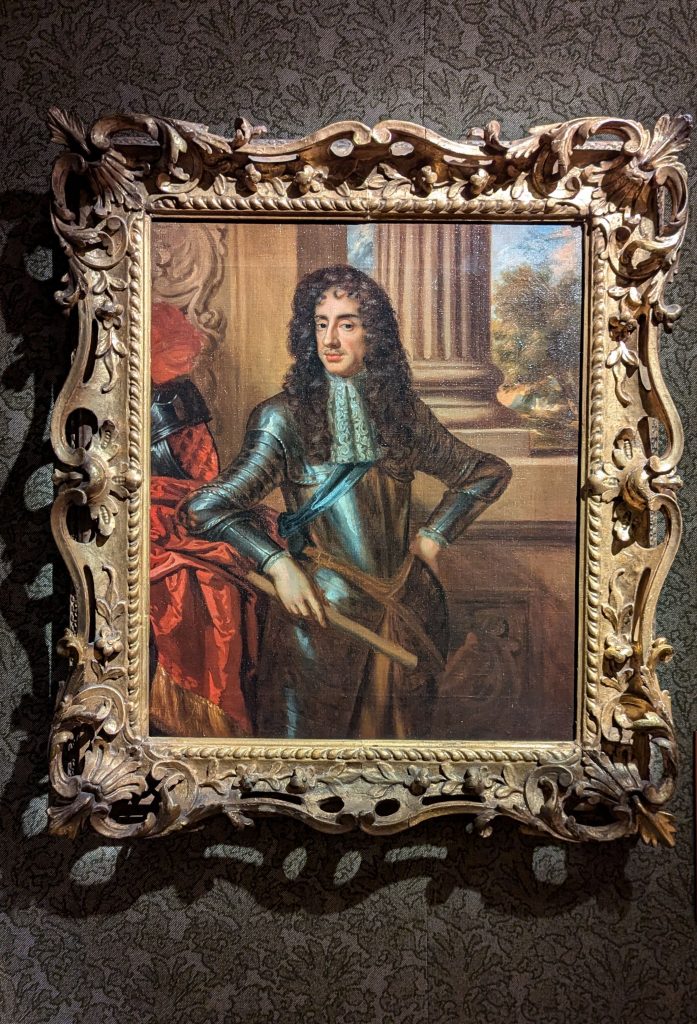
She was associated with Sir Peter Lely, the Court painter who succeeded Van Dyke. Mary Beale made copies of many of his paintings. She also painted many pictures of her family.
Mary Beale’s painting after Sir Peter Lely’s portrait of Charles II
There are several excellent short films about Mary Beale on the Gallery’s web site, which is well worth a visit. The exhibition ends on the 19th July, but there is also, for you to see, Tate Britain’s exhibition ‘Now you see us’ which is the story of British female artists from the 1520’s to 1920.
On continued this walk to the Royal Academy when I encountered the painting ‘Flaming June’ by Lord Leighton – I removed the content to its own page which you can see here
I have just come back from my very first Leap Year Walk, which I gave tonight for London Walks. It was one of a series of my walks, which are about the year through London’s History. So far, I have done, a New Year Walk, an Imbolc Walk (1 February, St Brigid’s Day), a Spring Equinox Walk, a May Day Walk, a Summer Solstice Walk, an Autumn Equinox Walk, a Halloween Walk, and a Winter Solstice Walk. All, at their core, have the subject of the year, how it is arranged, and celebrated in different cultures and different times in London.
I hoped to get this post done, today, but on arrival at home my burglar alarm was ringing, so had to get an emergency electrician out to pacify my neighbours, and tracking down the fault meant turning my house upside down. I rushed it out, with many bad proof reading errors and ommissions, And have now, on the dawn of a new month, and a new Season, updated it. Probably, knowing me, it still has a far few errors! Now, I am rushing to look after my Grandson!
So, the reason there is a leap year, is that the Sun and the Moon have different cycles, which cannot be easily aligned. And secondly, the solar year is not a fixed number, it is not 365 days, but 365 days and a bit.
Originally though, probably, most cultures lived their lives with time keeping controlled by time markers from their everyday environment, days and nights, the waning and waxing of the moon, the seasons, and the changes in the rising and setting of the Sun. Budding nature would have provided other markers as to when to sow, to harvest, to prune, to slaughter, to worship and marry.
The months were given by the cycle of the Moon, which also gave us tides and menstrual cycles. The months were given names, which were often associated with the weather. The trouble was that the Solar year did not align with the Moon, soon the months would get out of kilter with the seasons. So over time, the society would find it was winter in June, or summer in December. (which is OK if you live in Australia).
Society dealt with this in a number of ways. It could be ignored, why shouldn’t it be cold in June, why should June always be in Summer? Another way was to add in extra days, or months, every so often to make sure June remained in the Summer. This is what Egypt, the early Romans and the Celts did. They kept their months aligned to the actual movements of the Moon, and aligned their Solar Year with it by the addition of extra days or a month or two. or a combination of both.
I reported on this in my post on the Terminalia for February 23rd. As I wrote:
Terminus was an old ancient God who was the God of the boundary, the border, the edge, the liminal God. February was the last month of the original Roman year, but the rulers of Rome added an intercalary month every so often, called Mercedonius in an attempt to keep the Solar year in tune with the seasons. And when the intercalary month was added, the last five days of February were given to Mercedonius and the resulting leap year was either 377 or 378 days long.. So, in those years, the 23rd of February was the Terminus of the year. (For more on Terminalia look at my post for February 23rd on Terminalia-god-of-the-boundary)
Now, as the Roman Republic became more sophisticated, the intercalary months were added at the direction of the Pontiffs, supposedly every two and sometimes every three years. But the Pontiffs were often swayed by political advantage, and by the time of Julius Caesar the seasons had got wildly out of sync with the calendar year. The Dictator, therefore, instituted ‘the Year of Confusion’ which was over 400 days long and brought in the Julian Calendar which realigned the calendar back in line with the seasons.
Caesar spent time with Egyptian Astronomers, trying to understand their solution to the problem. They identified that the year was not 365 days long but 356.25 days, so JC ‘fixed’the issue with a leap day every four years. Based on the almost correct calculation of a solar year being 365.25 days. The new calendar was inaugurated on the Kalends of Januarius 709 AUC, or as we would call it I January 45 BC. It became, in time, something the Romans were very proud of – rationalising, measuring, time itself. Romans counted their dates from the time their City was founded by Romulus in what we call 753 BC or 753 BCE. So, 45 BCE in our reckoning is 709 ab urbe condita (AUC ‘from the founding of the City) as the Romans saw it.
I prefer not to use BCE because it seems ‘dishonest’ to me. The idea of AD BC was made up based on a guess as to when Jesus was born. Changing BC to BCE may rid the date of an explicit Christian identification but masks the fact that there is no such thing as the ‘Common Era. What the Common Era is, is the idea made up in the Late Roman period guessing when Jesus was born/ So I think call a spade a spade, even if it’s a broken meaningless spade that is not fit for purpose, either replace it with something rational, or real or call it what it is.
The interesting thing is that Caesar put the leap year in on the 24th February. Why? Because February, being the month of death, was the end of the year. March 25th was originally the beginning of the Roman year (Caesar moved it to January 1st). Why March 25th? Because it was the Spring Equinox. If you look at my post for March 25th you will find out it is the date of the creation of Humanity, the Birthday of Adam, the conception of Jesus, and until 1752, the day the year number changed in Britain.
The other strange thing about the new leap day was that it was not called February 25th. It was not given a number. Rather, February 24th was two days long. This continued in Britain until the date February 29th started appearing in calendars in the 15th Century, although the legendary Lawyer, Edward Coke (1552 – 1634), refers to the two days of February 24th, but the two day 24th was completely replaced by February 29th in the 16th Century.
One slight complication to the story of February 29th was that February 29th did exist before the Julian reforms. When February was not interrupted by the intercalary month, as described above, it was 29 days long. Julius Caesar made the months alternate 30 and 31 except for February which was 29 days long. When the Senate gave Julius the honour of having the 7th Month named after him, things were OK, but then Augustus wanted the same thing. The Senate duly gave him the next month, which became known as August, but it only had 30 days. This could not be allowed! So they made it up to 31 and stole the 29th from February and made February only 28 days long. This change also meant that there were now three 31 days months in a row, so they reduced September from 31 to 30, boosted October to 31, reduced November to 30 and boosted December to 31,
Hence, we can no longer remember Caesar rational allotment of days in the month, and we need to hum to ourselves:
Thirty days have September April, June, and November February has twenty-eight alone. All the rest have thirty-one. Excepting leap year – that’s the time When February’s days are twenty-nine.
But Caesar had not solved the problem of the shifting year, he had just minimised it. By the Council of Nicea in the early 4th Century (and not yet called AD!) the small error had changed the date of the Spring Equinox, from March 25th to March 21st. So, when Constantine convened the Council to bang the heads together of the Church leaders to unify their religion, particularly in regard to the date of Easter, and whether Jesus was equal to God. They fudged the complex issue of the date of Christ’s death, and used March 21st as the foundation of their calculation on the moon-based festival of Easter (more of which at Easter!)
It wasn’t until the 16th Century that Pope Gregory, solved the problem of the inaccuracy of Caesar’s solution, by introducting the Gregorian Calendar, for which see my post here.
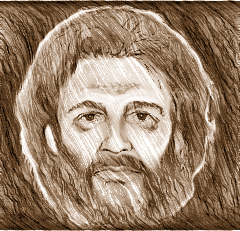
Archaeology discoveries. The Image is a sketch of the ‘Facial Reconstruction, Impossible Factual/BBC’
Interesting Archaeology discoveries.
The following discoveries were reported in Salon IFA the newsletter of the Society of Antiquaries of London in Salon: Issue 526 7 February 2024, which you can see here:
Pliny the Elder’s Villa found near Vesuvius?
The 1st Century seafront villa, with views of the Bay of Naples and of Mount Vesuvius, has been excavated at the town of Bacoli, which was the port of Misenum. Pliny commanded the fleet as ‘Praefectus classis Misenensis’. Pliny tried to rescue his friends and family, ignoring warnings saying ‘Fortune favours the brave’, ‘Audentes Fortuna luvat’. It didn’t and he died, at Stabiae, by toxic fumes. Read more about the villa here:
Face Reconstructed for a Victim of Roman Crucifixion
A male skeleton found, 4 years ago, in a Roman cemetery in Fenstaton in Cambridgeshire was found with a 2-inch nail through his heel bone. BBC 4 has made a documentary about the recent reconstruction of the man’s face by, as Salon reports it:
‘US forensic artist Joe Mullins, of George Mason University, Virginia. He usually works with law enforcement agencies, reconstructing the faces of modern-day crime victims. ‘
To follow the details, read more here, or watch the BBC documentary, ‘The Cambridgeshire Crucifixion’, which can be viewed on BBC iPlayer.
I have a friend with whom I argue about the sanctity of the book. She believes they need to be treated like the priceless spear carriers of culture that they are. While I, read them in the bath; turn down corners to mark my place; underline interesting phrases, mark paragraphs and commit other forms of libricide. (is there such a word?)
In my defense I note that I used to work at the Freud Museum, where they studied the marginalia in Freud’s Library to gain insight into his thought processes and influences.
But I recently came across the clincher to my ongoing argument in Charles Nicholls’ marvelous book on Shakespeare’s life as a lodger (‘The Lodger’) in Silver St. just down the road from the Guildhall in the City of London.
He quotes Shakespeare’s Cymberline where Iachino finds a book by Imogen’s bed and says:
‘She hath been reading late: The Tale of Tereus. Here, the leaf’s turn’d down.