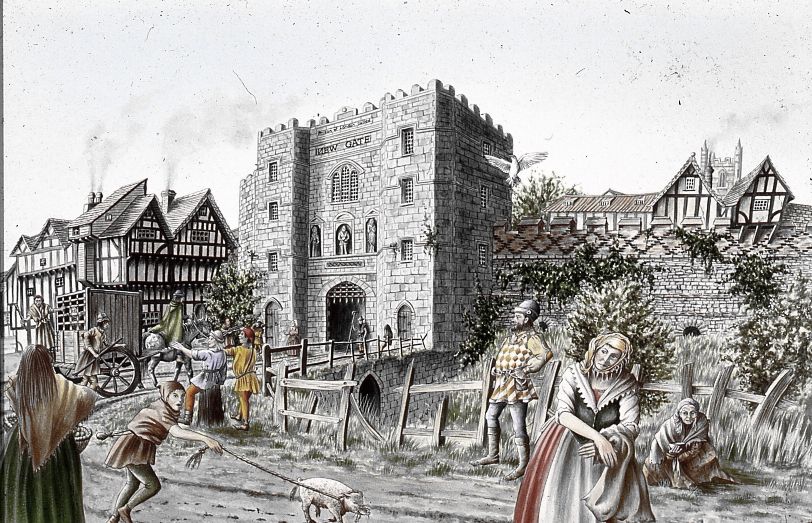

Twin, Twins – Festival of Castor and Pollux July 15th

The Ashwini kumaras twins, sons of the sun god Surya. Vedic gods representing the brightness of sunrise and sunset Wikipedia

The Divine Twins, aka the Dioscuri, were horsemen. Patrons of calvary, athletes and sailors, one of many Indo-European twin gods.   They had many adventures including sailing with Jason and the Argonauts.

And are they well connected?! Pollux is the son of Zeus  His twin brother has a different and mortal father, the King of Sparta.  But the boys share the same mother, Leda.  She was raped by Zeus in the guise of a swan.

This makes them examples of heteropaternal superfecundation as Mary Poppins didn’t sing.  But their different paternity had consequences. The most important is that one was (is?) therefore immortal and the other wasn’t. 

According to some version of the story, Castor (the mortal one) was mortally wounded. Zeus gave Pollux the option of letting his brother die while Pollux could spend eternity on Mount Olympus. The alternative was to share his immortality with his brother. Pollux did the good thing. So the twins spend half their year as the Constellation of Gemini and the rest, immortal, on Mount Olympus.  Thus, they are the epitome of brotherly love.

Divine Twins or Sisters from Hell?

The Dioscuri’s sisters were no less than Helen of Troy and Clytemnestra. Never mind the Brothers, what Sisters! Helen of Troy you know. And Clytemnestra! They were also twins, Helen the divine daughter of Zeus, husband of Menelaus, lover of Paris. Sister, Clytemnestra, mortal daughter of the King of Sparta, husband of Agamemnon (brother of Menelaus).

It happened like this.  The Swan was being pursued by an eagle, so Leda protected the Swan and took it to bed.  On the same night she slept with her husband Tyndareus of Sparta. Two eggs were fertilised, each split in two to give two sets of twins.
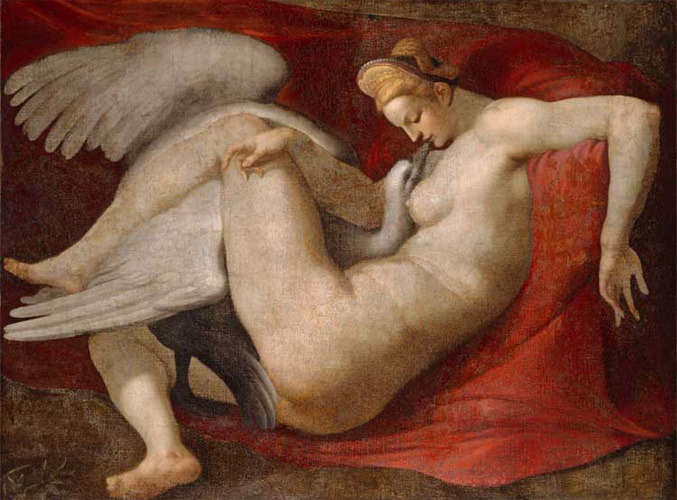
Leda and the Swan, 16th-century copy after the lost painting by Michelangelo

Clytemnestra

She was the wife of Agamemnon, the arrogant leader of the Greeks.  On the way to retrieve Helen from Troy, the Greek Fleet was becalmed. So, following his seers’ advice, Agamemnon sacrificed his own daughter, Iphigenia, on the island of Aulis.  The Gods then set the winds fair to Troy. (Read Iphigenia at Aulis by Aeschylus, a great play which I studied in Classical Studies at University).

Meanwhile, Queen Clytemnestra, abandoned at home, broods on her husband’s heartless fillicide. She takes a lover. After 10 years of war, Agamemnon comes back, in triumph, from the destruction of Troy. He brings with him his prize, the Trojan Princess, Cassandra, sister of Hector.

Cassandra has been gifted with the ability of accurate prophecy. But, as often in the case of prophecy stories, the gift came with a sting in its tale. She was also cursed with the inability to get anyone to believe her!  She prophesies disaster and that she too will be a victim.

Strutting with arrogance, Agamemnon demands Clytemnestra prepare him a bath. And, so she runs it for him, and she gives him the hottest bath possible. With the help of her lover, she hacks Agamemnon to pieces with an axe. Cassandra is butchered.
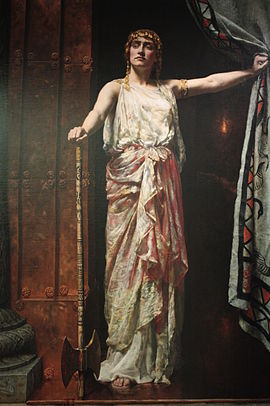
painting of Clytemnestra after she has slaughtered her husband Agamemnon _by_John_Collier,_1882 (Wikipedia Guildhall Museum)
Clytemnestra by John Collier,_1882 (Wikipedia Guildhall Museum)

Attitudes

I visit John Collier’s painting of Clytemnestra at the Guildhall, in London, regularly. I am fascinated by her grim, yet satisfied, expression.

In the 18th/19th Century, rich people were into ‘attitudes’.  For example, Emma Hart, later Lady Hamilton, would be invited to present an attitude in front of a dinner party of mostly male aristocrats.  She would dress up in a flowing, revealing unstructured classical gown.  Then she would stand on a table or pedestal, and present herself as Helen or Andromache or any other classical beauty guests might fancy an eyeful of.  She would assume an appropriate facial expression and posture for everyone’s pleasure. 
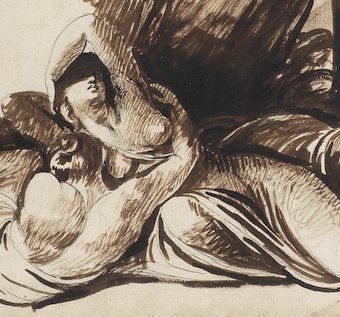
Detail of Emma Hart modelling as Iphigenia by George Romney in ‘Cimon and Iphigenia’

Being Clytemnestra is, surely, the most difficult? I imagine Collier’s model being prompted to look both sad at the loss of the daughter. Outraged at the arrogance of the husband. Horrified at the gore of the murder. But, overall, she has to portray a grim satisfaction that the bastard got exactly what he deserved.

Dorothy Dene

Lord Leighton had a famous model who was exceptionally skilled at adopting poses for his paintings. He determined to help her with an acting career. As part of the plan he helped improve her cockney accent. It is said this inspired Bernard Shaw’s story Pygmalion, which, in turn, inspired My Fair Lady and Eliza Doolittle. 

Leighton’s model was Dorothy Dene.  She became a famous actress, outstripping the fame of Ellen Terry and Lily Langtry. For more on Leighton and Dene look at my post here.

John Collier

Before we finish, do have a look at John Collier’s Wikipedia because he is the most ridiculously well-connected painter you can imagine! Related to half the Cabinet and married to TWO daughters of Darwin’s Bulldog, T.H. Huxley (grandfather of Aldous Huxley).

For more on Flaming June see my blog post of 12 July 2024

European Twin Gods

It is suggested that twin male gods are a feature of Indo-European religions. The divine Twins are associated with horses/chariots and are responsible for moving the Sun and the Moon. Their use of a horse above the water means that they can rescue people lost at sea.  

St Elmo’s fire was said to be the way they manifested their divinity to sailors.   Diodorus Siculus records that the Twins were Argonauts with Heracles, Telamon, and Orpheus. Further, he tells us, in the fourth book of Bibliotheca historica, that the Celts who dwelt along the ocean worshipped the Dioscuroi “more than the other gods”.

First written in 2023 updated in July 24 and 25
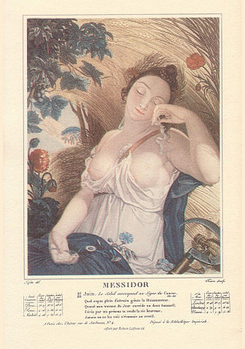
Fête Nationale Française. Le 14th Juillet. Bastille Day July 14th

French Revolutionary Month of Messidor (June-July) Bastille Day

Today, is the French National Day, le Quatorze Juillet. Bastille Day, celebrating the storming of the infamous Bastille on 14 July 1789. It was a symbol of Royal oppression, but only held 7 relatively insignificant prisoners on the day it was stormed. 200 attackers and 1 defender were killed in the first round of the battle.  Then the Commander, de Launay, surrendered to avoid more deaths.  But the angry attackers dragged him from the Castle to the Hôtel de Ville. He was beaten and shouted “Enough! Let me die’, kicking a cook in the groin. He was killed with 7 of his soldiers. However, inglorious a victory it was symbolic of the collapse of the old order.

The French Revolutionary Calendar introduced a rational non-christian calendar to France. The months were given new names as reported, satirically in Britain in 1811, by John Brady as Wheezy, Sneezy and Freezy; Slippy, Drippy and Nippy; Showery, Flowery and Bowery; Hoppy, Croppy and Poppy. (starting with ‘October).

In fact, the real French names were: Vendémiaire, Brumaire, Frimaire; Nivôse, Pluviôse, Ventôse; Germinal, Floréal, Prairial; Messidor, Thermidor, Fructidor.

The official name of July was Messidor (or ‘hoppy’). You might like to have a look at my post on the fascinating details of the Revolutionary Calendar to celebrate the French National Day. The 14th July was the day named after Sage in the Month of Messidor.

First published in 2024, revised 2025

June & July – Street Parties in London on the Vigils of Feast Days

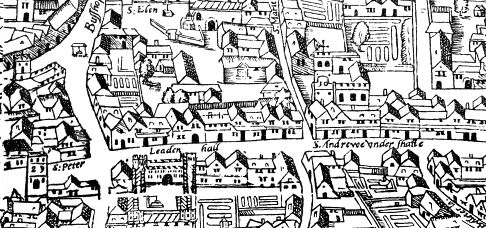
Image from the Agas Map of London
Civitas Londinum is a bird’s-eye view of London first printed from woodblocks in about 1561

John Stow tells us that there were bonfires and street parties in London throughout June and July. These were held on the Vigils of Saints’ Feast Days. The Vigil is the evening before a festival. A custom that might owe a little to the Celtic choice of dusk as the beginning of the new day.

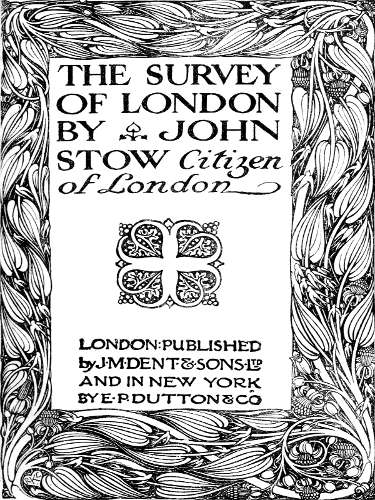
Front cover of the Survey of London by John Stow

Stow was the author of the ‘Survey of London‘ first published in 1598. Unfortunately, he does not give a list of the vigils thus celebrated. He only mentions those of St John the Baptist and of St Paul and St Peter. For these he gives a very vivid description, which I included in my post on June 24th here.

The other festivals would be for prominent Saints, particularly those with London Churches or Chapels named after them. These might include: St Botolph, St Alban, St James, St Thomas, St Margaret, St Wilgerfortis, St. Mary Magdalen, St Bridget, St James, as well as Saints John, Peter, and Paul. I’m guessing that City wide street parties would be reserved for the most important Saints. But with local celebrations for the Saint on the local Church. I am assuming these celebrations were ended or much reduced after the Reformation.

This is what Stow says of the Vigil celebrations.

In the months of June and July, on the vigils of festival days, and on the same festival days in the evenings after the sun setting, there were usually made bonfires in the streets, every man bestowing wood or labour towards them; the wealthier sort also, before their doors near to the said bonfires, would set out tables on the vigils, furnished with sweet bread and good drink, and on the festival days with meats and drinks plentifully, whereunto they would invite their neighbours and passengers also to sit and be merry with them in great familiarity, praising God for his benefits bestowed on them. These were called bonfires as well of good amity amongst neighbours that being before at controversy, were there, by the labour of others, reconciled, and made of bitter enemies loving friends; and also for the virtue that a great fire hath to purge the infection of the air.

John Stow is one of the most important sources for Tudor and Medieval London. He was a Londoner, buried in St Andrews Undershaft (see map above), who wrote up all he could glean about London. I use him all the time – for example, on my Wolf Hall Tudor London Walk. Stow’s Survey of London can be accessed online, in full, here: or via the wonderful online Agas Map, from which the map above came from.

First Published 2022 and republished 2025

Thoreau moves to Walden Pond July 4th 1845

1967 postage stamp of Thoreau

Today, is Independence Day. The day that a great democracy came into being and established a rational system of Government, designed to stop autocracy. One of the great thinkers of the US was Henry David Thoreau. He moved into his hut on Waldon Pond on 4th July 1845. He wanted to experience life to the full. He thought he could best do that by living a simple life in the wild. 

Some think he was autistic, but his journals and publications show he lived a rich life.  His work links observations of nature with philosophic meditations and folk lore. His interest in ecology and avoidance of waste are forerunners of modern environmentalism. 

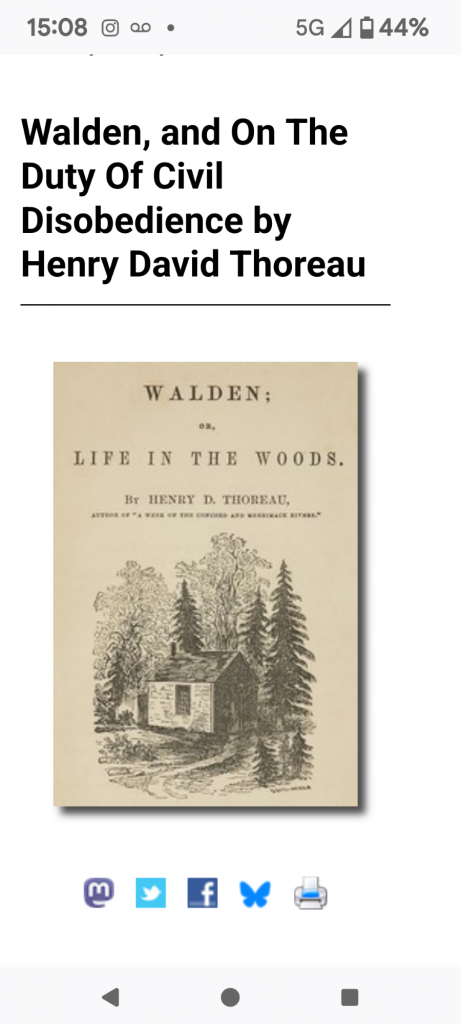
‘Walden’ his book about life in his hut near Concord, Massachusetts is his best known work. 

I began to occupy my house on the 4th of July, as soon as it was
boarded and roofed, for the boards were carefully feather-edged and
lapped, so that it was perfectly impervious to rain; but before
boarding I laid the foundation of a chimney at one end, bringing two
cartloads of stones up the hill from the pond in my arms. I built the
chimney after my hoeing in the fall, before a fire became necessary for warmth, doing my cooking in the mean while out of doors on the ground, early in the morning: which mode I still think is in some respects more convenient and agreeable than the usual one. When it stormed before my bread was baked, I fixed a few boards over the fire, and sat under them to watch my loaf, and passed some pleasant hours in that way. In those days, when my hands were much employed, I read but little, but the least scraps of paper which lay on the ground, my holder, or tablecloth, afforded me as much entertainment, in fact answered the same purpose as the Iliad.

Thoreau and Civil Disobedience.

From Project Gutenberg. Thoreau was also a principled opponent of unjust laws. He inspired Gandhi, amongst others, in the principles of Civil Disobedience.  He was imprisoned for refusing to pay tax to the American state in protest at the African-American War and Slavery.  He supported John Brown. 

Project Gutenberg page of Thoreau’s ebook.

John Brown’s Body lies a mouldering in his grave.

Brown believed that slavery would only be ended by fighting to liberate the slaves.  He was involved in the State Civil War in Kansas. Subsequently, he then launched a raid on Harper’s Ford, which caused several deaths.  Brown was found guilty of Treason against the Commonwealth of Virginia and executed. He was the first American to be found guilty of Treason. But Thoreau supported him, while other Abolitionists took a more pacifist position.

All in all, he is therefore an inspiring character. His life can inform that still tricky debate about challenging injustice in the modern world. Attitudes to ‘Just Stop Oil’ and the war in Gaza are causes where the same issues are still open to debate.

First published July 2025

World’s First ATM Honoured. Digital Heritage June 27th 1967

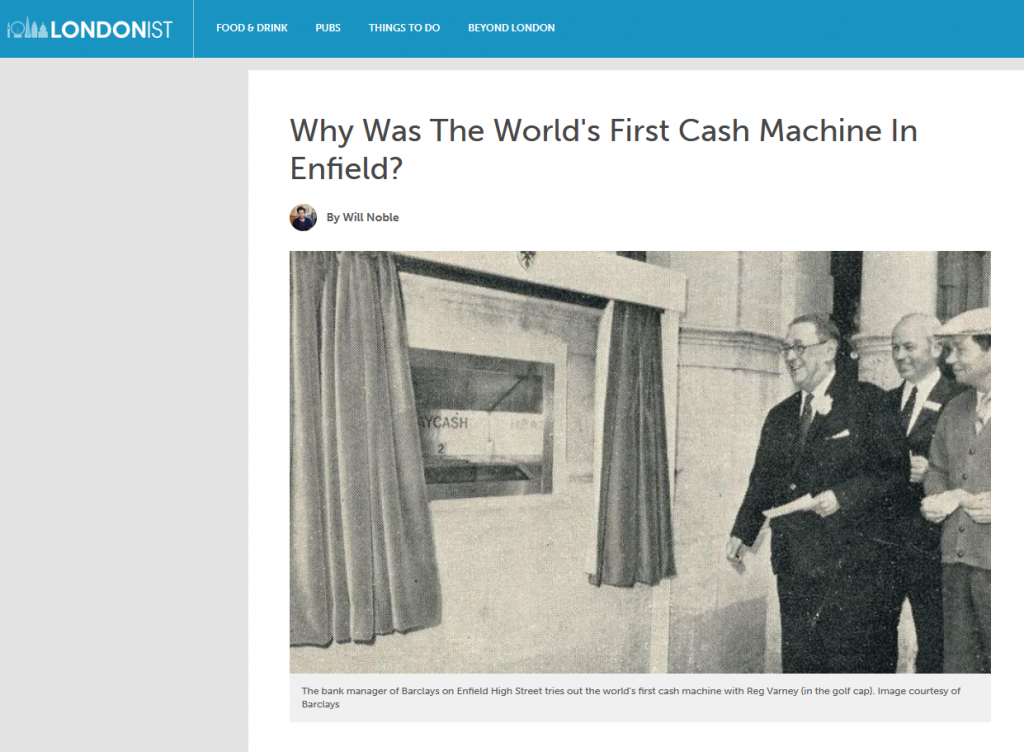
World’s First ATM. Screenshot from Londonist Web Page

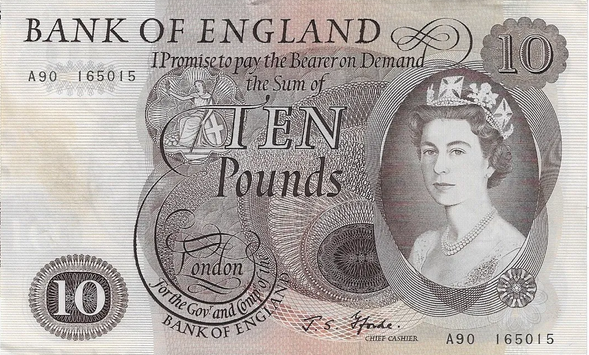
On the 10th April 2023, Heritage England announced on its webpage, that they had listed a Bank which contained the world’s first ATM Machine. On 27th June 1967 Barclays Bank open the first ATM at its Enfield Branch in London. Above, you will see local celebrity, Reg Varney (in hat), a star of a very popular and ‘corny’ sitcom called ‘On the Buses‘ opening the new machine. It miraculously delivered a £10 note without any human intervention, and offered access to money after banking hours.

1967 Ten pound note

Barclay’s had previously launched the UK’s first credit card, and selected Enfield to be the place where they launched an automatic machine to dispense money. They are nicknamed ‘money machines’ in the UK. The customer was issued a ‘punched card’ and had to enter a PIN for the magic to be initiated. Barclays were developing the idea of a magnetic strip on a card at the same time.

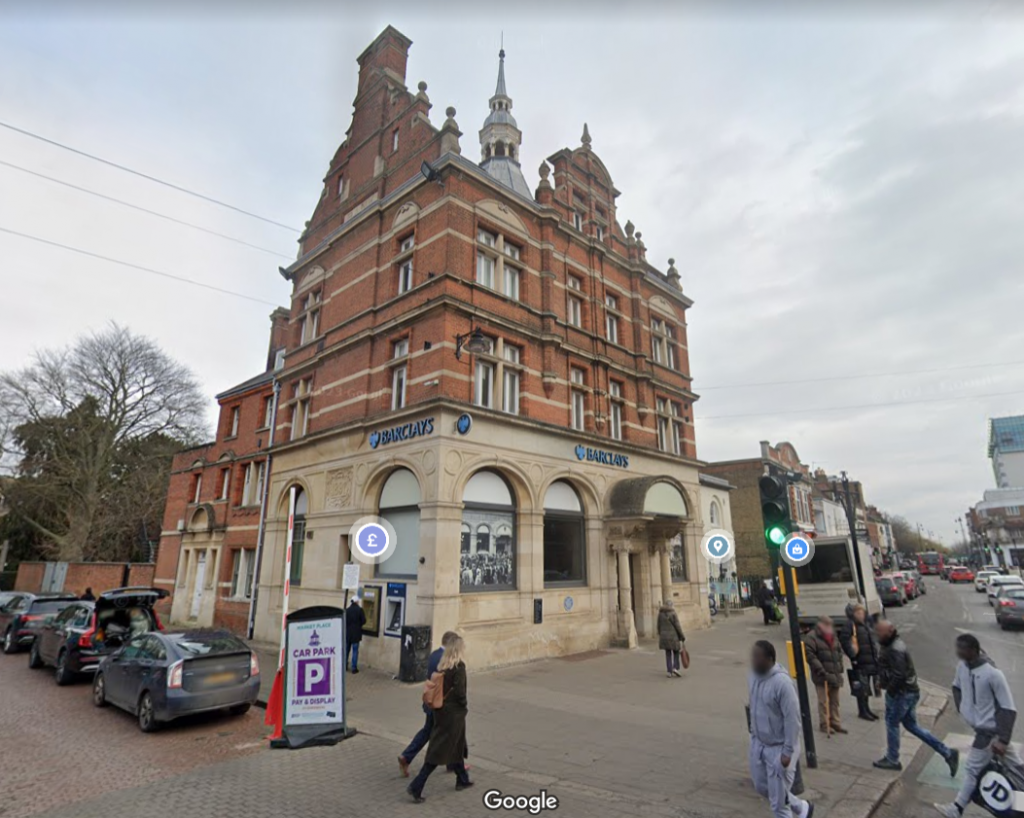
Google Street View image of the Enfield Barclays Bank (screenprinted 15/07/23)

The building, which now has a plaque and a gold-painted modern ATM, is Grade II listed and so should be protected from development in future. The building itself is an interesting, almost typical, late Victorian red brick commercial building, with fine details in the Flemish Renaissance style by William Gilbee Scott. Scott lived in Enfield.

I look forward to visiting it on my next visit to Enfield Lock on my narrow boat Mrs Towser.

For more on Digital Heritage see my post and for more on Mrs Towser see my post here

First published in June 2023 and republished in 2024, 2025

Festival of St John the Baptist June 24th

Two of the biggest feast days in London were held in late June. The Feast Days of St John the Baptist (June 24th) and of St Peter and Paul (29th June) were remarkable in the scale and the expense of the celebrations.

Here is what John Stow tells us about the processions on the night before the feast of St John (24th June) and St Peter and Paul (29th June):

On the vigil of St. John the Baptist, and on St. Peter and Paul the Apostles, every man’s door being shadowed with green birch, long fennel, St. John’s wort, orpin, white lilies, and such like, garnished upon with garlands of beautiful flowers, had also lamps of glass, with oil burning in them all the night; some hung out branches of iron curiously wrought, containing hundreds of lamps alight at once, which made a goodly show, namely in New Fish street, Thames street, etc.

Then had ye besides the standing watches all in bright harness, in every ward and street of this city and suburbs, a marching watch, that passed through the principal streets thereof, to wit, from the little conduit by Paule’s gate to West Cheape, by the stocks through Cornhill, by Leaden hall to Aldgate, then back down Fenchurch street, by Grasse church, about Grasse church conduit, and up Grasse church street into Cornhill, and through it into West Cheape again.

(Grasse Church Street is Gracechurch Street.)

The whole way for this marching watch extendeth to three thousand two hundred tailor’s yards of assize; for the furniture whereof with lights, there were appointed seven hundred cressets, five hundred of them being found by the companies, the other two hundred by the chamber of London.

(Note a cresset is: a ‘metal container of oil, grease, wood, or coal set alight for illumination and typically mounted on a pole’ (Wikipedia).)

Besides the which lights every constable in London, in number more than two hundred and forty, had his cresset: the charge of every cresset was in light two shillings and four pence, and every cresset had two men, one to bear or hold it, another to bear a bag with light, and to serve it, so that the poor men pertaining to the cressets, taking wages, besides that every one had a straw hat, with a badge painted, and his breakfast in the mornings amounted in number to almost two thousand.

The marching watch contained in number about two thousand men, part of them being old soldiers of skill, to be captains, lieutenants, serjeants, corporals, etc., wiflers, drummers, and fifes, standard and ensign bearers, sword players, trumpeters on horseback, demilances on great horses, gunners with hand guns, or half hakes, archers in coats of white fustian, signed on the breast and back with the arms of the city, their bows bent in their hands, with sheaves of arrows by their sides, pike-men in bright corslets, burganets, etc., halberds, the like bill-men in almaine rivets, and apernes of mail in great number;

There were also divers pageants, morris dancers, constables, the one-half, which was one hundred and twenty, on St. John’s eve, the other half on St. Peter’s eve, in bright harness, some overgilt, and every one a jornet of scarlet thereupon, and a chain of gold, his henchman following him, his minstrels before him, and his cresset light passing by him, the waits of the city, the mayor’s officers for his guard before him, all in a livery of worsted, or say jackets party-coloured, the mayor himself well mounted on horseback, the swordbearer before him in fair armour well mounted also, the mayor’s footmen, and the like torch bearers about him, henchmen twain upon great stirring horses, following him.

The sheriffs’ watches came one after the other in like order, but not so large in number as the mayor’s; for where the mayor had besides his giant three pageants, each of the sheriffs had besides their giants but two pageants, each their morris dance, and one henchman, their officers in jackets of worsted or say, party-coloured, differing from the mayor’s, and each from other, but having harnessed men a great many, etc

John Stow, author of the ‘Survey of London‘ first published in 1598. Available at the wonderful Project Gutenberg: ‘https://www.gutenberg.org/files/42959/42959-h/42959-h.htm’

Pagan Rituals

There are also pagan rituals associated with the Feast of St John. Here is an example of French pagan solstice fires:

“They were lit at the crossroads in the fields to prevent witches and sorceresses from passing through during the night; herbs gathered on Saint John’s Day were sometimes burned to ward off lightning, thunder and storms, and it was thought that these fumigations would ward off demons and tumults.”

For more information, have a look at ‘French Moments’ here:

Summer Solstice?

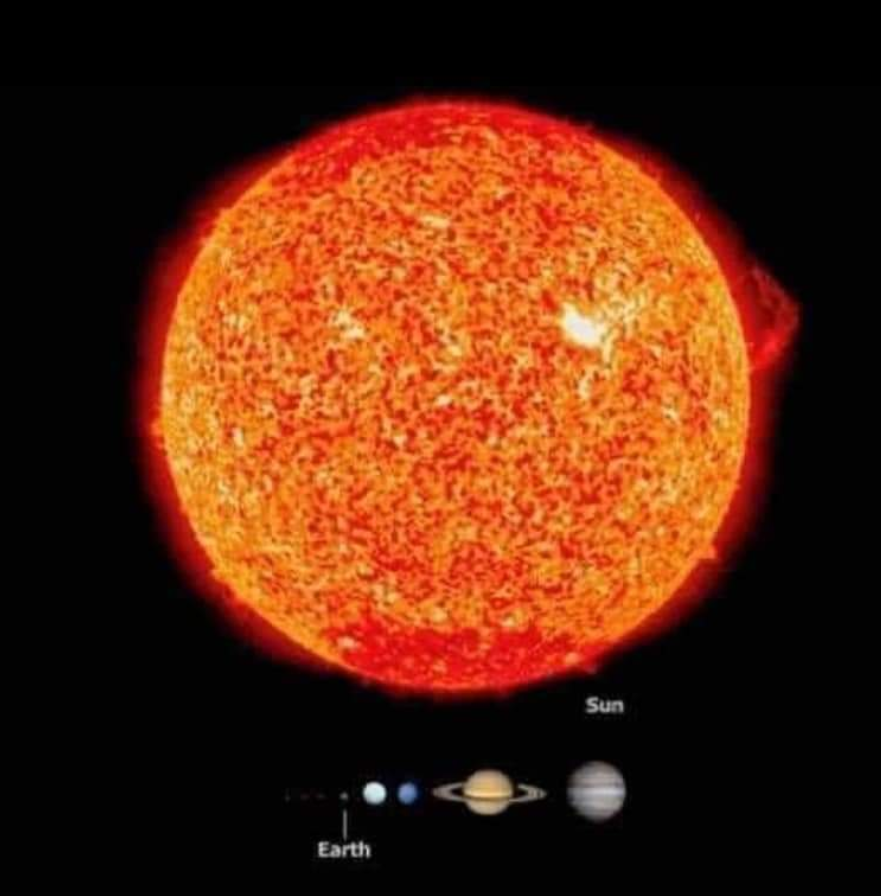
Image of the sun in relation to the planets

Hark! hark! The lark at heaven’s gate sings, And Phoebus ‘gins arise, His steeds to water at those springs On chalic’d flowers that lies; And winking Mary-buds begin To ope their golden eyes; With everything that pretty is, My lady sweet, arise: Arise, arise.
Cloten Scene III Cymberline

The Feast of St John is often described as being on the Summer Solstice, it isn’t by modern reckoning, but nor is December 25th the Winter Solstice. But they were celebrated as such by Christians, and the Solstice can be thought of as spread over 3 or 4 days (or more if taking into account Solstice Old style). The major events of the sun and the moon were linked into Christian theology and symbolism. Jesus, son of God, would clearly have arrived at the auspicious time of the Winter Solstice. His cousin, John the Baptist, came to tell the world about the coming of Jesus and so his birthday was exactly 6 months before the Winter Solstice.

St John is also special as most Saint’s Days are linked to the day of their death, but June 24th is the birthday of St John. His beheading by Herod is commemorated on 29th August.

St John Walbrook

St John the Baptist upon Walbrook in the City of London is first mentioned in the 12th Century, burnt down and not rebuilt after the Great Fire of London. The parish was, later, united with St Antholin, Budge Row, The Graveyard survived until 1884 when the District Line destroyed most of the Graveyard and the bones were reinterred below a monument, which can still be seen in Cloak Lane.

A Day Off for Anglo Saxon Freemen

In the Laws of King Alfred the Great, this day was a day off for freemen.  I will be writing about Days off in the Anglo Saxon Calender on August 15th.

First published June 2023 republished in 2024, and reorganised in 2025

Brexit Day & Sins of a Tour Guide June 23rd

Brexit Day, image from Wikipedia

Today, is Brexit Day, the 9th Anniversary of that terrible day when the Brexit Referendum was lost. Brexit was a terrible term but sadly stronger than the very weak, ‘remain’.  Ok you might say to your partner ‘Let’s give it another go.’  ‘Are you committed to the relationship?’ they ask.   You say.  ‘Yes, I am prepared to remain’. ‘All you can say is you want to remain!? Huh! Where’s the passion?’. But then the devil always had the best tunes.

Here is a survey of opinions about Brexit.  To sum it up, we regret it, although we think now is not the time to reopen the wounds. But it is the time to rebuild relationships with Europe.  In 10 years or so people believe we should rejoin.

We agree it was a disaster, and we blame the Conservatives and Boris Johnson most strongly, but also Teresa May. Rishi Sunak and Nigel Farage.

I posted on the other anniversary Brexit Anniversary in January here. Please be aware it features swear words, Boris Johnson and Farage.

Sins of a Tour Guide

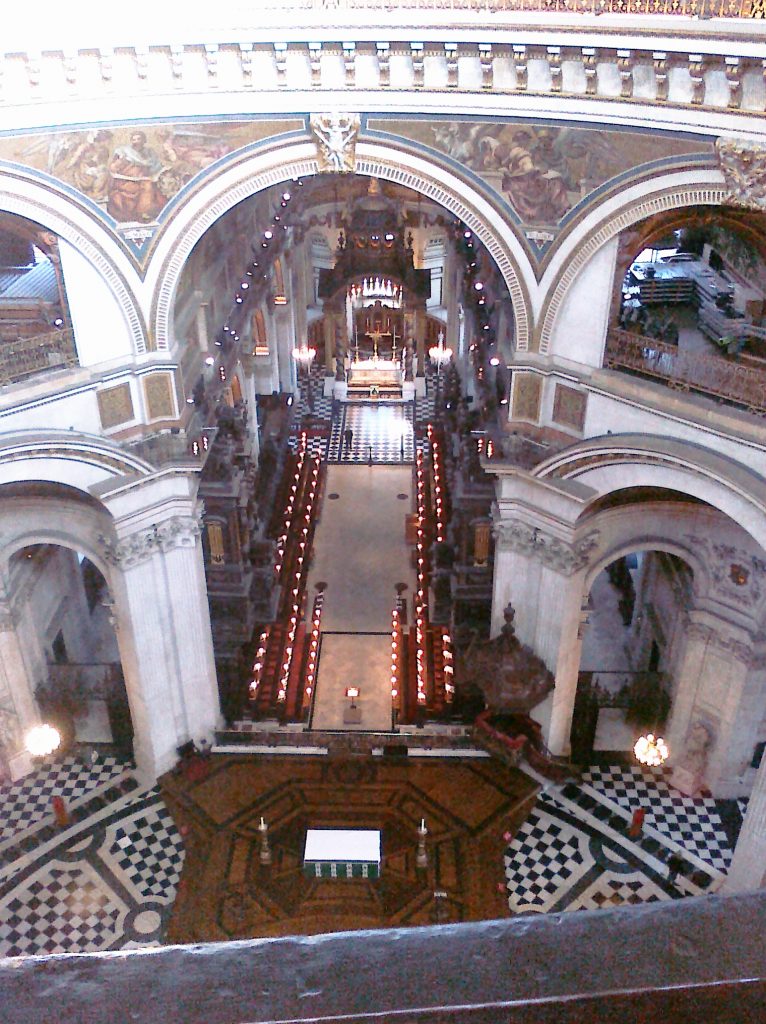
St Pauls from the Whispering Gallery, Photo by K Flude.

I was in St Pauls yesterday (I wrote this on 23rd June 2022) on an exploration of London’s History. My group had headsets so they can hear me talking into my mic without disturbing others. We went in, sat down in the nave to find an orchestra set up in the crossing. They were rehearsing with a grey haired man, informally dressed, at the podium. I hate talking through music, so wondered whether I would continue.

I began my introduction to St Pauls with a piece about Londinium and Christianity. A tremendous universe – shattering cord erupted from the Orchestra , deafening me. Then a pause, so I continued. I ascertained that my group could hear me, and I continued. I paused during crescendos and to some extent improvised what I was saying to the amazing drama of the atonal music. It was quite an experience and the music was amazing.

This morning I had a chance to check it out and it turns out that I spoke through rehearsals of Olivier Messiaen’s Et Exspecto Resurrectionem Mortuorum. (https://www.youtube.com/watch?v=AU7gVYM5bVE)

And the grey-haired man was none other than Sir Simon Rattle conducting the LSO.

I think I have the right piece of music.

I’m slightly shamefaced about it but on the other hand the group really enjoyed both the music and the explanation.

First written in 2022 and revised in 2025

Midsummer June 21st

A gentle midsummer reminder of our place in the universe – source Facebook post.

Midsummer Solstice is the 21st of June. The Celtic version begins when the Celtic Day begins. This is at dusk on June 20th, which we would call Midsummer’s Eve. Midsummer, astronomically, begins on 21st June.  But, meteorologically speaking, it has been here Summer since the beginning of June.

Midsummer is a fire festival, dedicated to the Celtic Fire God, Belinus. His name might mean Powerful One or Shining One, and he is linked to Apollo, one of the Greco-Roman Sun Gods. His main festival is Beltane, May Day, but many of the attributes of May celebrations and indeed Halloween celebrations are also carried out at Midsummer. (See my post on May Day)

In the early medieval period, the Church hijacked Midsummer’s Day and transferred it to June 24th. St John the Baptist’s Day. John was born 6 months before Jesus. John Aubrey in the 17th Century writes:

‘Still in many places on St John’s Night they make Fires on the Hills: but the Civil Warres coming on have putt all these Rites or customes quite out of fashion.’

John Aubrey, Miscellanies, 1695

For my post on St John the Baptist’s Day read my post here.

Appropriate Words for Midsummer?

Hark! hark!

The lark at heaven’s gate sings, And Phoebus ‘gins arise, His steeds to water at those springs. On chalic’d flowers that lies; And winking Mary-buds begin To ope their golden eyes; With everything that pretty is, My lady sweet, arise: Arise, arise.

Cloten Scene III Cymberline. William Shakespeare

Or words for a Druid watching the Sun rise?

Arise, O Sun!
Let the Darkness of Night
Fade before the beams of your glorious Radiance

Uncanny Summer

To prepare for Midsummer, remember that it is, like Halloween, an uncanny period. Hobgoblins, Fairies and Sprites, are, as in Shakespeare’s Play, Midsummer’s Night’s Dream, all abroad making mischief. Like May Fires, Belinus’ fire should be made from wood donated from all farms in the area, and using a range of trees. Ideally, collected by 9 men and from 9 different trees. Blazing branches should be carried sunwise around the fields to bless the crops, and it was good luck to jump over the ashes of the fire.

St John’s Wort

First in the line of defence against the infernal is St John’s Wort, known as Chasse-diable, Demon Chaser, Fuga Daemonum (amongst many other appellations). It was used to keep demons away, and to exorcise haunted houses. John Aubrey in ‘Miscellanies’ talks about a haunted London house which was cured by a Doctor who put St John’s Wort under the pillow of the bed. Bankes Herbel 1525 says:

Sedum_telephium by Bernd Haynold wikipedia

‘The virtue of St John’s Wort is thus. If it be put in a man’s house, there shall come no wicked sprite therein.’

Vervain, yarrow, corn marigold, and orpins were also used, often woven into garlands, and hung around the necks of cows, or on door lintels as protection. If the St John’s Wort withered, the picker was to die or at least endure disappointment. If orpins entwined themselves on Midsummer’s Night, marriage would follow. Orpine, (Sedum Telephium) aka Live Long, or Life Everlasting was valued for the length of time it remained fresh after being gathered. Medicinally, it was considered good to use outwardly to cool scaldings, inflammations, and wounds.

St John’s Wort has a reputation for helping with depression, menopausal symptoms, ADHD, anxiety and other conditions.

St John’s Wort Photo by Lex Melony on Unsplash

Hempseed & Love & Churches

A girl seeking love should walk around the Church seven or twelve times (accounts vary!) at midnight scattering hempseed, and singing:

Hempseed I sow
Hempseed I hoe
Let him that is my true love
Come after me and mow

In the South West of England, there was a custom to watch the church porch on Midsummer Evening. This was when the spirits of all the living people of the village could be seen entering the church. Those not seen coming out again would surely die, as would any watcher foolish enough to fall asleep.

Thanks to the ‘Customs and Ceremonies of Britain’ by Charles Kightly.

First written in June 2023, and revised and republished in June 2024, and 2025

Death of Luca Pacioli the Father of Double Entry Bookkeeping June 19th 1517

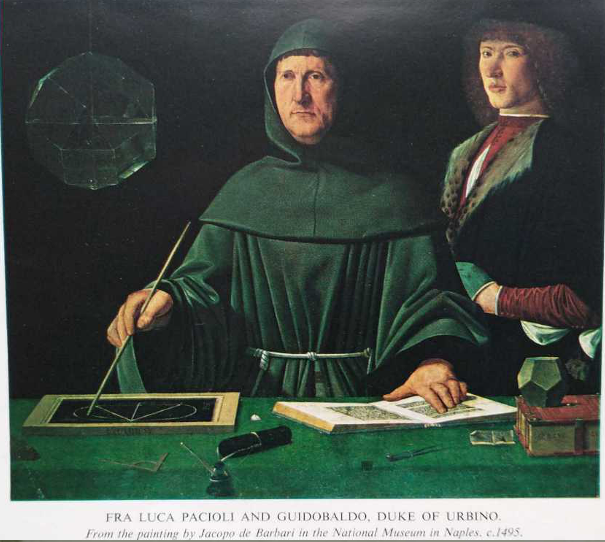
Luca Pacioli, father of double entry book keeping.

Luca Pacioli was a mathematician, whose mathematical text book had a section on Venetian book-keeping.  It was published in 1494 although double entry booking keeping was probably being used earlier.  The accountancy is a 27-page section called “Particularis de computis et scriptus.  It is part of the compendious ‘Summa de Arithmetica, Geometrica, Portiona et Proportionali’.

It is the source of modern double entry accounting, which spread from Venice as it was the printing capital of Southern Europe.

The key discovery, reported by Luca Pacioli, was that every transaction had to have an entry in both a debit and credit account.  So if I lend you £10,000 then my account is debited by 10k and yours is credited by the same amount.  Fra Luca (he was a Franciscan Friar) would have it that the accountant could not go to bed until the ledgers balanced. That is, that all the credits and balances in all the ledgers balance.

Double entry bookkeeping has prevented numberless frauds, kept many businesses on the straight and narrow. But it is of course not proof against sophisticated fraud.

Assyrian Double Entry booking keeping?

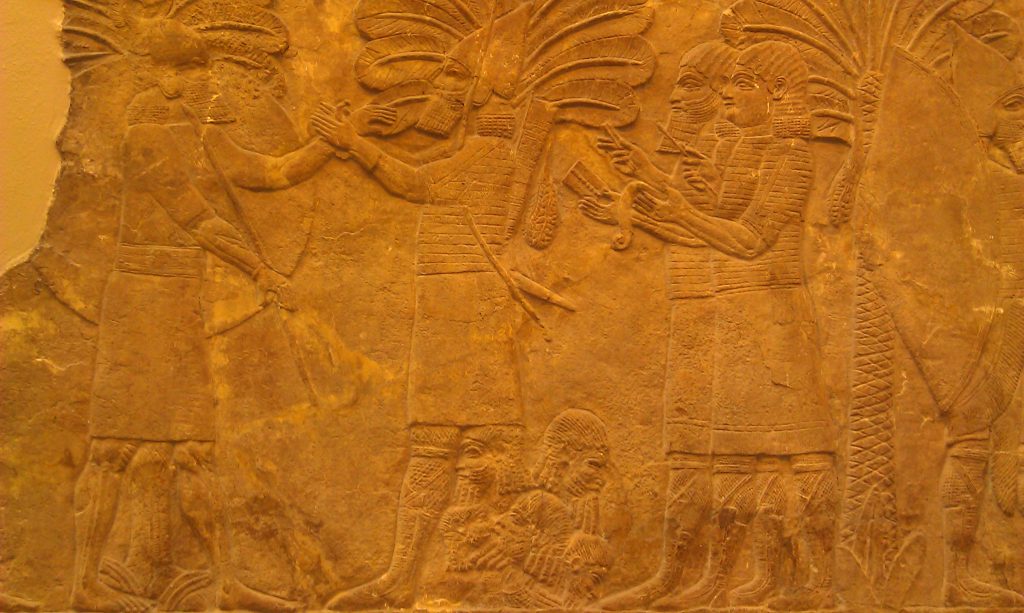
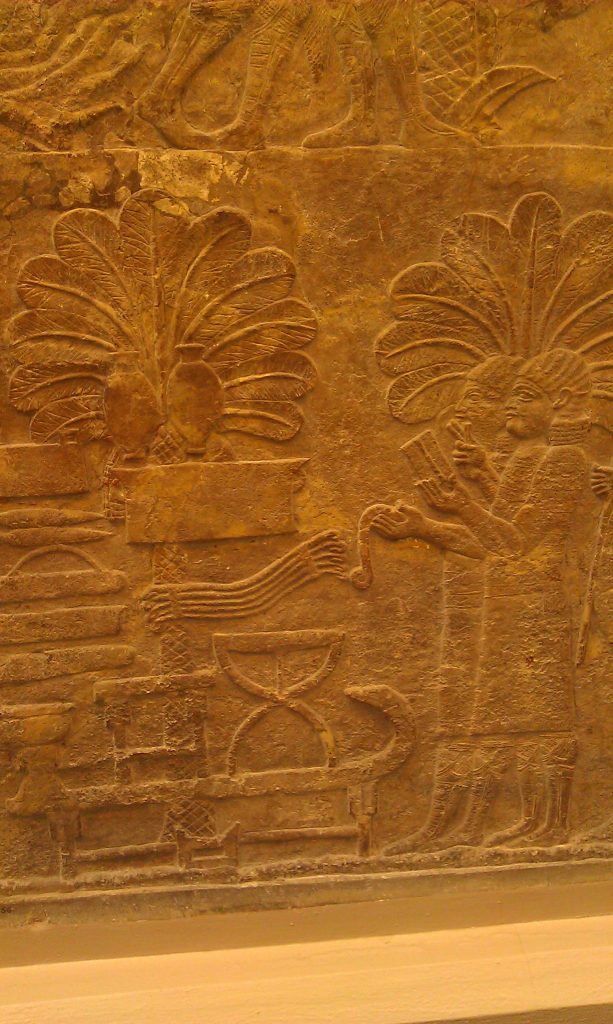
The gypsum stone reliefs shown below on display in the British Museum show clerks recording booty plundered in the Assyrians’ wars.  The soldiers are bringing goods in to be counted.  In the first picture, the goods are severed skulls.  In the second are a wide range of booty.

In every scene like this, there are two scribes writing notes on clay tablets with styli.  They stand side by side.  I presume their role is to make sure the other man doesn’t cheat, rather than to facilitate double entry book keeping as such.  Assyrians paid their soldiers for each enemy soldier they killed, and the head was the proof. You will see a little pile of severed heads between the soldier and the scribes.

Assyrian scribes recording severed heads.. British Museum. Photo Kevin Flude

Assyrian scribes recording war booty. British Museum.  Photo Kevin Flude

Italians, Accountancy and London.

The earliest work on double entry in England was by Oldcastle in 1543.  There were a lot of Italian businessmen in Tudor London. Thomas Cromwell was friends, and indeed neighbours, with some. As a young man he was helped out by the head of one of the great Florentine Finance houses, Frescobaldi.  They had branches in Bruges and London, and were major financiers to the Kings of England. Thomas More lived among the colony of Merchants from Lucca. The business centre of London before the building of the Royal Exchange was in Lombard St, where the Lombardian bankers hung out. 

More on the British Museum in my post here

First Published on June 19th 2025

The Great Broadway Paint off

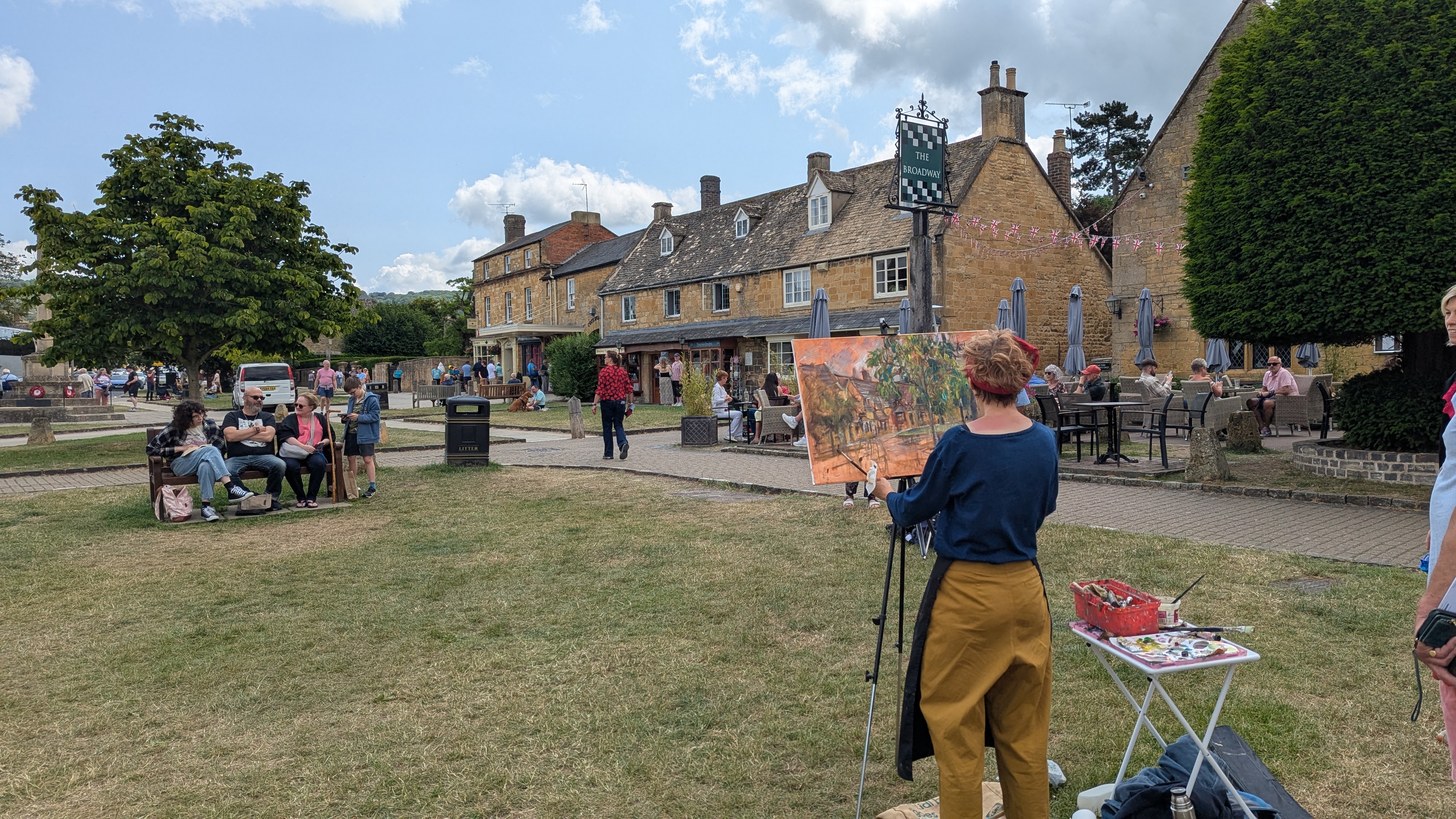
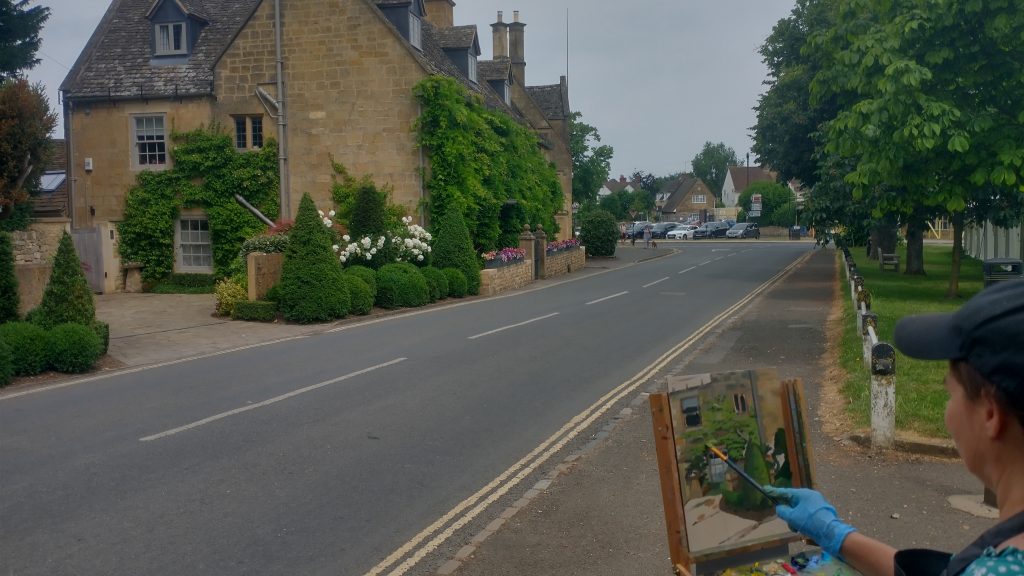
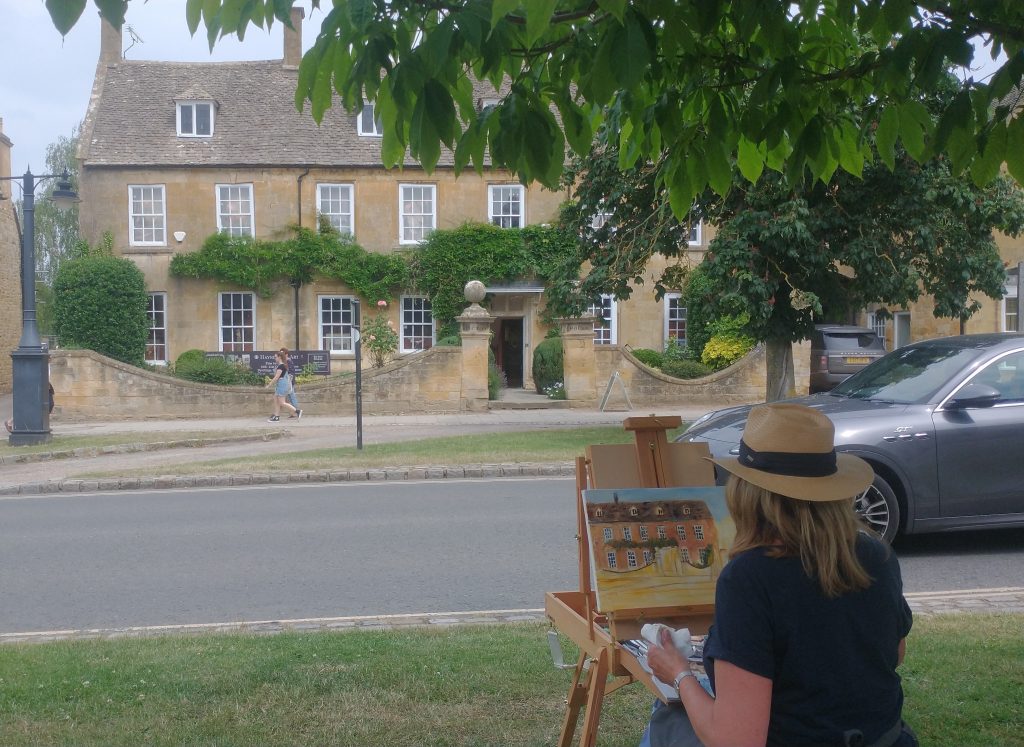
The Great Broadway Paint Off. Photo K Flude 2025

One of the joys of my Summer is revisiting places I know and love in my role as a Course Director for Road Scholar. I first came across the ‘en plein air’ in 2023. On Sunday, June 18th. I was in Broadway, once considered the most beautiful village in Britain. It was also the model for Riseholme in the wonderful Lucia books by E. F. Benson (made into a TV series by the BBC starring Prunella Scales, Geraldine McEwan and Nigel Hawthorne).

The day I visited, in 2025, was last Sunday, June 15th. I have added new photos and revised the texts.

How it Works

The artists register in the morning and have their paper or canvas stamped, or given a block of Maltese stone. This proves that they have done all the work on the day itself.

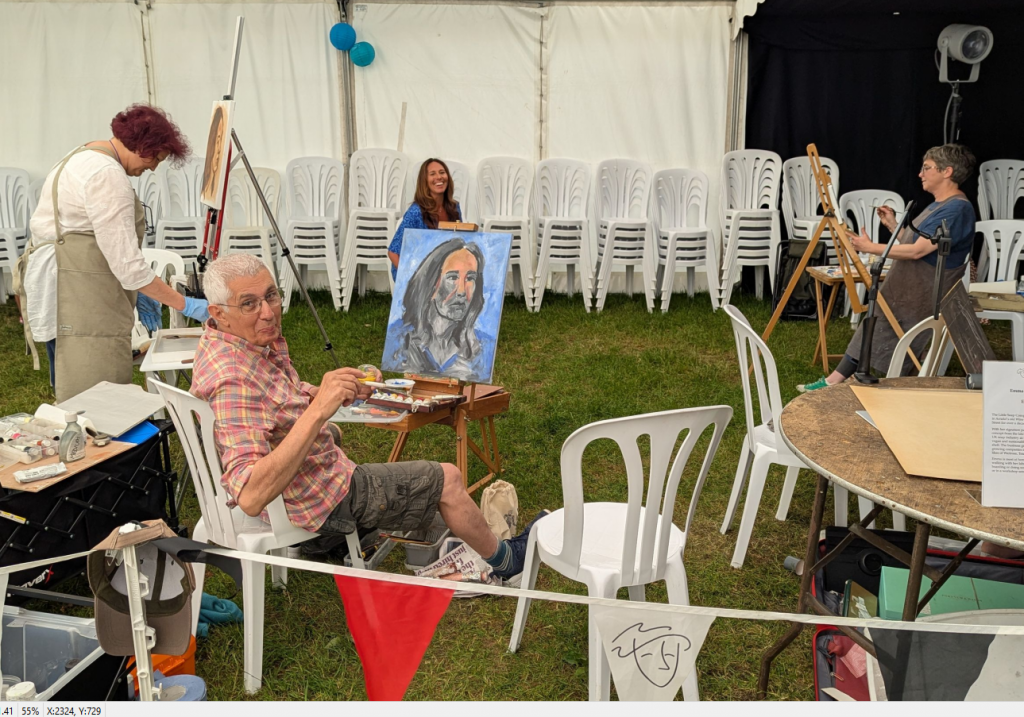
This year there were no sculptors.  Instead, there were live models in the marquee being painted by portrait painters. 

Broadway Paint off, Local Portraits. 2025 Photo K Flude

They take their blank canvases to create a work of art in the village. At 4pm or so, they are judged. At 5pm, the art works are exhibited and are on sale in the Marquee on the village green.

Broadway Arts Festival 2025, Photo K Flude

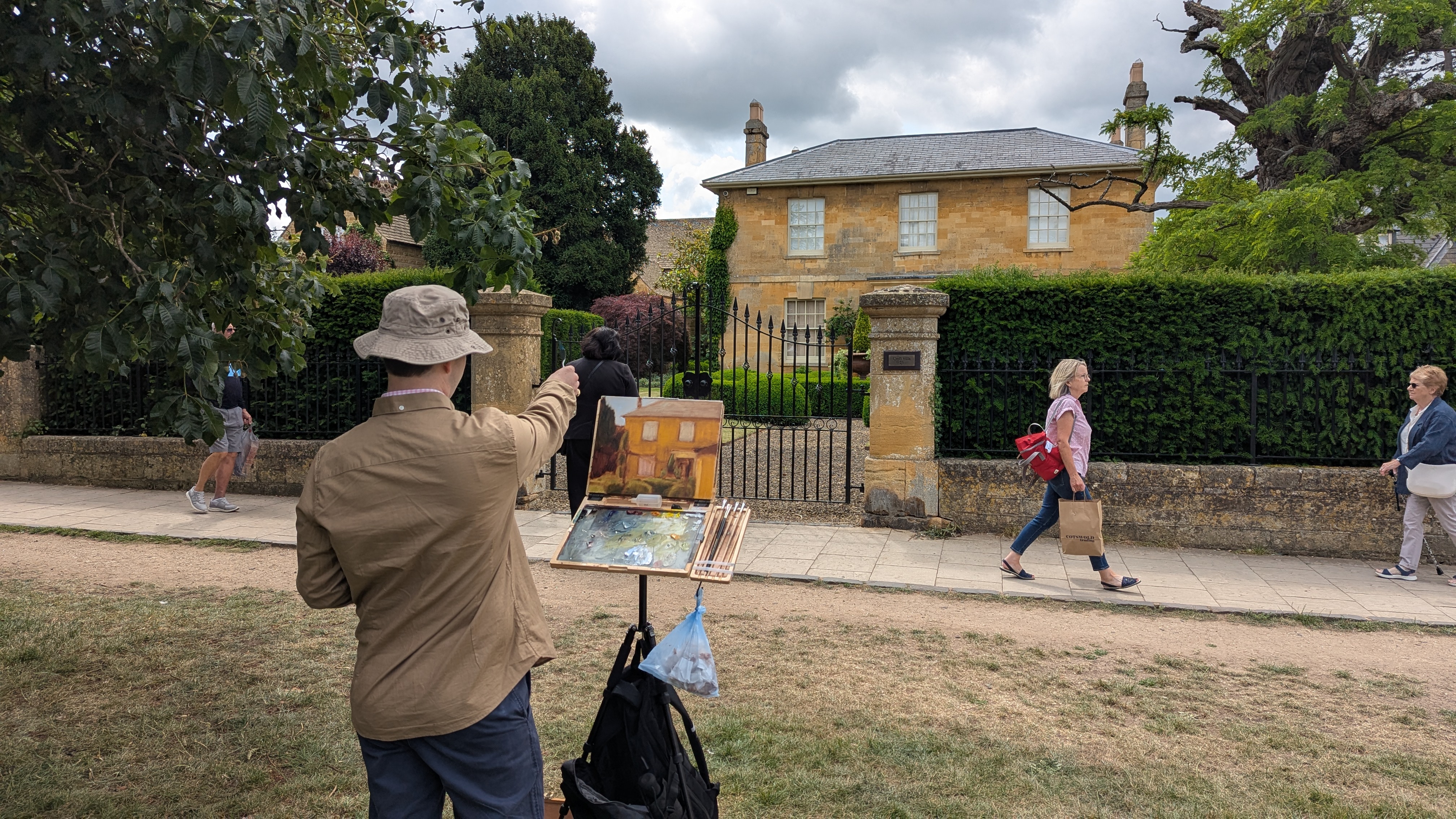
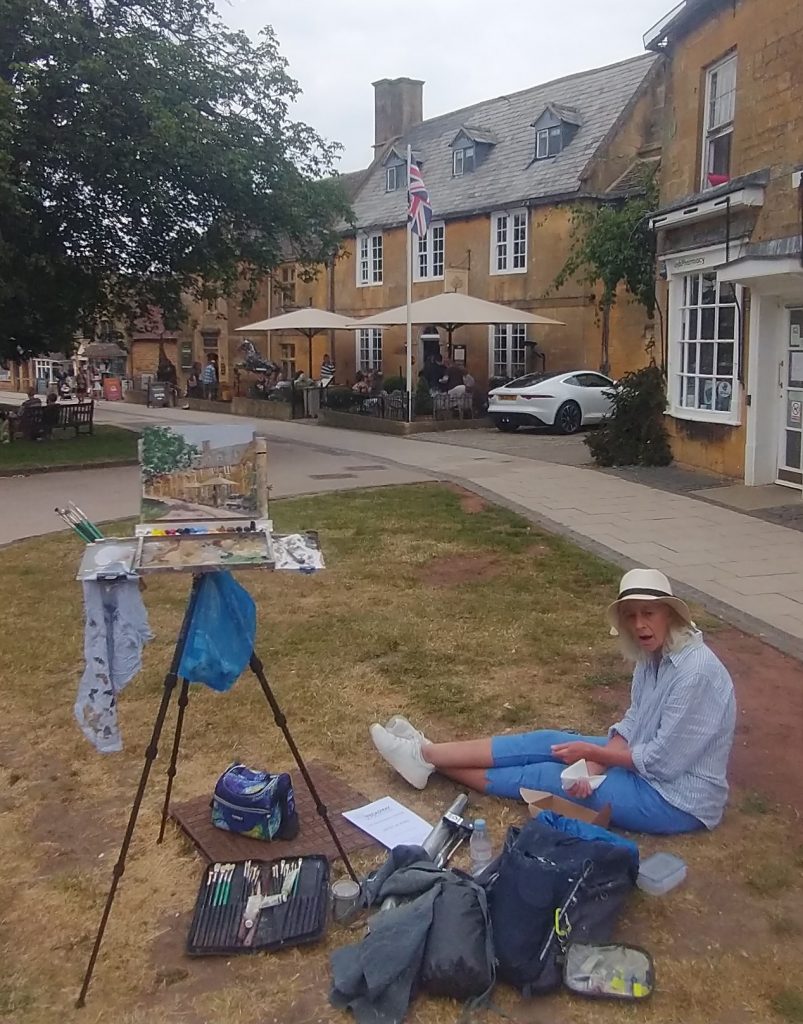
It’s always a delight walking around Broadway. Bun, but with an artist and easel every 50 yards or so even more enjoyable.

The Most Beautiful Village?

The appellation of most beautiful village, came in the late 19th Century. Broadway, once gained its wealth by selling wool. When that declined, the village became an important stop on the Toll Roads. It was on the stage coach route from Aberystwyth to Worcester, Oxford, and London. Fish Hill, nearly 1000 feet high, was an obstacle and coaches made a stop here to prepare or recover. Some coaches used up to 10 horses to get to the top. But with the arrival of Brunel’s Great Western Railway to the Cotswolds the village was nearly ruined. Half the village, the Broadway Museum says, moved away as their livelihood serving the coaching trade died.

Artist painting in the Broadway 'Great Paint off'
Artist painting in the ‘Great Broadway Paint off’ 2023 Photo K Flude
Artist painting in the Broadway 'Great Paint off'
Another artist participating Artist in the ‘Great Broadway Paint off’ Photo K Flude 2023
Painting in Broadway
@dawnjordanart Great Broadway Paint off’ Photo K Flude 2023

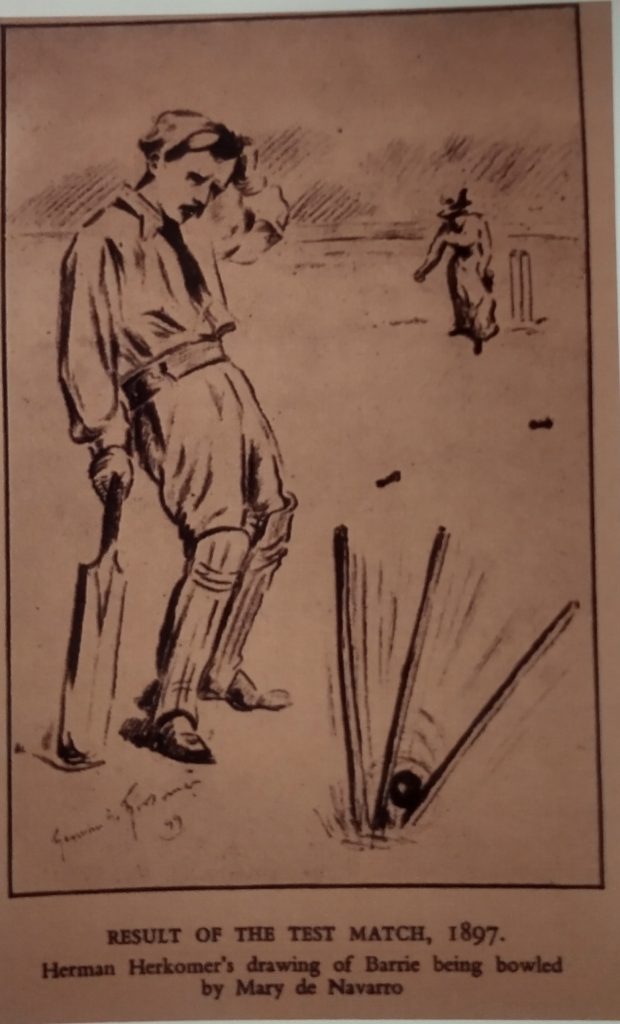
But artists and writers, led by Americans Frances Millet and Edwin Abbey, turned Broadway into a much sort-after country retreat. Visitors included Oscar Wilde, J. M. Barrie, Singer-Sargeant, William Morris, Edward Burne-Jones, Gabriel Dante Rossetti, American actress, Mary Anderson, Edward Elgar, E. F, Benson. Mark Twain visited for Millet’s marriage.

J.M. Barrie being bowled by Mary de Navarro. (aka Mary Anderson, who played many roles including Juliette at Stratford-on-Avon)

Gordon Russell & Henry T Ford

What made the visit particularly interesting was the story told by the volunteer at the Gordon Russell Museum in Broadway. This is the story as I understood it:

The Russells restored the Lygon Arms in Broadway using Arts And Crafts architects. They also restored antique furniture. The son, Gordon Russell, became a leading designer of modernist Furniture. He advertised to passengers on the Cunard Line in order to attract the attention of rich American visitors. One, Henry T Ford, was interested. He came to Broadway, staying at the Lygon arms. He was taken to nearby village Snowshill, where Ford bought a Cotswolds Farmhouse, complete with Blacksmith’s workshop. They were shipped stone by numbered stone to Brentford on the Thames. Then to the London Docks and across the Atlantic. Here. Ford set them up in a Museum in Michigan where they still are!

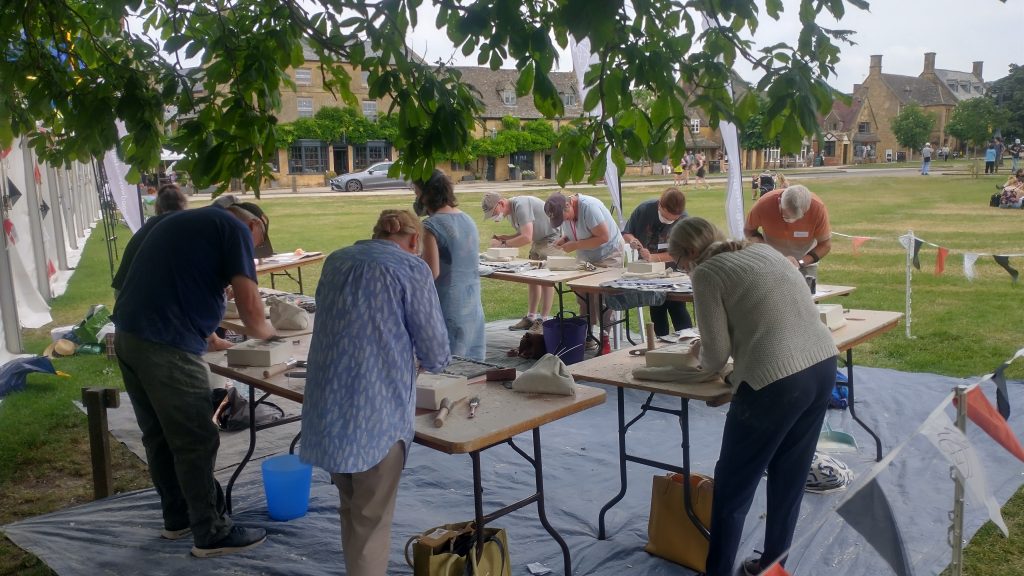
Sculptors at the Great Broadway Paint off.
Sculptors at the Great Broadway Paint off (2023)

Research suggests it’s a little more complicated, in so far as Ford purchased his first Cottage before coming to Broadway. But it still leaves a delightful story about American ideas of Quintessential English village life. For pictures see my post here. And for another look at the story look at this web site here:

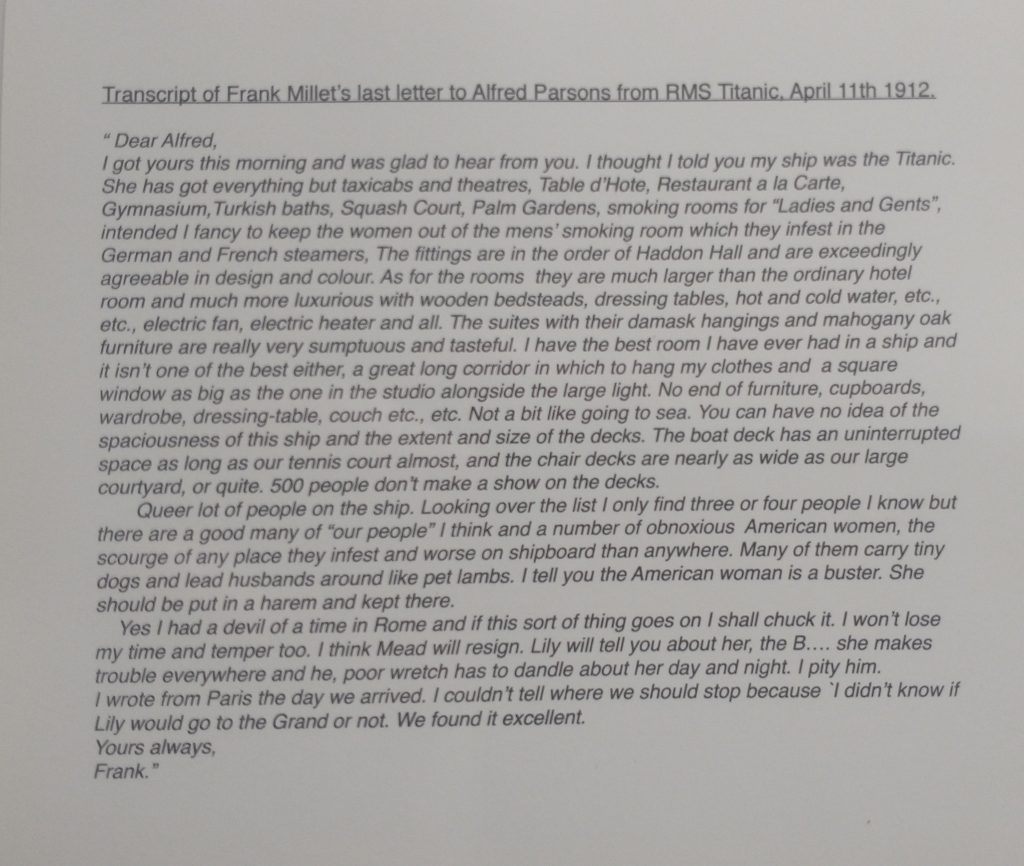
By the way, Frances Millet planned to return to the States on the Titanic. He was one of the 1500 who drowned. A letter he wrote while on the ship was posted, probably in France. It is on display in the Broadway Museum (2023).

For more about Broadway, Gordon Russell and Word War 2 see my post here:

June 18th is also:

International Sushi Day

Autistic Pride Day

National Chocolate Ice Cream Day

First Published in June 18th 2023, Republished in June 2024, and revised in 2025