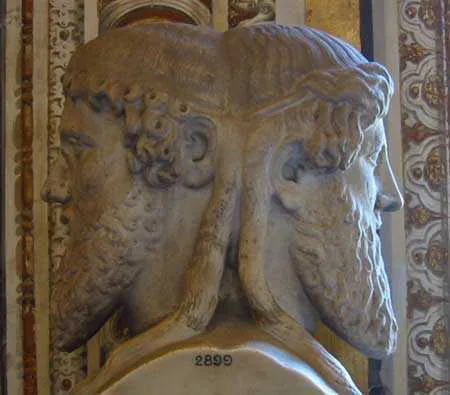
January is when people buy diaries, calendars and almanacs. January is named after the Roman God Janus. He faces both ways, to the old year and forward to the New Year. January is Ionawr in Welsh. An ceud Mhios Biadhna in Gaelic meaning ‘the first month of the year’.
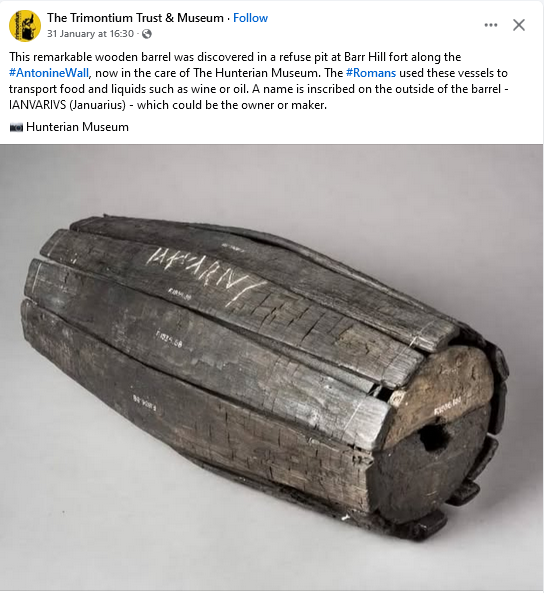
This is a Roman Barrel from Scotland is shown on the Trimontium Web Site with the name Januarius on it.
Almanacs
Arguably, they grew from medieval manuscript Books of Hours. The 1493 Kalendar of Shepherds, published in Paris, was particularly important. Each month has a succinct description of the activity. Moreover, there was important information for farmers and others. Eventually, a British version was made.
From the Kalendar of Shepherdes (illus. 1529)
Kalendar of Shepherds
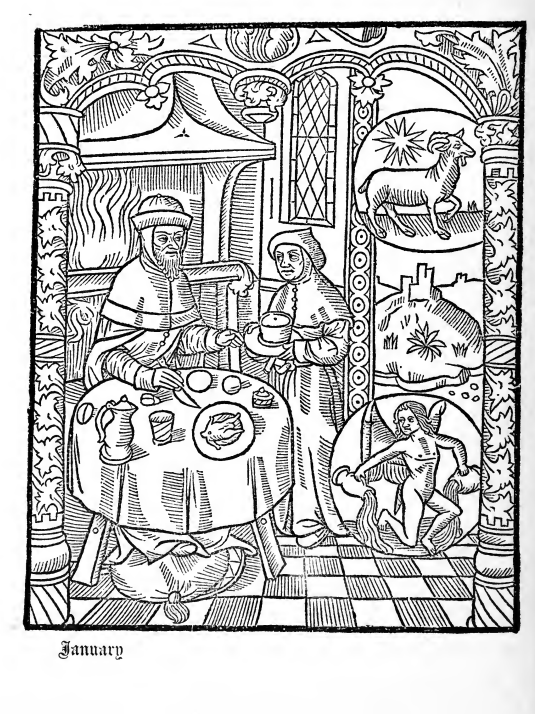
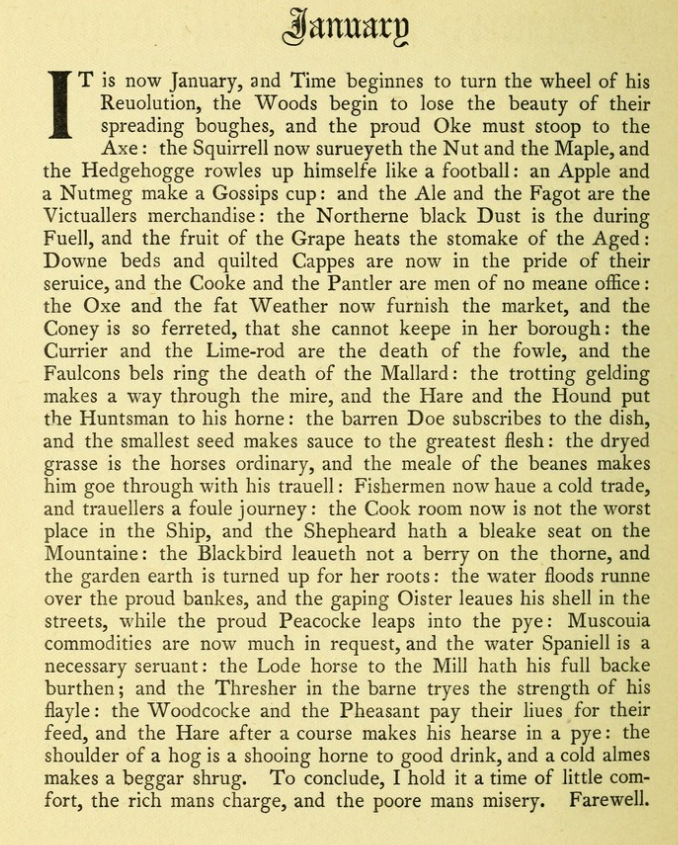
The Kalendar of Shepherds was printed in 1493 in Paris and provided ‘Devices for the 12 Months.’ I use a modern (1908) reconstruction of it using wood cuts from the original French and adding various text from English 16th and 17th Century sources. The text of the month (as shown above) is provided from a 17th Century source. It gives an interesting view of the countryside in January. To see the full Kalendar, look here:
Nicholas Breton, the writer of the text above, concludes that January:
‘is a time of little comfort, the rich man’s charge, and the poore man’s misery.’
The rich man is burdened by having to help out all the poor people who depending upon him to get through the shortages of winter. The image for January shows that January is best spent indoors by a roaring fire, eating pies.
Months of Your Life
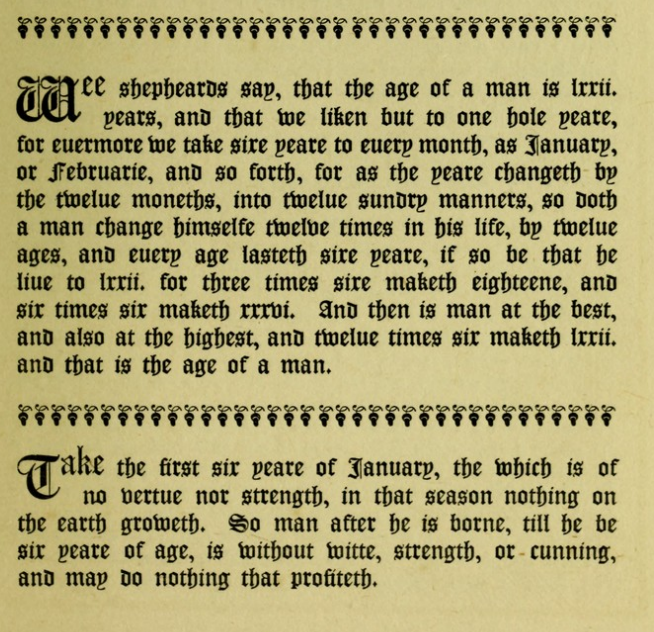
The Kalendar introduces a ‘conceit’ which is that the year mirrors our lives, and we can forecast what will happen in our lives by looking at the months.
Kalendar of Shepherds, January text
So our lives, which are of 72 years, can be divided into 12 ages of man, each of 6 years. So, January represents the first 6 years of a person’s life. And as you can see, that during these first 6 years, the child is ‘without witte, strength, or cunning, and may do nothing that profiteth‘. As the year changes every month, so, ‘a man change himself twelve times in his life’. At three times 6 (18 or March) a child becomes a man, and 6 times 6 (36 or June) man is at his best and highest. And at 12 times 6 (72 or December) man is at the end of his allotted span.
Shakespeare numbered the Ages of Man as seven, in the great speech of Jacques in ‘As You Like it’ I dealt with this and other Ages of the World in my post:
By the 1600s almanacs were the most published form of book apart from the Bible. Lauren Kassell in ‘Almanacs and Prognostications’ reports estimates that by 1660 one third of every household had one.
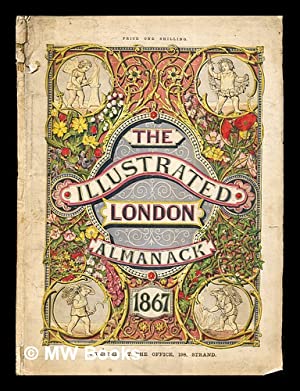
Originally, they had a Calendar for each month, and information about the phases of the month, the tides. They gave predictions of the weather, and health issues likely to occur at that time of the year. Astrology was an important element. London Almanacs contained further information about the year, its ceremonies and elections of officials. As this informational side to the almanac grew, they included lists of monarchs, interesting stories, verse foretelling the weather, recipes and cures.
As the New Year dawns, we might turn to an almanac to see what the year has ahead. Newspapers and the web have now taken over largely from almanacs. They print articles about the upcoming highlights of the Political, Sporting, Gardening or the Musical year. But almanacs are still produced. One of the most popular is Old Moore’s which has been in production since 1697. For more on Old Moore’s see my post here. As you can see, they promise to help with your gambling, gardening, fishing and help you through the year with predictions and horoscopes.
Originally published in 2024, republished in 2025. Content moved to new page and expanded 2026.
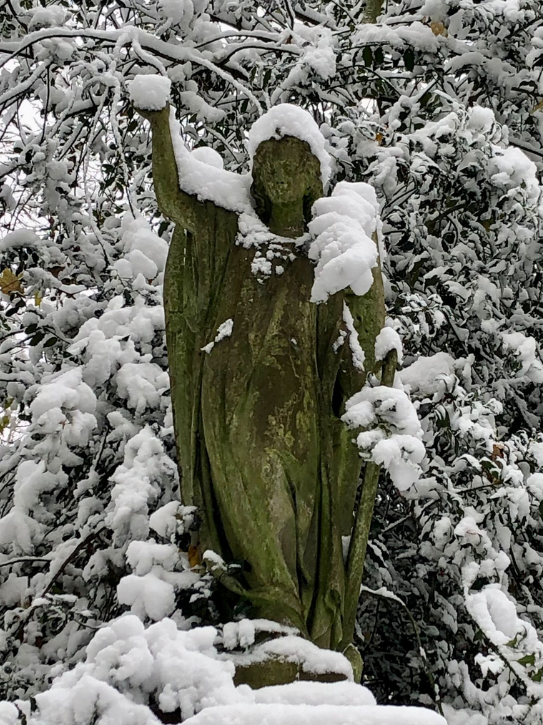
Winter at Abney Park Cemetery photo by Harriet Salisbury
Or so says the Shepherd’s Almanac for 1676. Until the 12th Night we were predicting that the weather on each of the 12 days will match the month of the same number. But having past Twelfth Night we have to find turn to other methods of weather lore.
Weather lore seems convinced of the undesirability of a warm January
‘January warm, the Lord have mercy’.
‘January commits the fault and May bears the blame.’
‘If Birds begin to Whistle in January, frosts to come’
‘When gnats swarm in January, the peasant become a beggar’
Most of the sayings about January quoted in Richard Inwards ‘Weather Lore’ first published in 1893, have this as their main focus. And the contrary (cold January good growing season) also generally holds:
‘When oak trees bend with snow in January, good crops may be expected.’
‘A cold January, a feverish February, a dusty March, a weeping April , and a windy May presage a good year and gay.’
The Weather according to Animals
So much for long range forecasts. Let’s see how Weather Lore helps us use animals to determine whether it will rain today.
‘If animals crowd together, rain will follow.’
‘When dogs eat grass it will be rainy‘
‘When a cat sneezes, it is a sign of rain‘
‘If young horses do rub their backs against the ground, if is a sign of great drops of rain to follow.’
The only weather lore repeated in my family was ‘Cows sitting down means it will rain.’ (And of course ‘red sky at night, shepherd’s delight’).
Meteorology Office on weather lore.
A survey by the Met Office in 2017 found that a surprisingly large number of people (75%) use ‘folklore’ to predict weather, and 55% think they are useful methods of predictions. Here is a quote from their post.
Red sky at night, shepherd’s delight – used by 70% of UK adults – CORRECT
It can be too cold to snow – used by 49% – PROBABLY NOT IN THE UK
Cows lie down when it is about to rain – used by 44% – NOT CORRECT
Pine cones open up when good weather is coming – used by 26% CORRECT
If it rains on St Swithin’s day, it will rain on each of the next 40 days – used by 22% Not Correct. In fact since records began in 1861, there has never been a record of 40 dry or 40 wet days following St Swithin’s Day
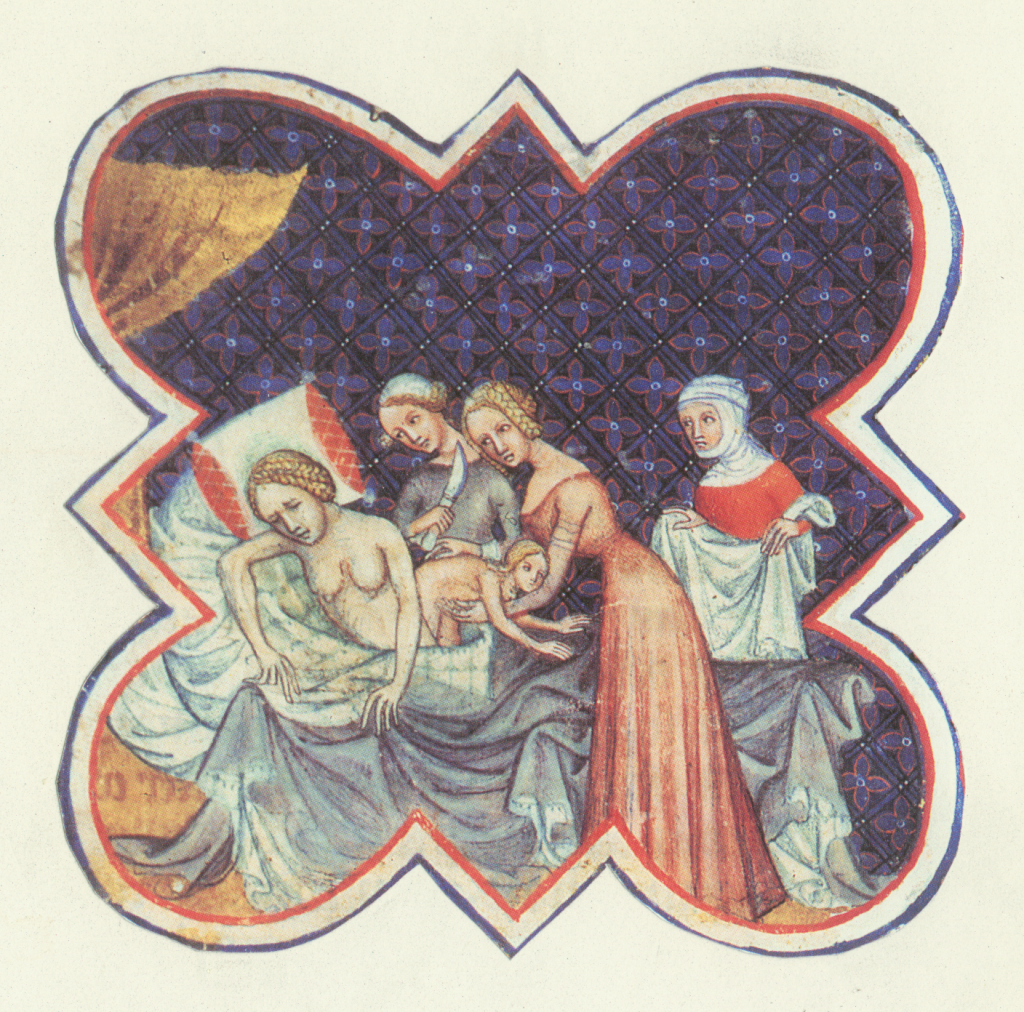
1375, French Caesarian Birth, (caesarians at this time would have killed the mother or be performed when she was already dead or dying.)
When Britain reluctantly joined the Gregorian Calendar, in 1752, we lost 11 days. So if you add 11 to 31st December you get to New Year’s Eve Old Style. You can do this with any festival date, and when celebrating, feel you are being really authentic.
So, anything you did on the New Year’s Eve New Style (31st Dec), you can do today New Year’s Eve Old Style. Except, of course, when you call in sick because of a hangover, you will need to convince your boss of the illegitimacy of the Gregorian Calendar! In case you have forgotten what you should be doing on New Year’s Eve you can look at my post here to find out.
Witchy New Year’s Eve Old Style
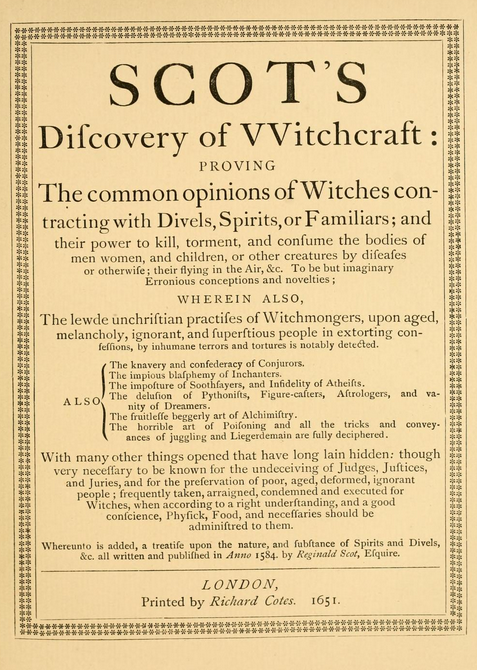
It’s a particularly ‘witchy’ evening because it is the traditional Eve, not the newfangled Gregorian one. Reginald Scot in his ‘Discovery of Witchcraft’ first published in 1584 reports on a way to find witches:
‘a charm to find who has bewitched your cattle. Put a pair of breeches upon the cow’s head, and beat her out of the pasture with a good cudgel upon a Friday and she will run right to the witch’s door and strike it with her horns‘
Reginald Scott’s book is available here and is a fascinating read. But, perhaps I need to say: don’t try this at home, as scientific research does not support it as a valid method!
Campaign against the slaughter of ‘poor, aged and the infirm’ as Witches
When I first posted this, I did not, to my shame, know the background to the book. I assumed the book was advocating this sort of nonsense. On the contrary. Reginald Scot was trying to debunk the absurd claims for witchcraft and magic. His book tries to prove that witchcraft and magic were rejected both by reason and religion. He believed that manifestations of either were ‘wilful impostures or illusions due to mental disturbance in the observers’.
The book is evidence that the large number of people who were executed as witches in the 16th and 17th Century, were the victims of a QAnon-style conspiracy, which was rejected by many educated and rational people. Please have a read of the cover of this 17th Century edition of Reginald Scot’s book. It gives a good idea of what he was setting out to counteract. Scot was a member of Parliament for New Romney, in Kent.
This is some of the text in the image below, which makes clear the prejudices at play in the campaign to execute witches:
‘For the preservation of poor, aged, deformed, ignorant people, frequently taken, arraigned, condemned and executed for witches, when, according to a right understanding and a good conscience, physic, food and necessaries should be administered to them.’
Carmentalia
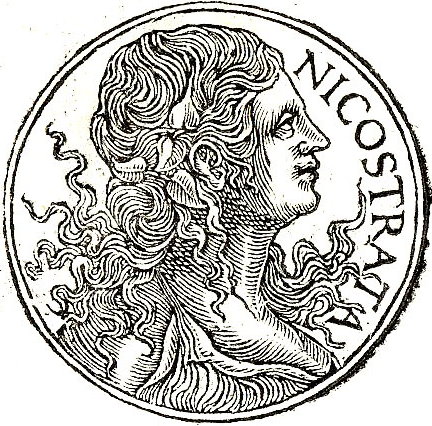
Carmenta or Nicostrata , Goddess of Prophecy, Childbirth, Midwives and Technical Innovations. Published by Guillaume Rouille (1518?-1589) – “Promptuarii Iconum Insigniorum”
It is also Carmentalia, the festival for Carmenta, the Roman Goddess of prophecy and childbirth. She was a much loved Goddess in the Roman pantheon. But little is known about her, perhaps because she has no clear match in the Greek pantheon? However, she was thought to be a nymph of the Arcadians, called Themis.
She has a long history in the story of Rome. She was the mother of Evander. Who is he? I hear you shouting! Well, he is the founder of Pallantium. Where on earth is that? You cry! It is the City on the site of Rome (on the Palatine Hill) that predated Rome! Who knew that? (The people at Vindolanda Roman Fort know, and they have a great page on Carmentalia here). The City was supposed to be of Greek origin, founded 60 years before the fall of Troy. Later, it was absorbed into Rome.
Carmenta
Carmenta had two sidekicks who were her sisters and attendants. Postvorta and Antevorta, They might be explained by Past and Future. (or, After and Before) as part of her role in prophecy. Or the two figures could represent babies that are either born head or legs first. She was an important enough Deity to command one of the fifteen flamens. These were priests of the state-sponsored religions. One of Carmenta’s flamen’s jobs was to ensure no one came to the temple wearing anything of leather. Leather was created from death, and not suitable for the Goddess of Childbirth, who was all about life.
The Vindolanda post makes the point that 2% of pre-modern births are likely to have caused the death of the mother. Because there was a high child mortality, the Roman Mother would have to have 5 children on average to keep the population stable. With a 2% death rate, and 5 children, they estimate that each mother had a 12% chance of death by giving birth. Good reason to have a Goddess on the Mum’s side. She is also the Goddess of Midwives.
Nicostrata
Carmenta was originally known as Nicostrata (which is Greek and means “victory-army”). She was credited with creating the Latin Alphabet by adding additional letters to the Greek one. So, she is also the Goddess of Technological Innovation. Some Goddess! . When she left Arcadia in Greece for Italy she took 15/16 letters of the Greek Alphabet, and joined them with local letters forming the original Latin alphabet. Later other letters were added. For more on Nicostrata see here. Her name was changed to Carmenta which comes from the word for song or spell or prophecy.
Old Archaic Latin Alphabet, founded by Nicostrata aka Carmenta from Wikipedia
On This Day
1869 The Anglo-Zulu War began
1963 Whisky-A-Go-Go, the first discotheque opened in Los Angeles or so says my copy of the Chambers Book of Days. But research suggest there was an earlier Whisky-A-Go-Go opened in 1958 in Chicago. And that the name sprang from the Whisky à Gogo, established in Paris in 1947. It got its name from the famous Ealing Comedy Film Whisky Galore which was marketed in Paris as ‘Whisky a Gogo‘. (à gogo, meaning, in French, “in abundance”, “galore”) (Wikipedia)
You can rent the film on YouTube but here is a little excerpt from Whisky Galore! where the Islanders start to sample the Whisky they have rescued from a War time ship wreck.
First published in Jan 2022, revised January 2024, 2025. Nicostrata and Whisky Galore! added 2026
Gervase Markham was born in 1568, in Nottinghamshire, and was a prolific writer. Today, prompted by the Perpetual Almanac by Charles Kightly, I am looking through Markham’s eyes at Apples. Apples were an important source of joy as well as nutrition through a cold winter, as fresh produce became unavailable.
Markham wrote detailed books for use by the householders, the Husbands and the Housewives. And with the coming of frost, the survival of food in your food store might depend upon reading Markham’s books. When the frosts hit, as they are now doing in the UK, you had to look after your store of apples. They were an important sweet food source over the winter.
For the women, he wrote the English Housewife, published in 1615. Here is his recipe for Apple Tart.
For the Housewife How to Make Apple-tart
Take apples and peel them and slice them thin from the core into a pan with white wine, good store of sugar, cinnamon and rosewater, and so boil it all shall it be thick. Then cool it and strain it, and beat it very well together with a spoon, and then put it into your coffin or crust and bake it. It carrieth with the colour red.
Gervais Markham, the English Housewife 1683 version (quoted by Charles Kightly).
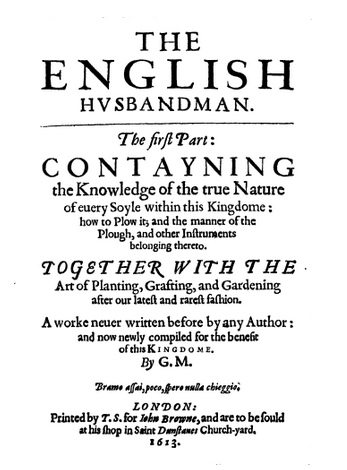
For the men, he wrote the English Husbandsman, published in 1613 and ‘Printed by T. S. for Iohn Browne, and are to be sould at his shop in Saint Dunstanes Church-yard.’ This is the St Dunstan’s in Fleet Street, I think (near Sweeney Todds, the Barbers.) The book is available on Project Gutenberg (Gervase Markham the English Husbandman. Project Gutenberg).
So to the frost – Markham ends his extensive piece on the best way to store apples as follows:
To keepe Fruit in frost. If the frost be very extreame, and you feare the indangering your fruit, it is good to couer them somewhat thicke with fine hay, or else to lay them couered all ouer either in Barley-chaffe, or dry Salte: as for the laying them in chests of Iuniper, or Cipresse, it is but a toy, and not worth the practise: if you hang Apples in nettes within the ayre of the fire it will kéepe them long, but they will be dry and withered, and will loose their best rellish.
I remember my Grandmother would store her excess apples from the tree, wrapped in paper and stored in cupboards in the pantry or outbuilding. They were often wrinkled but always delicious, and I think were Russets, which remain my favourite apple.
At the bottom of the piece, I include the rest of Markham’s advice for storing apples. To summarise it: Don’t store them near the ground. Place them on shelves ordered by variety based on which variety lasts longest. So at the back will be the long-lived species such as Russets and Pippins, to eat as spring approaches. The front the ones you need to eat now such as the ‘Costard, Pome-water, Quéene-Apple‘ varieties.
Marocco, Pocahontas and the Rhino – performing at the Bell Savage
Markham wrote many books, including one on the famous performing horse Marocco. He starred in shows at the Bell Savage, just outside Ludgate in the City of London. The horse would whinny in triumph with the naming of an English King. But snort with derision with the naming of a Pope. He could also count and add up. He was rumoured to have been burnt at the stake as a witch in Edinburgh. But this does not appear to be true. Also, appearing at the Bell Savage in the 17th Century was a Rhinoceros, other prodigies and Pocahontas.
How to Keep Apples extended version
For a more modern text on what to do with excess apples from your tree, have a look here. However, do read on to get an insight into life and the varieties of Apples that were eaten in the 17th Century.
The place where you shall lay your fruit must neither be too open, nor too close, yet rather close then open, it must by no meanes be low vpon the ground, nor in any place of moistnesse: for moisture bréedes fustinesse, and such naughty smells easily enter into the fruit, and taint the rellish thereof, yet if you haue no other place but some low cellar to lay your fruit in, then you shall raise shelues round about, the nearest not within two foote of the ground, and lay your Apples thereupon, hauing them first lyned, either with swéet Rye-straw, Wheate-straw, or dry ferne: as these vndermost roomes are not the best, so are the vppermost, if they be vnséeld, the worst of all other, because both the sunne, winde, and weather, peircing through the tiles, doth annoy and hurt the fruit: the best roome then is a well séeld chamber, whose windowes may be shut and made close at pleasure, euer obseruing with straw to defend the fruit from any moist stone wall, or dusty mudde wall, both which are dangerous annoyances.
The seperating of Fruit. Now for the seperating of your fruit, you shall lay those nearest hand, which are first to be spent, as those which will last but till Alhallontide, as the Cisling, Wibourne, and such like, by themselues: those which will last till Christmas, as the Costard, Pome-water, Quéene-Apple, and such like: those which will last till Candlemas, as the Pome-de-roy, Goose-Apple, and such like, and those which will last all the yéere, as the Pippin, Duzin, Russetting, Peare-maine, and such like, euery one in his seuerall place, & in such order that you may passe from bed to bed to clense or cast forth those which be rotten or putrefied at your pleasure, which with all diligence you must doe, because those which are tainted will soone poyson the other, and therefore it is necessary as soone as you sée any of them tainted, not onely to cull them out, but also to looke vpon all the rest, and deuide them into thrée parts, laying the soundest by themselues, those which are least tainted by themselues, and those which are most tainted by themselues, and so to vse them all to your best benefit.
Turning your Fruit
Now for the turning of your longest lasting fruit, you shall know that about the latter end of December is the best time to beginne, if you haue both got and kept them in such sort as is before sayd, and not mixt fruit of more earely ripening amongst them: the second time you shall turne them, shall be about the end of February, and so consequently once euery month, till Penticost, for as the yéere time increaseth in heate so fruit growes more apt to rot: after Whitsontide you shall turne them once euery fortnight, alwayes in your turning making your heapes thinner and thinner; but if the weather be frosty then stirre not your fruit at all, neither when the thaw is, for then the fruit being moist may by no meanes be touched: also in wet weather fruit will be a little dankish, so that then it must be forborne also, and therefore when any such moistnesse hapneth, it is good to open your windowes and let the ayre dry your fruit before it be turned: you may open your windowe any time of the yéere in open weather, as long as the sunne is vpon the skye, but not after, except in March onely, at what time the ayre and winde is so sharpe that it tainteth and riuelleth all sorts of fruits whatsoeuer.
1799 – Income Tax introduced for the first time by Prime MinisterWilliam Pitt the Younger at the rate of two shillings to the pound. This novel tax was used to pay for the war against Napolean.
1806 – Huge numbers attend Funeral and internment in St Pauls of Horatio Nelson, Killed at the Battle of Trafalgar.
Edinburgh from Arthur’s Seat. Castle to the left, St Giles the ’rounded’ spire in the middle, and Salisbury Crags to the right
Strange Case of Dr Jekyll and Mr Hyde by Robert Louis Stevenson
This is my select booklist for Edinburgh, one of my favourite towns. Strangely, heading it up is a book based in London, and written in Bournemouth. However, Stephenson’s Strange Case of Dr Jekyll and Mr Hyde is a very Edinburgh book but published in London on January 9th 1886.
What makes it fit for an Edinburgh booklist? Firstly, Edinburgh is the best place for a science-based Gothic Horror Novella. A City made for Ghost Tours, but with a scientific legacy arguably second to none. One of the inspirations for the book was the story of Deacon Brodie. He was a cabinetmaker who rose to be Deacon (president) of the craft of cabinetmaking. Therefore, he had wealthy clients and was impeccably respectable. When he went to his clients houses, or made them locked cabinets, he would copy the locks using wax moulds. Then he and his team would rob the house. He hid a cache of keys underneath Salisbury Crags which you can see above.
To cut a long story short, he made an attempt on robbing the Excise Office in Canongate, Edinburgh, on March 5th 1788. The heist failed, one of the robbers turned King’s Evidence. So Brodie fled to one of his mistresses in London, then to the Continent. But he was relentlessly pursued and captured in Amsterdam. He was brought back to face trial, found guilty, and hanged on a new scaffold, which he may just have had a part in designing.
Stevenson had cabinets made by William Brodie and as a young man produced a play about him. He was intrigued by the idea of a wealthy man having a dual life. The idea itself, seems obvious but the expression a ‘Jekyll and Hyde’ character is still often used to describe someone with two opposing sides to their characters. The idea of duality provides many ways to look at the book. Edinburgh itself was a duality. There was the old, filthy, higgledy-piggledy Old Town on top of the Volcanic Ridge, with the spacious New Town in the Valley below, with modern wealthy houses providing healthy homes for the rich. The idea of Two Cities, of the rich and the poor; the good and the evil; rationality and sensuality; hetero and homosexual fits well with Victorian Britain, but perhaps best into Victorian Edinburgh, the City of Burke and Hare. These famous Edinburgh serial killers were working for one of Europe’s greatest medical centres, where debate about Darwinism, and the powers of the brain were hotly debated in a City with a strong Presbyterian background.
In Bournemouth, Stevenson befriended the former Reverend Walter Jekyll, younger brother of gardener Gertrude Jekyll. He was probably homosexual and the author borrowed the name for the rational part of Jekyll and Hyde. At a time when to be gay was a crime, most gay people had to live a Jekyll and Hyde existence. In fact, Sodomy was a capital offence in Scotland until the year after the publication of the ‘Strange Case of Dr. Jekyll and Mr. Hyde.
Strangely, in a book list I would encourage you to watch the 1920 silent film starring John Barrymore to enjoy its ghastly atmosphere. You can watch it for free on YouTube here.
Ian Rankin’s Rebus
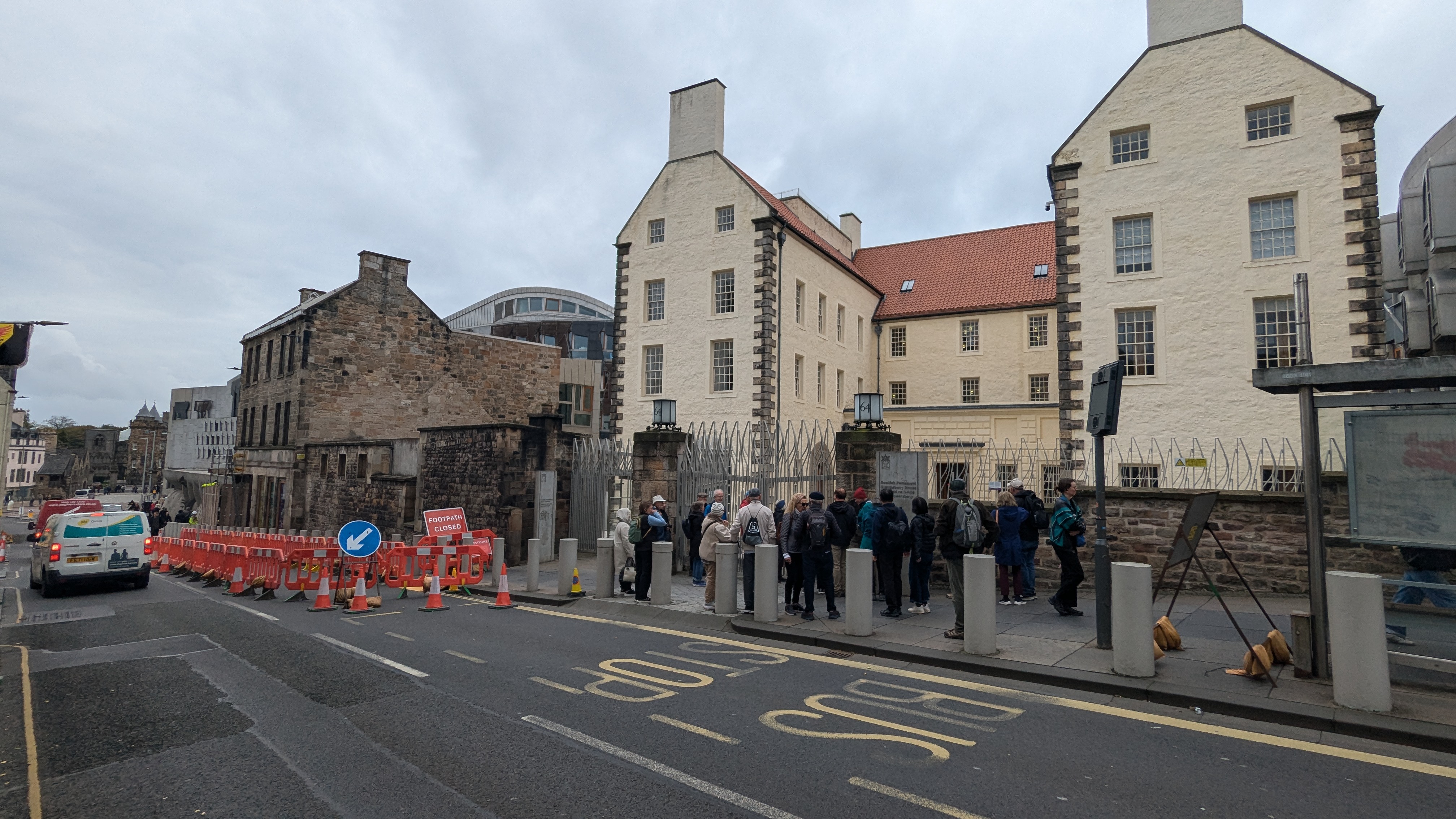
Ian Rankin is a typographical author of the highest rank. Every story brings Edinburgh, its people and its history to life. And yet set in a very readable crime fiction envelope. The Rebus I chose was ‘Set in Darkness‘ because it has the Scottish Parliament at its heart. It begins with a body found in Queensbury House, which is being preserved and incorporated into the new Scottish Parliament buildings. Please read my post on the book (link below).
Queensberry House to the right, with the Scottish Parliament in the background. Royal Mile, Cannongate in the foreground. (Photo: K. Flude)
Recently published is ‘Edinburgh a New History’ by Alistair Moffat. This is an excellent summary of Edinburgh’s History. He has written a large number of books about Scotland. I particularly liked ‘Reivers‘ which is a great book about the border raiders, both North English and Scottish who raided the borderlands between Edinburgh and York during the 13th to the 17th Centuries. They inspired the young Walter Scott, who collected Reivers ballads before inventing the Historical Novel.
As to Walter Scot, our Blue Badge Guide for Edinburgh, considers his long descriptive passages unreadable. But I’m not so convinced, having read Ivanhoe and Rob Roy as a boy. But if I were to recommend a Walter Scot, it would be Heart of Midlothian as it is set in Edinburgh and deals with crime, poverty, urban riots and other manifestations of life in Edinburgh in the 18th Century.
Midlothian is the country around Edinburgh, named after the legendary Celtic King Loth. The Heart of Midlothian, is Edinburgh or more precisely, a heart marked out in the cobbles. It is located outside of St Giles, on the Royal Mile, where the Tollboth (townhall and prison) and execution site for the City used to be. To this day, Edinburghers (or more correctly, Dunediners) are supposed to spit on the heart for good luck.
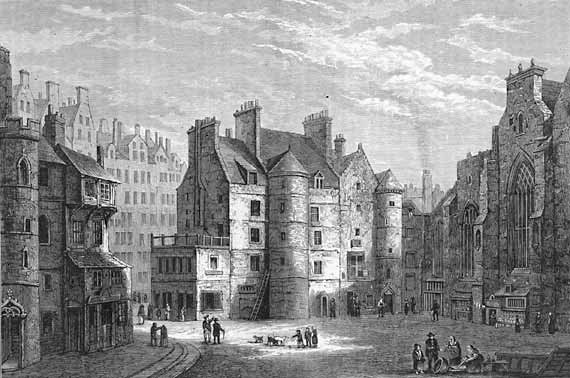
Old Print of the Tollbooth with St Giles to the right of the print.
It is hard to exaggerate the importance of Walter Scot. Byron said he had read his books 50 times, and never travelled without them. Goethe said ‘he was a genius who does not have an equal.’ Pushkin said his influence was ‘felt in every province of the literature of his age. Balzac described him as ‘one of the noblest geniuses of modern times’. Jane Austen and Dickens loved his books. The point is he invented the Historical Novel, and for the first time, as Carlyle wrote, he showed that history was made by people ‘with colour in their checks and passion in their stomachs.’ The only other person I can think of who was held in such universal regard was Tolstoy. There is also sense in which Scott invented our modern idea of Scotland, with its kilts and bagpipes.
The Scottish Enlightenment
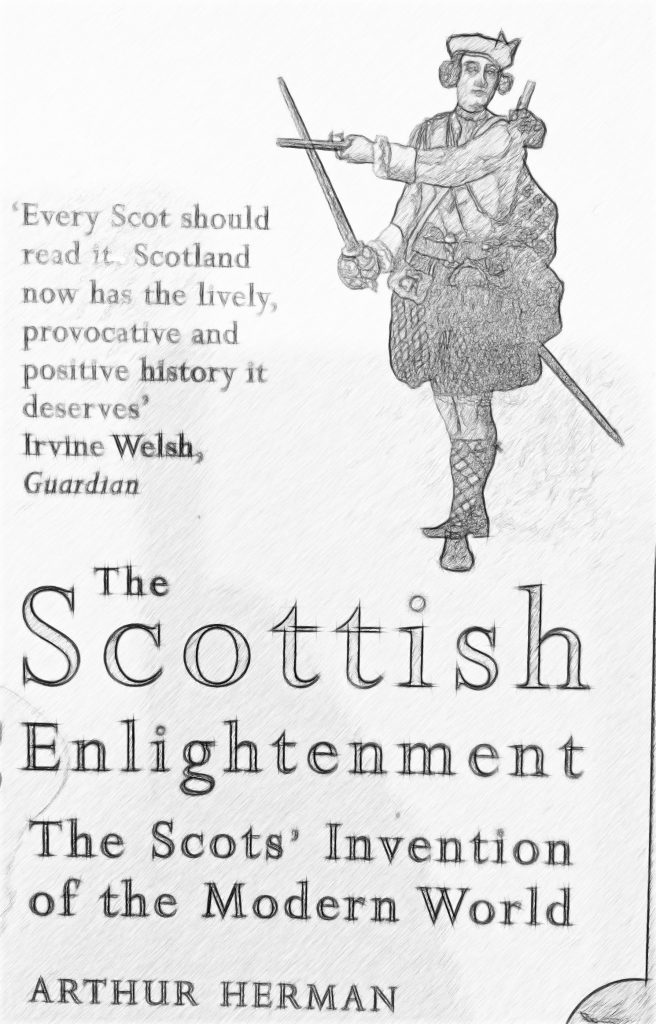
A walk through the centre of Edinburgh has so many statues of people who made the modern world it is astonishing. So you should read: ‘The Scottish Enlightenment – the Scots Invention of the modern world‘ by Arthur Herman.
Burke and Hare: The True Story Behind the Infamous Edinburgh Murderers by Owen Dudley-Edwards
The story of Burke and Hare is well known, but it shows how important Edinburgh was as a medical centre in the early 19th Century. Bodies were shipped to Edinburgh from the London docks, such was the demand for bodies for anatomy teaching. Arthur Conan Doyle got his medical training here from a man called Joseph Bell, whose logical mind was the model for Sherlock Holmes.
The Prime of Miss Jean Brodie
My last choice is Murial Spark’s The Prime of Miss Jean Brodie set in a school in Edinburgh where the teacher singles out 6 of her pupils for special education. She wants to give them a cultured outlook in life which includes her own fascistic views. Made into a wonderful film starring Maggie Smith, but also a great book. It also, in a strange way, reinforces the huge legacy of the Scottish Education system. It is said that the Reformation brought to the Scots the idea that everyone should be educated enough to read the Bible in their own language. But it seems to me the Scots had a particular understanding of the importance of Education before the Reformation. St Andrews University was founded in 1410, Glasgow in 1410, Aberdeen in 1495 and Edinburgh in 1510.
Of course, you should read some poetry by Burns, and I would begin with Tam O’Shanter the story of Tam, Maggie his horse and Nannie, the witch with the short skirt (Cutty Sark). The version above (see link) is read over a comic novel of the poem. But if you prefer the words, this is the one I read for my groups where I ruin the Scots dialect, and disgrace myself, but oh how I enjoy it! www.poetryfoundation.org tam-o-shanter
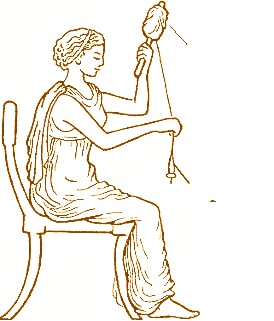
St Distaff Day. Spinning—showing the distaff in the left hand and the spindle or rock in the right hand
I’m not sure what the Three Kings were doing on the day after Epiphany. But, the shepherds, if they were like medieval English farmworkers, would still be on holiday. They went back to work, traditionally, next Monday, which is Plough Monday – (See my post here). This year, January 12th. By contrast, the women, according to folk customs, went back to work on St. Distaff Day, the day after Epiphany. Today, January 7th. In an ideal world, St Distaff’s Day is the Sunday after Epiphany (January 11th), and Plough Monday is the next day. Of course, it doesn’t always work out that way. I am not sure the woman going back to work on the 7th January, would be happy with the men lounging about until Plough Monday? An extra 4 days off! Maybe, St Distaff Day was normally on the Sunday before Plough Monday?
Distaffs and Women’s Work
A distaff is ‘a stick or spindle on to which wool or flax is wound for spinning’. Because of its importance in the medieval and early modern economy, it became a synecdoche for women. St Distaff is a ‘canonisation’ of this use of the word. So, a day to celebrate working women.
We know that medieval and early modern women were a vital part of the workforce, despite the demands of childcare. Many women took on apprenticeships, even more continued their husband’s work after he died. Some professions like silk became a female speciality. Many taverns were run by the Alewife. Plus, London was full of female servants and nurses. Many women had several jobs.
The exhibition at the British Library on Medieval Women. In Their Own Words, indicated that most of the sex workers had two or more other jobs. But even if a woman remained solely in the domestic realm, the wife had to be mistress of a formidable range of technologies. Baking, Brewing, Cooking, Laundry, Gardening, Dairy, Medicine (including distillation), horticulture, spinning, sewing and embroidery. Even, aristocratic women did embroidery of the finest quality, and it often made an important financial contribution to the household. They also ran the household, which means they had to have a formidable range of managerial skills. Dealing with servants, managing the accounts etc.
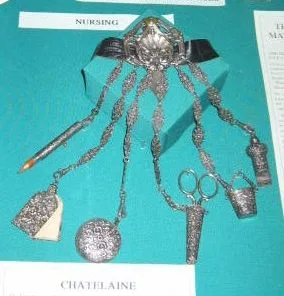
Chatelaine.
The other symbol of ‘women’s work’ was the Chatelaine. The word also means keeper of the Castle. But women who controlled households had a clasp that hung from the waist. It was a bit like a Swiss Knife as it had the keys, and all sorts of other useful items. Here is an old photo of the Chatelaine from the collection of the Old Operating Theatre Museum, of which I was the Director for 25 years. From left to right it has a pencil, a little notepad, a pill dispenser, a pair of scissors, a little bucket that held a dose of medicine, a whistle to summon urgent assistance. These were not only useful but a symbol of authority for the Matron. 19th Century.
St Distaff Day and Plough Monday
Robert Herrick (1591–1674), born in Cheapside, London, a Goldsmith, priest, Royalist and Poet wrote in ‘Hesperides’.
Partly work and partly play You must on St. Distaff’s Day: From the plough, soon free your team; Then come home and fother them; If the maids a-spinning go, Burn the flax and fire the tow. Bring in pails of water then, Let the maids bewash the men. Give St. Distaff all the right; Then bid Christmas sport good night, And next morrow every one To his own vocation.
Herrick, I think is suggesting fun and games are to be had. The men burning the flax and firing the tow, The women soaking the men with pails of water. In this piece, he links the plough team with St Distaff Day. This implies that the ploughs would be out on the next day. So as St Distaff’s Day is not always on a Sunday, perhaps Plough Monday is not always on a Monday? He certainly suggests everyone goes back to work either on St Distaff Day or on the day after,
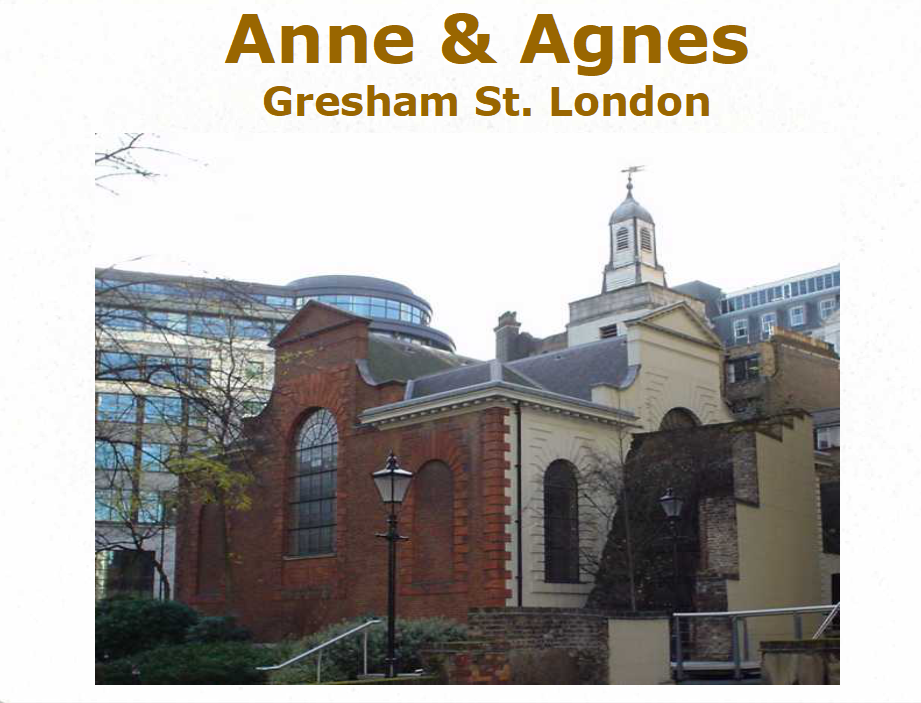
St Anne & St Agnes Church in London, Saints of the Distaff. Photo K Flude
Saints & Goddesses of the Distaff Side
In London, the Fraternity of St Anne and St Agnes met at the Church dedicated to the Saints. It is by a corner of the Roman Wall on the junction of Gresham Street and Noble Street. St Agnes is the patron saint of young girls, abused women and Girl Scouts. St Anne is the mother of the mother of the Son of God. So, together they represent the three generations of women: maidens, mothers, and grandmothers.
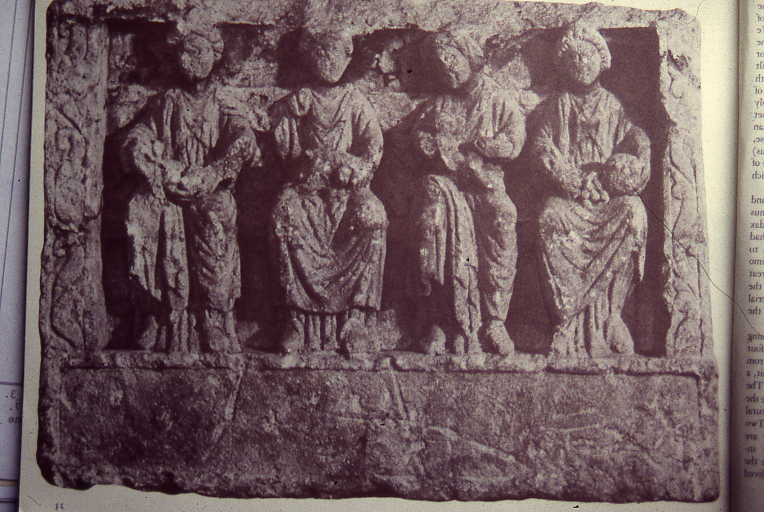
The Three Mother Goddesses (and someone else) “Limestone relief depicting four female figures sitting on a bench holding bread and fruit, a suckling baby, a dog and a basket of fruit’ the Museum of London
This trinity of women were worshipped by the Celts. Archaeologists discovered the sculpture above while investigating the Roman Wall a few hundred yards away at Blackfriars. Scholars believe it depicts the Celtic Three Mother Goddesses. The fourth person is a mystery, maybe the patron of a nearby temple? The relief sculpture was removed perhaps from a temple, or the temple was trashed at some point. Then the sculpture was used as rubble and became part of the defences of London.
The idea of triple goddesses is a common one. In Folklore and History they have been referred to as Maiden, Mother, and Crone, or even Maiden, Mother and Hag. They come in Roman, Greek, Celtic, Irish, and Germanic forms. Their names include the Norns, the Three Fates, the Weird Sisters, the Mórrígan and many more. The Three Fates, the Goddess Book of Days says, were celebrated during the Gamelia. This is the Greco/Roman January Festival to the marriage of Zeus and Juno. The Festival also gives its name to the Athenian month of January.
The Importance of the Grandma
The use of the terms Hag and Crone for the third Goddess is rare now, but was common. It does a great disservice to the importance of the Grandmother figure. (Although the original meaning of the words were less pejorative. For example, Hag may have meant diviner, soothsayer.) The three phases of womanhood are equally important to the continuation of the species. They provide love, support, and experience through the generations. Compare these three generations of supportive deities with Ouranos (Uranus), Cronus (Saturn) and Zeus (Jupiter). Saturn castrated and deposed his father, Uranus. Later, he tried to eat his son, Jupiter. But then, Jupiter is nobody’s idea of an ideal father. As one example, he eats his lover, Metis, to avoid her giving birth to his daughter, Athene. (See my post on the birth of Athena.)
Recent work on human evolution has suggested that the role of the Grandmother is crucial to our species’ ability to live beyond the age of fertility. Because, in evolutionary terms, once an individual cannot procreate, their usefulness for the survival of the genes is finished. So what’s the point of putting resources into grandma’s survival? The theory is the Grandmother has such an impact on the survival of the next generation, that longevity. for the female, beyond fertility makes evolutionary sense. Grandfathers less so.
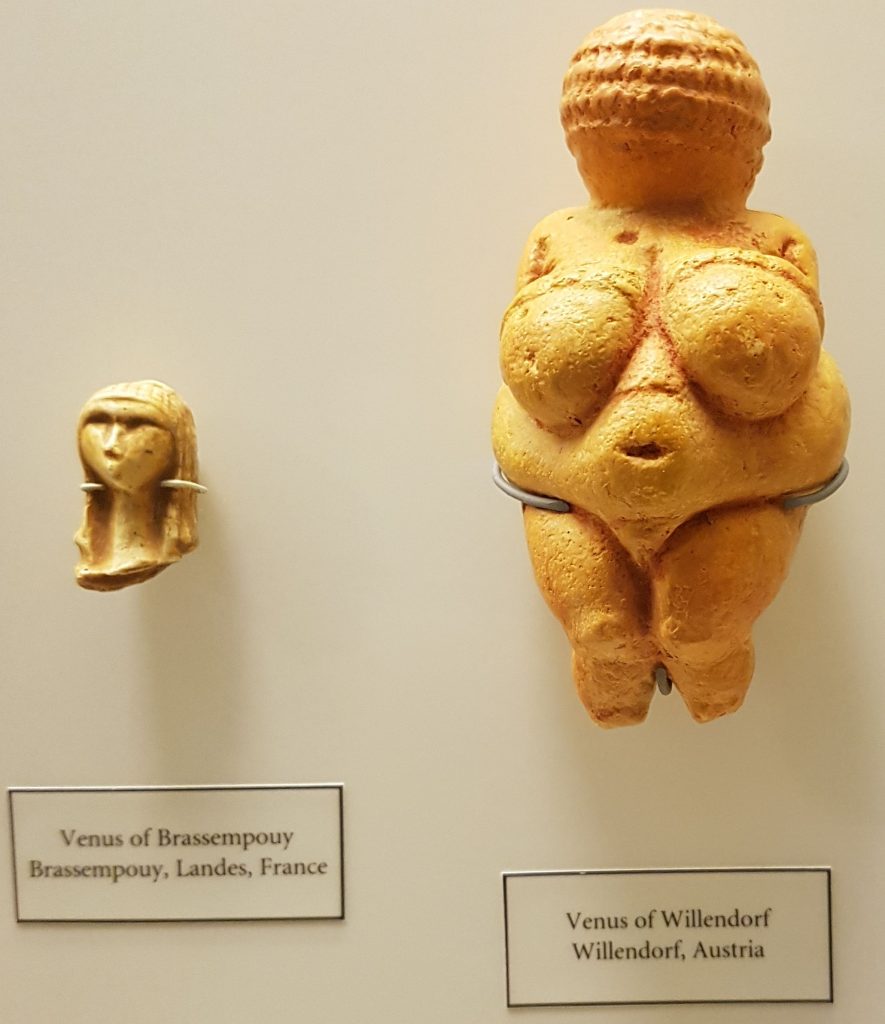
There was a theory widely held that the original Deities, dating before the spread of farming, were mother goddesses. The idea is that the hunter-gatherer goddesses (perhaps like the Venus of Willendorf) were overthrown by the coming of farmers. These patriarchal societies worshipped the male gods, which destroyed the ancient Matriarchy. Jane Ellen Harrison proposed an ancient matriarchal civilization. Robert Graves wrote some interesting, but no longer thought to be very scientific studies, on the idea. Neopaganism has taken these ideas forward.
1451 Glasgow University was founded (and you wonder why the Scots made such an impact on the world.)
1789 The USA held its first national presidential election. (Long may that fine democratic tradition survive and prosper!)
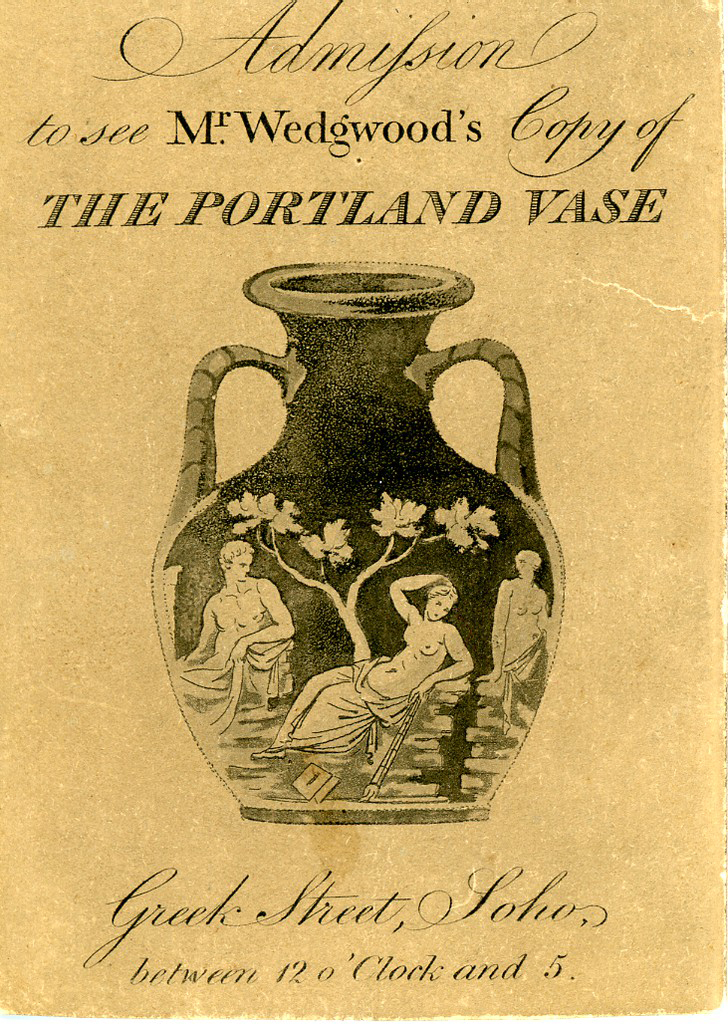
1845. Today is the anniversary of the breaking of the fabulous Portland Vase by a drunken visitor to the British Museum. It looks immaculate despite being smashed into myriad pieces, a wonder of the conservator’s art. To see the vase and read its story, go to the BM web site here:
Today in the orthodox church, дед Мороз (Ded Moroz= father of frost), accompanied by Cнегурочка (Snieguroshka= fairy of the snow) brings gifts on New Year’s Eve, (which is on January 7th). He travels with a horse-drawn troika.
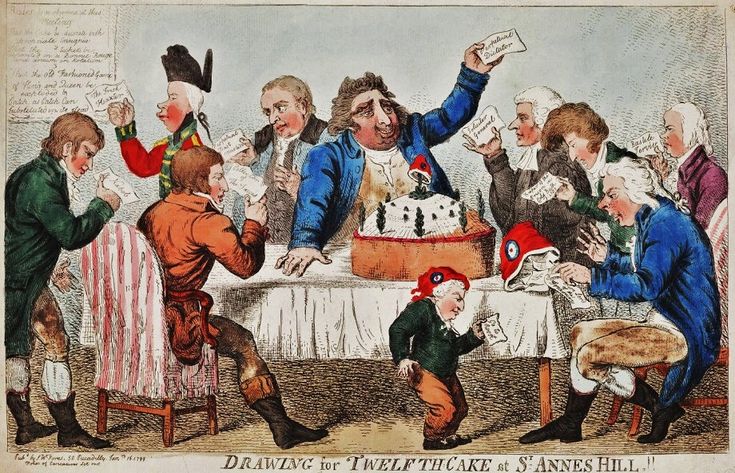
‘Drawing for Twelfth Cake’ at St. Annes Hill ’12th Night Cruikshank, Isaac, 1756-1811 printmaker. Published Janr. 10, 1807 by Thomas Tegg, 111 Cheapside’
Twelfth Night/Twelfth Day
Yesterday was Twelfth Night for the modern Church of England, but today is Twelfth Night for the Catholic Church and in England in former times ~(yesterday was Twelfth Day Eve. It is also Epiphany or Three Kings Day and because of calendrical differences, Christmas Eve for the Orthodox Church.
In Ireland, it is Nollaig na mBan. This is Women’s Little Christmas; when Women get to rest and let men do the work. This is a typical Saturnalia-style reversal of roles.
‘Drawing for Twelfth Cake’ at St. Annes Hill
I used the print above, three years ago for my post on New’s Day, then moved it to Twelfth Night. I also use it for lectures on Christmas and Jane Austen. But the focus of my presentation here is explaining the Twelfth Night Cake and the game that was played. But in fact, this is a very political satirical cartoon. More of that, later, let’s begin with the more trivial aspect of the print above.
Twelfth Night Performance, Party
It used to be the big party night, featuring the famous Twelfth Night Cake and theatrical entertainments; mumming and wassailing. Essentially, these terms mean wandering around the Town or Village dressed in costume and drinking beer, cider, or wine cups. The tradition of performance also was kept by the Royal Court and by institutions such as City Livery Companies and the Inns of Court in London.
These traditions saw someone chosen as the King for the night, and often someone else chosen as Queen. In 1606 Ben Jonson’s masque Hymen was performed before the Court. In 1613 Lord Bacon gave Gray’s Inn permission to a Twelfth Night Masque at Whitehall. During the performance, a character called Baby Cake brought in a ‘great cake with a bean and a pease’. On the Candlemas Feast of 2 February 1602 Middle Temple performed a play called Twelfth Night that the lawyers had commissioned from one William Shakespeare. Candlemas was the end of the Christmas Season. See my post on Candlemas here.
The cake has disappeared from current Christmas celebration, probably because it transmuted into our present Christmas Cake. This, I regret. I have had a lifetime when a very heavy Christmas Dinner is followed, first, by Christmas Pudding. Then, overloading with food, the Christmas Cake is brought out. No one, in their right mind, wants a slice of heavy Christmas Cake after a Christmas Dinner, and Christmas Pudding! Many of my American friends disparage fruit cake, but they are mistaken. Good Christmas Cake is something to be thoroughly enjoyed, but on the days following Christmas Day.
I gave a recipe for the Twelfth Night Cake in another post, (here it is). But the important point is that it had a bean and a pea in it. The one who got the bean was selected as King for night and the pea the Queen. The rest of the Christmas Party draw cards. Traditionally, the women draw a card from a ‘reticule’ (bag) and the men’s from a hat. But there are no women at this satirical party (pictured above).
The cards detailed a role the party goers were to play for the rest of the night. The card began with an introductory speech, or rhyme, for the person to speak. The King and Queen led the way, and for the rest of the evening the party members adopted their persona. They might be an aristocrat, a soldier, a cook, a parson, a dairy maid etc. The French do something similar with their Galette des Rois. The bean is called the feve, and may be replaced by a porcelain model. Other places have a King’s Cake for epiphany.
Twelfth Night Satire
So, as I was rushing to get the original Twelfth Night post done, I failed to examine it in any detail. I assumed the cards gave them satirical occupations which would be funny to the contemporary audience in 1807. But then, I noticed the title mentioned St Anne’s Hill. I looked it up and discovered myself down a deep and very enjoyable research rabbit hole.
St Anne’s Hill & Charles James Fox
Now, let’s go down that rabbit hole and look a little deeper.
The caption mentions St Anne’s Hill. I believe this refers to St Anne’s Hill, near Chertsey (SW of London on the River Thames). Here, there was a grand house which was owed by Charles James Fox. He was the leader of the Whigs, a persistent opponent of King George III. He was a supporter of the American and French Revolutions. This explains the red bonnet used to pull out the cards in the illustration.
The central figure is then, Fox. But he died in September,. 1806. The print is dated January 1807. Just before he died, his Foreign Slave Trade Bill of 1806 began the dismantling of this pernicious trade in the British Empire. He was Foreign Minister, who assumed a couple of civil chats with the French would end the long-standing war. But he soon discovered that Napoleon was not to be trusted in negotiations. The war went on for another 9 or so years.
Charles James Fox was a mercurial figure with many radical views. He was also a notorious gambler and loved the high life. One of his many lovers was Georgiana, Duchess of Devonshire. He eventually married, Elizabeth Armistead, an ex-mistress of the Prince of Wales. St Anne’s Hill was her house. I am pleased to report that she is credited with calming his life-style. He now spent more time at St Anne’s where they would ‘read, garden, explore the countryside and entertain friends’ (Wikipedia).
Isaac Cruikshank’s ‘Drawing for Twelfth Cake’ at St. Annes Hill
Cruikshank’s illustration is, of course, not designed to document quaint Twelfth Night customs but is a political satire and I discovered that the British Museum has the original version of this print, and. It is dated to 1799 which makes much more sense!
At the back right of the print is a notice which says:
‘Rules to be observed at this Meeting 1. That the Cake be decorated with appropriate insignia 2 That the tickets be deposited in a Bonnet Rouge and drawn in Rotation 3 That the Old Fashioned Game of King and Queen be exploded & Catch as Catch can Substituted in its stead.’
The bonnet rouge is a ‘redcap worn by ardent supporters of the French Revolution’ or ‘an extremist or revolutionary’. (defined by the Collins Dictionary as). Point 3 relates to Fox’s opposition to the King and the Republicanism of the French Revolution. The expression Catch as Catch Can refers to a free form of wrestling without rules, and presumably a satire on ideas of democracy.
Opponents of William Pitt
The characters in the scene (all men) are all political figures. They are associated with the opposition to the very right-wing Government of William Pitt. During the war with France, the opposition was led by a supporter of the French Revolution. For those on the right, which included Pitt’s government, supporting the French Revolution was tantamount to treason. Pitt suspended many civil liberties in ‘Pitt’s Reign of Terror’. He arrested and indeed executed leading members of those demanding political change. The Government even suspended Habeas Corpus to make it easier to arrest their opponents,
Fox is seen drawing a 12th Night Game ticket which is marked ‘Perpetual Dictator’. To his right is Frances Burdett. He was a radical politician, who supported universal male suffrage, equal electoral districts, vote by ballot, and annual parliaments. Note that this is well before these aims became the core of the Chartists campaign for electoral reform.
Frances Burdett
Burdett is shown holding a ticket saying ‘Keeper of the Prison in Cold Bath Fields’. This is a satirical reference to a serious political crisis. The Cold Baths Fields was the site of a medical spring in Clerkenwell, London. It was a prison where radicals were imprisoned. Conditions were very poor, despite the recent rebuilding under the aegis of the prison reformer, John Howard. Burdett exposed the scandalous conditions in the House of Commons. He began a campaign against the magistrates involved in the arrests. Francis Burdett married into the fabulously rich banking family the Coutts. His daughter was the famous Angela Burdett Coutts who was a philanthropist who collaborated extensively with Charles Dickens.
Edward and Catherine Despard
One of the prisoners was Edward Despard who had associations with many radical groups. These included the London Corresponding Society, the United Irishmen and United Britons. Despard married Catherine, the daughter of a free black woman from Jamaica. She, with Burdett, led the campaign against her husbands and other arrests without trial. Catherine wrote a letter to the Attorney General who replied in a demeaning manner:
‘it was a well-written letter, and the fair sex would pardon him, if he said it was a little beyond their style in general’
He did not comment on her colour. She described the imprisonment of her husband as being :
“in a dark cell, not seven feet square, without fire, or candle, chair, table, knife, fork, a glazed window, or even a book”
Despard was freed in 1802, went to Ireland. He returned to London. He was arrested again. And accused of a being the ringleader of a plot to assassinate the King. There was little real evidence. Horatio Nelson was a character witness, and appealed to the King for clemency. Clemency was granted. But only in so far as Despard was not disembowelled. Just ‘Hanged and Drawn’ at Horsemonger Lane Gaol in Southwark (1803). He was the last person to be drawn through the streets at the tail of a horse before execution for treason. These are his last words:
Fellow Citizens, I come here, as you see, after having served my Country faithfully, honourably and usefully, for thirty years and upwards, to suffer death upon a scaffold for a crime which I protest I am not guilty. I solemnly declare that I am no more guilty of it than any of you who may be now hearing me. But though His Majesty’s Ministers know as well as I do that I am not guilty, yet they avail themselves of a legal pretext to destroy a man because he has been a friend to truth, to liberty, and to justice
(a considerable huzzah from the crowd)
and because he has been a friend to the poor and to the oppressed. But, Citizens, I hope and trust, notwithstanding my fate, and the fate of those who no doubt will soon follow me, that the principles of freedom, of humanity, and of justice, will finally triumph over falsehood, tyranny and delusion, and every principle inimical to the interests of the human race.
(a warning from the Sheriff)
I have little more to add, except to wish you all health, happiness and freedom, which I have endeavoured, as far as was in my power, to procure for you, and for mankind in general.
https://en.wikipedia.org/wiki/Edward_Despard
After his death, his family denied that Catherine was his wife but merely his ‘house-keeper.’ I assume, this was because they wanted the inheritance rather than, or perhaps, as well as naked prejudice.
@Phew! This is what I love about what I do, you find things out that link disparate parts of your knowledge, creating an ever-interwining web of history.
On this Day
1066 Harold Godwinson crowned King of England on January 6, 1066, the same day as the funeral of the previous king, Edward the Confessor.
On the twelfth day of Christmas My true love gave to me Twelve drummers drumming, Eleven pipers piping, Ten lords a-leaping, Nine ladies dancing, Eight maids a-milking, Seven swans a-swimming, Six geese a-laying, Five golden rings, Four calling birds, Three French hens, Two turtle-doves And a partridge in a pear tree.
Twelfth Night
In 1775, William Snooke recorded in his diary, that he sat down to a fine dinner with:
‘Mr and Mrs William Clifford and their seven children (and maid), John Fox Snr. and Sally Twining, Mr and Mrs William Fox, and William Weale.’ To feed this crowd took “Ham, Greens, 3 fowls roasted, Soup, Leg of Mutton, potatoes, Boiled rump of beef (large)”
Dessert included pudding, mince pies and a forequarter of home lamb. For supper, the assembled party consumed tarts, stuffed beef, mince pies, cold mutton, oysters, cold sliced beef, cold lamb, apple pies and pears.
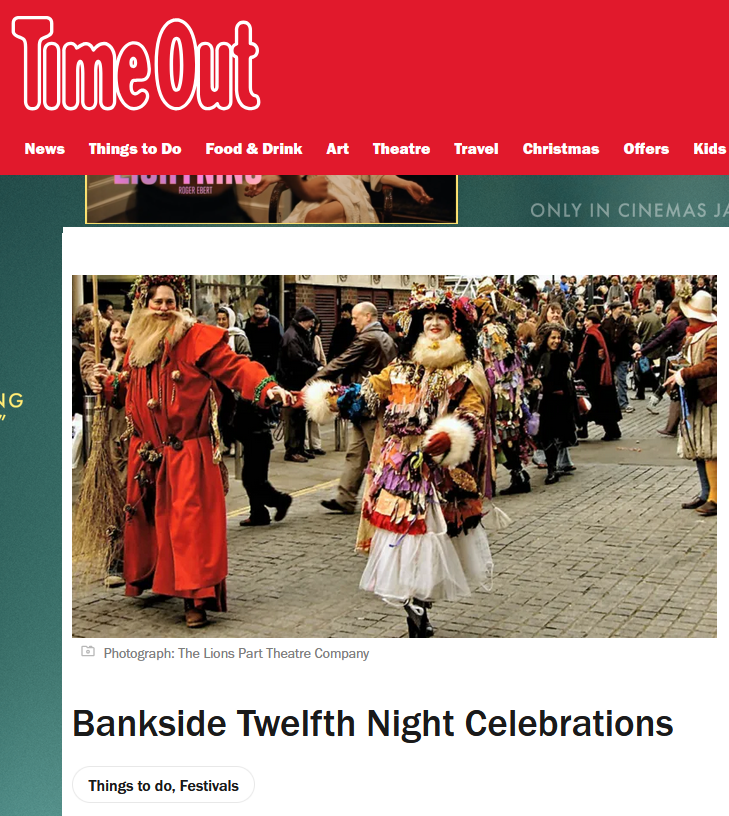
A recent ‘tradition’ for a Tweltfh Night procession has been established on the south side of the River Thames in London. The Lions Part Company begin their entertainments at the rebuilt Globe. The parade has all the traditional mummers characters, including the Green Man, and the Holly Man. They perform the Combat Play of St George. This involves the Old ‘Oss (which is the centre point of the May Day festivities at Padstow in Cornwall. They also have Twelth Night Cakes containing a bean and a pea. These are used to crown the King and Queen of the Day.
Photo of Twelfth Night Celebrations in Southwark, London on the South Bank
I’ve posted about this before but just to make sure those who find themselves on this page understand the issue:
Many people start their count of the Twelve Days of Christmas on the 25th December. But some folklore sources going back in time count from Boxing Day. For example, Gervase Markham’s ‘The English Husbandman of 1635 counts it from Boxing Day.
The Daily Express reveals that the Protestants count from Christmas Day and the Catholics from Boxing Day. That maybe it, but I wonder if the confusion more complicated than that? The religious festival really makes sense if it begins with Christmas Day, and ends with the Epiphany. This is the day the Three Kings from the Orient come to worship Jesus. But Epiphany is on the 6th January, which is 13 days from Christmas. 13 days of Christmas would be ill-omened. So two solutions: make the end of the Twelve Days the Eve of Epiphany, i.e. the 5th, or start the 12 days from Boxing Day.
I suspect there is a fudge going on here. Twelve is the magic number, twelve Apostles, 12 months in the year, so twelve Days of Christmas. But clearly, for Christians it stretches from Christmas Day to Epiphany. Two ways to square that 13 day difference. One is to begin the twelve days on Boxing Day. The other is to end with a Twelfth Night party on the Eve of Epiphany. Have a look at Notes&Queries for different viewpoints.
Time to take your decorations down- January 5th or Candlemas
However, we currently all seem to agree that January 5th is the day to take down your Christmas decorations. If you fail to do it now, you have to keep them until Candlemas, which is at the begining of February. See my Candlemas post to see the official end of Christmas.
Toss your unwanted Christmas Tree on the Pavement Day
In London, today and yesterday have seen people throw out their unwanted Christmas Streets out on the street, for someone else to pick up and throw away. This became a thing a few years ago not. But, no, people you are supposed to take them to a Recycling Centre, or arrange to have them picked up. Not just throw them on the street.
1753 People gathered around the Holy Thorn in Glastonbury. The Thorn normally blossomed on Christmas Day, but the Gregorian Calendar had been introduced the year before. Christmas Day was now 11 days earlier. on December 25th, it did not blossom. On the 5th, it blossomed, proving that the new Christmas Day was a fraud, From then on January 5th was called Christmas Day Old Style. Other festivals, and events thereafter kept their traditional slot in the year, by changing the date to the Old Style, and ignored the New Style.
Twelfth Night Cake at the Museum of the Home, photo Kevin Flude
Twelfth Night Cake
On the 11th day of Christmas My true love sent to me 11 pipers piping; Ten lords a-leaping; Nine ladies dancing Eight maids a-milking; Seven swans a-swimming Six geese a-laying Five golden rings (five golden rings) Four calling birds; Three French hens; Two turtle-doves And a partridge in a pear tree.
Now is your last chance to make your Twelfth Night cake, its the 11th hour after all! Of course, Stir Up Sunday would have been the best day. Here is a recipe from 1604 by Elinor Fettiplace:
Take a peck of flower, and fower pound of currance, one ounce of Cinamon, half an ounce of ginger, two nutmegs, of cloves and mace two peniworth, of butter one pound, mingle your spice and flower & fruit together, but as much barme [the yeasty froth from the top of fermenting beer barrels] as will make it light, then take good Ale, & put your butter in it, saving a little, which you must put in the milk, & let the milk boyle with the butter, then make a posset with it, & temper the Cakes with the posset drink, & curd & all together, & put some sugar in & so bake it.
The Quadrantid meteor shower appears from the point of the Plough’s handle. It continues to January 12th but peakon January 4th. At the peak there may be 100 meteors an hour. But, it will be low in the north-eastern sky and best seen from low light pollution areas. Twinkling above the Southern Horizon will be Sirius and this month’s brightest star. In the NE, the Plough can easily be seen. The Orion nebula south of Orion’s belt will be seen as a hazy patch with the naked eye. (from the Night Sky. Month by Month by Gater and Sparrow).
We are also seeing the Wolf Moon, as it moves closer than usual to the Earth and so feels bigger. It got its name as Wolves were said to Howl at the Moon more when the Moon came close.
On This Day
1642 Charles I marched on the House of Commons to arrest five Members of Parliament. It failed, the MPs fled to Guildhall in the City of London. Charles followed and was surrounded by citizens of the City of London shouting ‘Priviledge of Parliament. He fled London and the Civil began soon after. See my post charles-i-raises-the-standard-august-22nd-1642
Today: Sow alpine seeds. This give them the period of cold they get in the wild, which is essential for their germination in spring. Take root cuttings. Lift and divide overgrown clumps of herbaceous perennials. ‘Gardening through the Year’ by Ian Spence. RHS.
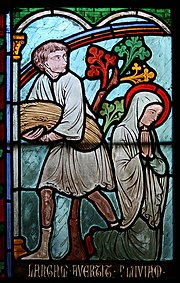
Saint Geneviève praying for the end of the rain. 19th Century by Alfred Gérente Notre-Dame de Paris.
St Genevieve of Nanterre (c. 419/422 AD – 502/512 AD) has her feast day today. Nanterre is an ancient settlement swallowed up by modern Paris. Genevieve was a most remarkable woman who met St Germanus of Auxerre on his way to Britain. She was only 7 when she met Germanus. He encouraged her piety. She became a consecrated virgin (someone who made vows of chastity to be a ‘bride of Christ’). Thereby living an aesthetic life of fasting and prayer. Hence, miracles soon became associated with her, (including changing the weather) and the ‘usual’ medical miracles. After moving to Paris, she encouraged the women of the City to stay in the City for prayer and fasting to prevent the Huns capturing the City in 451. Attila and the Huns abandoned the siege.
St Genevieve saved the City on other occasions too, helped build two large Church projects, including St Dennis. She intervened fearlessly in public affairs, and was a brave and resolute woman who challenged the male hierarchy with some success. And what makes me like her even more was that she is not a martyred teenager Saint tortured to death to gain her sainthood. But she did great works and lived to old age of 82 still ‘full of virtue’. In the medieval period, she became the Patron Saint of Paris. She is patron to: Paris, shepherds, winemakers, wax-chandlers, hatmakers; against eye complaints, fever, plagues, drought, and war.
St Germanus
St Germanus played a significant role in Genevieve’s life, protecting her from slander and attack. He is one of the most significant figures in post Roman studies in Britain. Accounts of his visits to Britain in the early 5th Century are among the very few descriptions of post-Roman life. He was sent to Britain to counter the Pelagian Heresy, which was endangering the Catholic version of Christianity.
Incidentally, Nanterre has an interesting prehistory. The name in Celtic means ‘enduring sacred site’. A large cemetery has been found, which helps support the possibility that it is the original site of Paris. Julius Caesar attended an assembly with local Gallic leaders in the area. The topography of Nanterre fits as well for the location of the assembly as the island in the Seine (Île de la Cité) which is an alternative location.
In Their Own Words
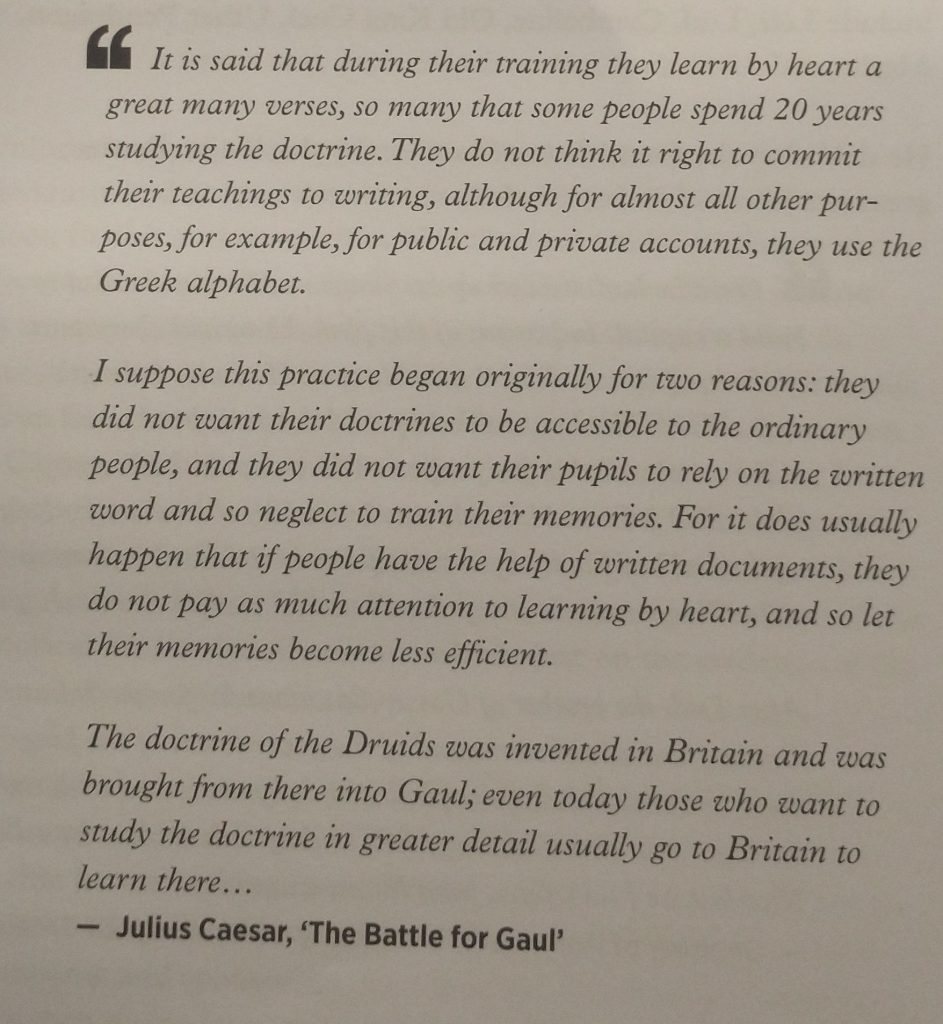
This is an excerpt from Julius’s Caesar book concerned with training druids. (It is photographed from my book ‘In Their Own Words- details below).
‘In Their Own Words – A Literary Companion To The Origins Of London‘ by Kevin Flude
It brings together contemporary quotations about the Prehistoric, Roman and Dark Ages with a commentary by the author. It’s an enjoyable read! To buy the Kindle (£2.40) or a paperback version (£5.99), click here.
If you have read it, please go here and write a review! It is sadly devoid of any!
On This Day
1521 Martin Luther excommunicated by Pope Leo X. (our present Pope is the XIV)
1661 Samuel Pepys saw the Beggar’s Bush at the Theatre in Gibbon’s Tennis Court, Vere Street, near Lincoln’s Inn Fields. He records it was ‘the first time that ever I saw women come upon the stage’. The Restoration of Charles II to the throne allowed, for the first time, women to appear on the professional stage.
1777 George Washington defeats Cornwallis at the Battle of Princeton
Today: keep bird feeders well stocked. Check houseplants for mealybugs, mites and other pests. (Gardeners’s Year The Metroplitan Museum of Art).
The Full Moon today falls in Cancer in a conjunction with Jupiter and an exact opposition to Mars and Venus. Thus, the mood of the times is divided between those supporters of individual liberties. And the Government’s right to control personal behaviours’. That, ast least is what Old Moore’s Almanack for 2026 says. And that’s probably enough Astrology for the year!
First written in January 2023, revised and republished January 2024, 2025, 2026