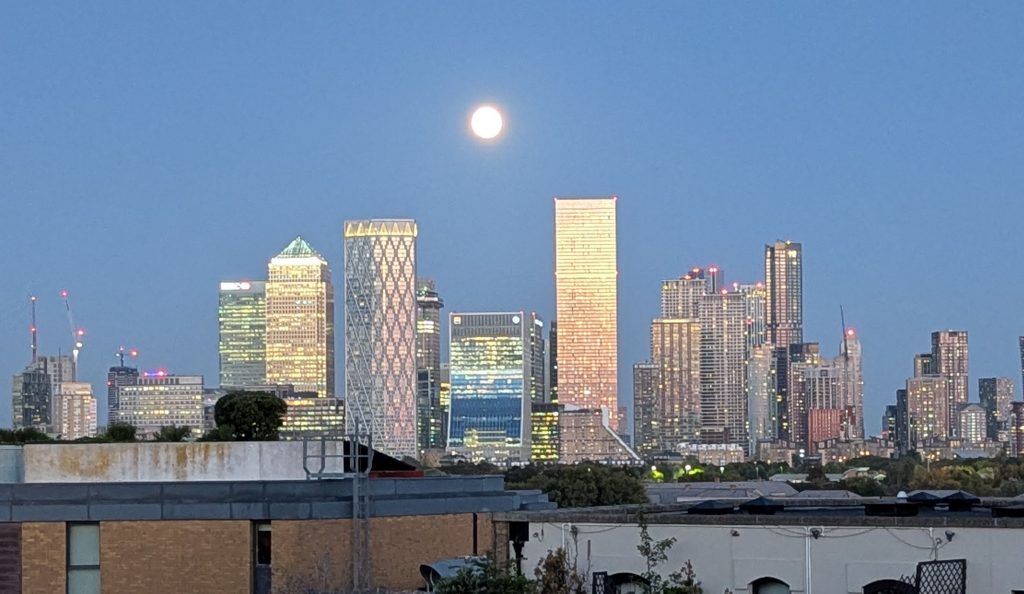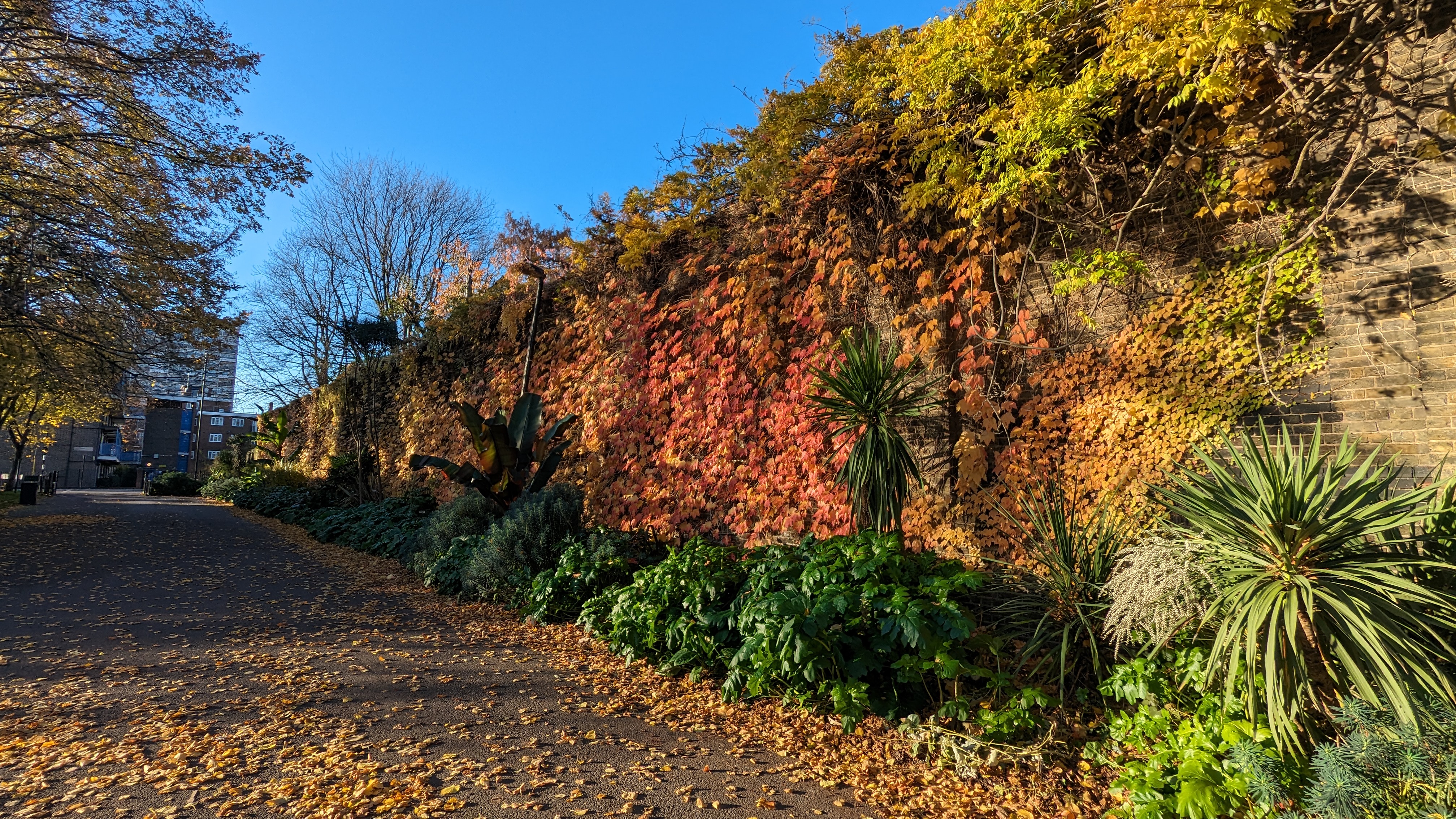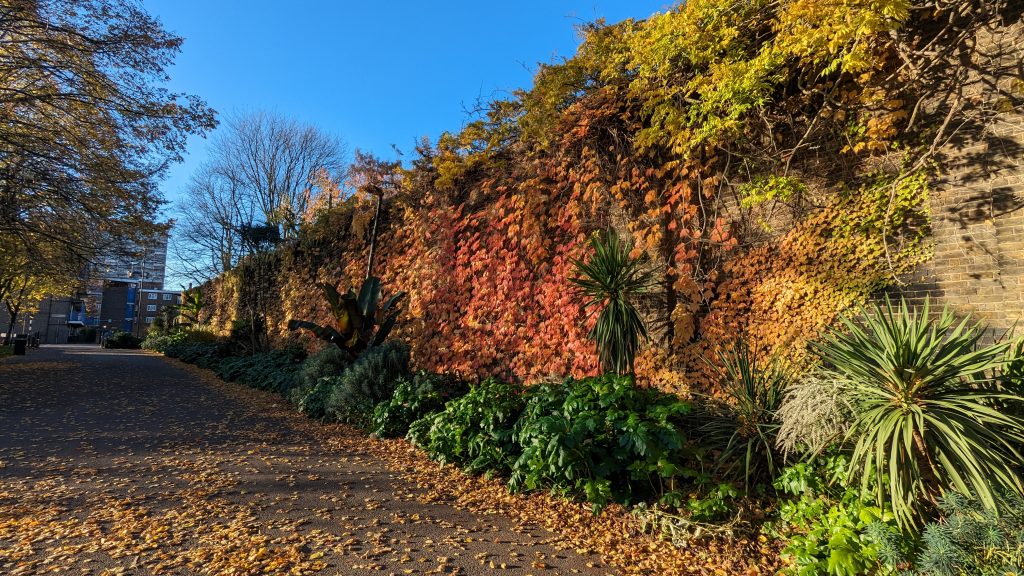
Autumn Equinox in Haggerston Park.Photo by K Flude.
Autumn Equinox.
This is the second day of the year when the sun rises due east and sets due west. When the day and night are of equal length. It is the beginning of the astronomical autumn. It is determined by the 23.5-degree tilt of the Earth’s rotation in relation to the orbit around the Sun.
In the Jewish Calendar, and the French Revolutionary Calendars it marks the new year. Many cultures preferred spring. But autumn is the end of harvest, when seeds are sown and the food stores are full of food. Similarly, the Celts started their new year at Halloween, half way between the equinox and the solstice.
For more about autumn, look at my post here. For my post on the Spring Equinox, see here. For the Celtic New Year see this post here and for the French Revolutionary Calendar, my post is here.
Rosh Hashanah, September 22nd to 25th.
Rosh Hashanah is the New Year in Judaism. There are other new years in the Jewish calendar. But this is for the Civil Year and to celebrate the anniversary of the birth of Adam.
The biblical name for this holiday is Yom Teruah. One of the High Holy Days, as specified by Leviticus 23:23–25. Like most New Years it is a time to reflect on life and put in place changes. It is after all a celebration of the beginning of the world.
Here is an excellent BBC web site which will tell you more.
A silhouette of a Zeppelin caught in searchlights over the City of London
On the night of September 8th, 32 year old, Kapitanleutnant Heinrich Mathy piloted Zeppelin L 13 across Central London, dropping bombs as he went. This was the most damaging airship raid of the war.
Background to the War
Before World War One London was the centre of the largest Empire the world had ever known. It was the first great era of globalisation; international trade and finance was booming. London was full of the mega-rich, but poverty and substandard housing was extensive. Such extremes of rich and poor have only recently began to appear in our society.
Inner London was still the home of Industry, and home to large immigrant communities. Political dissent was widespread, with the Labour Party beginning to erode the Liberal Party’s power base. The issue of Female Suffrage was rocking society. Then, catastrophe struck as ‘the lights went out all over Europe’.
The Hague Convention in 1899 banned bombing from balloons or other aerial craft. But as the aircraft and air balloons developed, the threat moved from theoretical to actual. Zeppelins could undertake long flights at a speed of up to 47 mph. They could ascend and descend quicker than winged aircraft and achieve higher altitudes. The gas that held up the Zeppelins was held in over 200,000 bags of cattle intestines. The huge number needed in the war effort led to a shortage of sausages in Germany! But it also made them very difficult to be shot down with the technology available to Britain, France and Russia.
The Kaiser originally forbade bombing raids on London in deference to his relatives, the British Royal Family. But he progressively reduced restrictions until he allowed bombing of London itself. He first allowed bombing of the London docks on February 12th 1915, and on May 5th allowed London, East of the Tower of London to be bombed. The first Zeppelin raid on London took place on 31st May 1915. On July 20th, he allowed unrestricted bombing of London (albeit sparing historical and religious buildings).
On the 8th September, 1915 Mathy crossed the North Sea to the coast at King’s Lyne. He arrived at 8.45pm. The aircraft came South via Cambridge, Ware, circled to the North East of London and via Golders Green. Here he dropped 12 bombs at 10.40., and followed the Finchley Road to Primrose Hill, Regent’s Park. Over Euston he was at 8,500 ft, and slowed down to 37 mph.
The first incendiary bomb in Central London landed just north of Russell Square at Woburn Place. The next one landed in the garden in the middle of Russell Sq. He dropped his first Central London explosive bomb in the garden in the centre of Queen’s Square, near the Great Ormond St Hospital, where it is marked with a plaque. He was turning east along the Theobald’s Road where he dropped a number of bombs. One hitting the National Penny Bank killing a person standing outside. Another landed on the nearby Dolphin pub, blowing out the front of the pub and killing someone standing there. If you visit the Pub, on the wall you will see the clock that was stopped when the bomb exploded (10:40pm).
The next strike was on a cycle club, to the West of Gray’s inn. Then Gray’s Inn itself. At Portpool Lane his incendiary bombs killed three children and injured 25 others.
Maxim Gun
Near here are the workshops where Hiram Maxim developed the Maxim Gun that killed so many in the trenches in WW1. Unfortunately, the design was not kept as a state secret and in the War No Man’s Land was being strafed by British, French, German, Russian and later in American versions of the same gun. He had the idea for it when as a child his shoulder was broken by the recoil of a shotgun. He realised that the recoil could be used to load the next bullet. This created a machine gun that was far superior to the Gatling Gun.
A Bomb called the Love Gift
Hatton Garden and Farringdon were also hit, and the Zeppelin continued to Smithfield. The Zeppelin had one 660 lb bomb on board. Mathy’s ‘Love Gift’ fell on St Bartholomew’s Close. It shattered all the building fronts and killed 2 men running for cover when they emerged from a pub.
The Zeppelin kept north of St Paul’s and next bombed City workshops and warehouses in Wood St, Addle St, Basinghall St and Aldermanbury – just missing the historic Guildhall. He also failed to bomb the Bank of England which was a mere 300 yards south,
Searchlights were now scouring the sky and anti-aircraft guns were firing, but they were ;all firing too low’. An American reporter, William Shepherd wrote:
‘Among the autumn stars floats a long gaunt Zeppelin. It is dull yellow – the colour of the Harvest Moon. The long fingers of searchlights, reaching up from the roofs of the city are touching all sides of the death messenger with their white tips. Great, booming sounds shake the city. They are Zeppelin bombs falling- killing – burning. Lesser noises – of shooting – are nearer at hand, the noise of aerial guns sending shrapnel into the sky.’
The final bombs were released over Liverpool Street. Just by the station, an explosive bomb hit a No 35a bus, wounding the driver and killing the conductor and some of the passengers. Another bomb landed by a No 8 bus, killing the driver and 8 passengers.
Mathy turned north towards Edmonton and climbed to over 11,000 ft as an anti-aircraft gun on Parliament Hill put a shell uncomfortably close to the Zeppelin. He returned safely to Germany where he reported to the Kaiser. The raid killed 17 people, injured 78 and caused half a million pounds worth of damage. It was the most effective raid of the war.
The authorities in Britain were faced with a stark reality which was that a single German Airship could fly through the heart of Britain, into its Capital and bomb its people without any defensive measures capable of resisting attack. Although when we consider the horrors of civilian deaths in the 20th and 21st Centuries, the shock of random attacks on civilians should not be underestimated.
I will conclude Kapitanleutnant Heinrich Mathy’s story on October 1st, and add more images to this page.
Thanks to Ian Castle and his book ‘London 1914-17 ‘The Zeppelin Menace.
September 3rd was Cromwell’s Lucky Day. This was because it was the date of two of his most famous victories. On September 3rd 1658 he refused to accept that he was dying because it was his lucky day. Unluckily, he was wrong.
The Battle of Dunbar September 3rd 1650
Engraving of Charles I
After the execution of King Charles I, the Scots chose Charles II as their King. This changed the Scots from allies of the English Parliament to enemies. The Lord General of the New Model Army, Thomas Fairfax, refused to lead an attack on their erstwhile allies. So Oliver Cromwell was promoted to command. He launched a preemptive attack but the army was ill prepared, and the campaign seemed in danger of failing. They took Arthur’s seat and bombarded Edinburgh and Leith from its heights. But they could not take Edinburgh.
In need of supplies, Cromwell retreated to Dunbar, which is on the North Sea, close to the Firth of Forth. The Scots advanced on Dunbar, and Cromwell came out to meet them. After a hard battle, the English Calvary outflanked the Scots and the Battle was won. Pride, Monk, Lilburne and Lambert were all involved in the Battle. Cromwell claimed to have killed 4,000 Scots and captured 10,000. Scottish sources suggested over 1,000 Scottish casualties and 5,000 prisoners.
The Battle enabled Cromwell to seize control of Edinburgh, and Leith. So he could then cross the First of Forth and attack Fife, where he was also successful.
Cromwell interpreted the overwhelming victory as a
“A high act of the Lord’s Providence to us [and] one of the most signal mercies God hath done for England and His people”.[ (Wikipedia)
Meanwhile, the Scottish Army marched South in to England. in an attempt to raise the support of English Royalists. King Charles II was now with them, They hoped Cromwell would be held up in Fife, but he wasn’t. He secured Perth and put General Monck in charge in Scotland. Lambert was sent to harrass the Scottish Army as they marched south. Meanwhile, Cromwell forced marched his way to the Tyne. General Harrison had collected fresh troops from Newcastle and joined Cromwell. Thomas Fairfax came out of retirement and raised troops in Yorkshire. The Southern troops were collected at Banbury by General Fleetwood. 14,000 militia men from the trained bands of London joined the march to intercept the Scottish Invasion.
The Battle of Worcester September 3rd 1651
The decisive battle took place at Worcester, which the Royalist occupied. It was an unusual battle in that it took place on both sides of the River Severn. Cromwell delayed the start of the battle to build two pontoon bridges. This meant he could reinforce his troops on either side of the River. It also delayed the start of the battle to his lucky day.
The pontoon bridges proved decisive. The Parliamentary side had over 30,000 troops while the Royalists only 16,000. Cromwell could shore up besieged formation with troops from the other side of the River. The Royalists were pushed back to the High Street. Here, they rallied to allow King Charles II to escape. And that was the end of the Second English Civil War. (The first being the defeat of Charles I, the second the defeat of Charles II).
Charles II made a hair-raising escape from England, hiding in an Oak Tree. Eventually, finding a ship on the South Coast at Shoreham, in Dorset to take him into a long exile. (see my post on Charles’ escape here🙂
Of the Scottish army, perhaps 3,000 men were killed and 10,000 taken prisoners. Some prisoners were conscripted into the New Model Army and sent to fight in Ireland. Many of the rest (perhaps up to 8,000) were forced into indentured labour. They were sent to New England, Bermuda, the West Indies or the Fens. Others were taken to London and detained in prison camps. One of which was at Tothill Fields in Westminster. Conditions were often appalling, leading to death by disease and malnutrition.
American Presidents pay their respects to the ‘famous’ Battlefield.
John Adams and Thomas Jefferson visited the site of the Battle in 1786. Adams reported:
‘The people in the neighborhood appeared so ignorant and careless at Worcester that I was provoked and asked “And do Englishmen so soon forget the ground where liberty was fought for? Tell your neighbors and your children that this is holy ground, much holier than that on which your churches stand. All England should come in pilgrimage to this hill, once a year”‘
And indeed will now only see the battle as one of the many battles of the Civil War. Generally, we are not aware of its special significance.
Cromwell’s Death September 3rd 1658.
By now, the Monarch in all but name, Cromwell, the Lord Protector fell ill, probably of malaria. Then, when weakened, his kidney stone infection turned to septicemia. On August 30th, there was a mighty storm, the like Europe had not seen for hundreds of years. And there was talk of the Lord taking him away in the furious storm. As he weakened he was asked to name his successor. He appeared to affirm when the name of his son Richard was spoken to him. But, it wasn’t very clear. He rallied, perhaps hoping that if he could survive to September 3rd, he would overcome his illness.
On the day, he said to his doctors ‘I tell you I shall not die this hour; I am sure on’t …. I speak the Words of Truth upon surer grounds than Galen and Hippocrates furnish you with.’
But he died on his lucky day. He was given a splendid funeral and was buried in state among the Kings and Queens in Westminster Abbey. And then in 1660 dug up, executed posthumously at Tyburn and buried under the Gibbet.
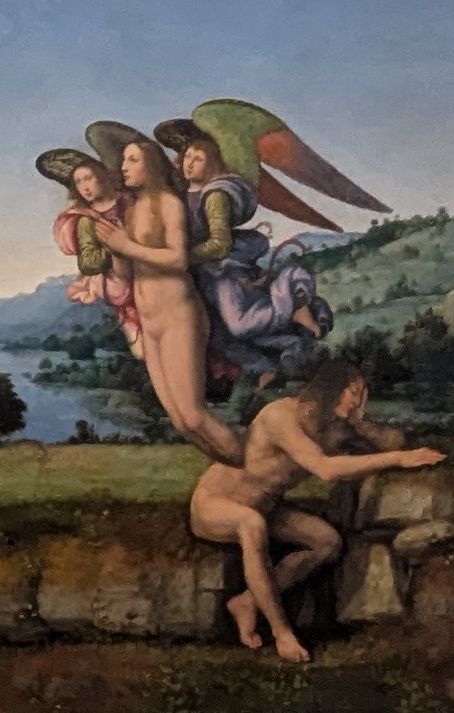
The Master of St Giles, National Gallery. ‘St Giles and the Hind’ This work is in the public domain in its country of origin and other countries and areas where the copyright term is the author’s life plus 100 years or fewer.
St Giles
Today, is St Giles’ Feast Day. His story is mostly unknown, but his legend holds that he was a hermit who had a pet Hind in the Arles District of France sometime after the fall of the Roman Empire. The hounds of King Wamba (a Visigothic King) were chasing the deer, and shot an arrow into the undergrowth. The King and his men followed to discover Giles wounded by the arrow, protecting the hind, who he held in his arms. The hounds were miraculously stayed motionless as they leaped towards the hind. Wamba, which apparently means ‘Big paunch’ in Gothic, also had a Roman name: Flavius. Giles was injured in the leg, although the image above shows the arrow hit his hand. Wamba set him up as an Abbot of a Benedictine Monastery.
St Giles is, therefore, the patron saint of disabled people. He is also also invoked for childhood fears, convulsions and depression. He was very popular in medieval Britain, with over 150 churches dedicated to him, including four in London. Perhaps the two most famous are St Giles Without Cripplegate in London and St Giles Cathedral in Edinburgh.
St Giles Cripplegate, photographed by the Author at night from the Barbican Centre.
St Giles Cripplegate
St Giles was built in the 11th Century, rebuilt in the 14th Century and again in 1545-50 after nearly being destroyed by fire. It survived the Great Fire of London, being just beyond the extent of the Fire. But it was badly damaged in the Blitz, although the Tower and the outer walls survived.
Oliver Cromwell married Elizabeth Bourchier here. John Foxe of the Book of Martyrs, John Speed, the Cartographer, Martin Frobisher, the explorer and John Milton, the Poet were buried here.
Shenanigans with Milton’s Coffin
Milton’s coffin was opened in 1793 and he was said to have looked as if he had just been buried. One of those present, then, had a go at pulling Milton’s teeth out. A bystander helped by hitting his jaw with a stone. The few teeth Milton had left in his head were divided between the men, who also took a rib bone and locks of his hair. The Caretaker then opened the coffin for anyone who wanted to see the corpse!
From the London City Wall Trail.
Cripplegate
St Giles is without Cripplegate. It is one of the Gates in the City Wall (originally the North Gate of the Roman Fort). It may be named because St Giles made it agood place to gather for those trying to beg alms for their disabilities. An alternative explanation it from the Anglo Saxon crepel, which is an underground tunnel which is said to have run from the Gate’s Barbican to the Gate. Or perhaps because of the cure of cripples when Edmund the Martyr’s remains passed through the Gate in 1010.
The Corner Tower of the London City Wall, the Barbican in the background, and the tower of St Giles’ Church behind the Tower. Photo by the author
First Published in September 2024, and revised in 2025.
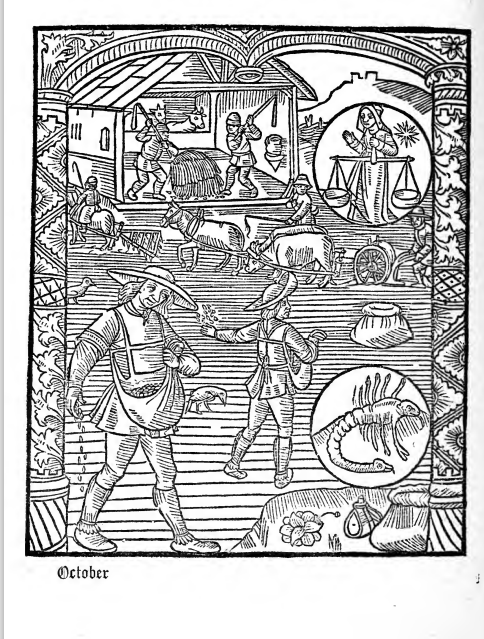
Kalendar of Shepherds illustration of September showing harvesting grapes and the astrological signs for Virgo (August 23 – September 22) and Libra (September 23 – October 22)
It is that time of the year when you say ‘Where has the Summer gone? It can’t be September already?’ But, meteorology, speaking, Autumn starts today. September 1st was chosen on a numerical basis for ease of measuring rather than any profound floral, agricultural or solar reason. So, there are three Gregorian Calendar months for each season, and each season starts on the first of the month. Autumn: September, November and December.
Autumn, Harvest, Fall
Autumn comes from Latin (autumnus) which went into French and then into English. The season was also called Harvest (which went into Dutch herfst, German Herbst, and Scots hairst -Wikipedia) or from the 16th Century: the ‘fall of the year’ or ‘fall of the leaf’ which spread to America as Fall.
Summer’s Ending
It still feels like summer. In England, we often have a glorious September, and what we can an ‘Indian’ Summer, an unexpectedly warm period in mid-September to October.
Solar Autumn
Of course, for the real Autumn, we have to wait for the Equinox, the beginning of Astronomical or Solar Autumn. This year, it is on Monday, September 22nd, 2025, 7:19 pm.
Astrological September
The star signs for astrological September are: Virgo which is linked to Aphrodite (Venus) the Goddess of Love and Libra which is linked to Artemis (Diana), virgin goddess of many things, including hunting, wild animals, children, and birth.
Star signs for September
September
September gets its name from the Romans, for whom it was the 7th Month of the year (septem is Latin for seven). Later, they added two new months so it became our 9th Month. (For more on the Roman year, look at my post here).
It is called Halegmonath in the early English language, or the holy month, named because it is the month of offerings, because of the harvest, and the mellow fruitfulness of September? Medi in Welsh is the month of reaping, and An Sultuine in Gaelic which means the month of plenty.
Roman personification of Autumn from Lullingstone mosaic
Early Modern September and the autumn of Life
Here is an early 17th Century look at September from the Kalendar of Shepherds – for more on the Kalendar, look at my post here.
From the Kalendar of Shepherds
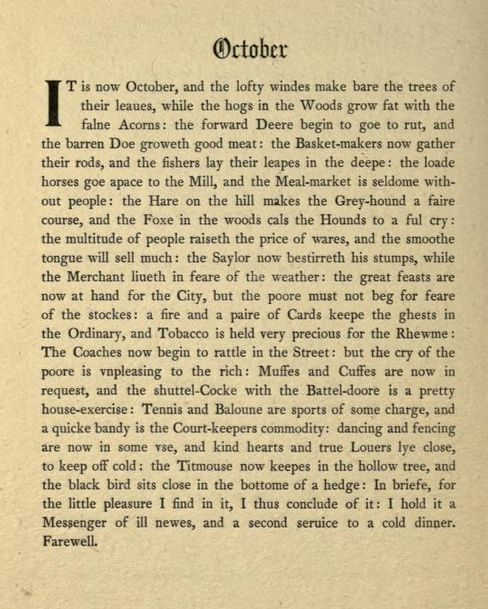
The Kalendar has an additional shorter look at September (see below). And it continues with its theme, linking the 12 months of the year with the lifespan of a man – 6 years for each month. So September is a metaphor for man at 56 years of age, in their prime and preparing for old age.
September from the Kalendar of Shepherds. The last sentence beginning ‘and then is man’ shows the link between September and the beginning of the autumn of life.
Season of ‘mists and mellow fruitfulness‘
John Keats (1795 – 1821) wrote a great poem called ‘To Autumn’:
Season of mists and mellow fruitfulness, Close bosom-friend of the maturing sun; Conspiring with him how to load and bless With fruit the vines that round the thatch-eves run; To bend with apples the moss’d cottage-trees, And fill all fruit with ripeness to the core; To swell the gourd, and plump the hazel shells With a sweet kernel; to set budding more, And still more, later flowers for the bees, Until they think warm days will never cease, For summer has o’er-brimm’d their clammy cells.
Who hath not seen thee oft amid thy store? Sometimes whoever seeks abroad may find Thee sitting careless on a granary floor, Thy hair soft-lifted by the winnowing wind; Or on a half-reap’d furrow sound asleep, Drowsed with the fume of poppies, while thy hook Spares the next swath and all its twined flowers: And sometimes like a gleaner thou dost keep Steady thy laden head across a brook; Or by a cider-press, with patient look, Thou watchest the last oozings, hours by hours.
Where are the songs of Spring? Ay, where are they? Think not of them, thou hast thy music too,— While barred clouds bloom the soft-dying day, And touch the stubble-plains with rosy hue; Then in a wailful choir the small gnats mourn Among the river sallows, borne aloft Or sinking as the light wind lives or dies; And full-grown lambs loud bleat from hilly bourn; Hedge-crickets sing; and now with treble soft The redbreast whistles from a garden-croft, And gathering swallows twitter in the skies.
Written September 19, 1819; first published in 1820. This poem is in the public domain and available here:
The Court House, Chipping Campden, poor photo by the Author! Where the mystery of the Chipping Campden Murder began
When I take Road Scholar groups to Chipping Campden, in the Cotswolds, we pass the Court House (pictured above) where I tell the story of the disappearance of William Harrison. Last time, looking at my old ragged notes, I noticed that the disappearance took place on the 16th August.
On that day in 1660 70 yr old William Harrison left the Court House where he was the Steward. The Steward went for a 2-mile walk, collecting rents. When he didn’t return, his wife sent out a man servant, John Perry, to bring him home. Neither had returned by the next morning.
Harrison’s son went out to search for his dad, and found John Perry. The two of them searched for Harrison without luck. Meanwhile, Harrison’s neckband and shirt were found with his hat. The clothes were said to be blood stained, but as those who read Sherlock Holmes will know, there was no certain test for blood stains (a test was introduced in the late 19th Century).
But the identification of blood stains led to suspicion of John Perry. He said he was innocent, but he buckled under questioning, maintaining it was nothing to do with him. But he claimed his brother and mother murdered Harrison for his money. Perry soon changed his testimony about his brother and mother and eventually pleaded insanity. All three were hanged.
Two years later, Harrison returned home, claiming to have been abducted by pirates and sold into slavery in Turkey before escaping and returning to England.
This is, pretty much, the bones of the story I have told my groups over the last 15 years. But what is wonderful about my job and this ‘Almanac of the Past:, is that you get to dig that little bit deeper than the local guidebook.
The first new ‘fact’ I discovered was that Harrison was Steward to the Lady Juliana Noel. She has a very prominent monument in St James Church, near the Court House and has long fascinated me. I will write more about her one day. Meanwhile, have a look at my post on her Dad, Baptist Hicks and how the family came to be Lords of the Manor of Chipping Campden, and Campden Hill, Notting Hill.
Back to my new discoveries about the Crime! John Perry, his mother and brother were actually tried twice for the crime. The first judge refused to try them for murder in the absence of the body. But they were encouraged to plead guilty to robbery, as they would then be eligible for an amnesty for first time convictions. This had been introduced by the new King Charles II on his restoration. So they were convicted.
However, another Judge was willing to try them in the absence of a body, and they were, after all, tried for the murder. But having pleaded guilty to robbery (to avoid the risk of being executed), they had no real defence to the charge and were sentenced to be hanged.
Nor was the hanging simple: Joan Perry, the mother, was hanged first because she was said to be a witch who was preventing her sons from pleading guilty. After she was hanged, her sons still maintained their innocence. The oldest son was then hanged. But the youngest son still claimed his innocence and was hanged too.
The hangings took place on the hill above Broadway, the highest point of the Cotswolds, where Broadway Tower now stands, and a famous beauty spot. Mother and son were buried under the Gibbet, but John Perry was hanged in chains and kept on display as a warning to others not to follow his example.
As to William Harrison’s story of his abduction, it sounds a little unlikely in rural Gloucestershire. To a modern mind, it seems more likely that he felt the need to leave home, or had some form of breakdown, or did he collude with the Perry’s to steal money from the Noel Estate? I wonder how he reacted when told that three people lost their lives because of him?
But, it has been suggested that Harrison was kidnapped by people involved in the English Civil War who had secrets to keep which Harrison as Steward might have known. He said English people had kidnapped him and put on a ship to America which was attacked by ‘Turkish’ (maybe Barbary?) Pirates.
The case led to a ‘no body, no murder’ rule which survived until 1954. But in modern times a body is not essential to a successful prosecution for murder, particularly in domestic murder cases, provided there is sufficient evidence to prove the case.
The case is normally referred to as ‘The Chipping Campden Wonder’ and it has often been written about, for example by Linda Stratmann. I have been wondering why it was so named, there being nothing wonderful about a murder or an abduction. But I have just found a ballad that was written about the case that might explain it. This claims that Joan Perry was indeed a witch, Harrison was attacked and buried in a pit but was, somehow, magically conveyed to Turkey, from which he eventually escaped to return to Chipping Campden. The Wonder is presumably the saving of Harrison by God and transportation to Turkey? The ballad clarifies that there was therefore no miscarriage of justice, as the Perrys were involved with diabolical doings, and that the Grace of God saved Harrison despite the best efforts of the Perrys.
Here is the ballad of the ‘Wonder’.
‘Amongst those wonders which on early are shown, In any age there seldom hath béen known, A thing more strange then that which this Relation, Doth here present unto your observation. In Glocestershire as many know full well, At Camben Town a Gentleman did dwell, One Mr. William Harrison by name, A Stewart to a Lady of great fame.
A Widdow likewise in the Town there was, A wick wretch who brought strange things to pass, So wonderful that some will scarce receive, […]hese lines for truth nor yet my words beleive.
[…] such as unto Cambden do resort, Have surely found this is no false report, Though many lies are dayly now invented, This is as true a Song as ere was Printed.
Therefore unto the story now give ear, This Widow Pery as it doth appear, And her two sons all fully were agréed, Against their friend to work a wicked déed.
One of her Sons even from a youth did dwell, With Mr. Harrison who loved him well, And bred him up his Mother being poor, But sée how he requited him therefore.
For taking notice that his Master went, Abroad to gather in his Ladies rent, And by that means it was an usual thing, For him great store of money home to bring.
He thereupon with his mischevous mother, And likewise with his vile ungodly Brother, Contriv’d to rob his Master, for these base And cruel wretches were past shame and grace.
One night they met him comming into Town, And in a barbarous manner knockt him down, Then taking all his money quite away, His body out of sight they did convey.
But being all suspected for this déed, They apprehended were and sent with spéed, To Glocester Goal and there upon their Tryal, Were guilty found for all their stiff denyal.
Jt was supposed the Gentleman was dead, And by these wretches robd and Murthered, Therefore they were all thrée condem’d to death, And eke on Broadway-hill they lost their breath.
One of the Sons was buried with his Mother, Vnder the Gibbet, but the other Brother, That serv’d the Gentleman was hang’d in Chains, And there some part of him as yet remains.
But yet before they died they did proclaim Even in the ears of those that thither came, That Mr. Harison yet living was And would be found in less then seven years space.
Which words of theirs for truth do now appear For tis but two year since they hanged were, And now the Gentleman alive is found Which news is publisht through the Countrys round
But lest that any of this truth shall doubt, Ile tell you how the business came about This Widow Pery as tis plainly shown Was then a Witch although it was not known.
So when these Villains by their mothers aid Had knockt him down (even as before was said) They took away his money every whit, And then his body cast into a pit.
He scarce was come unto himself before Another wonder did amaze him more, For whilst he lookt about, he found that he Was suddainly conveyd unto the Sea.
First on the shore he stood a little space And thence unto a rock transported was, Where he four days and nights did then remain And never thought to see his friends again.
But as a Turkish ship was passing by Some of the men the Gentleman did spy, And took him in and as I understand, They carried him into the Turkish Land.
And there (not knowing of his sad disaster) They quickly did provide for him a Master, A Surgeon or of some such like profession, Whose service he performed with much discretion.
It séems in gathering Hearbs he had good skill, And could the same excéeding well distil, Which to his Master great content did give, And pleas’d him well so long as he did live.
But he soon dyd, and at his death he gave him, A piece of plate that so none should enslave him, But that his liberty be might obtain, To come into his native land again.
And thus this Gentleman his fréedom wrought; And by a Turky Ship from thence was brought; To Portugal, and now both safe and sound, He is at length arrived on English ground.
Let not this séem incredible to any, Because it is a thing afirmed by many, This is no feigned story, though tis new, But as tis very strange tis very true.
You sée how far a Witches power extends, When as to wickedness her mind she bends, Great is her Malice, yet can God restrain her, And at his pleasure let her loose or chain her.
If God had let her work her utmost spight, No doubt she would have kild the man outright, But he is saved and she for all her malice, Was very justly hang’d upon the Gallows.
Titian’s Assumption of the Virgin Mary (Wikipedia)
August 15th is the date of the celebration of the Assumption of St Mary. This is the day she went to heaven. Opinion is divided as to whether she died and went straight to heaven. Or did she go directly to heaven without having to pass go? The stories about the Virgin Mary were a big part of the controversy in the Reformation. Protestants did not find evidence in the Bible supporting many of the tales they had been told by the clergy. Once they could read the Bible in their own language they were able to assess the evidence for themselves.
August 15th was taken as a day off in the Medieval oeriod. My post is inspired by Octavia Randolph who has an excellent web site with a fine post on Anglo Saxon Slavery. You can read the post here: https://octavia.net/slavery-in-anglo-saxon-england. But what particularly caught my attention was the excerpt from King Alfred the Great’s laws. It lays down the law on the days off which should be given to freemen.
‘These days are to be given to all free men, but not to slaves and unfree labourers: twelve days at Christmas; and the day on which Christ overcame the devil (15 February); and the anniversary of St Gregory (12 March); and the seven days before Easter and the seven after; and one day at the feast of St Peter and St Paul (29 June); and in harvest-time the whole week before the feast of St Mary (15 August); and one day at the feast of All Saints (1 November). And the four Wednesdays in the four Ember weeks are to be given to all slaves, to sell to whomsoever they please anything of what anyone has given them in God’s name, or of what they can earn in any of their spare time. Translated by Simon Keynes and Michael Lapidge and taken from Octavia.net
That comes to 38 days by my reckoning. In the UK 4 weeks off is a good average holiday entitlement. If we add 8 bank holidays in England and Wales that gives us 36 days off a year. So 1500 years of ‘progress’ has given us minus 2 days, and a lot less in the USA!
How depressing! Of course, most of these days off were lost during the Industrial Revolution and only clawed back by Trade Unions.
The days off are interesting, obviously Christmas and Easter. Harvest is more of a surprise in that one would expect to be working very hard bringing in the harvest. But, maybe the 7 days off were given after it was brought in?
The individual days make sense as they are the feasts of major saints or festivals – so St Gregory’s Day – he being the Pope who ordered the mission to convert the English to Christianity in 597AD. (See my post on St Gregory here).
Saints Peter and Pauls Day. St Mary and All Saints Day. I’m surprised there is no Candlemas or Michelmas.(More information about celebration of St Peter and St Paul in London in my post here)
Slaves holidays
Slaves seem to only have 4 days however. These are the Wednesday in Ember Weeks. Ember Days and Ember Weeks were Fasting Days, either named after a latin phrase for fasting or from Ymbren which is the Anglo-Saxon for circuit or revolution. It is thought that the days were originally tied to the ‘cycle of life’ that it part of each year. But later on became more liturgical and based on fasting.
They may have been founded in Roman roots. There only seems to be 3 in the days of the early church, rising to 4 ember weeks by the late 5th Century. They were brought to Britain by the mission of St Augustine, under Pope Gregory. These seem to be the dates:
December the week starting after St Lucy’s Day (Dec 13th)
March between 1st and 2nd Sunday
June between Pentecost and Trinity Sunday
September 3rd Week ending at Michaelmas.
So, the poor old slaves get 4 Wednesdays off in the year! This is presumably because the work of the household continues throughout the year, irrespective of season or festival. Maybe they are given a day off on the fasting days because household work can be put off as everyone is fasting?
But the laws make it clear: this is the time the poor slaves can work for themselves and make a little on the side.
Do have a look at Octavia’s web site which for more on slaves in the Anglo-Saxon period.
The ‘Agas’Map of 16th Century Map of London showing the Abbey of the Minoresses of St Clare with the yellow circle and St Botolphs in mauve just outside Aldgate. from the Map of Early Modern London project.
Today is the Feast day of St Clare of Assisi. An area of the City of London, called the Minories, is still to this day named after the Abbey of the Minoresses of St. Clare without Aldgate. This was was founded in 1294. The Abbey was part of the Order of St Clare or the Poor Clares as they were known . A minoress was a nun from the Order of Friars Minor (aka Franciscans) .who were also known as the Minoresses of St Clare.
Fresco of Saint Clare and sisters of her order, church of San Damiano, Assisi Wikipedia
Clare Sciffi was born in Assisi to a rich family. On Palm Sunday, 20 March 1212 Clare left her house, after refusing offers of an advantageous marriage. She had been inspired by hearing St Francis the founder of the Franciscan Monks who was also from Assisi. St Francis facilitated her transfer to Benedictine Nunneries. Her sisters followed her, one renamed Agnes became an Abbess and eventually a saint in her own right. Her family tried repeatedly to take her back into secular life. Eventually, they gave in – apparently when they saw that she had cut her flowing locks off and donned a plain robe.
A small nunnery was set up for them next to the church of San Damiano. More women joined, and they became known as the “Poor Ladies of San Damiano”. They undertook to live impoverished, and secluded.
The Franciscan friars were an itinerant order where the Friars preached to the people and were supported by begging. But this was not possible for women at that time so they lived a simple life of labour and prayer.:
‘The nuns went barefoot, slept on the ground, ate no meat, and observed almost complete silence.’ Wikipedia
Here is a site that gives information about the new Museum that will be established on the site of the Poor Clares. It also gives an outline history of the site.
The following link explores the illustrious noble women who choose to be buried in the Minories. It shows how important the Poor Clares were considered to be. It was dissolved by Henry VIII in 1539.
August was originally ‘sextilis’ or the 6th Month of the ten-month Roman Calendar. It became the 8th Month when January and February were added to the calendar to make a 12 month year. By tradition, this happened during the reign of King Numa Pompilius. Originally set as a 29-day month but changed to a 31-day month in the reforms of Julius Caesar. It was subsequently renamed August by a sycophantic Senate trying to flatter the divine Octavian, Emperor Augustus. (more of my posts about the Roman Calendar here and here)
The Celtic August
In modern Irish, it is Lúnasa, which means the month of the festival of Lughnasa. It is a harvest festival, celebrating the ripening of wheat, barley, rye, and potatoes. In Ireland, it is the festival of the God Lugh, celebrated with games, fairs, and ceremonies. Lughnasa is 6 months after Imbolc. It marks the ending of lactation of lambs and the beginning of the tupping season. (impregnation of the ewes). It can be celebrated by climbing hills, visiting springs, wells, lakes and eating bilberries. (Myths and Legends of the Celts. James MacKillop).
In Welsh, it is Awst which comes from the Latin. Called Calan Awst in Wales, it is the festival of August. In Gaelic Scotland it is called Lunasuinn, and Laa Luanistyn in the Isle of Man.
Lughnasa is one of the Celtic quarter days,. They are halfway between the Solstices and Equinoxes. They are: Samhain (1 Nov) Imbolc (1 Feb), Beltane (1 May) and Lughnasa (1 Aug). All are, or can be seen to be, a turning point in the farming year.
The Gallic Coligny ‘Celtic’ Calendar records August as a ‘great festival month’. The stone-carved Calendar was found near Lyon, whose Roman name was Lugodunum. The town is named after the Gaulish God Lugos. It is thought he is related to the Irish God, Lugh and the Welsh Llew Llaw Gyffes. He has an unstoppable fiery spear, a sling stone, and a hound called Failinis. The Romans associate Lugos with Mercury, and the Church associated Lugh with St Michael.
Lughnasa was founded by Lugh himself to honour his foster mother Tailtiu at Brega Co. Meath. Tailtiu became one of Ireland’s greatest festivals, springing from the horse races and marital contests set up by Lugh.
Anglo Saxon August
In Anglo-Saxon: the Venerable Bede, writing in the 8th Century, says August is Wēodmōnaþ or the Weed Month. Named because of the proliferation of weeds. Why does that seem such an unsatisfactory name for August? An early Kentish source calls the month Rugern – perhaps the month of the harvest of Rye? (Winters in the World by Eleanor Parker).
Lammas
For the Anglo-Saxons, August brings in the harvest period. This is the most important months of the year. The Harvest brings in the bounty of the earth. It needs to be carefully collected, enjoyed but not wasted. It begins with the festival of Lammas, which derives from the English words for bread and mass. The Bread Mass when bread made from the first fruits of the harvest is blessed.
Kalendar of Shepherds
Kalendar of Shepherds, August
The 15th Century illustration in the Kalendar of Shepherds, above, shows that the Harvest is the main attribute of the Month, and the star signs, Leo and Virgo.
The 16th/17th Century text in the Kalendar of Shepherds gives an evocative insight into the month.
St Germanus of Auxerre, Window in St Paul’s parish church, Morton, Lincolnshire, made by Sir Edward Burne-Jones and William Morris in 1914. Photo by Jenny of Jules & Jenny from Lincoln, UK (CC BY 2.0 Wikimedia Photo by Jenny of Jules & Jenny from Lincoln, UK)
St Germanus is the source of one of the few contemporary references to Britain in the 5th Century (the Dark Ages). One of his followers wrote his life story. The Saint, a Bishop in France, was sent to Britain because the Pelagian Heresy was endangering the Catholic version of Christianity. Pelagius was a highly educated British (or possibly Irish) priest who moved to Rome in the late 4th Century. He lived by a strict moral code, attacking Catholic laxity and opposing St Augustine of Hippo’s theory of Divine Grace. By contrast, Pelagius promoted human choice in salvation and denied the doctrine of original sin. Wikipedia tells us that he:
considered it an insult to God that humans could be born inherently sinful or biased towards sin, and Pelagius believed that the soul was created by God at conception, and therefore could not be imbued with sin as it was solely the product of God’s creative agency.
17th Century print of Pelagius
Germanus was sent to Britain, where he confronted Pelagian converts in a public debate which is thought to have taken place in a disused Roman amphitheatre. The author is not interested in Britain, per se, so does not tell us which town it was, but, it is mostly assumed to be St Albans, although London is possible.
In the stadium, the Saint and his acolytes confound the heretics and, so, convert the town’s people sitting watching the debate. St Germanus goes to a nearby shrine of St Alban to thank God, falls asleep in a hut, and is miraculously saved from a fire. He then comes across a man called a Tribune, and helps defeat a Saxon army in the ‘Alleluia’ victory. The importance of all this is that it gives us a few glimpses of Britain, in about 429AD, two decades after the Romans have left.
The British Bishops were led in their heresy by someone called Agricola. The writer describes these bishops as ‘conspicuous for riches, brilliant in dress and surrounded by a fawning multitude’. The use of the title ‘Tribune’ in the story suggests Roman administrative titles are still in use 19 years after the date of the ‘formal’ end of Roman Britain, 410AD. The Alleluia victory over the Saxons also gives us an early date for Saxon presence in the country as an enemy.
St Albans is the favoured choice for the location of the event because, Bede tells us St Albans was born, martyred and commemorated in Verulamium, now called St Albans. Archaeology shows possible post Roman occupation of the town. And it has a famous Amphitheatre.
However, Gildas, who is writing 200 years or more before Bede, tells us St Alban was born in Verulamium but martyred in London. This makes sense as London was the late Roman Capital and more likely to be the site of a martyrdom. There is also a church dedicated to St Albans close to the Roman Amphitheatre, where Gildas tells us the execution took place. Unfortunately, the Church cannot be, archaeologically dated back to 429AD.
Bede’s account of the martyrdom of St Albans is also somewhat farcical, as God divides the waters of the River Ver for Alban to get to his martyrdom more quickly. The bridge was said to be full of people walking to witness Alban’s execution, and blocking Alban’s path to Heaven. But the Ver is but a piddle, and it would be easy to walk across without even needing wellington boats, let along a miracle. This story is much more impressive, in Gildas’ version who has the miraculous crossing over the River Thames.
Had Pelegius won, and the Roman Church had a more optimistic view of the human spirit, would it have made any difference? It’s a big question, but maybe it would have left less room for pessimism and guilt?
What were the effects of original sin? …. it damaged our relationship with God. He seemed distant, we became mistrustful. We lost sanctifying grace. The weakening of the will, making us more prone to temptation. The darkening of the intellect. Increased vulnerability to sickness and disease. Spiritual death.
Germanus died in Ravenna. The story of his life by The Life of St. Germanus, Bishop of Auxerre by Constantius of Lyon written shortly after his death is a crucial source for the study of the 5th Century in Western Europe. It is an epic period where Imperial and Barbarian groups are fighting for control of Britain, France, Spain, Africa and Italy. There are competing views of what Christianity is and should be. not only the heresy of Pelagians but also the Arian Heresy which the German people tended to support. There were also the Nestorian and Eutychian heresy. I’ve just read a 2020 article about the Life of St Germanus by Leon Mintz which you can read here:
For more on Nick Fuentes and his theories on St Germanus, St Patrick and King Arthur read my post here: