Edinburgh from Arthur’s Seat. Castle to the left, St Giles the ’rounded’ spire in the middle, and Salisbury Crags to the right
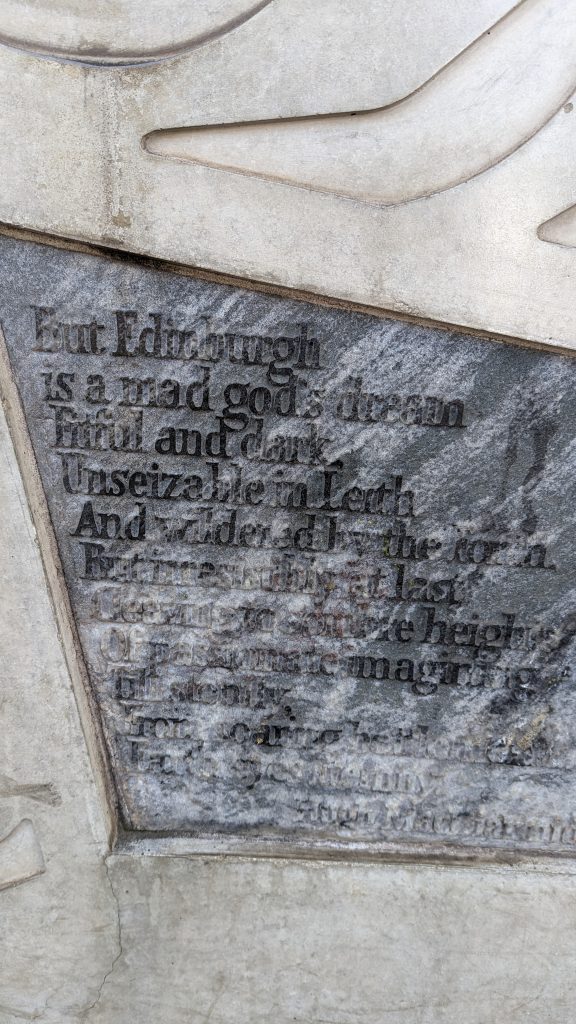
This is a poem which is ‘printed’ on the side of the Scottish Parliament.
by Hugh MacDiarmid
But Edinburgh is a mad god’s dream Fitful and dark, Unseizable in Leith And wildered by the Forth, But irresistibly at last Cleaving to sombre heights Of passionate imagining Till stonily, From soaring battlements, Earth eyes Eternity
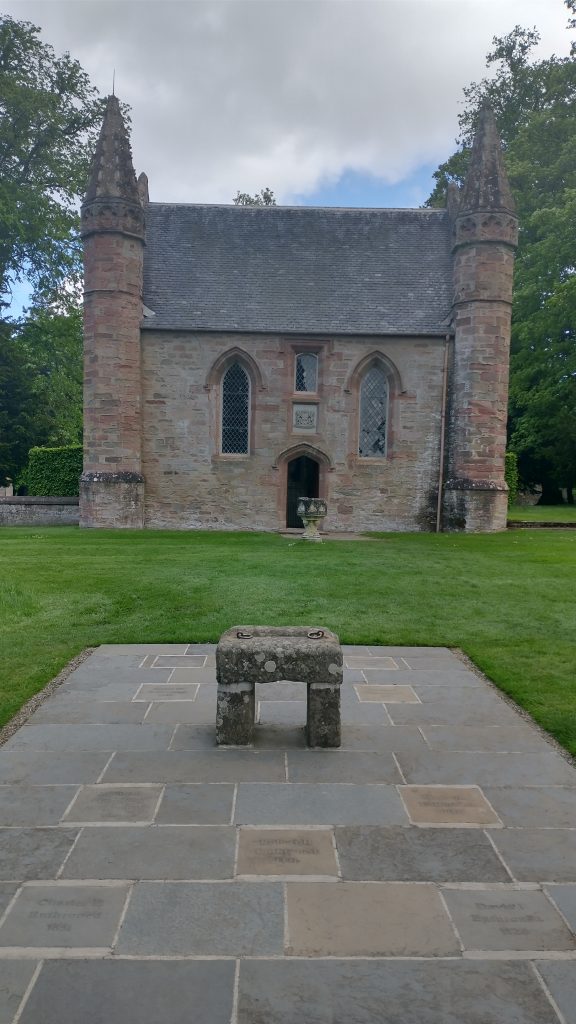
Replica of the Stone of Destiny at Scone Palace, Photo Kevin Flude
A study of the Stone of Destiny, the Stone of Scone, the Coronation Stone, has revealed new information. Firstly, it has some markings which look like three X’s and something like a V – perhaps Roman Numerals or more likely, crosses.
The Stone also revealed traces of copper alloy showing that a metal object had been attached to the Stone for a considerable time. The most obvious suggestion would be a relic associated with a Saint, and a Bell is one possibility.
Traces of gypsum suggested someone sometime made a plaster copy of the stone. No one knows when or why, and it has not been found.
Historic Environment, Scotland has released this fascinating 3-D scan of the stone for the public to view – it is annotated too.
You can read more at the links below, and thank you to Jean Kelly of the Britarch mailing list for alerting me to this.
The Stone has been moved from its permanent home at Edinburgh Castle for the first time since 1996, to be placed under the Coronation Chair for Charles’s May 6 Coronation at Westminster Abbey.
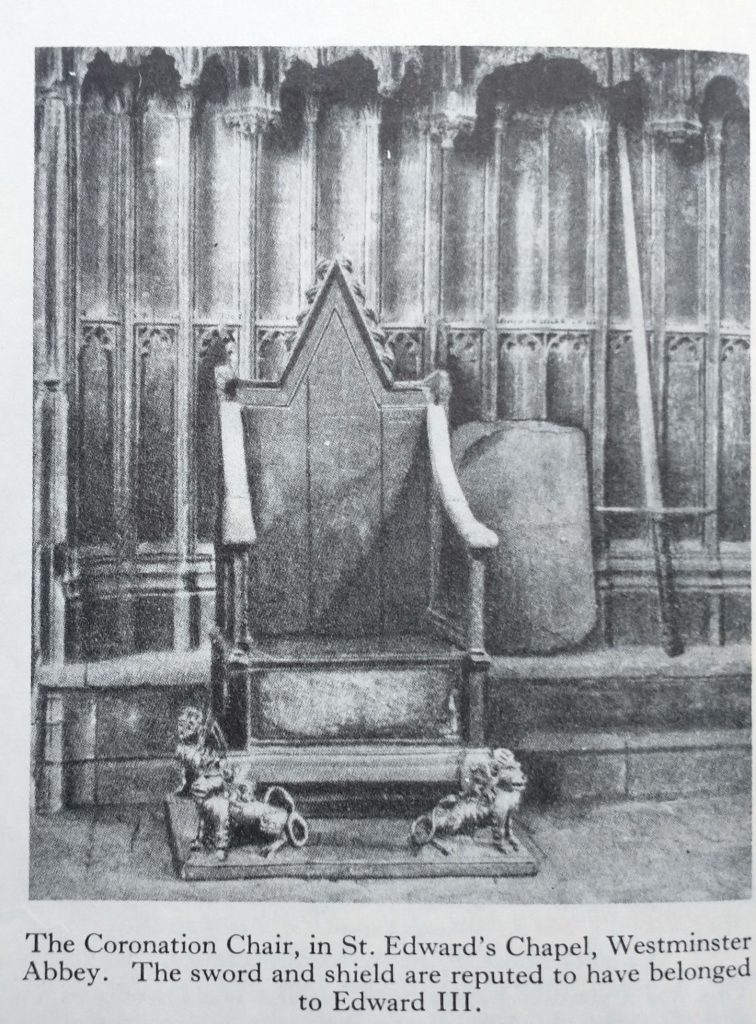
Coronation Chair, with Stone of Scone under the seat.
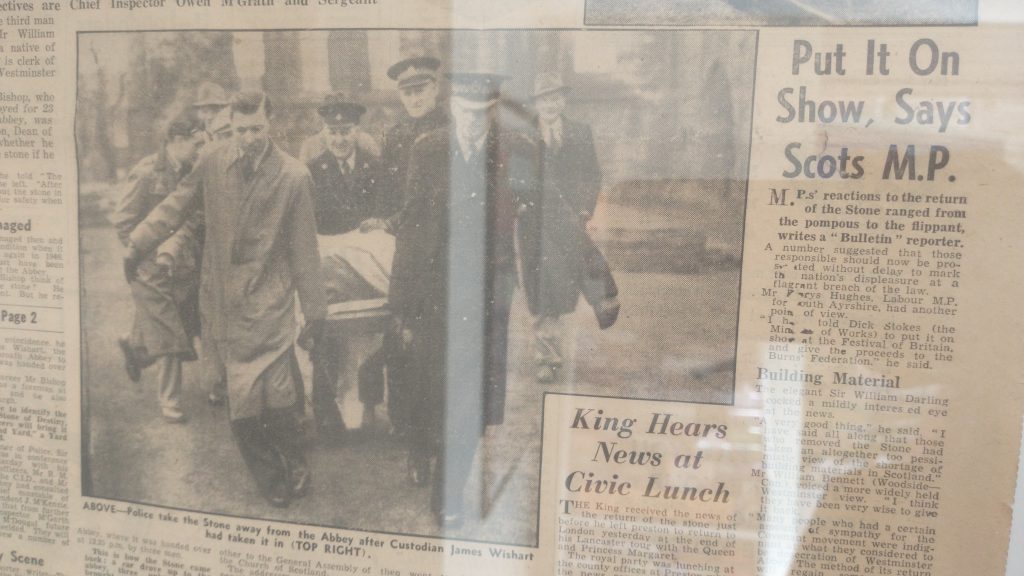
The Stone was kept at Scone before it was stolen by Edward 1 of England, who placed it under the Coronation Chair, at Westminster, to sanctify English Kings and to make the point that he was the overlord of the Scottish. In the 1950’s Scottish students stole it back, hid it for a few weeks and then left it at Arbroath Abbey. They did this because the so-called Declaration of Arbroath (1320) is a letter to the Pope asking for his endorsement of Scotland’s claim to be independent of England. The Pope agreed.
The Stone was recovered from Arbroath taken back to Westminster. The Labour Party under Tony Blair, granted Scotland back their own Parliament and as a symbol of their regained independence, the Stone of Destiny was taken back to Scotland.
Newspaper cutting showing the Stone being taken from Arbroath Abbey
To my mind it should be in Scone, which is where Macbeth and most other Scottish Kings were crowned, but perhaps they thought it should be in the Capital and in the safety of the Castle. At Scone, the Stone was placed on a mound of earth which was said to be made up of the dust from the feet of those attending Coronations symbolising the consent of all of Scotland for the new King.
I went to New Place in Stratford-upon-Avon to see the First Folio Exhibition on the anniversary of its publication in 1623. It was a very small exhibition, and, at first sight quite disappointing. Almost everything in it I had seen before. But, I came away quite excited, because it had a much better explanation of the Signet Ring than the one in its previous display.
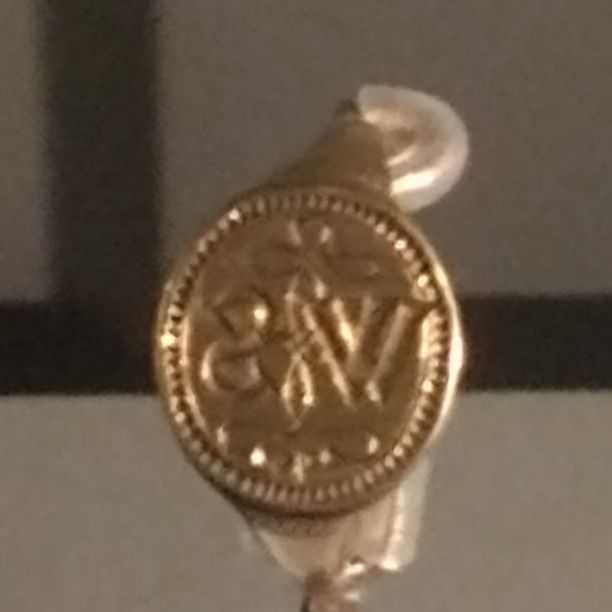
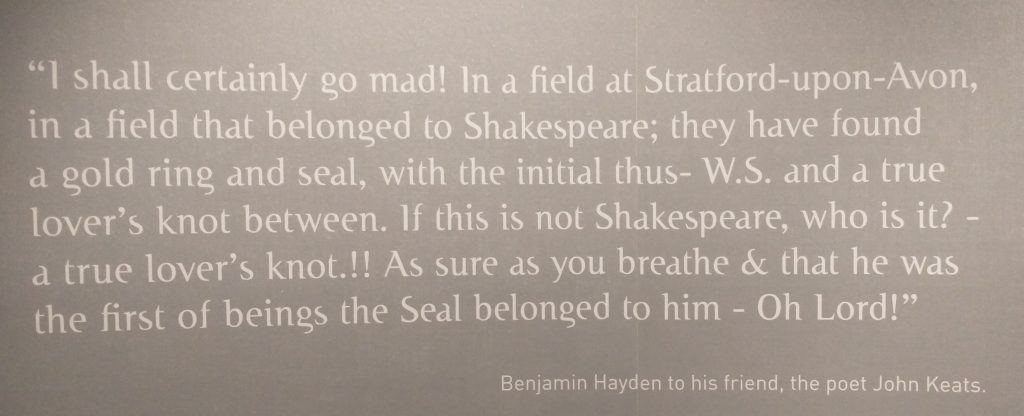
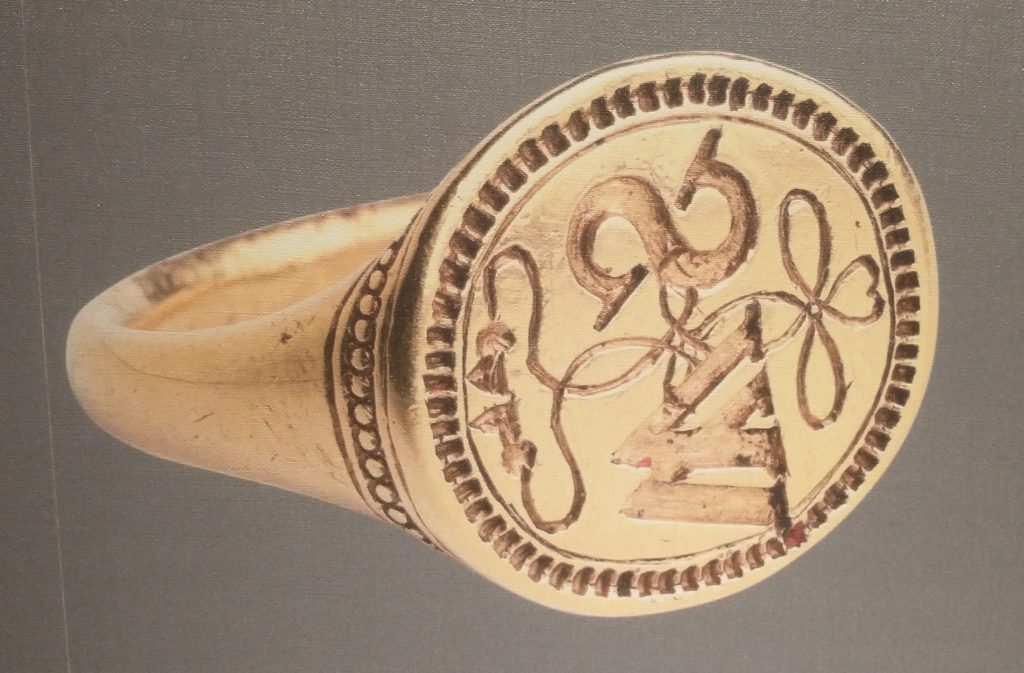
In 1810 someone found this gold ring in field near the Holy Trinity Church where Shakespeare was baptised and buried. It has a lover’s knot and the initials WS. It could ofcourse be anyone’s with those initials. But it certainly excited comment at the time as the display makes clear:
I did not know about the ring until New Place was refurbished a few years ago and the ring went on display. The new display gives more of an explanation as well as the delightful quotation above from Hayden to Keats.
Michael Wood suggested that Shakespeare might have lost the ring on the occassion of his daughter, Judith’s, marriage to Thomas Quiney in February 1616. Shakespeare made his Will a month later, and it is marked by three of his signatures. The Will says ‘whereof I have hereunto put my seale’. The word seale has been crossed out and the word ‘hand’ put in in its stead. So, he was intending to seale his approval of the Will, but changed his mind and put his signature instead? Why? Because he had recently lost his seal ring? Shakespeare died a month or so later.
Photo of the display photo of the Ring that maybe Shakespeare’s
Judith was the twin of Hamnet who died at age 11 and the Church has recently planted a couple of trees as a memorial to the twins, who are not buried, like their older sister, Suzanna, next to their mum and dad by the altar in the Church. Judith’s husband was a bit of a rogue, as he was called to the Bawdy Court and accused of debauchery with a local women who he made pregnant, and who died in childbirth. He is not mentioned in the Will.
But Shakespeare did leave money in his will to buy gold rings for his fellow actors, John Heminges and William Condell, who are buried in St Mary Aldermanbury in London. They outlived Shakespeare and collected his plays together in the First Folio. A Remembrance Ring is also in the display.
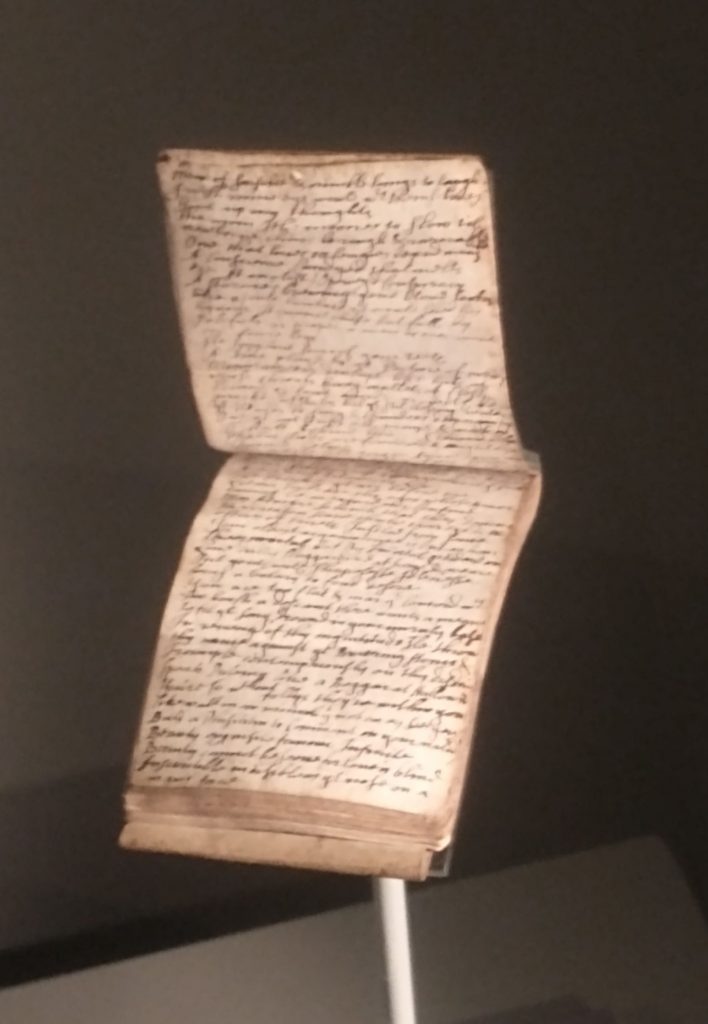
Handwritten notebook written in the 1620s full of quotations from the First Folio
The other main item in the display is this tiny 7.8 cm high notebook in which its unknown owner copied out his favourite quotes from the First Folio. It contains material from all 38 plays, and internal evidence shows it must have been made from the First Folio. It is about the size of the minature books the Brontes made. The tiny writing of the book must have been written with a quill from a small bird.
The display shows that a lot can be made of a few objects, if they are well chosen and with an excellent explanation.
By the way the rings and the Folio are clear evidence that Shakespeare wrote the plays as his friends put together his plays in a volume with introductory information which makes it absolutely clear he wrote them. Also in the Church the memorial to Shakespeare compares him to King Nestor in judgement, Socrates in wisdom, and Virgil in art. Nothing can be clearer, and why people continue to say Shakespeare was simply an actor who copied out the plays is beyond me.
Pylium is a reference to King Nestor of Pylos. Maronem is Virgil. The last line means ‘The earth buries him’ the people mourns him, Olympus posesses him’.