
Winter’s End February 7th

Photo of the cover of Winter's in the World by Eleanor Parker
Winter’s End in ‘Winters in the World’ by Eleanor Parker

Eleanor Parker’s book, on the Anglo-Saxon Year, is a wonderful book. It has a poetry about it, that also provides an insight into how Anglo-Saxon thought the world works. For a non-Old-English speaker, it, also, really gives some understanding of the language. It reveals that for the Anglo-Saxons, Winter’s End was on the 7th February. We are now in the season of ‘lencten’. This probably comes from ‘lenghtening days’ or Spring as we call it. The word eventually got absorbed into the Christian calendar, giving us the name of the fasting season, which is ‘Lent’.

So Winter began, for the Anglo-Saxon, on 7th October and ended on the 7th February. January was called ‘Gēola‘ the month of Yule. February ‘Sol-mōnaþ‘ which is Mud month. The Venerable Bede in the 8th Century calls this the:

‘month of cakes which they offered to their gods in that month’.
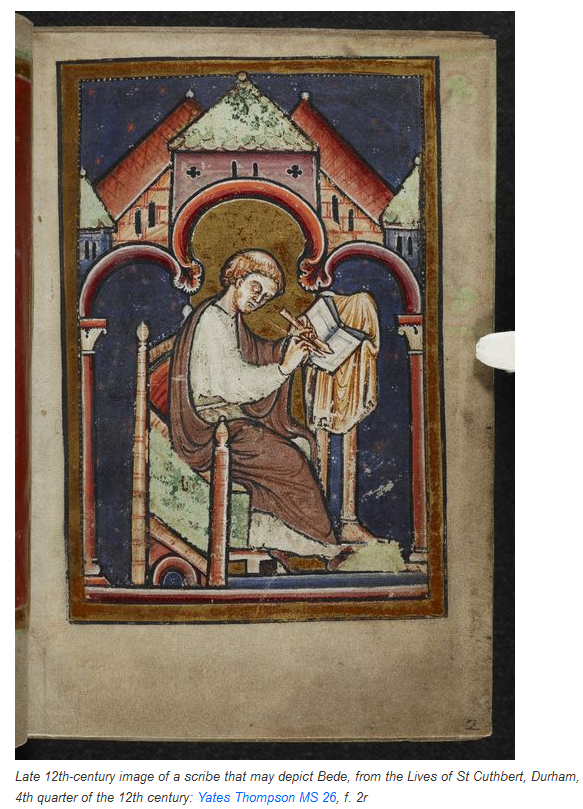
manuscript drawing possibly of the Venerable Bede
Thought to be the Venerable Bede, the first historian of the English

Bede tells us that before conversion to Christianity, the Anglo-Saxons had two seasons – Winter and Summer. Winter began on the first full moon of October, which they called Winterfylleth. The summer was called ‘sumor’ or ‘gear’ which developed into our word ‘year’. As in: ‘he was a boy of 10 summers.’

Roman, Celtic and Saxon Winter’s End

There is some sense in Winter’s End on February 7th. Lambs are being born; buds and shoot are appearing on branches and poking up from the cold earth. So, their winter is essentially, the time when nothing is growing, while ours is more aligned to the coldest period.

The Roman author Marcus Terentius Varro divided the Roman Year into 8 phrases and his Winter/Spring divide is also on 7th February. This is when, in Italy, the west winds began to blow warmer weather. So farmers ‘purged’ the fields, readying them for planting. They would be cleared of old growth and debris. Then blessed, weeded, pruned with particular attention given to preparing the grain fields, the vineyards, olive trees and fruit trees.

The Celtic year began at Halloween, and the spring begins with Imbolc, a week earlier than the Saxon on the 1st of February.

Anglo-Saxon Winter

In the section on Winter, Eleanor Parker gives a poetic description of winter. What seems particularly interesting about it is that the harshness of winter is often paired with descriptions of the ruins of Roman Civilisation. So, the despair of winter, the barren soil, the fight for survival is made more melancholic by the comparison to failed civilisation. Nature battering away at the useless ruins, and the destruction of people’s dreams.

Here, is a flavour of the juxtaposition of the bleakness of winter and the sadness of lost society. It is from ‘The Wanderer’ an alliterative poem from the Exeter Book, dating from the late 10th century. I have presumed to change a couple of words to make it a little more accessible.

Who’s wise must see how ghostly it has been
when the world and its things stand wasted —
like you find, here and there, in this middle space now —
there walls totter, wailed around by winds,
gnashed by frost, the buildings snow-lapt.
The winehalls molder, their Lord lies
washed clean of joys, his people all perished,
proud by the wall. War ravaged a bunch
ferried along the forth-way, others a raptor ravished
over lofty seas, this one the hoary wolf
broke in its banes, the last a brother
graveled in the ground, tears as war-mask.

That’s the way it goes—
the Shaper mills middle-earth to waste
until they stand empty, the giants’ work and ancient,
drained of the dreams and joys of its dwellers.”

Translation Dr. Aaron K. Hostetter.

Winter and Old Age

As I read this, I wonder if it is a tradition that began in the cold of Scandinavia? England, at least Southern England, can often have mild, rather than ferocious winters?

However, there is also an idea about the circularity of life and the interconnectedness of everything. There are 4 Seasons, 4 Ages of Man, and the cycle was from childhood to old age, from Spring to Winter. We start young, and become vigorous, and then we decline and eventually die. And so does the world of the Anglo-Saxons. The world of Adam was young, restored to vigour by the coming of Jesus. Now the World was in its old age awaiting the Apocalypse, before the Day of Judgement. So Winter was connected with Old Age and Death.

Bede’s Metaphor for Winter

Parker recounts a beautiful image of Bede’s. The King of Northumberland is thinking of taking his wife’s religion. He, therefore, invites the Christian evangelist, Paulinus to his court. Inclined to convert. He asks the opinion of one of his pagan advisers, who answers to the effect.

‘We are in the Great Hall, gathered warm with friends and family around the roaring fire, with Winter raging outside. A sparrow comes in from a hole in the end wall, flies through the warm of the Hall, and flies out through the other side. Such is life. The Hall is this world, we are the Sparrow, and as pagans we have no idea what happens before we enter the Hall, nor what happens after we leave. How much better it is to embrace a religion that can give us certainty as to what happens when we leave the hall.’

Lovely image, although, the pagan adviser does seem to have made his mind up to try Christianity? . What I like about it is that it echoes feelings I have. We as a species worry about what happens after death. It seems to many so final, to others unknowable. But I think ‘I don’t worry about what happened before I was born, so why should I worry about what happens after I die?’ It’s the same state of non-being. It gives me some comfort that I’m going back where I came from.

For the Ancient Grecian Winter looked at my Post on Hesiod

For the Roman Festival of Winter look at my post on the Festival of Brumalia

On This Day

1812 – Dickens born in Portsmouth. His father was the son of a Butler and a clerk in the Royal Navy Pay Board. He has much in common with Mr Micawber. His mother, Elizabeth Dickens was a source for the character of Mrs Nickleby. Dickens told a friend that his mother came to him exasperated by the stupidity of Mrs Nickelby. Dickens said words to the effect: ‘Little did she know that Mrs Nickleby was based on her’. Here is a section of Nicholas Nickleby that makes the point.

Nicholas Nickelby From Chapter 1

Mr Nickleby looked about him for the means of repairing his capital, now sadly reduced by this increase in his family, and the expenses of their education.

`Speculate with it,’ said Mrs Nickleby.

`Spec—u—late, my dear?’ said Mr Nickleby, as though in doubt.

`Why not?’ asked Mrs Nickleby.

`Because, my dear, if we should lose it,’ rejoined Mr Nickleby, who was a slow and time-taking speaker, `if we should lose it, we shall no longer be able to live, my dear.’

`Fiddle,’ said Mrs Nickleby.

`I am not altogether sure of that, my dear,’ said Mr Nickleby.

`There’s Nicholas,’ pursued the lady, `quite a young man—it’s time he was in the way of doing something for himself; and Kate too, poor girl, without a penny in the world. Think of your brother! Would he be what he is, if he hadn’t speculated?’

`That’s true,’ replied Mr Nickleby. `Very good, my dear. Yes. I will speculate, my dear.’

Speculation is a round game; the players see little or nothing of their cards at first starting; gains may be great—and so may losses. The run of luck went against Mr Nickleby. A mania prevailed, a bubble burst, four stock-brokers took villa residences at Florence, four hundred nobodies were ruined, and among them Mr Nickleby.’

Mr Nickleby ends up dead having falling 202 ft from the top of the Monument. In 1810 Elizabeth’s father, Chief Conductor of Monies in the Navy Pay Office was found guilty of embezzling £5,689 3s 3d.

Full text of Nicholas Nickely here.

First published in February 2023, republished on 7th February 2024, 2025, On This Day addedd 2026

New Irish Bank Holiday for St Bridget/Imbolc! Ist Monday in February

The celtic year shown as a circle
The Celtic Year showing Imbolc, the new Irish Bank Holiday

I just came across this which I published last in 2023. I should have republished it last weekend. But here it is. The Irish created a brand new Bank Holiday for St Bridget. The first one was Monday 6th February 2023. It followed a public holiday given in 2022 for Health Workers in March. The timing of the Bank Holiday is explained by the Irish Post:

St Brigid’s Day itself falls on February 1 each year but going forward the Imbolc/St Brigid’s Day public holiday will fall on the first Monday in February, unless February 1st falls on a Friday.

This means that Ireland now has a public holiday on the 4 Celtic festivals of Samain (Halloween), Imbolc (St Bridget’s Day), Beltane (May Day) and Lughnasa (Lammas Day). These festivals are quarter-days, which mean they fall halfway between the Solstices and Equinoxes.

The Independent wrote that ‘then-Tánaiste, Leo Varadkar, said‘ ….“This will be the first Irish public holiday named after a woman.”  He also is quoted as saying:

“It marks the half-way point between the winter solstice and the equinox, the beginning of spring and the Celtic New Year.”

Extra Bank Holidays in the UK?

There are occasional calls for a new Bank Holiday in the UK. It’s often a Conservative MP calling for a National Day for the British. More often than not they suggest Trafalgar Day 21st October would be a suitable date. This commemorates the great Naval battle in 1805 in which Nelson was fatally wounded. It has several virtues in their eyes. Firstly, it is a day that confirmed Britain’s mastery of the Seas , an ideal day for celebrating patriotism. Secondly, it is the school half-term, and gives a much-needed day off between summer and Christmas. Thirdly, they can propose the day should be taken from the May Day Bank holiday. This coincides with the International Worker’s Day, which is obviously ‘a bad thing’.

Here is an example: the MP for Portsmouth MP’s supported a call for Trafalgar Day here: . The report says: ‘there are currently no bank holidays in the UK which celebrate battles or war victories’. (Portsmouth News 2016).

This, I think, leaves the rest of us thinking: ‘What planet do these people live on?’ Yes, Trafalgar Day would have been a great day for a Bank Holiday, if this were 1839. Maybe even 1939. But now Trafalgar is just not on any ordinary person’s radar. We don’t think so very much about the Napoleonic War or Nelson. Nor do we often sing ‘Heart of Oaks, are our Men’ any more. In short, it is a reminder how distant from the rest of us some MPs are. By contrast, how progressive Ireland seems.

Productivity

The Trade Union Congress proposed the need for more bank holidays. We only have the usual eight annual bank holidays for workers in England and Wales. Scotland has nine or ten; the average for the EU is ‘12.3 bank holidays a year. Finland and Romania get 15, while workers in Japan have 16 public holidays in total’.

A radio programme ‘The Bottom Line’ compared productivity in Britain and France. It revealed that Britain is now 20% less productive than France, (10% worse since Brexit). And how do we make up that productivity deficit? Yes, indeed, by working longer hours for lower wages. It appears that the French high tax, high workers’ protection regime, means they have to find ways of getting more out of their workers in their working hours. While we can just hire and fire, and are happy to make people work in a more inefficient way. Strange isn’t we are told that the French economy is a victim of socialism. Turns out Socialism is more productive.

Here is my recent post about St Bridget’s Day

First Published February 2023, Republished 2026

St Agatha Feast Day February 5th

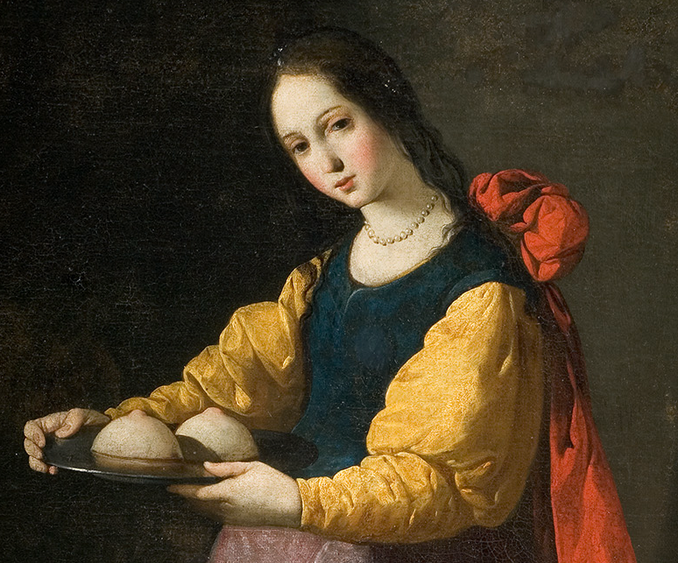
Saint Agatha, detail from a painting of Francisco de Zurbarán FROM wikipedia
Saint Agatha, detail from a painting of Francisco de Zurbarán – she is carrying her severed breasts

She is a Sicilian Saint, who refused to sleep with a powerful Roman (Quintianus) in the third Century. St Agatha was imprisoned, tortured, had her breasts pincered off, and still refused to sleep with him and died in prison. She is remembered in Sicily by cakes shaped as breasts eaten on her feast day (I kid you not).

breast shaped cakes called Minne di Sant'Agata, a typical Sicilian sweet
Minne di Sant’Agata, Sicilian (Wikipedia)

St Agatha Patronage

Her patronage springs from the usual mixture of deep and simplistic identifications. So she is ‘the patron saint of rape victims, breast cancer patients, martyrs, wet nurses, bell-founders, and bakers.’ As she is from Sicily ‘she is invoked against eruptions of Mount Etna.’ And therefore also against fire and earthquakes.’ (Wikipedia).

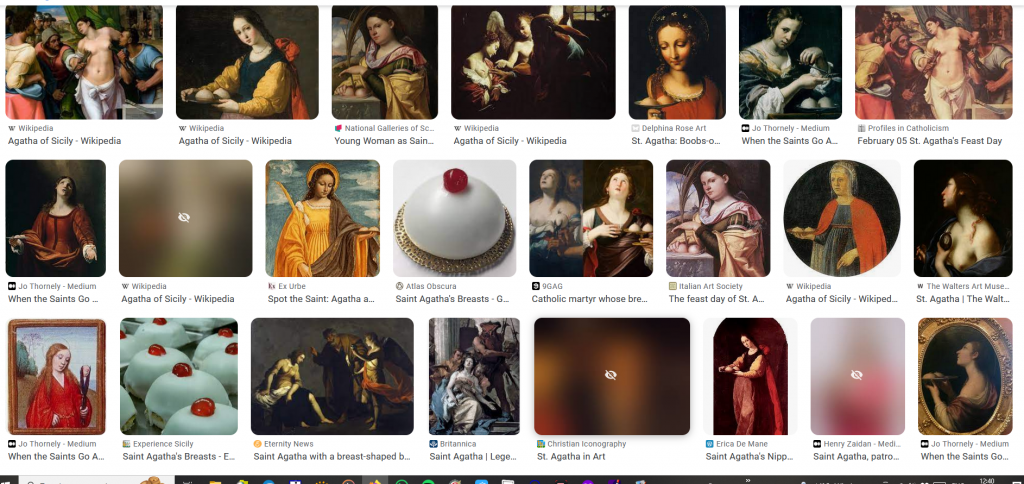
Bell Founders and Bakers? So, the bakers and bell founders, it is suggested, may have mistaken the trays of breasts as bells or loaves? Unlikely in my opinion, as Google image search shows they look clearly like breasts. They are cakes, of course, so that can help explain the Bakers, but the Bell Founders?

She was martyred, at the age of 20 (231-251AD), in the last year of the reign of Emperor Decius (Emperor 249 to June 251 AD). Thus, she is an early martyr whose cult was established in antiquity. But many of the details of her life and death are, as usual, apocryphal and from later traditions.

Results of a search for images of St Agatha in Google
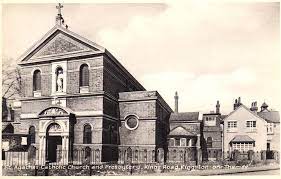
St Agatha's Church, Kingston on Thames
black and white illustration
St Agatha’s Church, Kingston on Thames

St Agatha and Etna

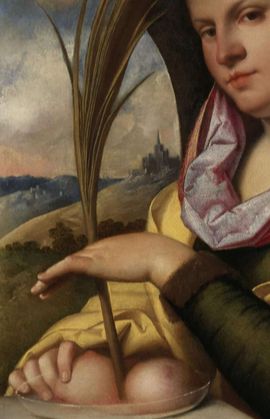
Detail of a Portrait of St Agatha by Cariana (Paintedin 1516-17). In the backgrouns is Catania

A year after her death, Mount Etna erupted. According to the story, the Christians of her home town of Catania lifted the Martyr’s veil towards the flowing lava. And the City was saved as the lava flow stopped. Hence, she protects against eruptions and by extension, earthquakes, and fire. This part of the story I got from my friend Derek who sent me the link to a piece written by Father Patrick van der Vorst. This also has the full image of the detail of painting by Cariani I show here.

For an explanation of gory matrydom’s please read my post on St Blaise.

For more on St Agatha, Ravenna, and a story about my motorcycling days please look at this post.

On This Day

2 BC – Caesar Augustus is granted the title Father of the Country (pater patriae) by the Roman Senate. Ovid celebrated this day in his alamanac poet Fasti. He seems to be praising Augustus mentioning him with the divine Julius Caesar, and Romulus and Reamus, founders of Rome.

Book II: February 5: Nones

Now I wish for a thousand tongues, and that spirit
Of yours, Homer, you who celebrated Achilles,
While I sing the sacred Nones in alternating verse.
This is the greatest honour granted to the calendar.
My wit deserts me: the burden ís beyond my strength,
This special day above all I am to sing.
Why did I wish, foolishly, to lay so great a task
On elegiac verse? This was a theme for the heroic stanza.
Sacred Father of the Country, this title has been conferred
On you, by the senate, the people, and by us, the knights.
Events had already granted it. Tardily you received
Your true title, you’d long been Father of the World.
You have on earth the name that Jupiter owns to
In high heaven: you are father of men, he of gods.
Romulus, give way: Caesar by his care makes your walls
Mighty: you made such as Remus could leap across.
Tatius, and the little towns of Cures and Caenina,
Knew you: under this Leader all the sun sees is Roman.

But suddenly the verse turns dark, and the references to Augustus are now slights and accusations. He continues:


You owned a little patch of conquered land:
Caesar possesses all beneath Jupiter’s heavens.
You raped married women: under Caesar they are ordered
To be chaste: you permitted the guilty your grove: he
forbids them.
Force was acceptable to you: under Caesar the laws
flourish.
You had the title Master: he bears the name of Prince.
Remus accused you, while he pardons his enemies.
Your father deified you: he deified his father.
Already Aquarius shows himself to the waist,
And pours the gods flowing nectar mixed with water,
And you who shrink from the north wind, be pleased,
A softer breeze is blowing from the West.

Ovid only finished the first 5 chapters of his calendar poem. He was exiled from Rome by Augustus, we don’t know why. But perhaps this is why he was exiled, because he was willing to defame the Godly Tyrant, Augustus, who had destroyed the Roman Republic. Dictators demand flattery, not criticism. Ovid paid the price. For more on Ovid’s exile please read my post on his abandonment of the Fasti here.

1811 – The Prince of Wales appointed Prince Regent during his dad’s, George III, mental incapacity

1924 – The famous pips, the time signal, first broadcasted by the BBC from Greenwich

1944 – War time diarist, Joan Wyndham receives letter from Norwegian lover Hans Gundersen. It confirms he is still alive and that she loves him. Follow the link to read his drunken letter and Joan’s reaction.

See my post here for another Joan Wyndham diary entry.

1953 – Last foodstuffs taken off Rationing in the UK. From this day forward, people could eat as many sweets and as much chocolate as they wanted. In the War they were limited to 2oz per person, and post war 6oz per person per week.

1990 – the last pips broadcasted from Greenwich by the BBC, henceforth the BBC generated their own pips.

First published in 2024, and republished in 2025, Ovid section added 2026

John Constable in Bond Street February 4th 1799

John Constable. National Gallery of Art seascape with two sailboats. public domain

I am this morning, admitted a student at the Royal Academy; the figure which I drew for admittance was the torso. Im now comfortably settled in Cecil Street, Strand number 23. I shall begin painting as soon as I have the loan of a sweet little picture by Jacob Ruysdael to copy. Since I have been in town, I have seen some remarkably fine ones by him. …

Smith’s friend, Clanch has left off painting, at least for the present. His whole time and thoughts are occupied in exhibiting an old, rusty, fusty head with a spike in it, which he declares to be the real embalmed head of Oliver Cromwell. Where he got it, I know not.; ’tis to be seen in Bond Street at half a crown admittance.’

John Constable. Letter to John Dunthorne, 1799.
From ‘A London Year. 365 Days of City Life in Diaries, Journals and Letters’ compiled by Travis Elborough and Nick Rennison.

John Constable in London

Constable would have had a short walk to the Royal Academy (in Piccadilly) from the Strand. As a painter, he subsequently spent his summers painting in Suffolk and his winters in London. When his wife became ill with Tuberculosis, they moved to Brighton. But he continued to return to London. Constable lived in a cottage in Hampstead, and is buried in the family tomb at the bottom of the graveyard of St John-at-Hampstead Church in Hampstead.

Royal Academy Photo KFlude

I don’t know what the Torso referred to was, but there was (and still is) a fine collection of plaster casts. The students used these for models.

A fine figure of the older man? Photo by K Flude of Zeus in the basement of the Royal Academy
Print on display at the Royal Academy of students drawing the sculptures in the Collection. Photographed by K Flude.

Cromwell’s Head

As to the head, it is a fascinating tale, which I partly tell on my Martyrdom of Charles I post. here: But here is more details, relevant to the Constable quote. At the Restoration of Charles II Cromwell’s body was dug up. Then the head was stuck on a pole on top of Westminster Hall. It blew off probably in 1684. The head was on display at a museum, but then no one knows where it was until, in 1799 the Hughes brothers, bought ‘it’ for £230. It was exhibited in Bond Street. Entrance fee was 2 Shillings and 6p. Constable’s acquaintance Clanch who I think is actually John Cranch was the publicist for the event.

The display was not a success because the provenance was not clear. All Cranch could say was Cromwell’s head was the “the only instance of a head cut off and spiked that had before been embalmed; which is precisely the case with respect to the head in question”. But then Henry Ireton’s was also treated thus, and maybe others. A head is now in Cambridge, Sidney Sussex College, which Cromwell attended.

The Wikipedia page on Cromwell’s Head, here., has a very full description of its travels.

Weather Outlook

Feb fill the dyke
Either black or white
But if with white, ’tis the better to like

If February gives much snow
A fine summer, it doth foreshow.

If in February there fall no rain.
‘Tis neither good for hay nor grain.

From The Perpetual Almanack of Folklore by Charles Kightly

On This Day

211 – Roman Emperor Septimius Severus dies at Eboracum (modern York, England). Leaving two sons, Caracalla and Geta, to dispute the succession. For several years York was the HQ for the Roman Emperor.

1555 – John Rogers, Vicar of the Holy Sepulchre Church in London and translator of the Bible, burned at the stake in Smithfield. The first of over 200 English Protestant martyrs condemned in the reign of Mary I. For more about Smithfield burnings see my post here.

1789 – George Washington unanimously elected as the first President of the United States. A great leader, who freed his slaves after his and his wife’s deaths, but who also evaded the rules against selling slaves. To consider the wrongs and rights of the issue look here.

1838 – ‘I walked with my daughter Charlotte across the Serpentine, much to my child’s delight, although I own I did not like to hear the ice cracking under the weight of thousands’.

John Cam Hobhouse, Diary, 1838. From ‘A London Year. 365 Days of City Life in Diaries, Journals and Letters’ compiled by Travis Elborough and Nick Rennison. See my post on the Great Freeze of 1895 with a picture of skating on the Serpentine.

1992 – Hugo Chávez ousts Venezuelan President Carlos Andrés Pérez in coup.

First Published February 4th 2026

St Blaise Day & The Tadpole Revels February 3rd

19th Century illustration of St Blaise’s Chapel, Westminster Abbey

The Blessing of St Blaise helps protect the throat. The way it is works is that blessed candles are made into a cross. These are then touched against the throat of the afflicted one. Why? Because a story was told that Blaise, on his way to martyrdom, cured a boy who had a fish bone stuck in his throat. So, he is the patron Saint of Sores Throats.

Blaise is thought to have been an Armenian Bishop of Sebaste, martyred (316AD) in the persecution of the Emperor Licinius.

Sage Advice for Sore Throats:

Salvia officinalis. Lamiaceae By Kurt Stüber [1] – caliban.mpiz-koeln.mpg.de/mavica/index.html part of www.biolib.de, CC BY-SA 3.0, https://commons.wikimedia.org/w/index.php?curid=8109

In the spirit of St Blaise, here is advice for care of your throats.

Sage Tea is said to be excellent for many things, including dental hygiene and alleviating sore throats. The Kalendar of Shepherds tells us how to treat our throats:

Good for the throat honey, sugar, butter with a little salt, liquorice, to sup soft eggs, hyssop, a mean manner of eating and drinking and sugar candy. Evil for the throat: mustard, much lying on the breast, pepper, anger, things roasted, lechery, much working, too much rest, much drink, smoke of incense, old cheese and all sour things are naughty for the throat.

The Kalendar of Shepherds 1604

The Martyrdom of St Blaise

Wool combs black and white illustration
Internet Archive book illustrations collection on Flickr. (from wovember see below)

So far, an uplifting, healing story. However, the Medieval Church’s propensity for the gruesome and its peculiar need to allocate a unique method of martyrdom to each early saint leads us to Blaise being pulled apart by wool-combers irons.  Then he was beheaded.

Hence, he is also the patron saint of wool-combers, and by extension, sheep. Wikipedia tells me that ‘Combing: was a regular form of torture.

Combing, sometimes known as carding (despite carding being a completely different process) is a sometimes-fatal form of torture in which iron combs designed to prepare wool and other fibres for woollen spinning are used to scrape, tear, and flay the victim’s flesh.

https://en.wikipedia.org/wiki/Combing_(torture)

Gory Martyrdoms Explained?

I am horrified by the goriness of these martyrdoms, and it needs some explanation. If we believe in Richard Dawkins idea of the meme we can find an explanation. Allocating a different and gory death to each and every saint has advantages for the survival of the cult. It brings a uniqueness to the story of the Saint. Particular details of death suggests authenticity. The extreme death creates an example of stoicism in the face of challenge to faith, and provokes empathy and piety. There is, also, we have to accept, a very human attraction in the bloodthirstiness of stories.

But, there is, I suspect, a financial interest too. In order for these cults to survive, they need adherents, acolytes, worshippers, donors, patrons. They require income streams that can help support the expensive clergy and the fabric of the Church or chapel. One source of income is from the wealthy, but in the medieval town, urban wealth was held within the booming guild structure. If the martyred Saint, could attract a particular Guild then (the sponsoring Priests, or Church) were quids in.

Wool was the mainstay of the economy in the medieval period. A martyr like St Blaise would prosper wherever there were people working with wool, cloth or sheep. So, is it too cynical to suggest someone with an eye for the main chance added the detail of the wool combing death to attract donations from rich wool merchants? As a successful meme, it spread throughout Europe.

Also, there were any number of endemic diseases and occupational hazards for which there was no clear cure. So if the Saint can become the Saint of common,  preferably chronic, illnesses, he/she can attract all those who suffer from that or similar diseases.

Of course, it may not always be a cynical drive for more income. In exchange, the Church offered the sufferer comfort in the face of suffering. This quality is not only of great use on its own, but it would have maximised the placebo effect. The effect has been scientifically measured. And would often be more effective a cure as than the available, often bizarre, medieval remedies.

Blaise’s hagiography suggests he was a physician. The cult was able to grow into being not only the Saint for Sore Throats and Sheep but one of the go-to saints for diseases in both humans and animals.

For a female tortured Saint see my post of St Margaret of Antioch here.

Blaise in Britain

His cult came to Britain when King Richard I was ship wrecked on Crusade. Richard was helped by Bishop Bernard of Ragusa where Richard was washed up. When the Bishop was deposed he sought sanctuary in Britain and was made Bishop of Carlisle where he promoted the cult of Blaise. Several churches in the UK founded churches named for him.

St Blazey in Cornwall is named after his Church and celebrates him by a procession of a ram and a wicker effigy of the Saint. Milton, in Berkshire, dedicated its Church to St Blaise, probably because the village’s wealth depended on sheep. The village held a feast on the third Sunday after Trinity, and the day after held the Tadpole Revels at Milton Hall. Tadpole is thought to be a corruption from the word ‘Tod’ which means cleaned wool.

Blaise in London

Westminster Abbey has a chapel dedicated to Blaise (see image at top of page). In the Bishop’s Palace at Bromley is St Blaise’s Well. It is thought to have begun as a spring when the Palace ‘was granted to Bishop Eardwulf by King Ethelbert II of Kent around 750 AD.’ A well near the spring became a place of pilgrimage and an Oratory to St Blaise was set up. In the 18th Century, the chalybeate waters of the well were considered to be useful for health. It still exists today.

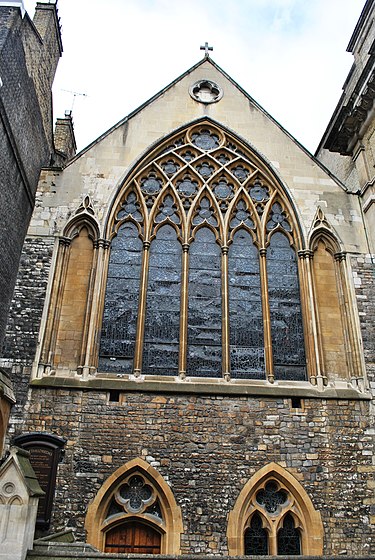
On February 3rd, St Etheldreda’s Church in London holds the Blessing of the Throats ceremony. It was a Catholic Church in the medieval period, then, in Reformation was used for various purposes until returned to the Catholic Church in 1876. It has memorials for Catholic Martyrs killed in the reign of Queen Elizabeth I

Elisa Rolle – Own work
CC BY-SA 4.0 Wikipedia St Etheldreda’s Church

One of London’s oldest guilds is the Worshipful Company of Woolmen, first mentioned in 1180, when fined, for operating without a license, by Richard 1’s dad, Henry II.

Sources: The Perpetual Almanac by Charles Kightly, Woolly Saints, Britannica, Wovember, wikipedia.

On This Day

1637Tulip Mania dramatic collapse of the soaring price of Tulip Bulbs within the Dutch Republic.

1761 – At the age of 87 Beau Nash, Master of Ceremonies at Bath died. To see my post on 18th Century Bath please look at March 14th

1870 – The 15th Amendment to the US Constitution was ratified. It prohibits the federal government or any state from denying or abridging a citizen’s right to vote “on account of race, colour, or previous condition of servitude”. What I don’t understand is how this is compatible with all the many ‘abridgements’ of a citizen’s right to vote which seem to flourish. In particular, Gerrymandering. Isn’t it effectively an abridgement of the right to vote, if the electoral districts are so artificially engineered as to make that vote meaningless? Maybe it’s ok if the abridgement is not about race, colour etc.? (OK as in ‘get away with subverting democracy’.

1917 – World War I: The USA enters the War (unrestricted submarine warfare being one of the causes)

1933 – The policy of Lebensraum announced by Adolf Hitler. This might be explained as one powerful country saying it is entitled to take over less powerful countries because they can?

Revised 2025, and 2026

Annual Grimaldi Memorial Service, All Saints, Haggerston. First Sunday in February

Annual Grimaldi Memorial Service at All Saints Church, Haggerston.

Today, was the Annual Grimaldi Memorial Service in Haggerston, Hackney, London. It began as a memorial service for the famous Regency Clown Joseph Grimaldi. But it has become a service to celebrate Clowns. The service takes place on the first Sunday in February. The service used to be at Holy Trinity Church, but has switched to Haggerston.

Joseph Grimaldi

Grimaldi as Clown, showing his own make-up design. George Cruikshankhttp://www.vam.ac.uk/content/people-pages/grimaldi-the-clown/ Public Domain

Grimaldi was born on 18 December 1778. He died in poverty on 31 May 1837. In between, he was the most famous clown. He transformed the Harlequin role and made the white-faced clown the central part of the British Pantomime. The part became known as a Joey after Grimaldi. He performed at the Theatre Royal, Drury Lane, the Sadler’s Wells and Covent Garden theatres.

All Saints Church, Haggerston

Video by K Flude of Annual Grimaldi Clown Service in Haggerston

All Saints Church, Haggerston is 5 minutes walk from where I live and 2 minutes from where my Dad was born. (see my post here). So I popped in today and took this video. The service, which has been held since the 1940s, attracts clown performers from all over the world who attend the service in full clown costume. The Spitalfield’s Life blog has a very full description of the service, and lots of very good pictures. Follow the link below:

First Published February 1st 2026

Festival of Imbolc, St. Bridget’s Day February 1st

Imbolc and St Bridget’s Day

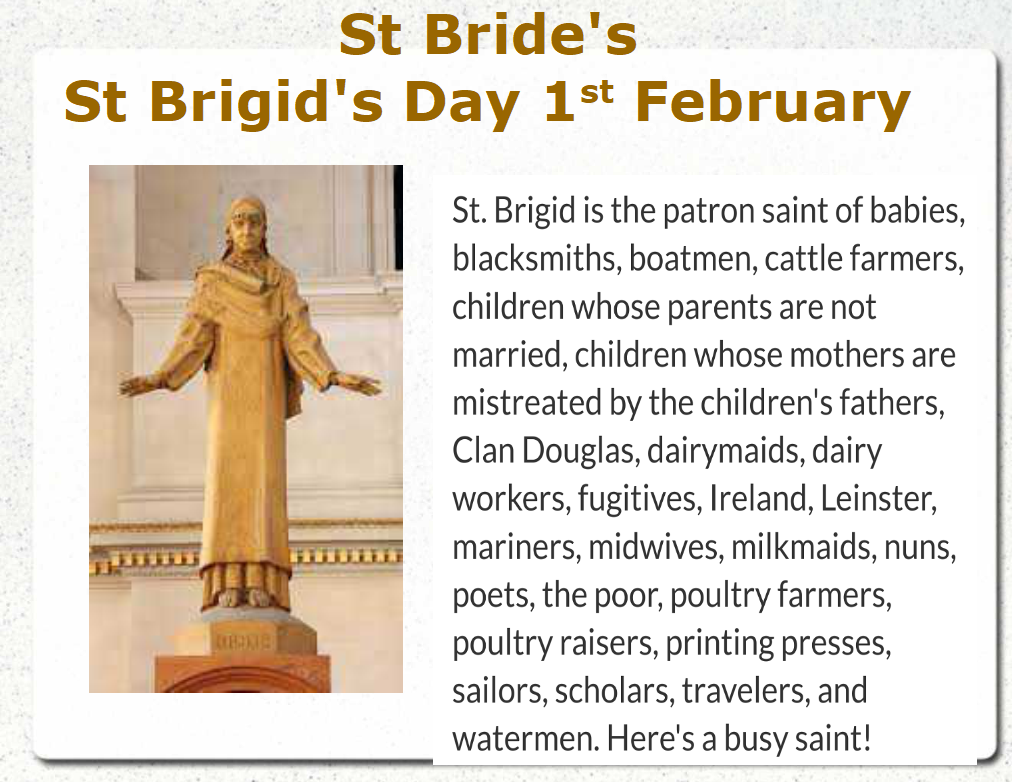
Today is Imbolc, one of the four Celtic Fire Festivals. It corresponds with St Bridget’s Day, which is a Christian festival for the Irish Saint, and is the eve of Candlemas. Bridget is the patron saint of all things to do with brides, marriage, fertility, and midwifery (amongst many other things, see below). And in Ireland, 2026 was the third St Bridget’s/ Imbolc Day Bank Holiday.

St Bride,s Statue St Bride's Church. Fleet Street
St Briget or St Bride’s Statue, St Bride’s Church. Fleet Street from K.Flude’s virtual tour on Imbolc

St Bridget, aka Briddy or Bride, converted the Irish to Christianity along with St Patrick in the 5th Century AD. Despite being a Christian, she appears to have taken on the attributes of a Celtic fertility Goddess. Her name was Brigantia, and it is difficult to disentangle the real person from the myth.

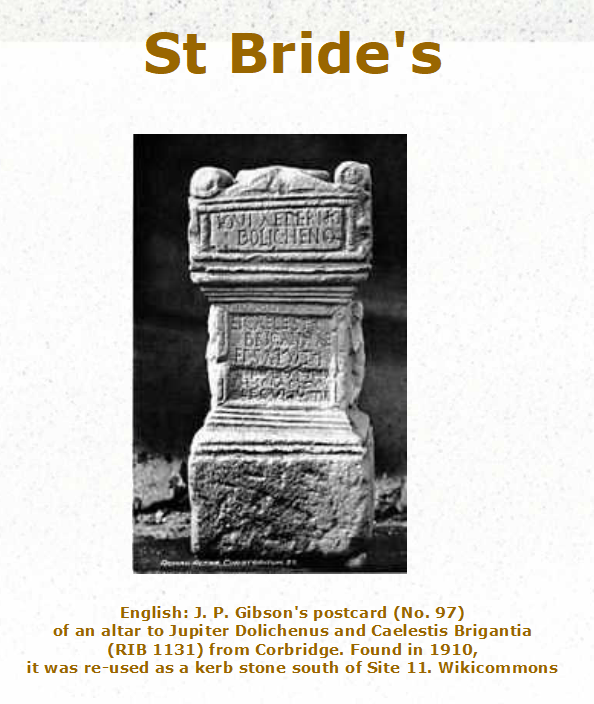
Brigantia

Archaeologists have found various Roman altars dedicated to Brigantia. The Brigantes tribe in the North are named after the Goddess (probably). They were on the front line against the invading Romans in the 1st Century AD, and led by Queen Cartimandua.  The Queen tried to keep her tribe’s independence by cooperating with the Romans. A few years later, Boudica took the opposite strategy. But both women had executive power as leaders of their tribes. This suggests a very different attitude to woman to the misogyny of the Romans.

altar to Brigantia
Altar to Brigantia from K Flude’s virtual tour on Imbolc

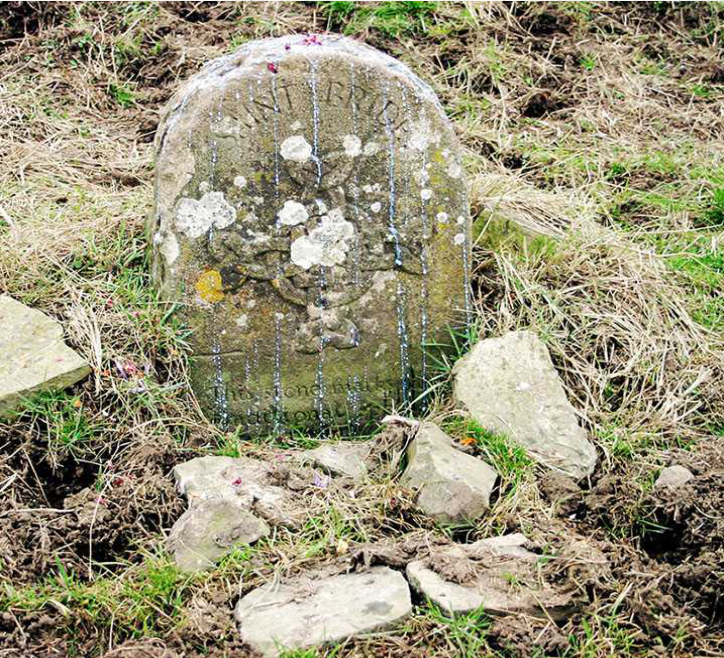
Wells dedicated to St Bridget

St Bridget's Well Glastonbury
St Bridget’s Well, Glastonbury

St Bride is honoured by many wells dedicated to her. Often they are associated with rituals and dances concerned with fertility and healthy babies. And perhaps, the most famous, was near Fleet Street. This was Bridewell, which became the name of Henry VIII’s Palace, and later converted into an infamous prison. St Bride’s Church, built near to the Well, has long been a candidate as an early Christian Church. Sadly, the post World War Two excavations found nothing to suggest an early Church. But, they did find an early well near the site of the later altar of the Church, and remains of a Roman building, possibly a mausoleum. Perhaps the Church may have been built on the site of an ancient, arguably holy, well. However, this is only a guess.

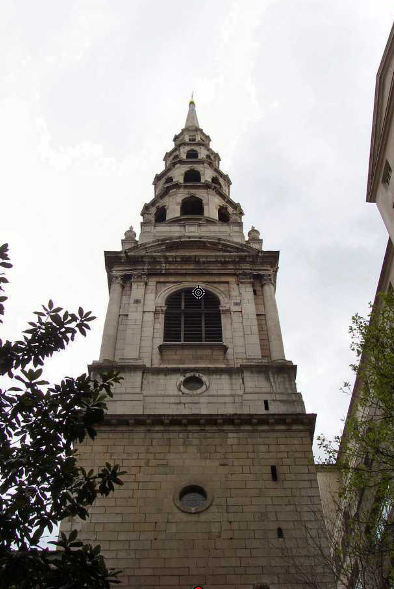
Steeple of St Brides Fleet Street
Steeple of St Brides Fleet Street, photo K Flude

The steeple of St Brides is the origin of the tiered Wedding Cake, which, in 1812, inspired a local baker to bake for his daughter’s wedding.

February signs of life

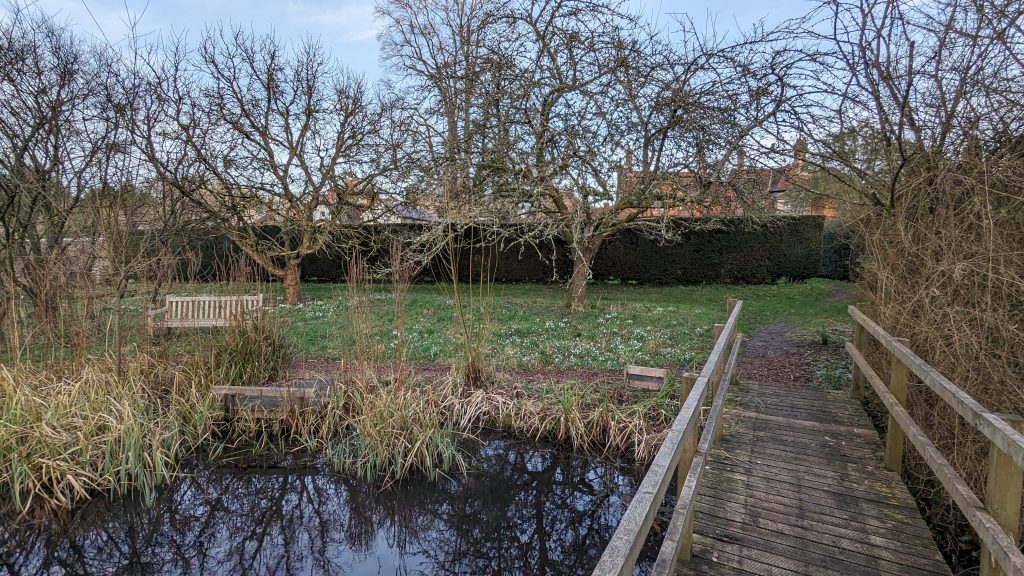
Imbolc and St Bridget’s Day are the time to celebrate the return of fertility to the earth as spring approaches. In my garden and my local park, the first snowdrops are out. Below the bare earth, there is a frenzy of bulbs and seeds budding, and beginning to poke their shoots up above the earth, ready for the Spring. In the meadows, ewes are lactating, and the first lambs are being born.

Violets, bulbs, and my first Daffodil of the year. Hackney (2022), London by K Flude

And let’s end with the Saint Brigid Hearth Keeper Prayer Courtesy of SaintBrigids.org

Brigid of the Mantle, encompass us,
Lady of the Lambs, protect us,
Keeper of the Hearth, kindle us.
Beneath your mantle, gather us,
And restore us to memory.
Mothers of our mother, Foremothers strong.
Guide our hands in yours,
Remind us how to kindle the hearth.
To keep it bright, to preserve the flame.
Your hands upon ours, Our hands within yours,
To kindle the light, Both day and night.
The Mantle of Brigid about us,
The Memory of Brigid within us,
The Protection of Brigid keeping us
From harm, from ignorance, from heartlessness.
This day and night,
From dawn till dark, From dark till dawn.

For more about go to this webpage St Bridget. To read my post on Mary Musgrove’s Candlemas Letter in Jane Austen’s Persuasion follow this link.

Imbolc and Myths and Legends Walks

I give walks about Imbolc and other Celtic festivals, and at May Eve, the Solstices, Equinoxes, Halloween and Christmas (when I have time). You might like to attend these walks or virtual tours. The following are currently in my calendar. I will be adding other walks to the calendar as the year progresses.

The Spring Equinox London Virtual Tour 7.30pm Fri 20th March26 To book

The London Equinox and Solstice Walk 2:30pm Sat 21st March26 To book

For more of my walks see the walks page of this blog here: https://www.chr.org.uk/anddidthosefeet/walks

First published in 2023, revised and republished Feb 2024, 2025, 2026

St Cadoc Day January 24th

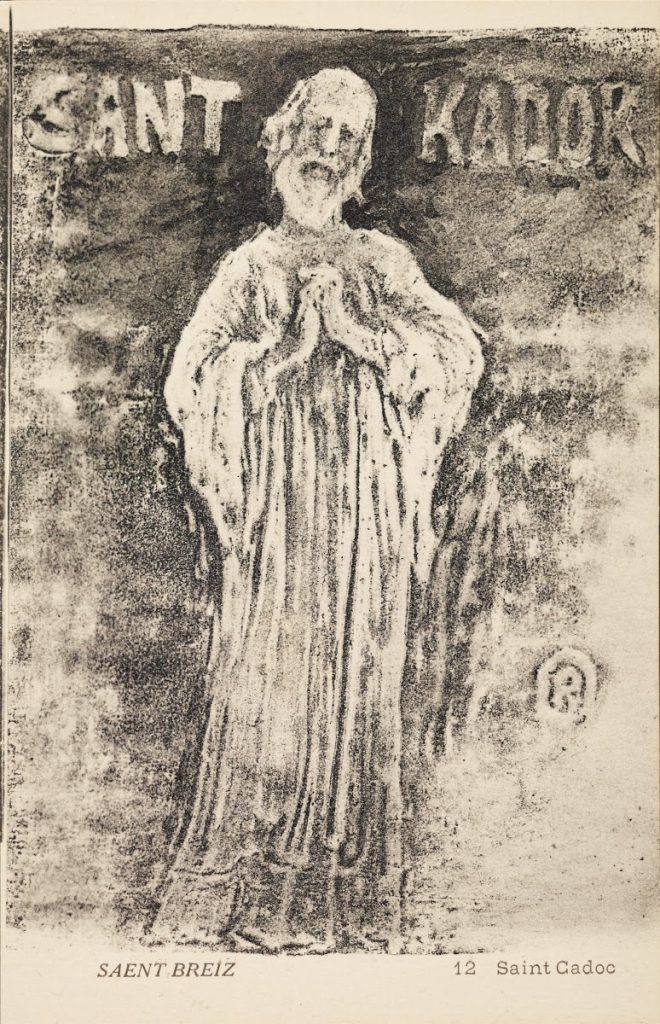
S Cadoc of Llancarfan
Image of St Cadoc

St Cadoc was born in 497 AD, a Saint, and Martyr, who founded a monastery at Llancarfan, near Cowbridge, Glamorgan, Wales. He also has associations with Scotland, Brittany, and England. His story is not written down until the 11th Century. But it is fascinating and, in its own way, a charming story. The gentle son of a savage, robber King, he was educated in Latin under an Irish priest, and refused his father’s orders to fight. But he lived to convert his parents . He is known as Cattwg Ddoeth, “the Wise”, although his sayings are mired in the forgeries of Iolo Morganwg. (aka Edward Williams, collector of Medieval Welsh literature and forger.)

Cadoc comes into conflict with King Arthur. In Welsh literature, King Arthur is a brave but wilful King. He demanded Cadoc give him compensation after the Saint sheltered a man who had killed three of Arthur’s men. The compensation was delivered as a herd of cows, but as soon as Arthur took charge of them they turned into ferns.

Cadoc and the Saxons

Cadoc was forced out of Britain by the pagan Anglo-Saxons, but eventually, he felt he had to return despite the grave danger he would face. He wanted to obey his own maxim:

Would you find glory? Then march to the grave.

He therefore moved to the Saxon settlements to give spiritual succour to the native British Christians, survivors of Saxon massacres. His martyrdom took place at Weedon in Northamptonshire. Here his Service was interrupted by Saxon horsemen, and Cadoc was slain as he served the Eucharist. He lived, probably, in the later 5th Century/Early 6th Century.

The Catholic Church celebrates him in September, elsewhere on the 24th January.

For more, look at https://celticsaints.org or Wikipedia.

On This Day

41 – Claudius found hiding behind a curtain and proclaimed Emperor after Caligula assassinated

1536 -Henry VIII falls off his horse while jousting, sustains brain injuries that some say explain his worsening behaviour? Or what is just that he was a narcissistic, privileged individual with too much power?

1972 – Japanese Sgt. Shoichi Yokoi discovered in a Guam jungle, where he had been hiding since the end of World War II.

1984 – Macintosh personal computer put on sale by Apple in the United States.

First published in January 2023, republished in January 2024, 2026

News from the Almanac of the Past January 22nd 2026

May Day Bedfordshire

This has become the day in which I update readers on the purpose and future plans for the Almanac of the Past.

What is the Almanac of the Past?

The nature of an almanac is to be a pot-pourri. They are about seasons, time, folklore, history, important events, and anniversaries. I also like to cover history, famous people and discoveries. Gods, Goddesses, Saints, sinners, and archaeology. What I want it to be is something that makes us more mindful about the passing of the year. How seasons and time change the way people see their world. My focus is mostly on the UK, but also on Rome and Greece. With occasional excursions to other ages, places and universes. I am also trying to find more content that is London-based.

What is the plan for the Almanac of the Past?

I plan to have one entry for each day. The problem with this, is that as I fill in the empty days, I will be republishing the already filled days. So subscribers will be seeing content they have seen before. Currently, I am trying to improve and extend existing content so it is worth reading again. And I am groping towards a final format for each day.

This is what I think it is. Each page will have the following sections:

Seasonal content: folklore about the day in question. Including historic texts about gardening, farming, cooking, witchcraft superstitions etc.

Saint or God/Goddess of the day

Calendar content: about epochs, ages, years, months, days, hours, and everything calendrical

Major article about something that happened on this day in history

On This Day section where other things that have happened on this day have happened.

I guess rather than a post it will be more like a newsletter of the day?

The almanac of the Past Publication

If I get the formula right, I will attempt to get a publication from it. Otherwise, it will remain online. So:

How’s it doin’?

The first graph, above, shows a steady growth from 2,000 views in 2020 to 26,000 views for 2025. Although encouraging, it has not gone ‘Kardashian viral’ as yet. 75% increase last year. This was partly achieved by taking more care of SEO – search engine optimisation. I’ve been doing a lot more of this. But if you are interested in this read last year’s ‘News from the Almanac of the Past’.

Screenshot from Jetpack showing the geographic reach of the Almanac of the Past from 2020 – 2025

The second graphic shows where the readers come from: mostly from the UK and the US, followed by France and Germany. It shows vast stretches of the world not registering as converts to the Almanac of the Past, including Greenland (or do I mean Iceland?).

Next up ‘Favourite pages, and referrers

Screenshot from Jetpack showing the most viewed pages (left and Referrers (Right)

The Skimmity Ride is way out ahead, the most popular post. The page is about a procession ‘designed to humiliate a member of the community.’ Why is it top? I think because hardly anyone else posts about it, so if you want to know what Thomas Hardy was writing about in the Mayor of Casterbridge my site is the go-to place.

Next is the ‘Beginning of the Universe‘ Post. This pleases me because it is something I discovered myself while writing the blog. It explains the beginning of the universe, the beginning of the year, the beginning of spring, and the Birthdays of Adam, Lilith, & Eve; the conception of Jesus, and why the year began in the medieval period on March 25th. So again, you won’t find this information easily in any one other place. The Almanac of the Past explains it all.

Queen Elisabeth I’s Nicknames are third. She is always popular and the nicknames she gave to her advisers are fun, and either flattering or rude.

Then we have the post on Antarctic explorer Lawrence Oates. It is an interesting post, of course, but why it rates highly I have no idea. Maybe people know this expression ‘I am just going outside and may be some time’ and want to track it down?

The last one I shall mention is the Miracle of the Testicles. This is one of my favourite posts! (I just typed: ‘because it’s nuts’ without realising the pun, so please forgive me!) But, really, it shows the often risible ways the early Saints became famous. And yet beneath that there is a real need in the community for spiritual help which the origin stories touch. Its high ranking must be down to the word ‘testicles?’ No?

The other side of the graphic shows referrers, which are mostly the obvious ones like search engines and facebook. But there is also a fansite for Damien Lewis, the actor who was in Band of Brothers and Henry VIII in Wolf Hall. One of his pages mentioned my page.

Screenshot from Jetpack showing the posting ativity for the past year. Grey means no posts, Dark green 2 or more, light green one post a day.

Posting Activity shows you how far I am from achieving one Almanac post a day. Not far in the winter, more to do in the summer.

So how can you help?

If you have a website or a blog or a social media page, post a reference to one of my pages, and encourage people to have a look. If you receive the email as a subscriber, occasionally visit the site, and like it? Send a WhatApp group a link to my page. Help me go properly viral, then, I can get a publishing deal, publish my Almanac and then my novels …… do it before you forget!

Any problems for the Almanac of the Past?

Please continue to forgive my wretched proofreading.

First Published in 2026

Queen Elizabeth 1 Coronation January 15th

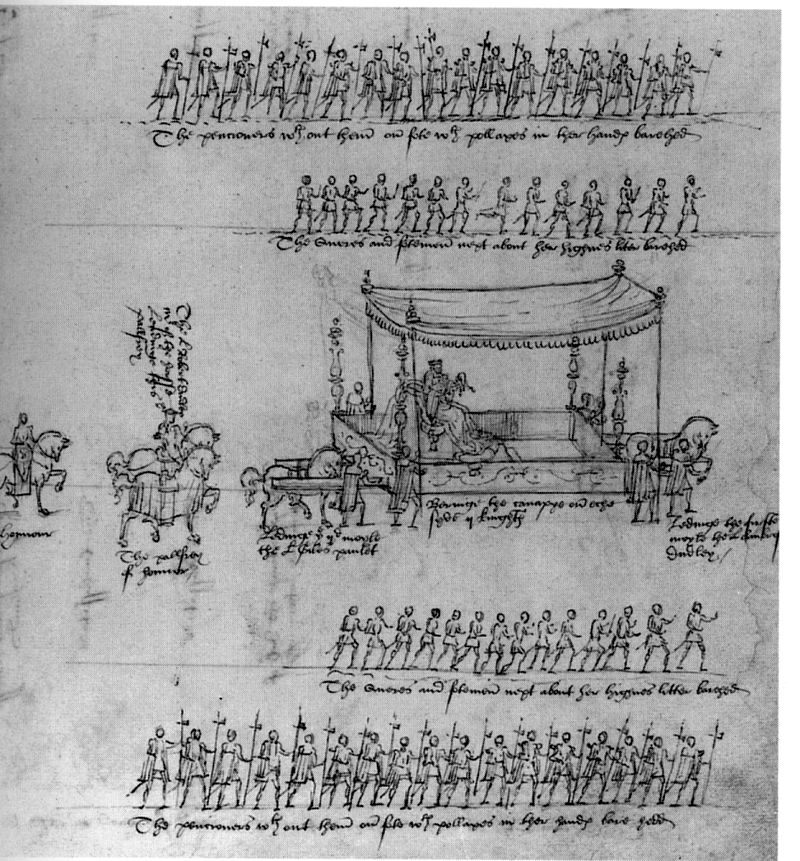
Queen Elizabeth 1 Coronation. Litter at her royal entry, accompanied by footmen and Gentlemen Pensioners. Unidentified engraver. (Wikipedia)

Queen Elizabeth 1 Accession

Queen Elizabeth 1 ascended the throne on 17 Nov 1558. Her accession was greeted with an outbreak of joy by the Protestant population. But the supporters of her dead sister Mary 1 did not want a Protestant monarch. On hearing the news of the death, Elizabeth rushed to occupy the Tower of London. She even risked shooting London Bridge, such was her haste. (see my post of the accession of Queen Elizabeth I)

She consulted lawyers about the legal position. Elizabeth, and her sister Mary, were declared bastards by two Succession Acts passed during Henry VIII’s ‘troubled’ married life. The Third Succession Act of 1543/44, following Henry’s marriage to Katherine Parr, restored Mary and Elizabeth to the Royal line. But it did not restore their legitimacy. Rather than tackle the complex legislation, Sir Nicholas Bacon, the Lord Keeper of the Great Seal, advised:

“the English laws have long since pronounced, that the Crown once worn quite taketh away all Defects whatsoever“. (Wikipedia)

Which, when you think about it, basically legitimises any successful ‘coup’! And, from a legal perspective, she was still, arguably, illegitimate.

Queen Elizabeth 1 Coronation

Her courtiers immediately began work on the Coronation, scheduled for January 15th 1559. In terms of Coronations, this was rushed. The precise date was, in fact, chosen by the Royal Astrologer. John Dee, a famous mathematician and credulous astrologer,. He found a date that the celestial bodies deemed propitious. But it needed to be sooner rather than later because Elizabeth’s position was so insecure.

Queen Elizabeth 1 Coronation Procession

The Coronation began with a procession from the Whitehall Palace in Westminster. Then back to the Tower of London for the Vigil. Followed by a Royal Procession through the City of London to Westminster Abbey for the Coronation service. After the Coronation, there was the traditional Coronation Banquet at Westminster Hall.

The Vigil Procession was on the Thames where she was escorted to the Tower by ‘ships, galleys, brigantines‘ sumptuously decorated. The Royal Entry consisted of 5 Pageants and 11 Triumphal Arches.

The first pageant showed the Queen’s descent from Henry VII and his marriage to Elizabeth of York. This marriage effectively ended the Wars of the Roses by linking the House of York and the House of Lancaster. The pageant also emphasised her ‘Englishness’ as opposed to the Spanish affiliations of Mary. The second pageant demonstrated that the Queen would rule by the four virtues of True Religion, Love of Subjects, Wisdom and Justice. At the same time she was shown trampling on Superstition, Ignorance and other vices.

The Procession at Cheapside

The third pageant, at the upper end of Cheapside near the Guildhall, provided the opportunity for the City to give Elizabeth a handsome present. This was a crimson purse with 1000 marks of gold, showing the closeness of the City and the Crown. The fourth pageant, contrasted a decaying country during the time of Mary with a thriving one under Elizabeth. It featured the figure of Truth, who was carrying a Bible written in English and entitled ‘the Word of Truth’. The Bible was lowered on a silken thread to the Queen. The Queen kissed it and laid it on her breast to the cheers of the crowd. She promised to read it diligently. The final pageant was Elizabeth portrayed as Deborah, the Old Testament prophet. Deborah rescued Israel and ruled for 40 years. So she was an ideal role model for Elizabeth. (For more details, look here.)

‘All the houses in Cheapside were dressed with banners and streamers, and the richest carpets, stuffs and cloth of gold tapestried the streets’.

British History.ac.uk Vol 1 pp315 -332

Queen Elizabeth 1 Coronation in Westminster Abbey

The Coronation was traditional – in Latin and presided by a Catholic Bishop, but there were significant innovations. Important passages were read both in Latin and in English. The Queen added to the Coronation Oath the promise that she would rule according to the:

‘true profession of the Gospel established in this Kingdom.’

This showed the path Queen Elizabeth was going to take. She would introduce innovation gradually into tradition, but emphasizing that the fundamentals had indeed changed. This was going to be a Protestant reign.

See also tomorrow’s post on the Nicknames the Queen gave to her advisors.

‘Divorced, Beheaded, Died’

Can I remind you that I wrote a best-selling book on the Kings and Queens of Britain? It has sold over 130,000 copies, has been reprinted several times and in several editions. Further details here.

On This Day

1535 King Henry VIII became Supreme Head of the Church of England

1759 The British Museum opened to the Public.

1867 Ice breaks on the boating lake at Regent’s Park, London, Forty people die.

2001 Wikipedia Day. The free wiki content encyclopedia launched. (Other days are possible but this one is the earliest recovered wikipedia page. I begin editing pages on November 28th, 2003.

Revised January 2026