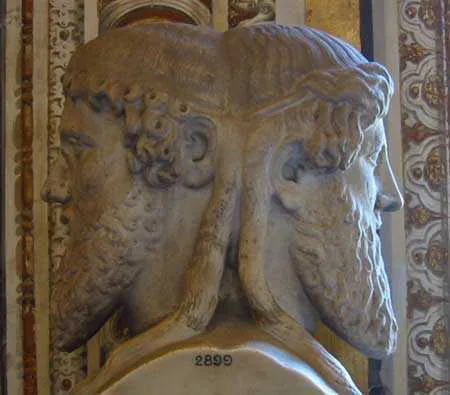
January is when people buy diaries, calendars and almanacs. January is named after the Roman God Janus. He faces both ways, to the old year and forward to the New Year. January is Ionawr in Welsh. An ceud Mhios Biadhna in Gaelic meaning ‘the first month of the year’.
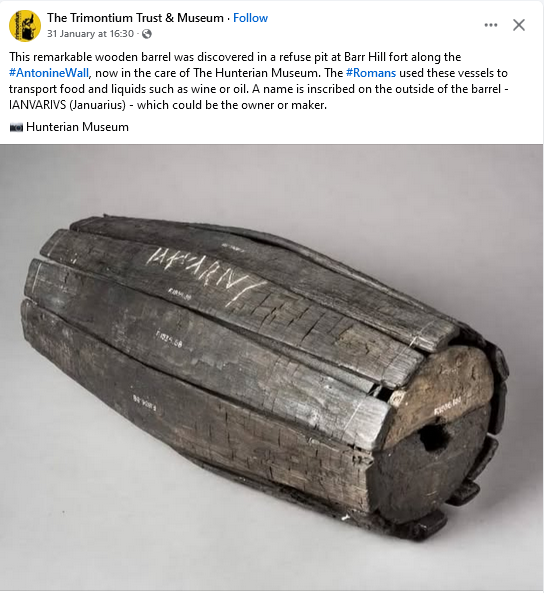
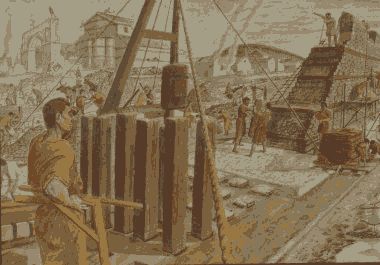
This is a Roman Barrel from Scotland is shown on the Trimontium Web Site with the name Januarius on it.
Almanacs
Arguably, they grew from medieval manuscript Books of Hours. The 1493 Kalendar of Shepherds, published in Paris, was particularly important. Each month has a succinct description of the activity. Moreover, there was important information for farmers and others. Eventually, a British version was made.
From the Kalendar of Shepherdes (illus. 1529)
Kalendar of Shepherds
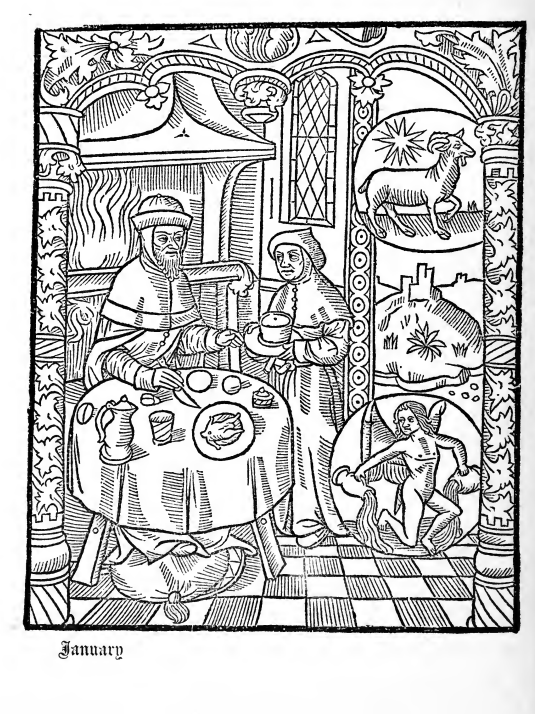
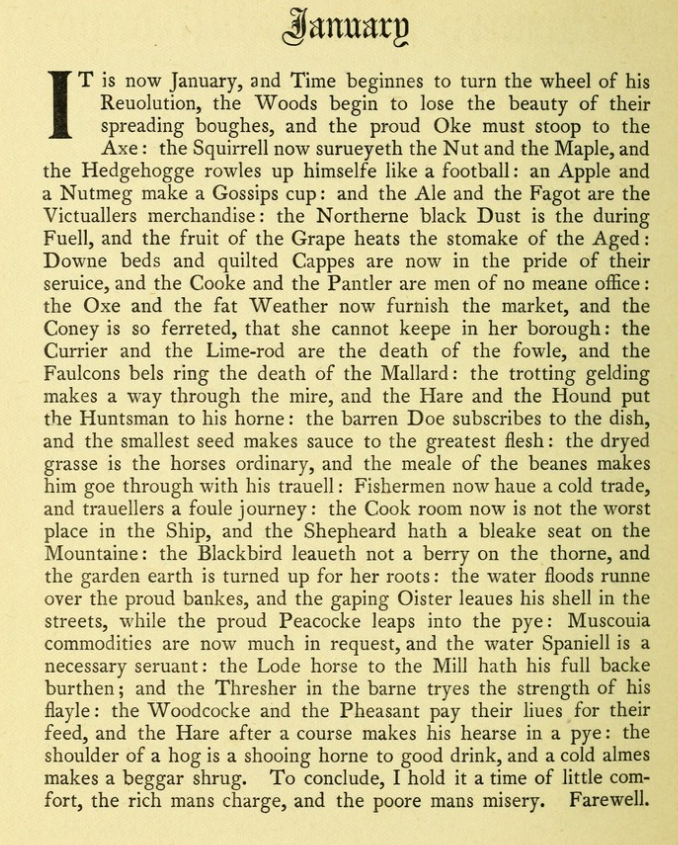
The Kalendar of Shepherds was printed in 1493 in Paris and provided ‘Devices for the 12 Months.’ I use a modern (1908) reconstruction of it using wood cuts from the original French and adding various text from English 16th and 17th Century sources. The text of the month (as shown above) is provided from a 17th Century source. It gives an interesting view of the countryside in January. To see the full Kalendar, look here:
Nicholas Breton, the writer of the text above, concludes that January:
‘is a time of little comfort, the rich man’s charge, and the poore man’s misery.’
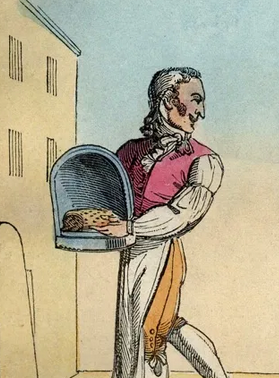
The rich man is burdened by having to help out all the poor people who depending upon him to get through the shortages of winter. The image for January shows that January is best spent indoors by a roaring fire, eating pies.
Months of Your Life
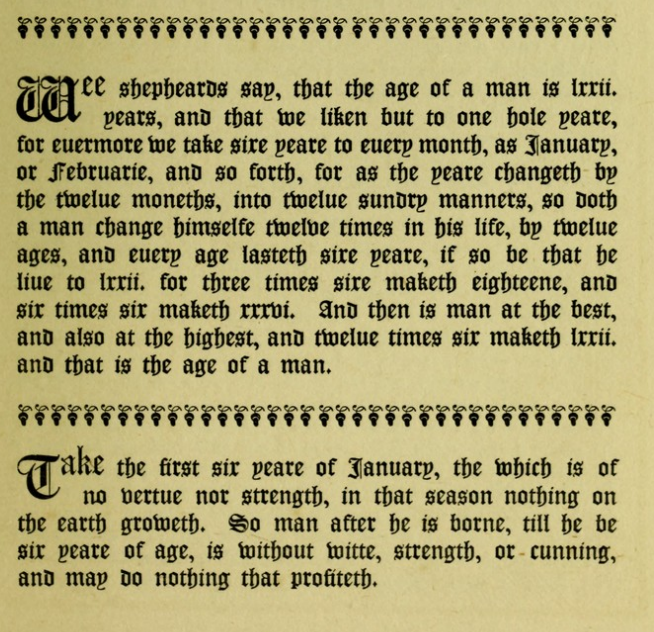
The Kalendar introduces a ‘conceit’ which is that the year mirrors our lives, and we can forecast what will happen in our lives by looking at the months.
Kalendar of Shepherds, January text
So our lives, which are of 72 years, can be divided into 12 ages of man, each of 6 years. So, January represents the first 6 years of a person’s life. And as you can see, that during these first 6 years, the child is ‘without witte, strength, or cunning, and may do nothing that profiteth‘. As the year changes every month, so, ‘a man change himself twelve times in his life’. At three times 6 (18 or March) a child becomes a man, and 6 times 6 (36 or June) man is at his best and highest. And at 12 times 6 (72 or December) man is at the end of his allotted span.
Shakespeare numbered the Ages of Man as seven, in the great speech of Jacques in ‘As You Like it’ I dealt with this and other Ages of the World in my post:
By the 1600s almanacs were the most published form of book apart from the Bible. Lauren Kassell in ‘Almanacs and Prognostications’ reports estimates that by 1660 one third of every household had one.
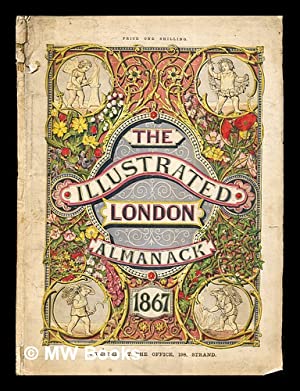
Originally, they had a Calendar for each month, and information about the phases of the month, the tides. They gave predictions of the weather, and health issues likely to occur at that time of the year. Astrology was an important element. London Almanacs contained further information about the year, its ceremonies and elections of officials. As this informational side to the almanac grew, they included lists of monarchs, interesting stories, verse foretelling the weather, recipes and cures.
As the New Year dawns, we might turn to an almanac to see what the year has ahead. Newspapers and the web have now taken over largely from almanacs. They print articles about the upcoming highlights of the Political, Sporting, Gardening or the Musical year. But almanacs are still produced. One of the most popular is Old Moore’s which has been in production since 1697. For more on Old Moore’s see my post here. As you can see, they promise to help with your gambling, gardening, fishing and help you through the year with predictions and horoscopes.
Originally published in 2024, republished in 2025. Content moved to new page and expanded 2026.
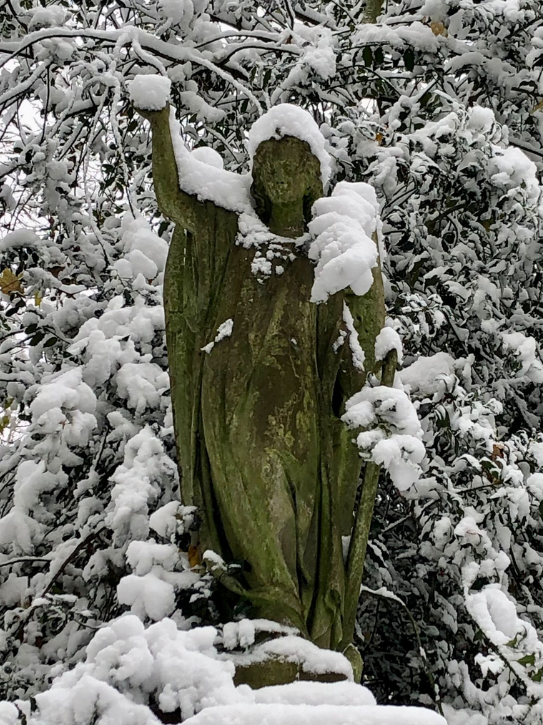
Winter at Abney Park Cemetery photo by Harriet Salisbury
Or so says the Shepherd’s Almanac for 1676. Until the 12th Night we were predicting that the weather on each of the 12 days will match the month of the same number. But having past Twelfth Night we have to find turn to other methods of weather lore.
Weather lore seems convinced of the undesirability of a warm January
‘January warm, the Lord have mercy’.
‘January commits the fault and May bears the blame.’
‘If Birds begin to Whistle in January, frosts to come’
‘When gnats swarm in January, the peasant become a beggar’
Most of the sayings about January quoted in Richard Inwards ‘Weather Lore’ first published in 1893, have this as their main focus. And the contrary (cold January good growing season) also generally holds:
‘When oak trees bend with snow in January, good crops may be expected.’
‘A cold January, a feverish February, a dusty March, a weeping April , and a windy May presage a good year and gay.’
The Weather according to Animals
So much for long range forecasts. Let’s see how Weather Lore helps us use animals to determine whether it will rain today.
‘If animals crowd together, rain will follow.’
‘When dogs eat grass it will be rainy‘
‘When a cat sneezes, it is a sign of rain‘
‘If young horses do rub their backs against the ground, if is a sign of great drops of rain to follow.’
The only weather lore repeated in my family was ‘Cows sitting down means it will rain.’ (And of course ‘red sky at night, shepherd’s delight’).
Meteorology Office on weather lore.
A survey by the Met Office in 2017 found that a surprisingly large number of people (75%) use ‘folklore’ to predict weather, and 55% think they are useful methods of predictions. Here is a quote from their post.
Red sky at night, shepherd’s delight – used by 70% of UK adults – CORRECT
It can be too cold to snow – used by 49% – PROBABLY NOT IN THE UK
Cows lie down when it is about to rain – used by 44% – NOT CORRECT
Pine cones open up when good weather is coming – used by 26% CORRECT
If it rains on St Swithin’s day, it will rain on each of the next 40 days – used by 22% Not Correct. In fact since records began in 1861, there has never been a record of 40 dry or 40 wet days following St Swithin’s Day
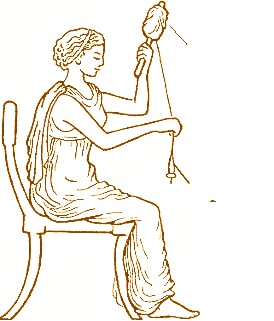
St Distaff Day. Spinning—showing the distaff in the left hand and the spindle or rock in the right hand
I’m not sure what the Three Kings were doing on the day after Epiphany. But, the shepherds, if they were like medieval English farmworkers, would still be on holiday. They went back to work, traditionally, next Monday, which is Plough Monday – (See my post here). This year, January 12th. By contrast, the women, according to folk customs, went back to work on St. Distaff Day, the day after Epiphany. Today, January 7th. In an ideal world, St Distaff’s Day is the Sunday after Epiphany (January 11th), and Plough Monday is the next day. Of course, it doesn’t always work out that way. I am not sure the woman going back to work on the 7th January, would be happy with the men lounging about until Plough Monday? An extra 4 days off! Maybe, St Distaff Day was normally on the Sunday before Plough Monday?
Distaffs and Women’s Work
A distaff is ‘a stick or spindle on to which wool or flax is wound for spinning’. Because of its importance in the medieval and early modern economy, it became a synecdoche for women. St Distaff is a ‘canonisation’ of this use of the word. So, a day to celebrate working women.
We know that medieval and early modern women were a vital part of the workforce, despite the demands of childcare. Many women took on apprenticeships, even more continued their husband’s work after he died. Some professions like silk became a female speciality. Many taverns were run by the Alewife. Plus, London was full of female servants and nurses. Many women had several jobs.
The exhibition at the British Library on Medieval Women. In Their Own Words, indicated that most of the sex workers had two or more other jobs. But even if a woman remained solely in the domestic realm, the wife had to be mistress of a formidable range of technologies. Baking, Brewing, Cooking, Laundry, Gardening, Dairy, Medicine (including distillation), horticulture, spinning, sewing and embroidery. Even, aristocratic women did embroidery of the finest quality, and it often made an important financial contribution to the household. They also ran the household, which means they had to have a formidable range of managerial skills. Dealing with servants, managing the accounts etc.
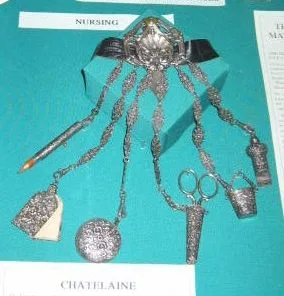
Chatelaine.
The other symbol of ‘women’s work’ was the Chatelaine. The word also means keeper of the Castle. But women who controlled households had a clasp that hung from the waist. It was a bit like a Swiss Knife as it had the keys, and all sorts of other useful items. Here is an old photo of the Chatelaine from the collection of the Old Operating Theatre Museum, of which I was the Director for 25 years. From left to right it has a pencil, a little notepad, a pill dispenser, a pair of scissors, a little bucket that held a dose of medicine, a whistle to summon urgent assistance. These were not only useful but a symbol of authority for the Matron. 19th Century.
St Distaff Day and Plough Monday
Robert Herrick (1591–1674), born in Cheapside, London, a Goldsmith, priest, Royalist and Poet wrote in ‘Hesperides’.
Partly work and partly play You must on St. Distaff’s Day: From the plough, soon free your team; Then come home and fother them; If the maids a-spinning go, Burn the flax and fire the tow. Bring in pails of water then, Let the maids bewash the men. Give St. Distaff all the right; Then bid Christmas sport good night, And next morrow every one To his own vocation.
Herrick, I think is suggesting fun and games are to be had. The men burning the flax and firing the tow, The women soaking the men with pails of water. In this piece, he links the plough team with St Distaff Day. This implies that the ploughs would be out on the next day. So as St Distaff’s Day is not always on a Sunday, perhaps Plough Monday is not always on a Monday? He certainly suggests everyone goes back to work either on St Distaff Day or on the day after,
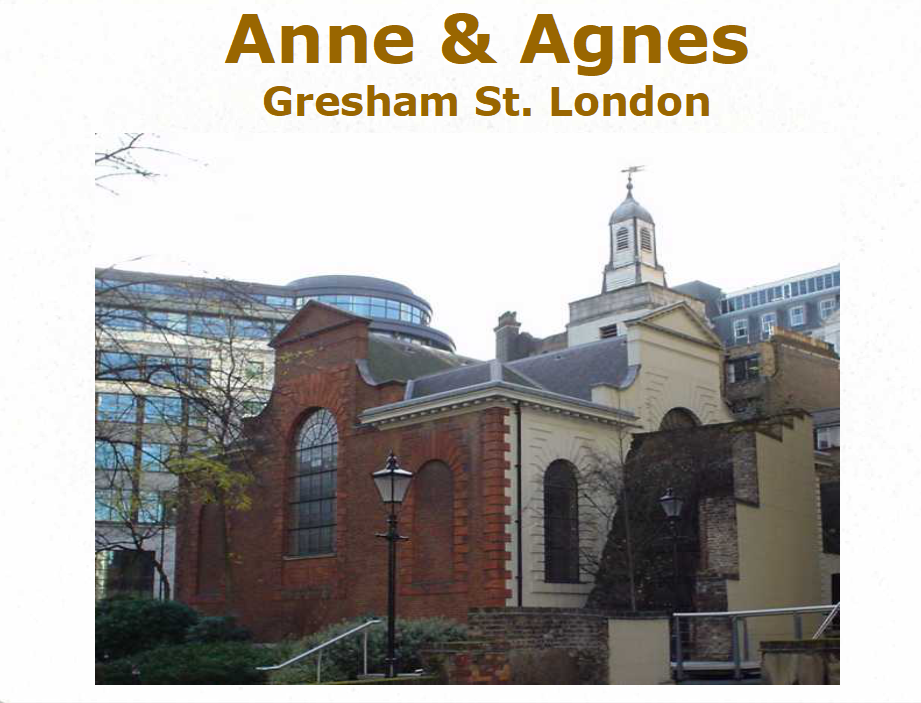
St Anne & St Agnes Church in London, Saints of the Distaff. Photo K Flude
Saints & Goddesses of the Distaff Side
In London, the Fraternity of St Anne and St Agnes met at the Church dedicated to the Saints. It is by a corner of the Roman Wall on the junction of Gresham Street and Noble Street. St Agnes is the patron saint of young girls, abused women and Girl Scouts. St Anne is the mother of the mother of the Son of God. So, together they represent the three generations of women: maidens, mothers, and grandmothers.
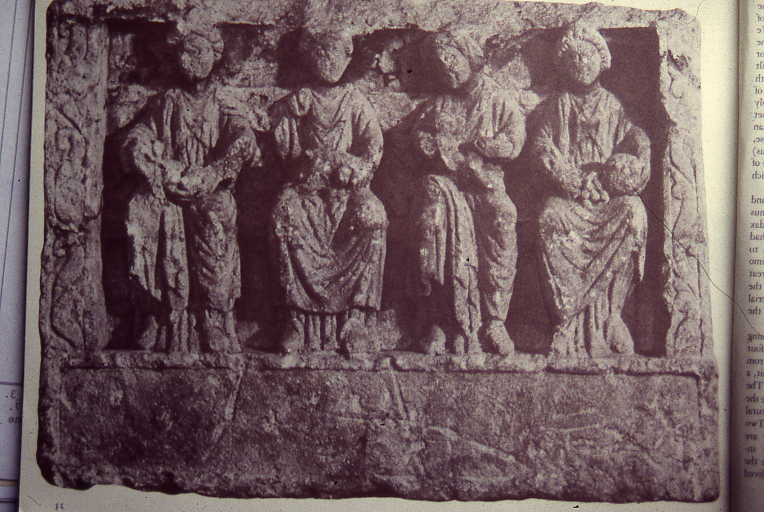
The Three Mother Goddesses (and someone else) “Limestone relief depicting four female figures sitting on a bench holding bread and fruit, a suckling baby, a dog and a basket of fruit’ the Museum of London
This trinity of women were worshipped by the Celts. Archaeologists discovered the sculpture above while investigating the Roman Wall a few hundred yards away at Blackfriars. Scholars believe it depicts the Celtic Three Mother Goddesses. The fourth person is a mystery, maybe the patron of a nearby temple? The relief sculpture was removed perhaps from a temple, or the temple was trashed at some point. Then the sculpture was used as rubble and became part of the defences of London.
The idea of triple goddesses is a common one. In Folklore and History they have been referred to as Maiden, Mother, and Crone, or even Maiden, Mother and Hag. They come in Roman, Greek, Celtic, Irish, and Germanic forms. Their names include the Norns, the Three Fates, the Weird Sisters, the Mórrígan and many more. The Three Fates, the Goddess Book of Days says, were celebrated during the Gamelia. This is the Greco/Roman January Festival to the marriage of Zeus and Juno. The Festival also gives its name to the Athenian month of January.
The Importance of the Grandma
The use of the terms Hag and Crone for the third Goddess is rare now, but was common. It does a great disservice to the importance of the Grandmother figure. (Although the original meaning of the words were less pejorative. For example, Hag may have meant diviner, soothsayer.) The three phases of womanhood are equally important to the continuation of the species. They provide love, support, and experience through the generations. Compare these three generations of supportive deities with Ouranos (Uranus), Cronus (Saturn) and Zeus (Jupiter). Saturn castrated and deposed his father, Uranus. Later, he tried to eat his son, Jupiter. But then, Jupiter is nobody’s idea of an ideal father. As one example, he eats his lover, Metis, to avoid her giving birth to his daughter, Athene. (See my post on the birth of Athena.)
Recent work on human evolution has suggested that the role of the Grandmother is crucial to our species’ ability to live beyond the age of fertility. Because, in evolutionary terms, once an individual cannot procreate, their usefulness for the survival of the genes is finished. So what’s the point of putting resources into grandma’s survival? The theory is the Grandmother has such an impact on the survival of the next generation, that longevity. for the female, beyond fertility makes evolutionary sense. Grandfathers less so.
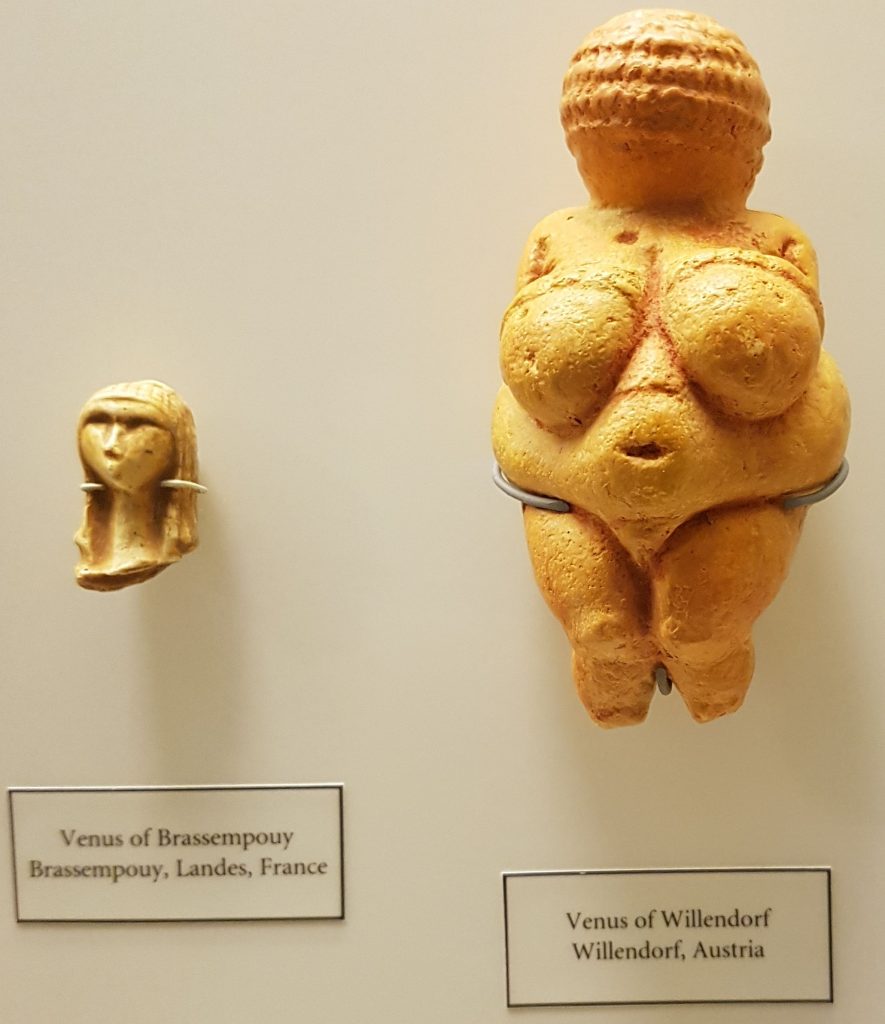
There was a theory widely held that the original Deities, dating before the spread of farming, were mother goddesses. The idea is that the hunter-gatherer goddesses (perhaps like the Venus of Willendorf) were overthrown by the coming of farmers. These patriarchal societies worshipped the male gods, which destroyed the ancient Matriarchy. Jane Ellen Harrison proposed an ancient matriarchal civilization. Robert Graves wrote some interesting, but no longer thought to be very scientific studies, on the idea. Neopaganism has taken these ideas forward.
1451 Glasgow University was founded (and you wonder why the Scots made such an impact on the world.)
1789 The USA held its first national presidential election. (Long may that fine democratic tradition survive and prosper!)
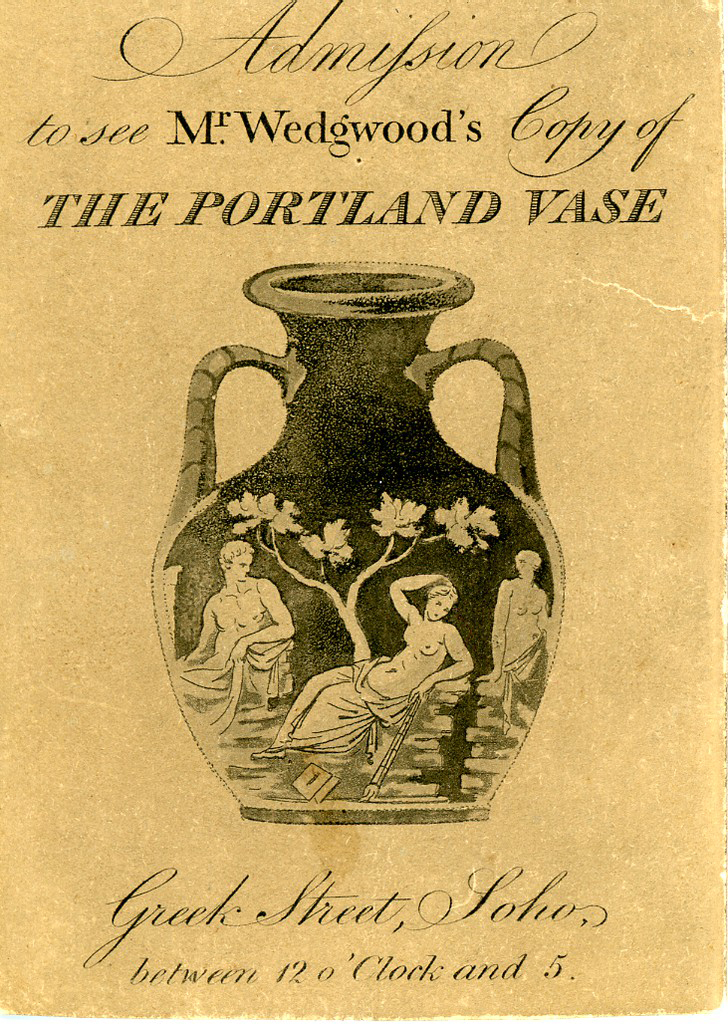
1845. Today is the anniversary of the breaking of the fabulous Portland Vase by a drunken visitor to the British Museum. It looks immaculate despite being smashed into myriad pieces, a wonder of the conservator’s art. To see the vase and read its story, go to the BM web site here:
Today in the orthodox church, дед Мороз (Ded Moroz= father of frost), accompanied by Cнегурочка (Snieguroshka= fairy of the snow) brings gifts on New Year’s Eve, (which is on January 7th). He travels with a horse-drawn troika.
On the twelfth day of Christmas My true love gave to me Twelve drummers drumming, Eleven pipers piping, Ten lords a-leaping, Nine ladies dancing, Eight maids a-milking, Seven swans a-swimming, Six geese a-laying, Five golden rings, Four calling birds, Three French hens, Two turtle-doves And a partridge in a pear tree.
Twelfth Night
In 1775, William Snooke recorded in his diary, that he sat down to a fine dinner with:
‘Mr and Mrs William Clifford and their seven children (and maid), John Fox Snr. and Sally Twining, Mr and Mrs William Fox, and William Weale.’ To feed this crowd took “Ham, Greens, 3 fowls roasted, Soup, Leg of Mutton, potatoes, Boiled rump of beef (large)”
Dessert included pudding, mince pies and a forequarter of home lamb. For supper, the assembled party consumed tarts, stuffed beef, mince pies, cold mutton, oysters, cold sliced beef, cold lamb, apple pies and pears.
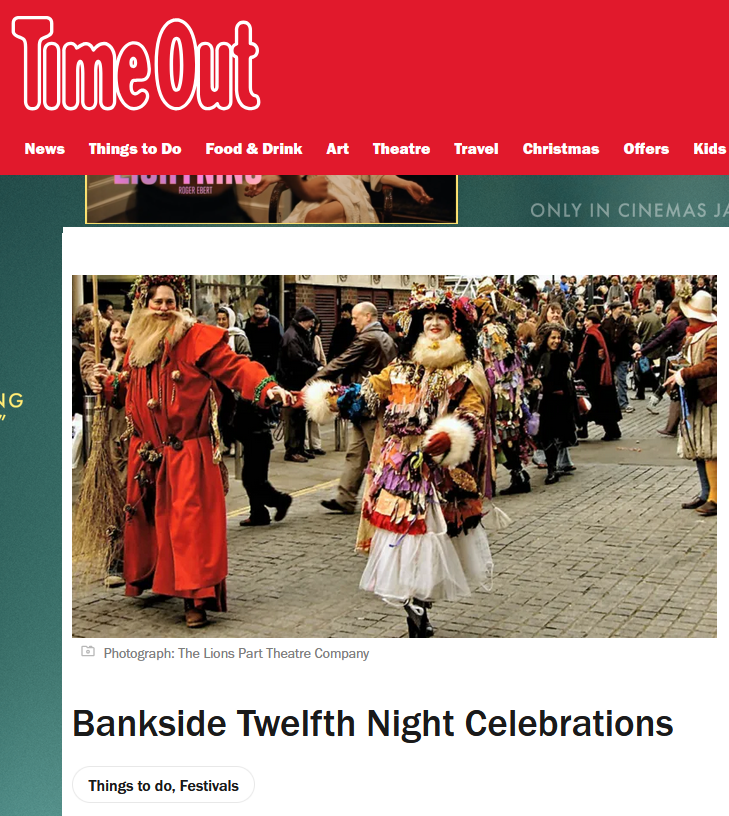
A recent ‘tradition’ for a Tweltfh Night procession has been established on the south side of the River Thames in London. The Lions Part Company begin their entertainments at the rebuilt Globe. The parade has all the traditional mummers characters, including the Green Man, and the Holly Man. They perform the Combat Play of St George. This involves the Old ‘Oss (which is the centre point of the May Day festivities at Padstow in Cornwall. They also have Twelth Night Cakes containing a bean and a pea. These are used to crown the King and Queen of the Day.
Photo of Twelfth Night Celebrations in Southwark, London on the South Bank
I’ve posted about this before but just to make sure those who find themselves on this page understand the issue:
Many people start their count of the Twelve Days of Christmas on the 25th December. But some folklore sources going back in time count from Boxing Day. For example, Gervase Markham’s ‘The English Husbandman of 1635 counts it from Boxing Day.
The Daily Express reveals that the Protestants count from Christmas Day and the Catholics from Boxing Day. That maybe it, but I wonder if the confusion more complicated than that? The religious festival really makes sense if it begins with Christmas Day, and ends with the Epiphany. This is the day the Three Kings from the Orient come to worship Jesus. But Epiphany is on the 6th January, which is 13 days from Christmas. 13 days of Christmas would be ill-omened. So two solutions: make the end of the Twelve Days the Eve of Epiphany, i.e. the 5th, or start the 12 days from Boxing Day.
I suspect there is a fudge going on here. Twelve is the magic number, twelve Apostles, 12 months in the year, so twelve Days of Christmas. But clearly, for Christians it stretches from Christmas Day to Epiphany. Two ways to square that 13 day difference. One is to begin the twelve days on Boxing Day. The other is to end with a Twelfth Night party on the Eve of Epiphany. Have a look at Notes&Queries for different viewpoints.
Time to take your decorations down- January 5th or Candlemas
However, we currently all seem to agree that January 5th is the day to take down your Christmas decorations. If you fail to do it now, you have to keep them until Candlemas, which is at the begining of February. See my Candlemas post to see the official end of Christmas.
Toss your unwanted Christmas Tree on the Pavement Day
In London, today and yesterday have seen people throw out their unwanted Christmas Streets out on the street, for someone else to pick up and throw away. This became a thing a few years ago not. But, no, people you are supposed to take them to a Recycling Centre, or arrange to have them picked up. Not just throw them on the street.
1753 People gathered around the Holy Thorn in Glastonbury. The Thorn normally blossomed on Christmas Day, but the Gregorian Calendar had been introduced the year before. Christmas Day was now 11 days earlier. on December 25th, it did not blossom. On the 5th, it blossomed, proving that the new Christmas Day was a fraud, From then on January 5th was called Christmas Day Old Style. Other festivals, and events thereafter kept their traditional slot in the year, by changing the date to the Old Style, and ignored the New Style.
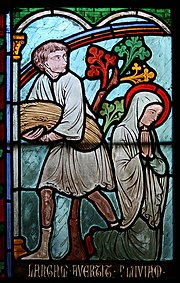
Saint Geneviève praying for the end of the rain. 19th Century by Alfred Gérente Notre-Dame de Paris.
St Genevieve of Nanterre (c. 419/422 AD – 502/512 AD) has her feast day today. Nanterre is an ancient settlement swallowed up by modern Paris. Genevieve was a most remarkable woman who met St Germanus of Auxerre on his way to Britain. She was only 7 when she met Germanus. He encouraged her piety. She became a consecrated virgin (someone who made vows of chastity to be a ‘bride of Christ’). Thereby living an aesthetic life of fasting and prayer. Hence, miracles soon became associated with her, (including changing the weather) and the ‘usual’ medical miracles. After moving to Paris, she encouraged the women of the City to stay in the City for prayer and fasting to prevent the Huns capturing the City in 451. Attila and the Huns abandoned the siege.
St Genevieve saved the City on other occasions too, helped build two large Church projects, including St Dennis. She intervened fearlessly in public affairs, and was a brave and resolute woman who challenged the male hierarchy with some success. And what makes me like her even more was that she is not a martyred teenager Saint tortured to death to gain her sainthood. But she did great works and lived to old age of 82 still ‘full of virtue’. In the medieval period, she became the Patron Saint of Paris. She is patron to: Paris, shepherds, winemakers, wax-chandlers, hatmakers; against eye complaints, fever, plagues, drought, and war.
St Germanus
St Germanus played a significant role in Genevieve’s life, protecting her from slander and attack. He is one of the most significant figures in post Roman studies in Britain. Accounts of his visits to Britain in the early 5th Century are among the very few descriptions of post-Roman life. He was sent to Britain to counter the Pelagian Heresy, which was endangering the Catholic version of Christianity.
Incidentally, Nanterre has an interesting prehistory. The name in Celtic means ‘enduring sacred site’. A large cemetery has been found, which helps support the possibility that it is the original site of Paris. Julius Caesar attended an assembly with local Gallic leaders in the area. The topography of Nanterre fits as well for the location of the assembly as the island in the Seine (Île de la Cité) which is an alternative location.
In Their Own Words
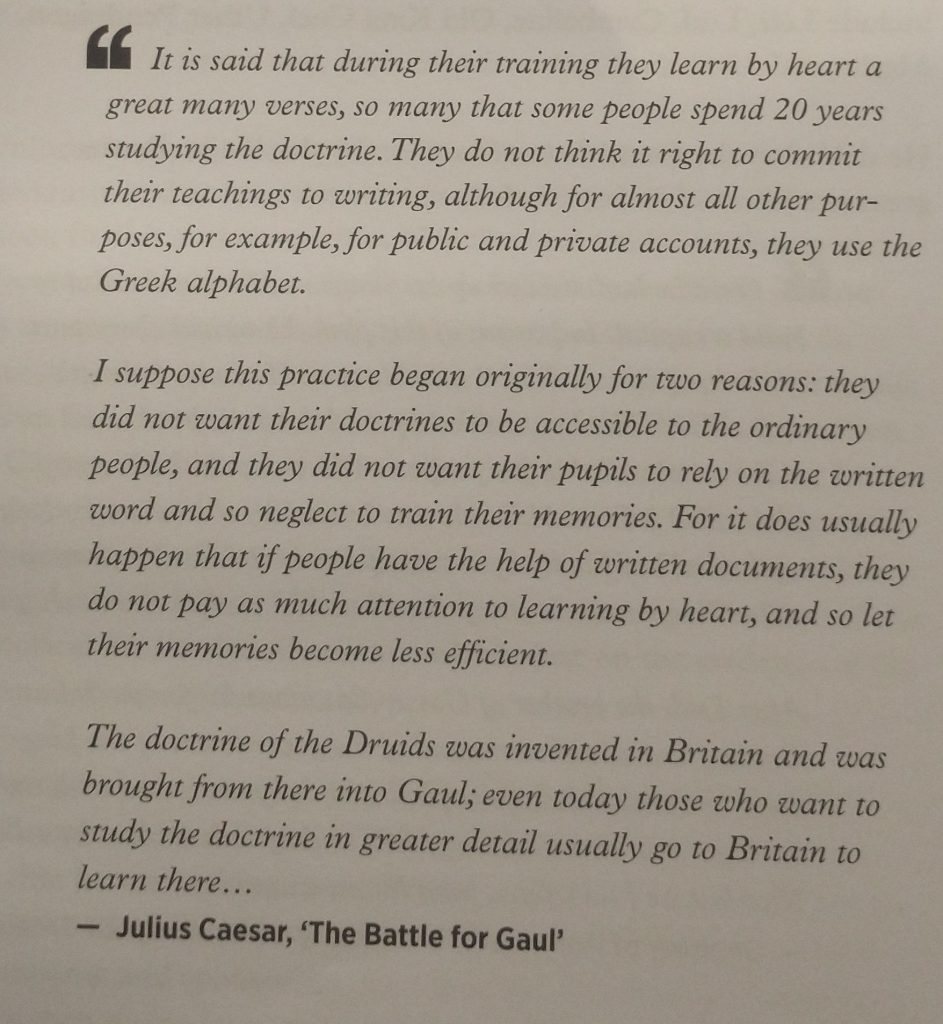
This is an excerpt from Julius’s Caesar book concerned with training druids. (It is photographed from my book ‘In Their Own Words- details below).
‘In Their Own Words – A Literary Companion To The Origins Of London‘ by Kevin Flude
It brings together contemporary quotations about the Prehistoric, Roman and Dark Ages with a commentary by the author. It’s an enjoyable read! To buy the Kindle (£2.40) or a paperback version (£5.99), click here.
If you have read it, please go here and write a review! It is sadly devoid of any!
On This Day
1521 Martin Luther excommunicated by Pope Leo X. (our present Pope is the XIV)
1661 Samuel Pepys saw the Beggar’s Bush at the Theatre in Gibbon’s Tennis Court, Vere Street, near Lincoln’s Inn Fields. He records it was ‘the first time that ever I saw women come upon the stage’. The Restoration of Charles II to the throne allowed, for the first time, women to appear on the professional stage.
1777 George Washington defeats Cornwallis at the Battle of Princeton
Today: keep bird feeders well stocked. Check houseplants for mealybugs, mites and other pests. (Gardeners’s Year The Metroplitan Museum of Art).
The Full Moon today falls in Cancer in a conjunction with Jupiter and an exact opposition to Mars and Venus. Thus, the mood of the times is divided between those supporters of individual liberties. And the Government’s right to control personal behaviours’. That, ast least is what Old Moore’s Almanack for 2026 says. And that’s probably enough Astrology for the year!
First written in January 2023, revised and republished January 2024, 2025, 2026
London. 1066 and All That Walk 11.30am Sun 8th March 2026 To book Tudor London – The City of Wolf Hall 2.30 8th March 2026 Barbican Underground Station To book The Spring Equinox London Virtual Tour 7.30pm Fri 20th March26 To book The Decline And Fall Of Roman London Walk 11.30 Sat 21st March26 To book The London Equinox and Solstice Walk 2:30pm Sat 21st March26 To book Roman London – Literary & Archaeology Walk 11.15pm Sun April 5th 2026 To book Samuel Pepys’ London – Bloody, Flaming, Poxy London 2:15pm Sun 5th April 26 To book Chaucer’s Medieval London Guided Walk 11.00am Sat 18th April 2026 To book Chaucer’s London To Canterbury Virtual Pilgrimage 7.45pm Sat 18th April 26 To book Jane Austen’s London Walk 11.00am Sun 19th April 26 To book Myths, Legends, Archaeology, and the Origins of London 11:15am Sat 2nd May 26 to Book London Bridge to Bermondsey Sat 2nd May 2026 To book
For a complete list of my guided walks for London Walks in 2025 look here
Thursday 1st January 2026 7.30pm . On this Virtual Walk we look at how London has celebrated the New Year over the past 2000 years.
The New Year has been a time of renewal and anticipation of the future from time immemorial. The Ancient Britons saw the Solstice as a symbol of a promise of renewal as the Sun was reborn. As the weather turns to bleak mid-winter, a festival or reflection and renewal cheers everyone up. This idea of renewal was followed by the Romans, and presided over by a two headed God called Janus. Janus looked both backwards and forwards. Dickens Christmas Carol was based on redemption. His second great Christmas Book ‘The Chimes’ on the renewal that the New Year encouraged.
We look at London’s past to see where and how the New Year was celebrated. Why did different societies have different New Years we use? How were their calendars arranged – the Pagan year, the Christian year, the Roman year, the Jewish year, the Financial year, the Academic year. We look at folk traditions and New Year London customs. Medieval Christmas Festivals, Boy Bishops, Lords of Misrule, Distaff Sunday and Plough Monday, and other Winter Festivals
At the end, we use ancient methods to divine what is in store for us in 2026..
The virtual walk finds interesting and historic places in the City of London to link to our stories of Past New Year’s Days. We begin, virtually, at Barbican Underground. Continue to the Museum of London, the Roman Fort; Noble Street, Goldsmiths Hall, Foster Lane, St Pauls, Doctors Commons, St. Nicholas Colechurch and on towards the River Thames.
On the seventh day of Christmas My true love sent to me: 7 Swans a Swimming; 6 Geese a Laying; 5 Golden Rings; 4 Calling Birds; 3 French Hens; 2 Turtle Doves and a Partridge in a Pear Tree
First Footing on New Year’s Eve
The first person to set foot into your house needs to be a ‘Tall, well-made man’. Dark-haired men are preferred to fair-haired, but he must not be dressed in black, nor be from the ‘professions’ (those people who can counter-sign your passport). He must not carry a knife, but he must bring gifts, particularly a loaf of bread, a bottle of whisky, a piece of coal or wood, and a silver coin. Silence is to welcome him to the house until he puts the coal on the fire, pours a glass of the whisky and greets the family.
He will bring in the luck through the front door on the stroke of midnight; the bread symbolising that you will be well-fed, the fuel that you will be warm and safe, the whisky that you will have fun and the coin will bring prosperity. Your first-footer will take the old year and its bad-luck out of the back door when he leaves.
An Irish tradition is that you should open your front door at Midnight to let the old year out and the New Year in. Perhaps, open the back door to let the old year out and the front door to let the New Year in.
Burn the Calendar First wind in nine Times round with red Wool and thread
Cast into the flames And say:
Burn, burn, burn Old Day Book, Burn! Old year’s troubles Never Return Ka!
Clean the house And do the first footing With silver, bread and a piece of coal or charchoal
Old Rhyme
Hogmanay – Holy Month or New Morning
Is the Scottish name for New Year’s Eve. There is no certain explanation of the word. But it has been suggested it comes from the Ancient Greek for Holy Month (or from the Anglo-Saxon for Holy Month). Or the Gaelic word for Oat Cakes or from the Middle French word for mistletoe (aguillanneuf = meaning “to the mistletoe be the new year”). Perhaps, it is named from the great giant Gogmagog. Or from Norse, or Scots. or any number of other possibilities. See Wikipedia for more guesses.
Hogmanay was celebrated all the way down to Richmond in North Yorkshire. (Remember that Northumbria used to control North Britain up to and including Edinburgh, and sometimes into Fife. ) The vividness of the Scottish Celebration, may simply stem from the Scottish temperament. But it is often proposed that it stems from a Presbyterian tradition in Lowland Scotland, which disapproved of the superstition that was Christmas. So all that Christmas Joy was transferred to the New Year Celebrations.
Wassail in the Orchard
On New Year’s Eve, wassailers went to the oldest tree in the apple orchard. There they poured a liberal dose of wassail over the roots of the tree. Then they pulled down the branches to dip the end of the branches in the punch. They decorated the tree, and then drank the cider based wassail themselves.
We wish you a merry Christmas, a Happy New Year A pocket full of money, and a cellar full of beer A good fat pig to last you all the year Please to give us a New Year’s Gift. (Radnorshire song)
For more on Wassail, see the bottom half of my post here.
New Year Weather Prophecy
The weather today will be reflected on the 7th month, according to Gervase Markham. First Day of the 12 Days of Christmas prefigures the weather in January and the 12th Day that in the following December. So we are going to have a cool, sunny winter, and a sunny June, July, August, by the looks of the weather forecast.
Or as a Scottish Rhyme has it (quoted in the Perpetual Almanac)
If New Year’s Eve night-wind blow south That betokens warmth and growth If west, much milk, and fish in the sea If North, much cold and storms will be If east, the tress will bear much fruit. If north-east, flee it, man and brute,
The wind is currently varying between West and West North West. So it would seem we are in for a year of much milk and fish in the sea, with the occasional cold storm? .
New Year Reflections
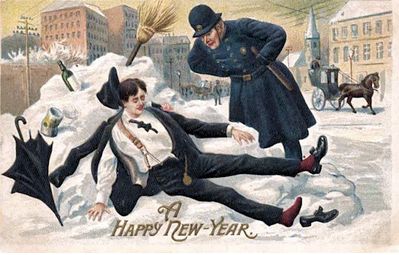
Victorian New Year’s Card
This is a day of preparation, and perhaps of anxiety. Have we got an invitation from anyone tonight? Is anyone going to come to our party? Can I take another blow-out feast, a belly full of alcohol and a very late night? I’ve just lost my Christmas weight, and you want me to come for a big feast?
My first memories of New Year’s Eve were spent with the parents watching some inexplicable variety show hosted in Scotland. Google has helped me remember that it was the ‘White Heather Club’ hosted by Andy Stewart. Up to 10 million people watched this between 1960 and 1968. I never understood the pleasure of it. To my rebellious teenage soul, it seemed a symbol of an old-fashioned world that was passing and irrelevant.
More recently, if not spent at a party, New Year’s Eve is often spent with Jools’ Annual Hootenanny, which is a music show masquerading as a live New Year’s Eve party. It features really excellent bands and singers. It is, however, recorded earlier in December (15th, 20th are dates I have seen) and hence a New Year’s fake. Here is a 2007 excerpt staring Madness’s ‘House of Fun’. The fun of this is to spot the stars grooving along to the music.
New Year’s Preparation
New Year’s Day needs a lot of preparation. Folklore suggests that this should include finishing off any unfinished work or projects, as a task carried forward is ill-omened. Your accounts for the year should be reconciled. As Charles Dickens suggests in the Chimes, his second Christmas Book, your moral account should also be addressed. So you can come into the New Year with a clean slate, good conscience and plans for a better new year. And don’t we all require that for 2025!
Monday 1st January 2025 7.00 pm On this Virtual Walk we look at how London has celebrated the New Year over the past 2000 years.
The New Year has been a time of review, renewal, and anticipation of the future from time immemorial. The Ancient Britons saw the Solstice as a symbol of a promise of renewal as the Sun was reborn. As the weather turns to bleak mid winter, a festival or reflection and renewal cheers everyone up. This idea of renewal was followed by the Romans, and presided over by a two headed God called Janus who looked both backwards and forwards. Dickens Christmas Carol was based on redemption and his second great Christmas Book ‘The Chimes’ on the renewal that the New Year encouraged.
We look at London’s past to see where and how the New Year was celebrated. We also explore the different New Years we use and their associated Calendars – the Pagan year, the Christian year, the Roman year, the Jewish year, the Financial year, the Academic year and we reveal how these began. We look at folk traditions, Medieval Christmas Festivals, Boy Bishops, Distaff Sunday and Plough Monday, and other Winter Festival and New Year London traditions and folklore.
At the end, we use ancient methods to divine what is in store for us in 2023.
The virtual walk finds interesting and historic places in the City of London to link to our stories of Past New Year’s Days. We begin, virtually, at the Barbican Underground and continue to the Museum of London, the Roman Fort; Noble Street, Goldsmiths Hall, Foster Lane, St Pauls, Doctors Commons, St. Nicholas Colechurch and on towards the River Thames.
The Civil War, Restoration and the Great Fire of London Virtual Tour
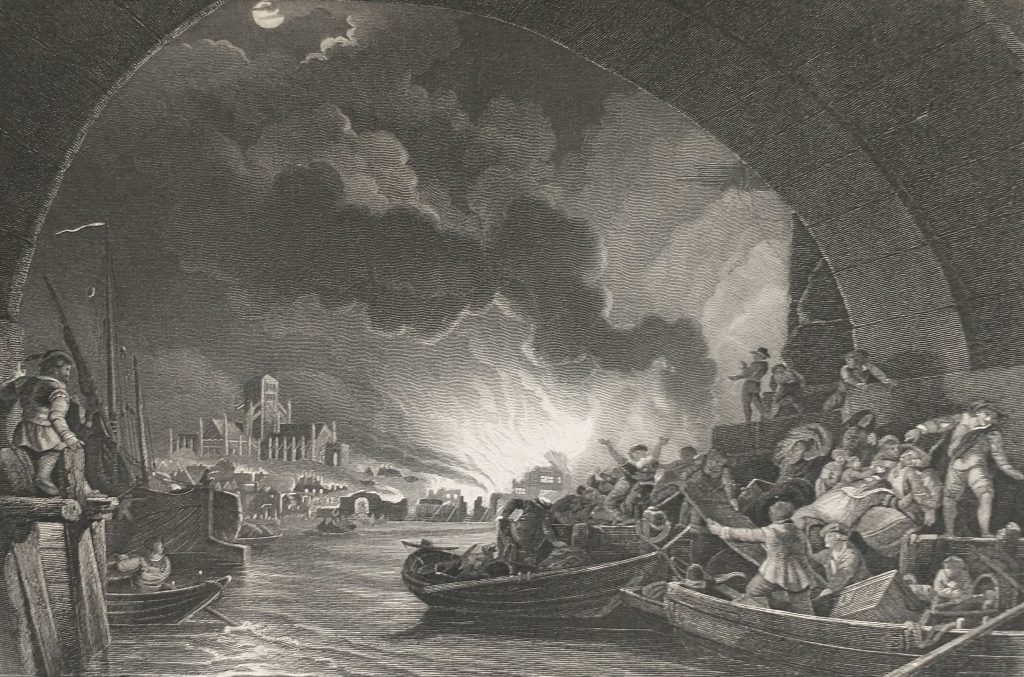
The Great Fire of London looking towards StPauls Cathedral from an old print
7:30pm Fri 30th January 2025
January 30th is the Anniversary of the execution of Charles I and to commemorate it we explore the events and the aftermath of the Civil War in London.
Along with the Norman Conquest of 1066 and winning the World Cup in 1966 the Great Fire in 1666 are the only dates the British can remember!
And we remember the Great Fire because it destroyed one of the great medieval Cities in an epic conflagration that shocked the world.
But it wasn’t just the Great Fire that made the 17th Century an epic period in English History. There was a Civil War, beheading of the King, a Republic, a peaceful Restoration of the Monarch, the last great plague outbreak in the UK, the Glorious Revolution and the Great Wind.
The Virtual Walk puts the Great Fire in the context of the time – Civil War, anti-catholicism, plague, and the commercial development of London. The walk brings to life 17th Century London. It starts with the events that lead up to the Civil War concentrating on Westminster and ends with a vivid recreation of the drama of the Fire as experienced by eye-witnesses. Route includes: Westminster, Fish Street Hill, Pudding Lane, Monument, Royal Exchange, Guildhall, Cheapside, St Pauls, Amen Corner, Newgate Street, Smithfield.
Roman London – Literary & Archaeology Walk
11.30 am Sun 9th Feb 2025 Monument Underground Station
also on 11.30am Sun 27th Apr 25 but starting from Moorgate
London Roman Riverside Wall o
This is a walking tour features the amazing archaeological discoveries of Roman London, and looks at life in the provincial Roman capital of Londinium.
This is a walking tour that features the amazing archaeological discoveries of Roman London, and looks at life in the provincial Roman capital of Londinium.
Our Guides will be Publius Ovidius Naso and Marcus Valerius Martialis who will be helped by Kevin Flude, former Museum of London Archaeologist, Museum Curator and Lecturer.
We disembark at the Roman Waterfront by the Roman Bridge, and then explore the lives of the citizens as we walk up to the site of the Roman Town Hall, and discuss Roman politics. We proceed through the streets of Roman London, with its vivid and cosmopolitan street life via the Temple of Mithras to finish with Bread and Circus at the Roman Amphitheatre.
Zinger Read: Talk about a high-quality one-two punch. This walk investigates the groundbreaking archaeological discoveries of Roman London. And then it reconstructs life in a provincial Roman capital using archaeological and literary sources. Discoveries – insights – like flashes of lightning in a cloud. We begin at the site of the Roman bridge. We might be decent young Roman citizens in togas, having this and that bit of explained to us as we make our way towards the Roman Town Hall. From there we head to the site of the excavation called ‘the Pompeii of the North.’ Followed by the Temple of Mithras. We finish with a walk along the Roman High Street in order to end at the site of the Roman Amphitheatre. So, yes, welcome to London as it was 2,000, 1,900, 1,800, 1,700 and 1,600 years ago. And, yes, the walk’s guided by a real expert, the distinguished emeritus Museum of London archaeologist Kevin Flude. That means you’ll see things other people don’t get to see, delve into London via fissures that aren’t visible, let alone accessible, to non-specialists.
REVIEWS “Kevin, I just wanted to drop you a quick email to thank you ever so much for your archaeological tours of London! I am so thrilled to have stumbled upon your tours! I look forward to them more than you can imagine! They’re the best 2 hours of my week! 🙂 Best, Sue
Jane Austen’s London Anniversary Guided Walk
2.30 pm Sunday 9th Feb 2025
Green Park underground station, Green Park exit, by the fountain To book
Also
9 February 2025
Sunday
2.30 pm
4.30 pm
8 March 2025
Saturday
2.30 pm
4.30 pm
6 April 2025
Sunday
11.30 am
1.30 pm
2025 is the 250th Anniversary of Jane Austen’s Birth in Steventon, Hampshire. We celebrate her fictional and real life visits to Mayfair, the centre of the London section of Sense & Sensibility and where Jane came to visit her brother
“It is a truth universally acknowledged, that a Jane Austen devotee in possession of the good fortune of a couple of free hours today must be in want of this walk.”
People associate Jane Austen and her characters with a rural setting. But London is central to both Jane Austen’s real life and her literary life. So, this tour will explore Jane’s connections with London and give the background to Sense and Sensibility, a good part of which is based in this very area. We begin with the place Jane’s coach would arrive from Hampshire, and then walk the streets haunted by Willougby; past shops visited by the Palmers, the Ferrars; visit the location of Jane Austen’s brother’s bank and see the publisher of Jane’s Books. The area around Old Bond Street was the home of the Regency elite and many buildings and a surprising number of the shops remain as they were in Jane Austen’s day.
Jane Austen’s ‘A Picture of London’ in 1809 Virtual Walk
With the help of a contemporary Guide Book, Jane Austen’s letters, and works we explore London in 1809.
‘The Picture of London for 1809 Being a CORRECT GUIDE to all the Curiosities, Amusements, Exhibitions, Public Establishments, and Remarkable Objects in and near London.’
This Guide Book to London might have been on Henry Austen’s shelf when his sister, Jane, came to visit him in London. But it enables us to tour the London that Jane Austen knew in some detail. We will look at the Curiosities as well as the shopping, residential, theatres areas as well as the Port, the Parks and the Palaces.
The guided walk is a thank you to Alix Gronau, who, having been to one of my lectures in 1994, wanted the book to come to me. I have had the book restored and am using it to explore London in 1809.
Jane Austen’s London Anniversary Walk
Jane Austen’s London Anniversary Walk 2.30 pm Sunday 9th February 25 To book
A Virtual Tour of Jane Austen’s Bath
7.30pm 10th February 2025
Tudor London – The City of Wolf Hall 11.30am Sat 22nd Feb 25
Myths, Legends, Archaeology and the Origins of London
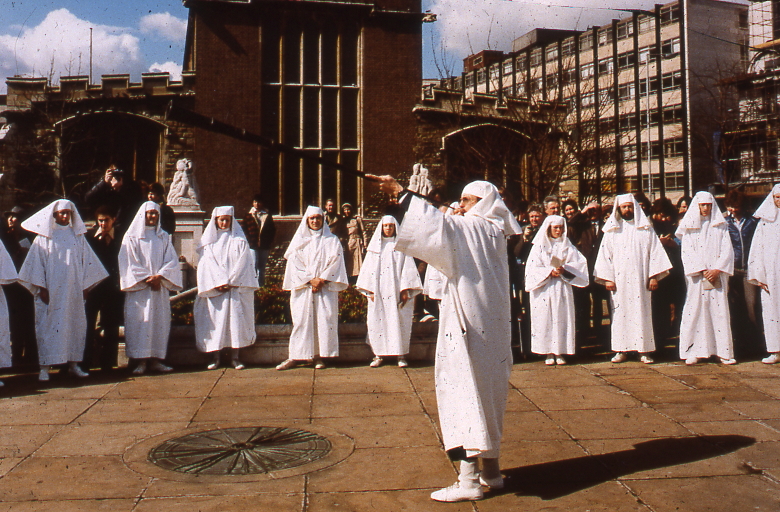
Druids at All Hallows, by the Tower
2.30pm Sat 22nd February 2025 Tower Hill Underground
The walk tells the stories of our changing ideas about the origins of London during the Prehistoric, Roman and Saxon periods.
The walk is led by Kevin Flude, a former archaeologist at the Museum of London, who has an interest both in myths, legends and London’s Archaeology.
The walk will tell the story of the legendary origins of London which record that it was founded in the Bronze Age by an exiled Trojan and was called New Troy, which became corrupted to Trinovantum. This name was recorded in the words of Julius Caesar; and, then, according to Legend, the town was renamed after King Ludd and called Lud’s Dun. Antiquarians and Archaeologists have taken centuries to demolish this idea, and became convinced London was founded by the Romans. Recently, dramatic evidence of a Bronze Age presence in London was found.
When the Roman system broke down in 410 AD, historical records were almost non-existent, until the Venerable Bede recorded the building of St Pauls Cathedral in 604 AD. The two hundred year gap, has another rich selection of legends. which the paucity of archaeological remains struggles to debunk.
The walk will explore these stories and compare the myths and legends with Archaeological discoveries.
The route starts at Tower Hill, then down to the River at Billingsgate, London Bridge, and into the centre of Roman London.
Roman London – Literary & Archaeology Walk 11.30am Sat Mar 8th 25 Jane Austen’s London Anniversary Walk 2.30pm Sat 8th Mar 25
The Decline And Fall Of Roman London Walk 11.30 Sat 22nd March 2025 London. 1066 and All That Walk Sat 2.30pm 22nd March 2025
Jane Austen’s London Anniversary Walk 11.30am Sun 6th Apr 25
Chaucer’s Medieval London Guided Walk 2:30pm Sun 6th Apr 25
and
Chaucer’s London To Canterbury Virtual Pilgrimage 7.30pm Friday 18th April 25 To book
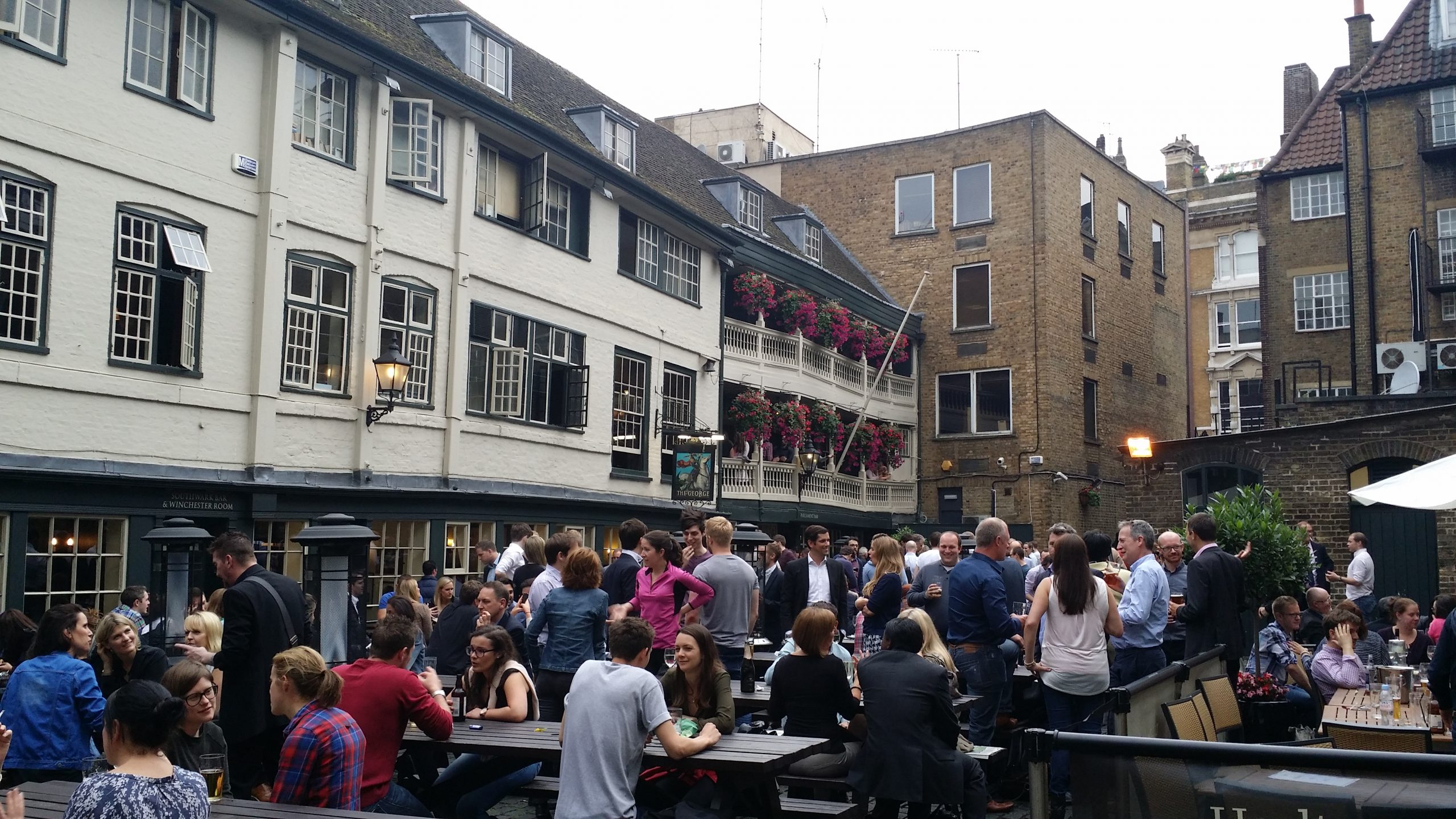
George Inn,Southwark
A Walk around Medieval London following in the footsteps of its resident medieval poet – Geoffrey Chaucer
One of the spectators at the Peasants Revolt was Geoffrey Chaucer, born in the Vintry area of London, who rose to be a diplomat, a Courtier and London’s Customs Officer. He lived with his wife in the Chamber above the Gate in the City Wall at Aldgate. His poetry shows a rugged, joyous medieval England including many scenes reflecting life in London. His stories document the ending of the feudal system, growing dissatisfaction with the corruption in the Church, and shows the robust independence with which the English led their lives.
His work helped change the fashion from poetry in French or Latin to acceptance of the English language as suitable literary language. This was helped by the growth of literacy in London as its Merchants and Guildsmen became increasingly successful. In 1422, for example, the Brewers decided to keep their records in English ‘as there are many of our craft who have the knowledge of reading and writing in the English idiom.’
Chaucer and other poets such as Langland give a vivid portrait of Medieval London which was dynamic, successful but also torn by crisis such as the Lollard challenge to Catholic hegemony, and the Peasants who revolted against oppression as the ruling classes struggled to resist the increased independence of the working people following the Black Death.
A walk which explores London in the Middle Ages, We begin at Aldgate, and follow Chaucer from his home to his place of work at the Customs House, and then to St Thomas Chapel on London Bridge, and across the River to where the Canterbury Tales start – at the Tabard Inn.
This is a London Walks event by Kevin Flude
Roman London – Literary & Archaeology Walk 11.30am Sun 27th Apr 25
Roman layer opus signinum,
Tudor London – The City of Wolf Hall 3:00pm Sun 27th Apr 25
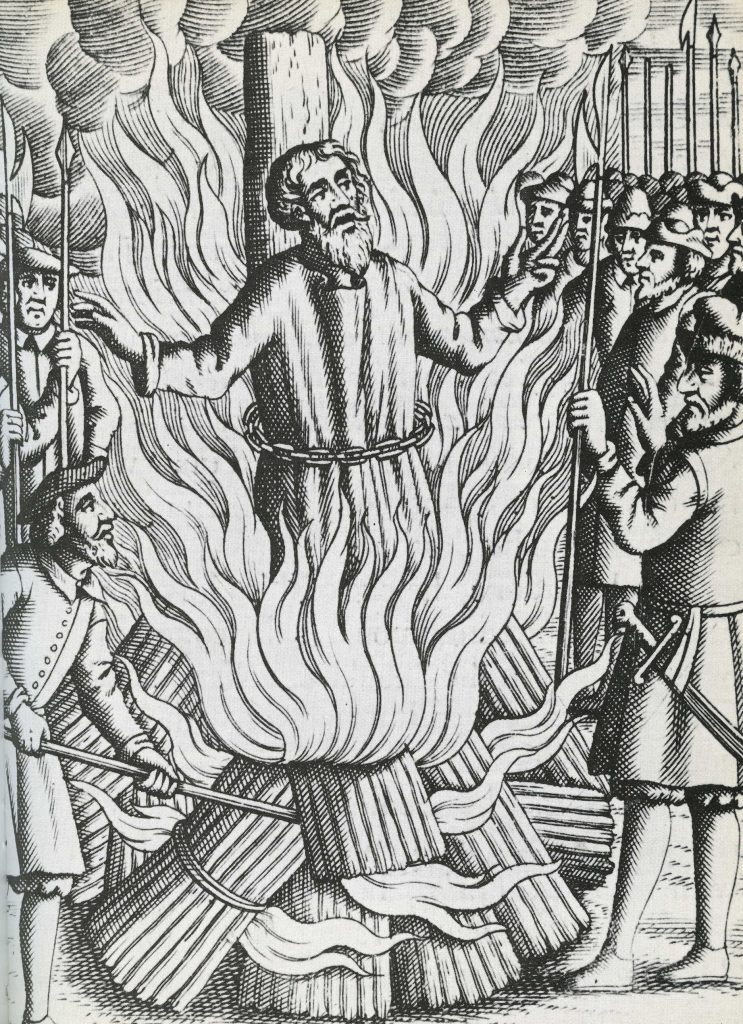
Thomas Bilney martyred in Smithfield.
The Walk creates a portrait of London in the early 16th Century, with particular emphasis on the life and times of Thomas Cromwell and Thomas More during the Anne Boleyn years.
More and Cromwell had much in common, both lawyers, commoners, who rose to be Lord Chancellor to Henry VIII, and ended their careers on the block at Tower Hill.
The walk starts with an exploration of Smithfield – site of the stake where heretics were burnt alive and of St Bartholomew’s Monastery – given to Richard Rich after his decisive role in the downfall of Thomas More. We continue to St Paul where Martin Luther’s books were burnt, and later, where Puritans preached against dancing round the Maypole.
We walk along the main markets streets of London, to Thomas More’s birthplace, and to the site of More’s and Cromwell’s townhouses before, if time allows, finishing at the site of the Scaffold where More and Cromwell met their ends, overlooking where Anne Boleyn was incarcerated in the Tower of London
To Book: https://www.walks.com/our-walks/tudor-london-the-city-of-wolf-hall/
A Boy From Haggerston before the War. 6pm 1st May 2025 Shoreditch Library.
Myths, Legends, Archaeology and the Origins of London 11.30am Sun 25th May 25 To book
The Decline And Fall Of Roman London Walk 3pm Sun May 25 To book
The Peasants Revolt Anniversary Guided Walk
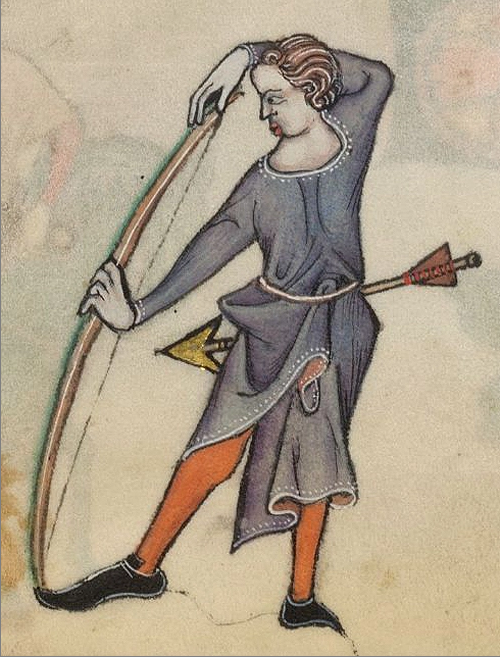
Medieval drawing of an archer
6.30pm Wed 11th June 2025 Aldgate Underground To book
An Anniversary Walk tracking the progress of the Peasants as they take control of London in June of 1381
Short read: The Summer of Blood
Long read: The Peasants’ Revolt. The greatest popular rising in English history. This is the anniversary walk. The London Walk that heads back to 1381, back to the Peasants’ Revolt. You want a metaphor, think stations of the cross. This is the stations of the Peasants’ Revolt walk. We go over the ground, literally and metaphorically. Where it took place. Why it took place. Why it took place at these places. What happened. The walk is guided by the distinguished Museum of London Archaeologist His expertise means you’ll see the invisible. And understand the inscrutable.
On the anniversary of the Peasants Revolt we reconstruct the events that shook the medieval world. In June 1381, following the introduction of the iniquitous Poll Tax, England’s government nearly fell, shaken to the core by a revolt led by working men. This dramatic tour follows the events of the Revolt as the Peasants move through London in June 1381.
We met up with the Peasants at Aldgate, force our way into the City. We march on the Tower of London as the King makes concessions by ending serfdom, at Mile End. But the leaders take the mighty Tower of London and behead the leaders of Richard’s government. Attacks follow on the lawyers in the Temple, the Prior at St. John’s of Jerusalem, Flemish Londoners, and on Lambeth and Savoy Palaces.
The climax of the Revolt comes at Smithfield where a small Royal party confront the 30,000 peasants.
Tudor London – The City of Wolf Hall 11.30am 13th July 2025 To Book Jane Austen’s London Anniversary Walk 3pm Sunday 13th July 25 To book Roman London – Literary & Archaeology Walk 11.30 am Sat 2nd Aug 2025 ToBook Chaucer’s Medieval London Guided Walk 2:30pm Sat 2nd Aug 2025 To Book Myths, Legends, Archaeology and the Origins of London 11.00am Sat 16th Aug25 to Book Roman London – Literary & Archaeology Walk 6:30pm Wed 24th Sept 2025 To book The Archaeology of London Walk 6.30pm Fri 3rd October 2025 To Book Chaucer’s Medieval London Guided Walk 11:30pm Sat 4th Oct 25 To book The Decline And Fall Of Roman London Walk 11.30pm Sat 8th Nov 25 To book Jane Austen’s London Anniversary Walk 2.00pm Sat 23rd Nov25 To book Rebirth of Saxon London 23rd Nov 25 Roman London – Literary & Archaeology Walk sat 11am 6th Dec 2025 To book Cromwell’s and More’s Tudor London Walk 2pm 7th Dec25 To book Jane Austen’s London Anniversary Walk 2.30pm Sun 14 Dec25 To book Christmas With Jane Austen Virtual London Tour 7.30pmTues 16 Dec25 To book The London Equinox and Solstice Walk 11:30pm Sun 21st Dec 25To book The London Winter Solstice Virtual Tour 7.30pm Sun 21 Dec 25 To book
Previous Years Archives
Here are previous archive of guided walks and events
John Stow reports on the Lord of Misrule. Memorial in St Andrew’s Church
On the sixth day of Christmas
My true love sent to me 6 Geese a Laying; 5 Golden Rings. 4 Calling Birds; 3 French Hens; 2 Turtle Doves and a Partridge in a Pear Tree
The Lord of Misrule, Masters of the Revels, and Boy Bishops
The Roman festival of Saturnalia reversed the rules so that slaves, ruled and masters served. It was held between 7th and 23rd of December. It also included giving gifts. In the medieval period, the disorders of Saturnalia was continued. Monarchs, Lords and Gentlemen, City Institutions elected Lords of Misrule, Masters of the Revels, and Boy Bishops. John Stow was London’s first great historian. In his Survey of London, he wrote of the Lords of Misrule in London. They were chooses at Halloween and continued until Candlemas, in early February. See my post here for more details on Candlemas.
From John Stow’s Survey of London
This is what Stow says:
Now for sports and pastimes yearly used.
First, in the feast of Christmas, there was in the king’s house, wheresoever he was lodged, a lord of misrule, or master of merry disports, and the like had ye in the house of every nobleman of honour or good worship, were he spiritual or temporal. Amongst the which the mayor of London, and either of the sheriffs, had their several lords of misrule, ever contending, without quarrel or offence, who should make the rarest pastimes to delight the beholders.
These lords beginning their rule on Alhollon eve, continued the same till the morrow after the Feast of the Purification, commonly called Candlemas day. In all which space there were fine and subtle disguisings, masks, and mummeries, with playing at cards for counters, nails, and points, in every house, more for pastime than for gain.
Against the feast of Christmas every man’s house, as also the parish churches, were decked with holm, ivy, bays, and whatsoever the season of the year afforded to be green. The conduits and standards in the streets were likewise garnished; (…) , at the Leaden hall in Cornhill, a standard of tree being set up in midst of the pavement, fast in the ground, nailed full of holm and ivy, for disport of Christmas to the people…
Holm is an evergreen oak. Its Latin name is Quercus ilex. The Tree in Leadenhall Street was also used as the Maypole. And he tells us it was destroyed in the great wind of 1444. You can read all about that here. You might also like to see my posts. These include information about John Stoww and midsummer celebrations and Boy Bishops, and l Stow’s Memorial.