St Gregory.  Punster Extraordinary March 12th

St Gregory and the Angles

Gregorius I is known as Saint Gregory the Great. Pope from 3 September 590 to his death on 12th March 604. So 12th March is traditionally his feast day. It was changed to September 3rd, the date of his elevation to Pope because 12th March was often in Lent.

His is the 2nd most popular name for Popes. This is the top 18. I guess St Peter was too hard an act to follow, but then there are only 6 Pauls? I can’t help feeling there should be six Sixtus’s?

  • John (23),
  • Gregory (16),
  • Benedict (16),
  • Clement (14),
  • Leo (13),
  • Innocent (12),
  • Pius (12),
  • Stephen (9),
  • Urban (8),
  • Alexander (7),
  • Adrian (6),
  • Paul (6),
  • Sixtus (5),
  • Martin (5),
  • Nicholas (5),
  • Celestine (5),
  • Anastasius (4),
  • Honorius (4).
  • Source: https://conclaveblog.wordpress.com

St Gregory the Great

St Gregory is the patron saint of musicians, singers, students, and teachers. It is traditionally believed he instituted the form of plainsong known as Gregorian Chant. However, he was also a formidable organiser and reformer. He made changes that helped the Catholic tradition survive Arian and Donatist challenges. To read more about the Arian Heresy look at my post on St. Hilary and the Arians. (St Gregory and the Angles – why do these all sound like 80’s post punk bands?)

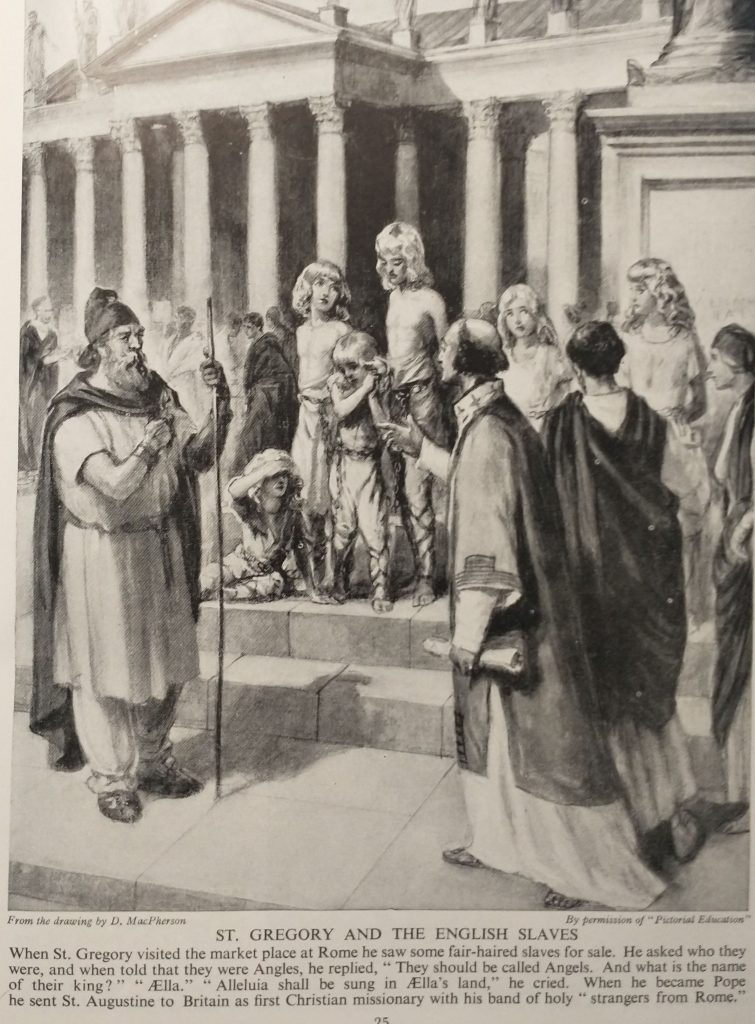
In the UK, St Gregory is venerated with St Augustine for bringing Christianity to the largely pagan Anglo-Saxons. The caption to the illustration above tells the story of how he came to send a mission to the pagan Angles in Briton. It includes his two most famous puns, riffing on the similarity of the words Angles/Angels and Aella/Alleluia. But in between these two he also punned on the name of Aella’s kingdom. This was called Deira which later joined with Bernicia to become the Kingdom of Northumbria. St Gregory said he would save them from the wroth of God which is ‘de ira’ in Latin. The ire of God. Deira. No? Not hitting your funny bone?

St Augustine’s Mission

In 597AD St Gregory sent St Augustine to Canterbury. His mission to convert the Germanic peoples of the former Roman Province of Britannia. Canterbury was chosen because its King was the ‘Bretwalda’ of Britain. And he, was married to Bertha, a French Princess who was already a Christian. The enigmatic title of Bretwalda was given to Britain’s most powerful King. At the time, it was Ethelbert of Kent. So, it was a relatively safe haven for St Augustine’s mission. The King was baptised, shortly, after in Canterbury.
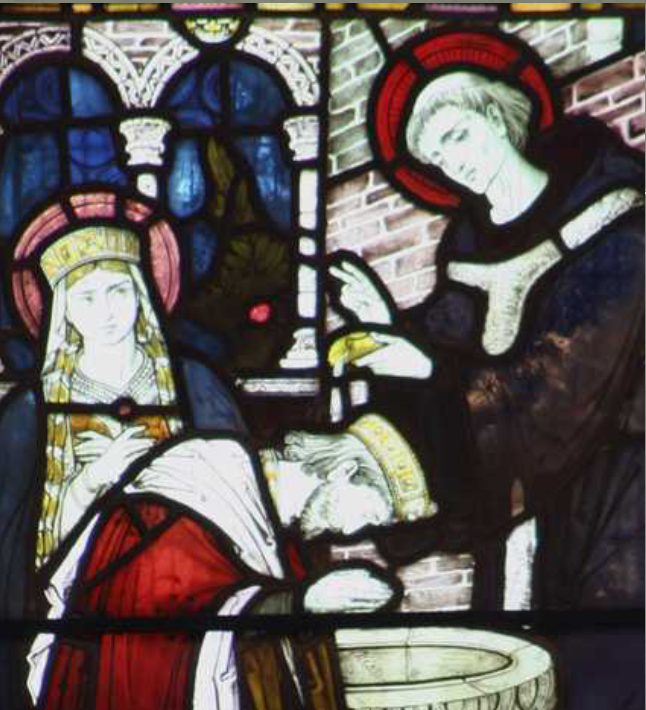
Stained glass window showing Baptism of King Ethelbert of Kent by St Augustine watched by Queen Bertha. In St Martins Church, Canterbury
Stained glass window showing the Baptism of King Ethelbert of Kent by St Augustine watched by Queen Bertha. In St Martins Church, Canterbury

Archbishop of London?

The mission came with a plan to recreate the ecclesiastical arrangements set up in the Roman period. From the early 4th Century there were archbishops in the two main capitals at London and York. (We know because they attended the Synod of Arles in 314). After Kent was converted, St Augustine sent St Mellitus to London. London was part of the Kingdom of Essex, ruled by St Ethelbert’s nephew, Sæberht. Mellitus was the first Anglo-Saxon bishop of London and he established St Pauls Cathedral in 604. St Paulinus was sent to convert Northumbria and established a Cathedral in York.

Unfortunately, for the plan, Sæberht died. His sons returned to paganism and Mellitus was kicked out. He returned to Canterbury, where he, eventually, became Archbishop. Ever since we have had an Archbishop of Canterbury and York and never had an Archbishop of London.

Photo of St Martin's Church - where the Church of England began. showing Roman tiles in the wall.
St Martin’s Church, Canterbury – where the Church of England began. Note the Roman tiles in the wall.

St Gregory and England

It is possible to argue (and I do) that St Gregory’s encounter with the Angles is why we are called English, not Saxons, nor Wessexians. Gregory sent Augustine to set up the Church of the Angles, not the Church of the Saxons. Saxon was the normal name used by the Romans for Germanic barbarians. The old Roman province of Brittania was by now divided into 3 Saxon Kingdoms. Essex, Wessex, and Sussex. (East, West, and South Saxons). 3 Anglian Kingdom, Mercia, East Anglia and Northumbria. (Middle, East and North Angles). And Kent, which the Venerable Bede says was a Jutish King of Germans from Jutland. These Kingdoms were often at war., sometimes allied, or subjected.

The Vikings then conquered most of these Kingdoms, except parts of Wessex and Mercia. After the attacks of the Vikings were beaten back, Alfred and his son, daughter and grandson reconquered or ‘liberated’ the ex-Viking areas. Alfred renamed the united kingdoms of Wessex and Mercia, the Kingdom of the Anglo-saxons. Athelstan his son liberated Northumbria and other areas, and in joining it to the Kingdom of the Anglo-Saxons renamed it Angeland or England.

The Church of England had made the term Anglish/English became a unifying term to unite Angles, Saxons and Jutes. Otherwise, the ‘liberated’ Angles and Jutes would have to swallow being part of Greater Wessex, rubbing in their loss of independence. Of course, it was all a bit more complicated, but it gives a summary of the formation of England, which was created by the end of the 10th Century.

St Gregory in Amsterdam

On a visit to Amsterdam and the Rijksmuseum I came across this painting which features Pope Gregory the Great. He is in the left hand part of the Triptych, shown in green kneeling at the altar. It shows Utrecht in the background.
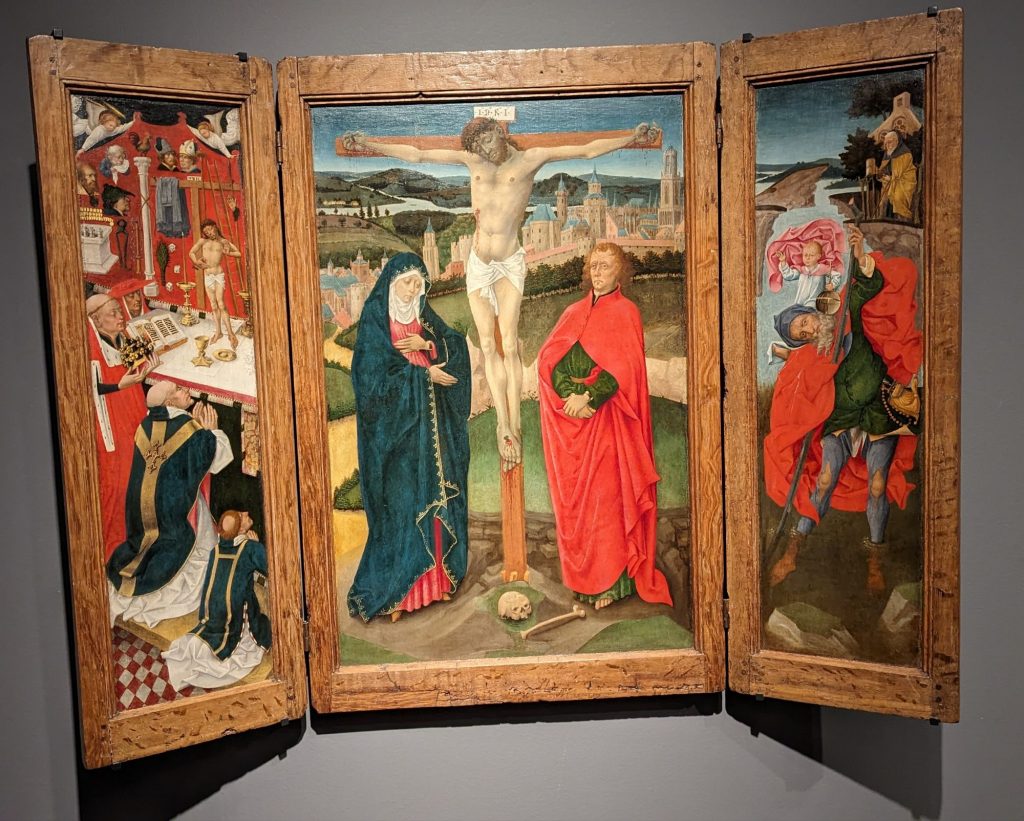
Triptych of the Crucifixion.  Showing the vision of the Crucifixion that St Gregory had while celebrating Mass (left). Crucifixion centre.  St Christopher (right)

What is fascinating is all the paraphernalia of the Crucifixion above Gregory’s head.  You’ll see 30 pieces of silver, dice to decide who gets Jesus’  robes, flails and torture devices, sponge and spear etc. Close up below.
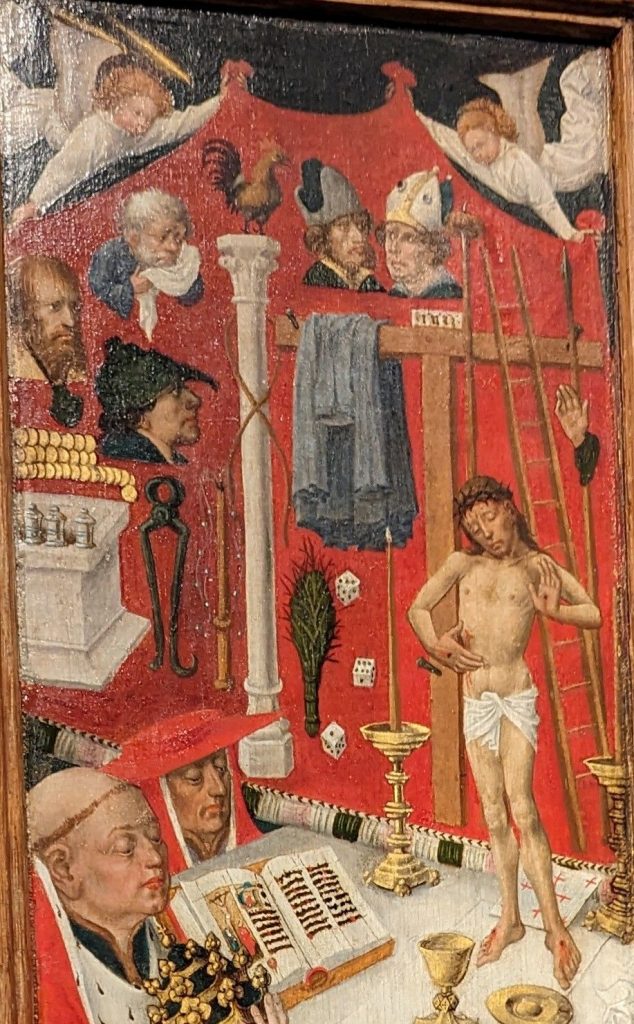
Detail Triptych of the Crucifixion. 

For King Ethelbert’s Feast Day see my post: st-wapburga-and-st-ethelbert-of-kents-day

On This Day

Lazy Day in Anglo-Saxon Times. In the Laws of King Alfred the Great, this day was a day off for freemen.  For more on Days off in the Anglo Saxon Calender see my post on August 15th.

1689 – Catholic King James II landed at Kinsale, County Cork, Ireland, in an attempt to regain the Kingdom from his daughter and son-in-law, William and Mary. James had fled to the continent following riots against his rule. William defeated James II at the Battle of the Boyne. James II returned to France never to return. Mary ruled jointly with her husband until she died of Smallpox, and he ruled alone until he fell off his horse.

1930 – Mahatma Gandhi begins the Salt March, a 200-mile march to protest the British monopoly on salt in India. One of the defining moments in non-violent civil disobedience. Offering the world a possible alternative to violent revolution, or military regime change.

1999 – Former Warsaw Pact countries, Czech Republic, Hungary and Poland join NATO. Bulgaria, Estonia, Latvia, Lithuania, Romania, Slovenia and Slovakia joined in March 2004; Croatia and Albania joined on 1 April 2009. Montenegro 2017. North Macedonia. 2020: (Ukraine) can forget about (NATO membership). That’s probably the reason the whole thing (war) started,” said U.S. President Donald Trump on February 26, 2026

First published in 2024, republished in 2025. On This Day added 2026
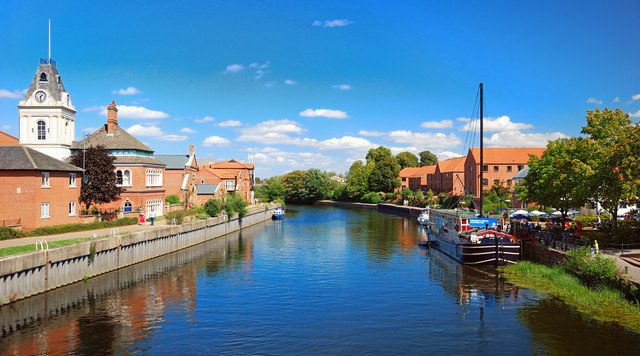
Newark & the Penny Loaf Day March 11th

River Trent from Trent Bridge, Newark on Trent by Peter Tarleton WIKIPEDIA -CC BY-SA 2.0
Newark on Trent by Peter Tarleton Wikipedia CC BY-SA 2.0 Newark & the Penny Loaf Day

This post is about Newark & the Penny Loaf, but as it is still Women’s Week, I’d like to share with you a discovery I have just made:

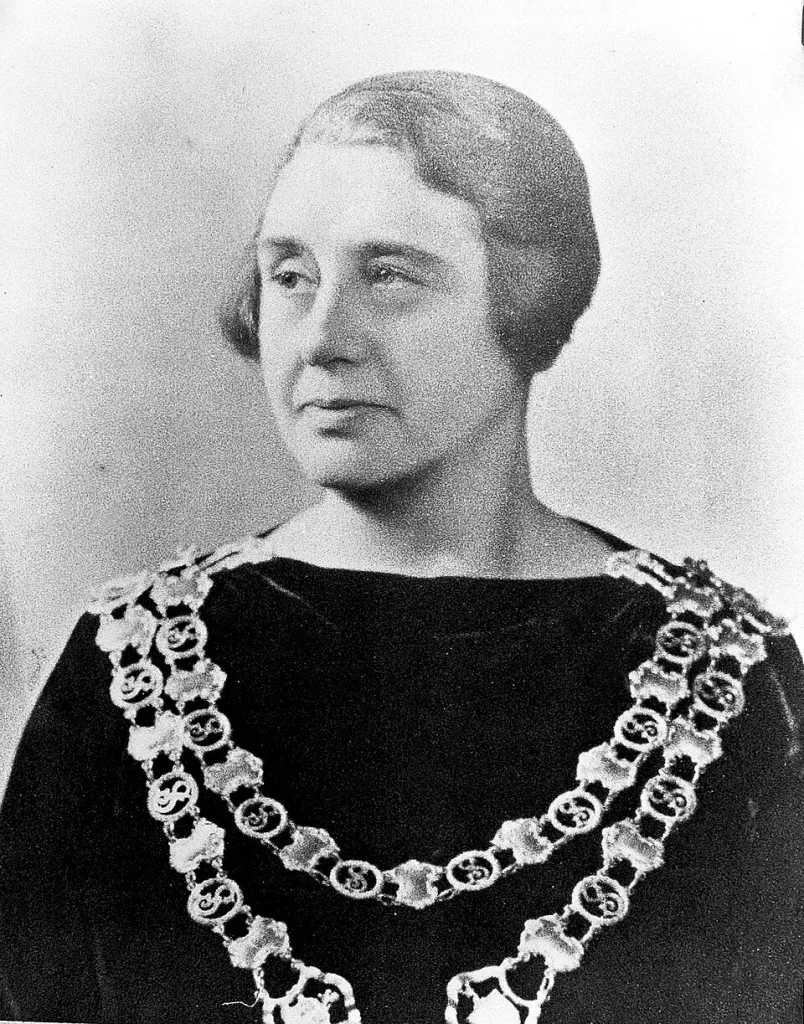
Dorothy Thurtle

Dorothy Thurtle. By https://wellcomeimages.org/indexplus/obf_images/b5/be/a6cfe553603c25fd36627e6c24d4.jpgGallery: https://wellcomeimages.org/indexplus/image/L0026656.html, CC BY 4.0, https://commons.wikimedia.org/w/index.php?curid=36012910

By chance, a few days after International Women’s Day, I was reading the Hackney Society’s Newsletter and read about some canon bollards in Shoreditch Park, in the Dorothy Thurtle Memorial Garden. Well, my nearest Bus Stop is Thurtle Street, which always seemed a strange turtle-like name. So, I looked her up!

Turns out she was a pioneer of the Labour Party. Also, daughter of the great George Lansbury. And a redoubtable pioneer of contraception, and abortion rights. Her opinion was that the Labour Party’s commitment to equality between the sexes made no sense unless it supported contraception and legal abortion. She and her husband, Ernest, founded the Workers’ Birth Control Group. Dorothy was general secretary of Shoreditch Trades Council and Labour Party, became a councillor and eventually Mayor of Shoreditch. She was the only supporter of Abortion Law reform on the Birkett Committee, and issued an influential dissenting report. In her report, she ‘argued that because many married women would face pregnancy every one or two years until their menopause, withholding access to fertility advice and birth control was “a form of class discrimination and penalisation”‘ (Wikipedia). World War 2 delayed any reform.

Right on my doorstep! For more read: https://en.wikipedia.org/wiki/Dorothy_Thurtle

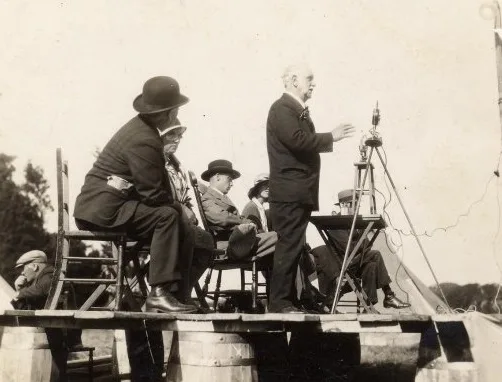
George Lansbury

George Lansbury making a speech. By LSE Library – Flickr: George Lansbury, c1935, Public Domain, https://commons.wikimedia.org/w/index.php?curid=31131566

Dorothy’s father was originally a Radical Liberal Party member. He then joined the Labour Party and became an MP for Bow and Bromley in 1910. During the struggle for Women’s Suffrage he was imprisoned. He was also imprisoned in the Poplar Rates Revolt of 1921. (He was the first labour Mayor of Poplar). After Ramsay MacDonald joined the National Government, Lansbury replaced MacDonald. He lead the few remaining ‘loyal’ Labour Party members who would not join a Conservative dominated Government. He was elected leader from 1932 to 1935, with Clement Atlee as his deputy. Lansbury was a life long Pacifist and so stood down in 1935, as he was out of step with the need for rearming with the rise of Fascism. Atlee became leader.

Canon Bollards

Canon Bollards are made of repurposed canons from the British Navy. They are sometimes hard to distinguish from those made from repurposed canon moulds, or bollards that are designed to look like canons.

Newark in the Civil War

I will move the Dorothy Thurtle content to International Women’s Day, by next year. Which leaves us with an abrupt change of subject! On the 11th March 1644, the Parliamentary forces were besieging the Royalist-held Newark-on-Trent. Newark was a strategic centre as it was on the River Trent and on a major road junction.  Here, the Great North Road (A1 from London to the North) and the Fosse Way (from Exeter, via the Cotswolds to Leicester) meet. It was vital for the King, as the roads linked Chester and York to Oxford.  Oxford was the King’s HQ; Chester was the key to Wales and the North West. York controlled access to the North East.

Newark withheld three sieges and only ‘fell’ when King Charles I surrendered. The Castle and other military defences were slighted.

Newark & the Penny Loaf & Hercules Clay,

During the second siege, in 1644, Hercules Clay dreamt that his house was on fire. He ignored the dream at first. Then it repeated, so he took his family out of the house (next door to the Town Hall).

Shortly after, a ‘bombshell’ hit his house, fired by the Parliamentary side.  Because of his miraculous delivery, he left £100 in his will for a distribution of ‘penny loaves’ to the poor of Newark. His Will said:

‘Upon the 11th day of March yearly forever upon which day it pleased God of his infinite mercy wonderfully to preserve me and my wife from a fearful destruction by a terrible blow of a granado in the time of the last siege’

And also he left £100 for a commemorative sermon to be read on the anniversary of the incident. The service is normally held on the closest Sunday to the 11th March. The Church is being refurbished, so instead they had an event in the Town Hall and a procession.

Clay was a Mercer and a Royalist. After his death he was fined for lending £600 for the maintenance of the Royalist Garrison. It was paid by his brother.

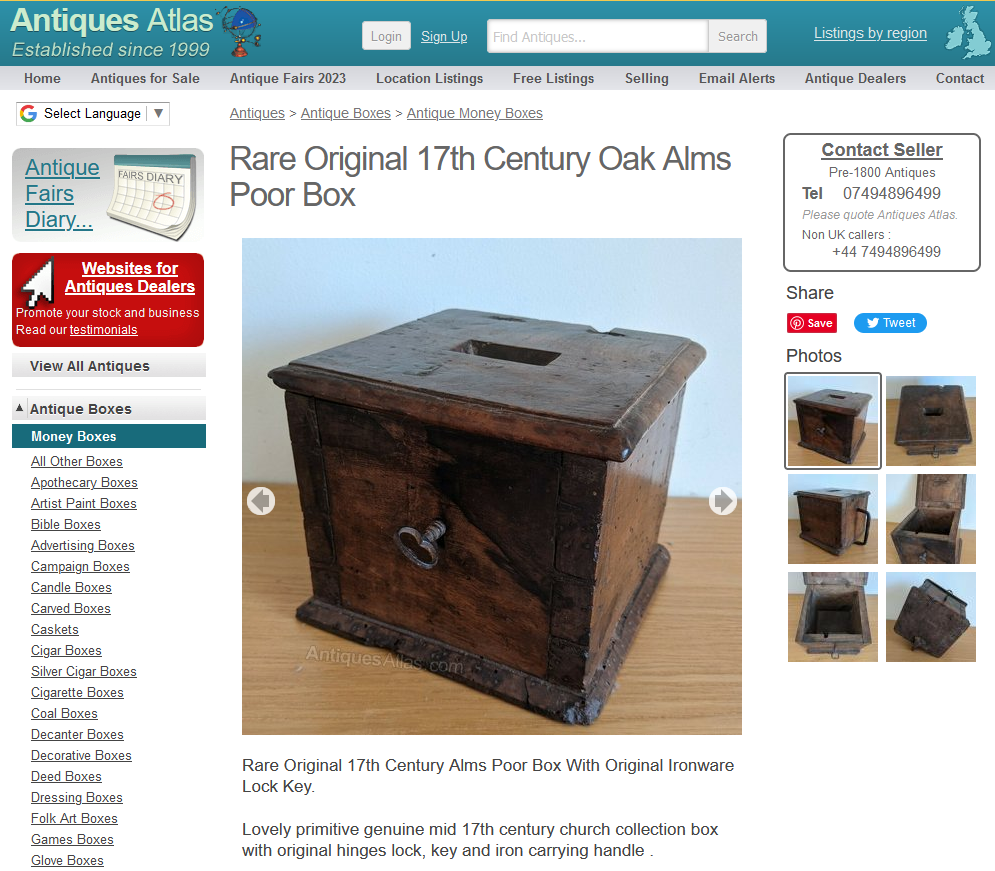
At the time Churches had poor or bread boxes into which the women of the Parish would place loaves for the poor.

Auction Web site showing 17th Century Poor Box used for holding loaves for the poor

For more information on Hercules Clay see https://www.clayofderbyshire.co.uk/mayors. And thanks to the Clays for the research.

Penny loaf day see https://calendarcustoms.com/articles/newark-penny-loaf-day/

For my post on the execution of Charles 1 look here https://www.chr.org.uk/anddidthosefeet/january-28th-31st-charles-i-martyrdom-get-back/

On This Day

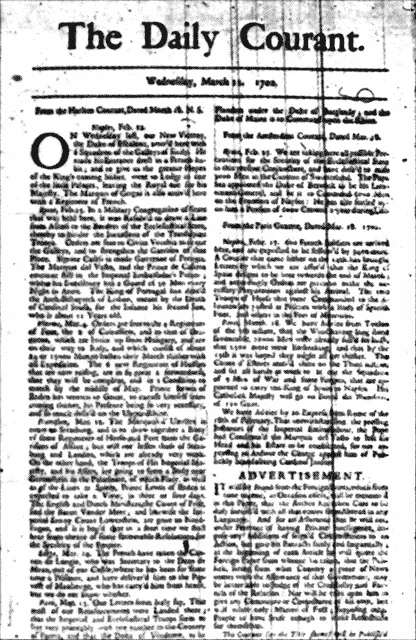
1702 – Elizabeth Mallet published the first English daily newspaper the Daily Courant, on Fleet Bridge, next to the King’s Arms. She, previously, dominated the publishing of ‘last dying speeches’ of people executed at Tyburn.

The Daily Courant By Edward Mallet from rooms above the White Hart pub in Fleet Street – The Daily Courant, Public Domain, https://commons.wikimedia.org/w/index.php?curid=880402. Elizabeth Mallet published under a male name.

1941 – Roosevelt signed the Lend-Lease Bill – this was a life-line to the UK as it enabled the supply of war materials to flow to Britain who stood alone, in Europe, against fascism. see my post for Roosevelt’s 4 freedoms.

1985 – Mikhail Gorbachev, appointed General Secretary of the USSR

First written in 2024, revised 2025, Thurtle and Lansbury and On This Day added in 2026

Nettle. Tea, Beer, Pudding & Flagellation March 10th

Nettle – photo by Paul Morley Unsplash

Nettle Tea

The store cupboards are getting denuded of the fruits, nuts, preserves, pickles, salted and dried foods saved from the summer and autumnal abundance. Of course, this is alleviated by the reduced consumption of the Lenten fast.  (I’m continuing my lenten practice of giving up, giving up things for Lent). But nettles are budding. I take a regular cup of nettle tea. Normally, provided by the excellent Cowan’s tea emporium in the Covered Market in Oxford. But I’m running out and not due to visit Oxford for a month or so. So Charles Kightley in his Perpetual Almanac tells me that young stinging nettles are appearing and this is the time to collect own young, juicy nettles.

Here is a video about collecting them.

YouTube Video on making Nettle Tea

Nettle Beer

Or better still, change up the tea for a nettle beer:

Take a gallon measure of freshly gathered young nettles washed well dried and well packed down. Boil them in a gallon of water for at least a quarter of an hour. Then strain them, press them and put the juice in an earthenware pot with a pound of brown sugar and the juice and grated skin of a lemon. Stir well, and before it grows cool put in an ounce of yeast dissolved in some of the liquid. Cover with a cloth and leave in a warm place for four or five days and strain again and bottle it, stopping the bottles well.  It’ll be ready after a week, but better if left longer.

Nettle Beer was brewed for old people against ‘gouty and rheumatic pains’.

Nettle: Detecting Virgins

A more sinister use is provided by William Coles who gives a method of detecting virginity.

Nettle tops are usually boiled in pottage in the Springtime, to consume the Phlegmatic superfluities in the body of man, that the coldness and moistness of the winter have left behind. And it is said that if the juice of the roots of nettles be mixed with ale and beer, and given to one that suspected to have lost her maidenhood, if it remain with her, she is a maid, But if she’s spews forth, she is not.

William Cole’s Adam in Eden 1657.

Flagellation with Nettles?

William Camden reported that Roman soldiers used nettles to heat up their legs in the cold of a British winter. (from Mrs Greaves’ ‘A Modern Herbal). Perhaps, I should have sent that idea to PM Keir Starmer? He might have suggested the method to Senior Citizens to alleviate the loss of their Winter Fuel Allowance? (which he has now restored). Flogging with nettles was a cure for rheumatism and the loss of muscle power in the early modern period. Nettles were also added to horse feed to make their coats shine. It was used as a hair tonic for humans. 

Nettle Fabrics

The 18th century poet Thomas Campbell is quoted on the virtues of nettles:

“I have slept in nettle sheets, and I have dined off a nettle tablecloth. The young and tender nettle is an excellent potherb. The stalks of the old nettle are as good as flax for making cloth. I have heard my mother say that she thought nettle cloth more durable than any other linen.”

In 2012, a Danish Bronze Age Burial was found to be dressed in a shroud made of Nettle. Strangely, the nettle was not local, perhaps being made in Austria where other objects in the rich burial came from. However, the person was thought to be Scandinavian. For more have a look at this article on www.nbcnews.com.

In the Irong Age, also in Denmark, Huldremose Woman was found buried in a bog. She had a severed arm and was buried in elaborate sheep and goat skin clothes, but underneath:

she wore a white inner garment made from plant fibres that reached from the shoulders to below the knees. The type of plant fiber is unclear but other evidence from the time period suggests that it could have been made of nettle.’

To find out more: the-woman-from-huldremose/the-huldremose-woman-clothes/

World War 1 use of Nettle cloth

Greaves tells us that the German and Austrians had a shortage of cotton during the blockade of World War 1. They turned to nettles to replace cotton production believing it to be the only effective substitute.  It was also substituted for sugar, starch, protein, paper and ethyl alcohol. 

YouTube Video on making fabric from nettles

Nettle Pudding

Pepys ate Nettle Pudding in February 1661 and pronounced it ‘very good’.  Here is more on Nettles in history AND a recipe for Nettle Pudding! I can see I’m going to have to get out there and carefully pick myself some nettles! ( For Folklore of Nettles look here).

Nettles Photo by Les Argonautes on Unsplash

Remember, none of the above is necessarily good advice as far as medicine is concerned. For smoking herbs see my post coltsfoot-smoking-cholera

March Weather

In the early modern almanacs there is much weather and horticultural advice to be had (Weather Lore. Richard Inwards).

March damp and warm
Will do farmer much  harm

or

‘In March much snow
to plants and trees much woe

On This Day

241 BC – The Battle of the Aegates in which the Carthaginian fleet is sunk, and the First Punic War ends. Carthage was destroyed in the Third Punic War in 146BC. Rebuilt as a Roman City 100 years later.

1629 – Parliament is dissolved by Charles I. This was followed by a Royal dictatorship which lasted 11 years, and then led to Civil War.

1906 – Bakerloo Line Opened. The name originated from the Baker Street and Waterloo Railway. It goes from Harrow &Wealdstone in the NW to Elephant & Castle in the South East, via the Central London section which goes from Bakers Street to Waterloo, Sherlock Holmes didn’t use the Tube very much (see this post here for those times he did). There is a proposed extension from Elephant & Castle to Lewisham.

1969 – James Earl Ray sentenced to 99 years in jail for murdering Martin Luther King. While Ray was a segrationalist and a supporter of George Wallace, he maintained he was set up as the scapegoat. He died in prison in 1998.

Written 2024, revised 2025, the content on Hesiod and a Grecian Spring moved to: march-13th-hesiod-and-a-grecian-spring/. On this Day added 2026.

My trip (in March 2022) to the British Museum with my 20 month year old Grandson is posted here:

5th of Lide St Piran’s Day March 5th

Lide 5th is St Piran’s Day. Photo of St Piran’s Oratory at Trézilidé, Finistère (wikipedia) By Kieffer92 – Own work, CC BY-SA 4.0,

March is named after the Roman War God Mars, whose Month it was. But in England it had, until recent times, a dialect name which survived in the South west of England. This was ‘Lide’.

Lide was still used in the 17th Century, and then survived into the 19th Century only in Cornwall.  The Cornish named the first Friday in March ‘Friday in Lide’. They had a proverb.

Ducks won’t lay till they’ve drunk Lide water’.

Daffodils were called Lide-lillies. Eleanor Parker, who is a Lecturer in Medieval Literature at Brasenose College, Oxford, wrote an interesting article in History Today. She called March the loudest month of the year. The early English names for March were Hlyda or Lide monath meaning stormy or loud month. Other names include Hraed monath (rugged month) and Lentmonath (month of lent).

The ‘loudness’ comes from the March winds, which were noisy – as described in this rhyme. (thanks to Millie Thom for the rhyme and all things March. )

March brings breezes loud and shrill,
Stirs the dancing daffodil.

Sara Coleridge (1802–1852), “The Months,” Pretty Lessons In Verse, For Good Children; With Some Lessons in Latin, In Easy Rhyme, 1834

There are many references to the changeable weather in March. Sometimes lovely spring days, and at others raging storms, and frosts. Parker quotes a proverb which says that March comes in:

like a lion and goes out like a lamb’.

In 2026, the 5th of Lide has been a beautiful spring like day, with, over the last few days a outburst of Hawthorn and Plum blossom.

St Piran

Lide 5th was a holiday for Miners, probably because it was St Piran’s Day. Very little is clear about St Piran. But he is thought to have been an Irish Missionary who founded an Abbey in Cornwall in the 5th Century. His legend says he was tied to a millstone by the Irish, who rolled the stone over a cliff. The sea was stormy, but calmed as soon as he fell into it. He floated on his stone to Perranzabuloe in Cornwall. Here he landed and got his first converts: a badger, a fox, and a bear. Then, he founded the Abbey of Llanpirran.

He is said to have reintroduced smelting to Cornwall, hence his attribution as patron Saint of Miners. Piran was martyred by Theodoric or Tador, King of Cornwall in 480. His bones scattered in reliquaries in the South West and in Brittany. He is the patron saint of Cornwall, so the week before the 5th of March is known as Pirrantide. And there are events and parades to commemorate him. People dress in black white and gold, carrying daffodils and walk across the dunes to St Piran’s Cross.

Screenshot from the Cornish Guide showing St Piran’s Cross. https://www.cornwalls.co.uk/history/sites/st_pirrans_cross.htm

For more about March look at my post https://www.chr.org.uk/anddidthosefeet/march-1st-the-month-of-new-life

On This Day

1702 – Queen Anne becomes Queen – the last of the Stuarts. She had 18 pregnancies. The eldest survived to 11 and then died. Of the other 17, 8 miscarried, 5 were stillborn. 4 were born alive but died soon after. She had poor health, gout and drank a lot, but she might well have had an autoimmune deficiency and her body rejected the offspring. The fact that the eldest was the only one to survive might suggest rhesus disease, which can now be prevented with an injection of a medication called anti-D immunoglobulin. The problem occurs when a woman with RhD negative blood is exposed to RhD positive blood and develops an immune response to it. The first child is not affected, subsequent ones risk miscarriage.

1936 – The Spitfire makes its maiden test flight. By 1947 over 20,000 had been made and it had been in continuous production throughout the war, unlike most other aircraft.

1946 – Churchill makes his”Sinews of Peace” Speech in which he coins the phrase ‘Iron Curtain. President Trueman invited the unemployed Statesman to Fulton Missouri to make the speech. In 1961, the proposal was made to commemorate the speech by reconstructing the blitzed City Christopher Wren Church, St Mary Aldermanbury in Fulton, Missouri. The Church was shipped to the States, rebuilt and rededicated on the 7 May 1969.

First published in 2024, rewritten March 2025 Revised, On This Day added 2026.

The Feast Day of St Winnold March 3rd

Portrait of Saint Guénolé (St Winnold) after a bust in silver on a reliquary from the Church Saint-Guénolé in Locquénolé.Public Domain Abgrall Jean-Marie (1846-1926) – Bibliothèque nationale de France

Here is a weather poem in which St Winnold appears

First comes David, then comes Chad.
And comes Winnold, roaring like mad.
White or black.
Or old house thack.

St David’s Day was March 1st. St Chad, the 2nd. St Winnold’s Day is the third of March. Winnold is his English name, and Winneral, or Winwaloe or Guénolé his Celtic names.

The poem suggests that snow, rain or wind is going to come on these three days. When the wind roars, it will threaten the thatch of houses. If the storms do not come in the first 3 days, then they will come on the last three days of March, which were called ‘the Borrowing Days’. Or so it is said.

St Winnold was around 50 years (460 – 3 March 532) after the end of Roman Britain. His family was from Cornwall. He was the son of a Prince Fragan of Dumnonia, and St Gwen the Three-Breasted, His mother’s Feast day is October 3rd. She is a Saint of fertility, because of God’s Gift of an extra breast. They moved to Brittany to escape a British Plague. Their son grew up to be holy and was the founder and first abbot of Landévennec Abbey (the Monastery of Winwaloe). It is south of Brest.

Winwaloe became what is known as a ‘phallic saint’ because he was associated with fertility. Wikipedia says this came about because of confusion about the origin of his name:

his name was thought to derive from gignere (French engendrer, “to beget”)’

St Winnold’s Breton name is Guénolé. How this etymology works is not clear to me! But surely, he as likely to have got a reputation for helping people with fertility problems from his mother? Supplicants would make a wax phallus to persuade the Saint to help them conceive. There are several churches/ chapels dedicated to him in Wales, and a Priory in East Anglia.

You might like to read my post about St Blaise Day & The Tadpole Revels February 3rd, or on St Chad.

On This Day

March 3rd 1847 Alexander Graham Bell was born. He was born in Edinburgh, and lived Scotland, in London, Canada and the US.

First written August 2024, republished MArch 2026

Spring & the Month of New Life March 1st

March from the Kalendar of Shepherds – French 15th Century

Spring & March

This is the beginning of Spring, meteorologically speaking. There is nothing magical about this day that makes it in any sense actually the start of Spring. It is a convenience determined by meteorologists. They divide the year up into 4 blocks of three months based on average temperature, and the convenience of keeping statistics to months. It could be that spring starts on 2nd March. 14th February.  Or the 1st of February as the Celts favoured.

The Venerable Bede in his ‘The Reckoning of Time’, written in 725 AD, quotes more diversity of dates:

However, different people place the beginnings of the seasons at
different times. Bishop Isidore the Spaniard said …, spring [starts] on the 8th kalends of
March [22 February],…

But the Greeks and Romans, whose authority on these matters, rather than that of the
Spaniards, it is generally preferable to follow, deem that spring [begins] on the 7th ides of February [7 February],…

Noting that summer and winter begin with
the evening or morning rising and setting of the Pleiades, they place the
commencement of spring and autumn when the Pleiades rise and set
around the middle of the night.

There is nothing that says we have to have 4 seasons. Egypt had three seasons, the tropics have two. Celts divided the year into 8. Plants have been blooming, sprouting and budding since January, and some will wait until later in the year. Lambs have been born since January. But scientists and society find it easiest to keep statistics on a monthly basis so March 1st it is.

Astronomically, the seasons are more rationally divided by the movement of the Sun. So Spring begins on the spring or vernal equinox, 20th or 21st of March. For my Spring Equinox post go here.

Anglo-Saxon March

In Anglo-Saxon ‘Hrethamonath’ is the month of the Goddess Hretha. Bede gives no further information on who she was and nothing else is known about her. Her name is Latinised to Rheda. J R. R. Tolkein used the Anglo-Saxon calendar as the calendar for the Shire where the third month is called Rethe.

For the Anglo-Saxon, spring was looked forward to with great joy after the bleakness of winter. Christian Anglo-Saxons also saw this as the pivotal month in the year. It was in March that the world was created, and the Messiah conceived, revealed, executed, and ascended to heaven. See my post:

In Welsh the month is called Mawrth, (derived it is thought from the Latin Martius). Gaelic Mart or Earrach Geamraidth – which means the ‘winter spring’.

Medieval/Early Modern March

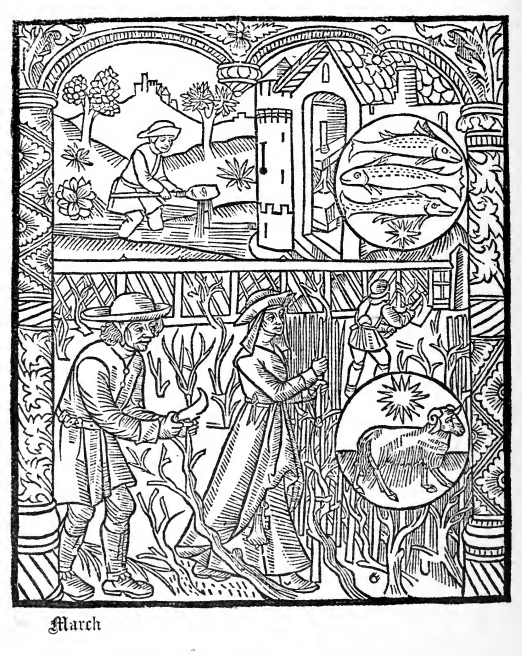
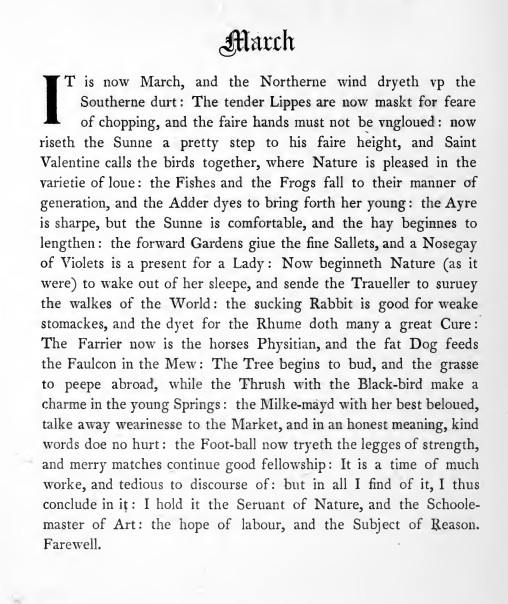
The illustration (above), from the Kalendar of Shepherds, shows that in Pisces and early Ares preparation was still the main order of the farming day, clearing out the moats, and preparing the fruit trees. Lambing is also increasing in number. And the early modern text below from the Kalendar gives a fine description of the joys of spring.

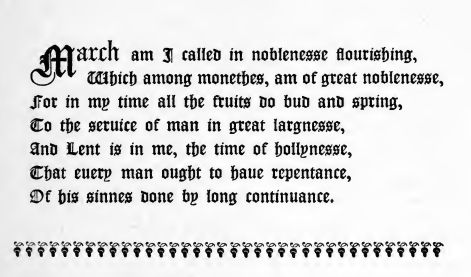
Kalendary of Shepherds- Description of March.
March in the Kalendar of Shepherds.

For more details of the Kalendar of Shepherds look at my post on December.

Roman March

March the 1st was the beginning of the Roman year in Rome’s early days. The Month was named after Mars, the God of War, as Mars was the patron God of the Rome. March was also the beginning of the campaign season, and the army was prepared, and ceremonies held to Mars. The Salii, twelve youths dressed in archaic fighting costumes led a procession singing the Carmen Saliare. March 1 was also the Matronalia a festival celebrating childbirth motherhood. Dedicated to the Mother Juno Lucina,

Ovid & March & Kalends, Nones & Ides

Ovid says the year started on the Kalends of March. Here is what Britannica says about their strange system of dividing months:

‘In a 31-day month such as March, the Kalends was day 1, with days 2–6 being counted as simply “before the Nones.” The Nones fell on day 7, with days 8–14 “before the Ides” and the 15th as the Ides. After this the days were counted as “before the Kalends” of the next month’.

More about this if you read my post on the Ides of March and Julius Caesar.

At the beginning of his book, Fasti, Ovid provides the story of Rome’s foundation. Mars took Silvia the Vestal while she slept. She later gave birth to Romulus and Remus. He also gives details of how Rome was organised. In the piece of the long text I have chosen below he discusses Romulus’ arrangement of the year. It is a year that began on the 1st March, and had only 10 months. 10 is the number of digits we have and the length of pregnancy (so Ovid says).

Ovid wrote in his almanac poem the Fasti:

So, untaught and lacking in science, each five-year lustre
That they calculated was short by two whole months.
A year was when the moon returned to full for the tenth
time:
And that was a number that was held in high honour:
Because it’s the number of fingers we usually count with,
Or because a woman produces in ten months,
Or because the numerals ascend from one to ten,
And from that point we begin a fresh interval.

So Romulus divided the hundred Senators into ten groups,
And instituted ten companies of men with spears,
And as many front-rank and javelin men,
And also those who officially merited horses.
He even divided the tribes the same way, the Titienses,
The Ramnes, as they are called, and the Luceres.
And so he reserved the same number for his year,

It ís the time for which the sad widow mourns her man.
If you doubt that the Kalends of March began the year,
You can refer to the following evidence.
The priest’s laurel branch that remained all year,
Was removed then, and fresh leaves honoured.
Then the king’s door is green with Phoebus’ bough,
Set there, and at your doors too, ancient wards.
And the withered laurel is taken from the Trojan hearth,
So Vesta may be brightly dressed with new leaves.
Also, it’s said, a new fire is lit at her secret shrine,
And the rekindled flame acquires new strength.
And to me it’s no less a sign that past years began so,
That in this month worship of Anna Perenna begins.
Then too it’s recorded public offices commenced,
Until the time of your wars, faithless Carthaginian.

Lastly Quintilis is the fifth (TXLQWXV) month from March,
And begins those that take their names from numerals.
Numa Pompilius, led to Rome from the lands of olives,
Was the first to realise the year lacked two months,
Learning it from Pythagoras of Samos, who believed
We could be reborn, or was taught it by his own Egeria.
But the calendar was still erratic down to the time
When Caesar took it, and many other things, in hand.
That god, the founder of a mighty house, did not
Regard the matter as beneath his attention,
And wished to have prescience of those heavens
Promised him, not be an unknown god entering a strange
house.

He is said to have drawn up an exact table
Of the periods in which the sun returns to its previous
signs.
He added sixty-five days to three hundred,
And then added a fifth part of a whole day.
That’s the measure of the year: one day
The sum of the five part-days is added to each lustre.

Translated by A. S. Kline online here:

For much more about the Roman Year (and leap years) look at my post here.

On This Day

St David’s Day – It is also the Feast of St David, (or Dewi) the patron saint of Wales, who lived in the sixth century AD. Little that is known about him is contemporary but he was an abbot-bishop. His hagiography was written in the 11th Century and not very trustworthy, but the aim was to show the independence of the Welsh Church from Canterbury. His association with the leek is unexplained.

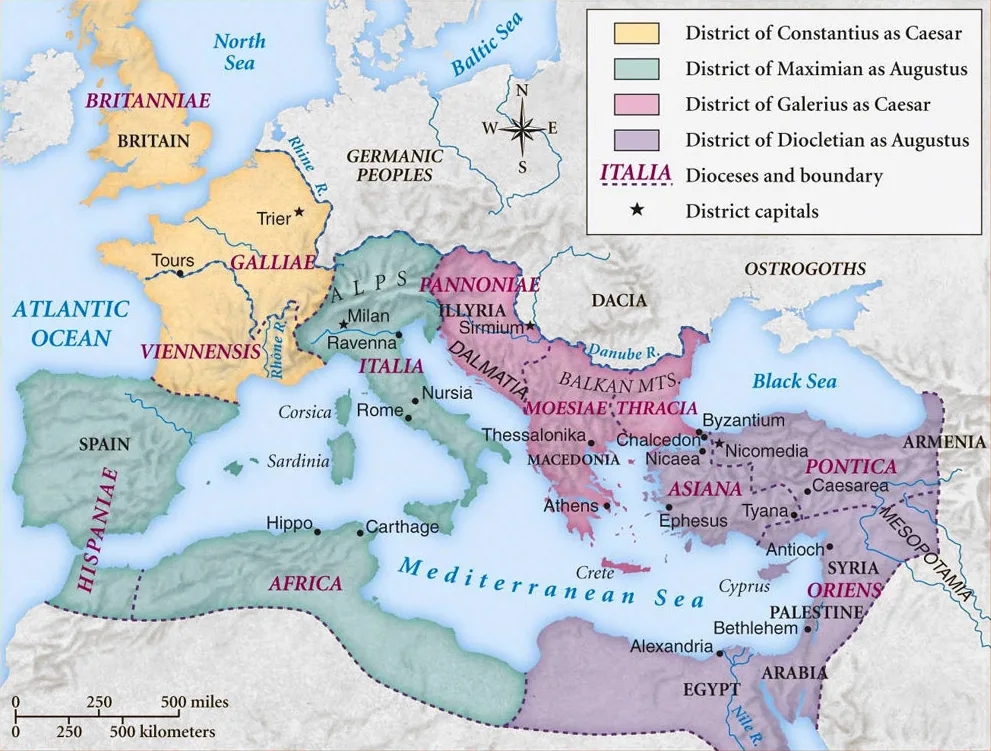
293 – Inauguration of the Tetrarchy

Diocletian reorganises the Roman Empire to be a Tetrarchy with himself and Maximian the Augusti, one in the East the other in the West. Below them were Constantius Chlorus and Galerius the Caesars.

Coppermine Photo Gallery - Coppermine Photo Gallery; Bishop, Aubrey. Imperial Imagery of the Tetrarchy. Rhodes College. Archived from the original on 15 September 2024.

Historic map of Roman Empire during the first tetrarchy
Coppermine Photo Gallery – Coppermine Photo Gallery; Bishop, Aubrey. Imperial Imagery of the Tetrarchy. Rhodes College. Archived from the original on 15 September 2024. Historic map of Roman Empire during the first tetrarchy CC BY-SA 3.0

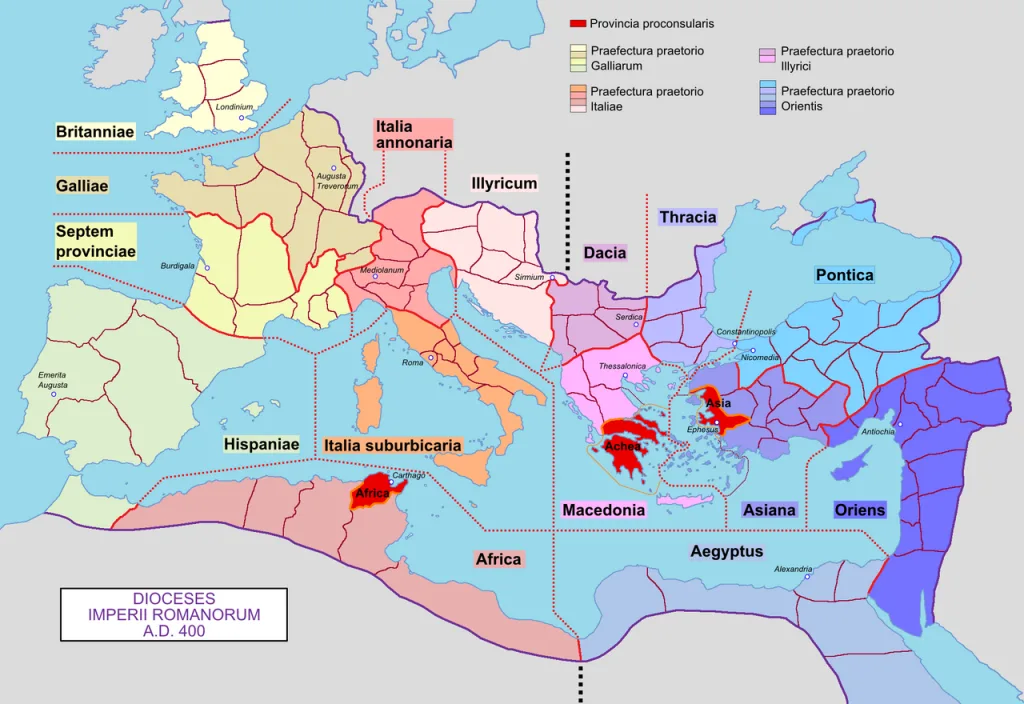
Below them were Prefectures run by Prefects, who controlled officials called the Vicarious. Britannia, was a Diocese ruled by the Vicarious in London. The Diocese was divided into 4 Provinces,. In charge of those were the Governors, who were now civilians rather than military figures.

Later dioceses of the Roman Empire, around 400 AD By Mandrak – Own work, Public Domain, https://commons.wikimedia.org/w/index.php?curid=6088363

The reorganisation was designed to provide a peaceful career path for ambitious men, but in that it failed.

1562 – Massacre in Wassy France, when sixty-three Huguenots were killed and the French Wars of Religion began. Many Huguenots came to Britain, and many settled in Spitalfields, London. My family believe we are Huguenots from the East End.

1628 – Charles I decrees that the ship tax should be extended to every county. This was not put to a Parliament, and illegal impositions like this eventually lead to the English Civil War in 1642. (see my post on the beginning of the Civil War here:

First Published in 2024, and revised in 2025


Walk of Socialists 28th February 1887

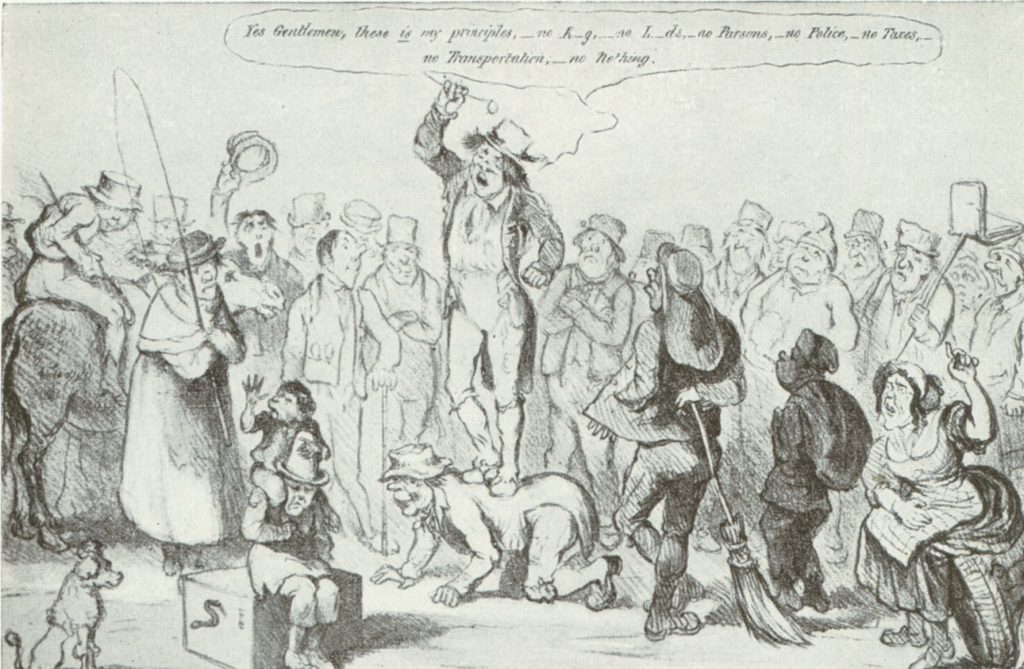
Victorian lampoon on Socialist Values 'Yes Gentlemen, these is my principles, no King, no Lords, No Parsons, No Police, No Taxes, No Transportation,  no No'thing.'
Victorian lampoon on Socialist Values ‘Yes Gentlemen, these is my principles, no King, no Lords, No Parsons, No Police, No Taxes, No Transportation, no No’thing.’

Walk of Socialists at St. Paul’s February 28th & London Socialism 1887

My French friend went yesterday to St. Paul’s and saw a large procession of socialists. It is a strange move of the socialists to visit all the Churches. The Archdeacon of London preached to them from: “the rich and poor meet together, and the Lord is the maker of them all.” A noble sermon, they behaved fairly well.

Helen G. McKenney, Diary, 1887 (source: A London Year. Compiled by Travis Eldborough and Nick Bennison)

The quotation is from the Bible, Proverbs 22, where it sits with a number of other wise sayings. Perhaps, number 16:

One who oppresses the poor to increase his wealth and one who gives gifts to the rich—both come to poverty

is most likely to stir a Socialist. I imagine the Archdeacon was also making a point that the Lord made the Rich and the Poor. So there is nothing wrong with being Rich, as long as you are generous to the Poor. Equally, nothing wrong with being Poor.

Bloody Sunday

It’s rather lovely to imagine the Walk of Socialists walking around Wren’s masterpieces in the City of London. However, later in 1887, things turned much worse. The Social Democratic Federation and the Irish National League organised a march against Unemployment and the Irish Coercion Acts. Among the 10 to 30 thousand citizens present were William Morris, Annie Besant , George Bernard Shaw and Eleanor Marx.

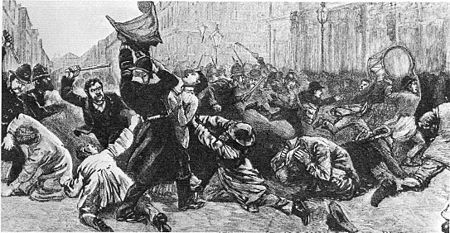
The Police had been trying to prevent the ever-increasing use of Trafalgar Square and Hyde Park as protest venues. So, on November 13th, Bloody Sunday, the Police Commissioner, Charles Warren, ordered a massive police presence. He backed this up with 400 Soldiers. He aimed to prevent the entry to Hyde Park. Warren was acting as a caretaker until a new Commissioner was in place. He had already resigned following criticism of the failure to find Jack the Ripper. By the end of the day there were 2 people dead, 100 seriously injured, and 45 arrests, as well as 75 accusations of police brutality. On the other hand there were many police casualties.

Engraving from The Graphic (published 19 November 1887). Wikipedia describes it as ‘depicting a policeman being clubbed by a demonstrator as he wrests a banner from “a Socialist woman leader, one Mrs. Taylor”, while other people are covering their heads to protect themselves from raised police batons.’ Pubic Domain

Progressive Politics

Before the Foundation of the Labour Party, progressive politics were in the lukewarm hands of the Liberal Party. This Party developed from the Restoration period Whig Party. Although, the Liberal Party had a radical wing, it had a reluctance to put forward working-class candidates. In the early 19th Century, much of the agitation was led by a movement called the Chartists. But as their goals became adopted by the main two parties, progressive politics was led by various reform, radical, socialist, marxist and anarchic groups.

I have not been able to find out who led the 1887 Walk of Socialists around the City Churches. However, William Morris’ presence suggests the Socialist League? In 1885, the Socialist League was an offshoot of the Social Democratic Federation. But it was not a harmonious group. Its most famous members were William Morris, and Eleanor Marx. It included Fabians, Christian Socialists and Anarchists. By 1887 it was split ideologically into three main factions, Anarchists, parliamentary orientated Socialists, and anti-parliamentary Socialists. William Morris was the editor of their newspaper, ‘the Commonweal’ but he was sacked and replaced by Frank Kitz as the Anarchists took over the organisation.

So, without going into a long history of Socialism in London, what happened was that the Socialist groups made very little impact until the Independent Labour Party was set up in Bradford 1893. And in 1900, Keir Hardie, who was already an independent MP in Parliament, set up the Labour Representation Committee in 1900. This was soon renamed the Labour Party. The Independent Labour Party joined, and Labour began to take over control of the working-class vote. It fought for this with the Liberal Party. The Liberal vote, declined after WW1 and Labour was able to secure minority Governments. After World War 2 the Labour Party replaced the Liberals as one of the two Political Parties which could win a majority in Parliament.

London ‘Soviets’

London was one of the places where the Party experimented with left wing policies. The East End areas of Poplar, Limehouse and Bermondsey were particularly important. Alfred and Ada Salter were ‘typical’ activists. She became the first female Mayor of a London Borough. She was Returning Officer when her husband was elected MP for Bermondsey. His medical practice gave free medical care for poor people. From this they established a free medical clinic, that was a forerunner to the formation of the National Health Service. The London Councils also led the way in promoting mass council housing and Trade Union reform.

Here is a part of a letter from Alfred to Ada:

Oh, the cruel wickedness of our society today! To thrust down these people by means of low wages and chronic unemployment into hopeless despair, and then leave them in that condition with no organised or conscious effort to rehabilitate them. What can we do?”

“You and I feel we have the same mission in life… we are living and working for the same goal- to make the world, and in particular, this corner of the world, happier and holier for our joint lives.”

Taken from this excellent blog post of Dr Alfred Salter.

Fenner Brockway said that in his youth Salter was a “Settlement firebrand – militant Republican, militant Socialist, militant Agnostic, militant Teetotaller, militant Pacifist.” Alfred converted Ada to Socialism and she converted Alfred to Christianity. They became Quakers.

Statues of Alfred Salter (sitting down) Ada Salter (behind his walking stick) and their only daughter Joyce (leaning against the River wall) who died aged 8 of Scarlet Fever. Garden near the Angel Pub, Rotherhithe. Photo K Flude

Life-long Labour voter

My Grandma, who was born in Hoxton in 1902, voted for Labour all her life. I’m pretty sure it was out of class loyalty because I always thought her opinions were more traditional than progressive. But she would never dream of voting anything other than Labour. For more on Hoxton and revolution, you may want to see my post on Hoxton and the Gunpowder plot.

Tomorrow isn’t the 29th but if it were you would want to see my post on leap year and the Roman Calendar – February 29th.

On This Day

1931 – Oswald Moseley formed the New Party which became the British Union of Fascists. He was a promising and economically radical MP for the Labour Party but resigned in frustration with their reluctance to adopt his policies. And his egotism, led him to the dark side.

1975 – An underground train ran into the end wall having failed to stop at the Moorgate terminus. 43 people died and 74 were injured. An inquiry concluded, in the absence of any faults in the train, that it was a driver’s error.

First Published in February 2024, republished in 2025 The Salters & On This Day added February 2026

St. Walburga and St. Ethelbert of Kent’s Day February 25th

engraving of St Walburga
St. Walburga
(public domain)

Today is the Feast day of two significant Saints, St. Walpurga and St. Ethelbert.

St. Walpurga

St. Walpurga was a nun at Wimborne in Dorset.  She, and her brothers St Willibald and St Winebald, accompanied their uncle, St Boniface of Crediton (in Devon) on his mission to convert the Germans to Christianity. They all became leading figures in the new German Church. Willibald set up the Monastery at Heidenheim, which was a duel monastery housing both Monks and Nuns. His sister, St Walpurga, became Abbess of the Monastery in 761. She died on 25 February 777 or 779 (the records are unclear),

In 870, St. Walpurga remains were ‘translated’ to Eichstätt, which St Willibald had set up as the Diocesan centre of this part of Bavaria. The date of the transfer was the night of April 30th/May 1st. This was her feast day. But the Church moved it to February 25th, to commemorate her death. However, May Eve is now ‘notorious’ as Walpurgis Night. This is the night of May Eve when witches are abroad up to all sorts of mischief, May Day being one of the main pagan festival days. Her body was placed in a rock-cut niche and her bones started exuding an oil called Walpurgis Oil which was said to have medical properties. She was also involved in a miracle of a boat saved in a storm-tossed sea.

For these reasons, Walpurgis is the Saint for battling pests, rabies, whooping cough, storms and sailors. She is also associated with witchcraft but not because of any actual association with it. Her remains were moved again in 1035 when she was enshrined at the Benedictine Abbey of St. Walburga which was named after her.

Walpurgis Nacht

Terrible things happen on Walpurgis Night in Dracula by Bram Stoker. So, the night has now become a trope for Heavy Metal Bands, doyens of horror stories and the Satanic. For more on this read my piece on Walpurgis Nacht.

Coincidently, I was reading about the fuss made about a Heavy Metal Band, called a Plague of Angels, playing in the glorious York Minster. A member of the band tried to calm down the controversy, saying people should just chill out. But other group members used to be in a band called ‘The Cradle of Filth’. Among their claims for Heavy Metal Fame is that they wore the most controversial t-shirt in heavy metal history. This has a visual of a nun in a compromising position and a slogan saying ‘Jesus is a ……..’ (add your favourite swear word here). All very silly. But it struck a cord with me, as I have a scene in my novel (unpublished) which is based on extreme forms of Heavy Metal Bands. I thought I might have gone over the top, but this story reassures me that extreme Metal can be extremely offensive!

To read more read the Guardian page. To publish my novel, email me!

St. Ethelbert.

Ethelbert is responsible for welcoming the Augustinian Mission to the Angles sent by the Pope, St Gregory. This re-established Christianity in Eastern Britain, and set up the Anglican Church or the Church of England as it became known.

I tell this story in this post.

On This Day

1308 – Edward II crowned King of England. His reign ended disastrously, with his Queen having an affair with Lord Mortimer and Edward losing control of the country (and Scotland). He was forced to abdicate, and died/was murdered/killed with red-hot pokers/or escaped to live a life as a hermit on the continent. Choose your favourite or read my History of the Kings and Queens of Britain.

1507 – Queen Elizabeth I excommunicated by Pope Pius and declared usurper of the throne, leading to the Spanish Armada and various plots against her life. (my post on Queen Elizabeth’s nicknames is here)

1836 – The Colt Revolver awarded a United States patent. Previously, he had obtained a UK Patent. It created the classic ‘Western’ Revolver’, much later called the Colt 45. It was a revolving-breech loading, folding trigger hand gun.

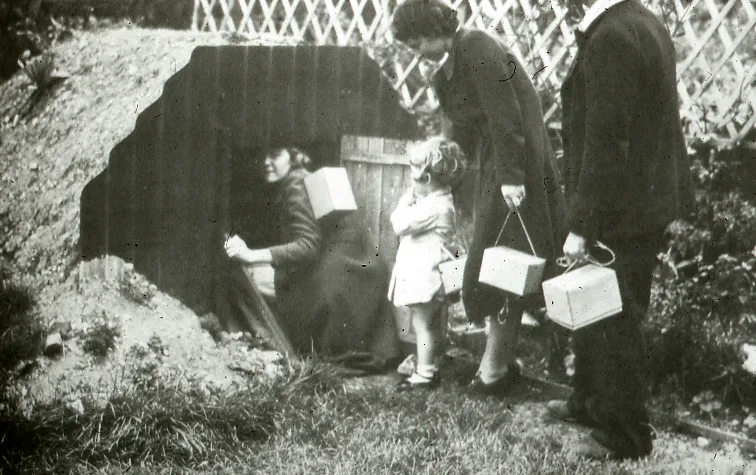
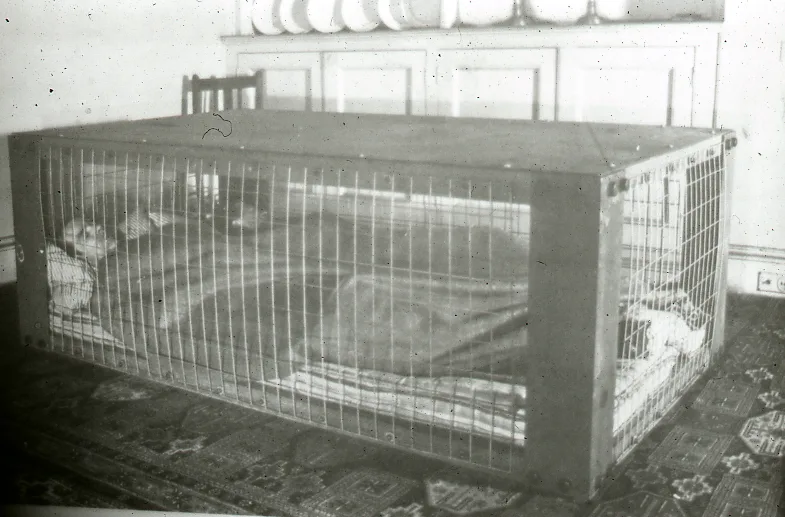
1939 – The first Anderson shelter built in a garden in Islington, London. They were named after the Home Secretary, and were dug in a trench with soil piled over the corrugated iron domed roof. Inside were bunks for the occupants to sleep in. They were 6 ft high, 4.5 ft wide, and 6.5 ft long. 2.5 million were built. The next shelter was the Morrison Shelter named after Herbert Morrison, who succeeded Anderson as Home Secretary. The Morrison Shelter was like a massive table that would protect the shelterers if the house collapsed above it. It allowed the family to sleep inside. London also had public shelters made of brick in many streets, or used cellars and brick arches as shelters. A small proportion of the population preferred to sleep in the Underground. Many stayed in their beds, unless planes were directly overhead. Photos from ‘The British People at War’ published during the war.

1956 – Nikita Khrushchev denounces Stalin.

First Written February 2024, revised February 2025. On This Day added in 2026

Terminalia God of the Boundary February 23rd

Hans Holbein the Younger Design for a Stained Glass Window with Terminus. Pen and ink and brush, grey wash, watercolour, over preliminary chalk drawing, 31.5 × 25 cm, Kunstmuseum Basel.
‘Terminus is often pictured as a bust on a boundary stone, His festival is ‘Terminalia’

Today is Terminalia, the Roman day for setting land boundaries. The festival of Terminus was a pastoral outdoor festival marking the boundaries of towns and villages. It resembles the Beating the Bounds tradition that we have in Britain. This is recorded, in the UK, from Anglo-Saxon times, and still continues in some parishes. I will talk about this on Ascension Day in May.

Terminus was an old ancient God who was the God of the boundary, the border, the edge, the liminal God. Ovid says King Tarquinus swept away the old Gods on the Capital Hill and Jupiter became the Great God. All the old temples were taken down, except for that of Terminus. Instead, Jupiter’s Temple was built around Terminus’ temple. They put a hole in the roof because Terminus had to be worshipped in the open air.

Terminus’s motto was “concedo nulli” which means “I yield to no one”. This was adopted by Erasmus as his personal motto in 1509.

Terminalia and the Roman Year

The Terminalia was celebrated on the last day of the old Roman year. February was the last month of the year. The rulers of Rome added an intercalary month called Mercedonius in an attempt to keep the Solar year in tune with the seasons. And when the intercalary month was added, the last five days of February were given to the month Mercedonius. The resulting ‘leap year‘ was either 377 or 378 days long. So, in those years, the 23rd of February was the Terminus of the year.

The intercalary months were added at the direction of the Pontiffs, supposedly every two or three years. But the Pontiffs were often swayed by political of financial advantage and delayed the decision. By the time of Julius Caesar, the seasons were wildly out of sync with the calendar year. The Dictator, responded by instituting a reform of the Calendar. It began with ‘the Year of Confusion’, over 400 days long.

The reforms introduced the Julian Calendar which realigned the calendar back in line with the seasons. It resolved the problem by adding leap day every four years. This was based on the almost correct calculation of a solar year being 365.25 days. It took another 1500 years before that inaccuracy was corrected. Then the year was another 11 days out of kilter, and the Julian Year was replaced by the Gregorian Year,

For more on Leap Years and the Roman Year look at my post here. For my post on the Gregorian calendar, look here.

Ovid & Terminalia

Here is what Ovid, in ‘Fasti’ says about Terminalis


When night has passed, let the god be celebrated
With customary honour, who separates the fields with his
sign.
Terminus, whether a stone or a stump buried in the earth,
You have been a god since ancient times.
You are crowned from either side by two landowners,
Who bring two garlands and two cakes in offering.
An altar’s made: here the farmer’s wife herself
Brings coals from the warm hearth on a broken pot.
The old man cuts wood and piles the logs with skill,
And works at setting branches in the solid earth.
Then he nurses the first flames with dry bark,
While a boy stands by and holds the wide basket.
When he’s thrown grain three times into the fire


The little daughter offers the sliced honeycombs.
Others carry wine: part of each is offered to the flames:
The crowd, dressed in white, watch silently.
Terminus, at the boundary, is sprinkled with lamb’s blood,
And doesn’t grumble when a sucking pig is granted him.
Neighbours gather sincerely, and hold a feast,
And sing your praises, sacred Terminus:
You set bounds to peoples, cities, great kingdoms:
Without you every field would be disputed.
You curry no favour: you aren’t bribed with gold,
Guarding the land entrusted to you in good faith.
If you’d once marked the bounds of Thyrean lands,
Three hundred men would not have died,
Nor Othryadesí name be seen on the pile of weapons.
O how he made his fatherland bleed!
What happened when the new Capitol was built?
The whole throng of gods yielded to Jupiter and made
room:


But as the ancients tell, Terminus remained in the shrine
Where he was found, and shares the temple with great
Jupiter.

Even now there’s a small hole in the temple roof,
So he can see nothing above him but stars.
Since then, Terminus, you’ve not been free to wander:
Stay there, in the place where you’ve been put,
And yield not an inch to your neighbour’s prayers,
Lest you seem to set men above Jupiter:
And whether they beat you with rakes, or ploughshares,
Call out: This is your field, and that is his!
There’s a track that takes people to the Laurentine fields,
The kingdom once sought by Aeneas, the Trojan leader:
The sixth milestone from the City, there, bears witness
To the sacrifice of a sheep’s entrails to you, Terminus.
The lands of other races have fixed boundaries:
The extent of the City of Rome and the world is one

Book II: February 23: The Terminalia

Translated by A. S. Kline copyright 2004

See the following posts for the Roman Year:

Romulus’s 10 month year here
Roman Months here
More on the Ides of March here
Leap Years and the Roman Year

The Sun Enters the House of Pisces February 20th

Attributes of Pisceans selfless, mystical compassionate imaginative sensitive

pisces from the zodiac from kalendar of shepherds
Pisces from Kalendar of Shepherds

A man born in Pisces shall be a great goer, a fornicator, a mocker and covetous: he will say one thing and do another. He shall trust is his sapience, he shall have good fortune: He will be a defender of widows and orphans. He shall be fearful on water: he shall soon pass all adversities and live 72 years after nature.

The woman shall be delicious, familiar in jests, pleasant of courage, fervent, a great drinker. She shall have sickness of her eyes and be sorrowful by shame, needlessly. Her husband will leave her and she shall have much trouble with strangers. She shall travel much, have pain in his stomach and live seventy-seven years.

Both man and woman shall live faithfully.

Kalendar of Shepherds, 1604 (from the Perpetual Almanac by Charles Kightly)

What surprises me about the fortune-telling above is that it has to be nearly always wrong as the predictions are way too specific. The art of the fortune-telling is about being vague, with subtle predictions that can be interpreted in different ways.

Here is Old Moore’s Prediction for Pisceans this week:

Innovation and originality flow freely as your unique perspective solves problems that stump others. Social consciousness drives you toward meaningful causes or community involvement. While your independent streak is strong, collaboration with like-minded individuals amplifies your impact. An unexpected insight arrives through friendship.

oldmooresalmanac-com-pisces-horoscope

Now, the Old Moore’s 2023 Almanac had a page on Liz Truss of all people, written before she became Prime Minister. It is clear they thought she had a real chance of being PM. They say she has ‘an almost steely determination and plenty of apparent ambition. …. She has every astrological requirement necessary to keep her nose clean and at this moment in time is certainly among the main contenders.‘. So yes, they are right about her being among the main contenders, but absolutely no hint of the epic disaster that her PMship was.

London Stone as a Palladium

OLD ENGRAVING OF London stone
Old Engraving of London Stone, Cannon Street

On February 18th, I revised a post about Ravens, King Bran’s Head and other Palladiums that protected Britain (or London) from invasion. If you missed it, look here. A possible palladium I missed out is London Stone. To remind you, a palladium is something that stops your country or City being harmed or invaded.

London Stone is an eponymous stone found in Cannon Street, in the heart of the City of London, It is first mentioned in the 12th Century, and no one knows why it was famous. In 1862, an ‘ancient proverb’ surfaced:

“So long as the Stone of Brutus is safe, so long shall London flourish”

It was made anonymously in the journal Notes and Queries. In Welsh, it was “Tra maen Prydain, Tra lled Llyndain’. This verse, if genuine, would link the Stone to Brutus of Troy, the legendary founder of London. To be precise: by genuine, I don’t mean it would prove the stone was linked to King Brutus, or that Brutus was a real person. I mean, if genuine, it would prove that in the medieval period the stone was linked to Brutus.

Richard Williams Morgan

However, the writer has been identified as Richard Williams Morgan, who was a passionate Welsh Nationalist and prolific author. He was, also, not very scrupulous with his analysis of sources. As no earlier source can be found, it is thought Morgan made it up.

He lived in London in the 1850s and was very struck by the London Stone. Archaeologists prefer the idea that London Stone is, likely, a milestone from which the Romans measured distance. For Shakespeare, it was the stone on which rebel Jack Cade claimed lordship of London. For the romantic, it was a coronation stone; a stone of power; the sword in the stone, stone; or an ancient megalith. The truth is, we have no idea. But it has been called the London Stone since the 12th Century.  Why was it so named, and what was it ‘for’ or symbolic of?

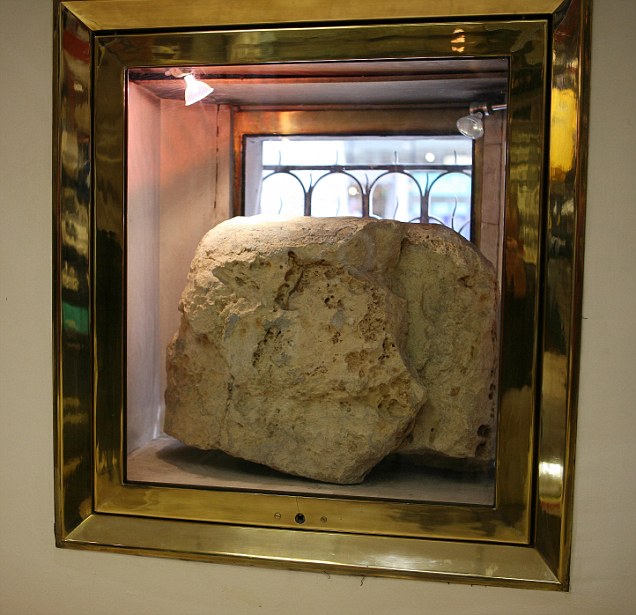
picture of london stone from the inside
Pic by Graham Hussey pic shows the LONDON STONE which is in Canon Street, London .pic taken inside the Tech Sports shop

Morgan came to the conclusion it was the stone plinth on which the original Trojan palladium had stood. This was a wooden statue of Pallas Athene, that protected Troy from invasion.  It was stolen by Odysseus and Diomedes shortly before the successful Trojan Horse plot. It was then taken to Italy.

Morgan’s idea was that King Brutus brought it from Rome when he sailed into Exile in Britain. Brutus, was a descendant of Aeneas. Aeneas was the only Trojan leader to escape from the destruction of Troy. He found his way to Rome, after leaving Dido in Carthage. He was the ancestor of Romulus who founded Rome, and the ancestor of King Brutus.

According to legend, Brutus gathered all the Trojan slaves and exiles in the Mediterranean. He then sailed to found a new Troy in our green and pleasant lands. His new capital he called Troia Nova (New Troy), which became Trinovantum, then Lud’s Dun, and finally London. Or so the Myths say.

Morgan’s theory held that the Stone was used as the altar stone of the Temple of Diana. Folklorist contend that the temple was originally on the site of St Pauls Cathedral. Morgan (in the 19th Century) was the first person to link London Stone with Brutus, or so people thought and still think (see Wikipedia). That was until 2018.

Picture of the plinth in which London stone is rehoused recently
London Stone as recently rehoused.(Photo K Flude)

John Clark

John Clark, Emeritus Curator at the Museum of London, found a reference to a narrative poem of the 14th Century. This links London Stone to Brutus and to the future prosperity of London. Just as Morgan did. So, it makes it possible, at least, that Morgan did not just make the connection but drew on a medieval ‘tradition.’

Brutus set up London Stone
And these words he said anon:
‘If each king that comes after me
Makes this city wide and roomy  
As I have in my day,
Still hereafter men may say 
That Troy was never so fair a city  
As this city shall be.’

From Burnley & Wiggins 2003b, lines 457–64(John Clark’s modern English version)

For the full story, see John Clark’s article.

London Stone & the Neolithic

Recent archaeological discoveries reveal that London was the site of Late Neolithic feasting on a possibly large scale (discussed here:). This increases the possibility that the London stone is a ‘ritual’ stone from prehistory. But, of course, there is still no evidence that London Stone is prehistoric, and even less that Brutus actually existed. 

On This Day

1472 – Orkney and Shetland are given to Scotland by Norway in lieu of  dowry for Margaret of Denmark.

1933 – Adolf Hitler meets with German industrialists to arrange for financing of the Nazi Party’s election campaign. Democracy is doomed.

Written in 2023 and revised in February 2024 and 2025 Pisces and London Stone joined into one page 2026