London Zeppelin Night September 8th 1915

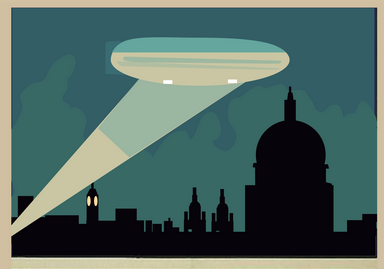
A silhouette of a Zeppelin caught in searchlights over the City of London

On the night of September 8th, 32 year old, Kapitanleutnant Heinrich Mathy piloted Zeppelin L 13 across Central London, dropping bombs as he went. This was the most damaging airship raid of the war.

Background to the War

Before World War One London was the centre of the largest Empire the world had ever known. It was the first great era of globalisation; international trade and finance was booming. London was full of the mega-rich, but poverty and substandard housing was extensive. Such extremes of rich and poor have only recently began to appear in our society.

Inner London was still the home of Industry, and home to large immigrant communities. Political dissent was widespread, with the Labour Party beginning to erode the Liberal Party’s power base. The issue of Female Suffrage was rocking society. Then, catastrophe struck as ‘the lights went out all over Europe’.

The Hague Convention in 1899 banned bombing from balloons or other aerial craft. But as the aircraft and air balloons developed, the threat moved from theoretical to actual. Zeppelins could undertake long flights at a speed of up to 47 mph. They could ascend and descend quicker than winged aircraft and achieve higher altitudes. The gas that held up the Zeppelins was held in over 200,000 bags of cattle intestines. The huge number needed in the war effort led to a shortage of sausages in Germany! But it also made them very difficult to be shot down with the technology available to Britain, France and Russia.

The Kaiser originally forbade bombing raids on London in deference to his relatives, the British Royal Family. But he progressively reduced restrictions until he allowed bombing of London itself. He first allowed bombing of the London docks on February 12th 1915, and on May 5th allowed London, East of the Tower of London to be bombed. The first Zeppelin raid on London took place on 31st May 1915. On July 20th, he allowed unrestricted bombing of London (albeit sparing historical and religious buildings).

On the 8th September, 1915 Mathy crossed the North Sea to the coast at King’s Lyne. He arrived at 8.45pm. The aircraft came South via Cambridge, Ware, circled to the North East of London and via Golders Green. Here he dropped 12 bombs at 10.40., and followed the Finchley Road to Primrose Hill, Regent’s Park. Over Euston he was at 8,500 ft, and slowed down to 37 mph.

The first incendiary bomb in Central London landed just north of Russell Square at Woburn Place.  The next one landed in the garden in the middle of Russell Sq. He dropped his first Central London explosive bomb in the garden in the centre of Queen’s Square, near the Great Ormond St Hospital, where it is marked with a plaque. He was turning east along the Theobald’s Road where he dropped a number of bombs. One hitting the National Penny Bank killing a person standing outside. Another landed on the nearby Dolphin pub, blowing out the front of the pub and killing someone standing there.   If you visit the Pub, on the wall you will see the clock that was stopped when the bomb exploded (10:40pm).

The next strike was on a cycle club, to the West of Gray’s inn. Then Gray’s Inn itself. At Portpool Lane his incendiary bombs killed three children and injured 25 others.

Maxim Gun

Near here are the workshops where Hiram Maxim developed the Maxim Gun that killed so many in the trenches in WW1. Unfortunately, the design was not kept as a state secret and in the War No Man’s Land was being strafed by British, French, German, Russian and later in American versions of the same gun. He had the idea for it when as a child his shoulder was broken by the recoil of a shotgun. He realised that the recoil could be used to load the next bullet. This created a machine gun that was far superior to the Gatling Gun.

A Bomb called the Love Gift

Hatton Garden and Farringdon were also hit, and the Zeppelin continued to Smithfield. The Zeppelin had one 660 lb bomb on board. Mathy’s ‘Love Gift’ fell on St Bartholomew’s Close. It shattered all the building fronts and killed 2 men running for cover when they emerged from a pub.

The Zeppelin kept north of St Paul’s and next bombed City workshops and warehouses in Wood St, Addle St, Basinghall St and Aldermanbury – just missing the historic Guildhall. He also failed to bomb the Bank of England which was a mere 300 yards south,

Searchlights were now scouring the sky and anti-aircraft guns were firing, but they were ;all firing too low’. An American reporter, William Shepherd wrote:

‘Among the autumn stars floats a long gaunt Zeppelin. It is dull yellow – the colour of the Harvest Moon. The long fingers of searchlights, reaching up from the roofs of the city are touching all sides of the death messenger with their white tips. Great, booming sounds shake the city. They are Zeppelin bombs falling- killing – burning. Lesser noises – of shooting – are nearer at hand, the noise of aerial guns sending shrapnel into the sky.’

The final bombs were released over Liverpool Street. Just by the station, an explosive bomb hit a No 35a bus, wounding the driver and killing the conductor and some of the passengers. Another bomb landed by a No 8 bus, killing the driver and 8 passengers.

Mathy turned north towards Edmonton and climbed to over 11,000 ft as an anti-aircraft gun on Parliament Hill put a shell uncomfortably close to the Zeppelin. He returned safely to Germany where he reported to the Kaiser. The raid killed 17 people, injured 78 and caused half a million pounds worth of damage. It was the most effective raid of the war.

The authorities in Britain were faced with a stark reality which was that a single German Airship could fly through the heart of Britain, into its Capital and bomb its people without any defensive measures capable of resisting attack. Although when we consider the horrors of civilian deaths in the 20th and 21st Centuries, the shock of random attacks on civilians should not be underestimated.

I will conclude Kapitanleutnant Heinrich Mathy’s story on October 1st, and add more images to this page.

Thanks to Ian Castle and his book ‘London 1914-17 ‘The Zeppelin Menace.

First published in 2024 and revised in 2025

To see my post war-from-the-air click here
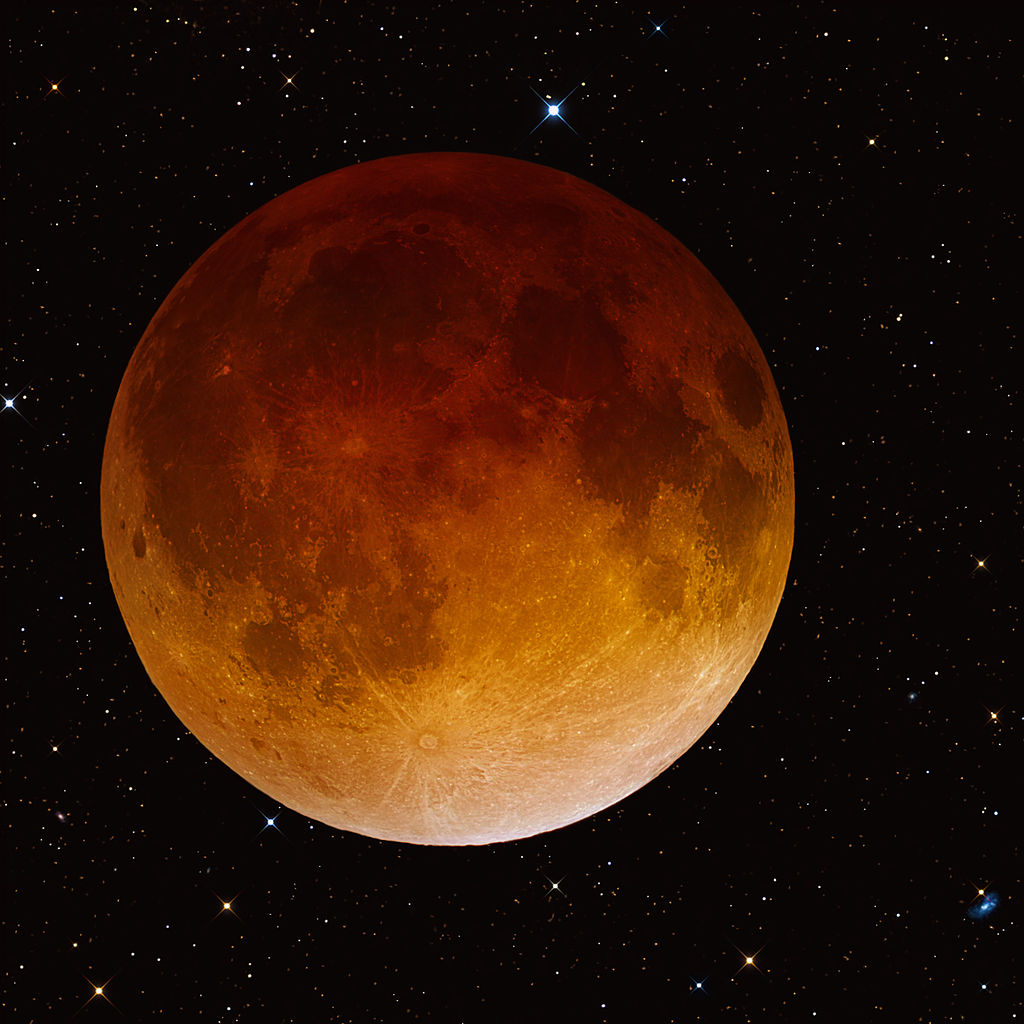

Total Lunar Eclipse of the Red Moon September 7th

Robert Jay GaBany - http://www.cosmotography.com/images/small_lunar_eclipse_04-15-2014.html

The total lunar eclipse took place on April 15, 2014. This 4 panel mosaic composite image was produced with an Officina Stellare PRO RC500 half meter telescope, an Apogee Alta U16M camera and Astrodon E-Series filters.
Robert Jay GaBanyhttp://www.cosmotography.com/images/small_lunar_eclipse_04-15-2014.html
The total lunar eclipse took place on April 15, 2014. This 4 panel mosaic composite image was produced with an Officina Stellare PRO RC500 half meter telescope, an Apogee Alta U16M camera and Astrodon E-Series filters.

Tonight, the Earth will move directly between the Sun and the Moon. This is an eclipse. The earth will block out the sun’s light which will not be reflected back to us. As we move in and out of the eclipse, the sun’s light will be scattered by our atmosphere. The blue light will be removed, leaving only the red light which has a longer wavelength. This will give the Moon a reddish colour. (https://www.bbc.co.uk/newsround/articles/czr6px4dpgmo).

The best view will be in Asia and Australia. But, here in the UK, go to a highpoint at 7.15pm and look East. It should be visible on the horizon. Clouds willing!

Celtic Eclipse

We have reason to believe the Celts celebrated the eclipse and were able to predict them. The Celtic Coligny Calendar, written on bronze and written in Celtic, shows they began their months with a full moon. The Calendar probably dates from the 1st Century BC, and is on display at the Palais des Arts in Lyon. It shows that the Celts kept a calendar which achieved complete synchronisation between the solar and lunar cycles. We, in the West, ignore the moon in how we set up our months. Of course the word month, obviously comes from the word Moon. Otherwise, our months are not at all synchronised with the moon.

Rabbit, Rabbit

The Celts celebrated the Rabbit and the Hare at an eclipse. They were very fertile and therefore linked to Aphrodite, who was herself associated with the Moon. Philostratus the Elder wrote:

For you know, I imagine, what is said of the hare, that it possesses the gift of Aphrodite to an unusual degree.‘.

For more on Hares and Rabbits look at my post here. I will be writing more about the Coligny Calendar on November 1st. In the meantime you might like to look at these posts:

First Written in September 2025

Oliver Cromwell and his Lucky Day September 3rd

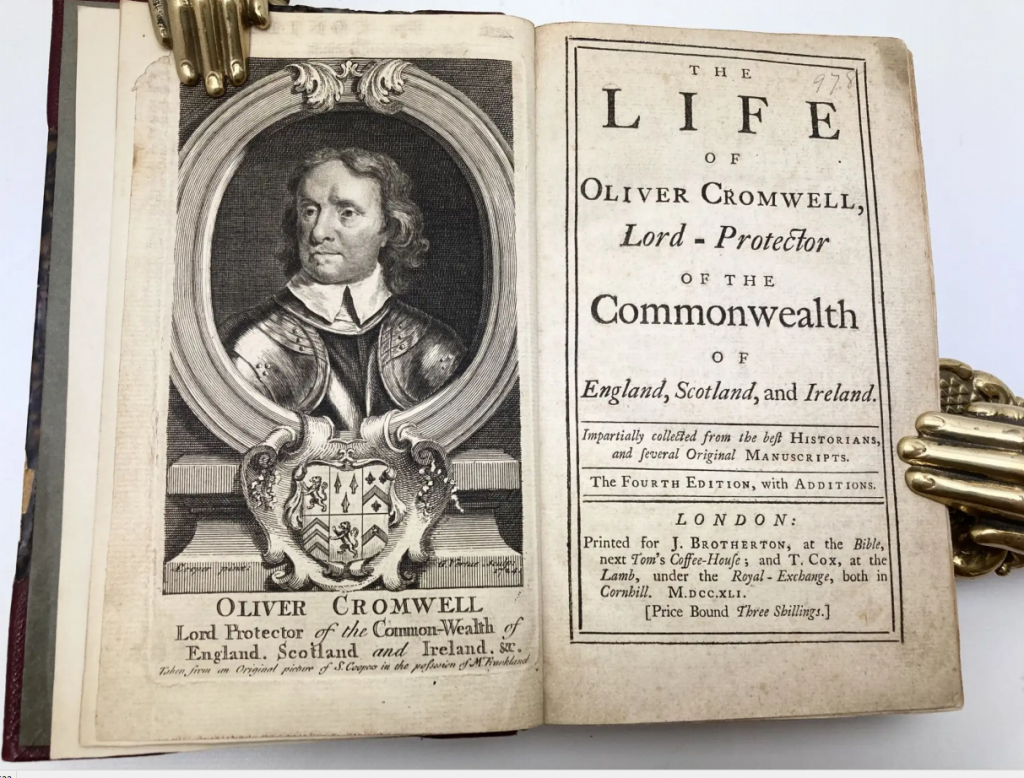
Frontispiece of ‘The Life of Oliver Cromwell’

September 3rd was Cromwell’s Lucky Day. This was because it was the date of two of his most famous victories. On September 3rd 1658 he refused to accept that he was dying because it was his lucky day.  Unluckily, he was wrong.

The Battle of Dunbar September 3rd 1650

Engraving of Charles I

After the execution of King Charles I, the Scots chose Charles II as their King. This changed the Scots from allies of the English Parliament to enemies. The Lord General of the New Model Army, Thomas Fairfax, refused to lead an attack on their erstwhile allies. So Oliver Cromwell was promoted to command. He launched a preemptive attack but the army was ill prepared, and the campaign seemed in danger of failing. They took Arthur’s seat and bombarded Edinburgh and Leith from its heights. But they could not take Edinburgh.

In need of supplies, Cromwell retreated to Dunbar, which is on the North Sea, close to the Firth of Forth. The Scots advanced on Dunbar, and Cromwell came out to meet them. After a hard battle, the English Calvary outflanked the Scots and the Battle was won. Pride, Monk, Lilburne and Lambert were all involved in the Battle. Cromwell claimed to have killed 4,000 Scots and captured 10,000. Scottish sources suggested over 1,000 Scottish casualties and 5,000 prisoners.

The Battle enabled Cromwell to seize control of Edinburgh, and Leith. So he could then cross the First of Forth and attack Fife, where he was also successful.

Cromwell interpreted the overwhelming victory as a

“A high act of the Lord’s Providence to us [and] one of the most signal mercies God hath done for England and His people”.[ (Wikipedia)

See my post on the execution of Charles 1st here:

March on England

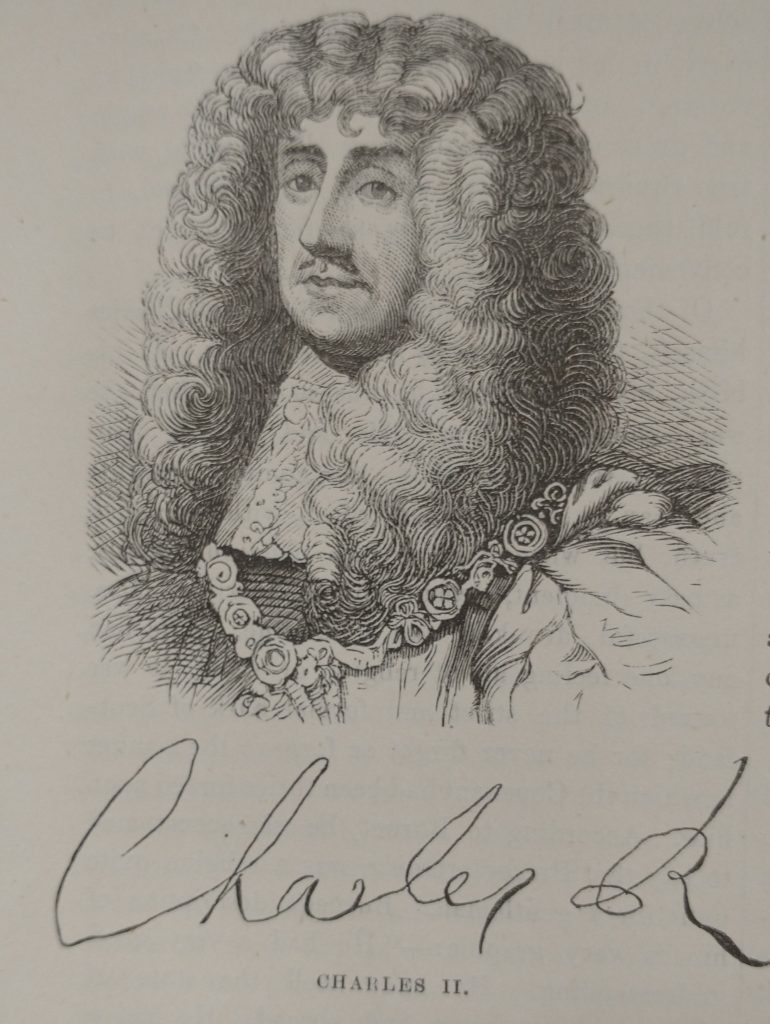
engraving of Charles II
Engraving of Charles II

Meanwhile, the Scottish Army marched South in to England. in an attempt to raise the support of English Royalists. King Charles II was now with them, They hoped Cromwell would be held up in Fife, but he wasn’t. He secured Perth and put General Monck in charge in Scotland. Lambert was sent to harrass the Scottish Army as they marched south. Meanwhile, Cromwell forced marched his way to the Tyne. General Harrison had collected fresh troops from Newcastle and joined Cromwell. Thomas Fairfax came out of retirement and raised troops in Yorkshire. The Southern troops were collected at Banbury by General Fleetwood. 14,000 militia men from the trained bands of London joined the march to intercept the Scottish Invasion.

The Battle of Worcester September 3rd 1651

The decisive battle took place at Worcester, which the Royalist occupied. It was an unusual battle in that it took place on both sides of the River Severn. Cromwell delayed the start of the battle to build two pontoon bridges. This meant he could reinforce his troops on either side of the River. It also delayed the start of the battle to his lucky day.

The pontoon bridges proved decisive. The Parliamentary side had over 30,000 troops while the Royalists only 16,000. Cromwell could shore up besieged formation with troops from the other side of the River. The Royalists were pushed back to the High Street. Here, they rallied to allow King Charles II to escape. And that was the end of the Second English Civil War. (The first being the defeat of Charles I, the second the defeat of Charles II).

Charles II made a hair-raising escape from England, hiding in an Oak Tree. Eventually, finding a ship on the South Coast at Shoreham, in Dorset to take him into a long exile. (see my post on Charles’ escape here🙂

Of the Scottish army, perhaps 3,000 men were killed and 10,000 taken prisoners. Some prisoners were conscripted into the New Model Army and sent to fight in Ireland. Many of the rest (perhaps up to 8,000) were forced into indentured labour. They were sent to New England, Bermuda, the West Indies or the Fens. Others were taken to London and detained in prison camps. One of which was at Tothill Fields in Westminster. Conditions were often appalling, leading to death by disease and malnutrition.

American Presidents pay their respects to the ‘famous’ Battlefield.

John Adams and Thomas Jefferson visited the site of the Battle in 1786. Adams reported:

‘The people in the neighborhood appeared so ignorant and careless at Worcester that I was provoked and asked “And do Englishmen so soon forget the ground where liberty was fought for? Tell your neighbors and your children that this is holy ground, much holier than that on which your churches stand. All England should come in pilgrimage to this hill, once a year”‘

And indeed will now only see the battle as one of the many battles of the Civil War. Generally, we are not aware of its special significance.

Cromwell’s Death September 3rd 1658.

By now, the Monarch in all but name, Cromwell, the Lord Protector fell ill, probably of malaria. Then, when weakened, his kidney stone infection turned to septicemia. On August 30th, there was a mighty storm, the like Europe had not seen for hundreds of years. And there was talk of the Lord taking him away in the furious storm. As he weakened he was asked to name his successor. He appeared to affirm when the name of his son Richard was spoken to him. But, it wasn’t very clear. He rallied, perhaps hoping that if he could survive to September 3rd, he would overcome his illness.

On the day, he said to his doctors ‘I tell you I shall not die this hour; I am sure on’t …. I speak the Words of Truth upon surer grounds than Galen and Hippocrates furnish you with.’

But he died on his lucky day. He was given a splendid funeral and was buried in state among the Kings and Queens in Westminster Abbey. And then in 1660 dug up, executed posthumously at Tyburn and buried under the Gibbet.

See my post on the Puritans’ abolition of Christmas here:

See my post on John Evelyn’s diary entry on the Restoration of Charles II to the throne.

First written in September 2025

Dame Leonora Bennet. Died September 5th 1636, Uxbridge

Dame Leonora Bennet d.1636

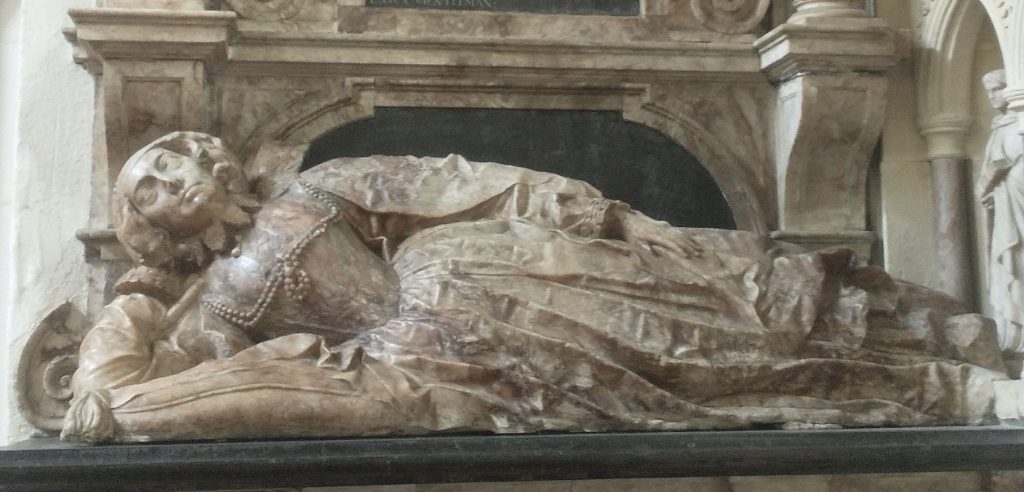
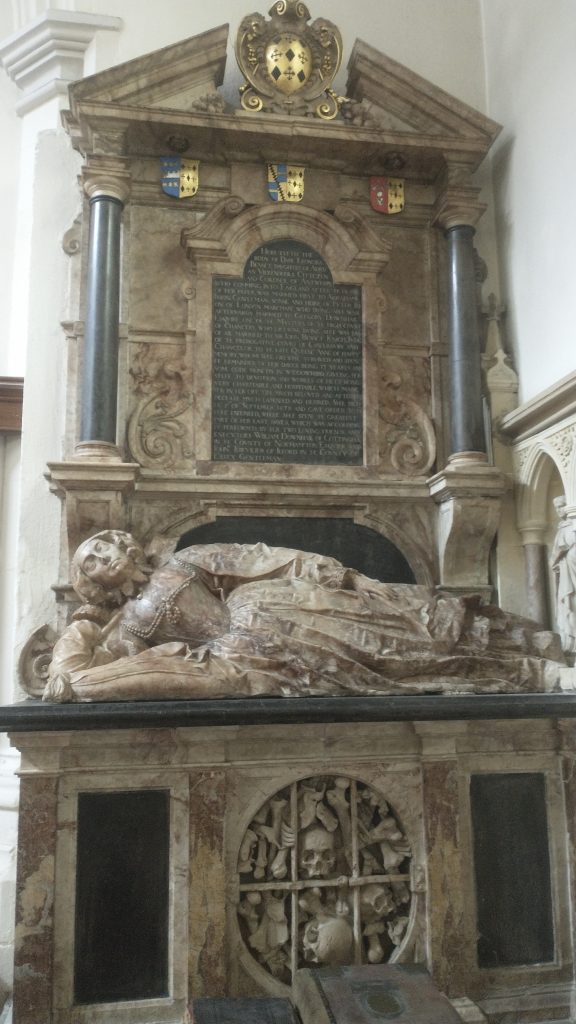
Love this monument in St Margaret’s Uxbridge to Dame Leonora Bennet.

She lies there resting on her arm with an insouciant air. She had three husbands before spending the rest of her life on good works. And the sculptors John and Matthew Christmas seem to me portray her as an attractive woman.

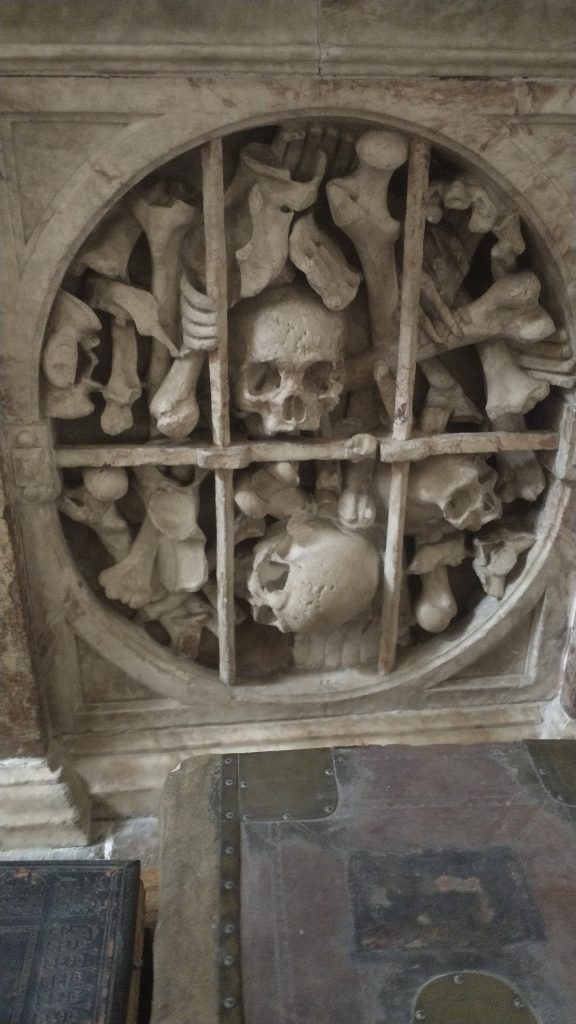
Love the contrast with the glimpse into the Charnel House below with the jumbled bones almost fighting to get out.

The Tomb of Leonora Benet. St Margaret’s Church, Uxbridge.
The scene from the charnel house at the bottom of the tomb of Leonora Benet. St Margaret’s Church, Uxbridge.

Last Surrender World War 2 September 4th 1945

I’m going to let this Quora answer speak for itself today. This is by Daniel Tiede and is his nomination for the last Germans to surrender in World War Two. You can find the article here:

St Giles Day and Cripplegate September 1st

Public domainThe Master of St Giles, National Gallery. ‘St Giles and the Hind’
This work is in the public domain in its country of origin and other countries and areas where the copyright term is the author’s life plus 100 years or fewer.

St Giles

Today, is St Giles’ Feast Day. His story is mostly unknown, but his legend holds that he was a hermit who had a pet Hind in the Arles District of France sometime after the fall of the Roman Empire. The hounds of King Wamba (a Visigothic King) were chasing the deer, and shot an arrow into the undergrowth. The King and his men followed to discover Giles wounded by the arrow, protecting the hind, who he held in his arms. The hounds were miraculously stayed motionless as they leaped towards the hind. Wamba, which apparently means ‘Big paunch’ in Gothic, also had a Roman name: Flavius. Giles was injured in the leg, although the image above shows the arrow hit his hand. Wamba set him up as an Abbot of a Benedictine Monastery.

St Giles is, therefore, the patron saint of disabled people. He is also also invoked for childhood fears, convulsions and depression. He was very popular in medieval Britain, with over 150 churches dedicated to him, including four in London. Perhaps the two most famous are St Giles Without Cripplegate in London and St Giles Cathedral in Edinburgh.

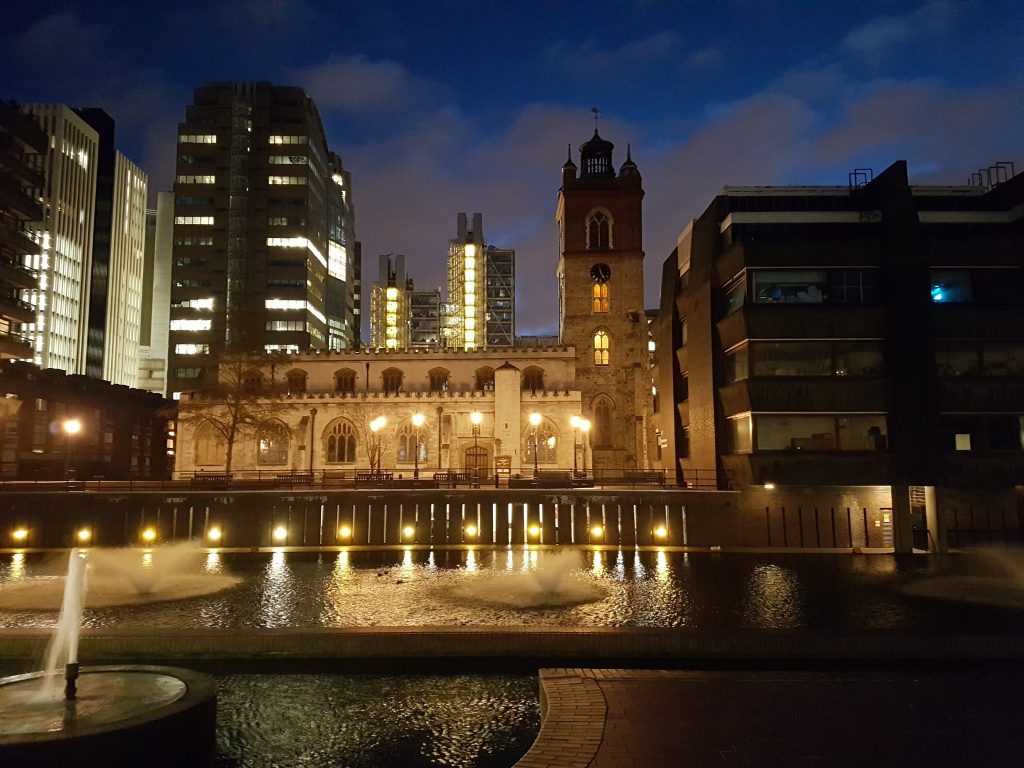
St Giles Cripplegate, photographed by the Author at night from the Barbican Centre.

St Giles Cripplegate

St Giles was built in the 11th Century, rebuilt in the 14th Century and again in 1545-50 after nearly being destroyed by fire. It survived the Great Fire of London, being just beyond the extent of the Fire. But it was badly damaged in the Blitz, although the Tower and the outer walls survived.

Oliver Cromwell married Elizabeth Bourchier here. John Foxe of the Book of Martyrs, John Speed, the Cartographer, Martin Frobisher, the explorer and John Milton, the Poet were buried here.

Shenanigans with Milton’s Coffin

Milton’s coffin was opened in 1793 and he was said to have looked as if he had just been buried. One of those present, then, had a go at pulling Milton’s teeth out. A bystander helped by hitting his jaw with a stone. The few teeth Milton had left in his head were divided between the men, who also took a rib bone and locks of his hair. The Caretaker then opened the coffin for anyone who wanted to see the corpse!

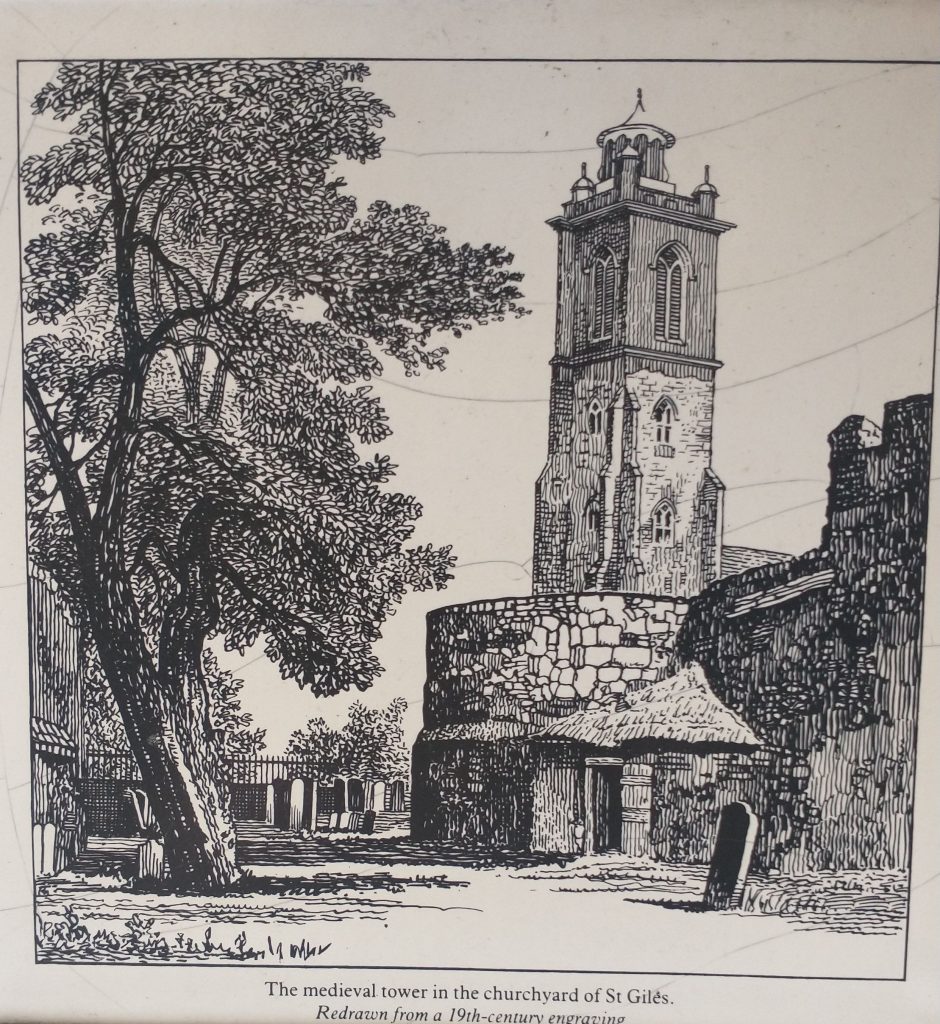
From the London City Wall Trail.

Cripplegate

St Giles is without Cripplegate. It is one of the Gates in the City Wall (originally the North Gate of the Roman Fort). It may be named because St Giles made it agood place to gather for those trying to beg alms for their disabilities. An alternative explanation it from the Anglo Saxon crepel, which is an underground tunnel which is said to have run from the Gate’s Barbican to the Gate. Or perhaps because of the cure of cripples when Edmund the Martyr’s remains passed through the Gate in 1010.

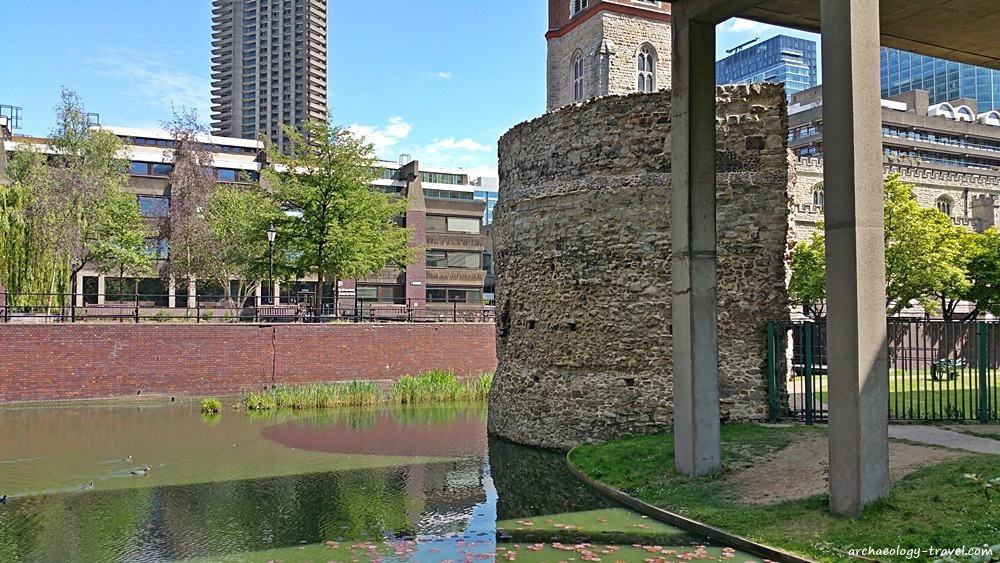
The Corner Tower of the London City Wall, the Barbican in the background, and the tower of St Giles’ Church behind the Tower. Photo by the author

First Published in September 2024, and revised in 2025.

September – ‘Winter’s Forewarning and Summer’s Farewell’

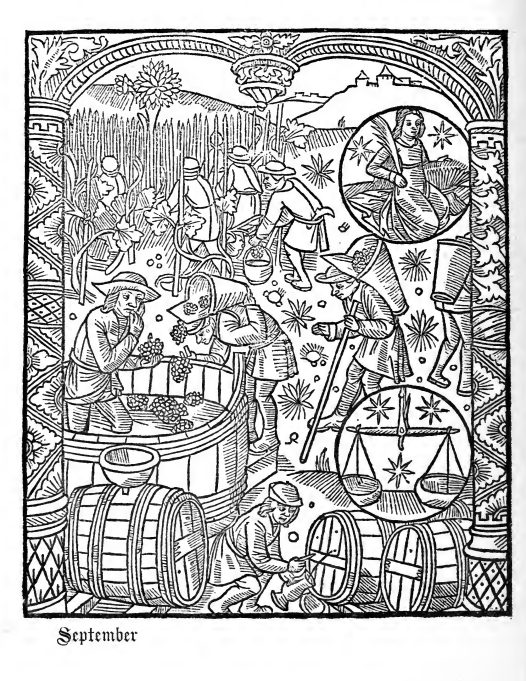
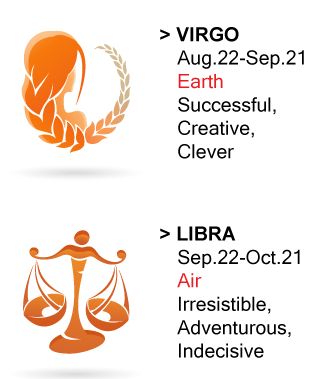
Kalendar of Shepherds illustration of September showing harvesting grapes and the astrological signs for Virgo (August 23 – September 22) and Libra (September 23 – October 22)

It is that time of the year when you say ‘Where has the Summer gone? It can’t be September already?’ But, meteorology, speaking, Autumn starts today. September 1st was chosen on a numerical basis for ease of measuring rather than any profound floral, agricultural or solar reason. So, there are three Gregorian Calendar months for each season, and each season starts on the first of the month. Autumn: September, November and December.

Autumn, Harvest, Fall

Autumn comes from Latin (autumnus) which went into French and then into English. The season was also called Harvest (which went into Dutch herfst, German Herbst, and Scots hairst -Wikipedia) or from the 16th Century: the ‘fall of the year’ or ‘fall of the leaf’ which spread to America as Fall.

Summer’s Ending

It still feels like summer. In England, we often have a glorious September, and what we can an ‘Indian’ Summer, an unexpectedly warm period in mid-September to October.

Solar Autumn

Of course, for the real Autumn, we have to wait for the Equinox, the beginning of Astronomical or Solar Autumn. This year, it is on Monday, September 22nd, 2025, 7:19 pm.

Astrological September

The star signs for astrological September are: Virgo which is linked to Aphrodite (Venus) the Goddess of Love and Libra which is linked to Artemis (Diana), virgin goddess of many things, including hunting, wild animals, children, and birth.

Star signs for September

September

September gets its name from the Romans, for whom it was the 7th Month of the year (septem is Latin for seven). Later, they added two new months so it became our 9th Month. (For more on the Roman year, look at my post here).

It is called Halegmonath in the early English language, or the holy month, named because it is the month of offerings, because of the harvest, and the mellow fruitfulness of September? Medi in Welsh is the month of reaping, and An Sultuine in Gaelic which means the month of plenty.

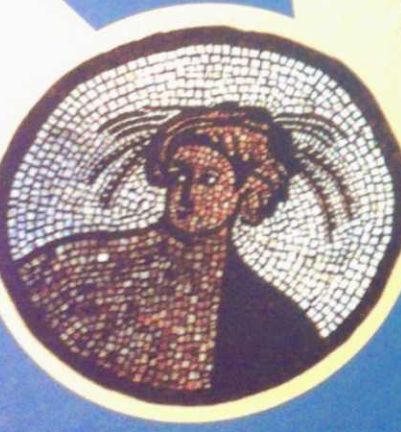
Roman personification of Autumn from Lullingstone mosaic

Early Modern September and the autumn of Life

Here is an early 17th Century look at September from the Kalendar of Shepherds – for more on the Kalendar, look at my post here.

From the Kalendar of Shepherds

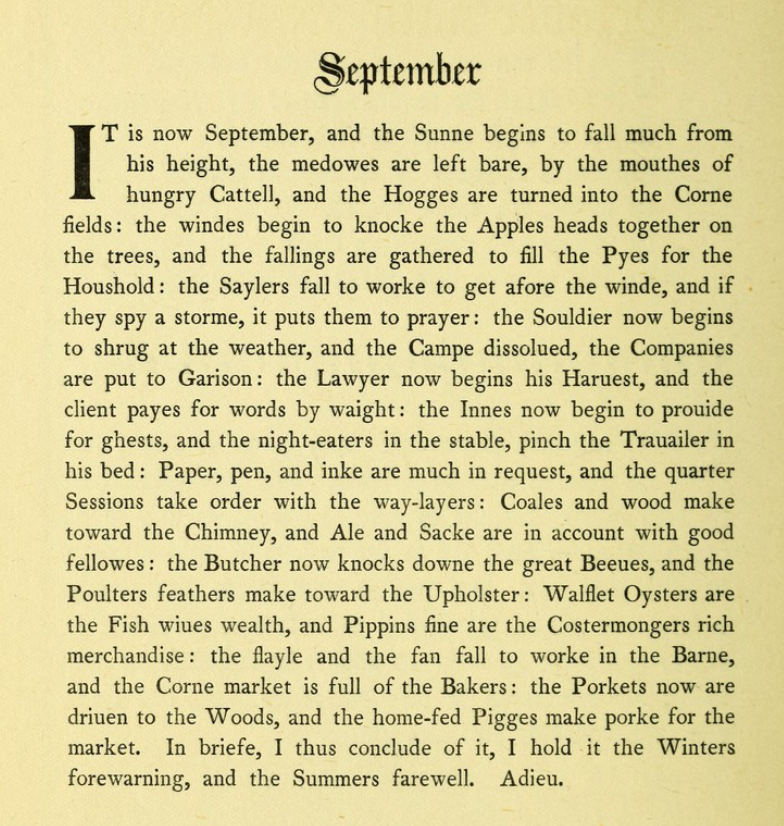
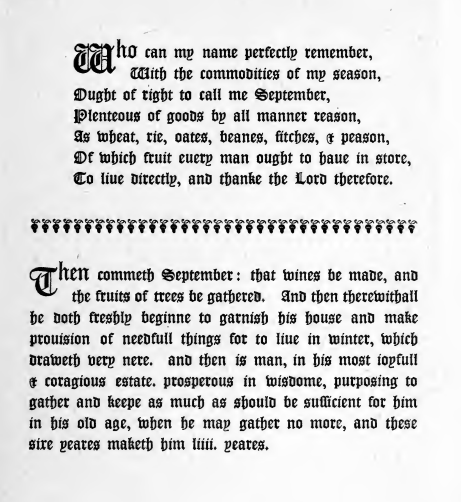
The Kalendar has an additional shorter look at September (see below). And it continues with its theme, linking the 12 months of the year with the lifespan of a man – 6 years for each month. So September is a metaphor for man at 56 years of age, in their prime and preparing for old age.

September from the Kalendar of Shepherds. The last sentence beginning ‘and then is man’ shows the link between September and the beginning of the autumn of life.

Season of ‘mists and mellow fruitfulness

John Keats (1795 – 1821) wrote a great poem called ‘To Autumn’:

Season of mists and mellow fruitfulness,
  Close bosom-friend of the maturing sun;
Conspiring with him how to load and bless
  With fruit the vines that round the thatch-eves run;
To bend with apples the moss’d cottage-trees,
  And fill all fruit with ripeness to the core;
    To swell the gourd, and plump the hazel shells
  With a sweet kernel; to set budding more,
And still more, later flowers for the bees,
Until they think warm days will never cease,
    For summer has o’er-brimm’d their clammy cells.

Who hath not seen thee oft amid thy store?
  Sometimes whoever seeks abroad may find
Thee sitting careless on a granary floor,
  Thy hair soft-lifted by the winnowing wind;
Or on a half-reap’d furrow sound asleep,
  Drowsed with the fume of poppies, while thy hook
    Spares the next swath and all its twined flowers:
And sometimes like a gleaner thou dost keep
  Steady thy laden head across a brook;
  Or by a cider-press, with patient look,
    Thou watchest the last oozings, hours by hours.

Where are the songs of Spring? Ay, where are they?
  Think not of them, thou hast thy music too,—
While barred clouds bloom the soft-dying day,
  And touch the stubble-plains with rosy hue;
Then in a wailful choir the small gnats mourn
  Among the river sallows, borne aloft
    Or sinking as the light wind lives or dies;
And full-grown lambs loud bleat from hilly bourn;
  Hedge-crickets sing; and now with treble soft
  The redbreast whistles from a garden-croft,
    And gathering swallows twitter in the skies.

Written September 19, 1819; first published in 1820. This poem is in the public domain and available here:

First published September 2024, revised 2025

Maponus & the Clochmaben Stone August 31st

Maponus was a Celtic God of Youth, linked, in the Roman period, to Apollo.  He held sway in Gaul and Britain and is attested by Roman inscriptions.

Here is an example from Ribchester in Lancashire.  This is from a Roman Cavalry Fort, founded c 70AD

To the holy god Apollo Maponus for the welfare of our Lord (the Emperor) and of Gordian’s Own Unit of Sarmatian cavalry of Bremetennacum Aelius Antoninus, centurion of the Sixth Legion Victrix, from Melitene, acting-commander and prefect, fulfilled his vow willingly, deservedly. Dedicated 31 August in the consulship of the Emperor Our Lord Gordian for the second time and of Ponpeianus.

(RIB583) Roman Inscriptions of Britain.

The supplicant Aelius Antoninus was stationed at Ribchester which the inscription refers to as Bremetennacum, but he is from Melitene, which is on the Euphrates. (RIB583)

With the inscription was a sculpture of Maponus showing him with a cloak but naked and with a lyre and possibly a quiver of arrows.  There were also two women one  young, largely naked and crowned. The other full clothed. One theory is that they are personifications of the place and the province. Perhaps they are the Divine Mother  and a lover?  You can read more about this inscription on this wonderful Roman Inscriptions site: https://romaninscriptionsofbritain.org/inscriptions/583

Maponus was the divine ever-youthful God.  He is mentioned on the Celtic Coligny Calendar.  This is a very rare inscription which is written in Celtic, and explains the Celtic Calendar.

On it the 15th day of the month of Riuos is marked with the word “Mapanos”. This around the end of August and suggests the Altar might have been raised on the feast day of Maponus.

Maponus & Oengus mac Óc

Maponus is associated also with the Irish Divine Boy  Oengus mac Óc. Son of the Dagda. There is more about Oengus and Maponus if you read this post.  But from it I got this lovely quotation:

 “And he was a beautiful young man, with high looks, and his appearance was more beautiful than all beauty, and there were ornaments of gold on his dress; in his hand he held a silver harp with strings of red gold, and the sound of its strings was sweeter than all music under the sky; and over the harp were two birds that seemed to be playing on it. He sat beside me pleasantly and played his sweet music to me, and in the end he foretold things that put drunkenness on my wits.”

Clochmabon or Lochmabon stone. 

This is a stone surviving from a 9 stone megalithic circle on the shore of the Solway Firth in Dumfries and Galloway, Scotland. It was built around 3200 BC. (The stone fell over in 1982 and radio-carbon dating produced the date quoted here.)

The granite stone is 7 feet tall and 18 feet wide weighing 10 tons (10,000 kg).  It has been identified as, possibly, the place called ‘Locus Maponi’ on the 7th Century  Ravenna Cosmography.  In historic times it was a meeting point for armies, for truces and prisoner exchanges.  Also used for community for local gatherings and markets. It was at one time the marker for the Border, and is near to Gretna Green.

Maponus appears to have been of special importance in the North West, and it is interesting how the stone retained its importance into the Christian era.

For more on Lochmabon look here

For more on Coligny see my post

First written in August 2025

Battle of Crécy August 26th 1346

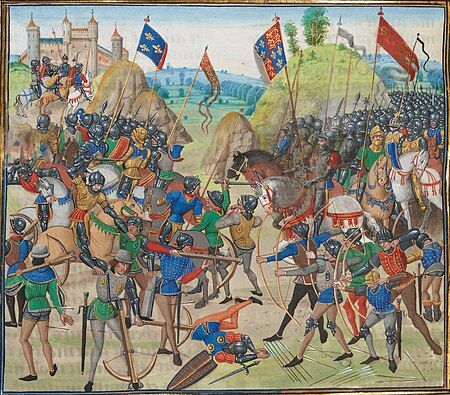
Jean Froissart - From Chapter CXXIX of Jean Froissart's Chronicles. From Wikipedia ,
Battle of Crécy Jean Froissart’s Chronicles (Wikipedia)

The Battle of Crécy was one of the most decisive victories in the Middle Ages.  Events began with King Philip VI of France declaring the English land in France forfeit.  Henry, Earl of Derby made significant gains in Gascony for King Edward III but then was besieged by the French. He demanded support from the English King. 

So King Edward gathered an army and landed in Normandy.  It was the largest invasion force until D-Day.

Edward burnt his way to Paris.  Within 2 miles of Paris Edward was confronted by superior forces and trapped on the wrong side of the Somme. His army was starved by the French scorched earth policy.

The English, only 6 miles away from the French Army forced their way across a defended tidal ford. Here they broke into an area which had not been scorched and were able to  resupply. This success also restored English moral as the French defenders could not stand against the longbow men.

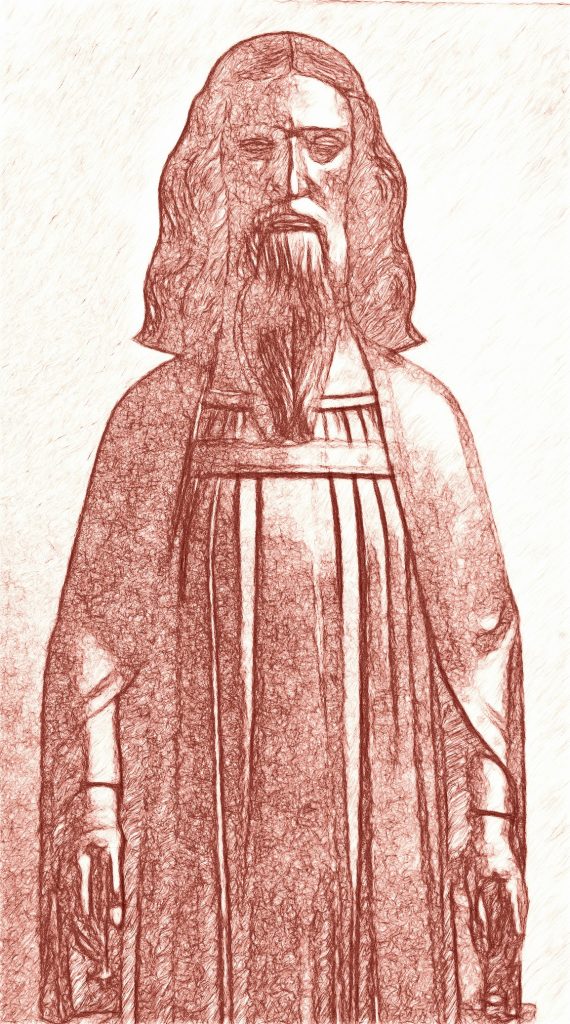
Sketch of statue of Edward III from Westminster Abbey

King Edward set up a defensive position at Crecy-en-Ponthieu, on land he owned.  It offered protection from flanking attacks and an uphill struggle for the French attackers.  The English dug pits to make French attacks more difficult. The English were badly outnumbered.  Estimates vary but the French at least had double the number of troops.  The English had about 15,000 troops, the French between 30,000 and 100,000.

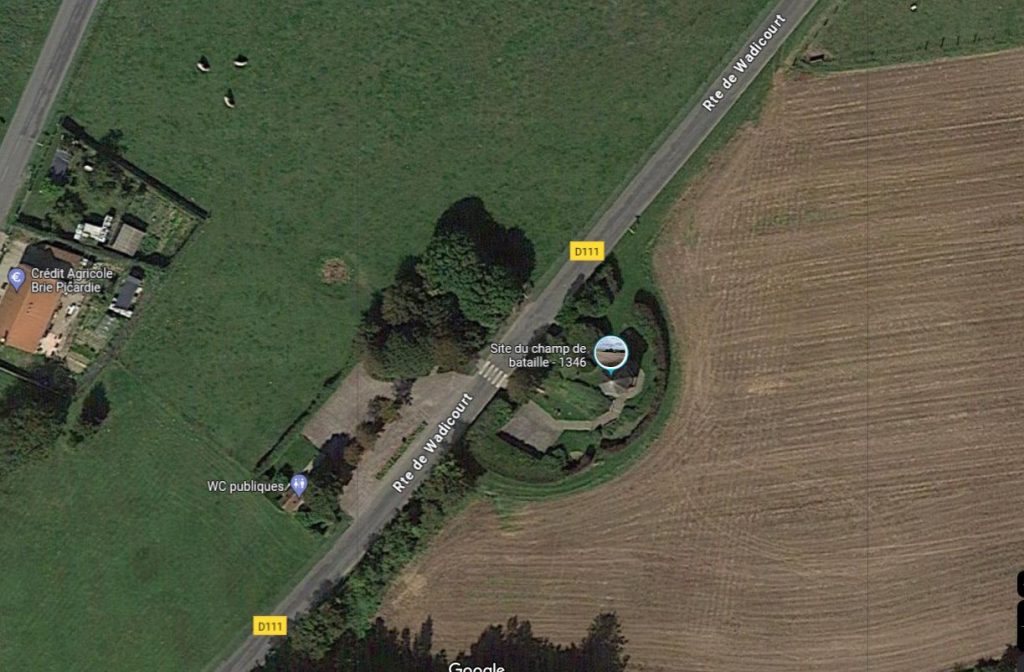
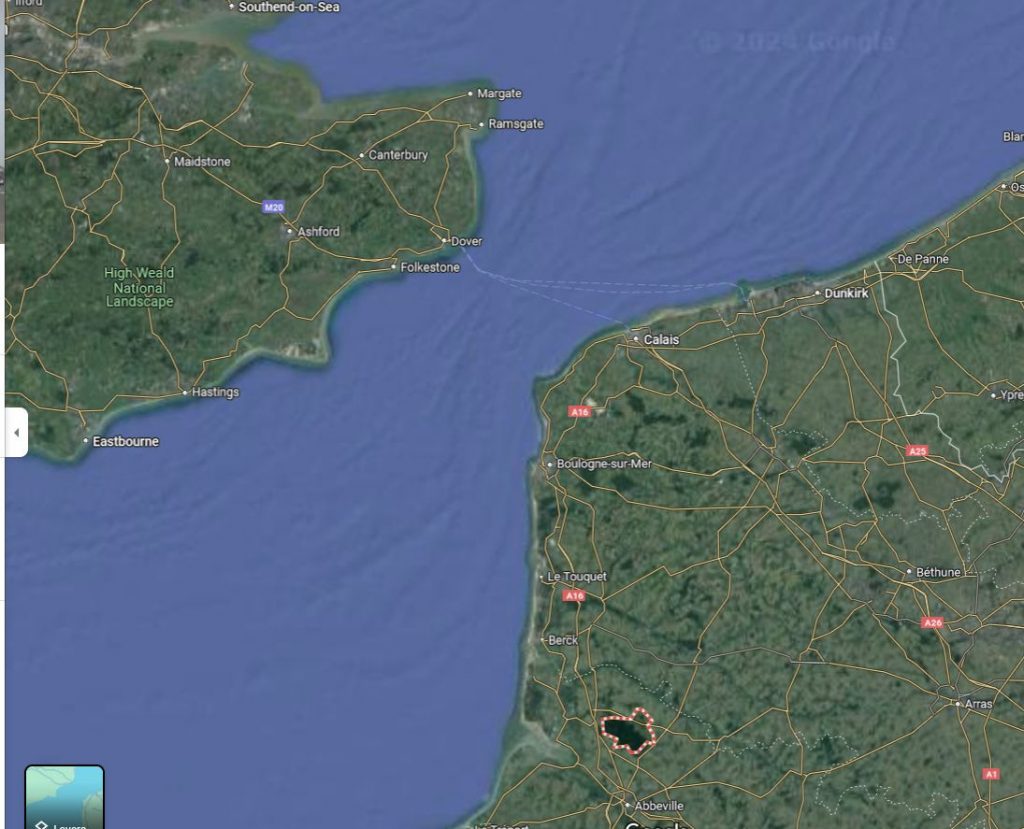
Aerial view of the battle site according to Google.

The first attack came from Genoese crossbowmen but the English and Welsh longbow men had the advantage of range and the Italians soon retreated.  French men-at-arms attacked in some confusion, killing Genoese as they attacked but were repulsed after terrible fighting.  Wave after wave of French attacks followed. None succeeding.  At the end of the two day battle very few English men were killed and many thousands of French, including the flower of the nobility.

English losses were 300 or less and the French lost are sometimes estimated as 30,000, but a third of that is probably more realistic.

The battle changed opinions about British fighting ability, and showed that heavily armoured wealthy knights could not stand against trained yeoman archers armed with long bows.  The archers could shoot 3 arrows a minute with a range of up to 300 yards. There may have shot half a million arrows.

But it can also be argued that the victory lulled the English into the belief that they could hold France. This led to the fruitless slaughter of the 100 years war which England ultimately lost.

On the other hand Edward III captured Calais which remained an important and strategic asset until the 16th Century.

Google image with the Crecy  in the orange bounded area bottom middle of the screen

Source of image: Jean Froissart – From Chapter CXXIX of Jean Froissart’s Chronicles, example source at http://www.maisonstclaire.org/resources/chronicles/froissart/book_1/ch_126-150/fc_b1_chap129.html

First published 2024, revised 2025

Bartlemas – Bartholomew Fair August 24th

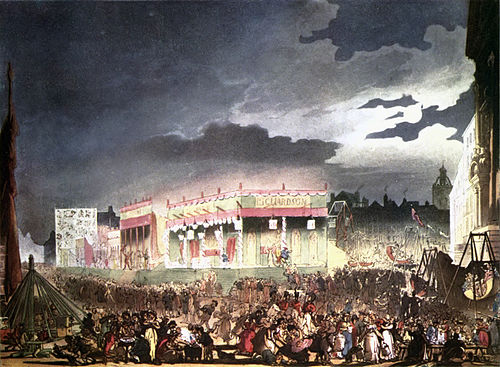
Bartholomew Fair as illustrated in 1808, Wikipedia Public Domain. Thomas Rowlandson (1756–1827) and Augustus Charles Pugin (1762–1832) (after) John Bluck (fl. 1791–1819), Joseph Constantine Stadler (fl. 1780–1812), Thomas Sutherland (1785–1838), J. Hill, and Harraden (aquatint engravers)

The Fair began in 1133 a few years after the foundation of St Bartholomew’s Priory 1123. Smithfield held a weekly livestock market. But on St Bartholomew’s Day they held an annual Fair.  It was originally 3 days long but expanded to 2 weeks by 1753. It became the chief wool fair for England by 17th Century. But it was also rowdy and in 1691, it was reduced to 4 days, and suppressed in 1855.

Ben Jonson wrote a marvellous play called Bartholmew Fair first performed in 1614 at the Hope Theatre on Bankside. In it, he portrays the characters who attended the Fair. There is a ballad singer who sings & sells printed ballad sheets. He spots where his customers keep their money purses. And signals to an accomplice cutpurse who steals the money. Then there is the horse-seller who cheats his customers with his tricks which make an old nag seem like a frisking colt. The Ale Wife in the beer tent froths up the beer, to short measure the beer drinkers, then whips away the beer pot before all the ale is finished, reselling the dregs. There is an absurd Puritan, pompous Citizens,  a puppet show, the pig with two pizzles, and other freak shows.

Pie Powder Court

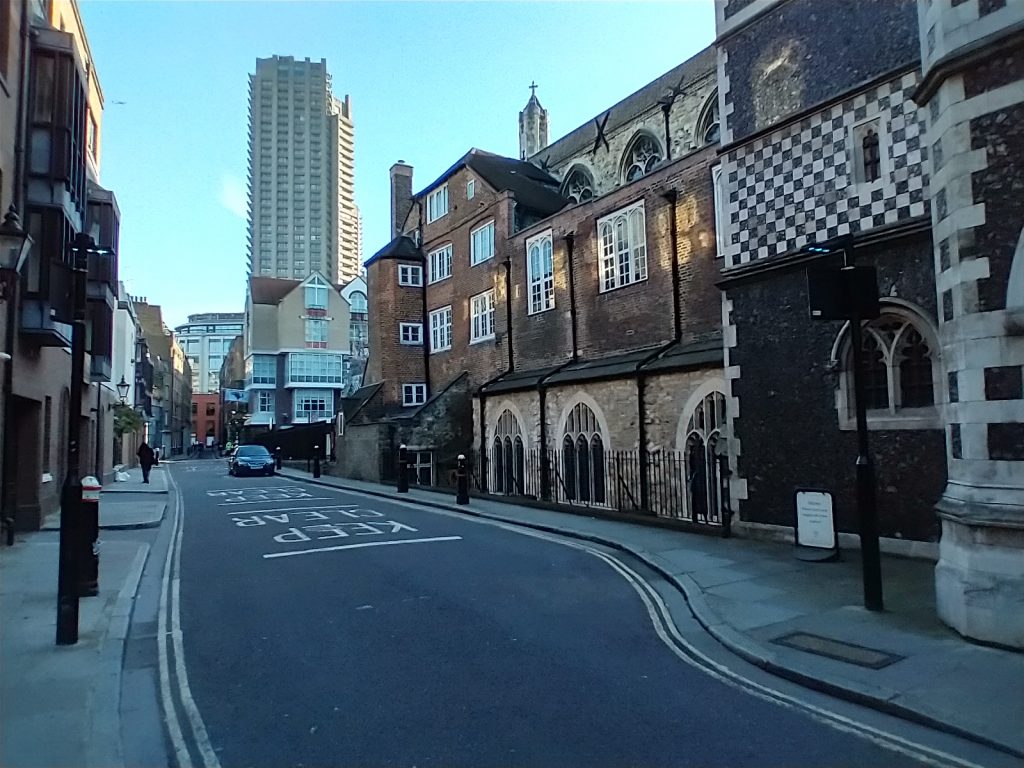
Cloth Fair, looking towards the Hand & Shears which where the Pie Powder Court was held.

Malfactors at the Fair could expect punishment at the Pie Powder Court, which was held in Cloth Fair at the Hand and Shears which is still a delightful London Pub.

Pie Powder might be derived from the French Pié a Foot, and Poudre Dust. Perhaps because the rustics came from the country with dusty Feet. (Guy Miege, The New State of England, 1693). Or could it be a reference to a Pie, which is the name that was given to a Magpie. Magpies have a folk reputation for theft and might have appeared on the Court sign.

See https://thingsturnedup.uk/tag/pie-powder-court

For my post on magpies, click here

St Bartholomew

St Bartholomew was one of the Apostles. But in case you haven’t heard of him he is identified as the same person St. Nathaniel.

The argument goes that Nathaniel was the son of Tolma or Bar-Tolmai, hence aka Bartholomew. He converted the King of Armenia, but the King’s Brother had him skinned alive. His eyes and tongue remained intact and he continued to proclaim the Gospel until he was beheaded.

So, being skinned he is the patron Saint of butchers, skinners, tanners, bookbinders, and all leather workers. Also of those suffering from skin diseases. He is the patron saint of Benevento, where his relics reside.

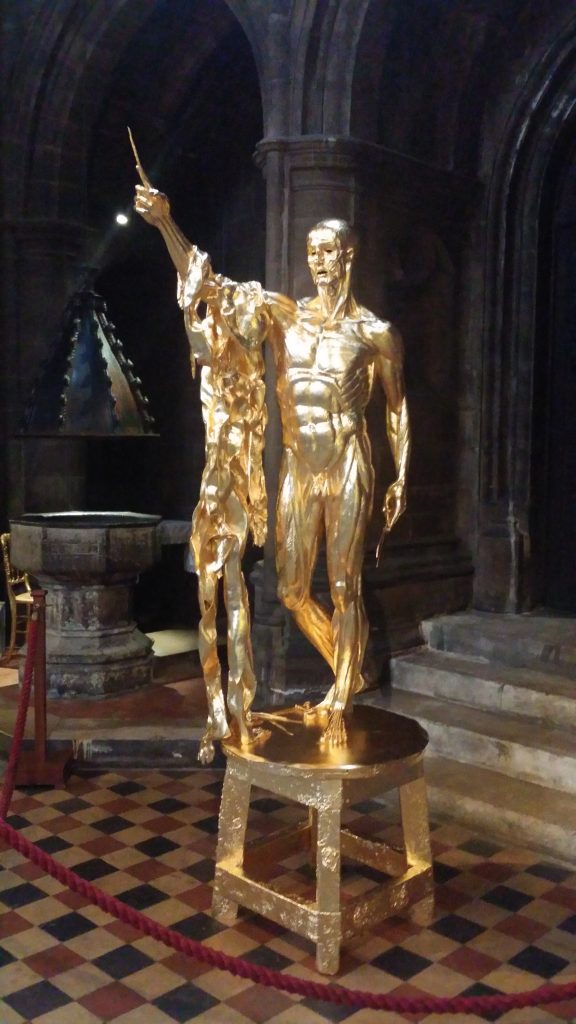
His martyrdom is depicted by Michaelangelo. And in the very marvellous St. Bartholomew’s Church in Smithfield, London, there is a golden sculpture of St Bart. by our very own Damien Hirst.

St Bartholomew by Damien Hirst, St Bartholomew’s the Great, Smithfield, Photo Kevin Flude

Bartlemas Weather Lore

If Bartlemas Day be fine and clear

You may hope for a prosperous autumn that year.

But it was also said that ‘St Bartholomew brings the cold dew’

It was also the day that might end the 40 days of rain brought by a wet St Swithun’s Day. (If such a long period of summer rain has ever occurred).

All the tears. St Swithin can cry
St Barthelmy can wipe dry.

See my post on St Swithun here

Also on this day:

Black Bartholemew Day

The St Bartholomew’s Day Massacre August 24th 1572.

This was the day when the Protestants of Paris were massacred. Up to 30,000 huguenots were killed in a massacre that spread from Paris to the countryside.  It happened following a rapprochement between the religions and the marriage of the Catholic Marguerite de Valois and Huguenot Henry de Navarre on 18 August.  Henry was heir to the throne, and prominent protestants were in fiercely Catholic Paris for the celebrations.  Riots followed assassination attempts, and attempted genocide followed.  Much like the St Brice’s Day Massacre in 1002 when the English King ordered the death of all Danes.

The French massacre  led to wholesale emigration of the Protestants to the UK.  William Shakespeare lodged with a Huguenot family in London.  Being highly educated and skilled the immigrants generally did very well in England but the size of the wave wasn’t without opposition. 

First published August 2025

Join the Mailing List

For occasional news of events