
St Chad
Today, is the Feast Day of St Chad who died on 2nd March 672. St Chad’s Church, Hackney is 400 yards from my house. It is a massive late 19th Century Church. Grade 1 listed built by James Brooks in 1869 in ‘his austere and muscular red-brick Gothic.’
![Chad is the patron saint of medicinal springs,[37] although other listings[38] do not mention this patronage.
St. Chad's Day (2 March) is traditionally considered the most propitious day to sow broad beans in England.](https://www.chr.org.uk/anddidthosefeet/wp-content/uploads/2024/03/haggerston_may_2020.jpg)
St Chad’s Church Haggerston, London. Photo K Flude

Chad was possibly of Celtic origins but associated with the Anglian nobility in Northumberland. He was a pupil of St Aidan who set up the Holy Island of Lindisfarne. As a young man, he spent time in Ireland, then became an Abbot, Bishop to the Northumbrians at York, and to the Mercians at Lichfield. His brother was St Cedd, who was important in early Christian Essex and Yorkshire.
Chad was very humble, refusing to ride around his diocese, preferring to walk, Whenever there was a violent storm, he would prostrate himself to pray to save his people. The weather, he believed, was one of the ways God communicated. This might reflect Chad’s Celtic origins. Chad is the patron saint of medicinal springs according to one source. St. Chad’s Day (2 March) is said to be the best time to sow broad beans in England. You see he is a humble man.
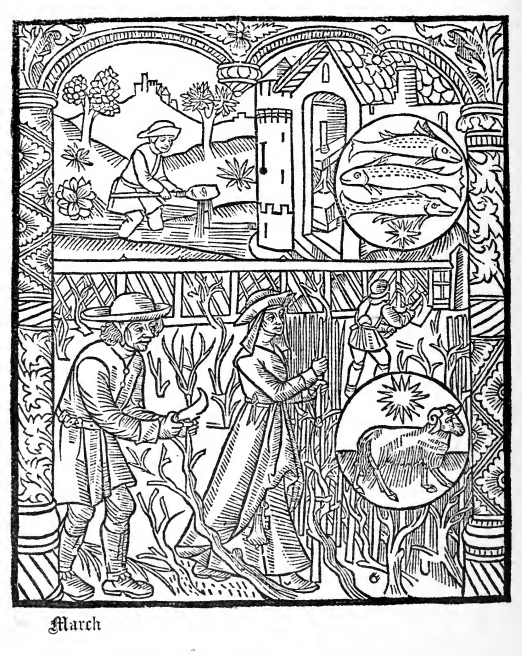
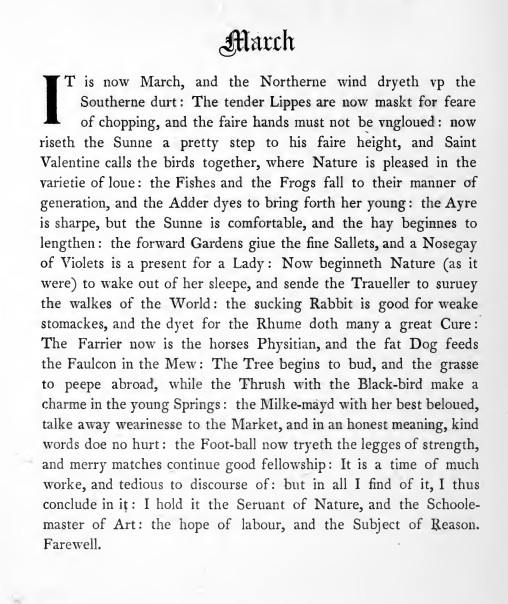
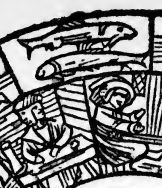
March & Pisces

Roman Months, Weeks (hours, minutes and 24/7, 60/360)
I have been discussing the way the Roman Calendar used to work. Now it is our turn to look at the week. A week is a division of a month.
Oxford Languages says that the month derives from:
Old English mōnath, of Germanic origin; related to Dutch maand and German Monat, also to Moon.
Its length is roughly the length the moon takes to complete its cycle. So the obvious division of the month is into the phases of the Moon. The early Romans chose to keep the lunar associations with their division of the month. Their month was divided according to the Moon’s phases into the Kalends, the Nones and the Ides, as I describe in my Ides of March post here. Note that these Roman divisions divide only half the cycle. That is from new moon to full moon. The next 15 days are one block ‘before the Kalends’. So, not weeks as we know them! Although alongside Kalends, nones and ides, the Romans had 8 day market ‘weeks’.
Julius Caesar’s successful calendar reforms, restored the Calendar to alignment with the Sun, but stopped any pretence that months were linked to actual movements of the moon. So, I’m not sure why he kept the moon based Kalends system.
For more on Roman months, see my post on the Ides of March.
Constantine and the Week
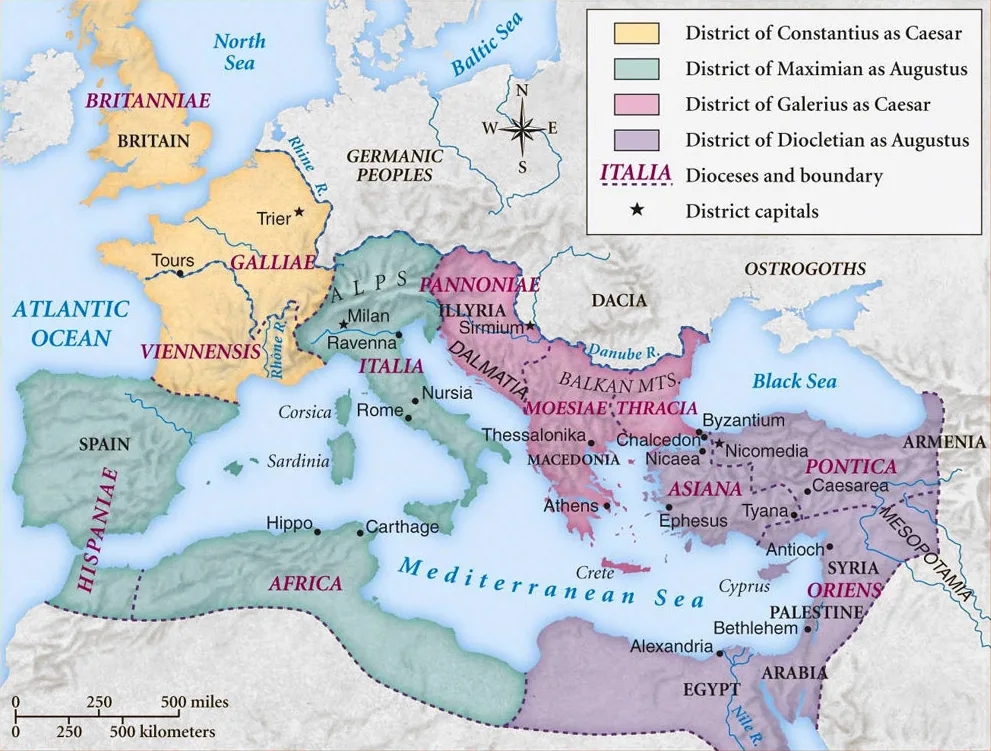
In the 4th Century, after re-uniting the Roman Empire, supreme leader, Constantine the Great, wanted to make his own contribution to the rationalisation of the calendar. So, he got rid of the moon based Kalends, Ides and Nones, and established the week as the main subdivision of the month.
To please the Christians, he swopped the day of leisure from old man Saturn’s Day to the Son of God’s Day, Sunday. This is the day Jesus ascended to heaven, but it was also the day for Mithras and the Unconquered Sun, so keeping some pagans happy. He then established the 7 day week. 7 was a sacred number and the number of the ‘planets’ in the Solar System as the Romans understood it (5 planets plus the sun and moon).
In Britain, we clung to some of our pagan names for the weeks. So Saturday, Sunday and Monday are Roman in origin. The Latin origins of the days of the week are obvious in the Romance languages, French, Spanish and Italian. Lundi from the moon, Mardi from Mars, Mecredi from Mercury, Jeudi from Jupiter, and Vendredi from Venus. Samedi came from Saturn. Dimanche from dies Dominica which means the Lord’s Day.
Tuesday – Friday are Anglo Saxon, named after the deities: Tiv, Woden, Thor, and Freya. Thank God its Freya’s Day, they probably didn’t say! (because they worked on Saturn’s Day.)
The Heavens and the Zodiac
The order of the days comes from their position in the sky. Not in their position around the Sun but their position in the zodiac. Babylon created the scheme of a division of the sky into 24 hour long sections, a god presided over each division. This is where we get our hours from. And half of 24 is 12 so the 12 signs of the Zodiac.
It is too complicated to explain but there were 7 deities and 24 divisions, so the deities rotated and did more than one shift. Babylon used the numerical base of 60. So we have 60 seconds in a minute, 60 minutes in an hour, 360 degrees in a circumference.
Other societies ignored hours until we had clocks to measure them. In Chaucer’s time, hours were a 12th of the Day and a 12th of the Night, so in summer, day time hours were longer, and nighttime hours shorter, and vice versa in winter. Those hours were called ‘artificial hours’. This makes a sort of sense – in winter, daytime hours are precious, so you get a shift on to get essential work done in the short hours of daylight. In summer, you have a long day, long hours, so you can take it a little easier. Therefore, your productivity in a winter hour might be similar to your productivity in a longer summer hour? Anglo-Saxons divided days by tides; morningtide, eventide and nighttide.
Ages of man
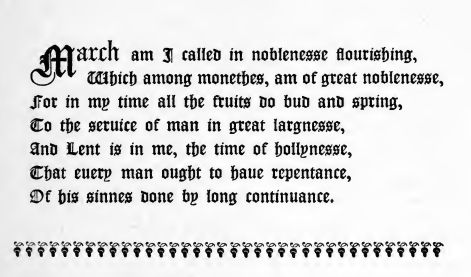
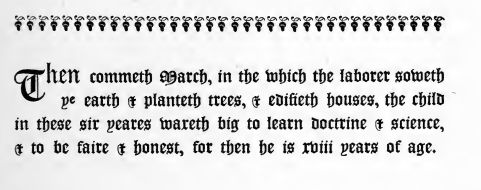
As I have mentioned before, prophecy often sees a connection between the yearly calendar and future events. For example, if it rains on the fourth day of the twelve days of Christmas, then it will rain during the fourth month (they say). The Kalendar of Shepherds illustrates this method, giving a comparison between the ages of man and the months of the year. Twelve months in a year, Twelve ages of man in six year blocks. So March represents ages twelve to eighteen, as it says, below, this is the ‘time to learn doctrine and science’.
On This Day
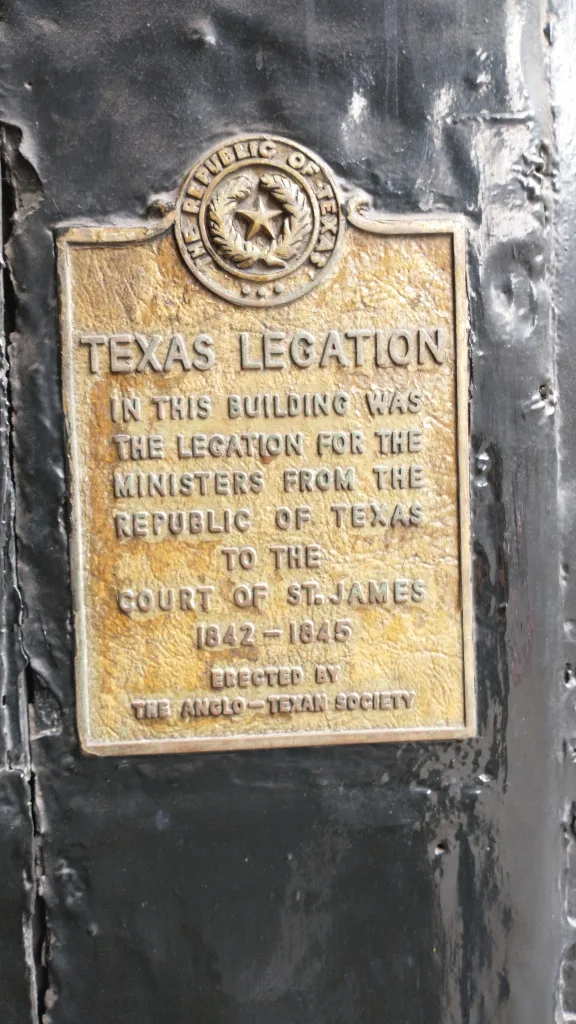
1836 – The Republic of Texas is set up as an independent State. The Alamo fell on March 6, 1836, but the Texans soon defeated the Mexicans and made the Republic a reality. It was annexed by the United States on December 29, 1845 and soon made a State.
While researching my Jane Austen’s London Walk I was delighted to find this plaque on a wall in Mayfair.

1969 – First flight of the Concorde, first supersonic aeroplane
1970 – the Republic of Rhodesia was set up by the Southern Rhodesian colonial government of Ian Smith. They declared a Unilateral Declaration of Independence (UDI) in 1965 in order to stop the transition to Black Majority Rule. The Republic of Zimbabwe took over on April 18th, 1980, after a bloody war.
First written in March 2023 revised on 2nd March 2024, St Chad added 2025, On This Day added 2026