This post slipped through the editorial net. So, I need to get it out there before November is a cold memory.
November is the 9th Month of the Roman Calendar. Novem coming from the Latin for nine. But the Romans added two months to the calendar during the time of the Dictator, Julius Caesar (for his reforms click here). So 9th month is now the 11th.
In Welsh it is ‘Tachwedd’ which means the month of slaughtering. Blōtmōnaþ (Blotmonath) in Anglo -Saxon – the month of blood. These reference the fact that this was the month when the surplus animals were slaughtered or as the historian, Venerable Bede has it, ‘the month of immolations’. In Irish the month of November is called sawhain. It is also the name of the festival marking the beginning of winter which starts at dusk on 31st October. We call it Halloween, the celts Sawhain or words similar. (see my post on Halloween).
The image, at the top of the page, from the Kalendar of Shepherds shows some aspects of November – star signs Scorpio and Sagittarius; Pigs are fattening up on the acorns in the forest and then being slaughtered, smoked or dried to preserve them through the hard winter. The text of the Kalendar (read it below) gives a good summary of what early modern life in November was like. In summary, the day when the ‘poore die through want of Charitie’.
They can be seen from Autumn to Spring, but they are visible all night in the Northern Hemisphere in November and December.
Nebra Sun disc from Stonehenge Exhibition British Museum. The Pleiades is thought to be represented by the 7 stars in the cluster above and between the Sun and the Cresent Moon, on this bronze age copper and gold disc
The frosty month of the French Revolutionary calendar.
The rational calendar divided the year into twelve 30-day months, plus 5 days for end of year festivities. And a leap year every 4 years.
Weeks were 10 days long, 3 per month. Days were named first day, second day, third day up to tenth day. There were ten hours in a day, 100 minutes per hour, and 100 seconds per minute. But this last part didn’t last very long, French people really objected to their day and hours being mucked up.
Revolutionary period pocket watch
The Revolutionary Year was adopted in 1793 but began retrospectively from September 22nd, 1792 commemorating when the Republic was proclaimed. Thereafter, the First Republic started on: Le premier Vendémiaire de l’an 1.
Napoleon gave it up as a bad job in 1806, and restored the Gregorian Calendar.
For my fuller explanation of the French Revolutionary Calendar click here).
On this Day
1847 James Young Simpson wrote an account of his testing of Chloroform for use as an anaesthetic. It was published in the medical journal, the Lancet. Chloroform was invented in 1831, used on animals successfully in 1842. But it was considered too dangerous for humans.
Simpson and his two assistants were in the habit of meeting in his Edinburgh house, at 52 Queen Street, in the New Town. There they tested new chemicals. He obtained some Chloroform, for the three of them to try. They found themselves merry, and the next thing they remember was waking up to a new dawn.
Chloroform is more effective than Ether, but the margin of error is tighter. Simpson and his friends were lucky the chosen dose didn’t kill them. Nor did the sudden unconsciousness knock them out or injure them.
They then tried it on his niece, Miss Petrie. Success meant it was set to become the anaesthetic of choice, particularly for childbirth, for the next 100 years.
1877 Thomas Edison announced the invention of the phonograph. This ushered in a new age of inexpensive recordings of music. Musicians feared it meant the end of the careers of most musicians. And indeed, it had profound effects, but live music survived. And so we hope it will also survive AI.
Wikipedia describes the process that produces the music for the gramophone, as:
The sound vibration waveforms are recorded as corresponding physical deviations of a helical or spiral groove engraved, etched, incised, or impressed into the surface of a rotating cylinder or disc, called a record.
First published on November 21st 2022, republished on November 21st 2023, 2024, 2025
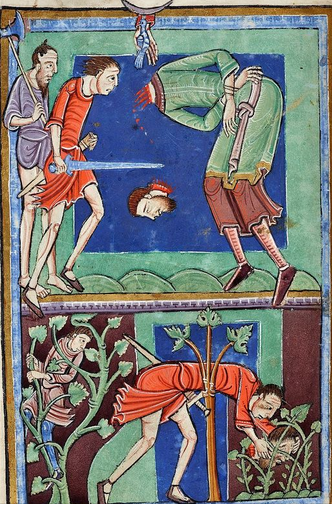
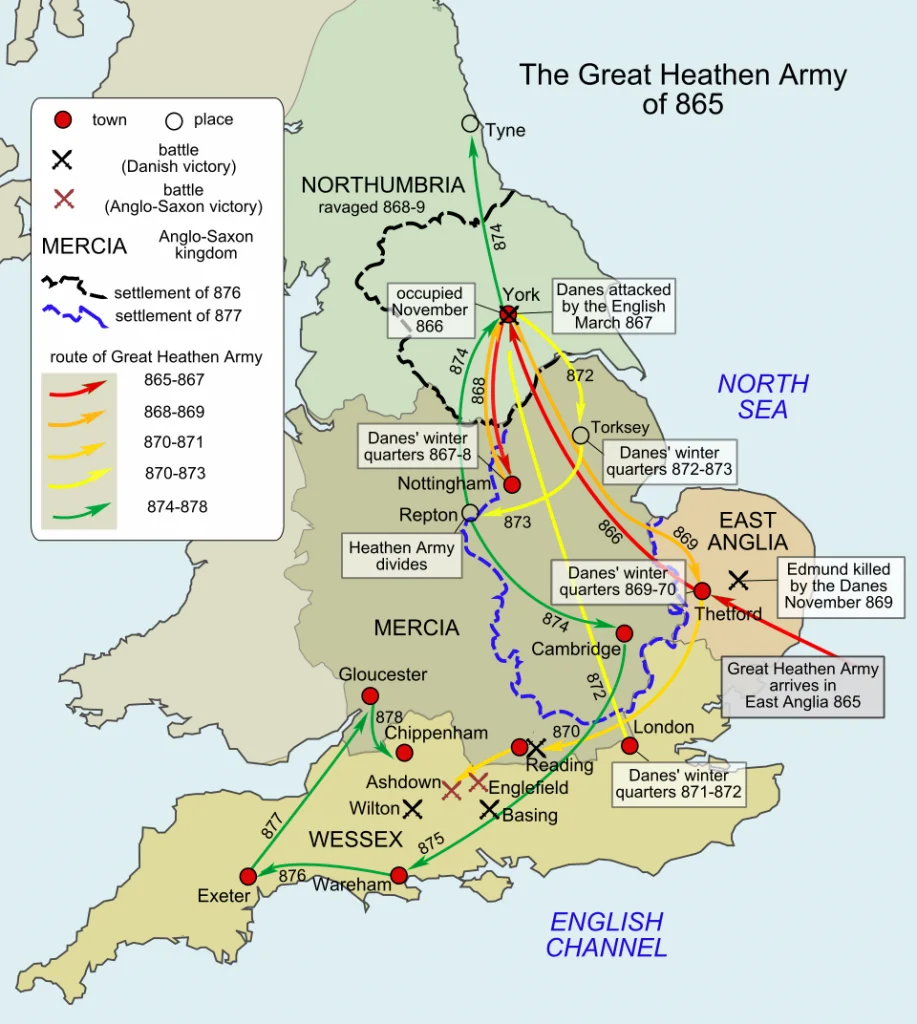
He was killed with an arrow by Vikings from the Great Heathen Army in 869. He was trying to convert them to Christianity, and they were trying to do the opposite. So, fed up, they tied him to a tree, shot him full of arrows and then beheaded him.
Based on Stenton ‘Anglo-Saxon England’ chapter 8 and Hill ‘ An Atlas of Anglo-Saxon England’ pp. 40-41By Hel-hama – Own work, CC BY-SA 3.0, https://commons.wikimedia.org/w/index.php?curid=20042870
Afterwards, the English set up a search party to find their King. As they passed nearby, his head shouted ‘Here! Here! Here!’ So they were able to retrieve his head. His remains were eventually taken to Bury which was renamed Bury St Edmunds. It became one of the most famous places of pilgrimage in England.
As a Royal martyr he was, with St Edward the Confessor, the saint of the monarchy. Being Kings themselves, they could explain to St Peter how difficult it was to be a King. Kings, they would explain, have to undertake actions which might be strictly against the Ten Commandments. King Edmund and King Edward could thus speed the King through to heaven from purgatory.
St Edmund Lombard Street (church at bottom left) Agas Map 16th Century
The City of London has a church dedicated to St Edmund, King, and Martyr. It is in Lombard Street, coincidentally, right above the South West corner of the Roman Forum. St Peter’s (29) top right corner is above the NE corner of the Forum, and St Michael’s which I think is no 27, above the North West corner. It is entirely possible their positioning original owed something to the masonry of the original Roman building. (click here to read my post about St Lucius and St Peter’s Church.)
St Edmunds is first mentioned in 1292, and rebuilt by Christopher Wren after the Great Fire of London. It was hit by bombs dropped from a German Gotha bombing on On 7 July 1917. It was also damaged in World War 2.
November 20th the day to Grow Garlic
Set garlic and beans, at St Edmund the King The moon in the wane, therefore hangeth a thing.
Quoted in Perpetual Almanac of Folklore Charles Kightly
Garlic is either a wondrous ‘healall’ for the rustics as Galen said. Or a foul herb detested by right-thinking people, (such as Horace and Shakespeare; ‘The breath of Garlic-eaters’ Coriolanus). In 1916, the British Government called for as much Garlic as could be produced at a good price for use as antiseptic for wounds. (Mrs Grieve’ A Modern Herbal’).
Garlic ….. mingled with soft cheese ‘stauncheth’ the falling down of humours called catarrh and so is good against hoarseness’.
William Turner Herbal 1568
On this Day
1917 Tanks were used effectively for the first time in warfare at the Battle of Cambrai. For more on Cambrai read my post here🙂
1947 Princess Elizabeth married her distant cousin Philip Mountbatten (He was created the Duke of Edinburgh on the evening before the wedding) Philip was renowned for his gaffes: ‘Do you still throw spears at each other?‘ he said to native Australians. And of himself he said: As so often happens, I discovered that it would have been better to keep my mouth shut.’ For more of Philip’s gaffes please look at The BBC’s page here.
1945 The Nuremberg Trials began. (Fascinating new film called Nuremberg currently showing! I ‘can recommend it. And it has clear lessons for future generations in how to deal with totalitarian evil).
2024 the Cambridge Dictionary announced that ‘manifest’ was the word of the year. The reason is that the word has been used in a very different way, and acquired a whole new definition and receiving many more mentions on the internet.
The new definition of the word is:
“To manifest” in the sense of “to imagine achieving something you want, in the belief doing so will make it more likely to happen”.
As in:
I’m manifesting my belief that this blog will go viral next year with the help of all my loyal readers who will recommend it to all their friends and, particularly, their acquaintances, and social media contacts!
For more information on the word of the year, have a look at this page on the BBC.
2025 This year the Cambridge Dictionary word of the year is ‘Parasocial’. They define it as:
‘involving or relating to a connection that someone feels between themselves and a famous person they do not know, a character in a book, film, TV series, etc, or an artificial intelligence’.
First Published Nov 20th 2022. Republished Nov 20th 2023, 2024,2025
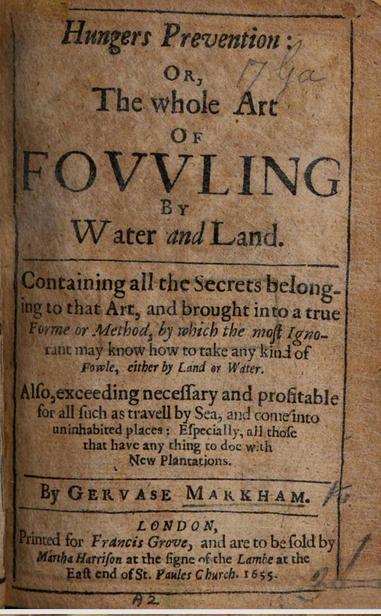
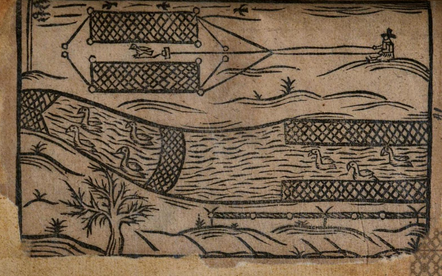
Gervase Markham Hungers Prevention: or, the Whole Art of Fowling by Water and Land. (Printed, London: for Francis Grove, 1655).
This was the period of the year for ‘Night-fowling’. Gervase Markham wrote a whole book about it in the 17th Century. It was called Hungers Prevention: or, the Whole Art of Fowling by Water and Land. (Printed London: for Francis Grove, 1655).
In it, he tells the reader to go to ‘a stubble field in November when the air is mild and the moon not shining. There take a dolorous low bell, and net. Spread the net over the stubble where there may be fowl, ring the bell, light fires of dry straw, and the fowl will fly and become entangled in the net.‘
Title illustration from Gervase Markham Hungers Prevention: or, the Whole Art of Fowling by Water and Land. (Printed London: for Francis Grove, 1655).
In Britain today, the Wild fowling season is from 1 September – to 20th February and largely takes place on the marshes and foreshore.
Duck, Geese, waders and other birds are the quarry. Species involved include: Gadwall goose, Canada goose, Common snipe, Coot, Goldeneye duck, Greylag goose, Golden plover, Moorhen, Mallard, Pink-footed goose, Jack snipe, Pintail, European Woodcock, white-fronted goose, Pochard, Scaup1, Shoveler, Teal, Tufted duck, Wigeon
‘3.5 billion people (who) still live without safely managed sanitation, including 419 million who practise open defecation.’
That is a third of the world’s population if my figures are correct. It also impacts particularly badly on women in those areas where decent hygiene cannot be guaranteed.
These are the ‘Key messages you should know on World Toilet Day’
Toilets are a place for peace. This essential space, at the centre of our lives, should be safe and secure. But for billions of people, sanitation is under threat from conflict, climate change, disasters and neglect.
Toilets are a place for protection.By creating a barrier between us and our waste, sanitation services are essential for public and environmental health. But when toilet systems are inadequate, damaged or broken, pollution spreads and deadly diseases get unleashed.
Toilets are a place for progress. Sanitation is a human right. It protects everyone’s dignity, and especially transforms the lives of women and girls. More investment and better governance of sanitation are critical for a fairer, more peaceful world.
First published Nov 19th 2022. Republished Nov 19th 2023, 2024, 2025
Following Martinmas, farmers used to slaughter a good many of their animals because of the difficulty of feeding them during the winter. So this was the time to make sausages from all that meat and guts. Follow this link for a Tudor Sausage recipe.
Pigs were a very productive part of the Medieval and Early modern farmers’ economy. Almost as much pork was eaten as lamb. The upper classes, of course, preferred beef. But even the lowliest family would keep a pig. They would be pastured in forests, commons and fallow fields around the village, foraging for themselves on whatever they could get. In Autumn, they would be taken to specially grown copses of pollarded oak groves. The farmers pollarded the trees to keep them short and bushy. They could use the wood they pruned for wood working projects, or for firewood. When the acorn season came, they would hit the low branches with cudgels to release a lovely torrent of acorns on the floor for the pigs to feast themselves upon. So they grew fat for Martinmas when they were slaughtered.
Another benefit for a community of peasants living on the margin was that the sow might have 6 – 14 piglets. When the time came to slaughter the pig, the small holder could swap piglets with others, and share the bounty of the slaughtered animal. This would be reciprocated, and help made good food available more of the time.
A silhouette of a Zeppelin caught in searchlights over the City of London. Zeppelins
Sausages were severely rationed in Germany in World War 1 because they used nearly 200,000 cattle guts to make gasbags for each of the Zeppelins that bombed London. This made them very difficult to shoot down as the gas was held in so many separate bags.
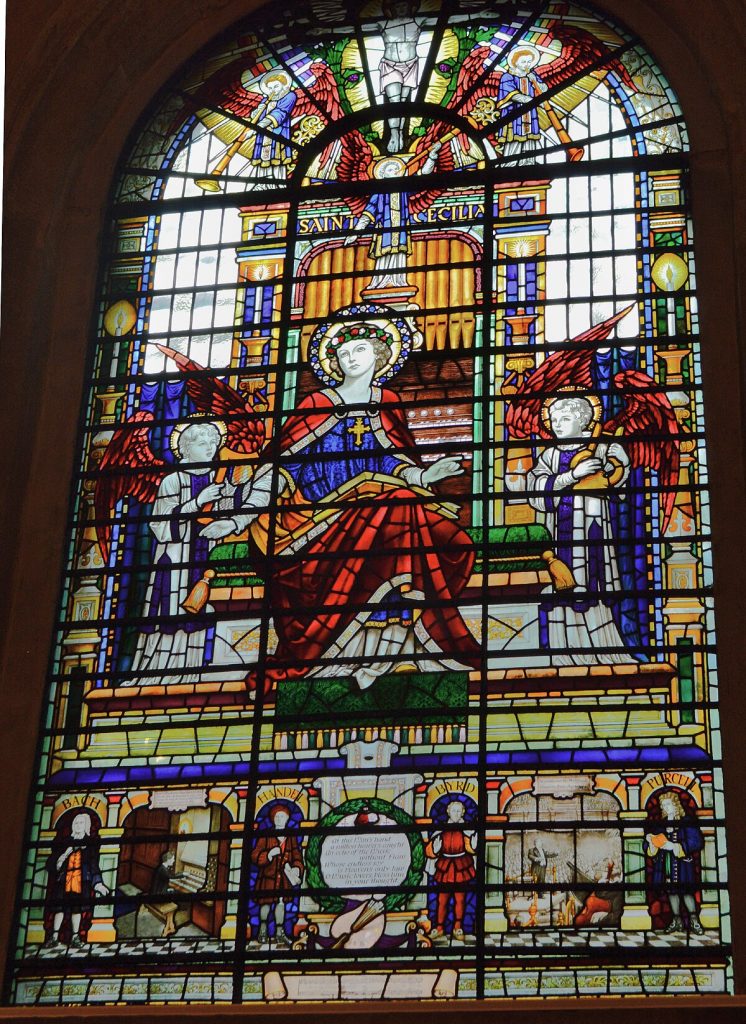
St Sepulchre-without-Newgate, Musician’s Chapel, St Cecilia window. 17 August 2022, Andy Scott
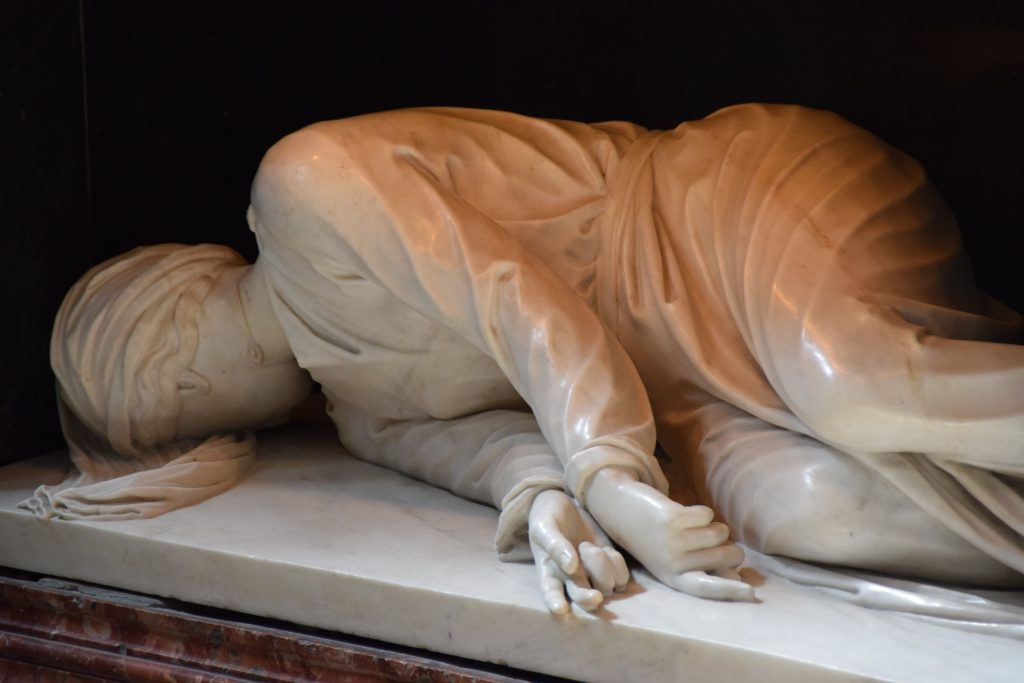
November 17th is St Cecilia’s Day She is the patron saint of musicians and was martyred in Rome in the Second or Third Century AD. The story goes that she was married to a non-believer. During her marriage ceremony she sang to God in her heart (hence her affiliation with musicians). She then told her husband that she was a professed Virgin. So, if he violated her, he would be punished by God. Cecilia told him she was being protected by an Angel of the Lord who was watching over her. Valerian, her husband, asked to see the Angel. ‘Go to the Third Milestone along the Appian Way’ he was told where he would be baptised by Pope Urban 1. Only then would he see the Angel. He followed her advice, was converted and he and his wife were, later on, martyred.
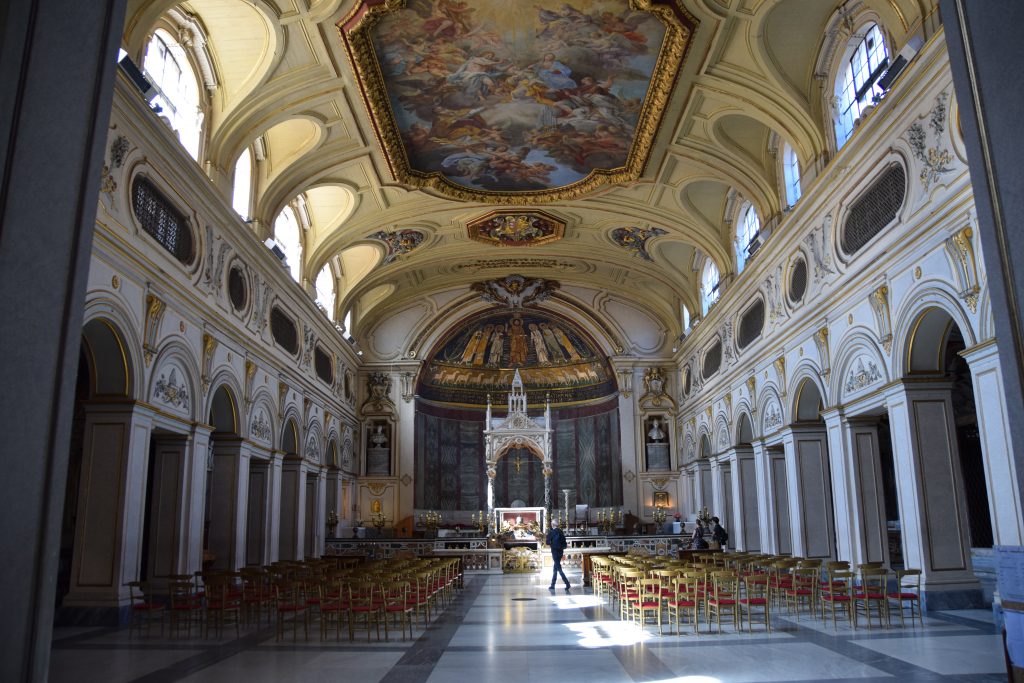
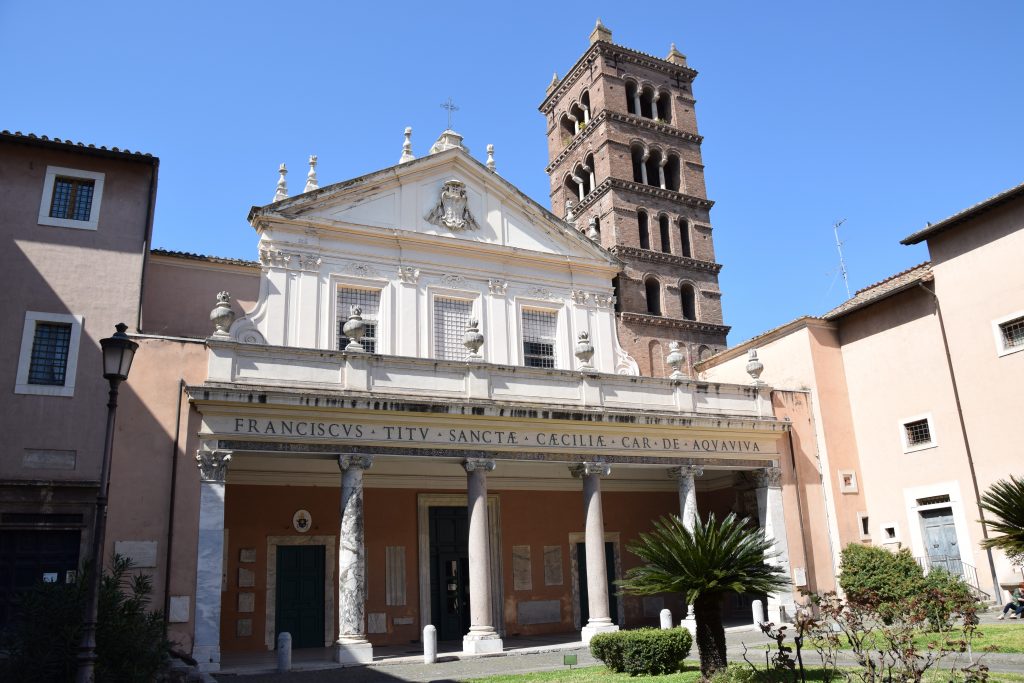
The Church in Rome, Santa Cecilia in Trastevere, is said to be built on the site of her house, and has 5th Century origins. My friend, Derek Gadd, recently visited and let me use these photographs:
St Cecilia in London
There is a window dedicated to her in the Holy Sepulchre Church-without-Newgate, In London, opposite the site of the infamous Newgate Prison. Henry Wood, one of our most famous conductors and the founder of the Promenade Concerts, played organ here when he was 14. In 1944, his ashes were placed beneath the window dedicated to St Cecilia and, later, the Church became the National Musician’s Church.
This window is dedicated to the memory of Sir Henry Wood, C.H., Founder and for fifty years Conductor of THE PROMENADE CONCERTS 1895-1944. He opened the door to a new world Of sense and feeling to millions of his fellows. He gave life to Music and he brought Music to the People. His ashes rest beneath.
The Concerts are now called the BBC Proms and continue an 18th and 19th Century tradition of, originally, outdoor concerts, and then indoor promenade concerts. At the end of the 19th Century, the inexpensive Promenade Concerts were put on to help broaden the interest in classical music. Henry Wood was the sole conductor.
Czech conductor Jiří Bělohlávek described the Proms as “the world’s largest and most democratic musical festival”.
The Eight-week Festival is held at the Royal Albert Hall. It moved here during World War 2 after the original venue, the Queen’s Hall, was destroyed in the Blitz in May 1941.
On This Day
1278 Edward 1 had over 600 Jews imprisoned in the Tower of London for coining, clipping and other counterfeiting. Of these, 269 Jews, along with 29 Christians, were executed. They were hanged at the Guildhall in the City of London. By 1290, the King had squeezed all the money he could from the Jews, and they were expelled, not to be let back into the Kingdom until the reign of Oliver Cromwell in the 17th Century. This ended a long period of savage state run antisemitism. Click here for further information.
First Published on November 17th 2023 and revised in November 2024, 2025.
The anniversary was celebrated in London with bonfires and bell-ringing. Lighted fire-barrels were rolled along Cheapside. It was, in a way, the precursor to Guy Fawkes Day (1605 onwards). Protestants celebrated it with such joy as it was the end of the reign of Elizabeth’s sister, Queen Mary I. ‘Bloody’ Mary, as she was named by Protestants, was the daughter of Katherine of Aragon. Her Government had 287 Protestants burnt at the stake, mostly relatively ordinary people: clergy, apprentices, artisans, and agricultural workers. 60 were women; 67 were Londoners: the majority were of the younger generation, and most from the South East of England.
The executions were overwhelmingly unpopular, ghastly exhibitions of brutality. In 1555 the weather was unusually wet, so the burnings were an even slower form of torture. The savagery was blamed by the Protestants on the Old Religion and particular the Spaniards who came over with Mary’s Spanish husband. Ironically, Philip, in fact, urged caution. When Mary refused to be as lenient to religious dissidents as she was to political ones, he suggested the executions should, at least, be in private. She refused, as the immortal souls of the population were put at risk by Protestant dogma. So the public nature of the deaths was a justifiable deterrent.
When, three years later, in 1558, in the early hours of the 17th November (6am) Queen Mary died, London rejoiced. An old regime, a foreign regime, a Catholic regime was swept away by a young Queen (Elizabeth was 25), with a young Court sworn to protect the new Protestant religion. (For my post on the nicknames for her courtiers look here.)
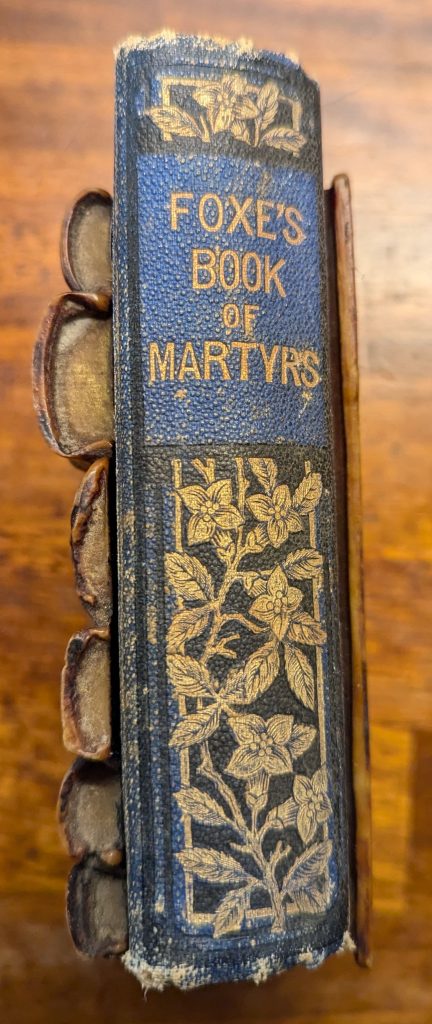
Soon, Foxe’s Book of Martyrs outsold all other books printed except the Bible, and enthusiasm for religious reform morphed into anti-Catholic intolerance.
The Author’s copy of Foxe’s Book of Martyrs
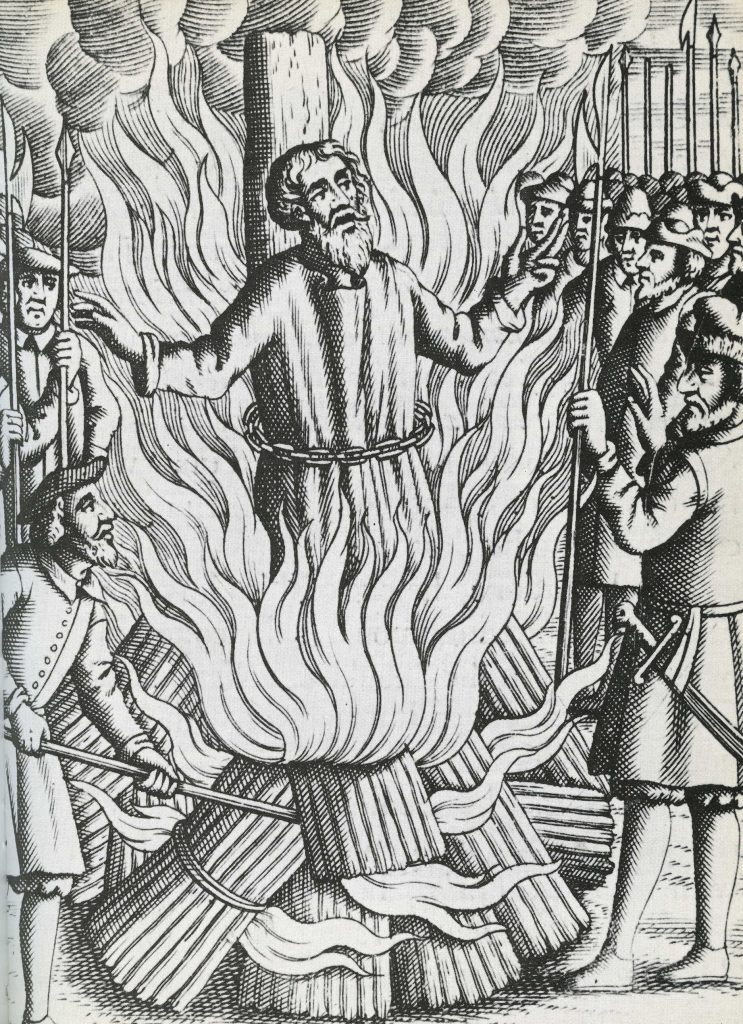
One of the martyrs in the book is Thomas Tomkins, a weaver and a Londoner from Shoreditch, a few hundred yards from where I live.
Tomkins was a humble but godly man who was kept imprisoned by Bishop Bonner, the Bishop of London, at his Palace at Fulham. Here he was beaten. The Bishop personally beat him around the face and ripped off part of his beard. The beatings continued for six months. Finally, exasperated at his failure to persuade the weaver of his error, Bonner burnt Tomkins hand with a lighted taper until ‘the veins shrunk and the sinews burst’. I assume Bonner would defend his action by saying he wanted to give the weaver Tomkins a foretaste not only of the burning he faced but of the very fires of Hell.
But nothing would avail; Tomkins, the simple man that he was, would not accept that bread was made into flesh. (Transubstantiation). He would not say that which he did not believe. So he met his end at Smithfield by fire with his bandaged hand in the reign of Queen Mary on 16th March 1555.
Thomas Bilney martyred in Smithfield.
First Published 17th November 2023, revised 2024,2025
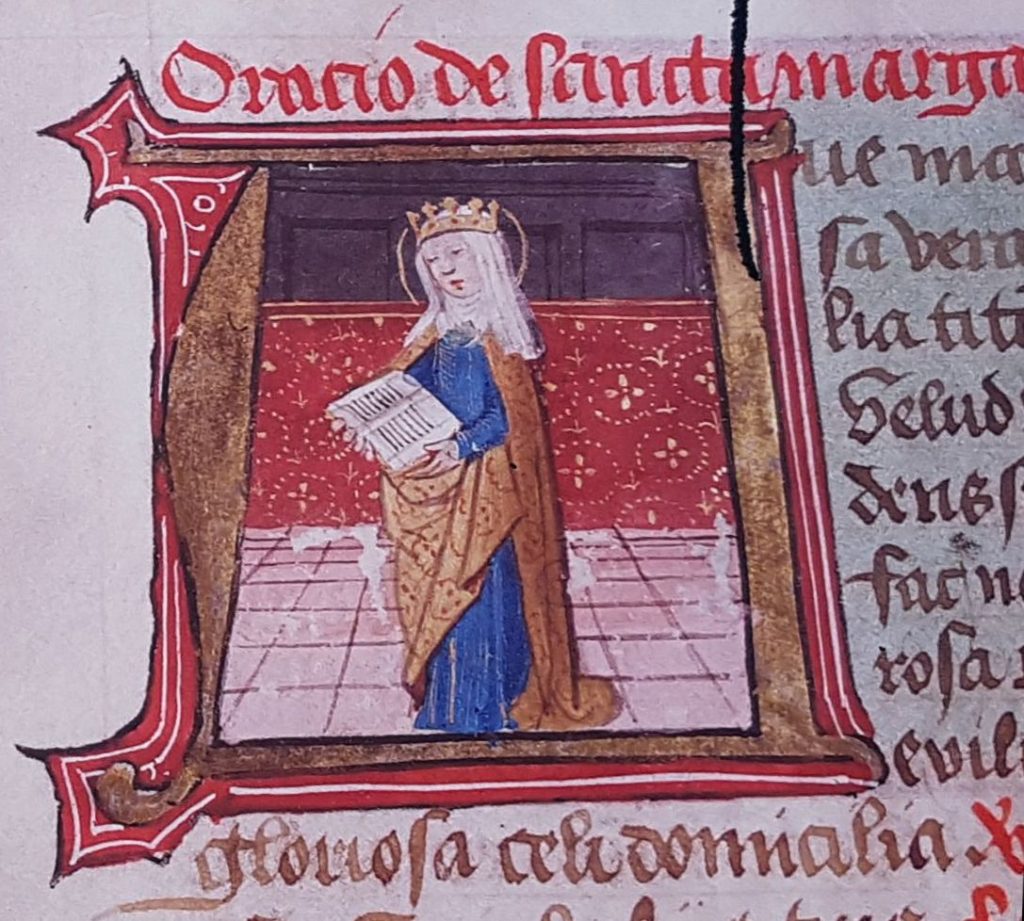
St Margaret should be better known in England because of her important rule in the bloodline of the English Monarchy. Her story is also of interest as it intertwines with the events of 1066 and of Macbeth.
She was the granddaughter of King Edmund Ironside. He was the last English King before the Danish Kings took over. He died after a peace treaty dividing England into an English and a Danish half.
This is what a draft of the text for my book on the Kings of Britain says about him:
Margaret’s Grandfather – King Edmund II 1016
Edmund was born in around 988AD and nicknamed Ironside. He was a formidable warrior who spent his short life fighting the Danes. In 1016, he was crowned in St Pauls Cathedral. Although he was defeated in battle by King Canute, the son of King Swein of Denmark, Edmund’s prowess won him a peace treaty in which England was divided between the two Kings. Unfortunately, Edmund died unexpectedly and Canute inherited the Kingdom. Edmund was buried in Glastonbury Abbey.
To buy ‘Divorced, Beheaded, Died – the history of the Kings of Britain in Bite-size Chunks’. click here.
Edmund’s wife Edith and her 2 children were exiled to Sweden and then, somehow, got to Hungary. Edmund’s eldest son was called Edward the Exile and was married to Agatha. Margaret was their third child. In 1056 Edward the Confessor invited the family back to England and soon made Margaret’s father the heir to the throne. Unfortunately, he died in 1057. He was buried in St Paul’s Cathedral.
Margaret’s Brother – Edgar the Atheling
The rest, as they say, is history. Edward the Exile’s son, Edgar the Atheling was only 6 or 7 and the throne was disputed between William of Normandy, Harald Hadarada of Norway, and Harold Godwinson.
In short, Margaret’s brother Edgar the Atheling was briefly chosen as King after the death of Harold. He was then forced to cede the throne to William the Conqueror. William was crowned King in December 1066.
Margaret’s brother Edgar the Atheling had an extraordinary life, living into his 70s. He continued to fight against the Norman rule of England, mostly from Scotland. Eventually, he reconciled with the Norman dynasty but was involved in any number of disputes, rebellions and dynastic fights.
Margaret’s Husband
Margaret was forced to flee and went to Scotland. In 1070, Margaret married the Scottish King Malcolm III ( Mael Column Mac Donnchada). Malcolm was the son of King Duncan (murdered by Macbeth – see my book Divorced, Beheaded, Died for a short biography!). In 1040, Malcolm fled to England, but returned with English help to defeat Macbeth at Dunsinane. (see my post on Macbeth and Equivocation of Phrophecy). After his first wife’s death he married the deeply pious Margaret. Their court was very influenced by Saxon and Norman ways. She helped aligned the Church more closely with the rest of Christendom, and brought up her children piously.
St Margaret’s Chapel at Edinburgh Castle. Built by her son King David. (Photos by the author)
Margaret’s Son – David
The Royal couple had 6 sons and two daughters. Her son David became one of the most influential Kings of Scotland. He introduced Norman ideas of feudalism, and created Boroughs to strengthen the Scottish economy. He also encouraged ‘modern’ forms of monasticism, encouraging the Cistercians to come to Scotland. By these means, he hoped to turn Scotland a Feudal society with a thriving market economy based on towns and monasteries.
Margaret – the Moderniser?
So, in many ways, Margaret had an influential role in ‘modernising’ the Scottish Monarchy from its Gaelic clan-based structure to a more European style that was ruled from the Lowlands and spoke the Scots version of English, rather than the Gaelic version of the Celtic branch of languages.
She died on 16th November 1093 AD and is ‘particularly noted’ for concern for orphans and poor people. There is an annual procession to her altar, followed by Evensong at Durham Cathedral on the following day. She was buried at Dunfermline following the violent death of her husband. The Abbey has recently celebrated the 950th anniversary of Queen Margaret consecrating the site.
Margaret’s Daughter
Margaret’s daughter, Matilda, married the son of William the Conqueror, King Henry I. This marriage was important for the Normans because it added a strong dose of English Royal blood to the French Norman Royal line. Their daughter was the formidable Empress Matilda, designated heir to the throne of England and founder of the Plantagenet line of English Kings. She was an uncrowned monarch of England and mother of Henry II. She was never crowned because of the disruption caused by the usurpation of the throne by King Stephen.
To read my posts on the events of 1066:
You can read what happened, in my detail, in my posts on the three battles that decided England’s fate in 1066.
Foul privies are now to be cleansed and fide, let night be appointed such baggage to hide: Which buried in garden,in trenches alowe, shall make very many things better to growe.
The chimney all sootie should now be made cleene, for feare of mischances, too oftentimes seene: Old chimney and sootie, if fier once take, by burning and breaking, soone mischeefe will make.
Five Hundred Points of Good Husbandry. 1573 by Thomas Tusser
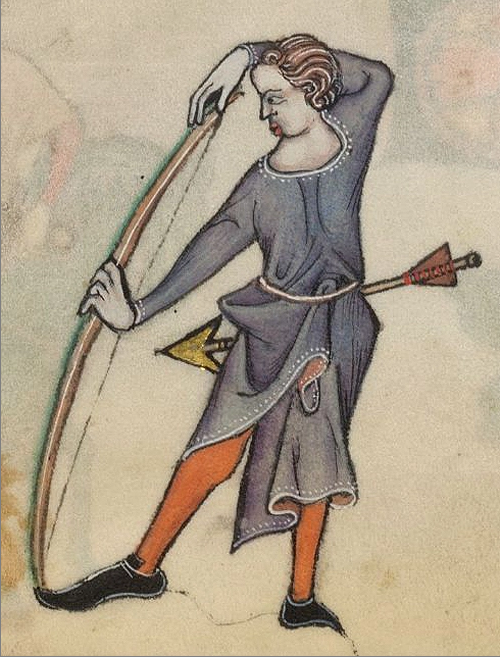
Medieval drawing of an archer. Good resistance exercise to get the muscle/fat ratio on the healthy side?
‘Leaping is an exercise very commendable and healthful for the body.’
The Compleat Gentleman 1634
Thomas Fuller in his book published in 1642 says:
Running, Leaping, and Dancing, the descants on the plain song of walking, are all excellent exercises. And yet those are the best recreations which besides refreshing enable, at least dispose, men to some other good ends. Bowling teaches mens hands and eyes Mathematicks, and the rules of Proportion: Swimming hath sav’d many a mans life, when himself hath been both the wares, and the ship: Tilting and Fencing is warre without anger; and manly sports are the Grammer of Military performance. But above all Shooting is a noble recreation…..
‘The Holy State’ by Thomas Fuller B.D. and Prebendarie of Sarum
Published St Pauls Churchyard 1642
The Holy State is a fascinating book – it provides instruction on how to be the Good Wife; the Good Advocate; the Good King; Bishop etc. etc.; has general rules of behaviour; some case studies of good lives to emulate and discussion of profane states not to emulate.
15th of November 1712 A Famous Duel between Lord Mohun and the Duke of Hamilton
‘In short, they fought at seven this morning. The dog Mohun was killed on the spot; and while the Duke was over him, Mohun shortening his sword, stabbed him in at the shoulder to the heart. The Duke was helped towards the Cake House by the Ring in Hyde Park (where they fought) and died on the grass, before he could reach the house; and was brought home in his coach by eight, while the poor Duchess was asleep.‘
Jonathan Swift ‘The Journal to Stella’ 1712
Lord Mohun seemed to be the villian, not only making the initial affront, but also issuing the challenge and stabbing his rival in such an underhand way! After the Duel there was fighting between the servants of the men, and the seconds had to flee to avoid arrest. Duels were illegal but remained a part of upperclass society into the 19th Century. Pehaps, Thomas Fuller’s advocacy of fencing as a good keep fit exercise is not such a great idea!
Text taken from ‘A London Year’ Compiled by Travis Elborough and Nick Rennison
To read my post on Jonathan Swift and Chelsea Buns see my post here.
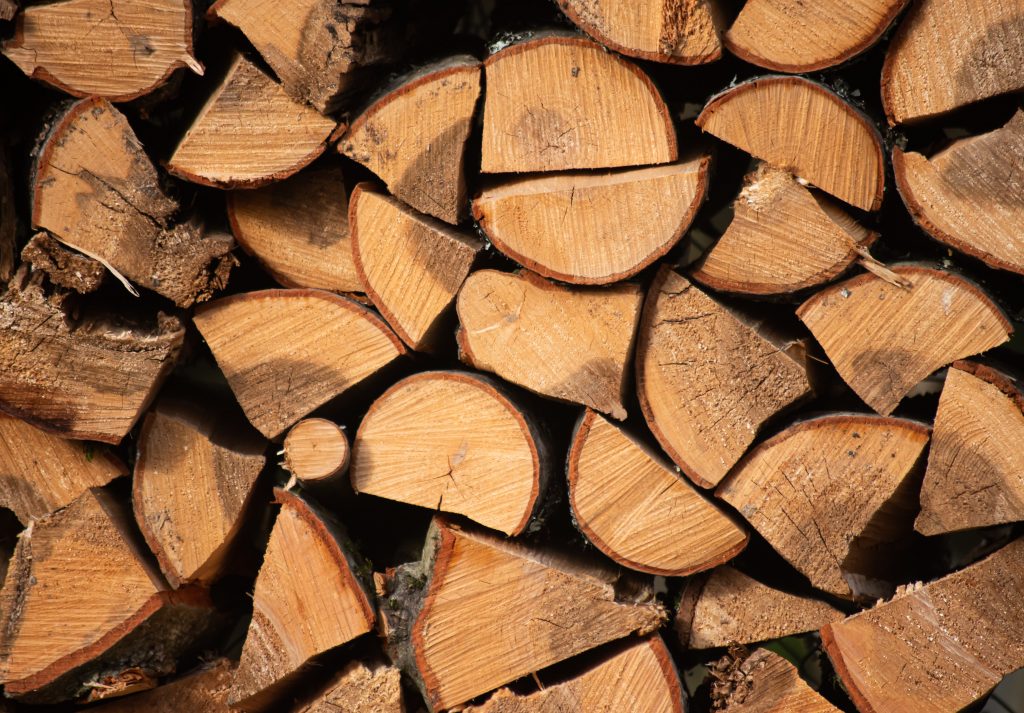
As the winter comes nearer and the St Martin’s Summer comes to an end – make sure you have good stocks of firewood. Here, is some ancient advice on the burning of wood:
Beechwood fires burn bright and clear If the logs be kept a year Oaken Logs if dry and old Keep away the winter’s cold Chestnut’s only good they say If for years ’tis laid away But ash-wood green or ash-wood brown Are fit for a King with a golden Crown Elm she burns like the churchyard mould Even the flames are cold Birch and pine-wood burn too fast Blaze too bright and do not last But ash wet or ash dry A Queen may warm her slippers by.
My own very limited experience of firewood is from the very occasional fires I lit during Christmas past. I found a particular joy in burning IKEA furniture which had failed during the year. My kindling of choice was dried Christmas tree, which pops and crackles like a good indoor firework. I suspect burning IKEA furniture, however good for the soul, is appalling for the environment, so please don’t do it! Take a pickaxe to it instead, or even better, upcycle it.
The nightmare that is a flatpack!
A postscript on IKEA. To appreciate the joy this gave me, you have to understand my dislike of shopping in IKEA. And my even greater frustration at putting together the flatpack items. I have a form of flatpraxia which begins with an inability to spot key construction information cryptically hidden in those little drawings. Magically, as you survey the slightly wonky creation in front of you at ‘completion’, my mind finally resolves the importance of tiny details on those little diagrams. Understanding comes with the realisation that I have put it all together in the wrong sequence. This added with a ham-fisted DIY disability means, my IKEA is full of quirks such as drawers that are not the smooth sliders you dream of. So, when an alternative piece of furniture comes to my attention, with more character and, crucially, already put together, the IKEA is ready for its joyous ritual disappearance from my house.
First Published 14th November 2022, revised 14th November 2023, 2024 and 2025