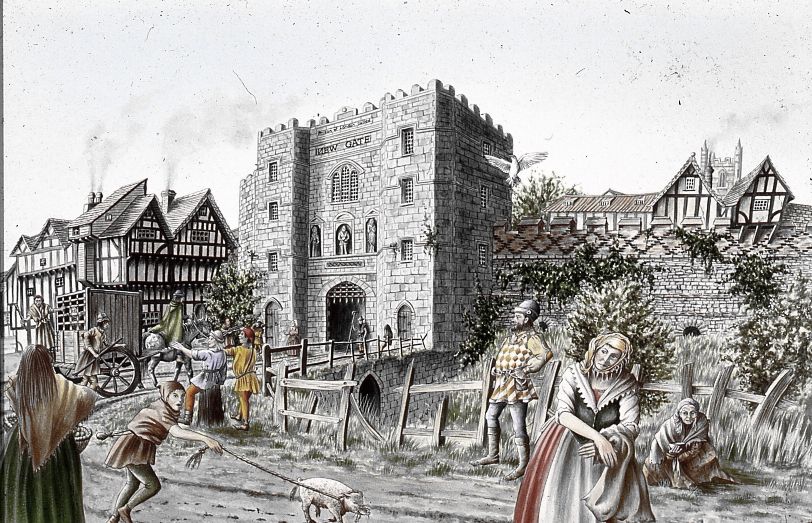

The Blessing of St Blaise helps protect the throat. The way it is works is that blessed candles are made into a cross. These are then touched against the throat of the afflicted one. Why? Because a story was told that Blaise, on his way to martyrdom, cured a boy who had a fish bone stuck in his throat. So, he is the patron Saint of Sores Throats.
Blaise is thought to have been an Armenian Bishop of Sebaste, martyred (316AD) in the persecution of the Emperor Licinius.
Sage Advice for Sore Throats:

In the spirit of St Blaise, here is advice for care of your throats.
Sage Tea is said to be excellent for many things, including dental hygiene and alleviating sore throats. The Kalendar of Shepherds tells us how to treat our throats:
Good for the throat honey, sugar, butter with a little salt, liquorice, to sup soft eggs, hyssop, a mean manner of eating and drinking and sugar candy. Evil for the throat: mustard, much lying on the breast, pepper, anger, things roasted, lechery, much working, too much rest, much drink, smoke of incense, old cheese and all sour things are naughty for the throat.
The Kalendar of Shepherds 1604
The Martyrdom of St Blaise

So far, an uplifting, healing story. However, the Medieval Church’s propensity for the gruesome and its peculiar need to allocate a unique method of martyrdom to each early saint leads us to Blaise being pulled apart by wool-combers irons. Then he was beheaded.
Hence, he is also the patron saint of wool-combers, and by extension, sheep. Wikipedia tells me that ‘Combing: was a regular form of torture.
Combing, sometimes known as carding (despite carding being a completely different process) is a sometimes-fatal form of torture in which iron combs designed to prepare wool and other fibres for woollen spinning are used to scrape, tear, and flay the victim’s flesh.
https://en.wikipedia.org/wiki/Combing_(torture)
Gory Martyrdoms Explained?
I am horrified by the goriness of these martyrdoms, and it needs some explanation. If we believe in Richard Dawkins idea of the meme we can find an explanation. Allocating a different and gory death to each and every saint has advantages for the survival of the cult. It brings a uniqueness to the story of the Saint. Particular details of death suggests authenticity. The extreme death creates an example of stoicism in the face of challenge to faith, and provokes empathy and piety. There is, also, we have to accept, a very human attraction in the bloodthirstiness of stories.
But, there is, I suspect, a financial interest too. In order for these cults to survive, they need adherents, acolytes, worshippers, donors, patrons. They require income streams that can help support the expensive clergy and the fabric of the Church or chapel. One source of income is from the wealthy, but in the medieval town, urban wealth was held within the booming guild structure. If the martyred Saint, could attract a particular Guild then (the sponsoring Priests, or Church) were quids in.
Wool was the mainstay of the economy in the medieval period. A martyr like St Blaise would prosper wherever there were people working with wool, cloth or sheep. So, is it too cynical to suggest someone with an eye for the main chance added the detail of the wool combing death to attract donations from rich wool merchants? As a successful meme, it spread throughout Europe.
Also, there were any number of endemic diseases and occupational hazards for which there was no clear cure. So if the Saint can become the Saint of common, preferably chronic, illnesses, he/she can attract all those who suffer from that or similar diseases.
Of course, it may not always be a cynical drive for more income. In exchange, the Church offered the sufferer comfort in the face of suffering. This quality is not only of great use on its own, but it would have maximised the placebo effect. The effect has been scientifically measured. And would often be more effective a cure as than the available, often bizarre, medieval remedies.
Blaise’s hagiography suggests he was a physician. The cult was able to grow into being not only the Saint for Sore Throats and Sheep but one of the go-to saints for diseases in both humans and animals.
For a female tortured Saint see my post of St Margaret of Antioch here.
Blaise in Britain
His cult came to Britain when King Richard I was ship wrecked on Crusade. Richard was helped by Bishop Bernard of Ragusa where Richard was washed up. When the Bishop was deposed he sought sanctuary in Britain and was made Bishop of Carlisle where he promoted the cult of Blaise. Several churches in the UK founded churches named for him.
St Blazey in Cornwall is named after his Church and celebrates him by a procession of a ram and a wicker effigy of the Saint. Milton, in Berkshire, dedicated its Church to St Blaise, probably because the village’s wealth depended on sheep. The village held a feast on the third Sunday after Trinity, and the day after held the Tadpole Revels at Milton Hall. Tadpole is thought to be a corruption from the word ‘Tod’ which means cleaned wool.
Blaise in London
Westminster Abbey has a chapel dedicated to Blaise (see image at top of page). In the Bishop’s Palace at Bromley is St Blaise’s Well. It is thought to have begun as a spring when the Palace ‘was granted to Bishop Eardwulf by King Ethelbert II of Kent around 750 AD.’ A well near the spring became a place of pilgrimage and an Oratory to St Blaise was set up. In the 18th Century, the chalybeate waters of the well were considered to be useful for health. It still exists today.
On February 3rd, St Etheldreda’s Church in London holds the Blessing of the Throats ceremony. It was a Catholic Church in the medieval period, then, in Reformation was used for various purposes until returned to the Catholic Church in 1876. It has memorials for Catholic Martyrs killed in the reign of Queen Elizabeth I
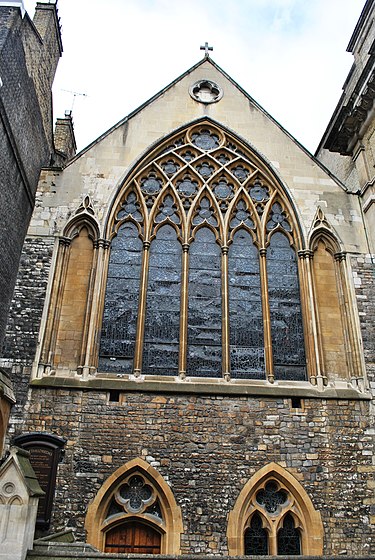
CC BY-SA 4.0 Wikipedia St Etheldreda’s Church
One of London’s oldest guilds is the Worshipful Company of Woolmen, first mentioned in 1180, when fined, for operating without a license, by Richard 1’s dad, Henry II.
Sources: The Perpetual Almanac by Charles Kightly, Woolly Saints, Britannica, Wovember, wikipedia.
On This Day
1637 – Tulip Mania dramatic collapse of the soaring price of Tulip Bulbs within the Dutch Republic.
1761 – At the age of 87 Beau Nash, Master of Ceremonies at Bath died. To see my post on 18th Century Bath please look at March 14th
1870 – The 15th Amendment to the US Constitution was ratified. It prohibits the federal government or any state from denying or abridging a citizen’s right to vote “on account of race, colour, or previous condition of servitude”. What I don’t understand is how this is compatible with all the many ‘abridgements’ of a citizen’s right to vote which seem to flourish. In particular, Gerrymandering. Isn’t it effectively an abridgement of the right to vote, if the electoral districts are so artificially engineered as to make that vote meaningless? Maybe it’s ok if the abridgement is not about race, colour etc.? (OK as in ‘get away with subverting democracy’.
1917 – World War I: The USA enters the War (unrestricted submarine warfare being one of the causes)
1933 – The policy of Lebensraum announced by Adolf Hitler. This might be explained as one powerful country saying it is entitled to take over less powerful countries because they can?
Revised 2025, and 2026