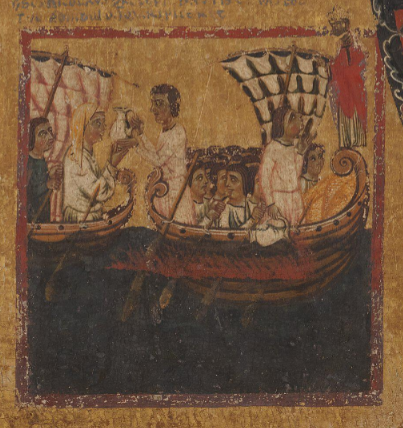
Santa Klaus was, originally a 4th Century Bishop from Asia Minor who saved three girls from prostitution. He throw golden balls through their window enabling the girls to marry with a good dowry and live a moral life. Saint Nicholas, also, saved three boys from beheading. So he became the patron saint of children. He died on the 6th of December in Myra, present day Turkey. From the moment of his internment, his tomb flowed with myrrh. There are many other miracles. Once St Nicholas appeared on a storm tossed boat and saved the sailors. Another has him saving people from poisoned olive oil. (see picture above.)
In 1087, the Normans from Apulia raided Myra, then under the control of the Seljuk Turks. The gang of 67 men stole the Saint’s remains, to bring them to Bari, in Southern Italy. Bari already had 6 churches dedicated to St Nicolas. In 1969, Pop Paul VI revoked his Feast Day as he decided there was no evidence St Nicholas was a real person.
Despite this, he is the ‘patron saint of sailors, merchants, archers, repentant thieves, children, brewers, pawnbrokers, toymakers, unmarried people, and students in various cities and countries around Europe’ (Wikipedia). He is also known as Nicholas the Wonderworker.
It’s all about the Balls
Representation of the balls can still be seen hanging in front of pawnbroker’s shops. The gifts Nicholas gave led to the exchange of gifts to honour him. Originaly, gift giving took place on December 6th, his feast day. The Dutch took the tradition of Santa Klaus to the United States. Here it mixed with other traditions, including the English Father Christmas, to create our modern spirit of Christmas, and Santa Klaus.
Boy Bishops
https://commons.wikimedia.org/w/index.php?curid=6709993
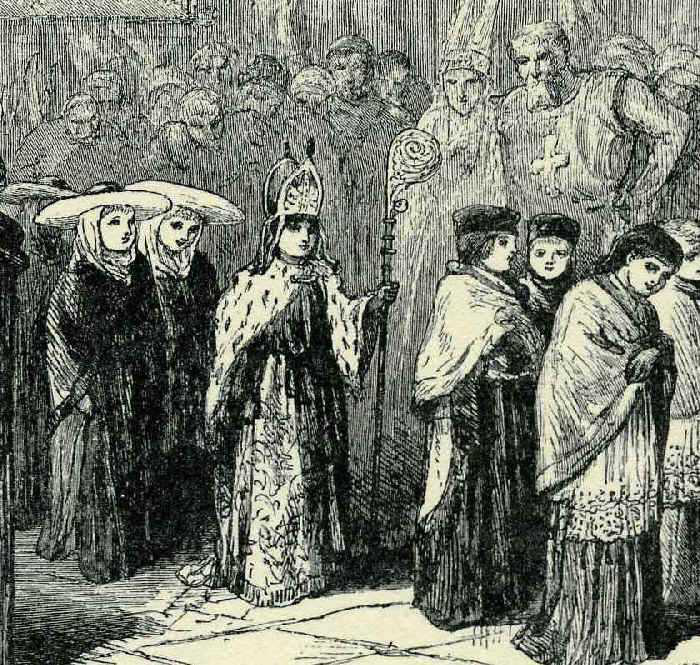
The idea of Boy Bishops may come from a tradition established by Saturnalia. This was the festival, in the Roman world, when servants exchanged duties with their masters and mistresses. Tthe Lord of Misrule presided over Medieval Christmas. While Church ceremonises were presided over by Boy Bishops. The tradition was attacked in some quarters but defended by others. They felt it engendered empathy. had an element of humanity and instigated seasonal fun. The Boy Bishops were elected on December 6th. Their reign might continue until Childermas (Holy Innocents Day December 28th).
The custom was stopped by Henry VIII. It was then revived and is still practised to this day in the Cathedrals of Hereford and Salisbury. The Boy Bishops wears full ceremonial gear and takes part in ceremonies and services for three weeks.
Boy Bishops in London
There are also medieval records that speak of the custom:
“two children’s copes, also a myter of cloth of gold set with stones.”
St. Mary-at-Hill, London Church Accounts
1549 “For 12 oz. silver, being clasps of books and the bishop’s mitre,
“The vj myter of Seynt Nycholas bysshoppe, the grounde therof of whyte sylk,
Westminster Abbey, St Pauls & St Nicholas Cole Abbey London inventories
garnysshed complete with ffloures, gret and small, of sylver and gylte, and stones
Also records at St Pauls record: una mitra alba cum flosculis breudatis ad opus episcopi parvulorum baculus ad usum episcopi parvulorum;’
St Nicholas Cole Abbey in the City of London has an inventory dating to the Reformation that records vestments for children at St Nicholas. The Church is first mentioned in the 12th Century and was never an Abbey. The Cole part of the name refers to a ‘Coldharbour’ which was a traveller’s or poor persons shelter from the cold. The Church was rebuilt by Christopher Wren after the Great Fire. This is, probably, the location where Trotty Veck stands awaiting employment as a messenger or runner, in Dickens’s second greatest Christmas Book after the Christmas Carol. The story is more a New Year story than a Christmas story. (I tell the story in my post here).
For more on boy bishops look at this, and look at this 1935 film about Boy ~Bishops in Compton, Guildford.
The Lord of Misrule.
Middle Temple, like the other Inns of Court in London, also had a Winter period of ‘condoned disorder’. This continued through to Christmas and beyond to Candlemas. It was presided over by a Lord of Misrule, or in the Middle Temple’s case a Prince of Love. The Revels of 1597-8 were republished in 1660. Each December, students, barristers and Benchers create and perform the Inn’s annual Christmas Revels. With thanks to https://www.middletemple.org.uk/about-us/history/elizabethan-and-jacobean-times
On This Day
1648 Pride’s Purge. The day that the New Model Army had had enough, and Colonel Thomas Pride, excluded members of the Long Parliament from sitting in Parliament. This led to the Execution of Charles I, and the establishment of Britain’s first and only Republic. (see my post on the execution of Charles I)
I am doing a walk Charles I and the Civil War – the Martyrdom Anniversary Walk on January 30th 2026. And a Virtual Tour on the Civil War, Restoration & the Great Fire of London on the evening of January 30th.
1964 Martin Luther King made a flying visit to St Pauls to deliver a sermon on his way to pick up the Noble Peace Prize in Oslo. He based his sermon on the following poem. The visit is described on the St Pauls Web Site here
Be The Best Of Whatever You Are
By Douglas Malloch
If you can’t be a pine on the top of the hill,
Be a scrub in the valley — but be
The best little scrub by the side of the rill;
Be a bush if you can’t be a tree.
If you can’t be a bush be a bit of the grass,
And some highway happier make;
If you can’t be a muskie then just be a bass —
But the liveliest bass in the lake!
We can’t all be captains, we’ve got to be crew,
There’s something for all of us here,
There’s big work to do, and there’s lesser to do,
And the task you must do is the near.
If you can’t be a highway then just be a trail,
If you can’t be the sun be a star;
It isn’t by size that you win or you fail —
Be the best of whatever you are!
Douglas Malloch. “Be The Best Of Whatever You Are.” Family Friend Poems,
First published December 6th, 2022. Revised and republished 6th December 2023. Martin Luther added in 2024, Pride’s Purge added in 2025