
British Exceptionalism Brexit Day January 31st

Today is the Anniversary of the day Britain left the European Union in 2020. It is possible to argue the case that one of the reasons so many people were willing to vote to leave the Union was English or British Exceptionalism. I think most people would be thinking of Winston Churchill and World War 2, and the British Empire. But you can argue a case that there has long been important distinctions between Britain and Europe.

I find it amusing that we left Europe at 11pm on January 31st 2020, which was midnight in the European Union. See the BBC round up on Britain and Europe.

This Island Story

When I was at school, there was a lot of emphasis on Great Britain being an Island. This is rarely emphasised in the 21st Century. But it was part of the Imperial story of the British Empire and helped distance ourselves from ‘the Continent’.

That Island story didn’t begin until the Mesolithic period. Before that, Britain was physically part of Europe, and the Thames was but a tributary of the Rhine. Then the land bridge that is now called Doggerland was swept away by rising meltwater. By 8,000 years BP. Britain was an Island.

Around 4000BC, the so-called Neolithic Revolution spread farming throughout Europe. But, the Channel acted as a barrier. So, it took an extra hundred years or so for farming to begin to penetrate Britain. The early farmers brought with them not only the domestic animals, crops, pottery and ground axes but also a new form of housing consisting of long, rectangular wooden houses. The DNA of the people of Britain, was radically changed and the so-called Western Neolithic DNA mostly took over. Strangely, the long house did not survive very long as a popular design. Britain while accepting the new farming technology, seem to have reverted to their own form of housing

Post Roman divergence?

While most major style and technology changes over the next 4 millenia were shared with Europe, Britain often had its own versions. Britain shared with Europe the adoption of the Celtic Languages and eventual integration into the Roman Empire. But, when the western part of the Roman Empire fell in the 5th Century, Britain had a different experience to much of Europe. On the face of it, a similar sequence happened. The Western Empire was taken over by Germanic Kings. The Franks in France and Germany; the Anglo Saxons in England; the Lombards in Italy and Goths, Visigoths, Vandals in Spain (and N. Africa). A similar sequence on the surface.

But on the mainland the German Kings allowed the local cultures to continue and adopted the Latin language, and Christian religion as their own. They maintained a strong tradition of Roman law and culture. French, Italian, Spanish, Rumanian are all romance languages based on Latin.

But across the Channel to England, it was different. Our German Kings didn’t adopt the Latin language and the native Celtic dialects died out (except of course in Cornwall, Wales, Scotland and Ireland ), They also maintained their pagan beliefs. So English culture is Germanic and not Roman. We do not have a foundation in Latin culture and Roman law. This is very different to western Europe.

Napoleon founder of modern Western Europe

Of course the Anglo-Saxons eventually soon adopted Christianity. In the 16th Century Britain turned against the universal Catholic Church. This was a rupture that had a similar impact to Brexit. But the next really significant difference was the changes instituted by Napoleon. He subdued then rationalised and liberalised the continent. He had dreams of a United Europe of Nations (in contrast to the Empires that held sway (such as the Holy Roman Empire, and the Austro-Hungarian Empirehttps://www.napoleon-series.org/research/napoleon/c_unification).

Most legal systems in Europe are based on Roman Law as amended by the Napoleonic code. England by contrast is based on the Common Law.

So these differences combined with our arrogance derived from Empire, the Industrial Revolution and belief we won World War 2. And our cultural pride based on our perception of the preeminence of people such as Shakespeare, Newton and Darwin etc etc). All this probably lay behind ‘British Exceptionalism’. This helped a nationalistic and misguided belief that we are held back by Europe despite all the evidence to the contrary.

And the future?

Opinion polls make it clear that most people think Brexit was a mistake, and they blame it on the Conservatives, Boris Johnson and Nigel Farage. Economists are clear the damage it has done to Britain’s financial position. And yet the main parties have been very reluctant to consider a return to Europe. Instead, Sunak and Starmer have tried to sort problems out on a case by case basis, without suggesting we go back into the European Union.

However, there is a dawning awareness that Europe cannot depend upon the US playing its usual leading role in maintaining the international status quo, and this may accelerate our move back towards Europe. Canadian Prime Minster Carney is proposed the formation of an alternative economic alliance to replace dependence on the US, and this may be our route back into the European Single Market.

Advice for Lambs

From ‘ FIUE HUNDRED POINTES OF GOOD HUSBANDRIE. BY THOMAS TUSSER.

The Edition of 1580 collated with those of 1573 and 1577.

Januaries husbandrie.

Yoong broome or good pasture thy ewes doo require,warme barth and in safetie their lambes doo desire.Looke often well to them, for foxes and dogs,for pits and for brembles, for vermin and hogs.

More daintie the lambe, the more woorth to be sold, the sooner the better for eaw that is old. But if ye doo minde to haue milke of the dame, till Maie doo not seuer the lambe fro the same.

Ewes yeerly by twinning rich maisters doo make, the lamb of such twinners for breeders go take. For twinlings be twiggers, encrease for to bring, though som for their twigging Peccantem may sing.

Note ewes who had twin lambs were thought to be better and fetched more at market. They were called twinlings.

On This Day

1606 – Guy Fawkes and fellow conspirators are hanged, drawn and quartered for plotting to blow up Parliament and King James. See my post on the Gunpowder Plot.

1865 – Congress passes the Thirteenth Amendment to the United States Constitution, abolishing slavery.

1953 – The North Sea Flood assail the east coast of Britain killing 280 people. ‘The combination of wind, high tide, and low pressure caused the sea to flood land up to 5.6 metres (18 ft 4 in) above mean sea level.’ (Wikipedia).
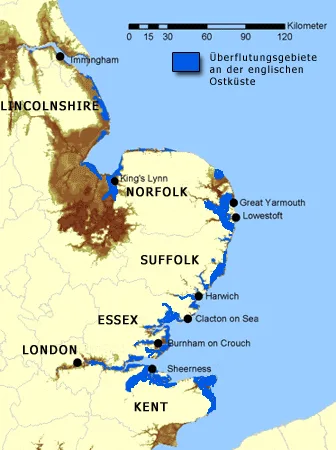
Map of
Map illustrating the extent of the Great Flood of 1953 in the United Kingdom
Deutsch: Sturmflut von 1953 Date 25 September 2008 Source: Draco. GNU Free Documentation License

You might like to see some great pictures of the floods here.

First Published 2025, revised and OnThis Day added 2026
The Martyrdom of Charles I & ‘Get Back’ January 30th

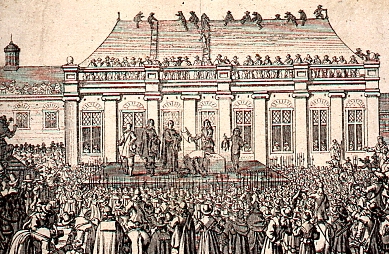
Banqueting Hall and Execution of Charles I
Banqueting Hall and the Martyrdom of Charles I

January 30th is the anniversary of the execution of King Charles I. Today, he was beheaded as a murderer and traitor. Or as a Royalist would see it, it is the anniversary of the Martyrdom of Charles I.

Thousands came to see the execution, amongst them Samuel Pepys. They crowded around the scaffold outside a window of Inigo Jones’s magnificent Banqueting Hall, in Whitehall, London. Charles was brought into the Banqueting House. There he must have looked up at the magnificent Peter Paul Reubens’ ceiling. Charles had commissioned the painting to depict of the Apotheosis of his father, James I. It was the symbol of the Divine Right of the King to rule.

Scaffold to Heaven?

I doubt he saw the irony. I suspect he thought he was going to heaven to join his father, in glory as a Martyr to his religion. He walked outside, through the window, into the cold January air. Two of his bloodstained shirts still exist, probably to stop him shivering. He wanted to be seen as going fearless to his death not shivering with fear. Then, he made a short speech exonerating himself. He spoke without stammering for the first time in his public life. The Rooftops around were lined with spectators. Black cloth framed the scaffold. As the executioner axe fell, there was a dull grown from the crowd (most could not see the axe falling).

This was on January 30th, 1648. But, if you look at a history book, it will tell you it was in 1649. This was before our conversation to the Gregorian calendar. Then the year number changed not as we do on January 1st but on March 25th. This was the day the Archangel Gabriel revealed to the Virgin Mary that she was pregnant. For more on the importance of March 25th look at my Almanac entry here:

Oh the stupendous, and inscrutable Judgements of God’

On the same day, twelve years later, in 1661 Oliver Cromwell and his chief henchmen were dug up from their splendid Westminster Abbey tombs. Their bodies were abused by official command. Cromwell’s head was stuck on the top of Westminster Hall. There it remained until blown off in the Great Fire of 1703 (or 1672, or 1684). Then, it taken to Cambridge, Sidney Sussex College, which Cromwell attended. Only the Head Porter knew where. (According to someone who came on my Oliver Cromwell Walk last year.) Whether it is his head or not is disputed. The tale of the head is told in detail here.

The Royalist, John Evelyn, said in his diary:

This day (oh the stupendous, and inscrutable Judgements of God) were the Carkasses of that arch-rebel Cromwel1, Bradshaw, the Judge who condemned his Majestie and Ireton, sonn in law to the usurper, dragged out of their superb Tombs (in Westminster among the Kings) to Tybourne, and hanged on the Gallows there from 9 in the morning till 6 at night, and then buried under that fatal and ignominious Monument in a deep pit. Thousands of people (who had seen them in all their pride and pompous insults) being spectators .

Samuel Pepys records by contrast:

…do trouble me that a man of so great courage as he was should have that dishonour, though otherwise he might deserve it enough…

Pepys served the Parliamentary side before the restoration of Charles II, when he adroitly, swapped over to the Royalist side.

Every year, I do a Guided Walk and a Virtual Tour on Charles I and the Civil War on this day or the last Sunday in January. Look here for details.

On This Day

1661 – Oliver Cromwell’s corpse disinterred and ritually executed

1826 – The Menai Suspension Bridge, considered the world’s first modern suspension bridge, Architect Thomas Telford

1933 – Hitler appointed Chancellor of Germany

1969Get Back to Where you Once Belonged – the anniversary of the rooftop concert in Saville Row where the Beatles played ‘Get Back’.

YouTube Clip with scenes from the Roof Top Concert

First published in 2023, revised on January 29th 2024,2025, 2026

Pax, the Concordia Peace Festival, Elagabalus, and Carausius January 29th

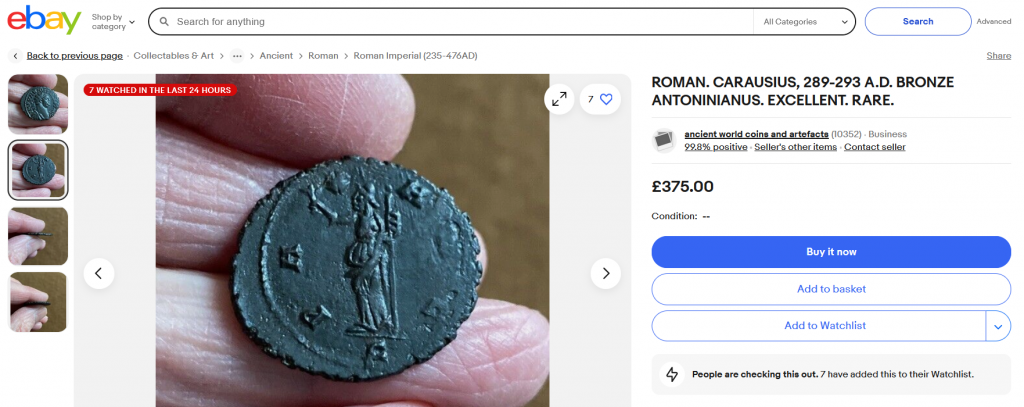
Photo from ebay sale of coin of Carausius, showing the reverse with image of the Roman Goddess Pax.

The Goddess Book of Days (Diane Stein) lists today as the birthday of Pax and her Greek equivalent Irene. She is the Goddess of Peace and the daughter of Jupiter and the Justitia, Goddess of Justice. This suggests that a lasting peace can only be assured by strength and justice. The usurping Emperor Carausius (whose coin you can see above) had good reason to use Pax on his coins. He took control of Britain and some of Gaul from the Roman Empire. But he hoped he might rule alongside the Tetrachy of Emperors set up by Diocletian.

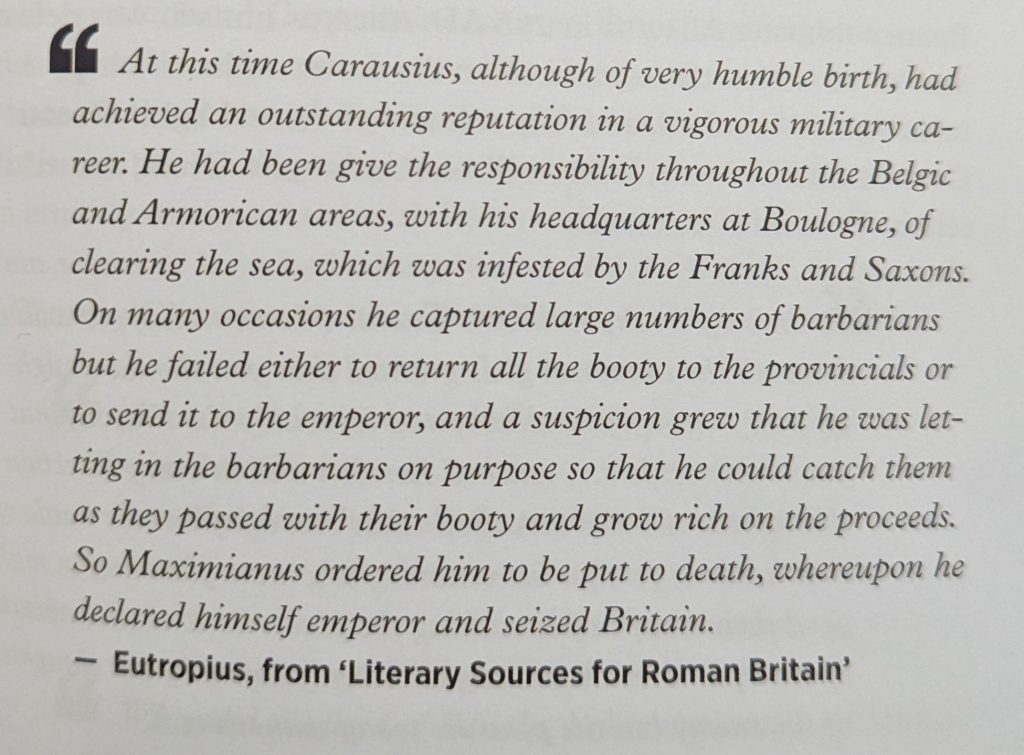
This is what Eutropius wrote:

Image of a quotation by Eutropius translation from 'Literary Sources for Roman Britain.' and from
Page from ‘In Their Own Words’ by Kevin Flude

He was murdered by Allectus, his financial minister in 296AD. Text above taken from my book In Their Own Words where you can read the rest of Carausius’ story.

Concordia

The Goddess book also says this is the day of the Concordia Peace Festival in Rome. Concordia is the Goddess of agreement, in war, marriage and in civic society. Harmonia is the Greek equivalent. Ovid has special days to Concordia on January 17th and January 30th. I’m led to the idea that much of January was dedicated to Concordia and Pax. For more on Concordia, look at my January 17th post here.

Pax in Ovid

Pax had her festival on the 30th January. Ovid in Fasti writes:

Book I: January 30
My song has led to the altar of Peace itself.
This day is the second from the month’s end.
Come, Peace, your graceful tresses wreathed
With laurel of Actium: stay gently in this world.
While we lack enemies, or cause for triumphs:
You’ll be a greater glory to our leaders than war.
May the soldier be armed to defend against arms,
And the trumpet blare only for processions.
May the world far and near fear the sons of Aeneas,
And let any land that feared Rome too little, love her.
Priests, add incense to the peaceful flames,
Let a shining sacrifice fall, brow wet with wine,
And ask the gods who favour pious prayer
That the house that brings peace, may so endure.
Now the first part of my labour is complete,
And as its month ends, so does this book.

Translated by A. S. Kline 2004 (Tony has a lovely site here: where he makes his translations freely available.)

Concordia, Julia Aquilia Severa & Elagabalus

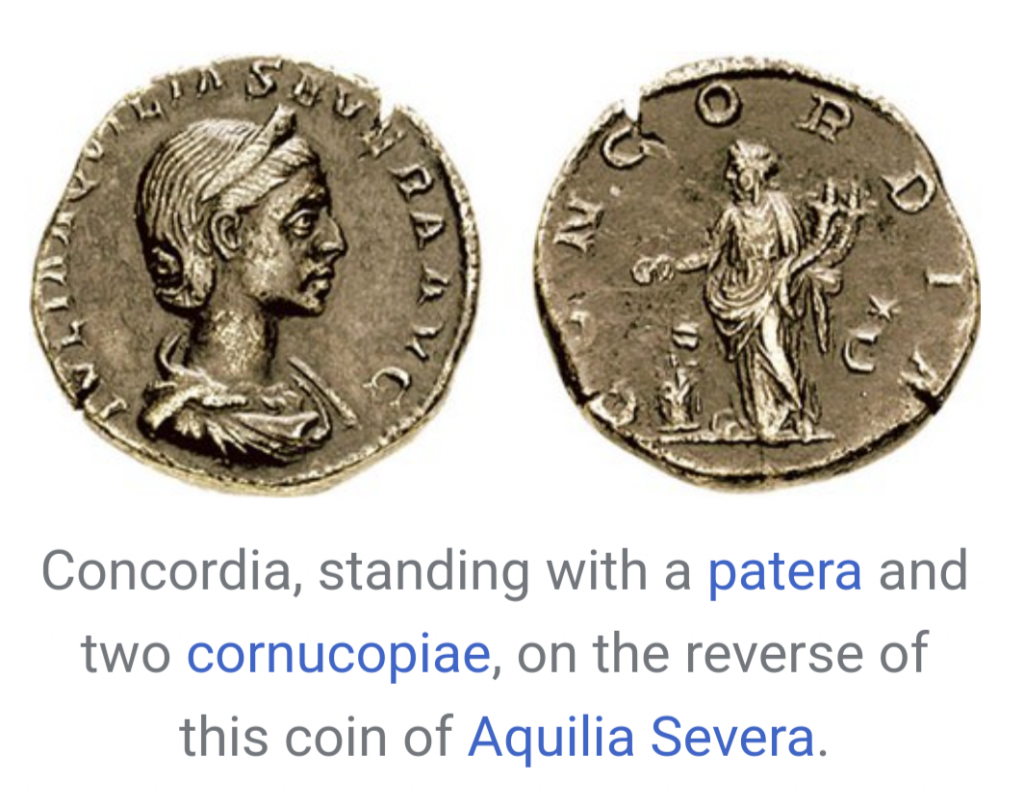
Roman coin, showing both sides, of the Goddess Concordia
A patera is a sacrificial bowl, and a cornucopia is a horn of plenty (Image from Wikipedia)

The coin above is of Empress Julia Aquilia Severa. She was a vestal virgin, who married the Emperor Elagabalus (c. 204 – 11/12 March 222). She was his 2nd and 4th wife. Normally, the punishment for a vestal Virgin losing their virginity was to be buried alive.

The Trouble with Pronouns

But I could have said ‘her 2nd and 4th wife’. Some sources suggest Elgabalus wanted to be known as a woman. The Wikipedia page of his wife has Elagabalus with the pronoun, ‘Her’. While the Emperor’s own web page uses ‘him’ throughout. He or she married several women. And also married to several men. They were also accused of prostituting himself in Taverns and Brothels. Clear? Confusing pronouns? Sorry to hedge my bets, but we don’t know what Elagabalus would want us to use? Wikipedia says:

‘In November 2023, the North Hertfordshire Museum in Hitchin, United Kingdom, announced that Elagabalus would be considered as transgender and hence referred to with female pronouns in its exhibits due to claims that the emperor had said “call me not Lord, for I am a Lady”‘

Elagabalus was born Sextus Varius Avitus Bassianus. He adopted the name of Elagabalus as he was a supporter of the Syrian Sun God Elagabal. He, a Syrian, wanted to promote the God to the top of the Roman Pantheon of Gods. Elagabalus rose to power partly because of his strong Grandmother, Julia Maesa. She was the sister of Julia Domna, the wife of African Emperor Septimus Severus (who lived for some time in York). Their children are the Emperors in Gladiator II starring Paul Mescal. Caracalla was Elagabalus’s cousin.

Elagabalus’s reign was fairly chaotic. He lost power, when his Grandmother transferred support to his cousin, Alexander. Elagabalus and his mother were assassinated.

Here, is a fascinating article in the Guardian about the Pax Romana. ‘Their heads were nailed to trees.’

Pax & Tagging

Posh boys in England, playing tagging games, used to shout ‘Pax’ to claim immunity or to call a temporary halt in the contest. I remember my childhood friends using the word ‘vainites’ as well as pax. But we were not by any means posh. There are many other ‘truce’ terms in tagging games. See them in this fascinating. Wikipedia page. From which I discover that Vainites comes from the medieval period and means: ‘to make excuses, hang back or back out of battle’.

First Published in January 2024, and revised, expanded and retitled in January 2025. Republished 2026

Gilbert White & The Cold of January 1776 January 28th

Photo of London Fields in the snow of 2022
Photo of London Fields in the snow of 2022 by Kevin Flude

January 1776:

‘On the 27th much snow fell all day, and in the evening the frost became very intense. At South Lambeth, for the four following nights, the thermometer fell to 7, 6, 6, and at Selborne to 7, 6, 10, and on the 3ist of January , just before sunrise, with rime on the trees and on the tube of the glass, the quicksilver sunk exactly to zero, being 32 degrees below the freezing point’ Gilbert White

Gilbert White and Darwin

He, of course, is talking Fahrenheit, so well below zero. If there was a Giant upon whose shoulders Charles Darwin climbed, then Gilbert White owned one pair.. He was one of many churchmen of the 18th and 19th Century who spent their extensive leisure time, on observing God’s wonderful creation in their gardens and parishes. What made White so important was that his practice was ‘observing narrowly’ and regularly. For example, his observations of the importance of earth worms were fundamental to Charles Darwin’s own studies. When Darwin came back from his travels on the Beagle, he settled in a country property in Orpington. Like White, he used his garden and the local area as his laboratory. Here he worked to prove his theory of evolution.

Gilbert White and Earth worms

Earth worms were one of Darwin’s passions. This is what Gilbert White wrote about their contribution to nature:

“Earth-worms, though in appearance a small and despicable link in the chain of Nature, yet, if lost, would make a lamentable chasm. For, to say nothing of half the birds, and some quadrupeds which are almost entirely supported by them, worms seem to be the great promoters of vegetation, by boring, perforating, and loosening the soil, and rendering it pervious to rains and the fibres of plants, and, most of all, by throwing up such infinite numbers of lumps of earth called worm-casts, which, being their excrement, is a fine manure for grain and grass.”

(Quoted from https://gilbertwhiteshouse.org.uk)

By such minute and repeated observations, Gilbert White investigated the food chain, and the migration of birds (which was at the time disputed). He laid the foundations of what we now call ecology.

Gilbert White’s Career

He became Dean of Oriel College in Oxford. But chose to spend his career in the relatively humble occupation of Curate. A Curate is the bottom-feeder in the Anglican Church food chain. A Curate hardly earned enough to maintain a position in the Gentry (£50 p.a.). Although, White was upgraded to the title of Perpetual Curate. He still would only be pulling in, I guess, something like £200 p.a. (Patrick Bronte was also a Perpetual Curate). Essentially, it is Vicar looking after a part of a too large Parish.

Financially, White didn’t need much, he inherited his father’s property at Shelborne, Hampshire. White’s grandfather was the Vicar at Shelborne. But Gilbert could not inherit the title because he went to Oriel College. The ‘living’ of the Parish of Shelborne was ‘in the gift of’ Magdalen College. And they were not going to give the role to an alumnus of a rival college.

Gilbert White & The Austen Family

The house, now open to the public, is just around the corner from Chawton. This is where Jane Austen spent her last years. He was born in 1720; was 55 when Austen was born, and he died in 1793, when she was 18. He lived 4 miles away, so the families knew of each other. We know Jane Austen’s brother wrote a poem about Gilbert White and his natural history observations, particularly on birds.

From ‘Selbourne Hanger’ by James Austen

Who talks of rational delight }
When Selbourne’s Hill appears in sight }
And does not think of Gilbert White? }
Such sure he was – by Nature grac’d
With her best gift of genuine taste;
And Providence – which cast his lot
Within this calm, secluded spot,
Plac’d him where best th’enquiring mind
Might study Nature’s works, and find
Within her ever open book
Beauties which others overlook.
Enthusiast sweet! Your vivid style
The attentive reader can beguile
Through many a page, and still excite
An Interest in what you write!
For whilst observant you describe
The habits of the feathery tribe
Their Loves and Wars – their nest and Song,
We never think the tale too long.

For more information on White and Austen, go to Gilbert White’s House’s web page here:

More Snow!

Here is more of that epic cold January 1776

‘… but by eleven in the morning, though in the shade, it sprang up to I6J,1 — a most unusual degree of cold this for the south of England. During these four nights the cold was so penetrating that it occasioned ice in warm chambers and under beds ; and in the day the wind was so keen that persons of robust constitutions could scarcely endure to face it. The Thames was at once so frozen over both above and below bridge that crowds ran about on the ice. The streets were now strangely encumbered with snow, which crumbled and trod dusty ; and, turning grey, resembled bay-salt : what had fallen on the roofs was so perfectly dry that, from first to last, it lay twenty-six days on the houses in the city ; a longer time than had been remembered by the oldest housekeepers living…..’

‘The consequences of this severity were, that in Hampshire, at the melting of the snow, the wheat looked well, and the turnips came forth little injured. The laurels and laurustines were somewhat damaged, but only in hot aspects. No evergreens were quite destroyed ; and not half the damage sustained that befell in January, 1768. Those laurels that were a little scorched on the south-sides were perfectly untouched on their north-sides. The care taken to shake the snow day by day from the branches seemed greatly to avail the author’s evergreens. A neighbour’s laurel-hedge, in a high situation, and facing to the north, was perfectly green and vigorous ; and the Portugal laurels remained unhurt.’

More Frost!

‘We had steady frost on to the 25th, when the thermometer in the morning was down to 10 with us, and at Newton only to 21. Strong frost continued till the 31st, when some tendency to thaw was observed ; and, by January the 3d, 1785, the thaw was confirmed, and some rain fell.’

Rosemary flowering in december
Rosemary flowering in my garden, photo by Kevin Flude

Gilbert White’s House is open to the public and also contains a display on Lawrence Oates, who died on Scots Antarctic expedition. For more information look at my post here.

There is another mention of Gilbert White in the Almanac of the Past here.

Foods in Season

Here are food stuffs that are in season now.

Wild Greens: Chickweed, hairy bittercress, dandelion leaves, sow thistle, winter cress

Vegetables: Forced Rhubarb, purple sprouting broccoli, carrots, brussels sprouts, turnips, beetroot, spinach, kale, chard, leeks, Jerusalem artichokes, lettuces, chicory, cauliflowers, cabbages, celeriac, swedes

Herbs: Winter savory, parsley, chervil, coriander, rosemary, bay, sage

Cheeses: Stilton, Lanark Blue

(from the Almanac by Lia Leendertz)

On This Day

1754 – Horace Walpole coined the new word ‘serendipity’ from the ‘Three Princes of Serendip’ fairy tale. The Princes ‘ere always making discoveries, by accidents and sagacity, of things they were not in quest of.’

1898 – Walter Arnold became the first motorist to be fined for speeding. He was going 8 miles an hour in a 2 mile an hour area in Kent

1986 – Explosion of US Space Shuttle Challenger. All 7 astronauts killed, including teacher Christa McAuliffe who would have been the first civilian in space.

The food section posted originally in 2023, the part on Gilbert White written on 28th January 2024, revised 2025, On This Day added 2026
Holocaust Memorial Day & Montaillou January 27th

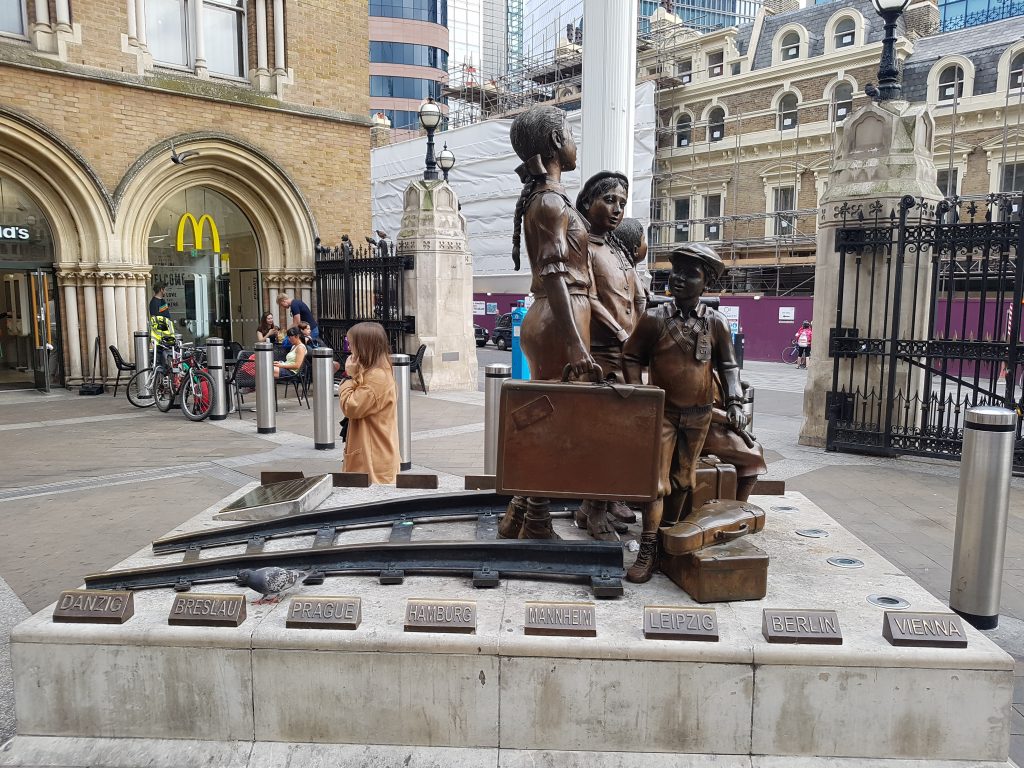
photo of The Kindertransport statue, Liverpool Street Station, London 2006 by Frank Meisler and Arie Oviada.
Holocaust Memorial Day photo fo The Kindertransport statue, Liverpool Street Station, London 2006 Statue by Frank Meisler and Arie Oviada Photo by K Flude

Statue for Holocaust Memorial Day

The statue commemorates the arrival of Jewish children by train at Liverpool St Station, In London. This was 1938/9 in the Kindertransport. They were sent by parents desperate to save their children from fascist genocide in Germany and Austria. The children were unaccompanied and, as depicted in the statue, stand proud as they arrive in a strange country. They are tagged. And the train track represents both the trains to the death camps, and the train to safety. There are some great photos and more information on the statue in: talkingbeautifulstuff.com

Holocaust Memorial Day and Montaillou

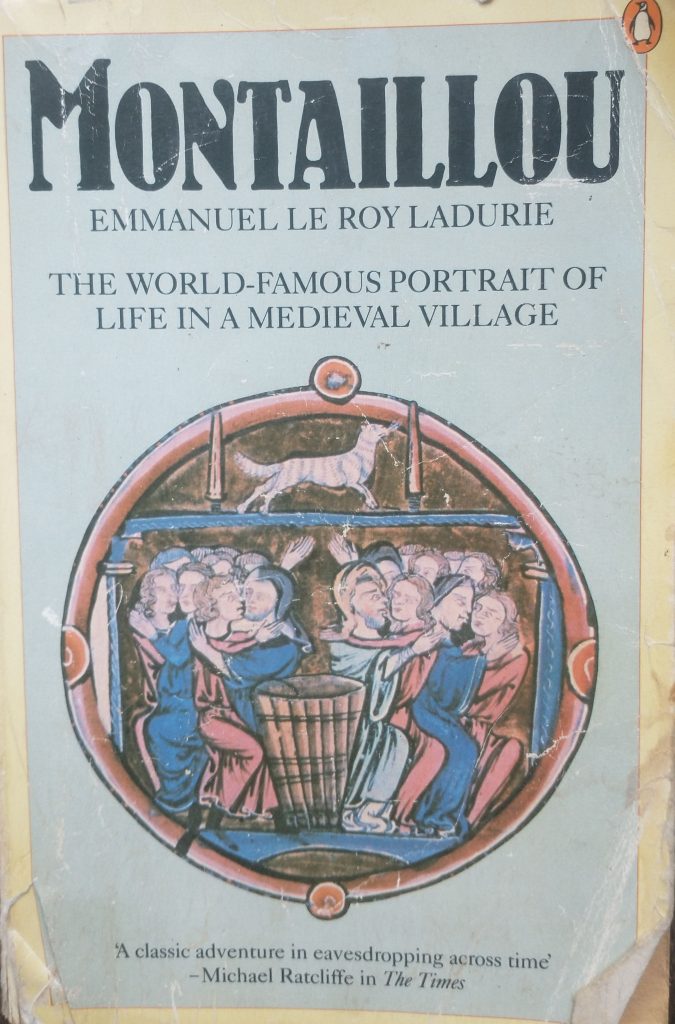
My copy of Montaillou by Emmanual Le Roy Ladurie

On the subject of prejudice, genocide and abuse of power. I was reminded of one of the formative reads of my life. The great Emmanuel Le Roy Ladurie was at dinner at my father-in-law’s house in the 1980s. I was awestruck. Because Montaillou was one of the early histories ‘from below’. The focus was not on kings, queens nor on the flux of states and empires. No, the focus was on the lives (and deaths) of ordinary people. Something that has continued as a focus of my historical interest.

Nor, before Ladurie, had I imagined that medieval lives could be so minutely brought to life. The book was a sensation, selling over a quarter of a million copies. Professor Ladurie became a media star, and, it remains one of the great historical reads. (Of course, the book and the historiography now attracts some criticism, but do read it!)

The context of the story is appalling. In 1208, the Pope decided to launch a crusade against heretics in the South of France. This is about the genocide of the Cathars. The lives of the persecuted are revealed under interrogation by the Cathodic Inquisition. Cathars had many unorthodox and ‘heretical’ ideas. They believed in a Good God and an Evil God. We, humans, are all angels trapped in this terrible world by the Evil God. Women and men were equal and could be reincarnated into each other’s bodies. Our lives are spent awaiting the time we became ‘perfect’ and released to our spiritual form for eternity.

“Kill them all, the Lord will recognise His own”

From the 21st Century, these ideas seem no more nor less irrational than mainstream religions. But these opinions ‘justified’ a Crusade and Inquisition that followed which were truly savage, with many thousand slaughtered. For example, on 22 July 1209, the Catholic forces were led by Arnaud-Amaury. He was not only the Commander of the army but also a Cistercian Abbot. Many of the citizens of Béziers were seeking refuge in St Mary Magdalene. The abbot ordered the doors to be battered down to get at the refugees inside. When asked how the soldiers could separate the Catholics from the Cathars. He replied:

Caedite eos. Novit enim Dominus qui sunt eius“—”Kill them all, the Lord will recognise His own”.

All 7,000 men, women, and children were killed. Thousands more in the town were mutilated, blinded, dragged behind horses, used for target practice and massacred. Arnaud-Amaury, remember an Abbot, wrote to Pope Innocent III:

“Today your Holiness, twenty thousand heretics were put to the sword, regardless of rank, age, or sex.”

But, despite this savagery in the name of religious purity, reading Montaillou is a pleasure. It brings those persecuted souls back to life in all their human glory.

We are all equally human

The Cathar Crusade is another reminder that it is by intolerance and ‘othering’ of normal homo sapiens which allows the conditions for evil to flourish. Massacres of the innocents becomes possible when sets of people are ‘othered’. Put in a category which, of itself, justifies their treatment. We have a very recent example with the Press Secretary at the White House. She has now referred to US citizens shot by ICE as ‘domestic terrorists’. These statements were made before due consideration of the facts. She may or may not be right, I’m not in a position to be definitive.

But we know that when the Press Secretary made them, no one could know whether she was right, or wrong. She is, in effect, saying: ‘Don’t worry about it. These are bad people who have been killed. No need to look into it too deeply. ‘ (for more on this story look here). We have to treat all human life as equal and sacred. And bring to bear our human empathy before passing judgement. Anything less allows the slaughter of the innocent.

Lessons from the Past

Holocaust Memorial Day offers a chance to remember and it is only by remembering that we can learn from the past. Sadly, more and more school are not marking the day any more. Perhaps as the survivors become fewer? However, other new sources claim that the massacres in Gaza are a cause. This is short-sighted.

Hitler’s rise to power is studied by historians who show how a functioning democracy can be taken down in a series of easy stages. Discrediting new sources, telling lies as if they were fact, subverting the legal system, making use of new media, creating a para-military force not bound by normal restraints. But the one that I think we most need to be aware of is the fact that honest, moral conservatives supported Hitler, despite their qualms about his more extreme policies. It is vital that people speak up before it is too late and too dangerous to oppose the tyranny.

On This Day

Today is also the Roman Festival of Castor and Pollux. (more on the divine twins on my post on the 15th July at the other festival of the Dioscuri).

98 – Trajan succeeds his adoptive Father Nerva

417 – Pope Innocent I declares Pelagius, a British Priest who held opposing views to Augustine of Hippo, excommunicated. For more see my post on Pelagius and Original Sin here.

1606 – The trial of Guy Fawkes and other conspirators begins, ending with their execution on January 31st. See my post on Guy Fawkes and his lantern here.

1880 – Edison received a patent for his electric incandescent lamp.

1945 – Auschwitz & Birkenau Liberated by Soviet Troops

1973 – Vietnam War cease fire came into effect.

First written in January 2023 and revised Jan 2024, 2025,2026

Civil War Parade through Westminster Last Sunday in January

Photos by Kevin Flude, Charles I, Martyr Parade

Every year the English Civil War Society commemorates the execution of King Charles I, Martyr, on the last Sunday in January. Charles was executed on January 30th. Please look at my post about the execution here.

This year, I went to the Parade for the second time, and include some photos below. The reenactors met at St James Palace and marched along the Mall to Horseguards Parade. There they assembled, and then a detachment went to the Banqueting House where Charles was lawfully executed/murdered/martyred, depending upon your attitude. Here they lay a wreath.

Charles I Martyr?

He was a tyrant who tried to subvert the rule of Magna Carta and undermined Parliament. Then started a Civil War which killed 85,000. For the numbers behind the Civil War look here. So I’m going for lawfully executed, and I might say good riddance, but I don’t believe in the death penalty. By the way, the legal arrangements made for the unprecedented trial of the Head of State, laid the foundations for trials such as those at Nuremberg, and Kosovo. The Prosecutor was a lawyer called John Cook. Please read about him in this excellent book . The Tyrannicide Brief: The story of the man who sent Charles I to the scaffold. By Robertson, Geoffrey (2005). Chatto & Windus/Vintage. ISBN 978-0-09-945919-4. Cook is remembered on Wikipedia as ‘Regicide’. But he was a pioneer of legal action against Tyranny. Another hero.

Here is the official publicity for Sunday’s Parade, followed by some of my photos.

January 25th 2026 Reenactors commemorating the execution of Charles I in Westminster

If you are interested, then you must either come to my walk, this Friday or attend my Virtual Tour, on Friday 30th January, evening. And you will find I am far more even-handed that this post suggests!

Kevin Flude’s walks to commemorate the Martyrdom of Charles I

Charles I and the Civil War. Martyrdom Anniversary Walk 2.30pm Jan 30th 26 To book

The Civil War, Restoration, and the Great Fire of London Virtual Tour 7:30pm Fri 30th Jan26 To book

First written on January 26th January 2026

Sementivae Dies—the Days of Sowing January 24–26th

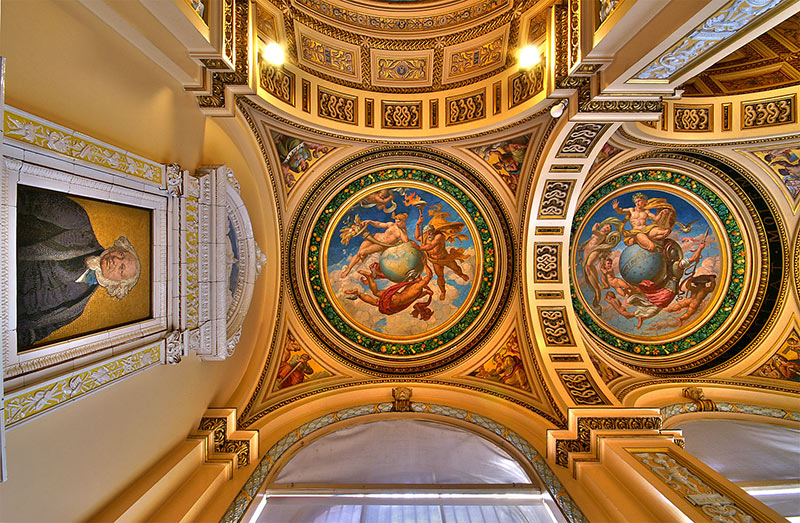
Victoria and Albert Museum” by Nick Garrod, licensed under CC BY-NC-ND 2.0. First V&A Director, Sir Henry Cole, to the left of the picture. Greek Deities in the roundells

Sementivae, was a festival dedicated to seed and to Ceres. Ceres is the Corn Goddess who gives her name to our word cereal. The festival was also called. Paganalia. The Mediterranean world had many names for the Earth Goddess. Tellus, Demeter, Cybele, Gaia, Rhea etc. who is celebrated around this time of the year with Ceres.

Ceres can be seen on the top left roundel resting on the Globe on the marvellous Ceramic Staircase at the V&A (photo above). And in my slightly out of focus photograph below. (To be honest, in real life, it looks a little more like my photo than the gorgeous photo above!)

Ceres represented Agriculture, Mercury Commerce, and Vulcan Industry.  Old Photo by the Author.  T
Ceres represented Agriculture, Mercury Commerce, and Vulcan Industry. Old Photo by the Author.

Sementivae Dies – a moveable feast.

To create life, we need earth and water to nurture and seeds for their fertility. And so into the cold dead world of January the Romans created a festival of sowing. It had two parts, one presided over by Mother Earth (Tellus) and the other by Ceres, the Goddess of Corn. The actual day of the festival was chosen not by rote on a set day of the calendar but by the priests, in accordance with the weather. This seems very sensible, as there is no point sowing seeds in terrible weather conditions. I’m assuming the Priests took professional advice!

On the 24th-26th January Tellus prepared the soil, and in early February seeds were sown under the aegis of Ceres. Tellus Mater (also Terra Mater) was known as Gaia to the Greeks.

Gaia

Gaia was selected by James Lovelock & Lynn Margulis in the 1970s as the face of their Gaia hypothesis. To me, the importance of the idea is not the scientific principle that environments co-evolve with the organisms within them. But, rather in Gaia as a personification of our world as a complex living ecosystem. One that we have to care for. Gaia exists as a series of feedback loops. Lovelock hypotheses is that she will spit us out unless we can live in balance with our alma mater. I cannot believe he was not knighted. However, he is one of my heros.

Photo of James Lovelock with Greenery behind him and a statue of a female who may be the earth goddess Gaia,
James Lovelock. The original uploader was Bruno Comby at English Wikipedia. – Transferred from en.wikipedia to Commons., CC BY-SA 1.0, https://commons.wikimedia.org/w/index.php?curid=3873472. I hope the Goddess in the background is Gaia

Here is a tribute to Lovelock by his friend Bryan Appleyard. In it. He claims that work done by Lovelock ‘saved the world’. Lovelock invented a device that enabled the detection (and eventual eradication) of DDT and CFCs. If you remember, CFCs were destroying the Ozone layer until international agreement phased them out. Lovelock also worked for MI5. Appleyard, writing in The Sunday Times, described Lovelock as “basically Q in the James Bond films”.

Ovid and Sementivae

Ovid allocated January 24th to Sementivae but explains it is a variable date. But let’s let the Roman Poet Ovid has to say in his poetic Almanac known as ‘Fasti’ (www.poetryintranslation.com)

Book I: January 24

I have searched the calendar three or four times,
But nowhere found the Day of Sowing:
Seeing this, the Muse said: That day is set by the priests,
Why are you looking for moveable days in the calendar?
Though the day of the feast ís uncertain, its time is known,
When the seed has been sown and the land ís productive.
You bullocks, crowned with garlands, stand at the full
trough,
Your labour will return with the warmth of spring.
Let the farmer hang the toil-worn plough on its post:
The wintry earth dreaded its every wound.

Steward, let the soil rest when the sowing is done,
And let the men who worked the soil rest too.
Let the village keep festival: farmers, purify the village,
And offer the yearly cakes on the village hearths.
Propitiate Earth and Ceres, the mothers of the crops,
With their own corn, and a pregnant sow ís entrails.
Ceres and Earth fulfil a common function:
One supplies the chance to bear, the other the soil.
Partners in toil, you who improved on ancient days
Replacing acorns with more useful foods,
Satisfy the eager farmers with full harvest,
So they reap a worthy prize from their efforts.
Grant the tender seeds perpetual fruitfulness,
Don’t let new shoots be scorched by cold snows.
When we sow, let the sky be clear with calm breezes,
Sprinkle the buried seed with heavenly rain.
Forbid the birds, that prey on cultivated land,
To ruin the cornfields in destructive crowds.
You too, spare the sown seed, you ants,
So you’ll win a greater prize from the harvest.

For more on Ovid look at my post on Ovid and Juno here. Or you can search for Ovid in the Search box for other my posts on the Roman poet.

On This Day

1788 – Foundation of the first colony of European Settlers at Port Jackson, now Sydney. It is now Australia Day, a public holiday.

1841 – Hong Kong became a British Sovereign Territory

1926 – The first Public demonstration of a TV image given by Scottish electrical engineer John Logie Baird (1888-1946)

1998 – ‘I did not have sexual relations with that woman’ or so said Bill Clinton, lying through his teeth. (although I guess it depends on your definition of lying?) For more, look at the Time article here.

First Published in January 2023, republished in January 2024, 2025, 2026


Burn’s Night January 25th

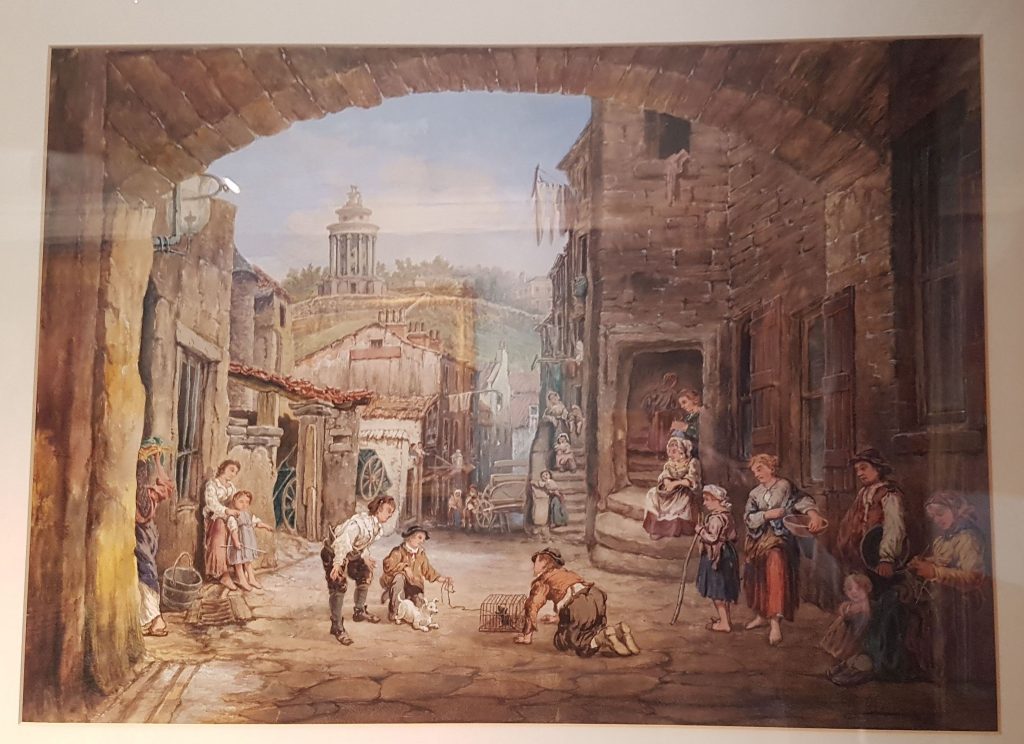
Edinburgh Writer’s’ Museum ‘Burn’s Monument from Campbell’s Close Canongate’ by John Bell. The Burn’s Monument is is on the hill in the background.

Burn’s Night is an increasingly important date on the calendar of Scotland’s Cultural Heritage. Wikipedia says it began:

at Burn’s Cottage in Ayrshire by Burns’s friends, on 21 July 1801

This was 5 years after his death. It is now celebrated around the world, making clear the importance of Robert Burns. Burns himself would have been astonished at the spread of Burn’s Night. He was modest about his attainments, saying, in his introduction to the Commonplace Book:

‘As he was but little indebted to scholastic education, and bred at a plough-tail, his performance must be strongly tinctured with his unpolished rustic way of life. ‘

To celebrate Burn’s Night here is one of his most famous works. Also have a look at my post on his great narrative poem, Tam O’Shanter and the Cutty Shark.

Address to a Haggis

Fair fa’ your honest, sonsie face,
Great Chieftain o’ the Puddin-race!
Aboon them a’ ye tak your place,
Painch, tripe, or thairm:
Weel are ye wordy of a grace
As lang ‘s my arm.

The groaning trencher there ye fill,
Your hurdies like a distant hill,
Your pin wad help to mend a mill
In time o’ need,
While thro’ your pores the dews distil
Like amber bead.

His knife see Rustic-labour dight,
An’ cut ye up wi’ ready slight,
Trenching your gushing entrails bright,
Like onie ditch;
And then, O what a glorious sight,
Warm-reekin, rich!

(for the other five verses have a wee lookie here)

The Writer’s Museum

Writers’ Museum photo K. Flude

Often bypassed by the tourists on a visit to the wonderful City of Edinburgh is the Writer’s Museum. It is in one of those remarkable Tower houses which seem unique to the High Street in Edinburgh. Inside, it gives a great introduction to the great writers of Scotland.

Is it not strange’ wrote philosopher David Hume in 1757 ‘that a time when we have lost our Princes, our Parliament, Independent Government …..that we shou’d really be the people most distinguish’d for literature in Europe?’ (source: Museum display panel)

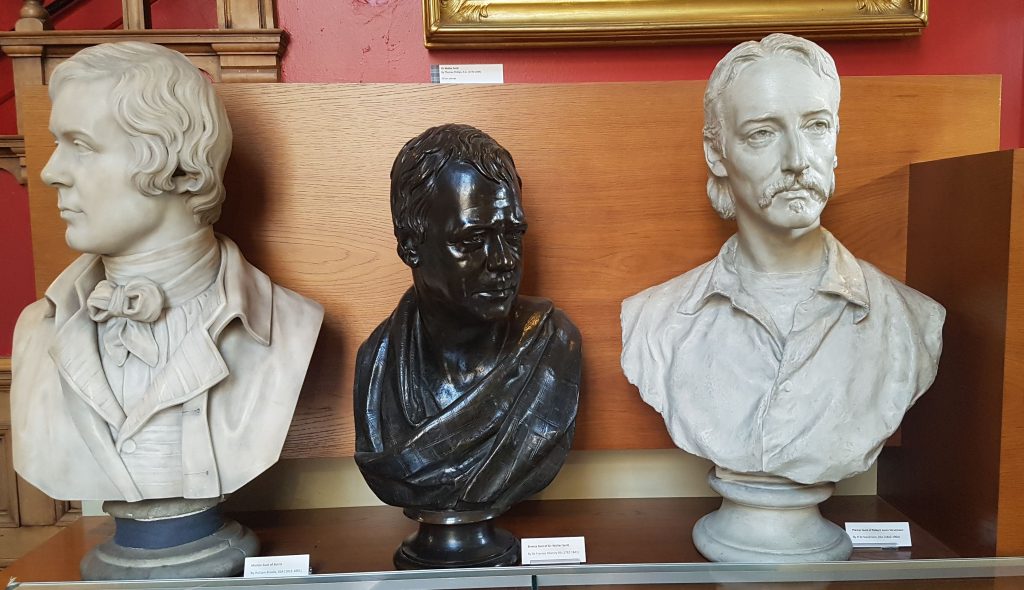
Edinburgh Writer’s Museum Burns, Scott, Stevenson.
A Visual for Burn’s Night ‘Window in the Writer’s Museum, Edinburgh’ Photo by K Flude

See my post on Literary Edinburgh here

On This Day in Scotland

1759 – The birth of Robert Burns.

1784 – The death in Edinburgh of Alexander Webster, a writer and church minister who is best remembered for the country’s first census. The first UK census was in 1801.

1817 – The Scotsman newspaper publishes its first edition in Edinburgh.

2012 – First Minister Alex Salmond launches a consultation on the SNP Government’s proposals for a referendum on Scottish independence. on the question “Should Scotland be an independent country?”. The voters answered “No” 55.3% and 44.7% voting in favour. (for more on Scottish Independence, see my post here.)

Source www.undiscoveredscotland.co.uk/

First published Jan 2023, republished Jan 2024, 2025, 2026

St Cadoc Day January 24th

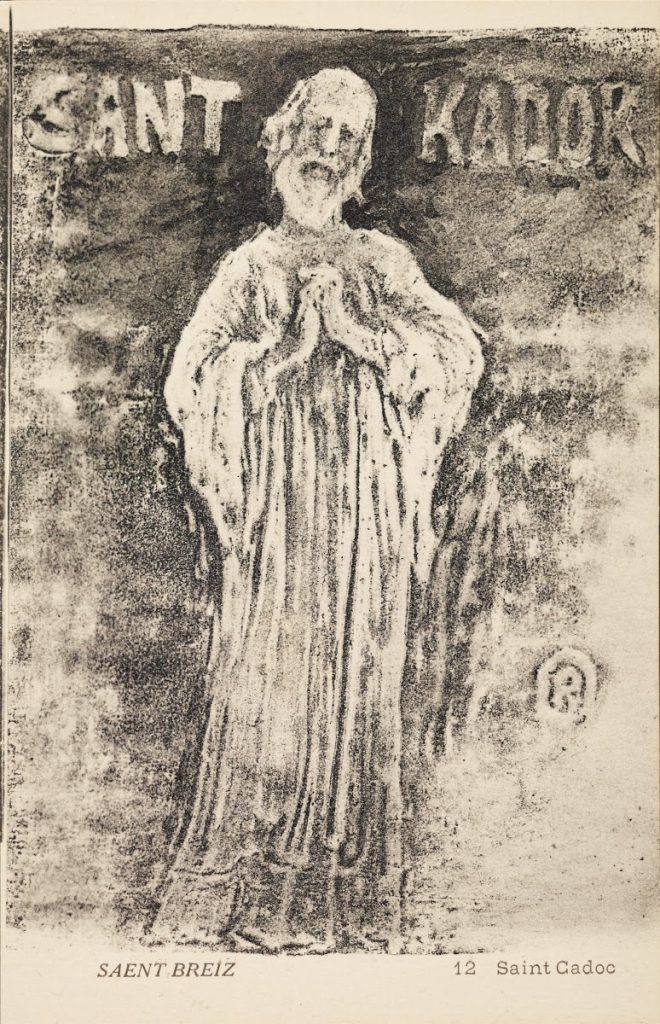
S Cadoc of Llancarfan
Image of St Cadoc

St Cadoc was born in 497 AD, a Saint, and Martyr, who founded a monastery at Llancarfan, near Cowbridge, Glamorgan, Wales. He also has associations with Scotland, Brittany, and England. His story is not written down until the 11th Century. But it is fascinating and, in its own way, a charming story. The gentle son of a savage, robber King, he was educated in Latin under an Irish priest, and refused his father’s orders to fight. But he lived to convert his parents . He is known as Cattwg Ddoeth, “the Wise”, although his sayings are mired in the forgeries of Iolo Morganwg. (aka Edward Williams, collector of Medieval Welsh literature and forger.)

Cadoc comes into conflict with King Arthur. In Welsh literature, King Arthur is a brave but wilful King. He demanded Cadoc give him compensation after the Saint sheltered a man who had killed three of Arthur’s men. The compensation was delivered as a herd of cows, but as soon as Arthur took charge of them they turned into ferns.

Cadoc and the Saxons

Cadoc was forced out of Britain by the pagan Anglo-Saxons, but eventually, he felt he had to return despite the grave danger he would face. He wanted to obey his own maxim:

Would you find glory? Then march to the grave.

He therefore moved to the Saxon settlements to give spiritual succour to the native British Christians, survivors of Saxon massacres. His martyrdom took place at Weedon in Northamptonshire. Here his Service was interrupted by Saxon horsemen, and Cadoc was slain as he served the Eucharist. He lived, probably, in the later 5th Century/Early 6th Century.

The Catholic Church celebrates him in September, elsewhere on the 24th January.

For more, look at https://celticsaints.org or Wikipedia.

On This Day

41 – Claudius found hiding behind a curtain and proclaimed Emperor after Caligula assassinated

1536 -Henry VIII falls off his horse while jousting, sustains brain injuries that some say explain his worsening behaviour? Or what is just that he was a narcissistic, privileged individual with too much power?

1972 – Japanese Sgt. Shoichi Yokoi discovered in a Guam jungle, where he had been hiding since the end of World War II.

1984 – Macintosh personal computer put on sale by Apple in the United States.

First published in January 2023, republished in January 2024, 2026

Hawthorn January 23rd

 Photo by Timo C. Dinger on Unsplash
photo of hawthorn flowers
Photo by Timo C. Dinger on Unsplash Hawthorn hedge flowers

Hawthorn Hedges

Many plants can be used for hedges, but hawthorn is the most common. It can be planted as bare-root from Autumn to Spring, so January is as good a time as any. It can also be grown from the seeds from its red berries. But this takes 18 months to achieve. Interspersed along the hedge line are often other trees—either trees for timber, or fruit trees perhaps crab-apples or pear-stocks. Trees were also useful as markers. Before modern surveys, property would be delineated by ancient trees. Hedges could be removed. Trees were more difficult to eradicate.

Hawthorn hedges are an oasis for insects, mammals and migrating birds (who eat the berries). It is a lovely plant for May. In fact, it is also called May, or the May Flower or May Tree and also whitethorn. The berries are called ‘haws’ hence hawthorn. For more on this, look at https://whisperingearth.co.uk.

Hawthorns & Folklore

a triangle of stained glass on a black background.
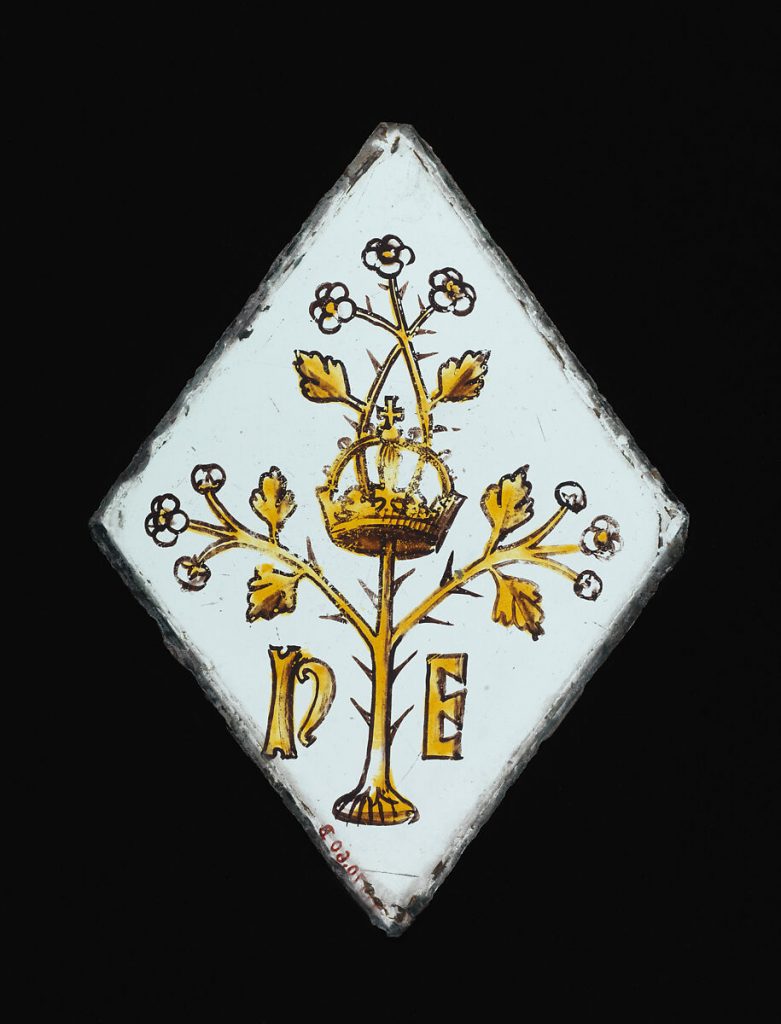
A 'Quarry' of Stained Glass showing the Crown, a hawthorn Bush and initials representing Henry VII and his, Queen, Elizabeth of York.  Possibly from Surrey. Early 16th Century and from the Metropolitan Museum of Art (Public Domain).
A ‘Quarry’ of Stained Glass showing the Crown, a hawthorn Bush and initials representing Henry VII and his, Queen, Elizabeth of York. Possibly from Surrey. Early 16th Century and from the Metropolitan Museum of Art (Public Domain).

Hawthorn produces white flowers in Spring. So, it is one of the great pagan fertility plants, its flowers forming the garlands on May Eve. One of the chemicals in the plant is the same as one given out in decay of flesh. It is, therefore, associated with death in folklore, and not to be brought into the house.

It was also said to be the thorn in the Crown of Thorns, so sacred. A crown from the helmet of the dead King Richard III was found on a hawthorn bush at the Battle of Bosworth Field. The victorious Henry VII adopted it for a symbol. . For more on the plant, https://www.woodlandtrust.org.uk

The virtues of Hawthorn

John Worlidge, wrote in 1697

‘And first, the White-thorn is esteemed the best for fencing; it is raised either of Seeds or Plants; by Plants is the speediest way, but by Seeds where the place will admit of delay, is less charge, and as successful, though it require longer time, they being till the Spring come twelvemonth ere they spring out of the Earth; but when they have past two or three years, they flourish to admiration.’

Systema Agriculturae 1697

Hawthorn is an excellent wood for burning, better than oak. It has the hottest fire so that its charcoal could melt pig-iron without the need of a blast. It is also good for making small objects such as boxes, combs, and tool-handles. The wood takes a fine polish, so also used for veneers and cabinets. For advice on the best wood to burn read my post here.

Hawthorn has many medicinal benefits according to herbalists. Mrs Grieve’s Herbal suggests it was used as a cardiac tonic, to cure sore throats and as a diuretic. (But don’t try any of these ancient remedies without medical advice!)

What to plant in late January

This is the time, according to Moon Gardeners, to plant and sow plants that develop below ground. So rhubarb and garlic, fruit trees, bushes, bare-root plants and hedging plants.

On This Day

1571 – The Royal Exchange opens in London. London first Business centre since the Roman Forum, creating the first Bourse in the UK

1785 – ‘Boys play on the Plestor at marbles & peg-top. Thrushes sing in the Coppices. Thrushes & blackbirds are much reduced.’ From the Garden Calendar in Gilbert White’s Year. the Plestor is the village green; peg-top is a spinning top game. For more on Gilbert White,the inspirer of Darwin, see my post.

1940 – The coldest day since the Great Freeze of February 12th 1895. The Thames froze over for the first time since 1880. Lovely photo here of skaters on the Serpentine.

1973 – Ceasefire in Vietnam agreed in negotiations in Paris

First Published in January 2023, revised 24, 25, 26