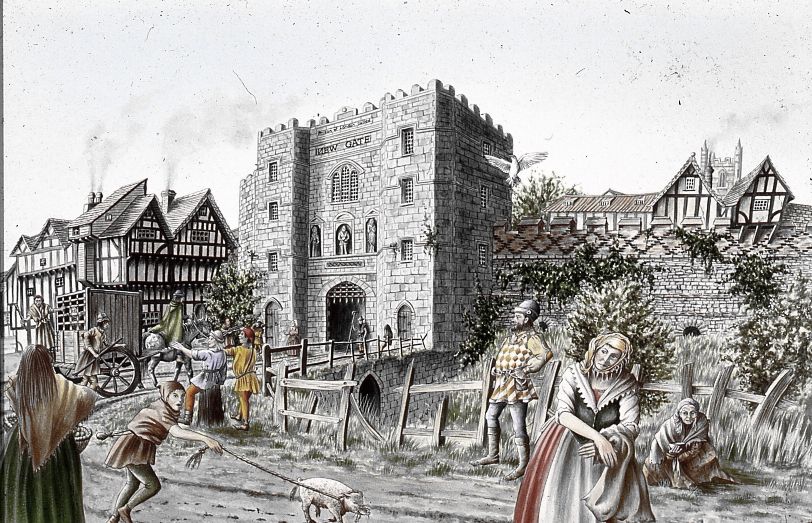
St Nicholas & Boy Bishops December 6th

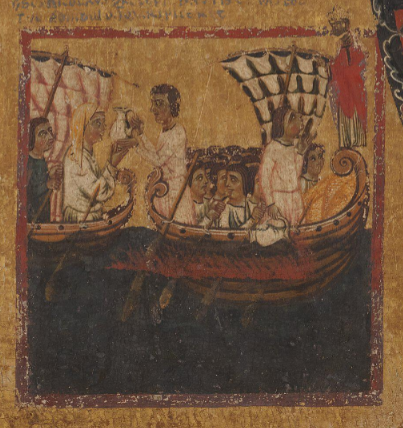
St Nicholas saving citizens from poisoned olive oil. Detail of painting by Margarito of Arezzo. National Gallery

Santa Klaus was, originally a 4th Century Bishop from Asia Minor who saved three girls from prostitution. He throw golden balls through their window enabling the girls to marry with a good dowry and live a moral life. Saint Nicholas, also, saved three boys from beheading. So he became the patron saint of children. He died on the 6th of December in Myra, present day Turkey. From the moment of his internment, his tomb flowed with myrrh. There are many other miracles. Once St Nicholas appeared on a storm tossed boat and saved the sailors. Another has him saving people from poisoned olive oil. (see picture above.)

In 1087, the Normans from Apulia raided Myra, then under the control of the Seljuk Turks. The gang of 67 men stole the Saint’s remains, to bring them to Bari, in Southern Italy. Bari already had 6 churches dedicated to St Nicolas. In 1969, Pop Paul VI revoked his Feast Day as he decided there was no evidence St Nicholas was a real person.

Despite this, he is the ‘patron saint of sailors, merchants, archers, repentant thieves, children, brewers, pawnbrokers, toymakers, unmarried people, and students in various cities and countries around Europe’ (Wikipedia). He is also known as Nicholas the Wonderworker.

It’s all about the Balls

Representation of the balls can still be seen hanging in front of pawnbroker’s shops. The gifts Nicholas gave led to the exchange of gifts to honour him. Originaly, gift giving took place on December 6th, his feast day. The Dutch took the tradition of Santa Klaus to the United States. Here it mixed with other traditions, including the English Father Christmas, to create our modern spirit of Christmas, and Santa Klaus.

Boy Bishops
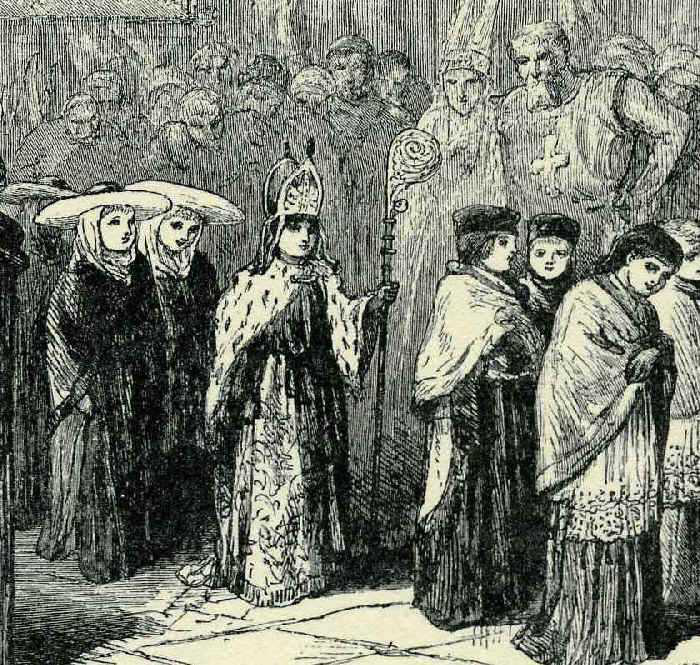
By Unknown author – fullhomelydivinity.org, Public Domain,
https://commons.wikimedia.org/w/index.php?curid=6709993

The idea of Boy Bishops may come from a tradition established by Saturnalia. This was the festival, in the Roman world, when servants exchanged duties with their masters and mistresses. Tthe Lord of Misrule presided over Medieval Christmas. While Church ceremonises were presided over by Boy Bishops. The tradition was attacked in some quarters but defended by others. They felt it engendered empathy. had an element of humanity and instigated seasonal fun. The Boy Bishops were elected on December 6th. Their reign might continue until Childermas (Holy Innocents Day December 28th).

The custom was stopped by Henry VIII. It was then revived and is still practised to this day in the Cathedrals of Hereford and Salisbury. The Boy Bishops wears full ceremonial gear and takes part in ceremonies and services for three weeks.

Boy Bishops in London

There are also medieval records that speak of the custom:

“two children’s copes, also a myter of cloth of gold set with stones.”
1549 “For 12 oz. silver, being clasps of books and the bishop’s mitre,

St. Mary-at-Hill, London Church Accounts

“The vj myter of Seynt Nycholas bysshoppe, the grounde therof of whyte sylk,
garnysshed complete with ffloures, gret and small, of sylver and gylte, and stones

Westminster Abbey, St Pauls & St Nicholas Cole Abbey London inventories

Also records at St Pauls record: una mitra alba cum flosculis breudatis ad opus episcopi parvulorum baculus ad usum episcopi parvulorum;’

St Nicholas Cole Abbey in the City of London has an inventory dating to the Reformation that records vestments for children at St Nicholas. The Church is first mentioned in the 12th Century and was never an Abbey. The Cole part of the name refers to a ‘Coldharbour’ which was a traveller’s or poor persons shelter from the cold. The Church was rebuilt by Christopher Wren after the Great Fire. This is, probably, the location where Trotty Veck stands awaiting employment as a messenger or runner, in Dickens’s second greatest Christmas Book after the Christmas Carol. The story is more a New Year story than a Christmas story. (I tell the story in my post here).

For more on boy bishops look at this, and look at this 1935 film about Boy ~Bishops in Compton, Guildford.

The Lord of Misrule.

Middle Temple, like the other Inns of Court in London, also had a Winter period of ‘condoned disorder’. This continued through to Christmas and beyond to Candlemas. It was presided over by a Lord of Misrule, or in the Middle Temple’s case a Prince of Love. The Revels of 1597-8 were republished in 1660. Each December, students, barristers and Benchers create and perform the Inn’s annual Christmas Revels. With thanks to https://www.middletemple.org.uk/about-us/history/elizabethan-and-jacobean-times

On This Day

1648 Pride’s Purge. The day that the New Model Army had had enough, and Colonel Thomas Pride, excluded members of the Long Parliament from sitting in Parliament. This led to the Execution of Charles I, and the establishment of Britain’s first and only Republic. (see my post on the execution of Charles I)

I am doing a walk Charles I and the Civil War – the Martyrdom Anniversary Walk on January 30th 2026. And a Virtual Tour on the Civil War, Restoration & the Great Fire of London on the evening of January 30th.

1964 Martin Luther King made a flying visit to St Pauls to deliver a sermon on his way to pick up the Noble Peace Prize in Oslo. He based his sermon on the following poem. The visit is described on the St Pauls Web Site here

Be The Best Of Whatever You Are

By Douglas Malloch

If you can’t be a pine on the top of the hill,
  Be a scrub in the valley — but be
The best little scrub by the side of the rill;
  Be a bush if you can’t be a tree.

If you can’t be a bush be a bit of the grass,
  And some highway happier make;
If you can’t be a muskie then just be a bass —
  But the liveliest bass in the lake!

We can’t all be captains, we’ve got to be crew,
  There’s something for all of us here,
There’s big work to do, and there’s lesser to do,
  And the task you must do is the near.

If you can’t be a highway then just be a trail,
  If you can’t be the sun be a star;
It isn’t by size that you win or you fail —
  Be the best of whatever you are!

Douglas Malloch. “Be The Best Of Whatever You Are.” Family Friend Poems,

First published December 6th, 2022. Revised and republished 6th December 2023. Martin Luther added in 2024, Pride’s Purge added in 2025
Snails & Cider December 5th

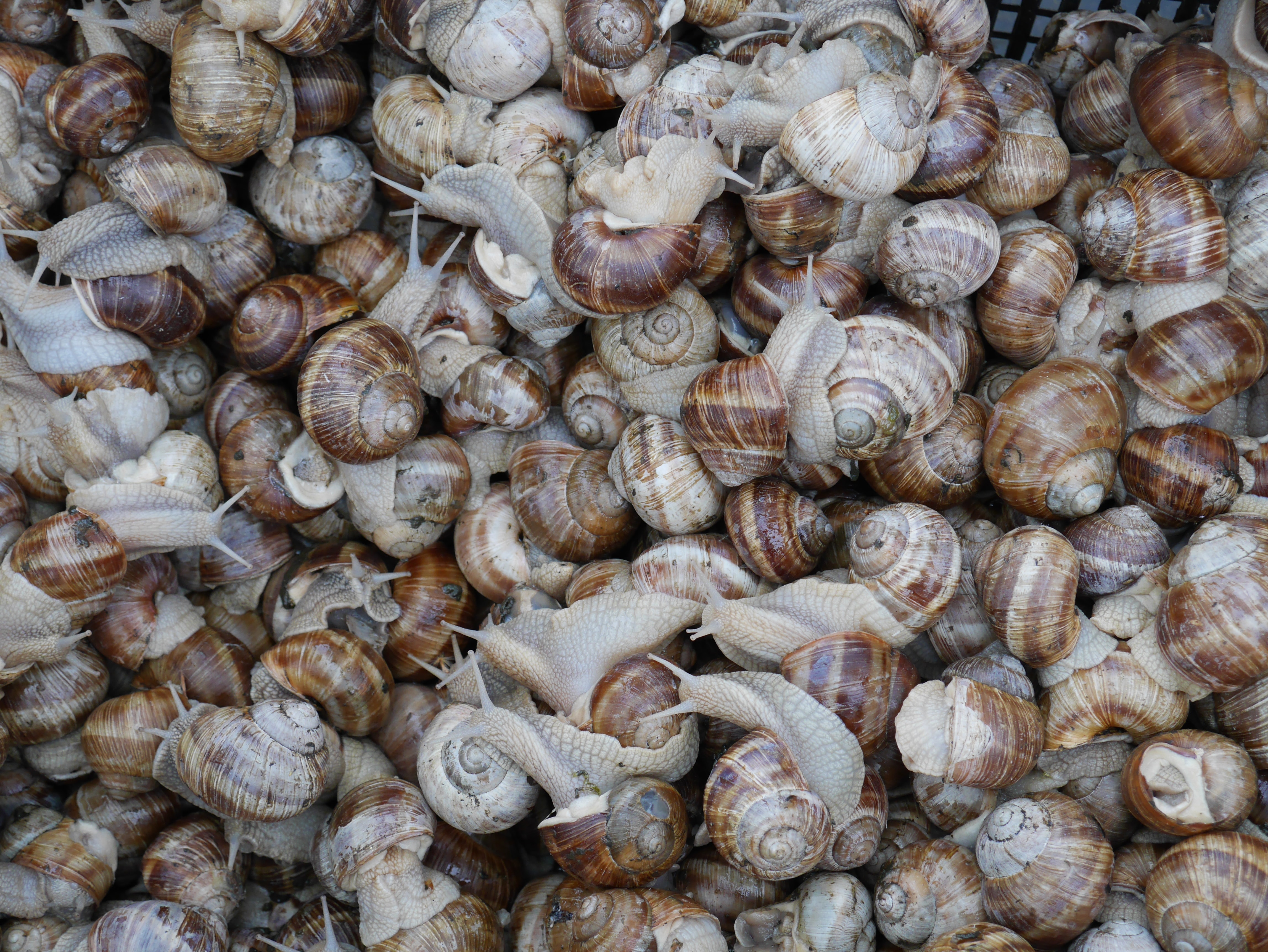
Snails. Photo by Mats Hagwall on Unsplash

Worlidge’s ‘Systema Agriculturae’ of 1697 says this is the time to destroy snails. He suggests that, at Michaelmas, you create a shelter for snails against a wall using bricks or boards. In Early December the plantsman can get his revenge on the little blighters, all unsuspecting and snuggled up in their cosy den. (More from Worlidge see my post here:)

The RHS has some more modern advice, but generally takes a negative opinion of snails. The Birmingham and Black Country Wildlife Trust take a much more positive view of snails and slugs. They propose their contribution to nature should be rewarded by our learning to love and live with the little critters.

(Thanks to Charles Knightly’s Perpetual Almanac)

Improving the cider before Christmas

Old Cider Tree Illustration

Britain is by far the largest Cider drinking nation, drinking 32% of the global total. South Africa is second at 15%. One of the reasons is that Britain does not have the climate for mass wine making, while it has an excellent climate for growing apples, particularly in the West Country. But other counties also produce it including: Somerset, Devon, Dorset, Herefordshire, Worcestershire, Gloucester, Kent, Sussex, Suffolk, Norfolk, and Cider has expanded into other counties such as Buckinghamshire and Cheshire.

As Cider makers approach Christmas, they will be worrying what their Cider is doing. If the cider was a bit off, an old trick was to add half a peck of wheat to restart the fermentation. This would make it more mild and gentle. Also, adding mustard or two or three rotten apples could clear the cider.

Although it’s all a little Thomas Hardy, Cider expert Gabe Cook provides instruction here in how to make cider from your own cider tree without investing in a huge fruit press. To buy small cider presses and cider making kits click here.

For Cider and Waissailling see my post here.

On This Day

1791 Death of Mozart. ‘Mozart appears as a being eccentrically formed to be a medium for the expression of music and no grosser purpose. Iin this he was strong: in everything else of body and mind, he remained a child during the 36 years to which his life was limited. Chambers Book of Days, 1864.

1872 Mary Celeste,a brig, carrying a cargo of alcohol, found abandoned off the Azores

1933 Prohibition Ended

First Published on December 5th 2022, revised and republished on December 5th 2023, 2024 and 2025

The Great British Smog December 5th 1952

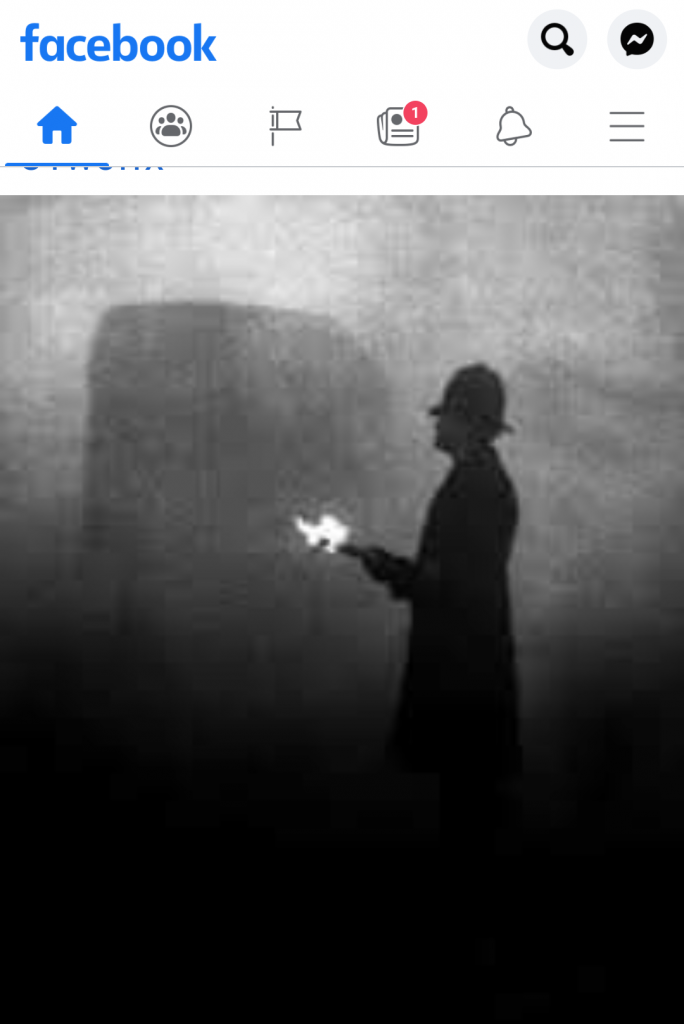
Image from Facebook of The Great British Smog

Today is the anniversary of the Great Smog. What happened in 1952 changed Britain forever. A terrible smog developed which lasted for a week, beginning on December 5th 1952. It killed probably 12,000 people. The hospitals, the emergency services, the mortuaries, the funeral parlours had more work to do than during the Blitz or the Cholera epidemics. Higher deaths than normal were still occurring as late as January 1953.

A temperature inversion kept a blanket of cold damp air over London. This stoped the pollutants being dispersed and blown away. But post-war austerity (this time introduced by the Labour Party) made it such a killer. Britain was exporting our top grade coals. And allowing domestic users to use terrible stuff called ‘nutty slack’. This was sludge, dust, and fragments of very low grade and therefore very smokey coal. 18% of the coal used was domestic, but it contributed 60% to the emissions. The fog was yellow and sulphuric. Public Transport had to be halted as no one could see beyond their hands in front of their faces. People had to leave cinemas because no one could see the screens.

What changed Britain was that it finally persuaded people that coal-polluted air was a killer. People had debated it since the Victorian period, but did very little about it, some even believing smoke was good for you. In World War II the government encouraged smog near Cities, to cloak the industrial areas from the Luftwaffe Bombers. After 1952, it was clear what a killer smog was. In 1956, the Clean Air Act established zones where only smokeless fuels could be used. Polluting industries were dispersed from the towns. Taller chimneys were used. This eventually cleared up the problem.

Pollution still killing people

Job done, or so we all thought. Dr Gary Fuller (see below) tells us that we are incapable of dealing with more than one pollution threat at a time. In 1962, another smog, created by sulphur dioxide pollution, killed perhaps 1,000 people in London. And London still has a lot of air pollution, not just from traffic fumes, and it is still killing people.

Traffic pollution in London is being dealt with more aggressively by the current Mayor. Partly as a response to a brave coroner who found that a 9-year-old girl, Ella Kissi-Debrah, died because of air pollution. (girls-death-contributed-to-by-air-pollution-coroner-rules-in-landmark-case). The London Mayor began addressing the issue by first creating and then expanding, the Ultra Low Emission Zone, to encompass all the London Boroughs. This has been very controversial as it has meant many people having to sell cars that do not meet the standard. This had the unfortunate byproduct which was that it enabled the unpopular Conservative Party hanging on, by the skin of their teeth, in Boris Johnson’s old constituency.

The creation of Local Traffic Neighbourhoods are another front against diesal pollution. They allow local authorities to introduce traffic reduction methods by blocking off many neighbourhood roads from through traffic. These have been fought tooth and nail by its opponents. But have been a success, cutting local pollution.

Freedom from Air Pollution?

But much less well known are other threats. For example, there is an increasing threat from trendy wood burning stoves which are very polluting. I very reluctantly decided to install a diesal heater in my narrowboat as it is less polluting that a cosy Wood Burning Stove. Yet their sales are soaring as people seek ways of mitigating soaring post-Ukraine war electricity prices.

Agriculture is very polluting too, with fertiliser, and manure mixing with urban pollution to create dangerous particulates. It turns out that the most polluting time of the year is not Autumn, nor Winter but Spring because of this agricultural activity.

Listen to the BBC’s excellent episode of ‘Inside Science: Killer Smog’. If you cannot use BBC Sounds, then go to the link to a Podcast at the bottom of the piece. These are both based on the work of Dr. Gary Fuller of King’s College, London, detailed in his book ‘Air Pollution: The Invisible Killer’.

We need to stop being short-sighted, not just ‘solving’ one problem before moving onto the next. We need a fundamental revision of our systems to allow us to enjoy the last two of the four freedoms so eloquently expressed by Roosevelt (the subject of the 2024 BBC Reith Lectures):

  1. Freedom of speech
  2. Freedom of worship
  3. Freedom from want
  4. Freedom from fear

Air Pollution Podcast click here:

To see my post on the Great Storm go to my post here.

First Published on December 5th 2022, Revised and republished on December 5th 2023, 2024 and 2025

Winter Song by William Shakespeare December 4th

Winter. Photo by Harriet Salisbury of Abney Park Cemetary, Hackney, London

When icicles hang by the wall,
And Dick the shepherd blows his nail,
And Tom bears logs into the hall,
And milk comes frozen home in pail,
When blood is nipp’d and ways be foul,
Then nightly sings the staring owl,
Tu-whit;
Tu-who, a merry note,
While greasy Joan doth keel the pot.

When all aloud the wind doth blow,
And coughing drowns the parson’s saw,
And birds sit brooding in the snow,
And Marion’s nose looks red and raw,
When roasted crabs hiss in the bowl,
Then nightly sings the staring owl,
Tu-whit;
Tu-who, a merry note,
While greasy Joan doth keel the pot.

William Shakespeare - Love's Labours Lost

Winter Song by William Shakespeare – Love’s Labours Lost (LLL V.ii.901)

Winter Song is near the end of the play. By way of the conclusion, two works are composed for the King of Navarro in praise of the Cuckoo and the Owl. One read by a representation of the Spring and the other, shown above, by ‘Hiems’ the representation of winter.

Is it very Shakespearean?  No, not if you are expecting ‘sweet and honeyed words’ but it brings us deep into the heart of cold winter. With the icicles on the wall, the fouled muddy roads, the cold wind, the nip in the air, and the outbreak of winter colds.

The focus is either from a working-class perspective or from a member of the gentry looking at his servants.  The owl and Greasy Joan stirring the food ends each verse. Roasted crabs are crab apples. The apples were heated in the oven then thrown into a dish of beer where they would hiss.  So there is a hint of winter conviviality.

The nail means warming your fingers by blowing on them. Alternatively, it means twiddling your fingers. Greasy Joan is probably a cook or kitchen maid, and she is cooling the pot by stirring it.   But some suggest that ‘Greasy Joan’ might refer to a prostitute.  But it doesn’t really fit the poem? Although the spring part of the poem, narrated by Cuckoo refers to cuckolding. Tu-whit, tu-whoo is, in fact, two tawny owls calling to each other, the female calling first and the male answering. John Lyly first used the call in 1595. Some suggested it can also be read ‘To it, to who?’ In Shakespeare’s day. To go ‘to it’ was a sexual reference, but then he also uses that phrase mostly innocently. The parson’s saw is a reference to the the parson’s sermon. The coughing in the cold nave of the Parish Church makes it difficult to hear.

This is a YouTube piece setting the poem to music by Ralph Vaughan Williams

On This Day

1940 Joan Wyndham, Love Lessons, A Wartime Diary.

‘Rowena rings to say in a dead, sort of voice, ‘The worst has happened. Billy Bolitho says I’m definitely pregnant. Can you lend me 15 quid to Saturday?’ I said I could give her six, which is all I had because I know just how she feels, and if she doesn’t have an abortion before Saturday, it will be too late. I meet her in Dean Street, and we wandered down to Duran’s in the icy cold for a delicious lunch. Christ, their pastries are good! Poor Rowena couldn’t eat anything. She says her only chance is to put lots of ether soap up her bottom for 10 days. Billy Bolitho says, it’s tough going, but infallible. But R says, How will I keep it from my mum if I go around smelling like an operating theatre?’

Reported in ‘A London Year’ Compiled by Elborough and Rennison. Needless to say, this could be dangerous and it is better to seek advice from a Doctor.

Link to Adebooks to buy Love Lessons

First Published on December 4th, 2024, revised 2025

Feast Day Of King Lucius – First Christian King Of Britain? December 3rd

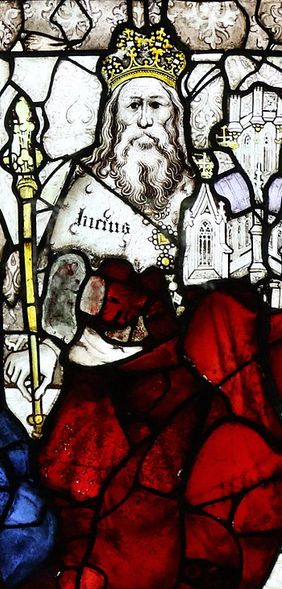
King Lucius York Minster Window

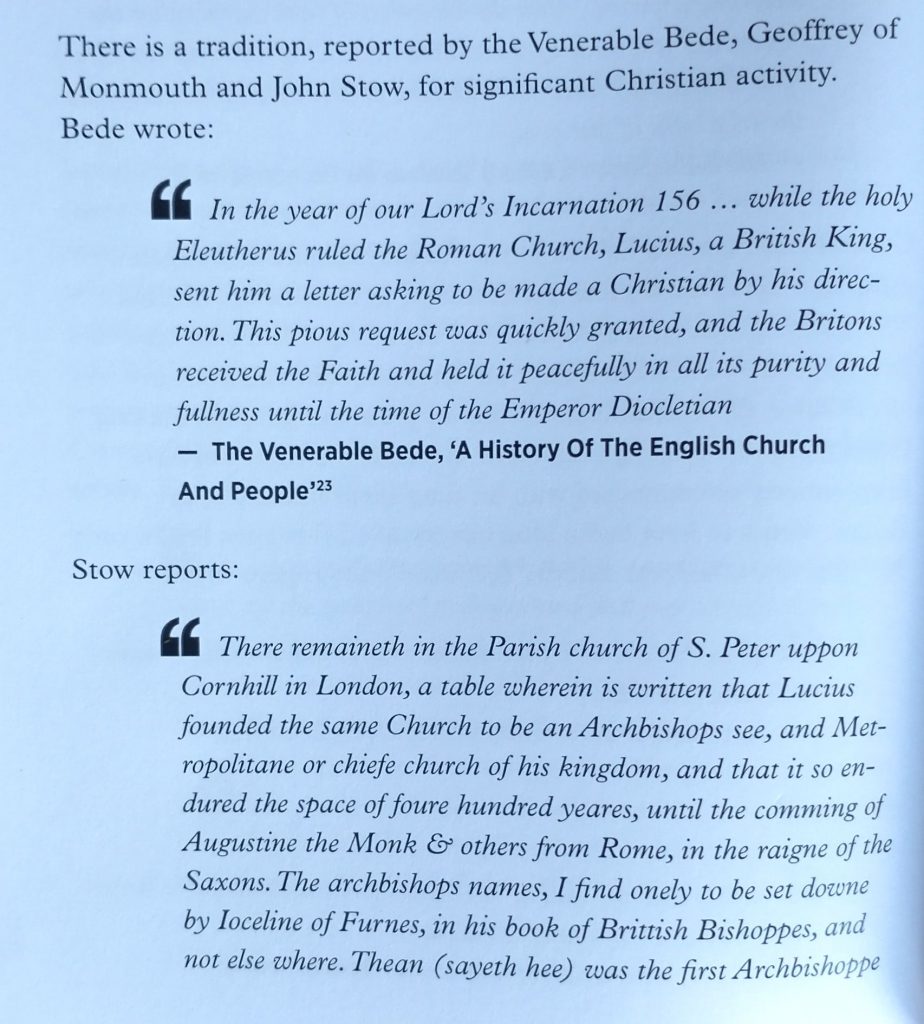
The Venerable Bede tells us that King Lucius converted to Christianity in around 180AD. He says that the King asked Pope Eleutherius to send teachers to instruct him. The Venerable Bede (died 735 AD) got this from the Liber Pontificalis of c 590. There is also a tradition that St Peter’s Cornhill in London was set up by King Lucius, and that St Peter’s is the oldest Church in London.

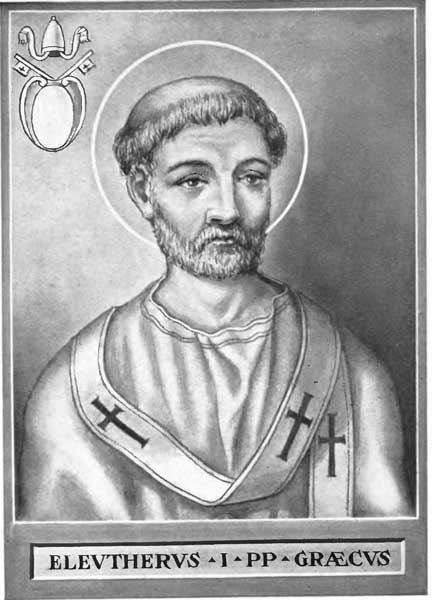
13th Pope Eleutherius

What to make of this? Bede is considered to be a reliable historian and got his information, in this case, from the Vatican. Pope Eleutherius is held to be a real Pope. He reigned at the right time, from perhaps as early as c. 171, and to his death which may be as late as AD 193. (Wikipedia). But the tradition of Lucius has been written off as a legend.

But to my mind there are questions that need asking. Not the least of the questions to ask about the veracity of this legend is: ‘What does it mean to be called the King of Britain in the middle of the Roman occupation?’

St Peters Church First Cathedral in Britain?

As to the early origin of St Peters Church, archaeologists dismissed the tradition of a Roman St Peters Church because it is built over the Roman Forum. So how can it have been the site of a Christian Church?

St. Peter’s seen from Cornhill in a rarely seen view as there is normally a building in the way. (Photo K Flude)

But the balance of possibilities, arguably, changed in the 1980s, when archaeologists led by Gustav Milne showed that the Basilica of the Forum was pulled down in about 300AD. So from being practically an impossibility, there is now a possibility that this subsequently became the site of a Roman Church. It doesn’t make it true but it makes it more of a possibility.

We know London sent at least one Bishop to Constantine the Great’s Council of Arles in AD 314. So a Christian community in London must have predated this time. There must have been Churches, here. And a site at the prestigious centre of the Capital of Londinium, makes a lot of sense. There are, in fact, three Churches on the site of the Roman Forum: St Peters, St Michael and St Edmund the Martyr.

Constantine the Great

In AD 306, Constantine was acclaimed Emperor on the death of his Father, Constantius Chlorus. Constantius’s wife was Helena, a Christian. He and his mother were in York when his father died. He was recognised as Caesar, (but not Augustus) by Emperor Galerius and ruled the province for a while. Then he moved to Trier, then moved on Rome, where he accepted the Christian God’s help to win the Battle of Milvian Bridge. This led him to supreme power in the Roman Empire. And might give a context for the demolished Basilica to be replaced by a Church.

There is, however, no archaeological evidence for St Peters being Roman in origin apart from the demolition of the Basilica and the legends. And there is certainly no evidence of the Basilica being turned into a Church as early as the 2nd Century.

Early Christianity in Britain

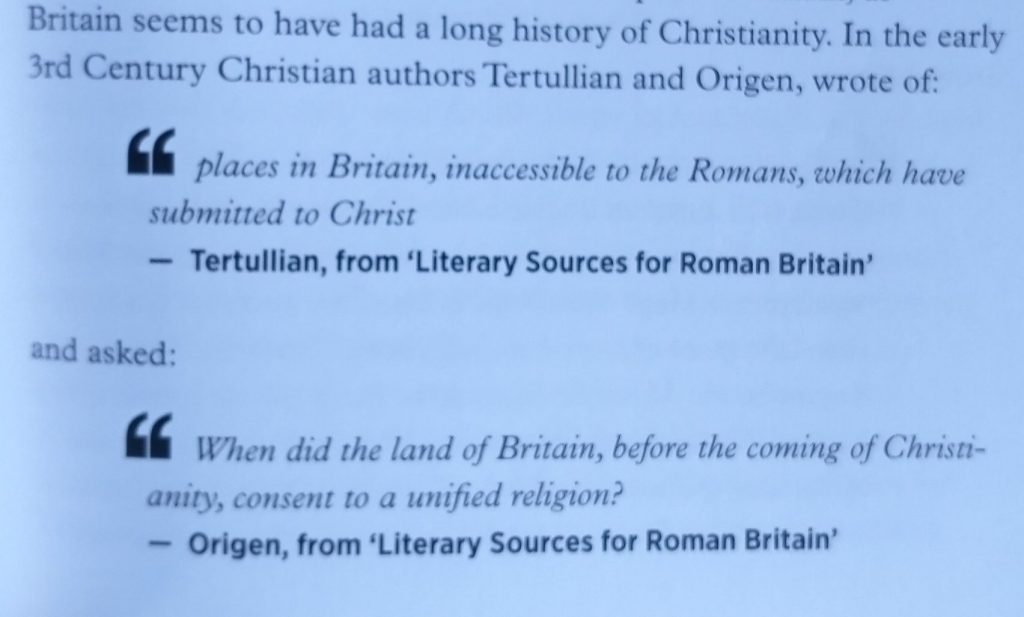
Where does that leave King Lucius? There are well attested Christian traditions that Britain was an early convert to Christianity. (The following quotes are from my book ‘In Their Own Words – A Literary Companion To The Origins Of London‘ D A Horizons, 2009 by Kevin Flude and available here.)

In Their Own Words – A Literary Companion To The Origins Of London‘ D A Horizons, 2009

So, an early date for an active Christian community is likely. A Church, replacing the Basilica, is plausible, particularly, after Constantine the Great probably passed through London on his way to seize the Roman Empire. So an early date for St Peters in possible. But there is no evidence for its origin as early as the late 2nd Century, the time of King Lucius.

A King of Britain in the Roman Era?

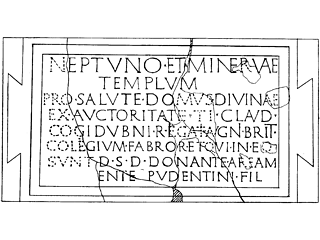
And could anyone, claim to be the ‘King of Britain’ at this date? We do know that King Togidubnus was called Great King of Britain in a Roman Temple inscription in Chichester in the First Century.

Altar Dedication, Chichester

To Neptune and Minerva, for the welfare of the Divine House by the authority of Tiberius Claudius Togidubnus, Great King of Britain, the Guild of Smiths and those therein gave this Temple from their resources, Pudens, son of Pudentinus, presenting the site.

https://romaninscriptionsofbritain.org/inscriptions/91

Togidubnos seems to have been placed in control of a large part of Southern England, centred around Chichester, after the invasion of 43AD. He is thought to have been the successor to Verica, who was exiled and called on the Romans to restore his throne. Tactitus says that Togidubnos remained loyal down ‘to our own times’ that is to the 70s AD. So he presumably held the line for the Romans against the Boudiccan revolt in 60AD.

The Romans had used Verica’s fall as their excuse for invasion, and so an honorific of Great King to him and his successors makes sense. It is assumed that after Togidubnos’s death after 80AD, the title lapsed. But it might have stayed with the family as an empty honour? Furthermore, we know that Britain had a plethora of Kings and Queens before the Roman period. Also, the Romans never conquered the whole of Britain. There were, therefore, many British Kings all the way through the period of Roman control, not least beyond Hadrian’s Wall.

So, it is possible there was someone in Britain who had, or made, a claim to be ‘King’. Whether he was ‘a’ or ‘the’ or merely descended from a King of Britain, we don’t know. And that that someone, perhaps converted to Christianity, possibly in the time of Pope Eleutherius. He may have taken the Roman name Lucius. Who knows? Its possible.

Confusing Luci?

It has been suggested that King Lucius of Britain was confused with King Lucius of Edessa, but this is considered unsatisfactory. Also, the link to London and St Peters, need not be a contemporary one. It might be two traditions that are linked together at a later period. But, of course, there is a faint possibility that the Basilica shrine room, above which St Peter’s is built, was converted for Christian use at the earlier time necessary to make sense of the King Lucius story.

King Lucius may not be a proper saint, but he has a feast day. This is because of his connections to Chur in Switzerland. There is a tradition that Lucius was martyred here. This got him an entry in the Roman Martyrology. David Knight proposes that the Chur connection comes from the transplanting of rebellious Brigantes to the Raetia frontier in the 2nd Century AD. He suggests that the Brigantes brought the story of Lucius to Chur. At the end of the King’s life, is it possible he travelled to join his people in exile in Switzerland. Here he met his unknown end. If true, this would base the story of Lucius in the North rather than London. For further reading, see ‘King Lucius of Britain’ by David J Knight.

Early Bishops of London

John Stow in the 16th Century records the tradition of King Lucius, which comes with a list of early British Bishops of London. These he finds are recorded in Jocelin of Furness’s ‘Book of British Bishops’. This book is discussed by Helen Birkett ‘Plausible Fictions: John Stow, Jocelin of Furness and the Book of British Bishops’. In Downham C (ed) /Medieval Furness: Texts and Contexts/, Stamford: Paul Watkins, 2013.

Her analysis concludes that the book is a ’12th-century confection in support of moving the archbishopric from Canterbury ‘back’ to its proper place in London. (This information was included in a comment to the original post by John Clark, Emeritus Curator of the Museum of London.)

To sum up. We can’t bring King Lucius out of legend, nor find any credible source linking him him with St Peters Cornhill. But the site of St Peters is a plausible, though unproven, location for a Roman Church from the 4th Century onwards. It also makes sense of the choice of the Saxons, to name their Church St Pauls. St Peter is more common as a dedication for important Churches and perhaps they chose St Paul as they knew of the ruins of St Peters the old Cathedral.

Any other early Cathedrals?

Archaeologists have also tentatively identified a masonry building in Pepys Street on Tower Hill as the Episcopal Church of late Roman London. The foundations suggest a large aisled building. Its identification as a Cathedral springs from multiplying the found foundations symmetrically by a factor of four and comparing the result to Santa Tecla in Milan. The discovery of Marble and window glass doesn’t sit so well with the alternative suggestion that it is a granary. But, to my mind, it’s not very convincing, although Dominic Perring in his recent book ”London in the Roman World’ makes the most of the case for it being a Cathedral.

And Finally?

If you look at the two maps above. The one on the left shows the Forum, the white lines are the Roman Road system. You might just be able to see the modern road system super-imposed. What this shows is that the Forum is on a different axis than the modern day road system. Cornhill cuts right across the North Western corner of the Forum. Where the letter L is, and to the left is under the modern road. So, that shows that this part of the Forum must have been knocked down before Cornhill was built. On the right hand side you can see the dark grey east-west road which is Cornhill. To the South of it you can see a dark area (above the green of St Peter’s Churchyard). This grey area is St Peters. What the Google map shows clearly, is that the orientation of St Peters, is clearly on a different orientation to that of the modern road of Cornhill. And that orientation is closer to the orientation of the Roman Forum. This makes it more likely that the axis upon which St Peters was originally built (assuming Wren followed the original axis when he rebuilt it after the Great Fire) conformed to the Roman grid pattern. This is by no means proof, and can only be proved by excavation. But, its interesting.

On This Day

1660 – Margaret Hughes became the first woman (we know about) to act on the English Stage. She played Desdemona in Shakespeare’s Othello. It was staged in a converted tennis court called the Vere Street Theatre, which was in Lincoln’s Inn Fields. In 1660 Charles II was restored to the throne, and had got used to watching female actors perform while he was in exile in France. So when he returned, he licensed two theatre managers, Thomas Killigrew and Sir William Davenant to run theatre. Davenant claimed to be the natural son of William Shakespeare, suggesting that Shakespeare stayed in his parents’ Inn, the Crown, in Cornmarket, Oxford on his way home to Stratford-upon-Avon.

First Published on December 3rd, 2022. Revised in December, 2023, 2024 and 2025

Winter December 2nd

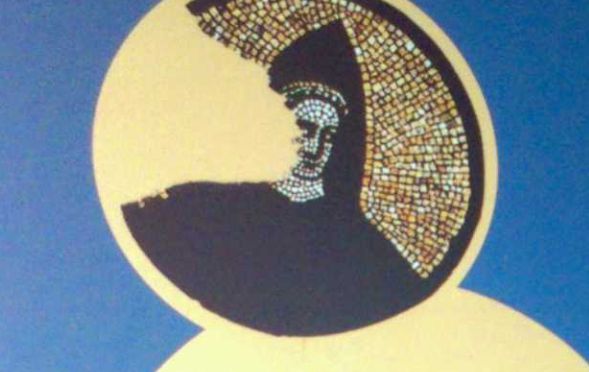
lullingstone mosaic for winter
Roman Mosaic from Lullingstone Villa, Kent representing winter

This is the second day of Winter. Winter is hiems in Latin; Gaeaf in Welsh. Geimhreadh in Old Irish; Wintar in Anglo-Saxon. The Anglo-Saxons counted years by winters, so a child might be said to be 4 winters old.

Winter, meteorologically speaking, is described in the Northern Hemisphere as being December, January, and February, which is, of course, a convention rather than a fact. There is nothing about December 1st that makes it more ‘wintery’ than November 30th or December 2nd. Astronomically, winter starts with the Winter Solstice when the sun is at its lowest and so stretches from around December 21st to the Equinox around March 21st.

Logically, the solstice, when the Sun is at its weakest, should be the coldest day, and a midpoint of winter rather than the beginning of it. With 6 weeks of winter on either side of it. This is roughly what the Celtic year does, winter starts at dusk on 31st October (Halloween/Samhain) and continues to the evening of 31st January (Candlemas/Imbolc). So a Celtic Winter is November, December, and January.

As far as the Sun goes, this is logically correct. In fact, because of the presence of the oceans (and to a lesser extent) the earth, the coldest time is not the Solstice when the Sun is at its weakest. But a few weeks later in January. Heat is retained by oceans (and the landmass), and so the coldest (and the warmest) periods are offset. Therefore, January 13th is probably the coldest day, not December 21st.

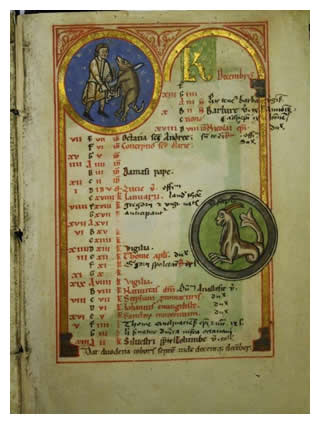
Medieval Liturgical Calendar for December. Note the image at the top which suggests this is the month for hunting bears.

My Own Winter

My personal calendar suggests that winter begins on November 5th because this is the day I generally notice how cold it has suddenly become. The house smart meter also identifies the week of November 4th being the day when the heating bill goes through the roof. However, this was not true this year, where in the London area we had a warm spell.

A final thought about Winter. Isn’t it strange that a small change in the axis of the planet should create such opposites? Cold and little growth, then hot and an explosion of flowers. Opposites just with a little tilt of the Globe towards the Sun. This, in the vastness of space, with unimaginably cold and unbelievable hot places and spaces. These make tiny the little difference between Summer and Winter seem insignificant. And yet to us, they are opposites and central facts to our existence as a species. In places, temperature ‘extremes’ make it hard to survive in. Some think this is because God made the Universe just for us. But, just think, we are completely adapted to our lives on our very own, blue planet.

A Roman View of Winter

Ovid, the great Roman poet wrote this poem on his exile from Rome to Tomis, on the Black Sea in what is now Romania. We don’t know why he was exiled, but he felt it bitterly. And winter is used to effect to show his pain.

Winter in Tomis

Harsh lands lie before him
As he struggles to keep his wit
Malicious thoughts infecting-
Crippling the morale of his spirit
Shattered visions of the fallen begin to transpire..
An awful nostalgia consumes him.
A crooked smile forms..exalting the dead

So began the fall of a mastermind.

Realizing as his mind falls to pieces
They are but catalysts – parts of a puzzle to a different plan
As the images surfaced, his virtue descends
Living amongst those barbarians
Though a fierce complication
Their tact was that of a wounded creature
And they were overrun

“I remain in exile
My bones grow weak like the sun
Descending into the trees
To end this daily affliction
As winter shows its pallid face
And the earth veiled with marbled frost
Forsaken –  this gradual madness consumes my mind
Perdition in Tomis

Undead armies of Tomis
Commanded only by the presence of my absense
Brought to life by the death of myself
Risen to ease this torment
Sacrilege; The second chance to formulate a reason
The relapse crucifixion forthwith to go into effect
Casting him away; instead insuring their demise.

I remain in exile
My bones grow weak like the sun
Descending into the trees
To end this daily affliction
As winter shows its pallid face
And the earth veiled with marbled frost
Forsaken –  this gradual madness consumes my mind
Perdition in Tomis

Each day passing now I beg for some remorse
Desperately grasping at what I feel to be my last bit of life
But unlike the cycle of the attic
I feel as though there is no recourse
I’ve withered to nothing.”

“Save me from drowning, and death will be a blessing.”
Hope for his designed tomb
“Rescue my weary spirit from annihilation
If one already lost may be un-lost”

Ovid abandoned writing his almanac poem because of his exile, so it never got beyond the Summer. To read about this see my post here or search for Ovid from the menu.

On this day

1859 – John Brown was hanged, following his raid on Harpers Ferry, violently opposing slavery.

1954 – Joseph McCarthy was formally censured by the Senate for the methods used in his anti-communist campaigns.

Published in 2024, and revised adding Ovid in 2025

Advent Sunday

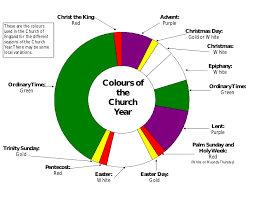
Colours of the Church Year

Advent Sunday 2025 was yesterday, November 30th. It is the beginning of the Christian Liturgical year, its name comes from the Latin ‘adventus’, or ‘coming’. It is the four Sundays before Christmas, the ‘coming’ of Jesus. So, therefore, the serious part of the Christian year and of the Messiah’s life begins here. His birth and his death. It begins with the ‘Hanging of the Greens’ when Churches and other public buildings were bedecked with seasonal foliage. The ‘Liturgical colours’, which are violet, green, gold (or white) and red – are changed to purple and used for altar linen, clergy robes and other hangings.

Advent divides the world into those who love to plan; who love to anticipate, and people like me who buy all my presents in a mad flurry on Christmas Eve. Surely, my nephew will like the Arsenal Yearbook, my father ‘The History of the Spitfire’ and my brother the remastered version of the early Fleetwood Mac LP that I have, he tells me, already bought him twice before. (In my defence, not the middle-of-the -road Fleetwood Mac but the one with Peter Green in it and capable of the Green Manalishi. Play it here).

Advent Calendars

It dates back to 480AD; although it was the Council of Tours in 567 that ordered monks to fast every day in December until Christmas time. This was sometimes known as St Martin’s Fast or Nativity Fast. The Fast might simply mean no more roasts but eating fish, and soups and stews. Other traditions including Advent wreaths and Advent Calendars, these are 18th or 19th Century in origins. Originally, they may have had pictures or texts for each day, but now it is mostly chocolate that counts down the year. However, recently, more expensive Advent Calendars might have a different gin or whisky. tea or in my grandsons’ case a different dinosaur each day.

Fortum and masons christmas advent calendar
Fortum and Masons, Piccadily. A living Christmas advent calendar

Too Late to wed before Advent

Traditionally, you could not marry after Advent and before 12th Night. So it’s now too late to marry before that bump gets too big!

First Published 28th November 2022. Republished Dec 3rd 2023, 2024, 2025

December and Kalendar of Shepherds December 1st

French 15th Century December and the ‘Kalendar of Shepherds’

December comes from the Latin for ten – meaning the tenth month. Of course, it is the twelfth month because the Romans added a couple of extra months especially to confuse us. For a discussion on this, look at an early blog post which explains the Roman Calendar.

In Anglo-Saxon it is ærra gēola which means the month before Yule. In Gaelic it is An Dùbhlachd – the Dark Days which is part of An Geamhrachd, meaning the winter. The word comes from an early Celtic term for cold, from an ‘ancient linguistic source for ‘stiff and rigid’’, which describes the hard frosty earth. (see here for a description of the Gaelic Year). In Welsh, Rhafgyr, the month of preparation (for the shortest day).

For the Christian Church, it’s the period preparing for the arrival of the Messiah into the World. (see my post on Advent Sunday which this year was yesterday November 30th).

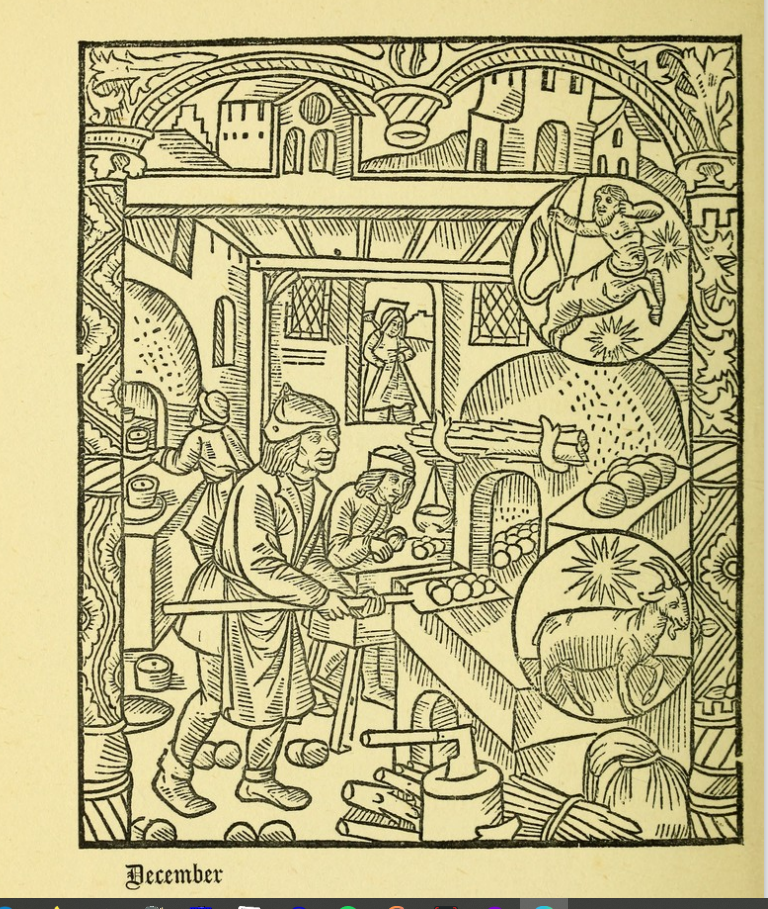
For a closer look at the month, I’m turning to the 15th Century Kalendar of Shepherds. Its illustration (see above) for December shows an indoor scene, and is full of warmth as the bakers bake pies and cakes for Christmas. Firewood has been collected, and the Goodwife is bringing something in from the Garden. The stars signs are Sagittarius and Capricorn.

The Sparrow and the Warm Hall

The Venerable Bede has an interesting story (reported in ‘Winters in the World’ by Eleanor Parker) in which a Pagan, contemplating converting to Christianity, talks about a sparrow flying into a warm, convivial Great Hall, from the bitter cold winter landscape. The sparrow enjoys this warmth, but flies straight out, back into the cold Darkness. Human life, says the Pagan, is like this: a brief period in the light, warm hall, preceded and followed by cold, unknown darkness. If Christianity, he advises, can offer some certainty as to what happens in this darkness, then it’s worth considering.

This contrast between the warm inside and the cold exterior is mirrored in Neve’s Almanack of 1633 who sums up December thus:

This month, keep thy body and head from cold: let thy kitchen be thine Apothecary; warm clothing thy nurse; merry company thy keepers, and good hospitality, thine Exercise.

Quoted in ‘the Perpetual Almanack of Folklore’ by Charles Kightly

December in the ‘Kalendar of Shepherds’

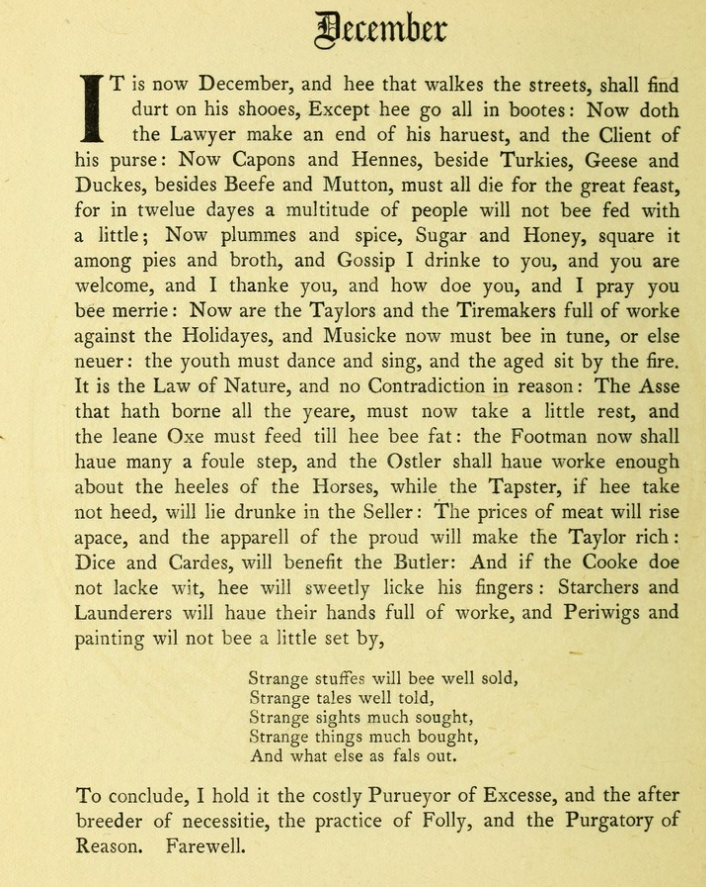
The Kalendar of Shepherds text below gives a vivid description of December weather. Dating from 1626 it gives a detailed look at the excesses of Christmas, which people are on holiday, and who is still working hard. But it concludes it is a costly month.

Nicholas Breton’s ‘Fantasticks of 1626 – December from the Kalendar of Shepherds

Six Dozen Years – a Lifespan

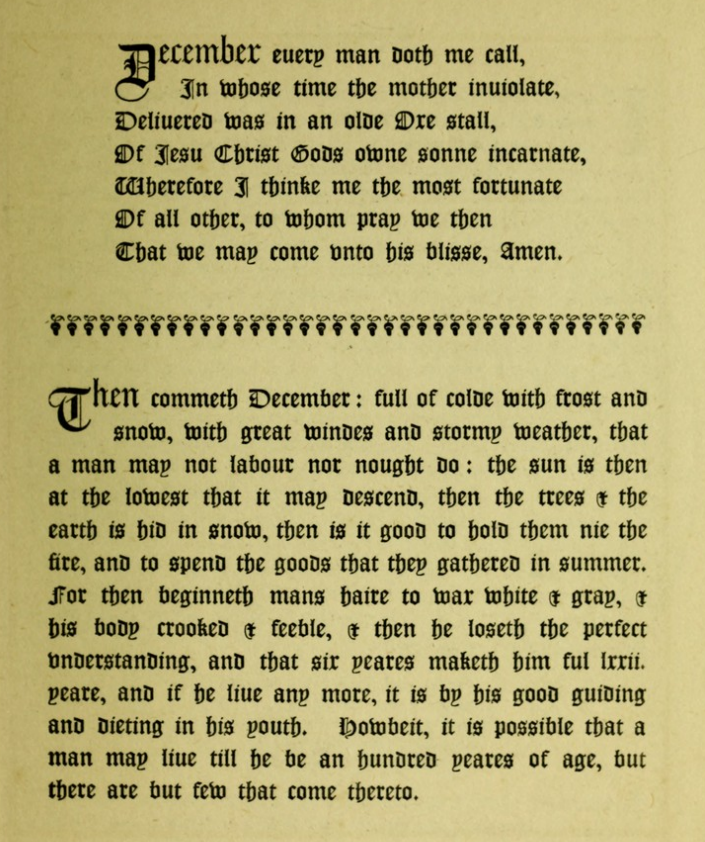
The other section of the Kalendar then elaborates on the last six years of a man’s life, with hair going white, body ‘crooked and feeble’. (from 66 to 72). The conceit here is that there are twelve months of the year, and a man’s lot of ‘Six score years and ten’ is allocated six years to each month. So December is not just about the 12th Month of the Year but also the last six years of a person’s allotted span. The piece allows the option of living beyond 72, ‘and if he lives any more, it is by his good guiding and dieting in his youth.’ Good advice, as we now know. But living to 100 is open to but few.

Kalendar of Shepherds

Interesting from my point of view as I have reached the end of my life span as suggested by the Calendar, and my father is 98 and approaching his hundred!

About the Kalendar of Shepherds.

The Kalendar was printed in 1493 in Paris and provided ‘Devices for the 12 Months.’ The version I’m using is a modern (1908) reconstruction of it. It uses wood cuts from the original 15th Century version and adds various texts from 16th and 17th Century sources. (Couplets by Tusser ‘Five Hundred Parts of Good Husbandrie 1599. Text descriptions of the month from Nicholas Breton’s ‘Fantasticks of 1626.) This provides an interesting view of what was going on in the countryside every month.

For more on the Kalendar look at my post here.

The original Kalendar can be read here: https://wellcomecollection.org/works/f4824s6t

To see the full Kalendar, go here:

On This Day

1990 The UK was rejoined to Europe for the first time for 8000 years, when the Channel Tunnellers breached the final wall of rock. French and British workers exchanged flags and shook hands. The Tunnel was opened to traffic in 1994 more than 10 years after work started and 200 years since Napoleon proposed the idea. Read what ICE has to say about the (ICE – Institute of Civil Engineers!).

Britain was connected to the Continent until about 6,100BC, the North Sea, the Channel, and the Irish Sea were all dry (or marshy lands). Water levels were rising and ice melting. the Storegga Slides in Norway saw huge cliffs of ice slipped into the sea. This caused a tsunami over 30ft high and penetrating 25 miles inland. Read the BBC here.

Since then, Britain has been an Island. Archaeologists have been exploring the flooded area which is known as Dogger Land, after the Dogger Bank. (for more on Dogger Land.)

First Published in 2024, republished 2025