St Giles Day and Cripplegate September 1st

Public domainThe Master of St Giles, National Gallery. ‘St Giles and the Hind’
This work is in the public domain in its country of origin and other countries and areas where the copyright term is the author’s life plus 100 years or fewer.

St Giles

Today, is St Giles’ Feast Day. His story is mostly unknown, but his legend holds that he was a hermit who had a pet Hind in the Arles District of France sometime after the fall of the Roman Empire. The hounds of King Wamba (a Visigothic King) were chasing the deer, and shot an arrow into the undergrowth. The King and his men followed to discover Giles wounded by the arrow, protecting the hind, who he held in his arms. The hounds were miraculously stayed motionless as they leaped towards the hind. Wamba, which apparently means ‘Big paunch’ in Gothic, also had a Roman name: Flavius. Giles was injured in the leg, although the image above shows the arrow hit his hand. Wamba set him up as an Abbot of a Benedictine Monastery.

St Giles is, therefore, the patron saint of disabled people. He is also also invoked for childhood fears, convulsions and depression. He was very popular in medieval Britain, with over 150 churches dedicated to him, including four in London. Perhaps the two most famous are St Giles Without Cripplegate in London and St Giles Cathedral in Edinburgh.
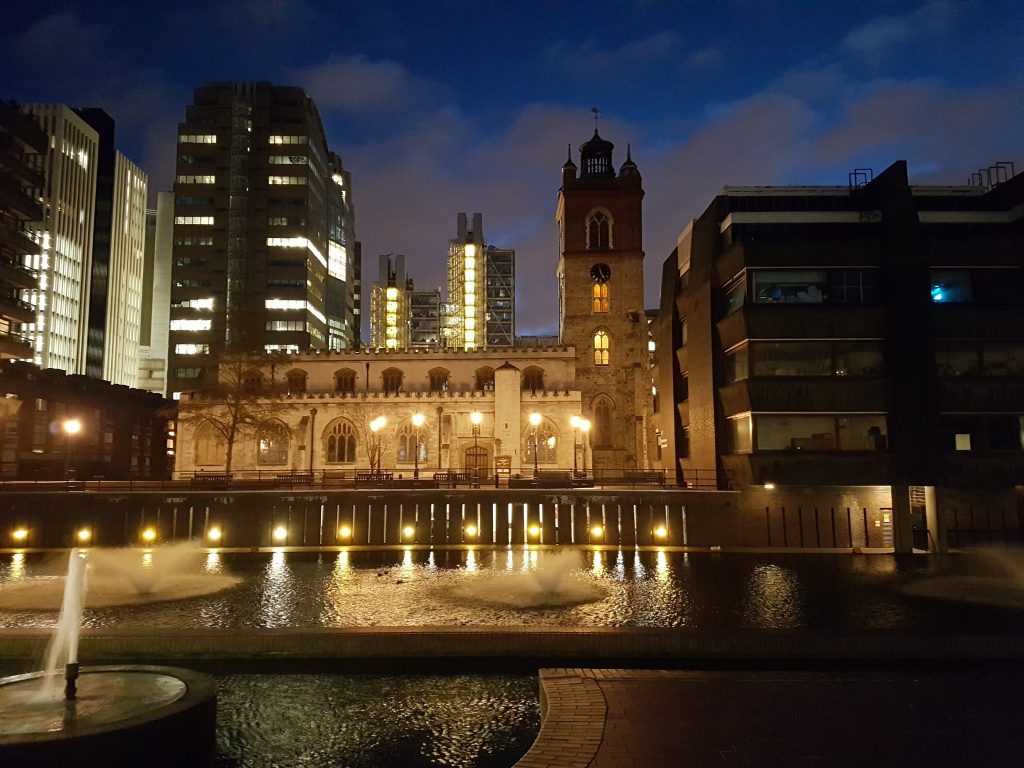
St Giles Cripplegate, photographed by the Author at night from the Barbican Centre.

St Giles Cripplegate

St Giles was built in the 11th Century, rebuilt in the 14th Century and again in 1545-50 after nearly being destroyed by fire. It survived the Great Fire of London, being just beyond the extent of the Fire. But it was badly damaged in the Blitz, although the Tower and the outer walls survived.

Oliver Cromwell married Elizabeth Bourchier here. John Foxe of the Book of Martyrs, John Speed, the Cartographer, Martin Frobisher, the explorer and John Milton, the Poet were buried here.

Shenanigans with Milton’s Coffin

Milton’s coffin was opened in 1793 and he was said to have looked as if he had just been buried. One of those present, then, had a go at pulling Milton’s teeth out. A bystander helped by hitting his jaw with a stone. The few teeth Milton had left in his head were divided between the men, who also took a rib bone and locks of his hair. The Caretaker then opened the coffin for anyone who wanted to see the corpse!
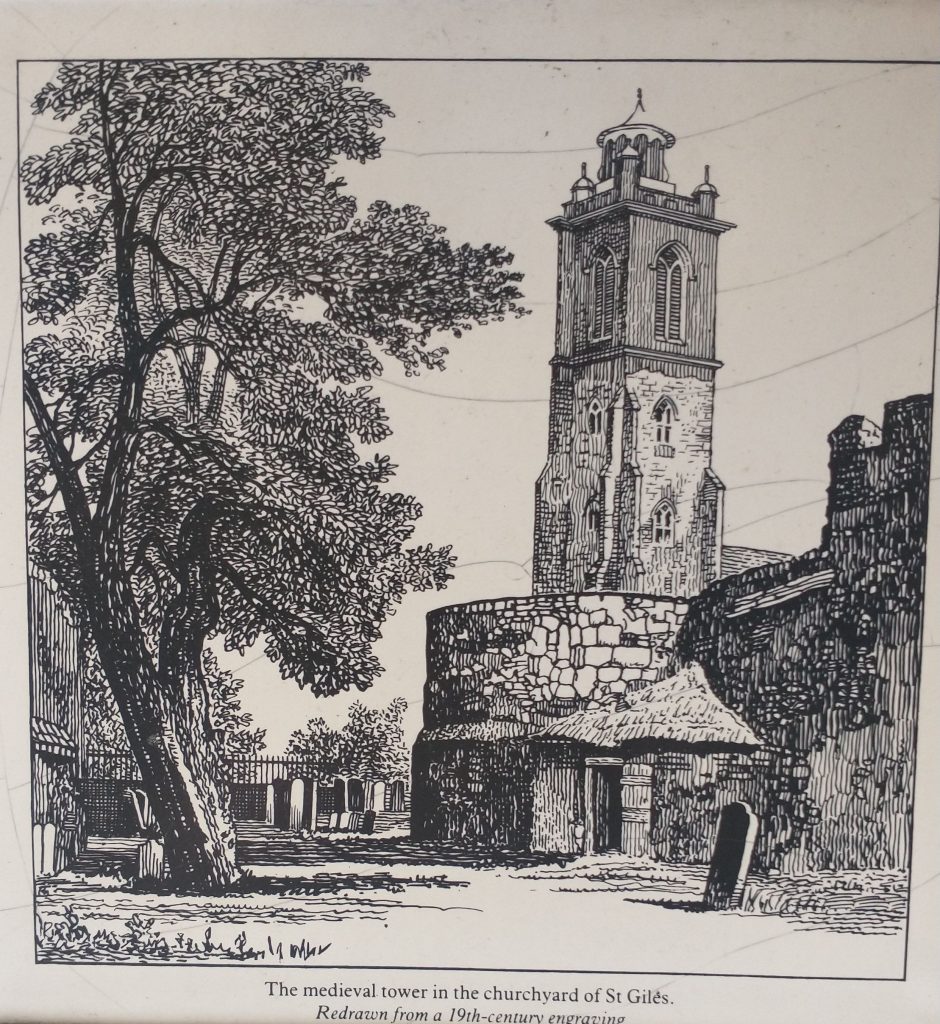
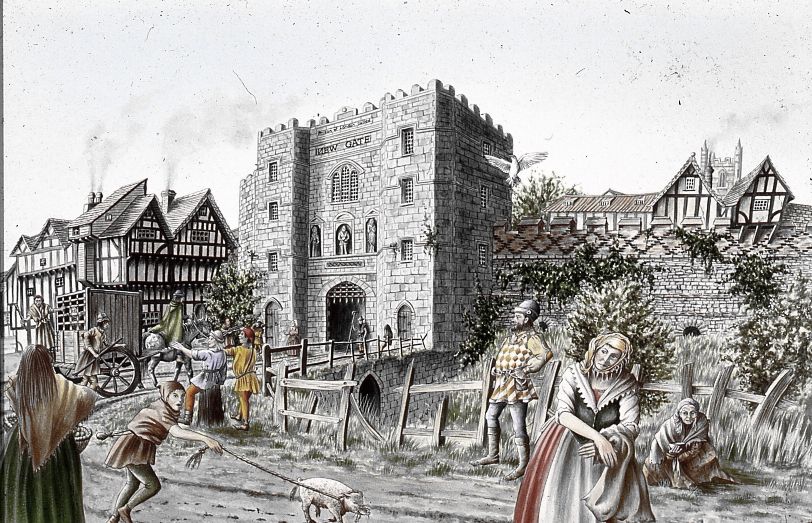
From the London City Wall Trail.

Cripplegate

St Giles is without Cripplegate. It is one of the Gates in the City Wall (originally the North Gate of the Roman Fort). It may be named because St Giles made it agood place to gather for those trying to beg alms for their disabilities. An alternative explanation it from the Anglo Saxon crepel, which is an underground tunnel which is said to have run from the Gate’s Barbican to the Gate. Or perhaps because of the cure of cripples when Edmund the Martyr’s remains passed through the Gate in 1010.
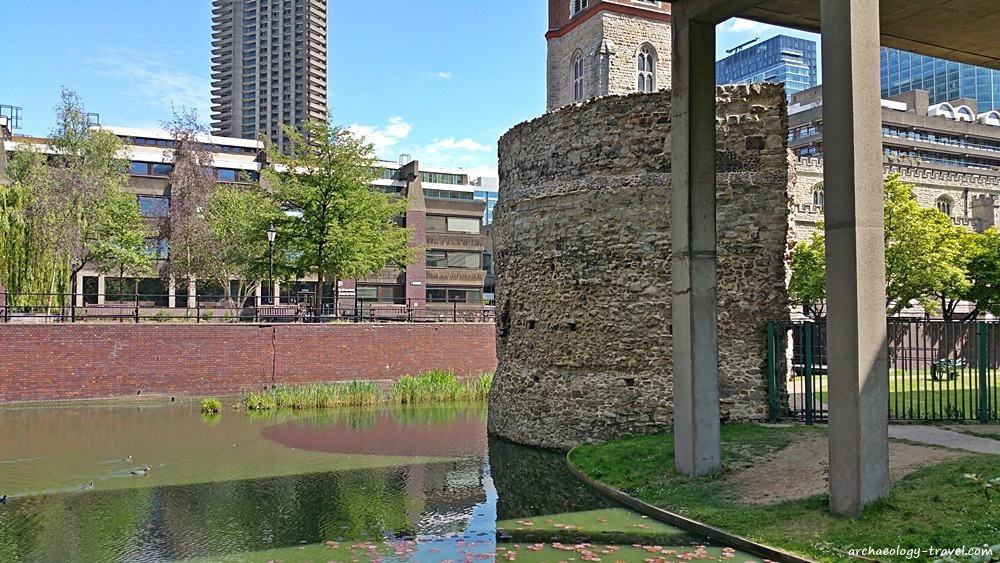
The Corner Tower of the London City Wall, the Barbican in the background, and the tower of St Giles’ Church behind the Tower. Photo by the author

First Published in September 2024, and revised in 2025.
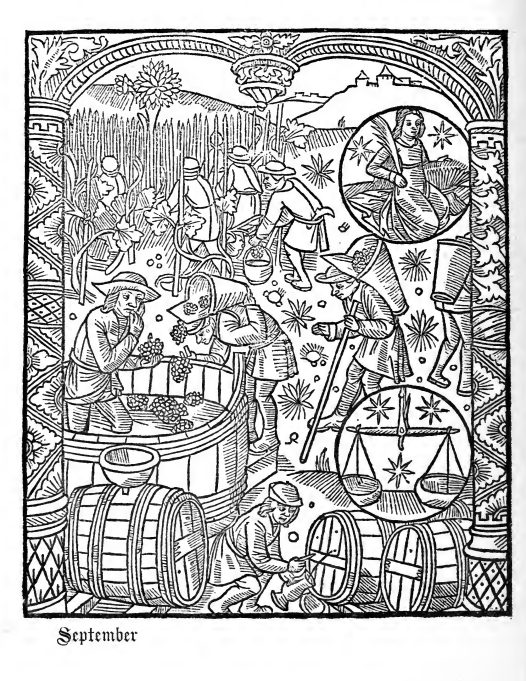
September – ‘Winter’s Forewarning and Summer’s Farewell’

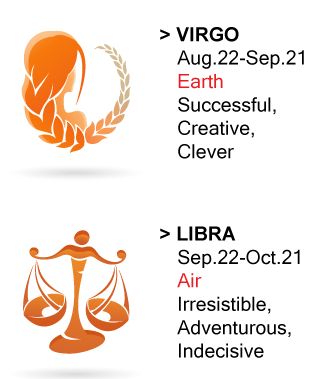
Kalendar of Shepherds illustration of September showing harvesting grapes and the astrological signs for Virgo (August 23 – September 22) and Libra (September 23 – October 22)

It is that time of the year when you say ‘Where has the Summer gone? It can’t be September already?’ But, meteorology, speaking, Autumn starts today. September 1st was chosen on a numerical basis for ease of measuring rather than any profound floral, agricultural or solar reason. So, there are three Gregorian Calendar months for each season, and each season starts on the first of the month. Autumn: September, November and December.

Autumn, Harvest, Fall

Autumn comes from Latin (autumnus) which went into French and then into English. The season was also called Harvest (which went into Dutch herfst, German Herbst, and Scots hairst -Wikipedia) or from the 16th Century: the ‘fall of the year’ or ‘fall of the leaf’ which spread to America as Fall.

Summer’s Ending

It still feels like summer. In England, we often have a glorious September, and what we can an ‘Indian’ Summer, an unexpectedly warm period in mid-September to October.

Solar Autumn

Of course, for the real Autumn, we have to wait for the Equinox, the beginning of Astronomical or Solar Autumn. This year, it is on Monday, September 22nd, 2025, 7:19 pm.

Astrological September

The star signs for astrological September are: Virgo which is linked to Aphrodite (Venus) the Goddess of Love and Libra which is linked to Artemis (Diana), virgin goddess of many things, including hunting, wild animals, children, and birth.

Star signs for September

September

September gets its name from the Romans, for whom it was the 7th Month of the year (septem is Latin for seven). Later, they added two new months so it became our 9th Month. (For more on the Roman year, look at my post here).

It is called Halegmonath in the early English language, or the holy month, named because it is the month of offerings, because of the harvest, and the mellow fruitfulness of September? Medi in Welsh is the month of reaping, and An Sultuine in Gaelic which means the month of plenty.

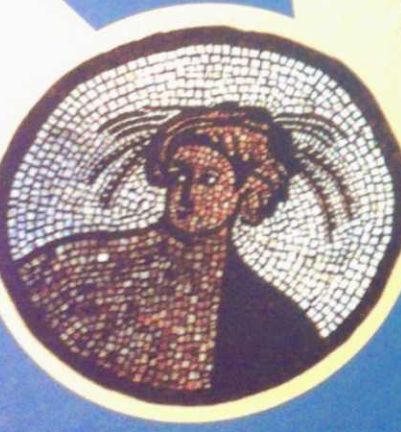
Roman personification of Autumn from Lullingstone mosaic

Early Modern September and the autumn of Life

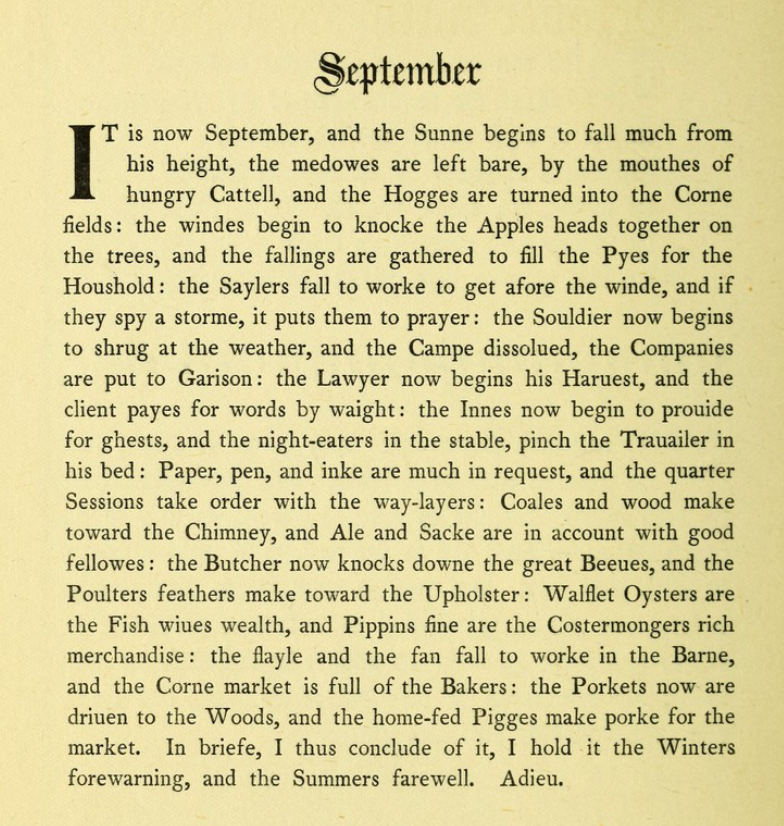
Here is an early 17th Century look at September from the Kalendar of Shepherds – for more on the Kalendar, look at my post here.

From the Kalendar of Shepherds

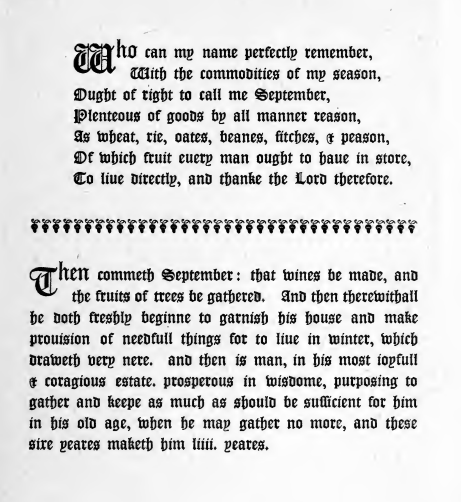
The Kalendar has an additional shorter look at September (see below). And it continues with its theme, linking the 12 months of the year with the lifespan of a man – 6 years for each month. So September is a metaphor for man at 56 years of age, in their prime and preparing for old age.

September from the Kalendar of Shepherds. The last sentence beginning ‘and then is man’ shows the link between September and the beginning of the autumn of life.

Season of ‘mists and mellow fruitfulness

John Keats (1795 – 1821) wrote a great poem called ‘To Autumn’:

Season of mists and mellow fruitfulness,
  Close bosom-friend of the maturing sun;
Conspiring with him how to load and bless
  With fruit the vines that round the thatch-eves run;
To bend with apples the moss’d cottage-trees,
  And fill all fruit with ripeness to the core;
    To swell the gourd, and plump the hazel shells
  With a sweet kernel; to set budding more,
And still more, later flowers for the bees,
Until they think warm days will never cease,
    For summer has o’er-brimm’d their clammy cells.

Who hath not seen thee oft amid thy store?
  Sometimes whoever seeks abroad may find
Thee sitting careless on a granary floor,
  Thy hair soft-lifted by the winnowing wind;
Or on a half-reap’d furrow sound asleep,
  Drowsed with the fume of poppies, while thy hook
    Spares the next swath and all its twined flowers:
And sometimes like a gleaner thou dost keep
  Steady thy laden head across a brook;
  Or by a cider-press, with patient look,
    Thou watchest the last oozings, hours by hours.

Where are the songs of Spring? Ay, where are they?
  Think not of them, thou hast thy music too,—
While barred clouds bloom the soft-dying day,
  And touch the stubble-plains with rosy hue;
Then in a wailful choir the small gnats mourn
  Among the river sallows, borne aloft
    Or sinking as the light wind lives or dies;
And full-grown lambs loud bleat from hilly bourn;
  Hedge-crickets sing; and now with treble soft
  The redbreast whistles from a garden-croft,
    And gathering swallows twitter in the skies.

Written September 19, 1819; first published in 1820. This poem is in the public domain and available here:

First published September 2024, revised 2025