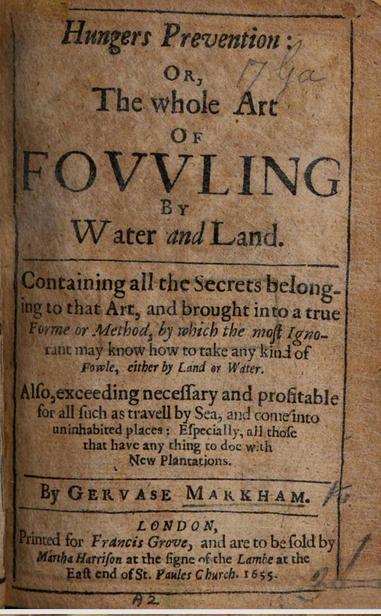
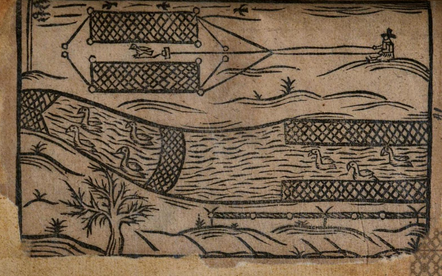
This was the period of the year for ‘Night-fowling’. Gervase Markham wrote a whole book about it in the 17th Century. It was called Hungers Prevention: or, the Whole Art of Fowling by Water and Land. (Printed London: for Francis Grove, 1655).
In it, he tells the reader to go to ‘a stubble field in November when the air is mild and the moon not shining. There take a dolorous low bell, and net. Spread the net over the stubble where there may be fowl, ring the bell, light fires of dry straw, and the fowl will fly and become entangled in the net.‘
In Britain today, the Wild fowling season is from 1 September – to 20th February and largely takes place on the marshes and foreshore.
Duck, Geese, waders and other birds are the quarry. Species involved include:
Gadwall goose, Canada goose, Common snipe, Coot, Goldeneye duck, Greylag goose, Golden plover, Moorhen, Mallard, Pink-footed goose, Jack snipe, Pintail, European Woodcock, white-fronted goose, Pochard, Scaup1, Shoveler, Teal, Tufted duck, Wigeon
(from https://basc.org.uk/wildfowling/advice/wildfowling-code-of-practice/)
For more Gervase Markham books see my post here:
On this Day
On this day, in 1660, Charles I was born.
In 1863. President Abraham Lincoln gave the Gettysburg Address.
World Toilet Day
Today is the United Nations’s World Toilet Day. It is ‘Sustainable Development Goal 6 Safe toilets for all by 2030’. It is astonishing that we, as a species, have:
‘3.5 billion people (who) still live without safely managed sanitation, including 419 million who practise open defecation.’
That is a third of the world’s population if my figures are correct. It also impacts particularly badly on women in those areas where decent hygiene cannot be guaranteed.
These are the ‘Key messages you should know on World Toilet Day’
- Toilets are a place for peace. This essential space, at the centre of our lives, should be safe and secure. But for billions of people, sanitation is under threat from conflict, climate change, disasters and neglect.
- Toilets are a place for protection. By creating a barrier between us and our waste, sanitation services are essential for public and environmental health. But when toilet systems are inadequate, damaged or broken, pollution spreads and deadly diseases get unleashed.
- Toilets are a place for progress. Sanitation is a human right. It protects everyone’s dignity, and especially transforms the lives of women and girls. More investment and better governance of sanitation are critical for a fairer, more peaceful world.
First published Nov 19th 2022. Republished Nov 19th 2023, 2024, 2025