On Resolutions. Aquarius & T-Shirts January 21st St Agnes Day

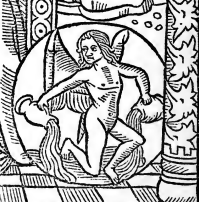
black and ehite engraving Aquarius (detail from Kalendar of the Shepherds)
Aquarius (detail from Kalendar of the Shepherds)

The Sun enters the house of Aquarius

The man born under Aquarius shall be lonely and ireful; he shall have silver at 32 years; he shall win wherever he goeth, or he shall be sore sick. He shall have fear on the water, and afterwards have good fortune, and shall go into divers strange countries. He shall live to be 75 years after nature.’

‘The woman shall be delicious, and have many noises for her children; she shall be in great peril at 24 years and thereafter in felicity. She shall have damage by beasts with four feet and shall live 77 years after nature.

The Kalendar of Shepherds, 1604 (quoted in the Perpetual Almanac by Charles Kightly)

Resolutions & Predictions
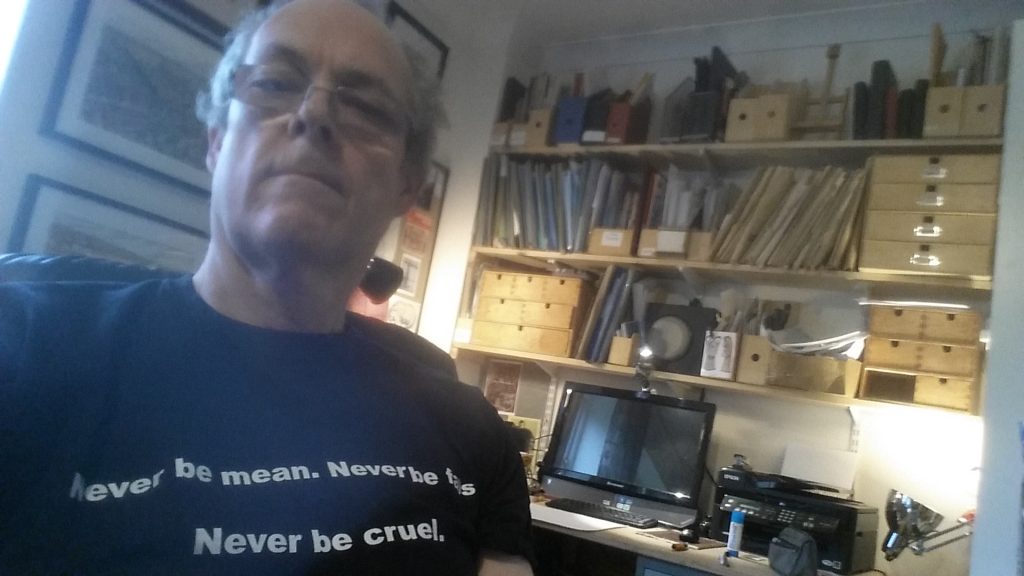
the Author sporting a Betsy Trotwood aphorism ‘Never be mean, never be false, never be cruel’

The Kalendar of Shepherds predictions for those born in Aquarius, (see above) are so specific they cannot help but be wrong for most people. Surely, the art of the prophecy, is to be vague, be general and to know human nature.

By the 21st of January, we should have an idea of whether we are going to keep to your resolutions or not. And perhaps we should now be tuning them or adapting them to fit our lives as actually lived, rather than on our pious hopes. (for more on prophecy, see my post here).

Wisdom in a Taxi Ride

In 2023, on January 21st after my Uncle Brian’s Funeral. I had a chat with a taxi driver on the way to the railway station . He told me that funerals make him wonder how his behaviour might influence those the people who will, one day, make that special effort to turn up at his funeral. As a young Asian guy, he was thinking ahead quite some way.

I replied that ‘Funerals make me reflect on how much time I have spoiled by not being fully engaged in the moment’. All those conversations where my mind wandered. Those radio programmes I only half heard as I tried to read a book at the same time. All those train journeys, walks in the woods or along the canal while listening to headphones. My visits to relatives where I rushed back to get home as quickly as possible. Being present in the moment was, maybe, the key to improving the quality of life and interactions with others.

Dickens’ solution to the woes of the world

We continued chatting through the short journey. As we arrived in the forecourt of the station he suggested we exchange a final word of wisdom. As we had been talking about history, I turned to Charles Dickens. I told him Betsy Trotwood’s words to David Copperfield:

“Never,” said my aunt, “be mean in anything; never be false; never be cruel. Avoid those three vices, Trot, and I can always be hopeful of you.”

Charles Dickens, David Copperfield

I said that Betsy’s words stem from Charles Dickens’ belief that the key to progress in the world was to ignore the dogma of religion but to live by just one tenet.

Treat people as you want to be treated by others.’

In return, he told me of an Islamic teacher who responded to his enquiry. ‘How to ensure salvation given all the many (possibly conflicting) moral teachings and texts there were’. The answer was, if he lived wisely and considered his impact on others, he could be sure of salvation.

By this time, I had missed my train. But the two of us had had a moment of connection. There are plenty of trains from Guildford to Waterloo.

Dickens Philosophy

Dickens was a brilliant propagandist against the evils that are endemic in society. And yet, he was no socialist. He wrote ‘Hard Times’ which is a virulently anti-trade union story. But his recipe for improvement in society was based on implementing the broad understanding of religion, as expressed in these two quotations:

Thou shalt love thy neighbour as thyself” (Matthew 22:37–39).

“Do to others as you would have them do to you” (Luke 6:31).

T-shirts & the Rolling Stones
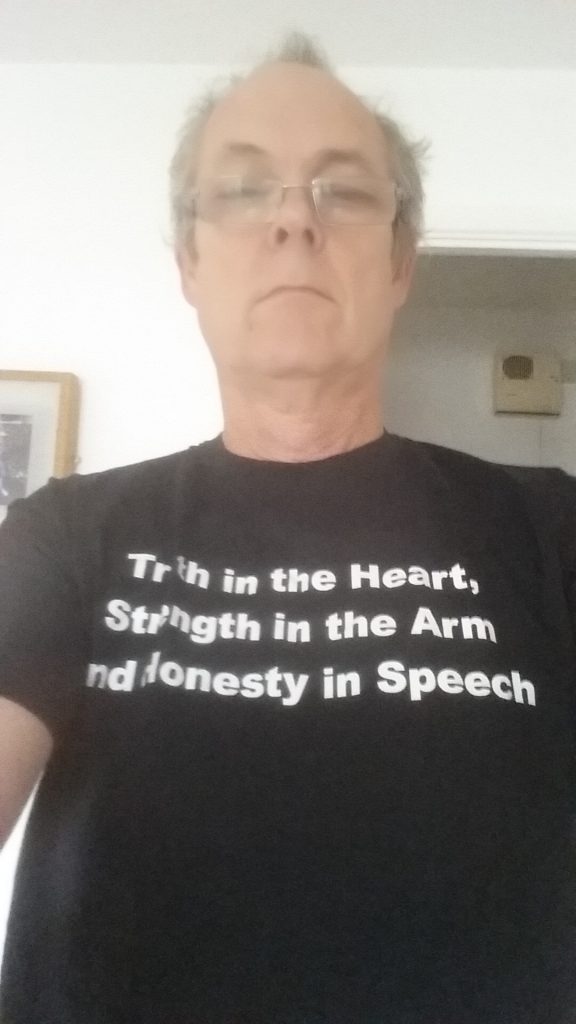
Philosophy for life as told to St Patrick by a Druid

I have a lot of t-shirts with quotations from history on them. I suspect I am one of the very few people who store his t-shirts in chronological order. The selfie shows chronologically, the first, and the last is:

“You can’t always get what you want
But if you try sometime you’ll find
You get what you need”

by Mick Jagger and Keith Richards of The Rolling Stones.

As the Rolling Stones have a big part to play in the musical history of Lindon, here are the lyrics in full and a youtube video.

You can’t always get what you want

I saw her today at the reception
A glass of wine in her hand
I knew she would meet her connection
At her feet was her footloose man


No, you can’t always get what you want
You can’t always get what you want
But if you try sometime you’ll find
You get what you need

repeat above

And I went down to the demonstration
To get my fair share of abuse
Singing, “We’re gonna vent our frustration
If we don’t we’re gonna blow a fifty-amp fuse”
Sing it to me, honey


You can’t always get what you want
But if you try sometimes, well, you just might find
You get what you need
Ah baby, yeah
Ah


I went down to the Chelsea drugstore
To get your prescription filled
I was standing in line with Mr. Jimmy
And, man, did he look pretty ill
We decided that we would have a soda
My favorite flavor, cherry red
I sung my song to Mr. Jimmy
Yeah, and he said one word to me, and that was “dead”
I said to him


You can’t always get what you want, well no
You can’t always get what you want. I tell you, baby
You can’t always get what you want, no
But if you try sometimes you just might find, uh, mm
You get what you need, oh yeah, woo!
Ah, woo!
You get what you need, yeah, oh baby
Ah yeah


I saw her today at the reception
In her glass was a bleeding man
She was practiced at the art of deception
Well, I could tell by her blood-stained hands, sing it


You can’t always get what you want, yeah
You can’t always get what you want, ooh yeah, child
You can’t always get what you want
But if you try sometimes you just might find
You just might find
You get what you need, ah yeah
Ah baby, woo!


Ah, you can’t always get what you want, no, no, baby
You can’t always get what you want, you can’t now, now
You can’t always get what you want
But if you try sometimes you just might find
You just might find that you
You get what you need, oh yeah

Ah yeah, do that

source: https://www.lyricsondemand.com/rolling_stones/you_cant_always_get_what_you_want

YouTube Video

And here is an early video of the band, with Brian Jones, playing the song. Sadly, it doesn’t have the sublime choir singing the chorus. Youtube will probably play an ad. I don’t make any money from that by the way!

First written on 21st January 2023, revised January 2024, and republished 2026

On this day

1793 Louis XVI of France was guillotined at the Place de la Révolution in Paris. The National Convention convicted him of high treason 4 days earlier
Trotty Veck, the Chimes and Charles Dickens’ Christmas Books December 16th

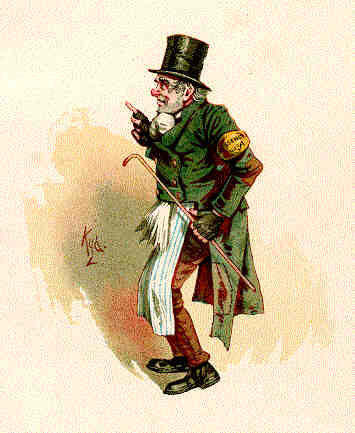
Dickens character Trotty Veck waits to run a message
Trotty Veck 1889 Dickens The Chimes by Kyd (Joseph Clayton Clarke)

As Christmas looms, seasonal publications have a mixture of wonder and joy at the coming family reunions and festivities mingled with an awareness that, for some, Christmas will depend on the Food Bank or the Charity Shelter. The weather is now cold, living costs continue to rise at the very time extra spending is needed to unlock the joy of the Season. Also to counter the dark, the cold, and the spectre of death which, in fact, has always been central to the season of winter.

Charles Dickens’ Christmas Books epitomise this dichotomy.And by adding an element of the supernatural, provided a vehicle for joy and hope. It also came with a forceful political message that the authorities and the rich were not doing their Christian duty to alleviate poverty. Christmas Carol contrasts the wealth of a mean rich Stockbroker with the family of his poor employee Bob Cratchit, and provides a powerful tale of redemption.

The Chimes

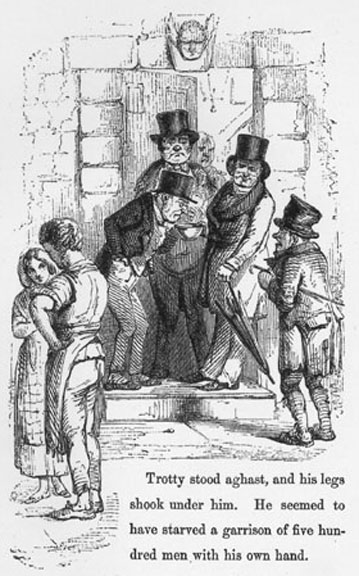
But in this post I want to concentrate on his second Christmas Book, ‘The Chimes’. It was published on December 16th, 1844. And tells the story of the stick-thin Trotty Veck who is an aged City messenger, nicknamed Trotty because of his habit of keeping himself warm by running on the spot. He is afraid to let his daughter, Meg, marry as he has so little hope for the future. While he is worrying, he, Meg and her intended Richard are approached by Alderman Cute and Mr Filer.

Meg, Richard, Mr Filer, Gentleman, Alderman Cute and Trotty Veck. Probably located by the door of St Nicholas, Colechurch, City of London.

Cute represents the financial industries in the City of London and the Law. Filer the new breed of political economists. These, working with the ideas of Malthus and the new science of Statistics, had proved, that generous support for the poor would, inevitably, lead to a country full of poor people and no rich people. And thus, they justified the Poor Law Amendment Act of 1832. At this time Dickens was a Parliamentary reporter (1831-1834), and he observed the cruelty and absurdity of this piece of iniquitous legislation. In 1929 my mother was born in a workhouse, where she had been taken by her unmarried mother. She was so ashamed she didn’t tell her children until she was in her 70s.

The Workhouse

That is the legacy of the cruel Workhouse system. It was based on providing the lowest possible level of support offering separation from family, meagre food, and sparse comforts. This the rate payers believed would encourage the poor to stop being lazy and get back out there to earn their own living. Thus allowing taxes to fall. (brilliantly satirised by Dickens’ Oliver Twist, asking for ‘More’).

Below, I enclose the scene from the Chimes, which satirises the attitude of the governing classes.

‘And you’re making love to her, are you?’ said Cute to the young smith.

‘Yes,’ returned Richard quickly, for he was nettled by the question.
‘And we are going to be married on New Year’s Day.’

‘What do you mean!’ cried Filer sharply?Enough  ‘Married!’

‘Why, yes, we’re thinking of it, Master,’ said Richard.  ‘We’re rather in a hurry, you see, in case it should be Put Down first.’

‘Ah!’ cried Filer, with a groan.  ‘Put that down indeed, Alderman, and you’ll do something.  Married!  Married!!  The ignorance of the first principles of political economy on the part of these people; their improvidence; their wickedness; is, by Heavens! enough to—Now look at that couple, will you!’

...

‘A man may live to be as old as Methuselah,’ said Mr. Filer, ‘and may
labour all his life for the benefit of such people as those; and may heap up facts on figures, facts on figures, facts on figures, mountains high and dry; and he can no more hope to persuade ’em that they have no right or business to be married, than he can hope to persuade ’em that they have no earthly right or business to be born.  And that we know they haven’t.  We reduced it to a mathematical certainty long ago!’

Alderman Cute was mightily diverted, and laid his right forefinger on the side of his nose, as much as to say to both his friends, ‘Observe me, will you!  Keep your eye on the practical man!’—and called Meg to him. 

...

‘Now, I’m going to give you a word or two of good advice, my girl,’ said the Alderman, in his nice easy way.  ‘It’s my place to give advice, you know, because I’m a Justice. ...

‘You are going to be married, you say,’ pursued the Alderman.  ‘Very
unbecoming and indelicate in one of your sex!  But never mind that.
After you are married, you’ll quarrel with your husband and come to be a distressed wife.  You may think not; but you will, because I tell you so. Now, I give you fair warning, that I have made up my mind to Put distressed wives Down.  So, don’t be brought before me.  

You’ll have children—boys.  Those boys will grow up bad, of course, and run wild in the streets, without shoes and stockings.  Mind, my young friend!  I’ll convict ’em summarily, every one, for I am determined to Put boys without shoes and stockings, Down.  Perhaps your husband will die young (most likely) and leave you with a baby.  Then you’ll be turned out of doors, and wander up and down the streets.  Now, don’t wander near me, my dear, for I am resolved, to Put all wandering mothers Down.  All young mothers,of all sorts and kinds, it’s my determination to Put Down.  Don’t think
to plead illness as an excuse with me; or babies as an excuse with me;
for all sick persons and young children (I hope you know the
church-service, but I’m afraid not) I am determined to Put Down.  

And if you attempt, desperately, and ungratefully, and impiously, and
fraudulently attempt, to drown yourself, or hang yourself, I’ll have no pity for you, for I have made up my mind to Put all suicide Down!  If there is one thing,’ said the Alderman, with his self-satisfied smile, ‘on which I can be said to have made up my mind more than on another, it is to Put suicide Down.  So don’t try it on.  That’s the phrase, isn’t it?  Ha, ha! now we understand each other.’

Project Gutenberg - The Chimes by Charles Dickens

It is a savage burlesque of a satire but at its core, Filer provides the economic/statistical justification. Cute enforces it by legal harassment of the poor. Dickens was writing after a recent introduction of legislation making suicide a punishable offence.

Government Cruelty

This has a contemporary resonance. During my lifetime, the first British Government to be cruel in its provision of benefits, in my opinion, for the poor was Teresa May’s Conservative Government. Her laws made getting help so difficult that people died as a result of the deliberately difficult system. ‘I, Daniel Blake’ a 2016 film by Ken Loach brilliantly captured the essence of this system. That government’s treatment of the Windrush generation was a similar example of bureaucratic cruelty. And the continual decline of the benefit system over the 14 years of Conservative Government meant that the poor bore the brunt of austerity. Keir Starmer started his period in office on the wrong foot too cutting benefits to the poor.

Dickens, progressive propagandist

The piece above reminds us what a brilliant propagandist Dickens was. Every generation of children, since he wrote Christmas Carol, has read it or seen it in popular retellings such as The Muppet Movie. I think it could be argued that the ‘More’ scene in Oliver Twist and the Christmas Carol have made the case for compassionate care and redemption far better than contemporary Christianity or political parties.

In the Chimes. these two men discourage Trotty from letting the young ones marry. He has a dream and sees the hopeless result of his decision: suicide, prostitution, crime. When he wakes up, he realises that what they do have is hope. Hope springs eternal and he lets them marry.

For more on this scene, have a look at the Victorian Web

Dickens was not a socialist. ‘Hard Times’ shows that Dickens was against strikes, despite leading a strike when he was a young newspaper man. He was a free trade Liberal; a reformer who believed that the rich needed to do their Christian duty and provide charitable support, pay decent wages and look after their dependents and servants. He thought society should care less about the dogma of Christianity but look to its essence, ‘love your neighbour like yourself’. This, alone, was sufficient to right the wrongs caused by the selfish.

First Published on December 16th 2022, republished and revised in December 2023, 2024, 2025

Canterbury Pilgrimage April 18th

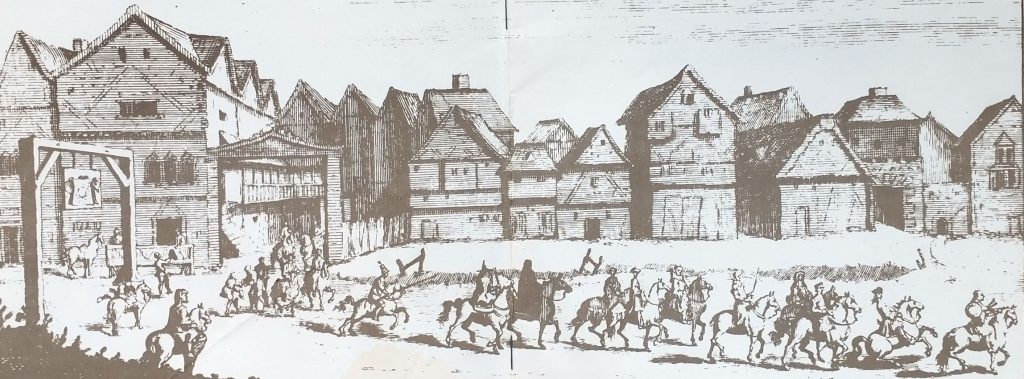
Pilgrims leaving the Tabard for the Canterbury Pilgrimage

Canterbury Pilgrimage

Tonight, I am leading  my annual Canterbury Tales Virtual Pilgrimage.  This is the day Chaucer’s pilgrims leave London to ride to Canterbury. (For more details or to book look here.)

At the beginning of the prologue, Chaucer gives clues as to the date. They go when April showers and Zephyrus’s wind is causing sap to rise in plants, engendering flowers. It is also when Aries course across the sky is half run.

The pilgrims are accompanied by Harry Bailly who is the landlord of the Tabard Inn in Southwark. He was a real person and a fellow Member of Parliament of Chaucer.

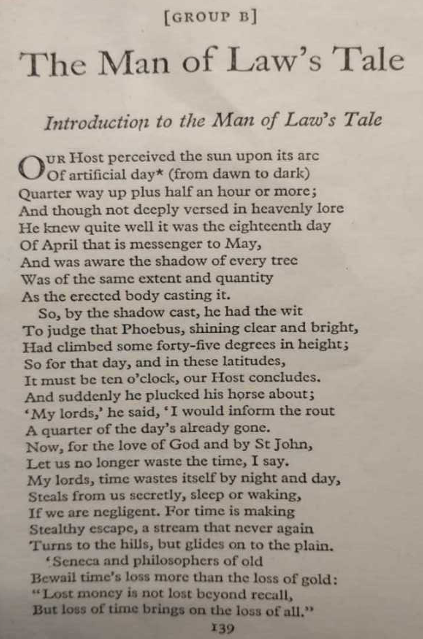
He is jolly and quite knowledgeable. In the Man of Law’s prologue we get a glimpse of Harry time telling in the days before clocks.

a mass clock at Steventon
A mass clock at Steventon Church. Hampshire

Telling the Time

Chaucer mentions ‘artificial day’ and this is a reference to the way days were divided into hours. There were twelve hours in the daylight part of the day, and twelve hours in the dark night. So in the winter daylight hours were short, and in the summer long.

Romans used water clocks. King Alfred used candles marked into hours. Harry Bailly knows how to tell the time by the height of the Sun. Harry tells the pilgrims it’s about time they got underway. Here is an extract:

Essentially, he is telling the time by the length of the shadows. The illustration of the mass clock at Jane Austen’s Church at Steventon shows how easy it was to tell the time by the sun.

The first mass clock I noticed was at St James’ Cooling in Kent. Dickens used this in Great Expectations, where Pip’s brothers and sisters were buried. Once you find one mass clock, you suddenly discover them everywhere!

Telling the time, before mechanical clocks, was not complicated. The basic unit is the day and the night, and we can all tell when the dawn has broken. The Moon provides another simple unit of time. The month’s orbit around the Earth is roughly every 29 days. The new, the crescents and full moons provide a quartering of the month. For longer units, the Earth orbits around the Sun on a yearly basic. But it is easily divided into four, the winter solstice; the spring equinox, the summer solstice and the autumn equinox.

Nature’s Way of Time Telling

But there were other ways of marking days in the calendar, with natural time markers marked by, for example, migrating birds, lambing, and any number of budding and flowering plants such as snowdrops, daffodils and elm leaves:

When the Elmen leaf is as big as a mouse’s ear,
Then to sow barley never fear;
When the Elmen leaf is as big as an ox’s eye,
Then says I, ‘Hie, boys” Hie!’
When elm leaves are as big as a shilling,
Plant, kidney beans, if to plant ’em you’re willing;
When elm leaves are as big as a penny,
You must plant kidney beans if you mean to have any.’

In my north-facing garden, I have my very own solar time marker. All through the winter, the sun never shines directly on my garden. Spring comes appreciably later than the front, which is a sun trap facing south. But in early April, just after 12 o’clock the sun peeks over the block of flats to the south of me. It finds a gap between my building and the converted warehouse next door. For a short window of time, a shaft of a sunbeam brings a belated and welcome spring.

New Light on Thomas Becket’s Window at Canterbury

Recent research has revealed the true story behind stained glass windows at Canterbury which had been reassembled wrongly.

The story is told here:

And if you cannot get through the pay wall here:

First published in 2023, revised 2025