Stanley Green, the Protein Man of Oxford Street February 22nd

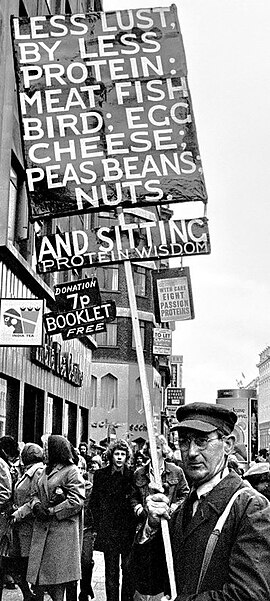
Stanley Green, the Protein Man, in Oxford Street, London, 1977 CC by 4.0 Deed

I was failing to find anything of significance to post when I came across a London Walks post about Stanley Green. Green was born on February 22nd in 1915. Most people who lived in London at the time, knew of him. He was always to be seen patrolling Oxford Street and other Central London Streets with his placard. He mounted a one-man campaign against too much protein. He thought it was a factor in promoting Lust. Lust was a bad thing. He campaigned, religiously, from 1969 to 1993, when he died.

Whether you agree with his views or not it is doesn’t diminish the impact an ordinary person had on an entire City. For more about him, including a podcast, have a look at the London Walks page here:

This post is dedicated to those people who are prepared to give up their normal lives to campaign for something they really believe in. If move of us did, the world would be a better but perhaps more eccentric world.

Mr Stop Brexit
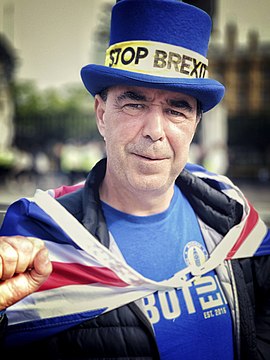
Steve Bray, also known as Stop Brexit Man. (Wikipedia CC0)

Another one man campaigner, Mr Stop Brexit, Steve Bray, was to be seen outside Parliament, most days in the run up to Brexit. He perfected photobombing techniques, appearing in the background of interviews of prominent Brexit campaigners, or was heard over his megaphone. He is from Splott in Wales, and said he lost all his friends because they supported Brexit. He continues to campaign.

In the vidoe below, you can see him upstaging one of the people who ruined this country, the dreadful Jacob Rees-Mogg

I must admit, I briefly considered dedicating my life to going to events Jacob Rees-Mogg attended, shouting ‘Brexit Opportunities!’ and collapsing in ironic laughter.

For my long view of Brexit see my post https://www.chr.org.uk/anddidthosefeet/brexit-day-31st-january-31-2021/

Stature unfurled for one man anti-war campaigner Brian Haw

https://www.ianvisits.co.uk/articles/statue-of-peace-campaigner-brian-haw-unveiled-near-parliament-20-years-after-parliament-tried-to-silence-him-79793/?utm_source=newsletter&utm_medium=email

On This Day

On this day contains items I come across. But more often from looking at Chambers Book of Days, or Wikipedia’s page for the date (today February 22nd). Occasionally I use the Perpetual Almanac of Folklore by Charles Kightley, or other almanacs, and random websites.

Sadly, i cannot find very much that interests me to day!

In Ancient Rome, today, was the Caristia, the day of family peace and household accord, dedicated to Concordia. The previous days have been dedicated to the dead. Today is for the living family members. Ovid seems pleased to return to the living but makes it clear the day is best enjoyed without the really annoying members of the family!

Ovid writes of the day as follows:

Book II: February 22
The next day has its name, Caristia from our dear ‘cari’
(kin),
When a throng of relations gathers to the family gods.
It ís surely pleasant to turn our faces to the living,
Once away from our relatives who have perished,
And after so many lost, to see those of our blood
Who remain, and count the degrees of kinship.
Let the innocent come: let the impious brother be far,
Far from here, and the mother harsh to her children,
He whose father ís too long-lived, who weighs his
mother’s years,
The cruel mother-in-law who crushes the daughter-in-law
she hates.
Be absent Tantalides, Atreus, Thyestes: and Medea,
Jason’s wife:
Ino who gave parched seeds to the farmers:
And Procne, her sister, Philomela, and Tereus cruel to
both,
And whoever has gathered wealth by wickedness.
Virtuous ones, burn incense to the gods of the family,
(Gentle Concord is said to be there on this day above all)
And offer food, so the robed Lares may feed from the dish
Granted to them as a mark of esteem, that pleases them.
Then when moist night invites us to calm slumber,
Fill the wine-cup full, for the prayer, and say:
Health, health to you, worthy Caesar, Father of the
Country!
And let there be pleasant speech at the pouring of wine.

From A S Kline’s translation of Fasti which can be found here.

For more on Concordia read my post here.

First published in 2024, republished in 2025, 2026
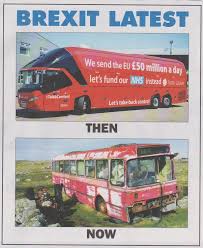
British Exceptionalism Brexit Day January 31st

Today is the Anniversary of the day Britain left the European Union in 2020. It is possible to argue the case that one of the reasons so many people were willing to vote to leave the Union was English or British Exceptionalism. I think most people would be thinking of Winston Churchill and World War 2, and the British Empire. But you can argue a case that there has long been important distinctions between Britain and Europe.

I find it amusing that we left Europe at 11pm on January 31st 2020, which was midnight in the European Union. See the BBC round up on Britain and Europe.

This Island Story

When I was at school, there was a lot of emphasis on Great Britain being an Island. This is rarely emphasised in the 21st Century. But it was part of the Imperial story of the British Empire and helped distance ourselves from ‘the Continent’.

That Island story didn’t begin until the Mesolithic period. Before that, Britain was physically part of Europe, and the Thames was but a tributary of the Rhine. Then the land bridge that is now called Doggerland was swept away by rising meltwater. By 8,000 years BP. Britain was an Island.

Around 4000BC, the so-called Neolithic Revolution spread farming throughout Europe. But, the Channel acted as a barrier. So, it took an extra hundred years or so for farming to begin to penetrate Britain. The early farmers brought with them not only the domestic animals, crops, pottery and ground axes but also a new form of housing consisting of long, rectangular wooden houses. The DNA of the people of Britain, was radically changed and the so-called Western Neolithic DNA mostly took over. Strangely, the long house did not survive very long as a popular design. Britain while accepting the new farming technology, seem to have reverted to their own form of housing

Post Roman divergence?

While most major style and technology changes over the next 4 millenia were shared with Europe, Britain often had its own versions. Britain shared with Europe the adoption of the Celtic Languages and eventual integration into the Roman Empire. But, when the western part of the Roman Empire fell in the 5th Century, Britain had a different experience to much of Europe. On the face of it, a similar sequence happened. The Western Empire was taken over by Germanic Kings. The Franks in France and Germany; the Anglo Saxons in England; the Lombards in Italy and Goths, Visigoths, Vandals in Spain (and N. Africa). A similar sequence on the surface.

But on the mainland the German Kings allowed the local cultures to continue and adopted the Latin language, and Christian religion as their own. They maintained a strong tradition of Roman law and culture. French, Italian, Spanish, Rumanian are all romance languages based on Latin.

But across the Channel to England, it was different. Our German Kings didn’t adopt the Latin language and the native Celtic dialects died out (except of course in Cornwall, Wales, Scotland and Ireland ), They also maintained their pagan beliefs. So English culture is Germanic and not Roman. We do not have a foundation in Latin culture and Roman law. This is very different to western Europe.

Napoleon founder of modern Western Europe

Of course the Anglo-Saxons eventually soon adopted Christianity. In the 16th Century Britain turned against the universal Catholic Church. This was a rupture that had a similar impact to Brexit. But the next really significant difference was the changes instituted by Napoleon. He subdued then rationalised and liberalised the continent. He had dreams of a United Europe of Nations (in contrast to the Empires that held sway (such as the Holy Roman Empire, and the Austro-Hungarian Empirehttps://www.napoleon-series.org/research/napoleon/c_unification).

Most legal systems in Europe are based on Roman Law as amended by the Napoleonic code. England by contrast is based on the Common Law.

So these differences combined with our arrogance derived from Empire, the Industrial Revolution and belief we won World War 2. And our cultural pride based on our perception of the preeminence of people such as Shakespeare, Newton and Darwin etc etc). All this probably lay behind ‘British Exceptionalism’. This helped a nationalistic and misguided belief that we are held back by Europe despite all the evidence to the contrary.

And the future?

Opinion polls make it clear that most people think Brexit was a mistake, and they blame it on the Conservatives, Boris Johnson and Nigel Farage. Economists are clear the damage it has done to Britain’s financial position. And yet the main parties have been very reluctant to consider a return to Europe. Instead, Sunak and Starmer have tried to sort problems out on a case by case basis, without suggesting we go back into the European Union.

However, there is a dawning awareness that Europe cannot depend upon the US playing its usual leading role in maintaining the international status quo, and this may accelerate our move back towards Europe. Canadian Prime Minster Carney is proposed the formation of an alternative economic alliance to replace dependence on the US, and this may be our route back into the European Single Market.

Advice for Lambs

From ‘ FIUE HUNDRED POINTES OF GOOD HUSBANDRIE. BY THOMAS TUSSER.

The Edition of 1580 collated with those of 1573 and 1577.

Januaries husbandrie.

Yoong broome or good pasture thy ewes doo require,warme barth and in safetie their lambes doo desire.Looke often well to them, for foxes and dogs,for pits and for brembles, for vermin and hogs.

More daintie the lambe, the more woorth to be sold, the sooner the better for eaw that is old. But if ye doo minde to haue milke of the dame, till Maie doo not seuer the lambe fro the same.

Ewes yeerly by twinning rich maisters doo make, the lamb of such twinners for breeders go take. For twinlings be twiggers, encrease for to bring, though som for their twigging Peccantem may sing.

Note ewes who had twin lambs were thought to be better and fetched more at market. They were called twinlings.

On This Day

1606 – Guy Fawkes and fellow conspirators are hanged, drawn and quartered for plotting to blow up Parliament and King James. See my post on the Gunpowder Plot.

1865 – Congress passes the Thirteenth Amendment to the United States Constitution, abolishing slavery.

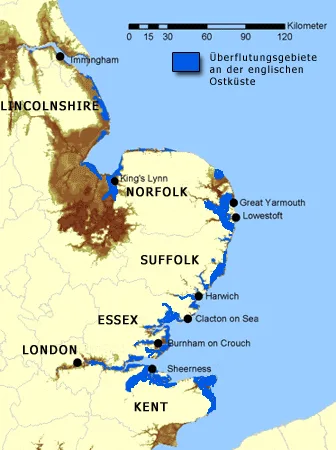
1953 – The North Sea Flood assail the east coast of Britain killing 280 people. ‘The combination of wind, high tide, and low pressure caused the sea to flood land up to 5.6 metres (18 ft 4 in) above mean sea level.’ (Wikipedia).

Map of
Map illustrating the extent of the Great Flood of 1953 in the United Kingdom
Deutsch: Sturmflut von 1953 Date 25 September 2008 Source: Draco. GNU Free Documentation License

You might like to see some great pictures of the floods here.

First Published 2025, revised and OnThis Day added 2026

London No 1 City, World’s Best Cities 2026 January 8th

The World’s Best Cities

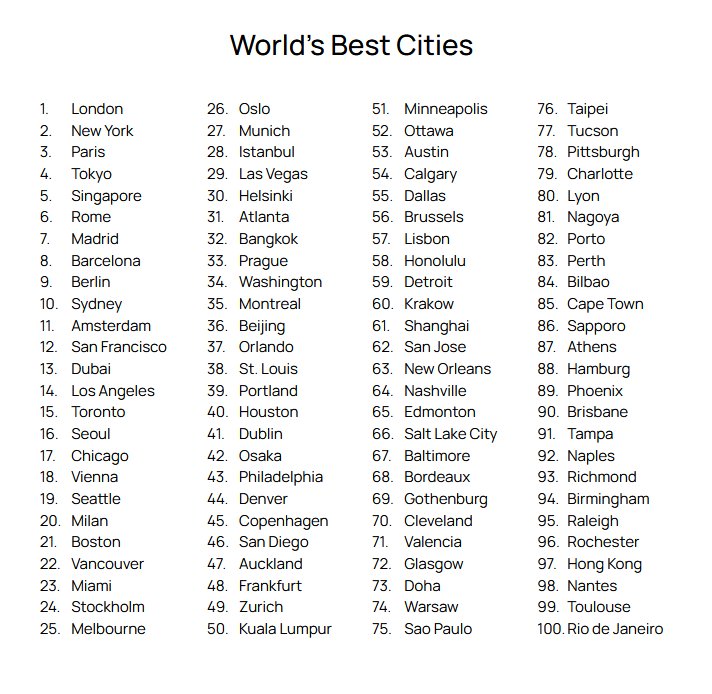
The World’s Best Cities report makes London the top City followed closely by New York and Paris. London has had top spot for 11 years now. The Report is based on core statistics plus a survey of visitors and residents. It is created by Resonance, a consultancy group working in real estate, tourism, and economic development. They are based in Vancouver.

This is what the report says about London:

Rankings: Lovability (1), Prosperity (2), Livability (3)

142026WORLD’S BEST CITIES
“London is a city of constant reinvention. It is this remarkable commitment to ongoing growth that has seen us retain our crown as the World’s Best City. In 2025 we launched a 10-year plan for growth in the capital and celebrated a number of wins: record-breaking London-based scaleups going global, growing visitor numbers and an almost £10 billion
planned investment in our experience economy over the next decade.”
—LAURA CITRON, CEO, LONDON & PARTNERS

AFAR gives a good analysis of Resonance’s methods on its web site:

‘London’s magnetic appeal continues to draw a global audience, from students and entrepreneurs to tourists and corporate titans. The city’s robust recovery post-
pandemic is reflected in its strong international traveler spending, which in
2024 reached almost $22 billion (up from $17.4 billion in 2023) and secured London the
third-highest amount globally, outpacing destinations like New York and Dubai. Benefiting from a softer pound, London has remained a compelling bucket-list destination. Heathrow Airport recorded record-breaking arrivals, exceeding pre-pandemic passenger levels, and Gatwick Airport’s recent $320-million upgrade underscores London’s infrastructural
excellence, enhancing the visitor experience with new concourses and improved amenities.
The city’s airports, not surprisingly, rank #1 in our Top 100 cities.’

London No 1. Really?

Last year, I asked the question. Is it a fix? My thought below largely repeat what I said last year. It was a bit of a surprise to me given the hit Brexit has given to the City. But, London’s dominance for eleven years may be because of the consultancy’s focus on real estate as well as tourism and economic development. This gives London a head start as it has long been considered a very safe place to invest in property. London, New York, Paris, Tokyo, Singapore as 1-5 also suggests the report writers might have a bias to the big hitters. This year it notes that tax rises have hit the wealthy sector property prices but, the reduction in prices at the top end has made London very attractive, particularly to Americans. London seems a very sane City when compared to what is going on in America.

What London offers is its status as one of the world’s leading financial/business capitals. Supported by outstanding creative and services industries. At the same time, it has a superb cultural offering and, consequently, high figures for tourism. It is a City that seems to have a deep past behind it and an equally important future ahead.

The future might depend on the growing Knowledge Quarter around Kings Cross. (British Museum & Library, Wellcome Institute, Crick Institute, UCL, Central St. Martins, Google etc.) With Silicone Roundabout and the wealth of investments from the nearby City of London, providing London with a leading place in AI, the Knowledge economy, and Fintech. London also has a very high value on the internet as far as hashtags, and internet searches are concerned. Click here to see last year’s post.

On This Day

1889 The first ‘tabulating machine’ was patented by Dr Herman Hollerith in the US. It provided the beginnings of IBM, and the age of the Computer.

1923 The World’s first Outside Broadcast took place. The BBC broadcasted Mozart’s Magic Flute from the Royal Opera House Covent Garden. Early radios were called ‘Listening In’ devices. (see ‘Lucia in London’ by E. F. Benson).

1940 Rationing Introduced in the UK (initially Bacon, Butter and Sugar).

1947 David Bowie Born in Brixton as David Robert Jones

Today’s Link Rare Iron Age war trumpet and boar standard found in Norfolk. The Britons, and Celts on the continent, used a carnyx to provide the soundtrack to battle. A bit like the vuvuzela used at football matches, they make a horrible noise! This one is one of the most complete ever found. It is found with a Boar’s Head standard. For pictures and more information, look here: https://www.bbc.co.uk/news/articles/cr7jvj8d39eo

Created on January 8th 2026 based on a similar post for 2025.

London No 1, World’s Best Cities 2025 January 8th

Top 100 Cities in the World's Best Cities Report London no 1. New York 2, Paris 3
Top 100 Cities in the the World’s Best Cities report with London No 1

The World’s Best Cities report makes London the top City followed closing by New York and Paris. London has had top spot for 10 years. The Report is based on core statistics plus a survey of visitors and residents. It is created by Resonance, a consultancy group working in real estate, tourism, and economic development. They are based in Vancouver.

This is what the report says about London:

Rankings: Lovability (1), Prosperity (2), Livability (3)

“Navigating the complexities of a post-Brexit era, geopolitical uncertainties and economic challenges, London’s resilient spirit and unmatched global appeal have solidified its place at the pinnacle of our annual ranking,“

AFAR gives a good analysis of Resonance’s methods on its web site:

‘England’s capital snagged the top spot for the 10th year in a row, continuing to draw students, investors, and tourists alike. A $305 million upgrade of the Gatwick Airport and new metro stops on the Elizabeth line are a few of the developments that indicate the city’s focus on improving infrastructure. Resonance particularly spotlights the building of the Camden Highline, a mile-long greenway inspired by New York’s High Line, as a project that demonstrates “London’s dedication to enhancing quality of life for both residents and visitors.”

London No 1. Really?

Or is it a fix? It was a bit of a surprise to me given the hit Brexit has given to the City. But, London’s dominance for ten years may be because of the consultancy’s focus on real estate as well as tourism and economic development. This gives London a head start as it has long been considered a very safe place to invest in property. London, New York, Paris, Tokyo, Singapore as 1-5 also suggests the report writers might have a bias to the big hitters.

What London offers is its status as one of the world’s leading financial/business capitals. Supported by outstanding creative and services industries. At the same time, it has a superb cultural offering and, consequently, high figures for tourism. It is a City that seems to have a deep past behind it and an equally important future ahead.

The future might depend on the growing Knowledge Quarter around Kings Cross. (British Museum & Library, Wellcome Institute, Crick Institute, UCL, Central St. Martins, Google etc.) With Silicone Roundabout and the wealth of investments from the nearby City of London, providing London with a leading place in AI, the Knowledge economy, and Fintech. London also has a very high value on the internet as far as hashtags, and internet searches are concerned.

Written on Jan 8th 2025