When icicles hang by the wall,
    And Dick the shepherd blows his nail,
And Tom bears logs into the hall,
    And milk comes frozen home in pail,
When blood is nipp’d and ways be foul,
Then nightly sings the staring owl,
                Tu-whit;
Tu-who, a merry note,
While greasy Joan doth keel the pot.

When all aloud the wind doth blow,
    And coughing drowns the parson’s saw,
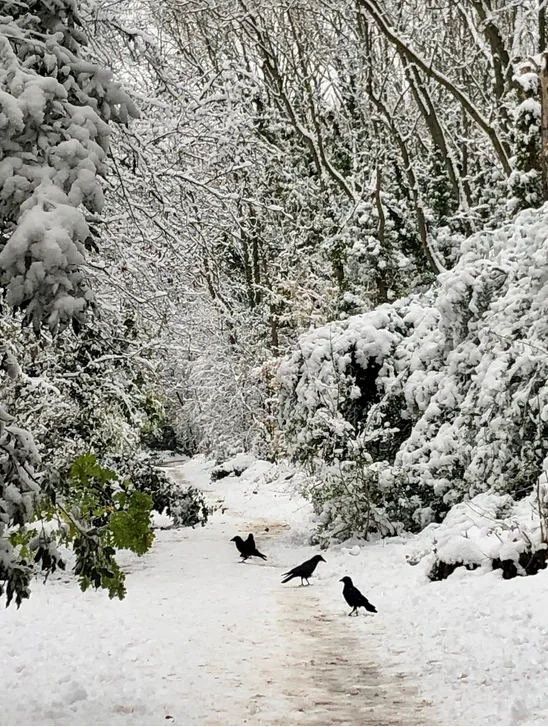
And birds sit brooding in the snow,
    And Marion’s nose looks red and raw,
When roasted crabs hiss in the bowl,
Then nightly sings the staring owl,
                Tu-whit;
Tu-who, a merry note,
While greasy Joan doth keel the pot.

William Shakespeare - Love's Labours Lost
Winter Song by William Shakespeare – Love’s Labours Lost (LLL V.ii.901)
Winter Song is near the end of the play. By way of the conclusion, two works are composed for the King of Navarro in praise of the Cuckoo and the Owl. One read by a representation of the Spring and the other, shown above, by ‘Hiems’ the representation of winter.
Is it very Shakespearean? No, not if you are expecting ‘sweet and honeyed words’ but it brings us deep into the heart of cold winter. With the icicles on the wall, the fouled muddy roads, the cold wind, the nip in the air, and the outbreak of winter colds.
The focus is either from a working-class perspective or from a member of the gentry looking at his servants. The owl and Greasy Joan stirring the food ends each verse. Roasted crabs are crab apples. The apples were heated in the oven then thrown into a dish of beer where they would hiss. So there is a hint of winter conviviality.
The nail means warming your fingers by blowing on them. Alternatively, it means twiddling your fingers. Greasy Joan is probably a cook or kitchen maid, and she is cooling the pot by stirring it. But some suggest that ‘Greasy Joan’ might refer to a prostitute. But it doesn’t really fit the poem? Although the spring part of the poem, narrated by Cuckoo refers to cuckolding. Tu-whit, tu-whoo is, in fact, two tawny owls calling to each other, the female calling first and the male answering. John Lyly first used the call in 1595. Some suggested it can also be read ‘To it, to who?’ In Shakespeare’s day. To go ‘to it’ was a sexual reference, but then he also uses that phrase mostly innocently. The parson’s saw is a reference to the the parson’s sermon. The coughing in the cold nave of the Parish Church makes it difficult to hear.
This is a YouTube piece setting the poem to music by Ralph Vaughan Williams
On This Day
1940 Joan Wyndham, Love Lessons, A Wartime Diary.
‘Rowena rings to say in a dead, sort of voice, ‘The worst has happened. Billy Bolitho says I’m definitely pregnant. Can you lend me 15 quid to Saturday?’ I said I could give her six, which is all I had because I know just how she feels, and if she doesn’t have an abortion before Saturday, it will be too late. I meet her in Dean Street, and we wandered down to Duran’s in the icy cold for a delicious lunch. Christ, their pastries are good! Poor Rowena couldn’t eat anything. She says her only chance is to put lots of ether soap up her bottom for 10 days. Billy Bolitho says, it’s tough going, but infallible. But R says, How will I keep it from my mum if I go around smelling like an operating theatre?’
Reported in ‘A London Year’ Compiled by Elborough and Rennison. Needless to say, this could be dangerous and it is better to seek advice from a Doctor.
Link to Adebooks to buy Love Lessons
First Published on December 4th, 2024, revised 2025
Discover more from And Did Those Feet
Subscribe to get the latest posts sent to your email.