Today is the Feast day of two significant Saints, St. Walpurga and St. Ethelbert.
St. Walpurga
St. Walpurga was a nun at Wimborne in Dorset. She, and her brothers St Willibald and St Winebald, accompanied their uncle, St Boniface of Crediton (in Devon) on his mission to convert the Germans to Christianity. They all became leading figures in the new German Church. Willibald set up the Monastery at Heidenheim, which was a duel monastery housing both Monks and Nuns. His sister, St Walpurga, became Abbess of the Monastery in 761. She died on 25 February 777 or 779 (the records are unclear),
In 870, St. Walpurga remains were ‘translated’ to Eichstätt, which St Willibald had set up as the Diocesan centre of this part of Bavaria. The date of the transfer was the night of April 30th/May 1st. This was her feast day. But the Church moved it to February 25th, to commemorate her death. However, May Eve is now ‘notorious’ as Walpurgis Night. This is the night of May Eve when witches are abroad up to all sorts of mischief, May Day being one of the main pagan festival days. Her body was placed in a rock-cut niche and her bones started exuding an oil called Walpurgis Oil which was said to have medical properties. She was also involved in a miracle of a boat saved in a storm-tossed sea.
For these reasons, Walpurgis is the Saint for battling pests, rabies, whooping cough, storms and sailors. She is also associated with witchcraft but not because of any actual association with it. Her remains were moved again in 1035 when she was enshrined at the Benedictine Abbey of St. Walburga which was named after her.
Walpurgis Nacht
Terrible things happen on Walpurgis Night in Dracula by Bram Stoker. So, the night has now become a trope for Heavy Metal Bands, doyens of horror stories and the Satanic. For more on this read my piece on Walpurgis Nacht.
Coincidently, I was reading about the fuss made about a Heavy Metal Band, called a Plague of Angels, playing in the glorious York Minster. A member of the band tried to calm down the controversy, saying people should just chill out. But other group members used to be in a band called ‘The Cradle of Filth’. Among their claims for Heavy Metal Fame is that they wore the most controversial t-shirt in heavy metal history. This has a visual of a nun in a compromising position and a slogan saying ‘Jesus is a ……..’ (add your favourite swear word here). All very silly. But it struck a cord with me, as I have a scene in my novel (unpublished) which is based on extreme forms of Heavy Metal Bands. I thought I might have gone over the top, but this story reassures me that extreme Metal can be extremely offensive!
Ethelbert is responsible for welcoming the Augustinian Mission to the Angles sent by the Pope, St Gregory. This re-established Christianity in Eastern Britain, and set up the Anglican Church or the Church of England as it became known.
1308 – Edward II crowned King of England. His reign ended disastrously, with his Queen having an affair with Lord Mortimer and Edward losing control of the country (and Scotland). He was forced to abdicate, and died/was murdered/killed with red-hot pokers/or escaped to live a life as a hermit on the continent. Choose your favourite or read my History of the Kings and Queens of Britain.
1507 – Queen Elizabeth I excommunicated by Pope Pius and declared usurper of the throne, leading to the Spanish Armada and various plots against her life. (my post on Queen Elizabeth’s nicknames is here)
1836 – The Colt Revolver awarded a United States patent. Previously, he had obtained a UK Patent. It created the classic ‘Western’ Revolver’, much later called the Colt 45. It was a revolving-breech loading, folding trigger hand gun.
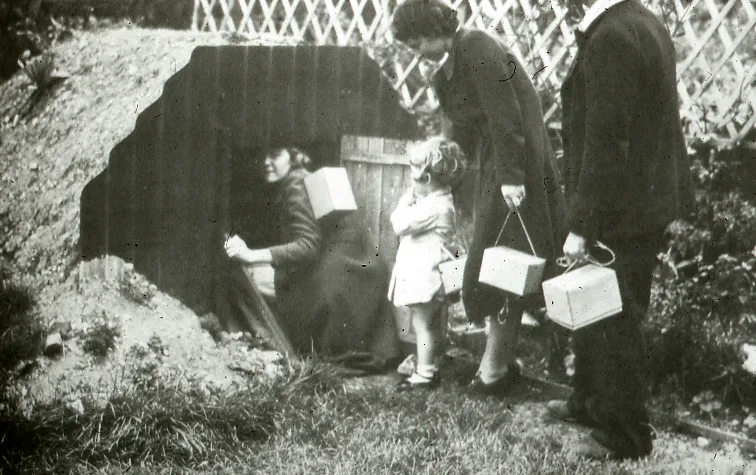
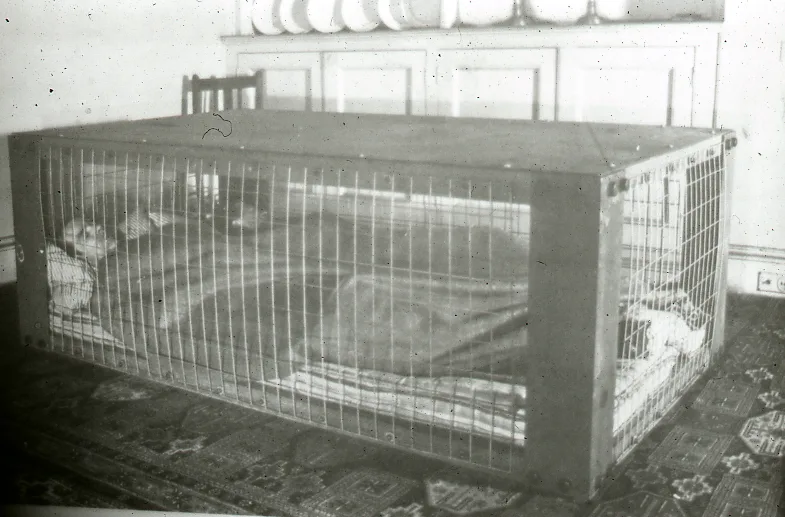
1939 – The first Anderson shelter built in a garden in Islington, London. They were named after the Home Secretary, and were dug in a trench with soil piled over the corrugated iron domed roof. Inside were bunks for the occupants to sleep in. They were 6 ft high, 4.5 ft wide, and 6.5 ft long. 2.5 million were built. The next shelter was the Morrison Shelter named after Herbert Morrison, who succeeded Anderson as Home Secretary. The Morrison Shelter was like a massive table that would protect the shelterers if the house collapsed above it. It allowed the family to sleep inside. London also had public shelters made of brick in many streets, or used cellars and brick arches as shelters. A small proportion of the population preferred to sleep in the Underground. Many stayed in their beds, unless planes were directly overhead. Photos from ‘The British People at War’ published during the war.
Anderson ShelterMorrison ShelterConcrete Public Shelter in London Museum Docklands (Photo C. Mossie)
1956 – Nikita Khrushchev denounces Stalin.
First Written February 2024, revised February 2025. On This Day added in 2026
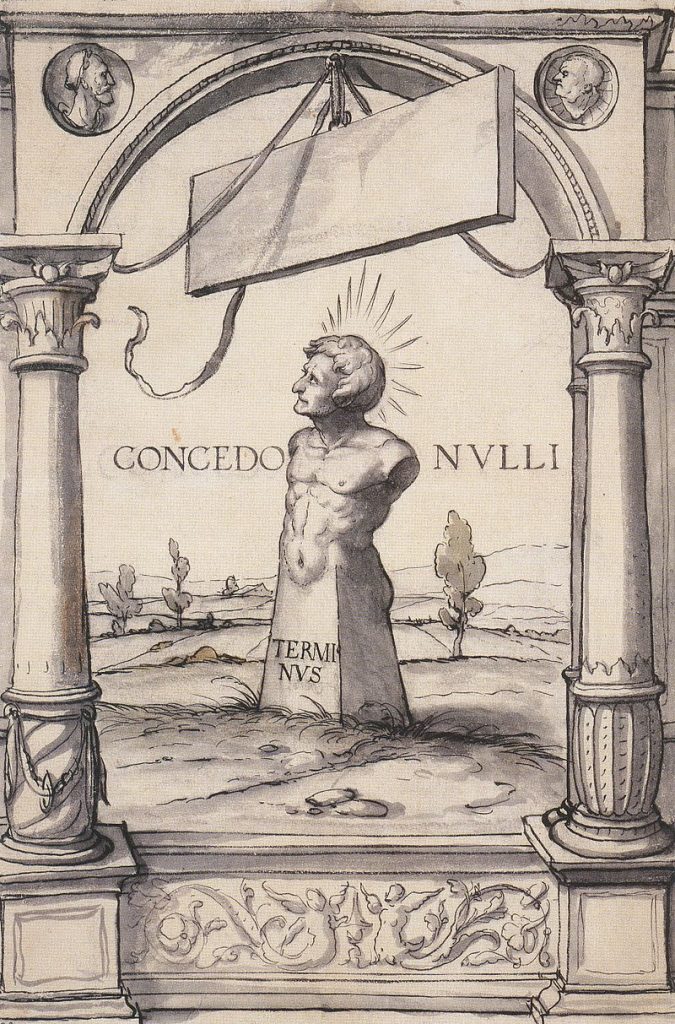
Hans Holbein the YoungerDesign for a Stained Glass Window with Terminus. Pen and ink and brush, grey wash, watercolour, over preliminary chalk drawing, 31.5 × 25 cm, Kunstmuseum Basel. ‘Terminus is often pictured as a bust on a boundary stone, His festival is ‘Terminalia’
Today is Terminalia, the Roman day for setting land boundaries. The festival of Terminus was a pastoral outdoor festival marking the boundaries of towns and villages. It resembles the Beating the Bounds tradition that we have in Britain. This is recorded, in the UK, from Anglo-Saxon times, and still continues in some parishes. I will talk about this on Ascension Day in May.
Terminus was an old ancient God who was the God of the boundary, the border, the edge, the liminal God. Ovid says King Tarquinus swept away the old Gods on the Capital Hill and Jupiter became the Great God. All the old temples were taken down, except for that of Terminus. Instead, Jupiter’s Temple was built around Terminus’ temple. They put a hole in the roof because Terminus had to be worshipped in the open air.
Terminus’s motto was “concedo nulli” which means “I yield to no one”. This was adopted by Erasmus as his personal motto in 1509.
Terminalia and the Roman Year
The Terminalia was celebrated on the last day of the old Roman year. February was the last month of the year. The rulers of Rome added an intercalary month called Mercedonius in an attempt to keep the Solar year in tune with the seasons. And when the intercalary month was added, the last five days of February were given to the month Mercedonius. The resulting ‘leap year‘ was either 377 or 378 days long. So, in those years, the 23rd of February was the Terminus of the year.
The intercalary months were added at the direction of the Pontiffs, supposedly every two or three years. But the Pontiffs were often swayed by political of financial advantage and delayed the decision. By the time of Julius Caesar, the seasons were wildly out of sync with the calendar year. The Dictator, responded by instituting a reform of the Calendar. It began with ‘the Year of Confusion’, over 400 days long.
The reforms introduced the Julian Calendar which realigned the calendar back in line with the seasons. It resolved the problem by adding leap day every four years. This was based on the almost correct calculation of a solar year being 365.25 days. It took another 1500 years before that inaccuracy was corrected. Then the year was another 11 days out of kilter, and the Julian Year was replaced by the Gregorian Year,
Here is what Ovid, in ‘Fasti’ says about Terminalis
When night has passed, let the god be celebrated With customary honour, who separates the fields with his sign. Terminus, whether a stone or a stump buried in the earth, You have been a god since ancient times. You are crowned from either side by two landowners, Who bring two garlands and two cakes in offering. An altar’s made: here the farmer’s wife herself Brings coals from the warm hearth on a broken pot. The old man cuts wood and piles the logs with skill, And works at setting branches in the solid earth. Then he nurses the first flames with dry bark, While a boy stands by and holds the wide basket. When he’s thrown grain three times into the fire
The little daughter offers the sliced honeycombs. Others carry wine: part of each is offered to the flames: The crowd, dressed in white, watch silently. Terminus, at the boundary, is sprinkled with lamb’s blood, And doesn’t grumble when a sucking pig is granted him. Neighbours gather sincerely, and hold a feast, And sing your praises, sacred Terminus: You set bounds to peoples, cities, great kingdoms: Without you every field would be disputed. You curry no favour: you aren’t bribed with gold, Guarding the land entrusted to you in good faith. If you’d once marked the bounds of Thyrean lands, Three hundred men would not have died, Nor Othryadesí name be seen on the pile of weapons. O how he made his fatherland bleed! What happened when the new Capitol was built? The whole throng of gods yielded to Jupiter and made room:
But as the ancients tell, Terminus remained in the shrine Where he was found, and shares the temple with great Jupiter. Even now there’s a small hole in the temple roof, So he can see nothing above him but stars. Since then, Terminus, you’ve not been free to wander: Stay there, in the place where you’ve been put, And yield not an inch to your neighbour’s prayers, Lest you seem to set men above Jupiter: And whether they beat you with rakes, or ploughshares, Call out: This is your field, and that is his! There’s a track that takes people to the Laurentine fields, The kingdom once sought by Aeneas, the Trojan leader: The sixth milestone from the City, there, bears witness To the sacrifice of a sheep’s entrails to you, Terminus. The lands of other races have fixed boundaries: The extent of the City of Rome and the world is one
Photo Mohammad Amiri from unsplash. Notice the crimson stigma and styles, called threads, Crocus is one of the characters in Ovid’s Metamorphoses
The story of Crocus and Smilax is in Ovid’s Metamorphoses. The book tells the story of myths which involve the metamorphosis of a person to a flower, or to a constellation, or to an echo or some supernatural change in being. This poem is one of the most famous in the world, written in about 6 AD. It influenced Dante, Bocaccio, Chaucer, Shakespeare, Keats, Bernard Shaw, and me. Seamus Heaney and Ted Hughes have translated modern versions of some of the tales.
The mechanicals in ‘The Midsummers Night Dream’ perform Ovid’s story of Pyramus and Thisbe, Titian painted Diana and Actaeon. Shaw wrote about Pygmalion, and we all know the story of Arachne. She claimed to be better than Athene at weaving. And then was turned into a spider.
The poem is about love, beauty, change, arrogance and is largely an Arcadian/rural poem. This is a contrast to Ovid’s ‘Art of Love’ which I use for illustrations of life in a Roman town. The stories are all about metamorphoses, mostly changes happening because of love. But it is also an epic as it tells the classical story of the universe from creation to Julius Caesar.
Ovid’s Metamorphoses and the Crocus
‘Crocus and his beloved Smilax were changed into tiny flowers.’ Ovid tell us, but chooses to give us no more details. So we have to look elsewhere. There are various versions. In the first, Crocus is a handsome mortal youth, beloved of the God Hermes (Mercury). They are playing with a discus which hits Crocus on the head and kills him. Hermes, distraught, turns the youth into a beautiful flower. Three drops of his blood form the stigma of the flower. In another version, Crocus and the nymph Smilax, fall in love. And are rewarded by immortality as a flower. One tale has Smilax turned into the Bindweed.
Morning Glory or Field Bindweed photo Leslie Saunders unsplash
Ovid’s Metamorphoses and Bindweed
It turns out that Smilax means ‘bindweed’ in Latin. Bindweed is from the Convolvulus family, and I have grown one very successfully in a pot for many years. But they have long roots. According to the RHS ‘Bindweed‘ refers to two similar trumpet-flowered weeds. Both of which twine around other plant stems, smothering them in the process. They are difficult to remove. This, could suggest that Smilax is either punished for spurning Crocus, or that she smothered him with love. Medically, Mrs Grieve’s Modern Herbal says all the bindweeds have strong purgative virtues, perhaps another insight into Smilax’s psychology?
The Metamorphosis of Data and the correct use of the plural
Apparently, in the UK some say crocuses and others use the correct Latin plural, croci. On an earlier version of this post I used the incorrect plural crocii.
On the subject of Roman plurals, the Financial Times editorial department made an earth-shattering decision, a couple of years ago. They updated their style guide to make the plural word data (datum is the singular form) metamorphise into the singular form.
So it is now wrong to say ‘data are’ but right to say ‘data is’. For example, it was correct to say: ‘the data are showing us that 63% of British speakers use crocuses as the plural’ but now, it is better to write ‘the data is showing us that 37% of British people prefer the correct Latin form of croci’.
Violets and Crocuses
Violets and crocuses are coming out. They often come out for St Valentine’s Day, and so obviously associated with Love. White croci usually represented truth, innocence, and purity. The purple variety imply success, pride and dignity. The yellow type is joy.’ according to www.icysedgwick.com/, which gives a fairly comprehensive look at the Crocus.
Crocus & Saffron
The autumn-flowering perennial plant Crocus sativus, is the one whose stigma gives us saffron. Roman civilisation spread the plants around Europe. They used it for medicine, as a dye, and a perfume. It was much sought after as a protection against the plague, and extensively grown in the UK. Saffron Walden was a particularly important production area in the 16th and 17th Centuries.
Saffron in London
Snowdrop, Crocus, Violet and Silver Birch circle in Haggerston Park. (Photo Kevin Flude, 2022)
The Bishop of Ely grew Saffrom in his beautiful Gardens just outside of the City of London. The area remembered by the London street name: Saffron Hill. It is home to the fictional Scrooge. This area became the London home of Christopher Hatton, the favourite of Queen Elizabeth 1. His garden was on the west bank of the River Fleet, in London EC1, in the area now known as Hatton Garden. (For more on Christopher Hatton see my post on nicknames Queen Elizabeth I gave to her favourites).
I found out more about Saffron from listening to BBC Radio 4’s Gardener’s Question time and James Wong.
Croydon (on the outskirts of London) means Crocus Valley. A place where Saffron was grown. The Saffron crops in Britain failed eventually because of the cost of harvesting, and it became cheaper to import it. So, we now import it from Spain, Iran, and India amongst other places. But it is being reintroduced in Norfolk, Suffolk, Kent, and Sussex. These are – the hot and dry counties. The plant enjoys a South-facing aspect. But it needs protection from squirrels and sparrows who love it. To grow it, look at this post from the Garden Doctor.
Saffron Photo by Vera De on Unsplash
Violets
Viola odorata CC BY-SA 2.5 Wikipedia
The Celts used Violets as cosmetics; the Athenians to moderate anger; the Iranians for insomnia, and are loved by all because of their beauty and fragrance. They have been symbols of death for the young, and used as garlands, nosegays posies, which Gerard says are ‘delightful’.
For more on Ovid, use the search facility (click on menu) or read my post here.
On This Day
197 – The Battle of Lugdunum sees the victory of Septimius Severus over Clodius Albinus reputedly the bloodiest battle between Roman armies. The previous emperor Pertinax died in 193 during the Year of the Five Emperors. Three main contenders emerged Severus who was African, Niger was from Central Italy, Albinus was the Governor of Britain.
1800 – Napoleon proclaims himself First Consul making him the dictator of France.
1846 – The Republic of Texas officially transfers power to the State of Texas government and becomes part of the United States.
1878 – Thomas Edison patents the phonograph.
1945 – Battle of Iwo Jima began with the landing of 30,000 US troops.
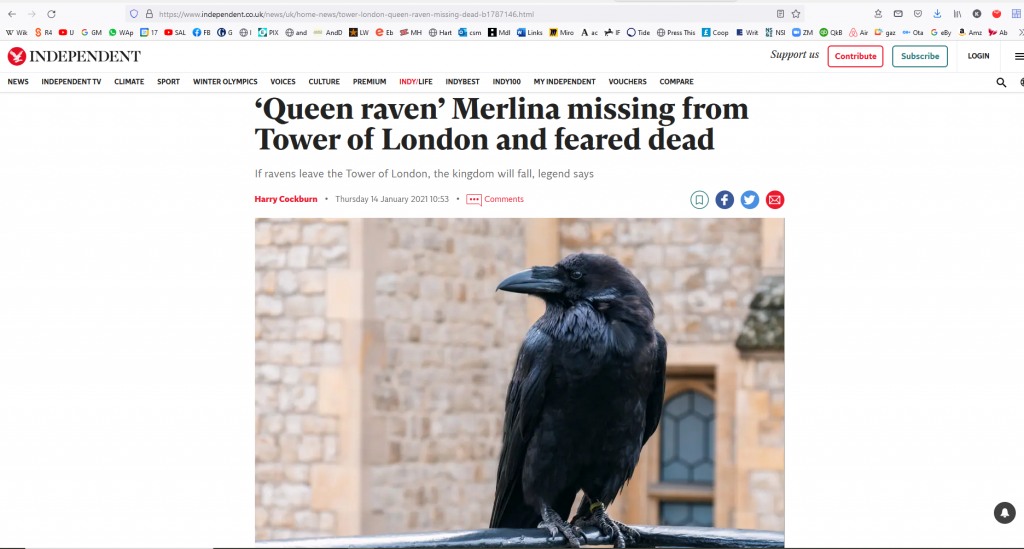
The Independent January 2021 The Raven the Palladium of Britain
The Raven – the Palladium of Britain
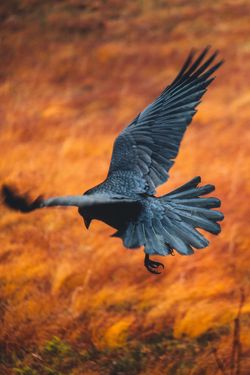
Corvus corax is hatching. An early nesting bird, the Raven is the biggest of the Corvids. They were pushed to the west and north by farmers and game keepers but are making a comeback. Ravens are finding towns convenient for their scavenging habits. So they, again, cover most of the UK except the eastern areas. The Raven is one of the Palladiums of Britain.
A Palladium is something that keeps a city or country safe, They are named after a wooden statue of Pallas Athene, which protected Troy. Perceiving this, Odysseus and Diomedes stole the Palladium from Troy shortly before the Trojan Horse episode. Troy fell and the palladium went to Italy (I’m guessing with Diomedes who is said to have founded several cities in Italy). It ended up in Rome.
The Romans claimed to be descendants of Trojan exiles led by Aeneas. So it was back with its rightful owners. It protected Rome until it was transferred to the new Roman capital at Constantinople. It then disappeared, presumably allowing the Ottoman Turks to conquer the City of Caesar? To read of London Stone as a Palladium see my post here.
The Ravens habits (it is said they know where the battlefields are before they are fought) and their black plumage have made them harbingers of death. In poetry, Ravens glut on blood like the warriors whose emblem they are. Here is a very famous quotation from Y Gododdin, a medieval poem but thought to derive from a poem by the great poet Aneirin from the 7th Century.
‘He glutted black ravens on the rampart of the stronghold, though he was no Arthur.’
This is one of the much argued-about references to King Arthur in the ‘Was he a real person’ trope. The point being, it doesn’t make sense to mention Arthur if King Arthur wasn’t a real person. The story at the Tower of London is that the Ravens kept in the Tower, with clipped wings, keep Britain safe from Invasion. (But see below).
Bran’s Head – the original Palladium of Britain?
By Sonny Mauricio from Unsplash
The Raven was also the symbol of the God-King Bran. Bran was one of the legendary Kings of Britain. His sister, Branwen, was married to the King of Ireland. To cut a long story short, Branwen was exiled by her Irish husband to the scullery. She trained a starling to smuggle a message to her brother, to tell of her abuse.
So Bran took an army over the Irish Sea to restore her to her rightful state. But the ships were becalmed. Mighty Bran blew the boats across the sea – he was that much a hero. Bran was mortality wounded in the fighting that followed. This was a problem because he had previously given away his cauldron of immortality. He gave it to the Irish King in recompense for the insults given to the Irish by Bran’s brother, who hated anyone not British.
Bran’s Head Returns to London
So, the dying Bran, told his companions to cut off his own head and take it back to the White Hill in London. His head was as good a companion on the way back as it was on the way out, and the journey home took 90 years.
At last, they got to London, where Bran told his men to bury his head on the White Hill. As long as it stays here, he said, Britain would be safe from foreign invasion. The White Hill is said to be Tower Hill with its summit at Trinity Gardens, although Primrose Hill is sometimes offered as an alternative.
This was one of the Three Fortunate Concealments and is found in ‘the Triads of the Island of Britain.’ The Triads are from medieval manuscripts which preserve fragments of folklore, mythology and history. They are grouped in groups of three.
Arthur and Bran’s Head
But many years later, King Arthur saw no need for anybody or anything other than himself to protect the realm. So he had the head dug up. Calamity followed in the shapes of Sir Lancelot and Mordred which led to the end of the golden age of Camelot and conquest of Britain by the Saxons. This was one of the Three Unfortunate Disclosures.
If we want a rational explanation for the story, there is evidence that Celtic cultures venerated the skull, and palladiums play a part in Celtic Tales.
So what was Arthur doing destroying the palladium that kept Britain safe? Vanity is the answer the story gives. But, perhaps, it’s a memory of Christian rites taking over from pagan rituals? God, Arthur might have thought, would prefer to protect his people himself rather than Christians having to rely on a pagan cult object.
Ravens in the Tower of London
The story of Bran’s head is inevitably linked to the Ravens in the Tower who, it is still said, keep us safe from invasion. As you can see from the photo at the top we still get in a tizz when one goes missing.
Sadly, and I am probably sadder about this than most, the link between the Tower, Bran, and the Ravens cannot be substantiated. Geoffrey Parnell, who is a friend of mine, told me that while working at the Tower of London he searched the records assiduously for the story of the ravens. He found no evidence of the Raven myth & the Tower before the 19th Century, and concluded that it was most likely a Victorian invention. IanVisits has a 2025 story about the Ravens, and also concurs that the Ravens are a recent myth.
The Welsh Triads give a total of two palladiums for Britain, a couple of nationalistic fighting dragons.
The Head of Bran the Blessed, son of Llyr, which was concealed in the White Hill in London, with its face towards France. And as long as it was in the position in which it was put there, no Saxon Oppression would ever come to this Island; The second Fortunate Concealment: the Dragons in Dinas Emrys, which llud son of Beli concealed; And the third: the Bones of Gwerthefyr the Blessed, in the Chief Ports of this Island. And as long as they remained in that concealment, no Saxon Oppression would ever come to this Island.
All good but then came:
The Three Unfortunate Disclosures:
And there were the Three Unfortunate Disclosures when these were disclosed. And Gwrtheyrn the Thin disclosed the bones of Gwerthefyr the Blessed for the love of a woman: that was Ronnwen the pagan woman; And it was he who disclosed the Dragons; And Arthur disclosed the head of Bran the Blessed from the White Hill, because it did not seem right to him that this Island should be defended by the strength of anyone, but by his own.
Gwrtheyrn is Vortigen, the leader of the Britons after the fall of the Roman Empire in Britain, one or two leaders before Arthur. Vortigern, which means something like strong leader in Welsh was a real person in so far as he, unlike Arthur, is mentioned by Gildas a near contemporary source.
The story of the dragons is supposedly from the pre-Roman Iron Age. Every May Day, the Dragons made a terrible noise, causing miscarriages and other misfortunes. So, King Ludd, whom legends says gave his name to London (Ludd’s Dun or Ludd’s walled City), drugged the dragons. He had them buried in a cavern at Dinas Emrys in Eryri (Snowdonia). The Red Dragon represented the Britons (also called the Welsh) and White Dragons the Saxons.
Vortigern, Merlin and Vortimer
Hundreds of years later, (five hundred?) after the Romans had come and gone. Vortigern was trying to build a castle in Eryri at Dinas Emrys. But the walls keep falling down. ‘You need the blood of a boy born not of man’, his necromancers say. They find a boy called Ambrosius aka Merlin whose mother had lain with an incubus. Merlin accused the necromancers of ignorance and explains the wall collapse is caused by two dragons. They find the cavern and let the dragons go. The walls now stand undisturbed. But the Welsh Red Dragon and the Saxon White Dragon can not now be at peace, and the Britons are defeated by the Saxons.
Vortigern betrayed his own people for the lust of Rowena the daughter of Hengist, the Saxon. Hengist was given the province of Kent as his reward, and thus began the Anglo-Saxon take over.
Vortigern’s son is Gwerthefyr (or Vortimer). He was a better man than his dad and fought to keep the Saxons out. After Vortimer’s death his bones were buried at the chief ports on the South Coast. Here they acted as a palladian and they kept the country safe. But they were moved to Billingsgate, in London and put in a Tower. The loss of the palladium allowed the Saxons to land safely on the Kent coast and consolidate their increasing hold over Britain and turning it into England.
Birds in Love
Here is a lovely little medieval poem. It was found in 1931 in the end leaf of a manuscript where someone had been testing their goose quill and scribbled these three lines:
Why it is so wet in the UK at the moment (February 18th)? The answer seems to be that there is a block of cold weather over the States that is moving the Jet Stream south, bringing lots of wet weather. But there is also another block of cold weather over Scandinavia. This means that the low pressures being driven by the Jet Stream, have no where to go and are stopping and dumping their rain all over the UK.
3102 BC – the death of Krishna starts Kali Yuga, the fourth and final yuga of Hinduism.
1478 – George, Duke of Clarence, traitor to his Brother, Edward IV, was executed in private at the Tower of London. It is said he was drowned in a vat of Malmsey Wine.
1678 – First Part of Pilgrim’s Progress by John Bunyan published.
1991 – The IRA plant bombs at Paddington station and Victoria station in London. The IRA gave warnings, and the Victoria bomb went off at 4.20am and caused no casualties. At or just before 7am, the IRA warned that all London Stations were to be bombed in 45 minutes time. The Authorities were slow to clear the stations and at Paddington a bomb went off at 7:40am. 1 person was killed and 38 people were injured. 11 days earlier, the IRA attacked Downing St with a mortar bomb attack.
Written on February 21 revised in February 18th 23, 24, 25, Birds in Love, Wet Weather and On This Day added in 2026
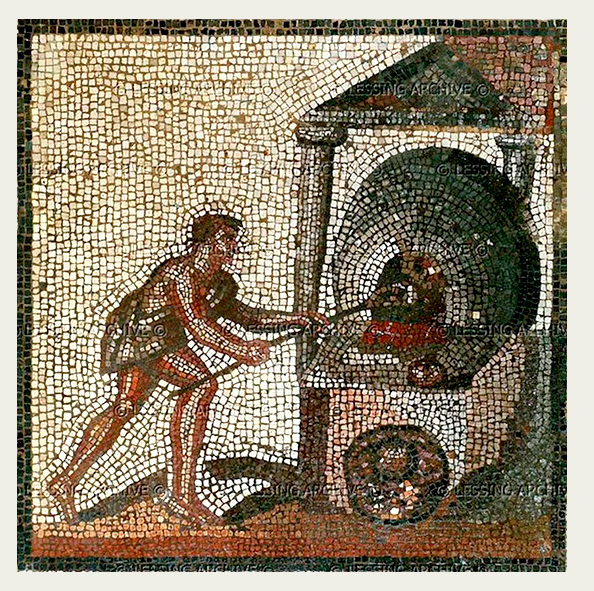
Fornacalia was a corn festival that took place around February 7th to the 17th. Romans were assigned individual days to celebrate (see below) but the last day, today, was reserved for those fools who did not know their proper day.
Pliny the Elder says it was King Numa Pompilius (753-673 BC), who established Fornacalia, The Feast of Ovens. Fornacalia celebrated Fornax who was the Goddess of the Oven – specifically the grain oven for drying grain. The word for oven is also Fornax, from which we probably derive our word furnace.
Organising the Fornaclia and the Curio Maximus
The Festivals in Rome were organised by the Curio Maximus who was a priest who supervised the curiae. In Rome the citizens were arranged, originally, into the 3 ancient tribes of Rome (founded in the 8th Century BC). The Tribes were supposed to represent the ancient ethnic groups. These were the Ramnes the Latin population, the Tities the Sabines, and the Luceres the Etruscans. The tribes were then divided into 10 curiae each. So there were 30 curiae.
Each Roman was supposed to be assigned to one of the curiae, which had a religious, social and voting function. The name may come from ‘co-viria – a gathering of men’. The members of the curiae were known as curiales. Each curiae had their own priest, or curio, and assistant priest ‘flamen curialis‘. And they organised the religious ceremonies of the curiae. They met in a meeting place called the curia.
So the Curio Maximus would declare when a festival was to be held, and get the curiae to organise the celebrations at the curia. I hope you are still with me! They would choose a date, for example for the Fornacalia, between about the 7th Feb and the 17th of February. And the citizens would go to their curia where there would be a ceremonial roasting of the grain, and baking into bread which would be in honour of the Goddess Fornax.
Ovid & the Feast of Fools
Ovid, who wrote his almanac poem on the Roman festivals (Fasti), reveals many of these details. This is what he says:
Learn too why this day is called the Feast of Fools. The reason for it is trivial but fitting. The earth of old was farmed by ignorant men: Fierce wars weakened their powerful bodies. There was more glory in the sword than the plough: And the neglected farm brought its owner little return. Yet the ancients sowed corn, corn they reaped, Offering the first fruits of the corn harvest to Ceres. Taught by practice they parched it in the flames, And incurred many losses through their own mistakes. Sometimes they’d sweep up burnt ash and not corn, Sometimes the flames took their huts themselves: The oven was made a goddess, Fornax: the farmers Pleased with her, prayed she’d regulate the grain’s heat. Now the Curio Maximus, in a set form of words, declares The shifting date of the Fornacalia, the Feast of Ovens: And round the Forum hang many tablets, On which every ward displays its particular sign. Foolish people don’t know which is their ward, So they hold the feast on the last possible day.
Book II: February 17 From: Fasti, Book 2. Translated by A.S Kline and available here
I am led to believe that the Roman word for the person who looked after a furnace was the fornicator. And as heat was a ’cause’ of lust, fornicators well, they fornicated.
However, others derive the word from the word Fornix, which is an arch. And arches, it was said, was where the Brothels were, hence fornicator. Not sure that I’m going with the idea that Brothels were always under arches. Below is what the online etymology dictionary’s definition which might help you make up your mind:
from Late Latin fornicationem (nominative fornicatio), noun of action from past-participle stem of fornicari “to fornicate,” from Latin fornix (genitive fornicis) “brothel” (Juvenal, Horace), originally “arch, vaulted chamber, a vaulted opening, a covered way,” probably an extension, based on appearance, from a source akin to fornus “brick oven of arched or domed shape” (from PIE root *gwher- “to heat, warm”). Strictly, “voluntary sex between an unmarried man and an unmarried woman;” extended in the Bible to adultery. The sense extension in Latin is perhaps because Roman prostitutes commonly solicited from under the arches of certain buildings.
As you can see, it’s a big old mix-up of arches, brothels, brick ovens, all quite unconvincing, so I’m sticking with my over-heated stoker theory. To find out more about Ovid and his Almanac look at my post here.
The Annona
Rome had a population of one million people, and keeping them fed was a difficult task. So the celebration of Fornacalia was an important feast designed to protect Rome’s all important grain supply. The Imperial Government took on the responsibility of providing the grain in a system called the Annona. and provided the Citizens with free bread. The Italian Annona brought much of its grain from Egypt.
Londinium & the Annona
Dominic Perring in his recent book on Roman London (Londinium in the Roman Empire) speculates that the fluctuating fortunes of London was dependent upon the routing of a northern Annona through Londinium. When the Emperor was engaged with the North Western Empire London thrived, when he wasn’t interested it declined.
On This Day
1634 – Puritan author William Prynne was sentenced in the Star Chamber for publishing “Histrio-masti”, criticising the theatre (and criticising Bishops). This was one of various trials he faced in the Star Chamber. The Star Chamber was not a normal court, with a Jury but was the instrument of repression by Charles I’s autocratic regime. Prynne had already been imprisoned in the Tower of London for a year. On the 17th February he was sentenced to: imprisonment for life; £5,000 fine; expelled from Lincoln’s Inn (i.e. deprived of the right to practice law); deprived of his Oxford degree; to have his ears cut off; to be pilloried at Westminster and Cheapside in the City of London. Oh and branded on the Cheek with S.L (Seditious Libeller).
1864 – The CSS H. L. Hunley, a Confederate vessel, is the first submarine to sink a warship, the USS Housatonic.
First published February 2023. Revised and republished 17th February 2024, 2025, On This Day added 2026
Today, February 17th, is the Chinese New Year or the Lunar New Year. It falls on the second new moon after the winter solstice. However, not always. The problem with a lunar calendar is the need to keep the lunar and the solar years in some sort of sync. The Chinese manage by adding intercalary months from time to time,. Then, the Chinese New year will fall on the third new moon after the winter solstice.
Chinatown. Soho 2023 Photo K Flude
If you look at the chart, you will see this is the year of the Horse. www.chinahighlights.com tells us that:
‘2026 is the year of the Fire Horse. It is viewed as a year of optimism and opportunity, with strong public and investor confidence pointing towards economic growth, particularly driven by AI advancement.’ The idea being that Horses are dynamic. I’m sure Keir Starmer is hoping this prophecy is true!
The Great Race
According to folktales, the twelve animals were asked to participate in a race. The Ox was winning, but the Rat jumped onto the Ox, onto his head, and jumped across the line. I’m a little surprised that the Ox should have been second, because surely the dragon, or the horse or the tiger would have been in the lead?
Having written that, I have just found a website that gives the whole story. But the long and short of it is that the Jade Emperor set up the race to cross a river. This delayed the tiger. The dragon stopped on the way to help out some villagers. The snake wrapped itself around the horse’s hoof thus delaying him. The Cat and the Rat enlisted the help of the kind-hearted Ox to cross the river. Then the Rat pushed the Cat into the River, jumped onto the Bank and got to the Emperor first. For the entire story visit the Great Race here.
The V&A has a page exploring the chinese animals in more depth here.
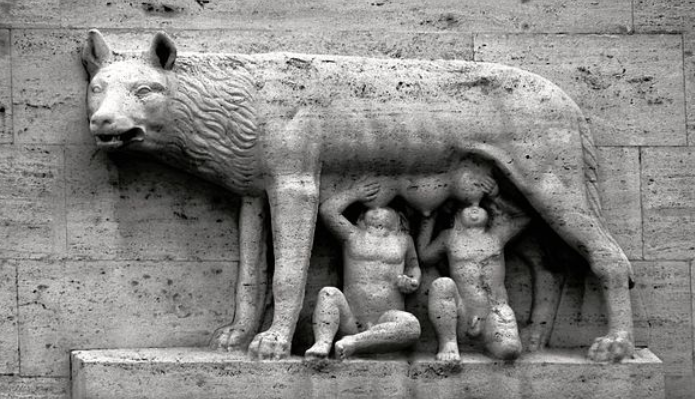
Romulus and Remus suckling from a wolf. The event was celebrated by the festival of Lupercalia
Lupercalia was a Roman feast of purification. It was dedicated to the she-wolf who saved Romulus and Remus, the traditional founders of the City of Rome. The centre of the festivities in Rome was a cave called the Lupercal. This was, supposedly, where the wolf suckled the twin brothers until they were rescued by Faustulus, a shepherd.
The Lupercalia was also called dies Februatus. The word seems to be derived from proto-italic word februum for purification by making an offering. The purification instruments were called februa. This is the basis for the Roman month named Februarius and our February. For more about February see my post here.
We are also in the middle of the Parentalia, which began on the 13th February and lasted nine days. It honoured parents and family ancestors. People would visit the family tombs found along the roadsides outside of the City. Here they would honour the ancestors by making offerings.
Goddesses of the Family Heath
There would be a family banquet and offerings made to the Lares – the household deities. Romans had a household altar for their worship. The Greek Goddess Hestia was the Goddess of the Hearth – the centre of any household, and Vestal was the Roman equivalent. Dickens borrowed the concept of the Household Gods in his Christmas book ‘the Chimes’.
According to Wikipedia the Codex-Calendar of 354, shows that 13 February had become the holiday Virgo Vestalis parentat. This was a public holiday which by then appears to have replaced the older Parentalia.
29 – The Day that Christ overcame the devil. February 15th was the date chosen for this festival, which was called Sarum Rite. But it is long obsolete in the Church calendars, and no one seems to know what it was about. Although it seems obvious to me, it must be when the Devil tried to tempt Jesus in the Wilderness. I have just found this site which is equally unsure. But feast-of-the-triumph-of-christ-over-the-devil suggests that Jesus was baptised on 6th January and 40 days later takes us to February 15th when the Devil:
‘took him up into the holy city, and set him upon the pinnacle of the temple,
And said to him: If thou be the Son of God, cast thyself down, for it is written: That he hath given his angels charge over thee, and in their hands shall they bear thee up, lest perhaps thou dash thy foot against a stone.
Jesus said to him: It is written again: Thou shalt not tempt the Lord thy God.‘
The story continues, but you get the gist of it. As to the date of AD 29. Dates about Jesus are very uncertain.
898 – In the Laws of King Alfred the Great, February 15th, the day Christ overcame the devil, was a day off for freemen. This is about the date of the first day in Lent. Lent of course varies with the date of Easter. In 2026 Lent starts on February 18th. But the law code says the 15th is the day off. I delve more into Days off in the Anglo Saxon Calender on August 15th.
1748 – Jeremy Bentham was born. He was a utilitarian philosopher, who believed ethics consisted on contributing to the great good of humanity. He was also involved in the foundation of the London University and founded University College, London – London’s first university. Founded in 1826.
Jeremy Bentham’s “Auto-Icon” at University College London. Photo Michael Reeve. Licensed by author under GNU Free Documentation License
My part in his story is that the mother of my children is a textile conservator and one of her first projects was to sort Jeremy Bentham out. He was an atheist and did not believe humans survive death. In order to encourage free thought, he ordered that his body should be publicly dissected (after his death!). His skeleton was then dressed in a suit, stuffed with straw, adorned with a cast of his head, Hat put on, and seated on a chair. Then placed in a cupboard, only to be brought out on ceremonial occasions. He’d got a bit dusty over the years, and a little frayed at the edges. So his clothes were repaired and cleaned, and restuffed with acid-free stuffing. Then put back in the cupboard, where you can still see him.
Photo by Polina M on Unsplash illustrating Friday the Thirteenth
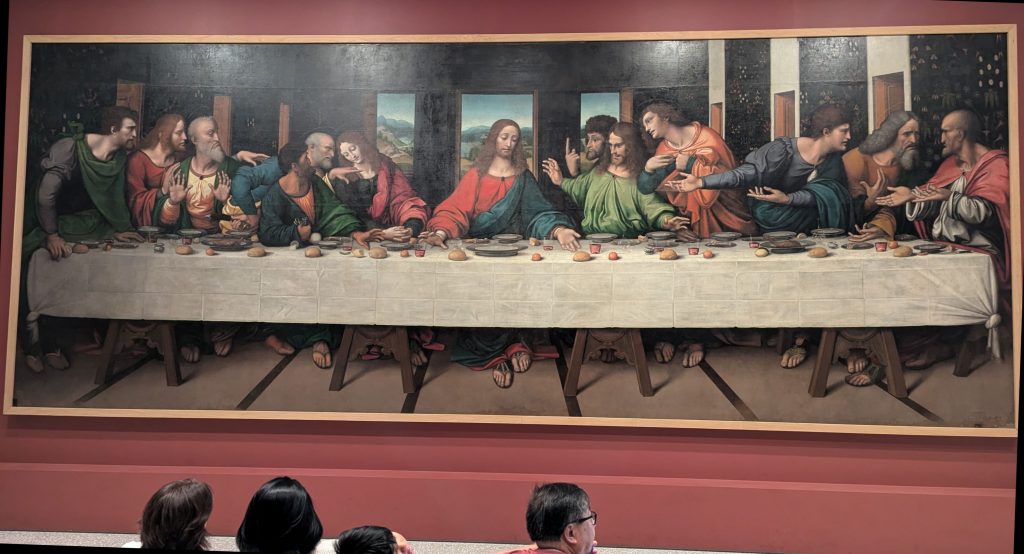
On the other hand, ‘Thank God It’s Friday!’. In fact, the belief that Friday the Thirteenth is a very bad luck days is not that old. Researchers can only trace it back to the 19th Century in France. Have a look at this BBC site for details. However, 13 has long been an ill-omened number. Judas Iscariot was the 13th to arrive at the Last Supper, And that didn’t turn out well. 13 was an unlucky day for the Romans too.
Copy of the Last Supper at the Royal Academy showing 13 participlants
Baldur and Loki
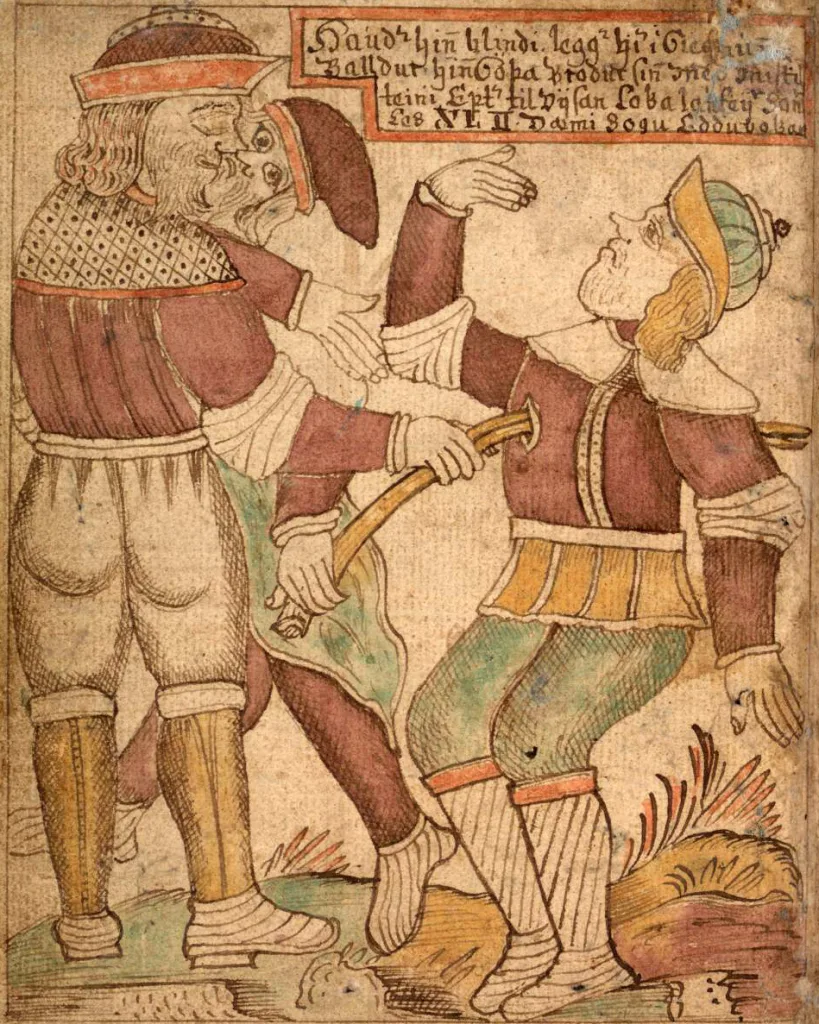
In Norse Mythology, Baldur, the son of Odin who was a bright and cheerful God, was having premonitions of doom. Odin sought the advice of a dead seer who told him, Baldur was doomed. Baldur’s mother, the Goddess Frigg, was determined to save him. So got every entity in the cosmos live or dead to swear they would not harm Baldur.
Thereafter, the Gods enjoyed themselves at banquets by throwing missiles at Baldur who was now immune to all threats. The mischievous God, Loki, saw an opportunity for his evil skills. He spoke, in disguise, to Frigg asking if she had really got every single entity to swear? She said yes except the Mistletoe as it was so innocuous. So, ofcourse, Loki went to make a spear out of the mistletoe.
With the weapon, Loki attended a Banquet of twelve gods to which he was not invited, being therefore the 13th. When the Gods began their now customary game of throwing things at Baldur, Loki asked the slayer God Hodr to throw the mistletoe spear. It killed Baldur, and despite many attempts the Gods could not get Baldur out of Hell, Much of the joy of the world died with him. For more detail see norse-mythology.org.
By Jakob Sigurðsson[2] – SÁM 66, 75v. Digitized version available from http://sagnanet.is/saganet/?MIval=/SinglePage&Manuscript=1109&Page=150&language=english. Image processing (crop, rotate, color-levels) by Skadinaujo (talk · contribs)ou Jakob Sigurðsson. The Death of Baldr. From: Reykjavik: Stofnun Árna Magnússonar í íslenskum fræðum. SÁM 66. 1765. 75v. Hand copied paper manuscript. MyNDIR: My Norse Digital Image Repository. Ed. P. A. Baer. 2023. Edition 2.5.1. Victoria, B. C.: Humanities Computing and Media Centre, University of Victoria. 2023., Public Domain, https://commons.wikimedia.org/w/index.php?curid=6029049
Unlucky Friday?
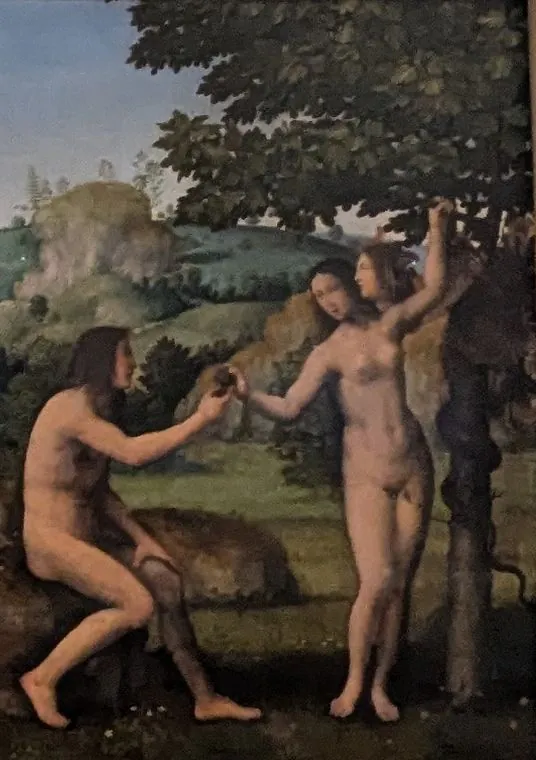
Friday was often an unlucky day in the Bible. In particular, it was the day Adam and Eve ate of the Tree of Knowledge. Below you can see the human-headed snake beguiling Eve who hands the fruit of knowledge to Adam.
Detail from The Creation and Fall of Man by Mariotto Albertinelli Courtauld Institute photo by KFlude
It was the day when Noah’s premonition was proven correct. In the Canterbury Tales, Chaucer writes that “And on a Friday fell all this mischance. O Venus, sweet goddess of love’s chance”. (Nun’s Priest’s Tale). And Friday was the normal Hangman’s Day in England.
But no one seems to have put the two together until the 19th Century. In 1834 a French play had a line
“I was born on a Friday, December 13th, 1813 from which come all of my misfortunes.”
There is one Friday 13th a year, and often three. They insist on appearing only in a month that starts on a Sunday. The compound word for fear of Friday 13th is paraskevidekatriaphobia.
On This Day (Friday 13th)
1307 – On Friday 13 October, King Philip IV of France arrested leading members of the Knight’s Templars. One of the most powerful monastic orders in Europe to whom many of the leading Knights belonged. They had basically become the bankers to the Royalty of Europe, But they had become too powerful, and were destroyed very violently.
First Published on Friday the 13th of February 2026
Daffodils & Narcissus. In 2023, I saw my first Daffodil in Hackney in a Council Estate on 12 January. My first daffodil in 2024 was outside my first floor window in early February. On February 11th, 2025, I saw the shoots of Daffodils in my garden but nothing blooming. However, there were daffodils on another Council Estate. In 2026, my first daffodil came out in early January. And the Estates and Parks around have been showing daffodils since late January. They bring such joy and hope for the return of the Sun.
12 Jan 2023. Hackney, London, the first Daffodil.
Narcissus the Flower
Their formal name is Narcissus. The Roman natural historian, Pliny tells us that the plant was:
‘named Narcissus from narkē not from the fabulous boy.’
Narkē is the Greek word from which we derive the word narcotic. It is a reference to the narcotic properties of the narcissus. An extract of the bulb applied to open wounds produced numbness of the whole nervous system and paralysis of the heart. The flowers are also slightly poisonous. So, they were used as an emetic. They brought on vomiting when it was felt necessary that the stomach be emptied. It was used to treat hysteria and epilepsy. They treated children with bronchial catarrh or epidemic dysentery. Among Arabian doctors, it was used to cure baldness and as an aphrodisiac. (Source: A Modern Herbal by Mrs M Grieve.) Please remember these are not recommendations for use medicinally, but are historic uses and may be dangerous.
The Fabulous Boy
The fabulous boy, mentioned by Pliny, was Narcissus. He, according to the Roman Poet Ovid, met the nymph Echo, and she fell in love with the beautiful boy. He spurned her, and she faded until all that remained of her was her voice – the echo we hear.
Nemesis, the Goddess of Revenge (the one with the fiery sword) decided on revenge upon the handsome boy. She lured the thirsty youth to a fountain, where, in the pool around the fountain, he saw an image of a breathtakingly handsome boy. He fell instantly in love with such beauty. But it was an image of himself. Realising he would never meet anyone as fabulous as himself, he faded from life. He eventually metamorphised into a white and yellow flower, which was named after him.
Nemesis, with her fiery sword, from the painting on the Staircase at Hampton Court by Antonio Verrio, Photo K Flude
Daffodils & Shakespeare
Daffodils are mentioned in a list of Spring Flowers by Shakespeare in the pastoral play The Winter’s Tale:
(Please note that as you read Shakespeare’s words below that Prosperpina is the wife of Pluto, the God of the Underworld, Dis, is another name for him, Cytherea is the Goddess of Beauty and Love. Phoebus is the Sun God. And the Spring Flowers are Daffodils, violets, primroses, oxlips (primula), Crown Imperial (Fritillaria imperialis), Lilies, flower-De-luce (Iris)
Perdita to Camillo
Out, alas! You’d be so lean that blasts of January Would blow you through and through. (To Florizel) I would I had some flowers o’th’ spring, that might Become your time of day – (to the Shepherdesses) That wear upon your virgin branches yet Your maidenheads growing. O Proserpina, For the flowers now that, frighted, thou let’st fall From Dis’s waggon! Daffodils, That come before the swallow dares, and take The winds of March with beauty; violets, dim, But sweeter than the lids of Juno’s eyes Or Cytherea’s breath; pale primroses, That die unmarried ere they can behold Bright Phoebus in his strength – a malady Most incident to maids; bold oxlips and The crown imperial; lilies of all kinds, The flower-de-luce being one: O, these I lack To make you garlands of, and my sweet friend To strew him o’er and o’er!
WT IV.iv.110.2
The reference to Daffodils suggests that for Shakespeare they are around to withstand the March Winds before the Swallows arrive in April. With selective breeding, early flowering species have been developed. Now February and even January are within the scope of the glorious bulb. (here is a post on winter flowering varieties). For my post on Shakespeare & Winter see here.
Once a noisy Nymph, (who never held her tongue when others spoke, who never spoke till others had begun) mocking Echo, spied him as he drove, in his delusive nets, some timid stags.—For Echo was a Nymph, in olden time,—and, more than vapid sound,—possessed a form: and she was then deprived the use of speech, except to babble and repeat the words, once spoken, over and over. Juno confused her silly tongue, because she often held that glorious goddess with her endless tales, till many a hapless Nymph, from Jove’s embrace, had made escape adown a mountain.
But for this, the goddess might have caught them. Thus the glorious Juno, when she knew her guile; “Your tongue, so freely wagged at my expense, shall be of little use; your endless voice, much shorter than your tongue.” At once the Nymph was stricken as the goddess had decreed;—and, ever since, she only mocks the sounds of others’ voices, or, perchance, returns their final words.
One day, when she observed Narcissus wandering in the pathless woods, she loved him and she followed him, with soft and stealthy tread.—The more she followed him the hotter did she burn, as when the flame flares upward from the sulphur on the torch. Oh, how she longed to make her passion known! To plead in soft entreaty! to implore his love! But now, till others have begun, a mute of Nature she must be. She cannot choose but wait the moment when his voice may give to her an answer. Presently the youth, by chance divided from his trusted friends, cries loudly, “Who is here?” and Echo, “Here!” Replies. Amazed, he casts his eyes around, and calls with louder voice, “Come here!” “Come here!” She calls the youth who calls.—He turns to see who calls him and, beholding naught exclaims, “Avoid me not!” “Avoid me not!” returns. He tries again, again, and is deceived by this alternate voice, and calls aloud; “Oh let us come together!” Echo cries, “Oh let us come together!” Never sound seemed sweeter to the Nymph, and from the woods she hastens in accordance with her words, and strives to wind her arms around his neck.
He flies from her and as he leaves her says, “Take off your hands! you shall not fold your arms around me. Better death than such a one should ever caress me!” Naught she answers save, “Caress me!” Thus rejected she lies hid in the deep woods, hiding her blushing face with the green leaves; and ever after lives concealed in lonely caverns in the hills. But her great love increases with neglect; her miserable body wastes away, wakeful with sorrows; leanness shrivels up her skin, and all her lovely features melt, as if dissolved upon the wafting winds—nothing remains except her bones and voice—her voice continues, in the wilderness; her bones have turned to stone. She lies concealed in the wild woods, nor is she ever seen on lonely mountain range; for, though we hear her calling in the hills, ’tis but a voice, a voice that lives, that lives among the hills.
Thus he deceived the Nymph and many more, sprung from the mountains or the sparkling waves; and thus he slighted many an amorous youth.—and therefore, some one whom he once despised, lifting his hands to Heaven, implored the Gods, “If he should love deny him what he loves!” and as the prayer was uttered it was heard by Nemesis, who granted her assent.
There was a fountain silver-clear and bright, which neither shepherds nor the wild she-goats, that range the hills, nor any cattle’s mouth had touched—its waters were unsullied—birds disturbed it not; nor animals, nor boughs that fall so often from the trees. Around sweet grasses nourished by the stream grew; trees that shaded from the sun let balmy airs temper its waters. Here Narcissus, tired of hunting and the heated noon, lay down, attracted by the peaceful solitudes and by the glassy spring.
There as he stooped to quench his thirst another thirst increased. While he is drinking he beholds himself reflected in the mirrored pool—and loves; loves an imagined body which contains no substance, for he deems the mirrored shade a thing of life to love. He cannot move, for so he marvels at himself, and lies with countenance unchanged, as if indeed a statue carved of Parian marble. Long, supine upon the bank, his gaze is fixed on his own eyes, twin stars; his fingers shaped as Bacchus might desire, his flowing hair as glorious as Apollo’s, and his cheeks youthful and smooth; his ivory neck, his mouth dreaming in sweetness, his complexion fair and blushing as the rose in snow-drift white. All that is lovely in himself he loves, and in his witless way he wants himself:—he who approves is equally approved; he seeks, is sought, he burns and he is burnt.
And how he kisses the deceitful fount; and how he thrusts his arms to catch the neck that’s pictured in the middle of the stream! Yet never may he wreathe his arms around that image of himself. He knows not what he there beholds, but what he sees inflames his longing, and the error that deceives allures his eyes. But why, O foolish boy, so vainly catching at this flitting form? The cheat that you are seeking has no place. Avert your gaze and you will lose your love, for this that holds your eyes is nothing save the image of yourself reflected back to you. It comes and waits with you; it has no life; it will depart if you will only go.
Nor food nor rest can draw him thence—outstretched upon the overshadowed green, his eyes fixed on the mirrored image never may know their longings satisfied, and by their sight he is himself undone. Raising himself a moment, he extends his arms around, and, beckoning to the murmuring forest; “Oh, ye aisled wood was ever man in love more fatally than I? Your silent paths have sheltered many a one whose love was told, and ye have heard their voices. Ages vast have rolled away since your forgotten birth, but who is he through all those weary years that ever pined away as I?
Alas, this fatal image wins my love, as I behold it. But I cannot press my arms around the form I see, the form that gives me joy. What strange mistake has intervened betwixt us and our love? It grieves me more that neither lands nor seas nor mountains, no, nor walls with closed gates deny our loves, but only a little water keeps us far asunder. Surely he desires my love and my embraces, for as oft I strive to kiss him, bending to the limpid stream my lips, so often does he hold his face fondly to me, and vainly struggles up. It seems that I could touch him. ‘Tis a strange delusion that is keeping us apart. Whoever thou art, Come up! Deceive me not! Oh, whither when I fain pursue art thou? Ah, surely I am young and fair, the Nymphs have loved me; and when I behold thy smiles I cannot tell thee what sweet hopes arise. When I extend my loving arms to thee thine also are extended me—thy smiles return my own.
When I was weeping, I have seen thy tears, and every sign I make thou cost return; and often thy sweet lips have seemed to move, that, peradventure words, which I have never heard, thou hast returned. No more my shade deceives me, I perceive ‘Tis I in thee—I love myself—the flame arises in my breast and burns my heart—what shall I do? Shall I at once implore? Or should I linger till my love is sought? What is it I implore? The thing that I desire is mine—abundance makes me poor. Oh, I am tortured by a strange desire unknown to me before, for I would fain put off this mortal form; which only means I wish the object of my love away. Grief saps my strength, the sands of life are run, and in my early youth am I cut off; but death is not my bane—it ends my woe.—I would not death for this that is my love, as two united in a single soul would die as one.”
He spoke; and crazed with love, returned to view the same face in the pool; and as he grieved his tears disturbed the stream, and ripples on the surface, glassy clear, defaced his mirrored form. And thus the youth, when he beheld that lovely shadow go; “Ah whither cost thou fly? Oh, I entreat thee leave me not. Alas, thou cruel boy thus to forsake thy lover. Stay with me that I may see thy lovely form, for though I may not touch thee I shall feed my eyes and soothe my wretched pains.” And while he spoke he rent his garment from the upper edge, and beating on his naked breast, all white as marble, every stroke produced a tint as lovely as the apple streaked with red, or as the glowing grape when purple bloom touches the ripening clusters.
When as glass again the rippling waters smoothed, and when such beauty in the stream the youth observed, no more could he endure. As in the flame the yellow wax, or as the hoar-frost melts in early morning ‘neath the genial sun; so did he pine away, by love consumed, and slowly wasted by a hidden flame. No vermeil bloom now mingled in the white of his complexion fair; no strength has he, no vigor, nor the comeliness that wrought for love so long: alas, that handsome form by Echo fondly loved may please no more.
But when she saw him in his hapless plight, though angry at his scorn, she only grieved. As often as the love-lore boy complained, “Alas!” “Alas!” her echoing voice returned; and as he struck his hands against his arms, she ever answered with her echoing sounds. And as he gazed upon the mirrored pool he said at last, “Ah, youth beloved in vain!” “In vain, in vain!” the spot returned his words; and when he breathed a sad “farewell!” “Farewell!” sighed Echo too. He laid his wearied head, and rested on the verdant grass; and those bright eyes, which had so loved to gaze, entranced, on their own master’s beauty, sad Night closed. And now although among the nether shades his sad sprite roams, he ever loves to gaze on his reflection in the Stygian wave. His Naiad sisters mourned, and having clipped their shining tresses laid them on his corpse: and all the Dryads mourned: and Echo made lament anew. And these would have upraised his funeral pyre, and waved the flaming torch, and made his bier; but as they turned their eyes where he had been, alas he was not there! And in his body’s place a sweet flower grew, golden and white, the white around the gold.
Elbridge signed a bill which created a voting district packed with voters for the Democratric-Republican Party. It was said to be shaped like a salamander, and so by joining his name to the last part of salamander the name gerrymandering was created. Gerry was Vice-President under Madison. Please, could someone tell me how gerrymandering is at all compatible with Democracy and the Constitution of the United States? And why it is tolerated in so brazen a fashion?
1826 – University College London was founded.
It was originally called London University. Until this time, England only had Oxford and Cambridge as Universities. In order to attend or teach, the candidates had to belong to the Church of England. ‘No Catholics, No Jews, no Hindus’. But UCL was created to be open to all faiths. This alarmed conservatives so much that they founded King’s College in London as a counterweight. This created a collegiate University of London, which now has 17 constituent colleges. Imperial College left the federation to become a separate University in 2007. It now brands itself as ‘A world-leading university. 2nd in the world, 1st in the UK and Europe’. Here is a promo for the 200th Anniversary of UCL. I’m proud to have been an honorary lecturer for a few years.
1945 – Yalta Conference agrees to set up the United Nations to help prevent future World Wars.
1975 – Mrs Thatcher defeats Ted Heath to become leader of the Conservative Party.
First published in February 2023, revise and republished in February 2024, 2025, 2026
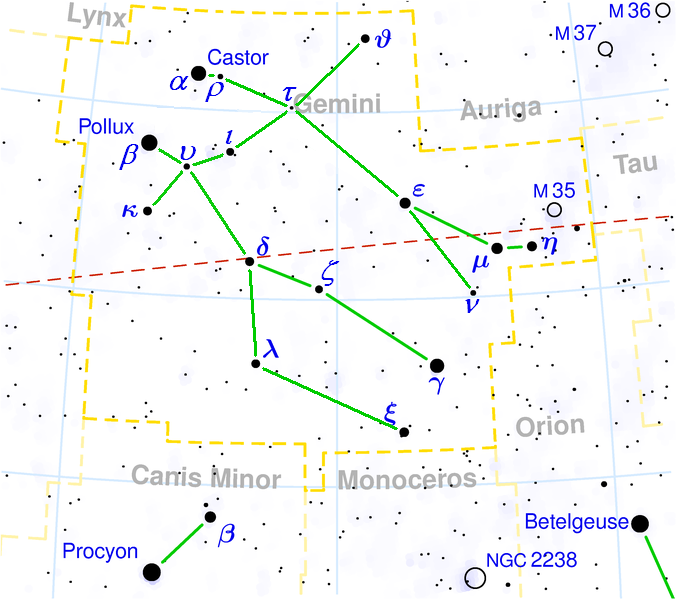
Gemini should be almost overhead in the Northern Hemisphere, and can be picked out by its two brightest starts, Castor and Pollux. The constellation can be seen from September to May. But between September to November it is only visible in the morning before sunrise. It is best viewed from January to March. For evening viewing it is possible from December to May In February it should best visible at 9.00pm.
The Divine Twins, the Dioscuri, were horsemen, patrons of calvary, athletes, and sailors. Pollux is the son of Zeus and Leda (raped by Zeus in the guise of a swan). His twin brother has a different and mortal father, the King of Sparta and the same mother, Leda. So they are examples of heteropaternal superfecundation.
One is therefore immortal and the other isn’t. They had many adventures including sailing with Jason as Argonauts.
According to some versions of the story, Castor was mortally wounded, and Zeus gave his twin brother the option of letting Castor die while Pollux spends eternity on Mount Olympus. Or sharing his immortality with his brother. He agreed to the latter, and the twins spend half their year as the Constellation of Gemini and the rest, immortal, on Mount Olympus. Thus, they are the epitome of brotherly love.
Their sisters were, no less than Helen of Troy, and Clytemnestra. But more about them in read my post on the brothers and sisters here.
Diagram of H. A. Rey‘s alternative way to connect the stars of the constellation Gemini. Twins are shown holding hands. Wikipedia AugPi CC BY-SA 3.0
Yesterday’s Subscribers Email
For some obscure reason, the email excluding a couple of paragraphs which were in the online version.
This is what you missed:
Magic and Toothache
John Aubrey, an erudite and educated 17th Century writer, reports on the use of Magick for tooth care. When he relates these unlikely cures he often provides information that the person who told him the story is worthy of belief. So he seems to give some credence to the efficacy of these magical ‘cures’. But, judge for yourself; this is what he wrote:
To Cure the Tooth-ach.
Take a new Nail, and make the Gum bleed with it, and then drive it into an Oak. This did Cure William Neal, Sir William Neal’s Son, a very stout Gentleman, when he was almost Mad with the Pain, and had a mind to have Pistoll’d himself.
To Cure the Tooth-ach, out of Mr. Ashmole’s Manuscript Writ with his own Hand.
Mars, hur, abursa, aburse. Iesu Christ for Marys sake, Take away this Tooth-ach.
Write the words, Three times; and as you say the Words, let the Party burn one Paper, then another, and then the last.
He says, he saw it experimented, and the Party immediately Cured
On February 3rd, 2026 the National Trust announced that it had received £330,000 in 60 days to purchase land around the infamous Cerne Abbot Giant. This was on top of £2m in grants previously received. This means they can buy the ‘138‑hectare (340‑acre) site – equivalent to 190 football pitches – surrounding the famous Cerne Abbas Giant in Dorset.’ (National Trusts Press Release).
The giant is one of the icons of Hardy’s Dorchester. It is ‘drawn’ or sculpted by cutting the turf to reveal the white chalk below. Chalk Cut figures appear particularly in the South West. The Vale of the White Horse chalk cut figures has been dated to the Late Bronze Age. Most people thought the Cerne Abbas Giant was in the Romano-Celtic tradition so was either pre-Roman, or perhaps Hercules and, therefore, Roman. The name of the village and Abbey are named after the Celtic Horned God Cernunnos. For more about him read my Almanac of the Past Page here.
Some dissenters believed the lack of references to the Giant showed that it could not have been cut until the 17th Century. Some even thought it might be a ‘cartoon’ of Oliver Cromwell! They could not believe that the Monks of Cerne Abbey would allow a giant erect phallus to overlook their holy site for all those centuries.
How we laughed!
Dating the Cerne Abbas Giant
But the National Trust embarked on a project to get the Giant properly dated. They used Optically Stimulated Luminescence (OSL) dating, which had also been used on the White Horse. But the results which came back were shocking. It appears to have been cut in the Late Saxon period.
I do admit to a certain amount of scepticism. The art style is similar to British Art of the Iron Age, part of the Celtic Art tradition. Also, how reliable is OSL dating? The process depends on taking soil samples from the soil nearest the chalk, and OSL measures the time since the soil was last exposed to light. It’s a relatively new technology, although based on Thermoluminescence dating of pottery, which has been around since the 1970s. So,, if they are analysing soil that does not represent the first cutting of the figure then the dating would be wrong.
However, there was also some corroboration in the form of snails which were not indigenous to the UK? So a date of 700-1100AD is suggested. And I have nothing other than a gut reaction to the date they propose. Maybe I’m just disappointed by a Saxon date as I have no way of understanding the context?
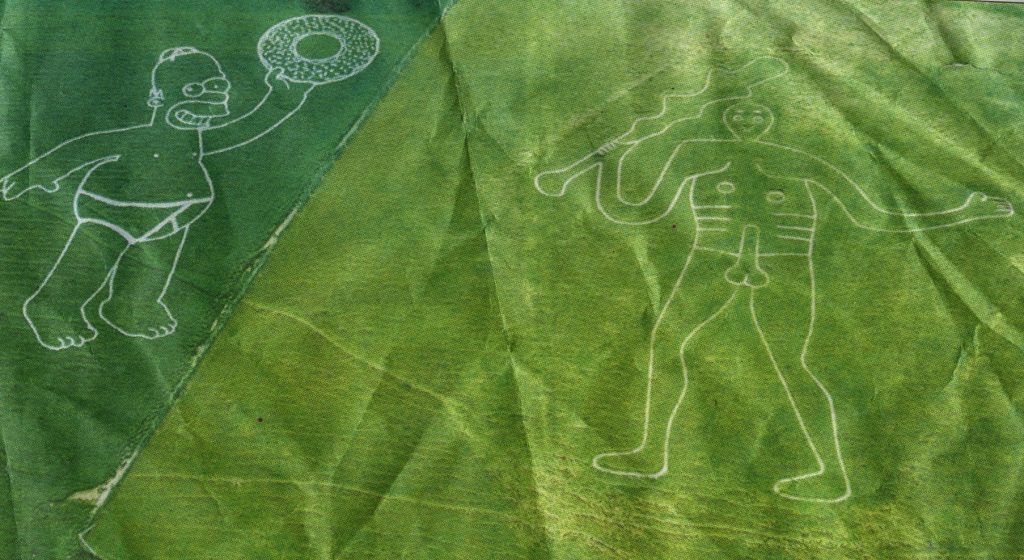
Homer and the Cerne Abbas Giant, Image from Facebook of unknown origin.
The first Coach Trip I ever led was in the 1980s. An American College Professor asked my friend and I to lead a tour of Arthur’s Britain and Hardy’s Wessex. The group included his wife and about 10 students. We drove a mini bus around and stayed in Bed and Breakfast in places like Avebury and Cerne Abbas.
Following the Tour, the professor wrote to tell us that he had been successful in one of his, unstated, aims for the tour. He revealed that this was to get his wife pregnant. He was a bit of a romantic and thought it would be fun to try for the baby while staying in such mystical places. Apparently, they had heeded our tales of the fertility rites that used to take place on and around the Giant, and had gone out for a moonlight walk, and ‘rested’ on one of the Giant’s testicles.
Lost Books from the Ancient World
burnt scrolls from Heraculeum
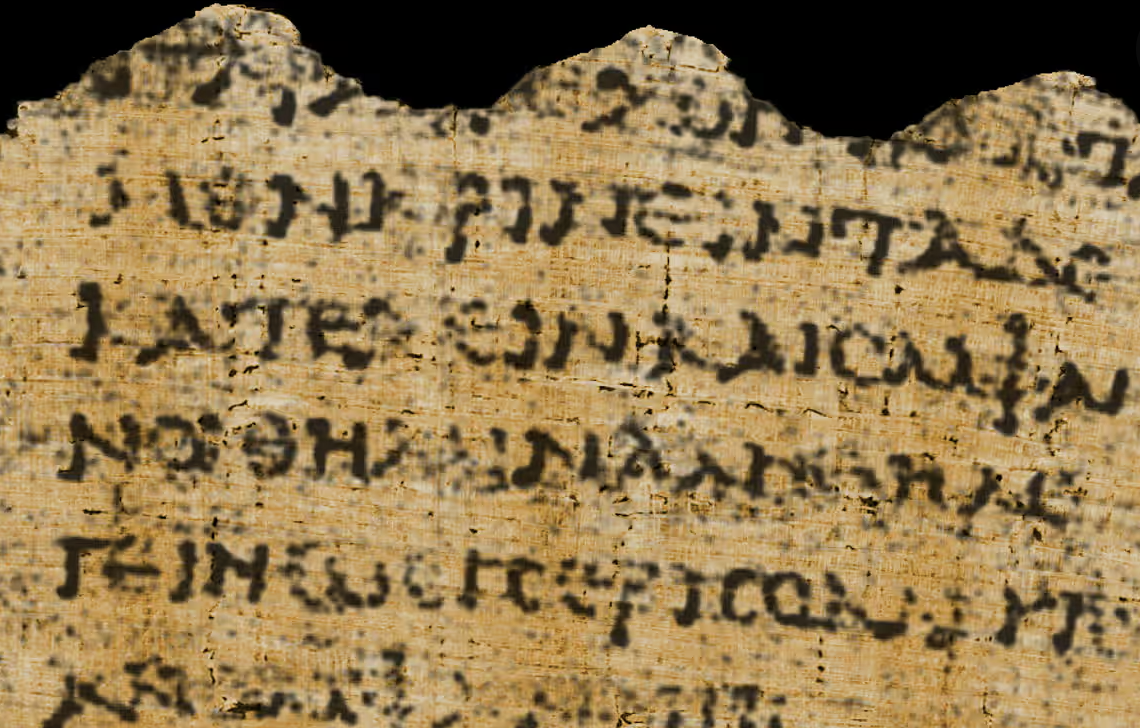
Last year, one of the most exciting discoveries was made. This was the news that burnt scrolls from Herculaneum have been digitally unrolled. Then ‘read’ using AI. The scroll was in the library of Julius Caeser’s father in law it is thought. There are over 1,000 carbonised scrolls found in 1750 in the Villa of the Papyri. And this one reveals details of Plato’s last hours. But more than that, the technology opens the possibility of other lost books being discovered. Of the ‘known unknowns’ I would like to see are the lost history books of Tacitus. But perhaps the ‘unknown unknowns’ are even more exciting. What might we find out?
Here is an excellent introduction to the discoveries:
1306 – This is the day that Robert the Bruce killed his rival for the Crown of Scotland. He murdered John ‘Red’ Comyn, In front of the high altar of Greyfriars Church in Dumfries. Somehow he got away with this most impious act, to confirm Scotland’s independence from England.
1567 – the first Gunpowder plot saw the Kirk o’ Field house in Canongate, Edinburgh, blown up. Outside the house was found the corpse of Lord Darnley. But he was strangled not burnt. He was the second husband of Mary, Queen of Scots. Darnley was thought to be responsible for the brutal murder of the Queen’s Private Secretary, David Rizzio. He was Italian and was often in close proximity to Mary. Darnley didn’t like the rumours of an illicit affair. So recruited a gang of Scottish Noblemen. On 9 March 1566They went up the stairs of Holy Rood Palace where they tore Rizzio from the protection of the Queen. They stabbed him 57 times in front of her and her ladies in waiting. (Julius Caesar was stabbed 23 times).
Darnley’s murder it was thought was the Queen’s way of getting rid of a, frankly, stupid, and nasty husband. Albeit, very good-looking and charming. Her third husband, Earl Bothwell, is frequently blamed, and whether she was part of it we don’t know.