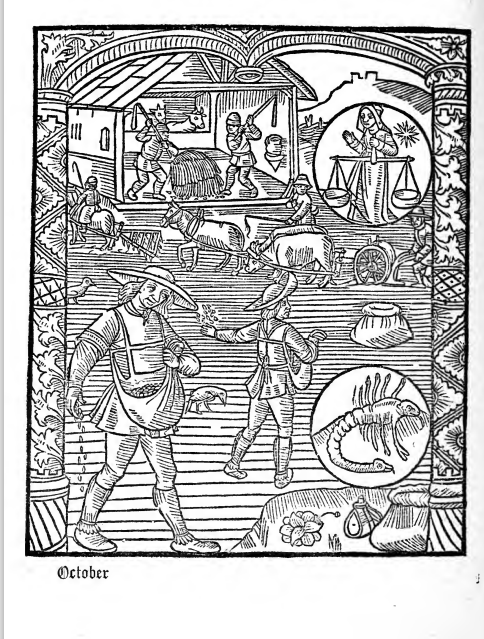
The 15th Century French illustration in the Kalendar of Shepherds shows October as a busy month. It is the time when the cereals are being flailed, the fields ploughed and sown. Perhaps winter wheat or barley or peas and beans?
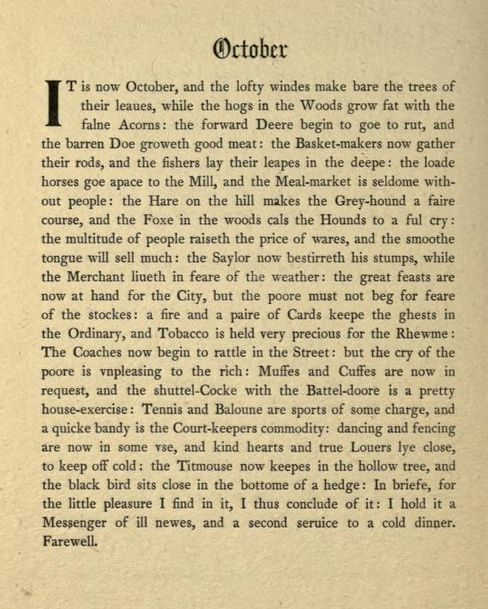
The 16th Century English text of the Kalendar of Shepherds (read the illustration) shows what a busy month it was, but the writer comes down hard against the month as ‘a messenger of ill news’ the harbinger of cold dark nights.
About the Kalendar of Shepherds.
The Kalendar was printed in 1493 in Paris and provided ‘Devices for the 12 Months.’ I’m using a modern (1908) reconstruction of it using wood cuts from the original 15th Century version. It includes various text from 16th and 17th Century sources. (Couplets by Tusser ‘Five Hundred Parts of Good Husbandrie 1599. Text descriptions of the month from Nicholas Breton’s ‘Fantasticks of 1626. This provides an interesting view of what was going on in the countryside every month.
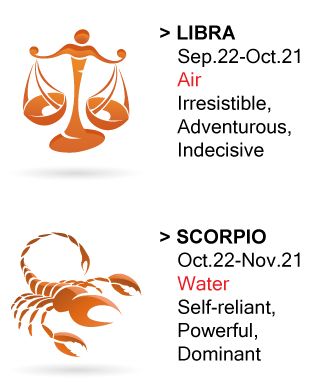
The star signs of October are the Scales of Libra and the Scorpion of Scorpio.
The star signs of October
Angelic October
Michael is the Angel of Autumn, the Angel of Judgement Day, and the Weigher of Souls. Uriel is the Angel of Libra and was sent by God sent to warn Noah. So the protector against, floods, fire and natural disasters. Scorpio’s Angel is Barbiel, he looks over health, genitalia and doubtful things. (‘An Angel Treasury’, Jacky Newcomb).
You might like to look at my post on Michaelmas here.
Roman October
In the Roman world it was, originally, the 8th Month (octo=8) but then they added January and February to the year. So it became the 10th Month. It was their time to celebrate the new wines of the Harvest. In Britain, the wine harvest is late September to October, but in hotter climes can be from July. But the grapes need to be processed, and the Romans thought that new wine was health giving and celebrated it in October.
Rustic October
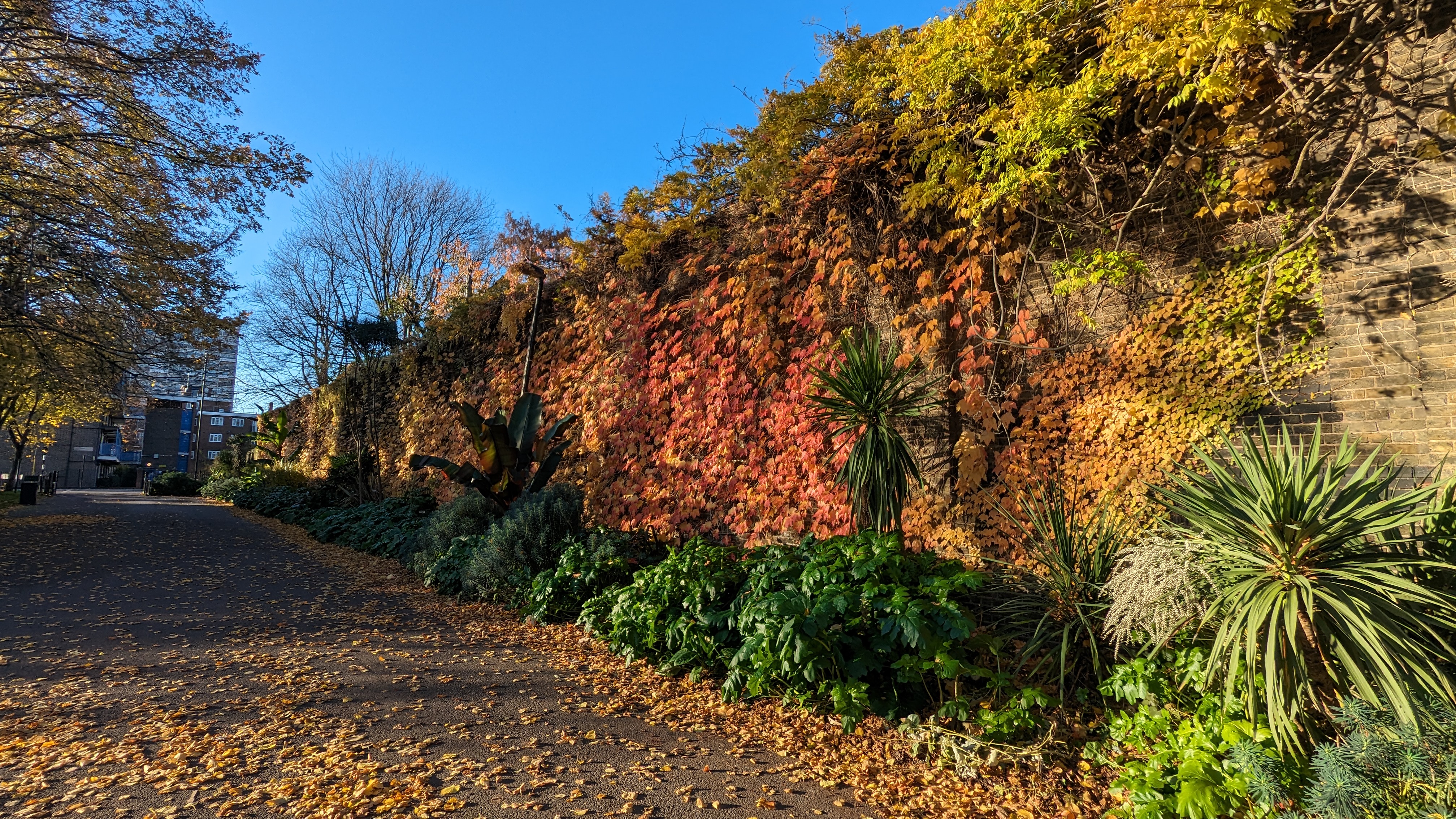
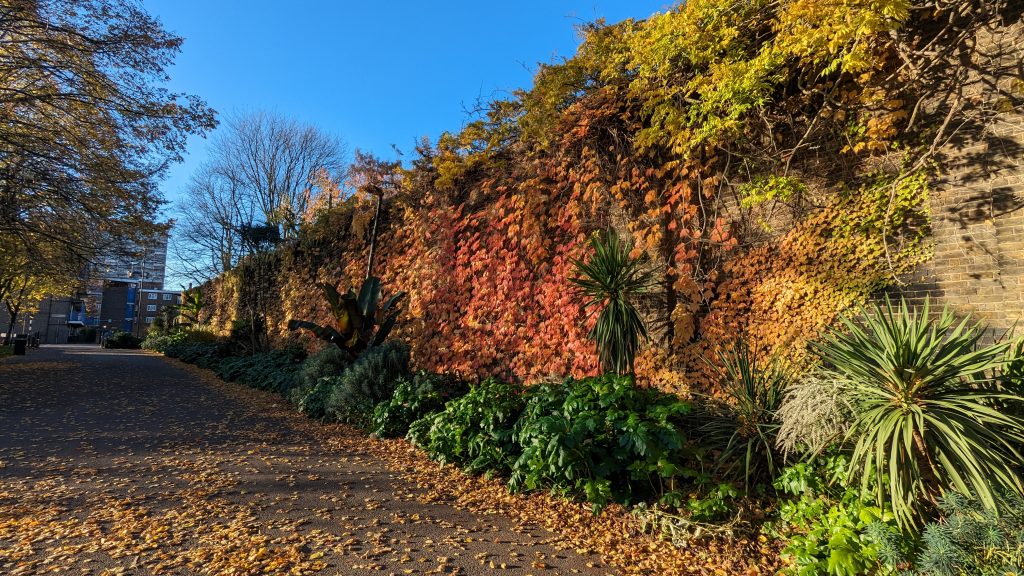
But for many people, October is a beautiful month. The dying leaves bring a sophisticated array of rustic colours, which makes the wooded countryside exceptionally beautiful.
Autumn in Haggerston Park, London (photo Kevin Flude)
It can still be warm enough to go for pleasant walks. And the surfeit of the harvest and the culling of animals meant there was plenty to eat before winter austerity begins.
Anglo-SaxonWinter Fall
The Venerable Bede tells us that the month was called Winterfylleth, in the 8th Century. The English divided the year into Summer and Winter. And Winter began for the Anglo-Saxons on the first full moon of October. This means that this year winter begins on 7th October. This is the Harvest or Hunter’s Moon, which is also a supermoon, the first of 3 ending the year.
Celtic October
In Welsh, it is Hydref, which also means Autumn. For the Welsh it was the last month of Autumn and the last month of the year. The Celtic new year, and winter starts on 1st November. The same is true of the Irish Calendar. Autumn is called Fómhair, and October Deireadh Fómhair which means ‘End of Autumn’.
Astronomical & Meteorological Autumn
Astronomically, autumn ends at the Winter Solstice and meteorologically at the end of November. So the Celtic Autumn ends a whole month or more earlier than the other measures. My very personal view is that Winter begins on November 5th more often than not. This is an evening we often spend outside watching the fireworks displays to celebrate Guy Fawkes’ Night. It always seems to be the first time that you feel cold enough to need hat, gloves, and scarves.
Legend says that London was founded as New Troy. Historians believed it was founded as Londinium after the Bridge was built by the legionaries of the Emperor Claudius in AD 43. Archaeologists in the 1970s and 1980s discovered that London was refounded as Lundenwic in the 7th Century and again in the 9th Century when it was called Lundeburg.
This walk tells the epic tale of the uncovering of London’s past by Archaeologists. And provides an insight into the dramatic history of the Capital of Britannia, and how it survived revolts, fires, plagues, and reacted to the decline and fall of the Roman Empire. It became the foremost English City but with periods under Viking and Norman control.
We tell the story in the streets of the City of London, beginning in the valley of the River Walbrook by the Temple of Mithras, and visit many sites where important archaeological discoveries were made.
Autumn Equinox in Haggerston Park.Photo by K Flude.
Autumn Equinox.
This is the second day of the year when the sun rises due east and sets due west. When the day and night are of equal length. It is the beginning of the astronomical autumn. It is determined by the 23.5-degree tilt of the Earth’s rotation in relation to the orbit around the Sun.
In the Jewish Calendar, and the French Revolutionary Calendars it marks the new year. Many cultures preferred spring. But autumn is the end of harvest, when seeds are sown and the food stores are full of food. Similarly, the Celts started their new year at Halloween, half way between the equinox and the solstice.
For more about autumn, look at my post here. For my post on the Spring Equinox, see here. For the Celtic New Year see this post here and for the French Revolutionary Calendar, my post is here.
Rosh Hashanah, September 22nd to 25th.
Rosh Hashanah is the New Year in Judaism. There are other new years in the Jewish calendar. But this is for the Civil Year and to celebrate the anniversary of the birth of Adam.
The biblical name for this holiday is Yom Teruah. One of the High Holy Days, as specified by Leviticus 23:23–25. Like most New Years it is a time to reflect on life and put in place changes. It is after all a celebration of the beginning of the world.
Here is an excellent BBC web site which will tell you more.
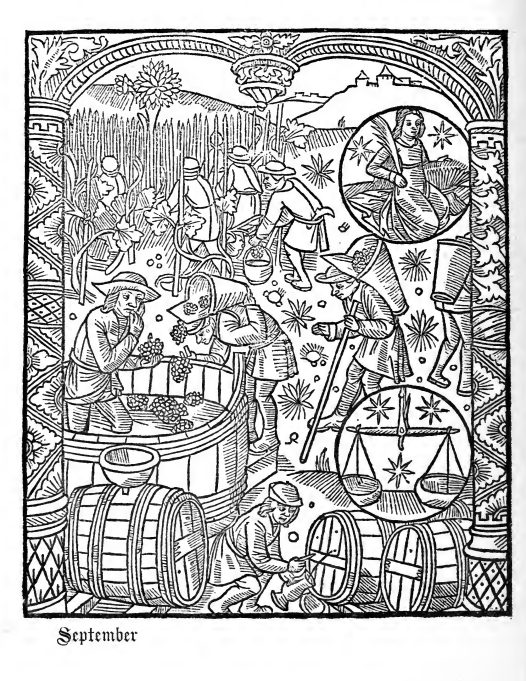
Kalendar of Shepherds illustration of September showing harvesting grapes and the astrological signs for Virgo (August 23 – September 22) and Libra (September 23 – October 22)
It is that time of the year when you say ‘Where has the Summer gone? It can’t be September already?’ But, meteorology, speaking, Autumn starts today. September 1st was chosen on a numerical basis for ease of measuring rather than any profound floral, agricultural or solar reason. So, there are three Gregorian Calendar months for each season, and each season starts on the first of the month. Autumn: September, November and December.
Autumn, Harvest, Fall
Autumn comes from Latin (autumnus) which went into French and then into English. The season was also called Harvest (which went into Dutch herfst, German Herbst, and Scots hairst -Wikipedia) or from the 16th Century: the ‘fall of the year’ or ‘fall of the leaf’ which spread to America as Fall.
Summer’s Ending
It still feels like summer. In England, we often have a glorious September, and what we can an ‘Indian’ Summer, an unexpectedly warm period in mid-September to October.
Solar Autumn
Of course, for the real Autumn, we have to wait for the Equinox, the beginning of Astronomical or Solar Autumn. This year, it is on Monday, September 22nd, 2025, 7:19 pm.
Astrological September
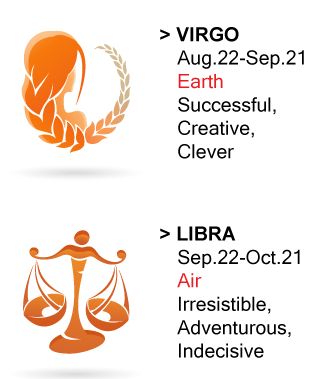
The star signs for astrological September are: Virgo which is linked to Aphrodite (Venus) the Goddess of Love and Libra which is linked to Artemis (Diana), virgin goddess of many things, including hunting, wild animals, children, and birth.
Star signs for September
September
September gets its name from the Romans, for whom it was the 7th Month of the year (septem is Latin for seven). Later, they added two new months so it became our 9th Month. (For more on the Roman year, look at my post here).
It is called Halegmonath in the early English language, or the holy month, named because it is the month of offerings, because of the harvest, and the mellow fruitfulness of September? Medi in Welsh is the month of reaping, and An Sultuine in Gaelic which means the month of plenty.
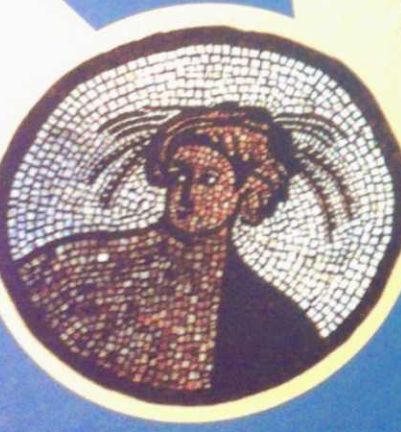
Roman personification of Autumn from Lullingstone mosaic
Early Modern September and the autumn of Life
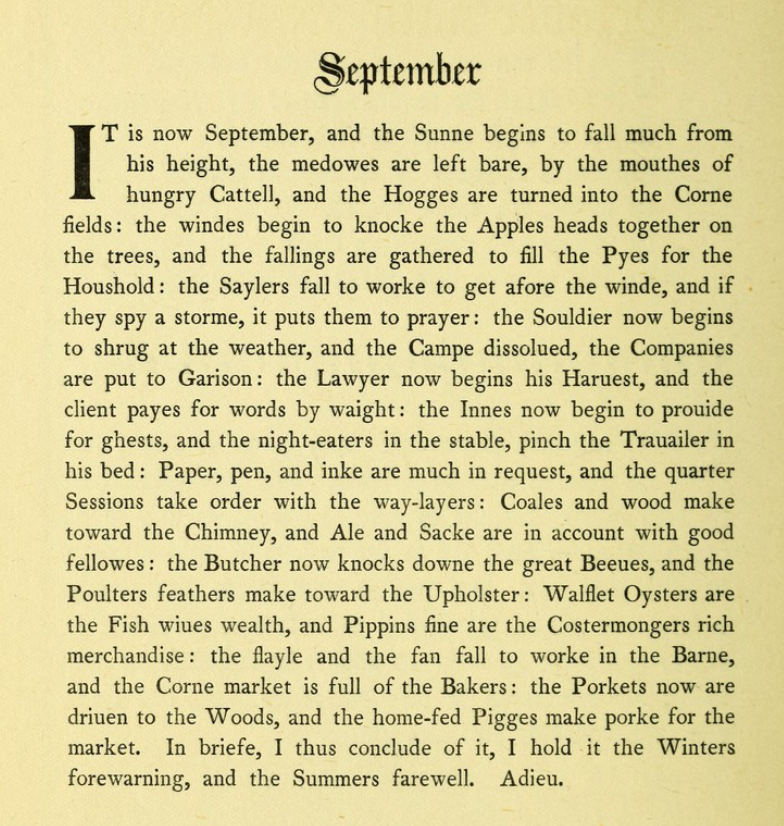
Here is an early 17th Century look at September from the Kalendar of Shepherds – for more on the Kalendar, look at my post here.
From the Kalendar of Shepherds
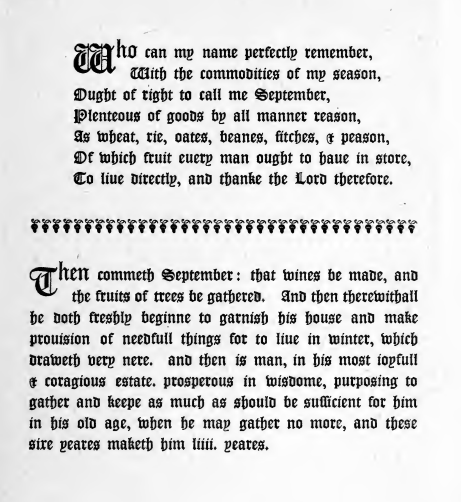
The Kalendar has an additional shorter look at September (see below). And it continues with its theme, linking the 12 months of the year with the lifespan of a man – 6 years for each month. So September is a metaphor for man at 56 years of age, in their prime and preparing for old age.
September from the Kalendar of Shepherds. The last sentence beginning ‘and then is man’ shows the link between September and the beginning of the autumn of life.
Season of ‘mists and mellow fruitfulness‘
John Keats (1795 – 1821) wrote a great poem called ‘To Autumn’:
Season of mists and mellow fruitfulness, Close bosom-friend of the maturing sun; Conspiring with him how to load and bless With fruit the vines that round the thatch-eves run; To bend with apples the moss’d cottage-trees, And fill all fruit with ripeness to the core; To swell the gourd, and plump the hazel shells With a sweet kernel; to set budding more, And still more, later flowers for the bees, Until they think warm days will never cease, For summer has o’er-brimm’d their clammy cells.
Who hath not seen thee oft amid thy store? Sometimes whoever seeks abroad may find Thee sitting careless on a granary floor, Thy hair soft-lifted by the winnowing wind; Or on a half-reap’d furrow sound asleep, Drowsed with the fume of poppies, while thy hook Spares the next swath and all its twined flowers: And sometimes like a gleaner thou dost keep Steady thy laden head across a brook; Or by a cider-press, with patient look, Thou watchest the last oozings, hours by hours.
Where are the songs of Spring? Ay, where are they? Think not of them, thou hast thy music too,— While barred clouds bloom the soft-dying day, And touch the stubble-plains with rosy hue; Then in a wailful choir the small gnats mourn Among the river sallows, borne aloft Or sinking as the light wind lives or dies; And full-grown lambs loud bleat from hilly bourn; Hedge-crickets sing; and now with treble soft The redbreast whistles from a garden-croft, And gathering swallows twitter in the skies.
Written September 19, 1819; first published in 1820. This poem is in the public domain and available here:
August was originally ‘sextilis’ or the 6th Month of the ten-month Roman Calendar. It became the 8th Month when January and February were added to the calendar to make a 12 month year. By tradition, this happened during the reign of King Numa Pompilius. Originally set as a 29-day month but changed to a 31-day month in the reforms of Julius Caesar. It was subsequently renamed August by a sycophantic Senate trying to flatter the divine Octavian, Emperor Augustus. (more of my posts about the Roman Calendar here and here)
The Celtic August
In modern Irish, it is Lúnasa, which means the month of the festival of Lughnasa. It is a harvest festival, celebrating the ripening of wheat, barley, rye, and potatoes. In Ireland, it is the festival of the God Lugh, celebrated with games, fairs, and ceremonies. Lughnasa is 6 months after Imbolc. It marks the ending of lactation of lambs and the beginning of the tupping season. (impregnation of the ewes). It can be celebrated by climbing hills, visiting springs, wells, lakes and eating bilberries. (Myths and Legends of the Celts. James MacKillop).
In Welsh, it is Awst which comes from the Latin. Called Calan Awst in Wales, it is the festival of August. In Gaelic Scotland it is called Lunasuinn, and Laa Luanistyn in the Isle of Man.
Lughnasa is one of the Celtic quarter days,. They are halfway between the Solstices and Equinoxes. They are: Samhain (1 Nov) Imbolc (1 Feb), Beltane (1 May) and Lughnasa (1 Aug). All are, or can be seen to be, a turning point in the farming year.
The Gallic Coligny ‘Celtic’ Calendar records August as a ‘great festival month’. The stone-carved Calendar was found near Lyon, whose Roman name was Lugodunum. The town is named after the Gaulish God Lugos. It is thought he is related to the Irish God, Lugh and the Welsh Llew Llaw Gyffes. He has an unstoppable fiery spear, a sling stone, and a hound called Failinis. The Romans associate Lugos with Mercury, and the Church associated Lugh with St Michael.
Lughnasa was founded by Lugh himself to honour his foster mother Tailtiu at Brega Co. Meath. Tailtiu became one of Ireland’s greatest festivals, springing from the horse races and marital contests set up by Lugh.
Anglo Saxon August
In Anglo-Saxon: the Venerable Bede, writing in the 8th Century, says August is Wēodmōnaþ or the Weed Month. Named because of the proliferation of weeds. Why does that seem such an unsatisfactory name for August? An early Kentish source calls the month Rugern – perhaps the month of the harvest of Rye? (Winters in the World by Eleanor Parker).
Lammas
For the Anglo-Saxons, August brings in the harvest period. This is the most important months of the year. The Harvest brings in the bounty of the earth. It needs to be carefully collected, enjoyed but not wasted. It begins with the festival of Lammas, which derives from the English words for bread and mass. The Bread Mass when bread made from the first fruits of the harvest is blessed.
Kalendar of Shepherds
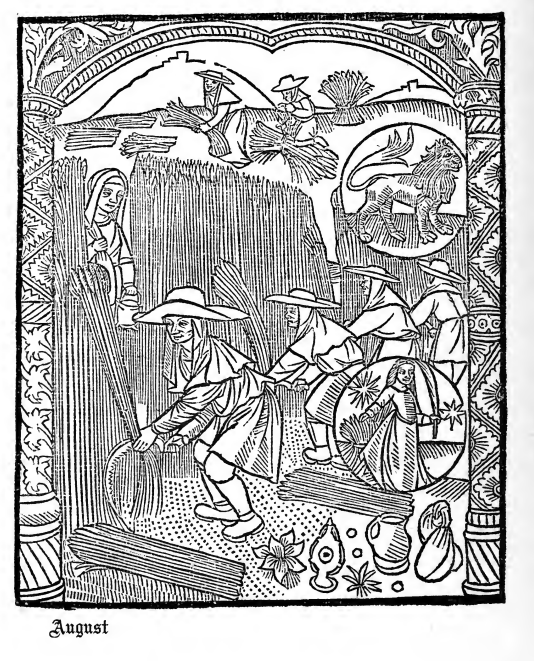
Kalendar of Shepherds, August
The 15th Century illustration in the Kalendar of Shepherds, above, shows that the Harvest is the main attribute of the Month, and the star signs, Leo and Virgo.
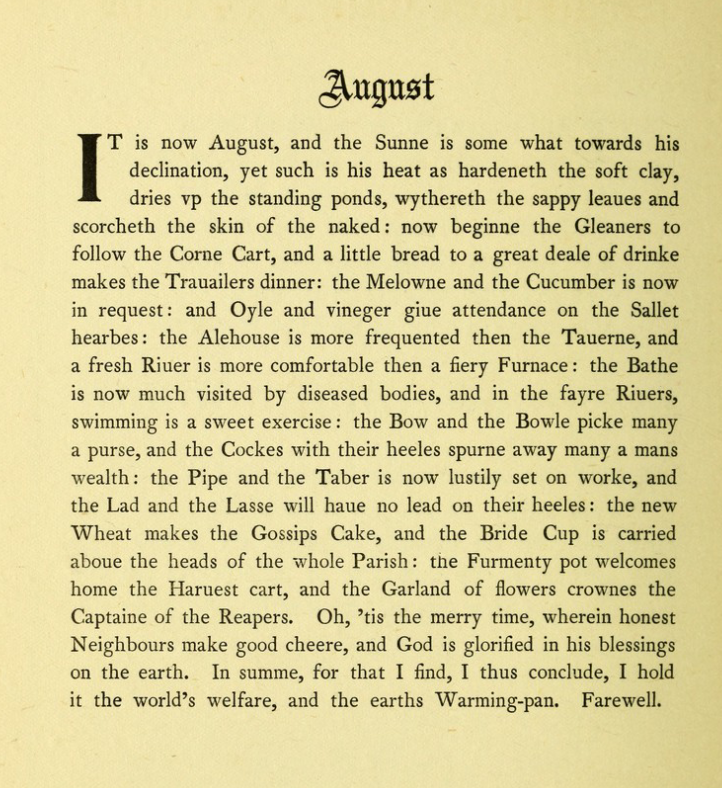
The 16th/17th Century text in the Kalendar of Shepherds gives an evocative insight into the month.
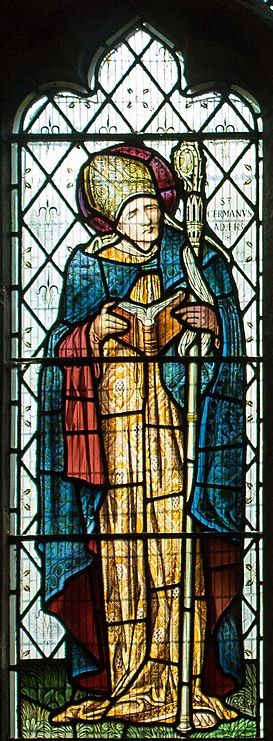
St Germanus of Auxerre, Window in St Paul’s parish church, Morton, Lincolnshire, made by Sir Edward Burne-Jones and William Morris in 1914. Photo by Jenny of Jules & Jenny from Lincoln, UK (CC BY 2.0 Wikimedia Photo by Jenny of Jules & Jenny from Lincoln, UK)
St Germanus is the source of one of the few contemporary references to Britain in the 5th Century (the Dark Ages). One of his followers wrote his life story. The Saint, a Bishop in France, was sent to Britain because the Pelagian Heresy was endangering the Catholic version of Christianity. Pelagius was a highly educated British (or possibly Irish) priest who moved to Rome in the late 4th Century. He lived by a strict moral code, attacking Catholic laxity and opposing St Augustine of Hippo’s theory of Divine Grace. By contrast, Pelagius promoted human choice in salvation and denied the doctrine of original sin. Wikipedia tells us that he:
considered it an insult to God that humans could be born inherently sinful or biased towards sin, and Pelagius believed that the soul was created by God at conception, and therefore could not be imbued with sin as it was solely the product of God’s creative agency.
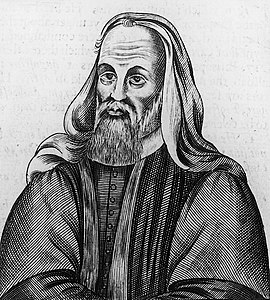
17th Century print of Pelagius
Germanus was sent to Britain, where he confronted Pelagian converts in a public debate which is thought to have taken place in a disused Roman amphitheatre. The author is not interested in Britain, per se, so does not tell us which town it was, but, it is mostly assumed to be St Albans, although London is possible.
In the stadium, the Saint and his acolytes confound the heretics and, so, convert the town’s people sitting watching the debate. St Germanus goes to a nearby shrine of St Alban to thank God, falls asleep in a hut, and is miraculously saved from a fire. He then comes across a man called a Tribune, and helps defeat a Saxon army in the ‘Alleluia’ victory. The importance of all this is that it gives us a few glimpses of Britain, in about 429AD, two decades after the Romans have left.
The British Bishops were led in their heresy by someone called Agricola. The writer describes these bishops as ‘conspicuous for riches, brilliant in dress and surrounded by a fawning multitude’. The use of the title ‘Tribune’ in the story suggests Roman administrative titles are still in use 19 years after the date of the ‘formal’ end of Roman Britain, 410AD. The Alleluia victory over the Saxons also gives us an early date for Saxon presence in the country as an enemy.
St Albans is the favoured choice for the location of the event because, Bede tells us St Albans was born, martyred and commemorated in Verulamium, now called St Albans. Archaeology shows possible post Roman occupation of the town. And it has a famous Amphitheatre.
However, Gildas, who is writing 200 years or more before Bede, tells us St Alban was born in Verulamium but martyred in London. This makes sense as London was the late Roman Capital and more likely to be the site of a martyrdom. There is also a church dedicated to St Albans close to the Roman Amphitheatre, where Gildas tells us the execution took place. Unfortunately, the Church cannot be, archaeologically dated back to 429AD.
Bede’s account of the martyrdom of St Albans is also somewhat farcical, as God divides the waters of the River Ver for Alban to get to his martyrdom more quickly. The bridge was said to be full of people walking to witness Alban’s execution, and blocking Alban’s path to Heaven. But the Ver is but a piddle, and it would be easy to walk across without even needing wellington boats, let along a miracle. This story is much more impressive, in Gildas’ version who has the miraculous crossing over the River Thames.
Had Pelegius won, and the Roman Church had a more optimistic view of the human spirit, would it have made any difference? It’s a big question, but maybe it would have left less room for pessimism and guilt?
What were the effects of original sin? …. it damaged our relationship with God. He seemed distant, we became mistrustful. We lost sanctifying grace. The weakening of the will, making us more prone to temptation. The darkening of the intellect. Increased vulnerability to sickness and disease. Spiritual death.
Germanus died in Ravenna. The story of his life by The Life of St. Germanus, Bishop of Auxerre by Constantius of Lyon written shortly after his death is a crucial source for the study of the 5th Century in Western Europe. It is an epic period where Imperial and Barbarian groups are fighting for control of Britain, France, Spain, Africa and Italy. There are competing views of what Christianity is and should be. not only the heresy of Pelagians but also the Arian Heresy which the German people tended to support. There were also the Nestorian and Eutychian heresy. I’ve just read a 2020 article about the Life of St Germanus by Leon Mintz which you can read here:
For more on Nick Fuentes and his theories on St Germanus, St Patrick and King Arthur read my post here:
Screenshot of BBC Webpage annoucing the attack on the Stone of Destiny
I just tried to book a visit to see the Stone of Destiny, at Perth Museum. But I was told it was closed until at least the end of August. The reason being that a case had been damaged. A quick search revealed this notice that an Australian had attacked the case containing the Stone with a hammer. They are now repairing the Case, and double checking the condition of the stone, which is thought to be undamaged. The Stone is well protected in a special room of the Museum. But, until now, those booking to see it are not searched. So I imagine that this will become more formal in future.
Below is my post of 2024, updated on March 30th 2025.
New Home for the Stone of Destiny
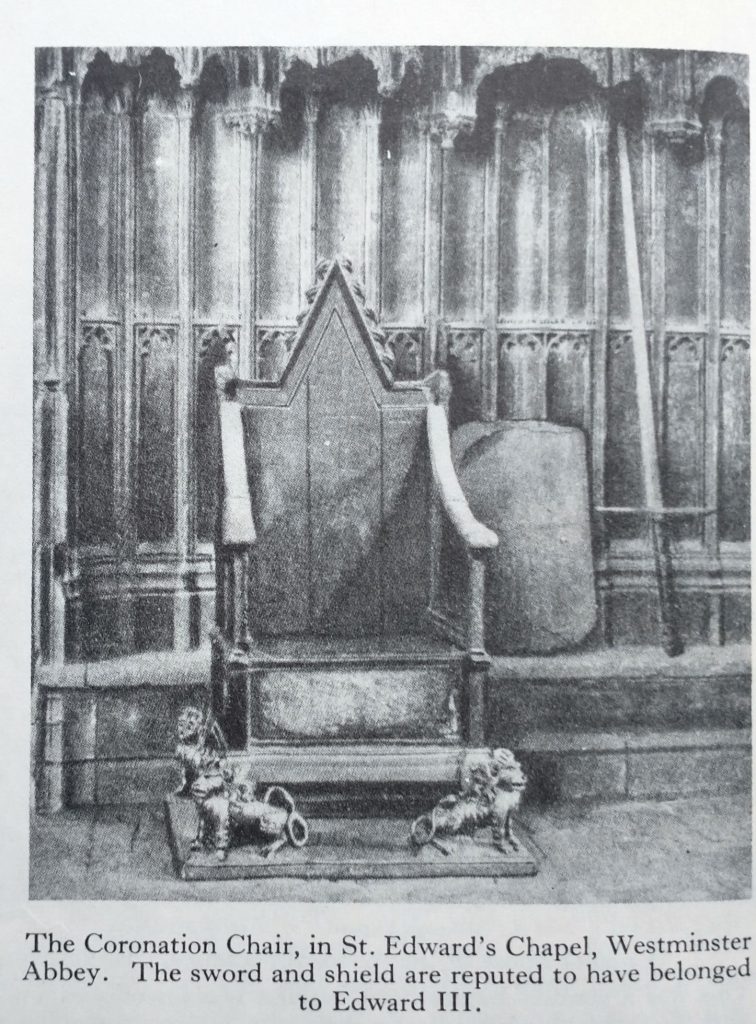
Old Photograph of the Stone of Destiny beneath the Coronation Chair.
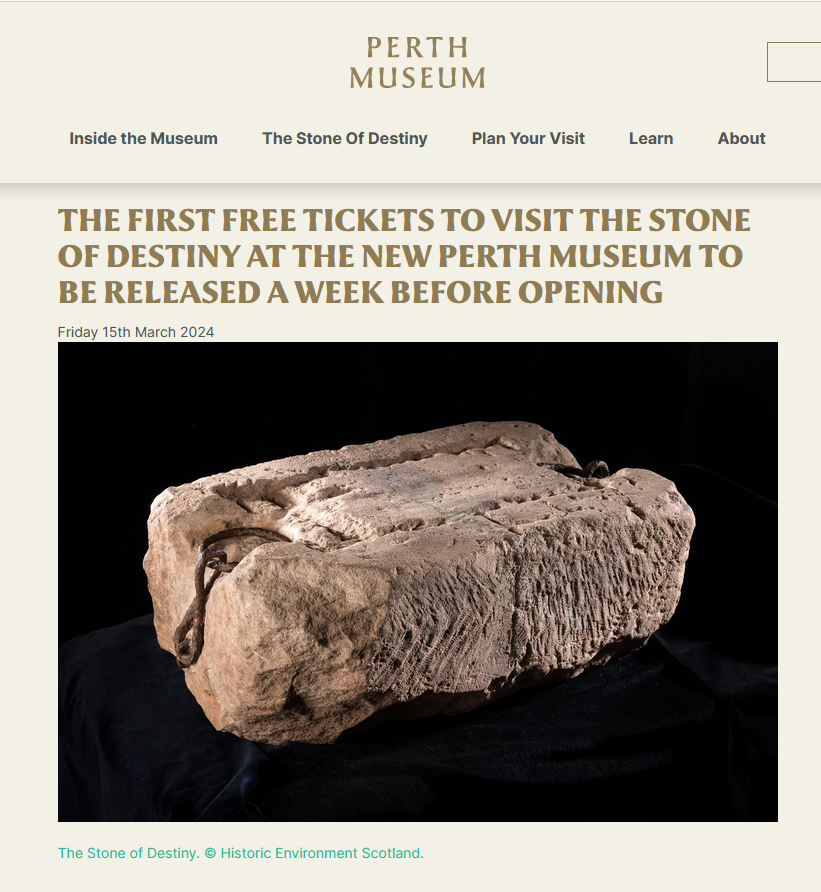
Last year, the Stone of Destiny was set up in its new permanent place. The Stone was unveiled in a room at the centre of the redeveloped Perth Museum, in Scotland. This is near to its ‘original’ home at the Palace of Scone.
‘£27m development project ….funded by £10m UK government investment from the £700m Tay Cities Deal and by Perth & Kinross Council, the museum is a transformation of Perth’s former city hall by architects Mecanoo.’
As well as the Stone of Destiny, the Museum has Bonnie Prince Charlie’s sword and a rare Jacobite wine glass. Both on public display for the first time. This is the first time the sword has been in Scotland since it was made in Perth in 1739. https://perthmuseum.co.uk/the-stone-of-destiny/. Since I first wrote this I have visited about 5 times. Entry is free but needs to be booked. It is held in a separate structure in the open space at the heart of the Perth Museum. There is an excellent-animated introduction, and then the doors open and the Stone is revealed in a glass cabinet. It is very effective.
Webpage of the Perth Museum show a photo of the Stone of Destiny
The Stone of Destiny in the Modern Era
Before Perth, the Stone was in London for a brief visit for the Coronation of King Charles III (6 May 2023) . It was put back, temporarily under the Coronation Chair. Before that it was on display in Edinburgh Castle. Tony Blair’s Labour Government sent it back to Scotland as a symbol of the devolution of power from Westminster. This was on the occasion of the restoration of the Scottish Parliament in Edinburgh in November 1996. Until then the Stone was under the Coronation Chair, where Edward I put it after he stole it (1296) from Scone. Virtually every English and British King has been crowned upon the Stone of Scone.
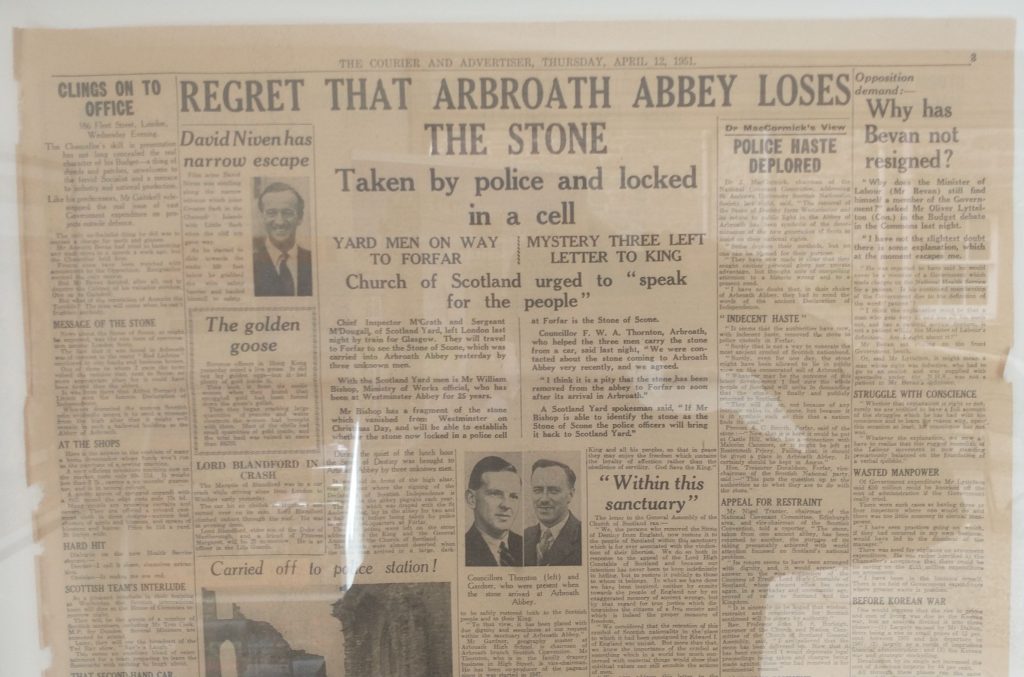
However, the Stone had a brief holiday in Scotland in 1950/51. Four Scottish students removed it from Westminster Abbey on Christmas Day 1950. After three months, it turned up at the high altar of Arbroath Abbey. It was briefly in a Prison Cell, then returned to Westminster for the Coronation of Elizabeth II.
Poor photograph of a press cutting on display at the Palace of Scone (Photo by me!)
Declaration of Arbroath
I’m guessing the-would-be liberators of the Stone, thought Arbroath was the most suitable place to return it. For it was the Declaration of Arbroath which is the supreme declaration of Scottish Independence from England.
Following the Battle of Bannockburn the Scots wrote to the Pope of their commitment to Scotland as an independent nation. They said:
“As long as a hundred of us remain alive, never will we on any conditions be subjected to the lordship of the English. It is in truth not for glory, nor riches, nor honours that we are fighting, but for freedom alone, which no honest man gives up but with life itself”
The Pope agreed and Scotland remained independent until voluntarily joining England in the United Kingdom in 1707.
Before Edward 1 stole the Stone, it was at Scone Palace. Here most of the Kings of Scotland were crowned, including Macbeth (August 14, 1040).
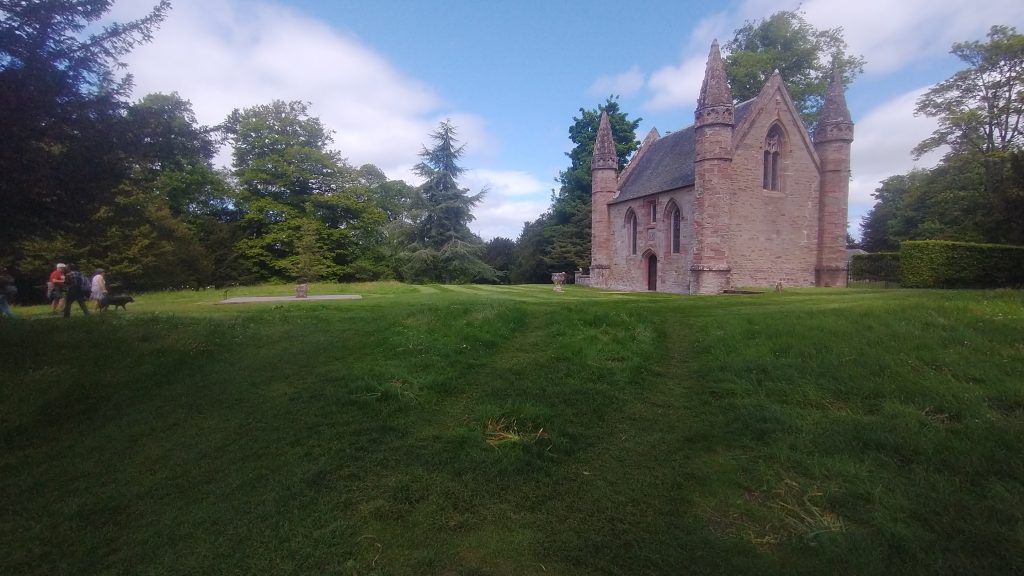
Moot or Boot Hill where Scottish Kings were crowned. Palace of Scone Photo Kevin Flude)
Those who attended the coronation traditionally shook their feet of all the earth they had brought from their homelands. This over the centuries, grew into Boot Hill, aka Moot Hill. So the mound represents the sacred land of Scotland. 42 Kings were crowned upon its soil on its Stone. (but not Mary Queen of Scots she and her son were crowned at the Chapel Royal of Stirling Castle).
Where was the Stone of Destiny before Scone?
Before Scone, it was, possibly, in Argyllshire where the Gaelic Kings were crowned. Their most famous King was Kenneth MacAlpin. He united the Scots, Gaelic people originally from Ireland, the Picts, and the British. And created a new Kingdom which was originally called Alba, but became Scotland.
MacAlpin was the first king to be crowned on the Stone at Scone in 841 or so. He made Scone the capital of his new Kingdom because it was a famous Monastery, associated with the Culdees, an early sect of monks. MacAlpin brought sacred relics from Iona to sanctify the new capital. And Scottish Kings were by tradition crowned at Scone and buried on the holy Island of Iona.
Legend has it that the Scots bought the Stone from Ireland when they began to settle in Western Scotland (c500AD). The Scots, it is said, got the Stone from the Holy Land. Jacob lay his head on the stone to sleep. He had a dream of Angels ascending and descending a ladder to Heaven. Jacob used the stone as a memorial, which was called Jacob’s Pillow (c1652 years BC).
Fake, Copy or Genuine?
But, questions about the Stone remain. Firstly, would the Monks of the Abbey meekly hand over the stone to a raging King Edward I? Sacking the Abbey was one of the last events of Edward’s failed attempt to unite the two countries. Isn’t it more likely that they hide the original and gave him a fake?
Secondly, was the Stone brought to Scone from Western Scotland in the 9th Century? Or was it made in Scone?
These questions of doubt are based on the assumption that the Stone is made of the local Scone sandstone. If it were brought to Scone from somewhere else, it would be in a different type of stone, surely? So, either it was made in Scone, possibly for MacAlpin’s Coronation or the Monks fooled the English into taking a copy. The English would then have been crowning their Monarchs on a forgery.
Ha! Silly English but then the Scots have spent £27m on the same forgery.
Before bringing the stone to Scone, Historic Environment Scotland undertook a new analysis of the stone. This confirmed:
‘the Stone as being indistinguishable from sandstones of the Scone Sandstone Formation, which outcrop in the area around Scone Palace, near Perth‘.
It also found that different stone workers had worked on the stone in the past. It bore traces of a plaster cast being made. It had markings which have not yet been deciphered. There was copper staining suggesting something copper or bronze was put on the top of it at some point in its life.
So it seems the Stone of Destiny was made in Scone. The simplest explanation is that it was made for MacAlpin in the 9th Century. But it does not rule out that it is a copy given to Edward I. But if this is the case it is still an awesome relic of history as so many Kings and Queens, Scottish and English, have been crowned upon it.
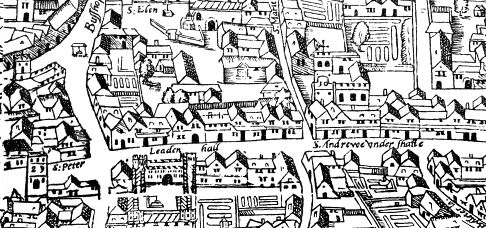
Civitas Londinum is a bird’s-eye view of London first printed from woodblocks in about 1561
John Stow tells us that there were bonfires and street parties in London throughout June and July. These were held on the Vigils of Saints’ Feast Days. The Vigil is the evening before a festival. A custom that might owe a little to the Celtic choice of dusk as the beginning of the new day.
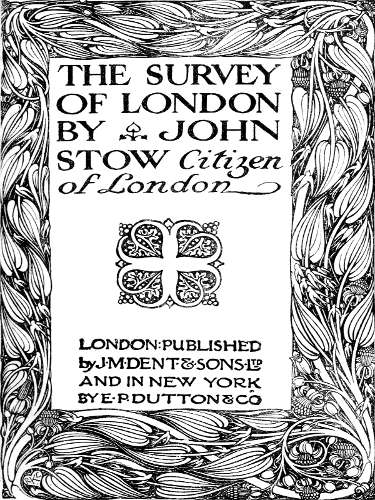
Front cover of the Survey of London by John Stow
Stow was the author of the ‘Survey of London‘ first published in 1598. Unfortunately, he does not give a list of the vigils thus celebrated. He only mentions those of St John the Baptist and of St Paul and St Peter. For these he gives a very vivid description, which I included in my post on June 24th here.
The other festivals would be for prominent Saints, particularly those with London Churches or Chapels named after them. These might include: St Botolph, St Alban, St James, St Thomas, St Margaret, St Wilgerfortis, St. Mary Magdalen, St Bridget, St James, as well as Saints John, Peter, and Paul. I’m guessing that City wide street parties would be reserved for the most important Saints. But with local celebrations for the Saint on the local Church. I am assuming these celebrations were ended or much reduced after the Reformation.
This is what Stow says of the Vigil celebrations.
‘In the months of June and July, on the vigils of festival days, and on the same festival days in the evenings after the sun setting, there were usually made bonfires in the streets, every man bestowing wood or labour towards them; the wealthier sort also, before their doors near to the said bonfires, would set out tables on the vigils, furnished with sweet bread and good drink, and on the festival days with meats and drinks plentifully, whereunto they would invite their neighbours and passengers also to sit and be merry with them in great familiarity, praising God for his benefits bestowed on them. These were called bonfires as well of good amity amongst neighbours that being before at controversy, were there, by the labour of others, reconciled, and made of bitter enemies loving friends; and also for the virtue that a great fire hath to purge the infection of the air. ‘
John Stow is one of the most important sources for Tudor and Medieval London. He was a Londoner, buried in St Andrews Undershaft (see map above), who wrote up all he could glean about London. I use him all the time – for example, on my Wolf Hall Tudor London Walk. Stow’s Survey of London can be accessed online, in full, here: or via the wonderful online Agas Map, from which the map above came from.
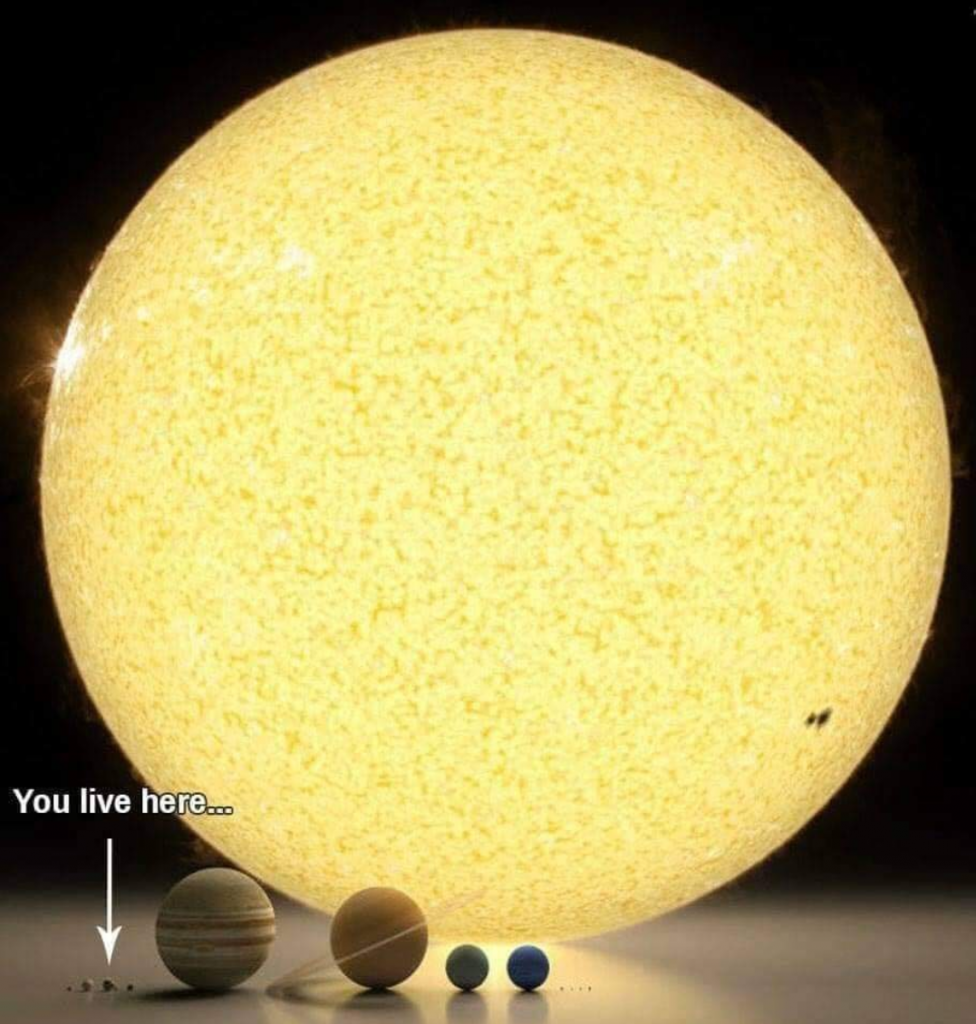
A gentle midsummer reminder of our place in the universe – source Facebook post.
Midsummer Solstice is the 21st of June. The Celtic version begins when the Celtic Day begins. This is at dusk on June 20th, which we would call Midsummer’s Eve. Midsummer, astronomically, begins on 21st June. But, meteorologically speaking, it has been here Summer since the beginning of June.
Midsummer is a fire festival, dedicated to the Celtic Fire God, Belinus. His name might mean Powerful One or Shining One, and he is linked to Apollo, one of the Greco-Roman Sun Gods. His main festival is Beltane, May Day, but many of the attributes of May celebrations and indeed Halloween celebrations are also carried out at Midsummer. (See my post on May Day)
In the early medieval period, the Church hijacked Midsummer’s Day and transferred it to June 24th. St John the Baptist’s Day. John was born 6 months before Jesus. John Aubrey in the 17th Century writes:
‘Still in many places on St John’s Night they make Fires on the Hills: but the Civil Warres coming on have putt all these Rites or customes quite out of fashion.’
The lark at heaven’s gate sings, And Phoebus ‘gins arise, His steeds to water at those springs. On chalic’d flowers that lies; And winking Mary-buds begin To ope their golden eyes; With everything that pretty is, My lady sweet, arise: Arise, arise.
Cloten Scene III Cymberline. William Shakespeare
Or words for a Druid watching the Sun rise?
Arise, O Sun! Let the Darkness of Night Fade before the beams of your glorious Radiance
Uncanny Summer
To prepare for Midsummer, remember that it is, like Halloween, an uncanny period. Hobgoblins, Fairies and Sprites, are, as in Shakespeare’s Play, Midsummer’s Night’s Dream, all abroad making mischief. Like May Fires, Belinus’ fire should be made from wood donated from all farms in the area, and using a range of trees. Ideally, collected by 9 men and from 9 different trees. Blazing branches should be carried sunwise around the fields to bless the crops, and it was good luck to jump over the ashes of the fire.
St John’s Wort
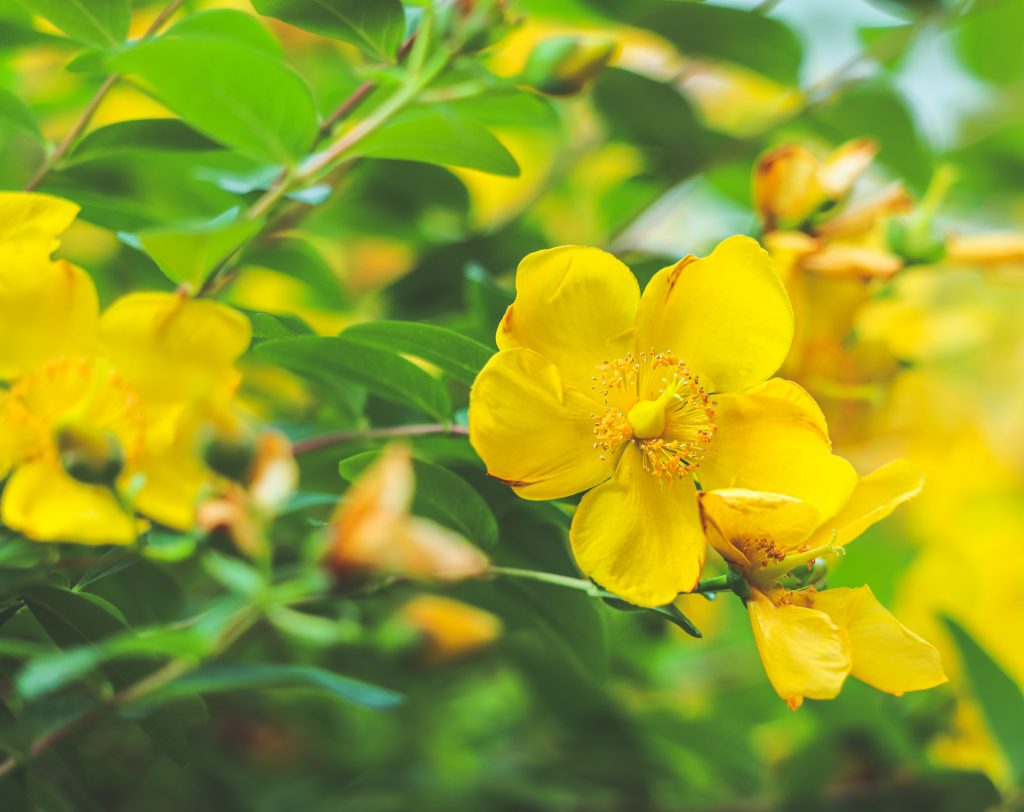
First in the line of defence against the infernal is St John’s Wort, known as Chasse-diable, Demon Chaser, Fuga Daemonum (amongst many other appellations). It was used to keep demons away, and to exorcise haunted houses. John Aubrey in ‘Miscellanies’ talks about a haunted London house which was cured by a Doctor who put St John’s Wort under the pillow of the bed. Bankes Herbel 1525 says:
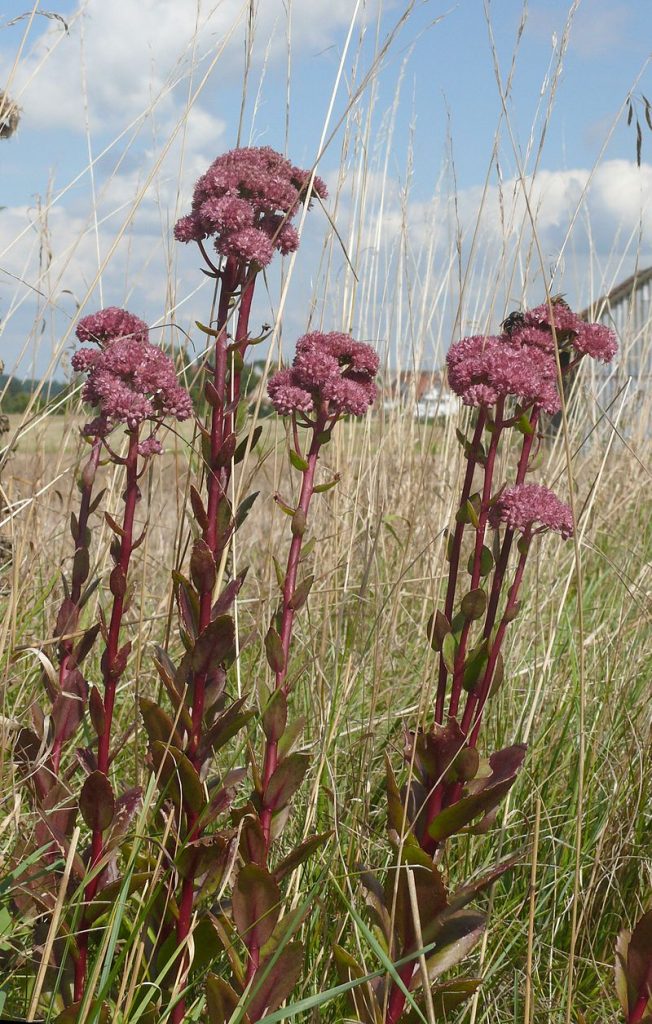
Sedum_telephium by Bernd Haynold wikipedia
‘The virtue of St John’s Wort is thus. If it be put in a man’s house, there shall come no wicked sprite therein.’
Vervain, yarrow, corn marigold, and orpins were also used, often woven into garlands, and hung around the necks of cows, or on door lintels as protection. If the St John’s Wort withered, the picker was to die or at least endure disappointment. If orpins entwined themselves on Midsummer’s Night, marriage would follow. Orpine, (Sedum Telephium) aka Live Long, or Life Everlasting was valued for the length of time it remained fresh after being gathered. Medicinally, it was considered good to use outwardly to cool scaldings, inflammations, and wounds.
St John’s Wort has a reputation for helping with depression, menopausal symptoms, ADHD, anxiety and other conditions.
A girl seeking love should walk around the Church seven or twelve times (accounts vary!) at midnight scattering hempseed, and singing:
Hempseed I sow Hempseed I hoe Let him that is my true love Come after me and mow
In the South West of England, there was a custom to watch the church porch on Midsummer Evening. This was when the spirits of all the living people of the village could be seen entering the church. Those not seen coming out again would surely die, as would any watcher foolish enough to fall asleep.
Thanks to the ‘Customs and Ceremonies of Britain’ by Charles Kightly.
First written in June 2023, and revised and republished in June 2024, and 2025
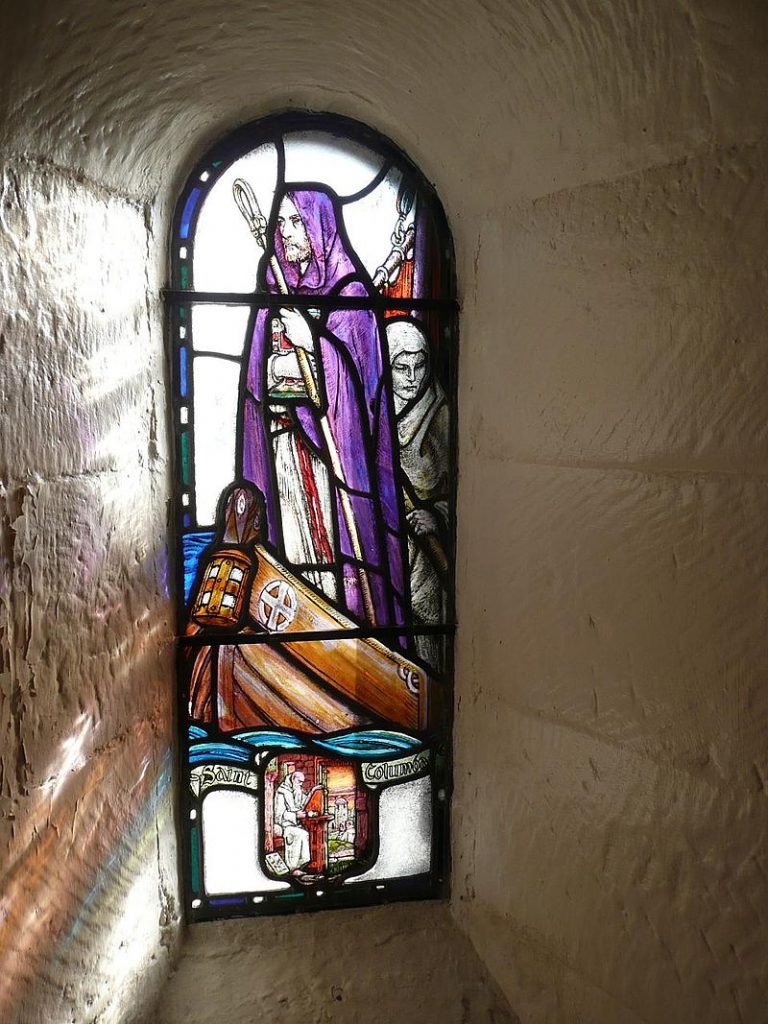
St Columba Stained Glass window in St Margaret’s Chapel Edinburgh Castle Photo by Graham van der Wielen Wikipedia CC BY 2.0
St Columba, or Colmcille is one of the most important saints for the early transmission of Christianity. He was born in 521 and said to be a descendant of the possibly legendary Irish King Niall of the Nine Hostages. (The Hostages were a token of Niall’s power over Ireland as they came from the five provinces of Ireland. These are Ulster, Connacht, Leinster, Munster, andMeath. The other four hostages represented Scotland, the Saxons, the Britons, and the Franks.)
St. Columba was sent at an early age to be brought up as a Monk, and went on to set up Monasteries in Ireland at Derry and Durrow. In 563, he left Ireland, possibly because he got involved in a dispute that had a deadly outcome. He went into exile to Scotland and set up the famous Monastery on the island of Iona, Inner Hebrides. This is off the coast of what would one day be called Scotland. At the time, it was under the control of the Kingdom of Dál Riata, which was, Gaelic, nominally Christian, and controlled parts of Ulster and Western Scotland.
From Iona, Columba led the conversion of the Picts to Christianity. The Picts were Britons, speaking a different dialect of Celtic than the Gaels of Ireland and Dál Riata. Their name is said to have been given by the Romans and meant Painted Men. A shared religion, which St Columba brought from Ireland, helped towards the eventual union of the Gaels, the Picts and other British groups into the Kingdom of Alba. Alba is the Gaelic name for Scotland – meaning white, and from which we also get Albion. Alba became Scotland, which is derived from the Roman word for the area which in Latin was “Scotia”. Iona became the traditional burial place of early Scottish Kings such as Macbeth (Mac Bethad mac Findlaích). These Kings were crowned at Scone and buried in Iona. Alba was also able to take territory from the Anglian Kingdom of Northumbria, namely, the Scots-speaking areas South of the Firth of Forth. (Scots being a dialect of English). There were also Norse settlers in the Ireland so Scotland was made of a coalition of Gaelic, Brittonic, Norse and English speakers.
St Columba and the Loch Ness Monster
Much of the events of this part of Columba’s life are recorded by St. Adamnan in The Life of Saint Columba. This was written in the 7th Century, much of which is apocryphal. One notable story tells how he came across a group of pagan Picts who were mourning a child killed by a monster in the River Ness. St Columba revived the child. He then sent one of the Brothers to swim across the Loch to fetch a boat. The “water beast” pursued the Monk and was about to attack him when St Columba told the monster to stop. So it did, retreating to the depths of Loch Ness. Thus began the legend of the Loch Ness monster.
St Columba died in 597AD. Iona continued to prosper and in, 634 sent St Aidan from Iona to found the Monastery at Lindisfarne. The island is on the Eastern coast of Britain in the Anglo-Saxon Kingdom of Northumbria. This Kingdom of the North Angles, was one of the most powerful at the time and Lindisfarne was instrumental in its conversion. The tradition of evangelism took hold in the British Isles, and it was from here that much of the German-speaking world was converted to Christianity.
This is St Columba’s legacy.
Northumbria’s Contribution to the development of Christianity
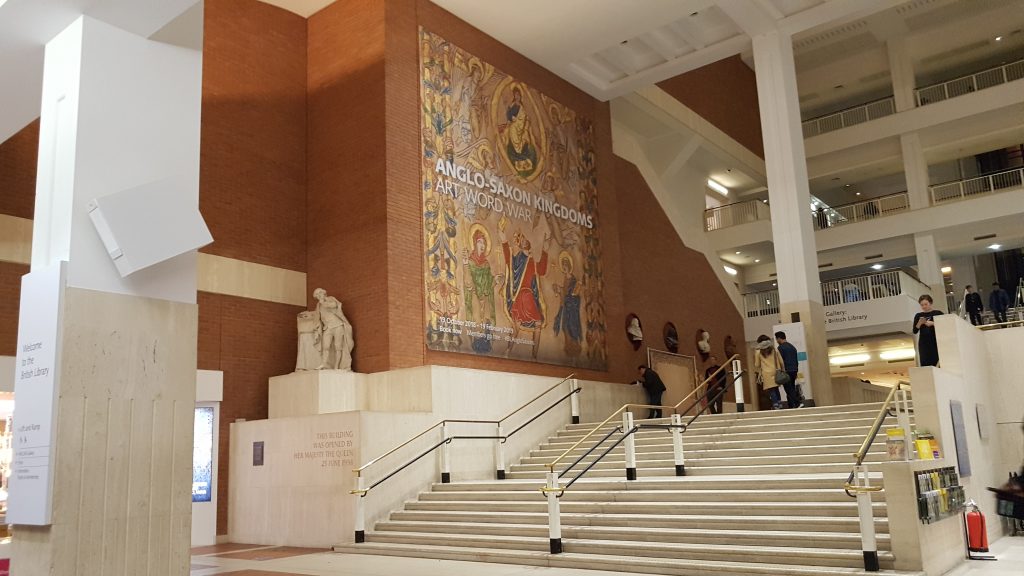
There is a developing understanding among scholars that this Irish inspired form of Christianity, fused with the Anglo-Saxon Northumbria took a leading role in ritual, art, scholarship in the Roman Catholic world. Just stop and think about that sentence for a moment. The northern parts of an out of the way set of islands off the edge of Europe took a leading role in the development of Western Christianity. This was highlighted in a recent exhibition of Anglo-Saxon art at the British Library.
British Library with Poster for Anglo-Saxons Kingdoms Exhibition, Photo K Flude
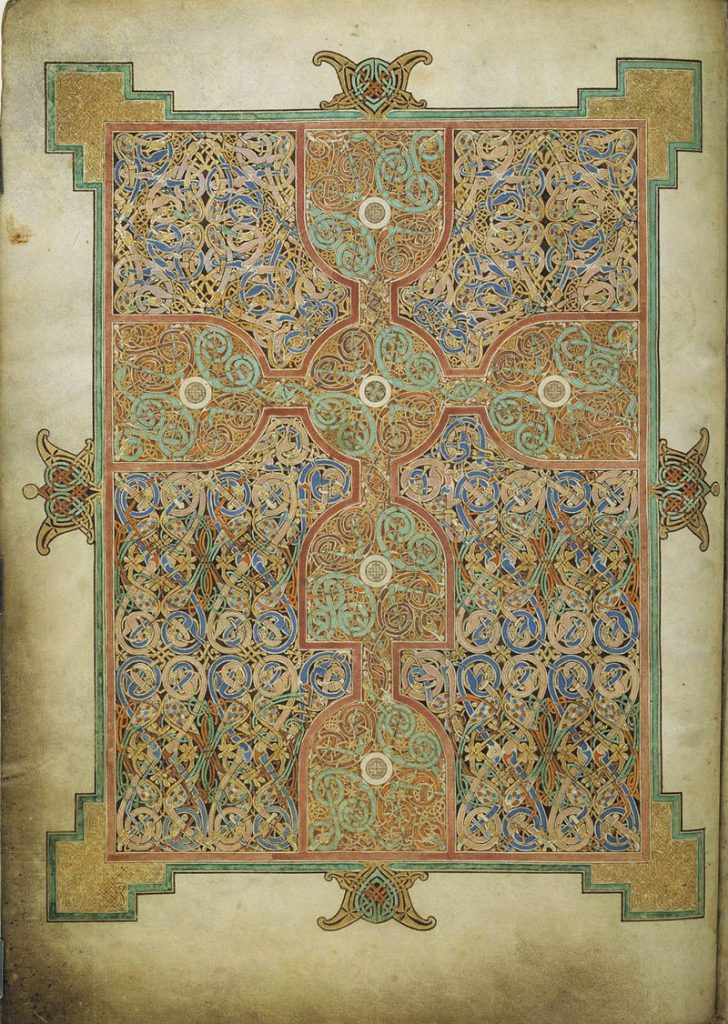
A look at the Lindisfarne Gospel and the Book of Kells showcases the amazing art of this period. For a real treat, look through this scrollable virtual copy of the Lindisfarne Gospel. (Currently this is unavailable, I suspect since the BL was hacked. So instead, here is a slightly breathless online introductory video of the Gospel.)
The Book itself has been missing from the displays of the British Library for a couple of years, but was on display in Northumberland in 2022. I’m not sure whether it is yet back on display at the British Library. I think not. You can see the Book of Kells at Trinity College, Dublin or look at their online offering here: Not quite as joyous an experience as the online Lindisfarne but beautiful enough.
Carpet Page from the Lindisfarne Gospel Photo Wikiepedia Eadfrith – Lindisfarne evangeliarium, tapijtbladzijde op f26v, Matteüsevangelie