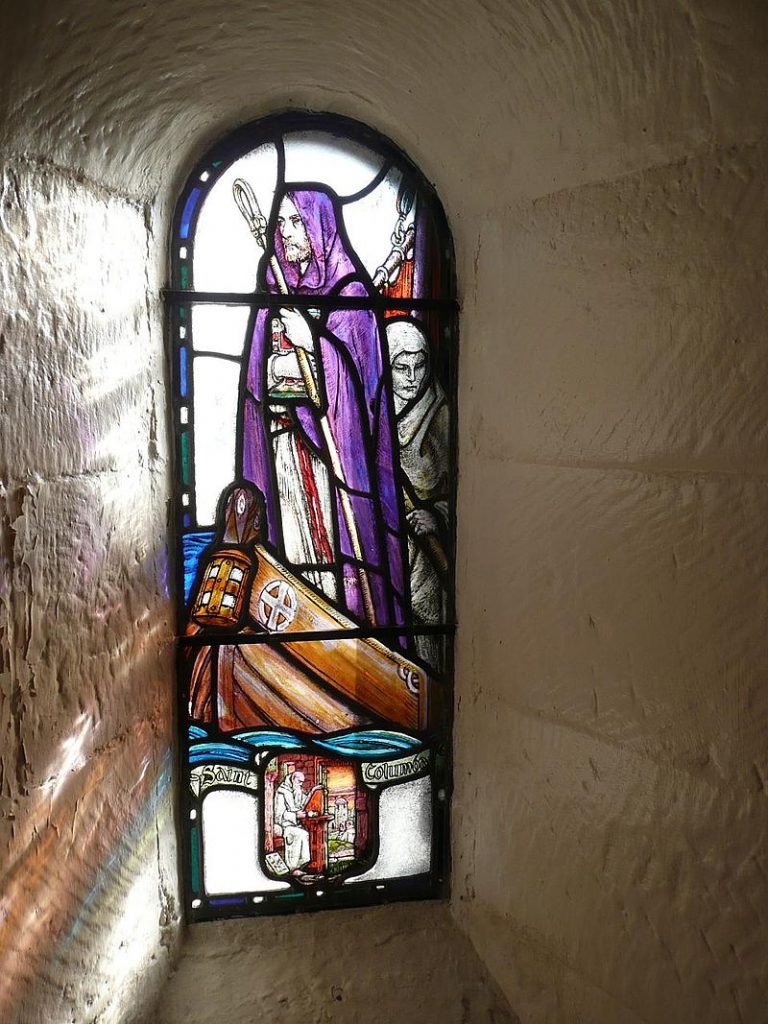
St Columba (St Colmcille) Day June 9th

St Columba st margarets chapel by Graham van der Wielen  Edinburgh  Lead glass
St Columba Stained Glass window in St Margaret’s Chapel Edinburgh Castle Photo by Graham van der Wielen Wikipedia CC BY 2.0

St Columba, or Colmcille is one of the most important saints for the early transmission of Christianity. He was born in 521 and said to be a descendant of the possibly legendary Irish King Niall of the Nine Hostages. (The Hostages were a token of Niall’s power over Ireland as they came from the five provinces of Ireland. These are Ulster, Connacht, Leinster, Munster, and Meath. The other four hostages represented Scotland, the Saxons, the Britons, and the Franks.)

St. Columba was sent at an early age to be brought up as a Monk, and went on to set up Monasteries in Ireland at Derry and Durrow. In 563, he left Ireland, possibly because he got involved in a dispute that had a deadly outcome. He went into exile to Scotland and set up the famous Monastery on the island of Iona, Inner Hebrides. This is off the coast of what would one day be called Scotland. At the time, it was under the control of the Kingdom of Dál Riata, which was, Gaelic, nominally Christian, and controlled parts of Ulster and Western Scotland.

From Iona, Columba led the conversion of the Picts to Christianity. The Picts were Britons, speaking a different dialect of Celtic than the Gaels of Ireland and Dál Riata. Their name is said to have been given by the Romans and meant Painted Men. A shared religion, which St Columba brought from Ireland, helped towards the eventual union of the Gaels, the Picts and other British groups into the Kingdom of Alba. Alba is the Gaelic name for Scotland – meaning white, and from which we also get Albion. Alba became Scotland, which is derived from the Roman word for the area which in Latin was “Scotia”. Iona became the traditional burial place of early Scottish Kings such as Macbeth (Mac Bethad mac Findlaích). These Kings were crowned at Scone and buried in Iona. Alba was also able to take territory from the Anglian Kingdom of Northumbria, namely, the Scots-speaking areas South of the Firth of Forth. (Scots being a dialect of English). There were also Norse settlers in the Ireland so Scotland was made of a coalition of Gaelic, Brittonic, Norse and English speakers.

St Columba and the Loch Ness Monster

Much of the events of this part of Columba’s life are recorded by St. Adamnan in The Life of Saint Columba. This was written in the 7th Century, much of which is apocryphal. One notable story tells how he came across a group of pagan Picts who were mourning a child killed by a monster in the River Ness. St Columba revived the child. He then sent one of the Brothers to swim across the Loch to fetch a boat. The “water beast” pursued the Monk and was about to attack him when St Columba told the monster to stop. So it did, retreating to the depths of Loch Ness. Thus began the legend of the Loch Ness monster.

St Columba died in 597AD. Iona continued to prosper and in, 634 sent St Aidan from Iona to found the Monastery at Lindisfarne. The island is on the Eastern coast of Britain in the Anglo-Saxon Kingdom of Northumbria. This Kingdom of the North Angles, was one of the most powerful at the time and Lindisfarne was instrumental in its conversion. The tradition of evangelism took hold in the British Isles, and it was from here that much of the German-speaking world was converted to Christianity.

This is St Columba’s legacy.

Northumbria’s Contribution to the development of Christianity

There is a developing understanding among scholars that this Irish inspired form of Christianity, fused with the Anglo-Saxon Northumbria took a leading role in ritual, art, scholarship in the Roman Catholic world. Just stop and think about that sentence for a moment. The northern parts of an out of the way set of islands off the edge of Europe took a leading role in the development of Western Christianity. This was highlighted in a recent exhibition of Anglo-Saxon art at the British Library.
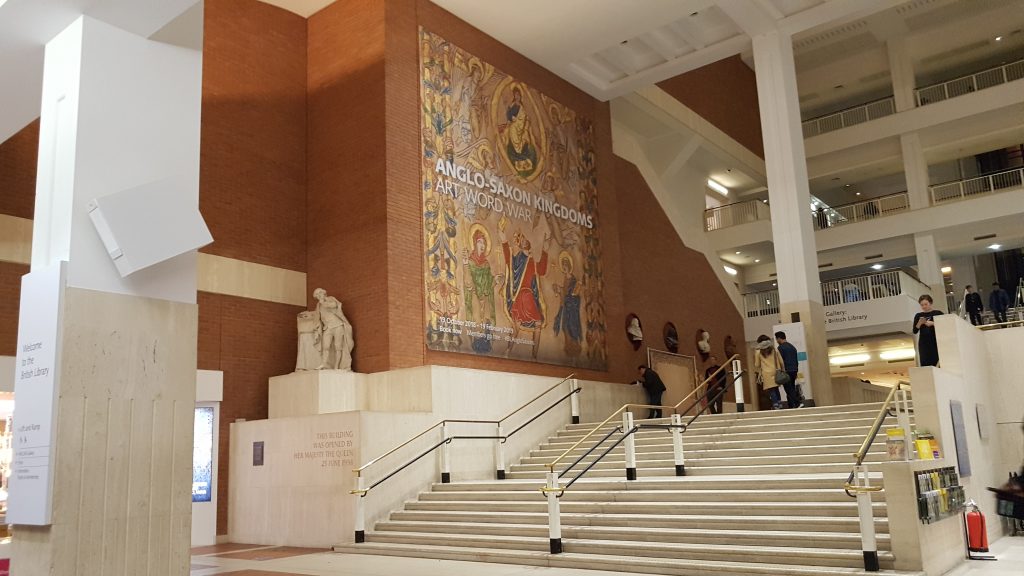
British Library with Poster for Anglo-Saxons Kingdoms Exhibition, Photo K Flude

A look at the Lindisfarne Gospel and the Book of Kells showcases the amazing art of this period. For a real treat, look through this scrollable virtual copy of the Lindisfarne Gospel. (Currently this is unavailable, I suspect since the BL was hacked. So instead, here is a slightly breathless online introductory video of the Gospel.)

The Book itself has been missing from the displays of the British Library for a couple of years, but was on display in Northumberland in 2022. I’m not sure whether it is yet back on display at the British Library. I think not. You can see the Book of Kells at Trinity College, Dublin or look at their online offering here: Not quite as joyous an experience as the online Lindisfarne but beautiful enough.
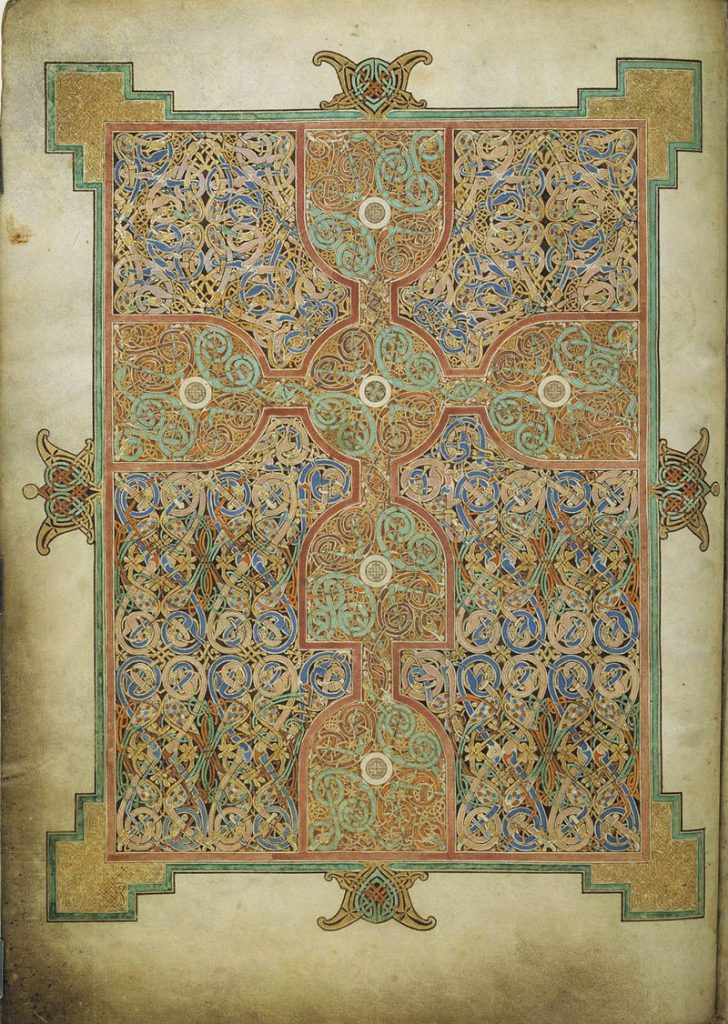
Carpet Page from the Lindisfarne Gospel
Carpet Page from the Lindisfarne Gospel Photo Wikiepedia Eadfrith –
Lindisfarne evangeliarium, tapijtbladzijde op f26v, Matteüsevangelie

Click here to read my post on Scone and the emergence of Alba.

Here is a virtual tour of Iona

Here is a 360-degree panoramic photo tour of Lindisfarne Abbey

First Published in 2023, revised, 2024 and improved 2025

Whitsun

Pentecost by Giotto and Workshop, probably about 1310-18, National Gallery

Today, June 8th, is Whitsun or Pentecost. (next year is is: Sun, May 24th 2026) 50 days after the Crucifixion. Celebrated on the 7th Sunday after Easter. The Day the Holy Ghost descends on the disciples.  According to one of my teachers, it gave the disciples the power of expression and turned them from bereft disciples to self-confident Apostles.   They could now begin to spread the Christian message.

Giotto’s painting shows the Apostles with their halos in the chamber. There are 12 of them, St Matthias having replaced the dead, Judas. The Holy Spirit is represented by the little dove in the centre of the Ceiling. The narrative is carried by the two men in the foreground leaning towards each other. We imagine them saying something like ‘What’s all this about! Galilean nonentities, lost their guru and yet, confident, speaking authoritatively to all and sundry and they can all understand them?

Giotto was a forerunner of the Renaissance. According to the great Giorgio Vasari (30 July 1511 – 27 June 1574) who wrote about the advances in painting achieved by Italian artists:

‘that very obligation which the craftsmen of painting owe to nature, who serves continually
as model to those who are ever wresting the good from her best and most beautiful features and striving to counterfeit and to imitate her, should be owed, in my belief, to Giotto, painter of Florence, for the reason that, after the methods of good paintings and their outlines had lain buried for so many years under the ruins of the wars, he alone, although born among inept craftsmen, by the gift of God revived that art, which had come to a grievous pass, and brought it to such a form as could be called good.

The miracle was that this boy, a poor shepherd with no training in art was able to show nature its true face.

One day [the artist] Cimabue, going on business from Florence to Vespignano, found Giotto, while his sheep were feeding, drawing a sheep from nature upon a smooth and solid rock with a pointed stone, having never learnt from anyone but nature.’

One of the points Vasari is making is that the Byzantine Art had lost the use of perspective, something the Romans knew. Paintings had become cartoon like spaces had no solidarity, groups of people stood on shoulders. If you look at the painting above you will the room the Apostles are in has the beginnings of a realistic space, the rafters slope down to a vanishing point. The Apostles are ranged convincingly around the space. Their faces are rounded and realistic. They are separated from the outside world by a dividing wall. And two dudes at the front are convincingly on the ground, rather than hovering in mid air (though I might have cropped the photo too closely!)

It would be over one hundred years before photo realistic portraits and realistic perspective paintings were rediscovered but Giotto showed the way.

For more on Giotto see my post here:

And on Italian art and perspective my post here

First published on June 8th 2025

St Agatha, Ravenna and Motor Cycling in Inferno

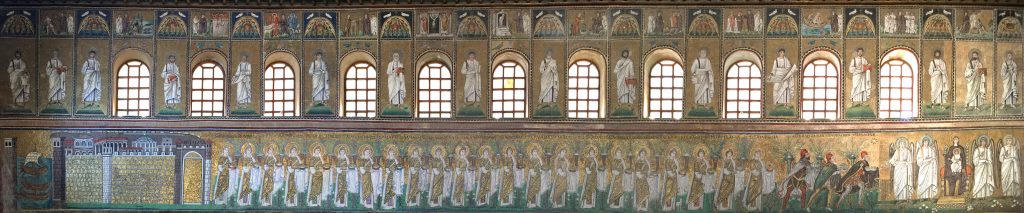
Procession of female saints leaving Classis (bottom left) behind the Three Kings heading to the Virgin Mary (bottom right between four angels). Basilica of Sant’Apollinare Nuovo (pic. Wikipedia)

Today, I am in Ravenna. One of those places where the history brings gasps of amazement.  To honour my visit, I thought I should roll out last year’s post. This is what I said:

When I revised my Saint Agatha post (link see below), I felt I needed an early image of Agatha.  After all, her cult spread early on, and therefore, was likely to be genuine.

As I started to track down her image I was led, with some joy, to one of the most amazing Churches in the wonderful town of Ravenna. I visited the Basilica of Sant’Apollinare Nuovo with some wonderment when working as an archaeologist at Ferrara, in Emilia-Romagna. Forty Years ago.

I found out that Agatha was one of 22 female Saints on one of the walls of the Church. I discovered a pretty comprehensive description of the Church. As I looked at it, I noticed the record was made by, or involved, Professor Bryan Ward-Perkins. He was the Director of the site my friends and I worked on in Ferrara! (And I met him again last night, 2025 for the first time in years!  We had dinner with fellow archaeologists, and Bryan was talking about the work he did on the Saints of St Apollinaire.)

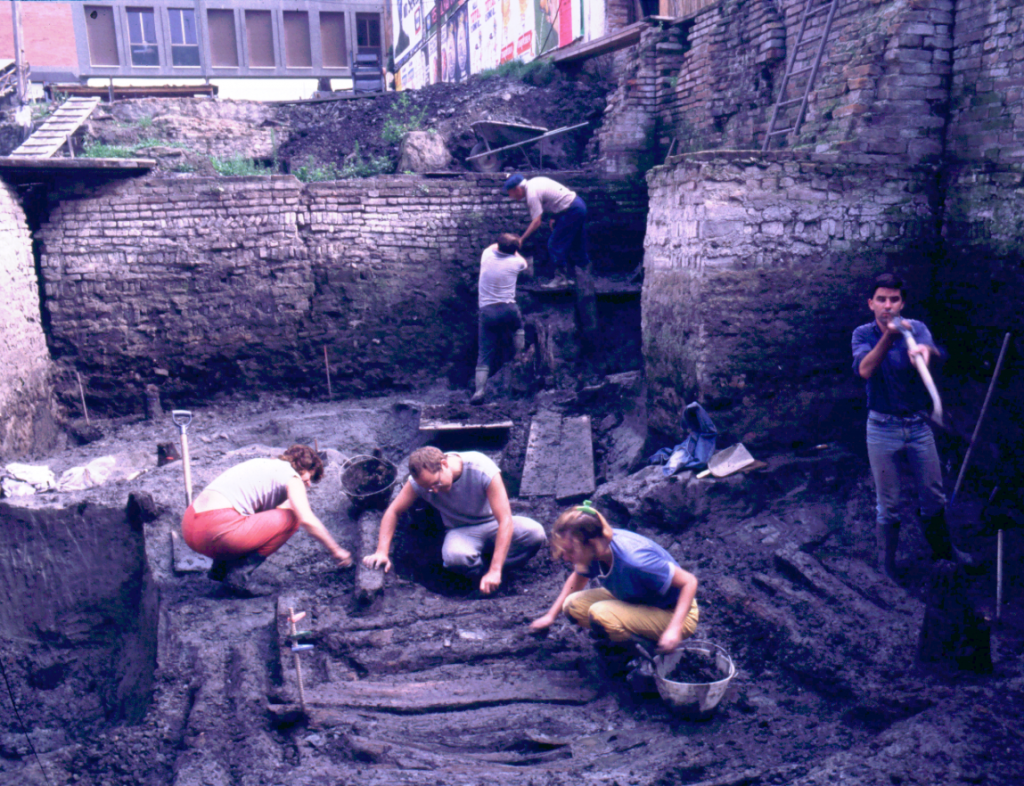
Medieval Excavation in Ferrara. The author is in the centre of the photo,

Ravenna

I’m guessing Bryan suggested we visit Ravenna on one of our trips to the beach at nearby Rimini. Ravenna was so awesome because the City became the capital of the Roman Empire in the West. It took over when Rome fell, then it was part of the Ostrogothic Kingdom, then of the Byzantine Empire. It spanned the period of the Arian Heresy.

And so, it was provided with some of the great glories of 5th and 6th Century Architecture. These include the Mausoleum of Galla Placidia, the Neronian Baptistery, the Basilica of Sant’Apollinare Nuovo, the Arian Baptistery, the Archiepiscopal Chapel, the Mausoleum of Theodoric, the Church of San Vitale and the Basilica of Sant’Apollinare in Classe. It’s hard to overestimate the impact on a young British archaeologist of seeing 5th Century buildings with roofs and astonishingly detailed mosaics still intact. Please visit!

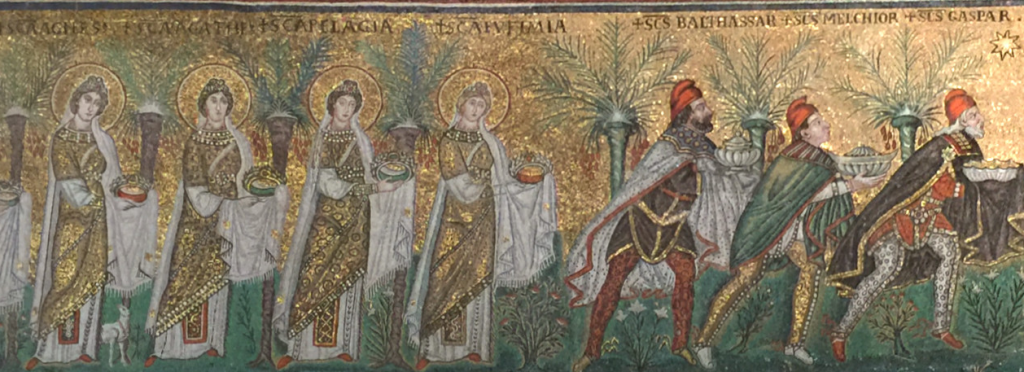
Detail showing the first four female saints behind the Three Kings. Basilica of Sant’Apollinare Nuovo wikipedia

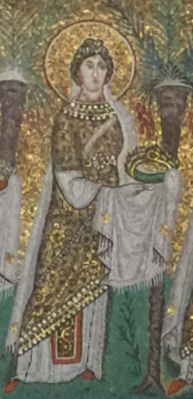
Bryan Ward-Perkins description says All the saints are haloed, bear crowns and are dressed in elaborate court dress. Unlike the men …., all have essentially the same youthful features. The only saint with a distinguishing attribute is Agnes, who is accompanied by a lamb.’ The men are given some personality, some have white beards others are youthful. While all the female martyrs are, essentially young virgins, and cannot be distinguished from each other. St Agatha, the list says, is the Saint next to Agnes with her lamb; the third in precedent. You can see her above and in detail below.

St Agatha
Basilica of Sant’Apollinare Nuovo wikipedia

Motorcycling from Ravenna to Inferno

Enough of the sublime! Now for the ridiculous. Whether on this visit or another, we decided to have a day at the beach at Rimini. After the day on the beach, a collective decision to stay over was made. The reason was to go to one of the big clubs (did we still call them discos?) probably to dance to ‘Frankie Goes to Hollywood’.

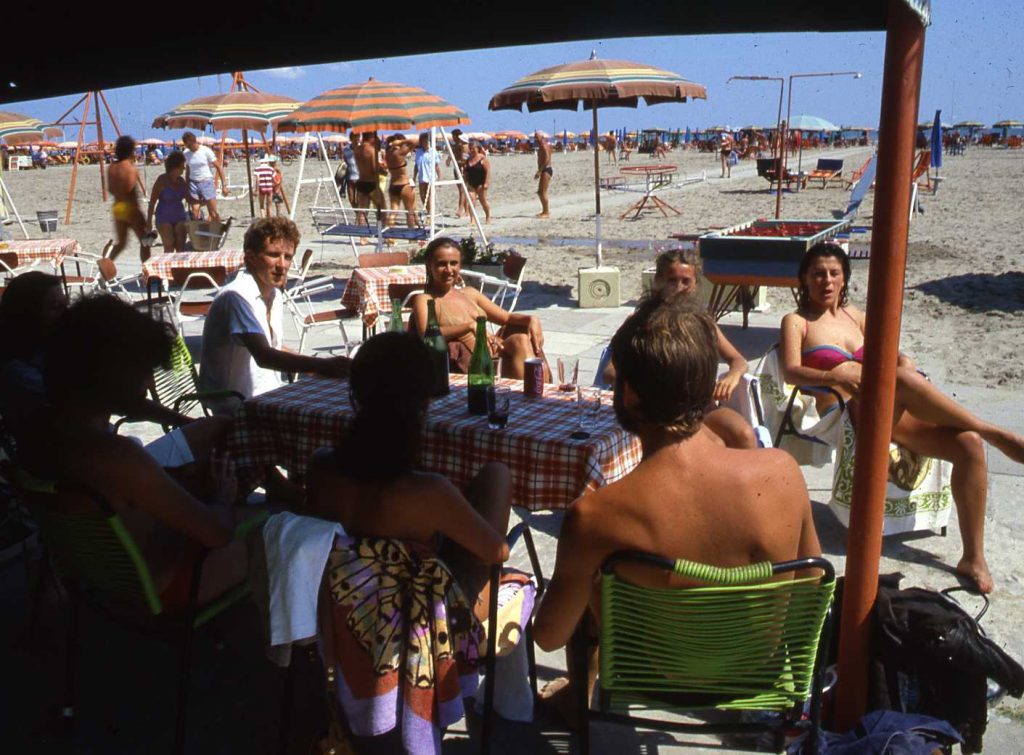
Archaeologists, Italian and English, on the beach at Lido di Spina

However, the hotels were all full. So I decided, late at night, to go back to Ferrara, on my own on my 175 cc Yamaha motorbike.

My Yamaha 175cc bike looked something like this but was red. A thing of underpowered beauty.

Thing was, I had started the day in Ferrara in the blazing Italian summer heat. So, I had hopped onto my bike dressed in shorts and t-shirt. Ferrara was 77 miles away (says google). One hour into the trip back, I was getting pretty cold, and really not enjoying driving through the lonely countryside. Therefore, I decided to pull off the main road to find a rural hostelry for what remained of the night.

Now, I remember this very vividly – the only likely road I could find was signposted to ‘Inferno’. I shrugged my shoulders, wondering what that was about, and drove towards it on a very deserted road. Eventually, I came to a sign which told me I was about to enter ‘Inferno’.

There was something very surreal about the situation. My courage failed me! I was not going to stay in a ‘motel’ in a place called ‘inferno’! I had seen too many horror films set in Motels and one in Inferno seemed madness. So, I turned round and continued my cold journey to Ferrara.

Inferno

Whenever I tell this story, I have some doubt about it.  Did I really drive into a place called ‘Inferno’? But I have, for the first time, checked Google. It tells me that the road off the Rimini to Ferrara road goes through somewhere called: Vicolo Inferno, 40026 Imola BO, Italy.

Below is the post about St Agatha of Sicily who has a most interesting story.

Written in 2023 and updated in 2024, and 2025

St Kevin’s Day June 3rd

St Kevin of Glendalough (Wikipedia)

Thank you very much to my subscriber for alerting me to St Kevin’s Day which is my Saint’s Day. I was aware of St Kev and that the name meant ‘of noble birth’ but that’s was the extent of my knowledge.

But a little research on Wikipedia while on the train to visit my Dad, revealed that Kev lived to the grand old age of 120, born in 498 and died in 628.  As my Dad is 97 and still going strong, maybe he and St Kevin will inspire my longevity?

Briefly, St Kevin met the great St. Columba; had a poem written about him by the marvelous Seamus Heaney (https://poetryarchive.org/poem/st-kevin-and-blackbird/); a song by the Dubliners; several mentions by James Joyce and a long distance path, the St Kevin’s Way, part of the Camino de Santiago network, named after him. And St Kev can help us understand the weather for the rest of June :

The weather on St Kevin’s Day will last all month‘. 

So that means uninterrupted sun.  At least in Ravenna where I currently am.

Live recording of Dubliners’ Song about St Kevin

Coemgen, as he is known in Irish, was a hermit, living in a cave-like ledge above a lake.  His piety attracted followers and a monastic settlement.  He was known for his ascetic life and love for nature.  So, a role model for all us Kevins?

His hagiography was written very late, so little of it can be confirmed. But, like other saintly hermits, he is associated with being tempted by women or the devil disguised as a woman.  (St. Anthony the Great, St. Benedict of Nursia, Saint Chrysanthus, St. Vitus,  St. Bernard of Clairvaux, St. Hilary etc.)  Unfortunately, rather than just resisting his temptress, Coemgen is said to have drowned her. Not so good!

On the other hand, my sister sent me this photo of a souvenir from a shop in Northumberland.

That’s more like it! And oh so true! Clearly we, handsome, clever, positive, analytical Kevins have a lot going for us, despite the name.

For more on the Temptations of Hermits read this article:

Nechita, Andrea.“Offering Body, Pleasure, and Wealth: The Visual Representation of Women Tempting Saints (Fifteenth and Sixteenth Century).” Annual of Medieval Studies at CEU, 20 (2014): 96-112. For a summary, and some tempting illustrations, look here.

First written in 2023. revised June 2024, 2025

June & Juno, Queen of Goddesses

Palazzo Scifanoia, Ferrara Showing Fresco of June

June is, probably, named after Juno, the leading lady of Olympus, sister and brother to the Great God Jupiter (Jove). In Welsh, it’s ‘Mehefin’ – Midsummer. In Gaelic, ‘An t’Og mhios’ – the Young Month. In Anglo-Saxon, ‘Litha’, the month of the Midsummer Moon.

I am in Ferrara where I worked on a joint UK/Italian excavation in the 1980’s. We are currently at a reunion, in the beautiful UNESCO World Heritage City. The weather is beautiful, and so are the people and the City! One of its gems is the Palazzo Schifanioa, which was the home of the Este Family, Dukes of Ferrara. Borso D’Este in the 15th Century initiated the frescos on the wall of the Hall of the Months. There is one for each month although not all survive in recognisable form. But above is June. The top panels show the Gods of the Month with their chariots or waggons. Below are the star signs for the month, and at the bottom a scene from 15th Century seen from an aristocratic perspective. June has a delightful agricultural scene. You will see more of these in future months. Although I won’t say much today as its difficult to do anything serious without a desk and a decent internet connection.

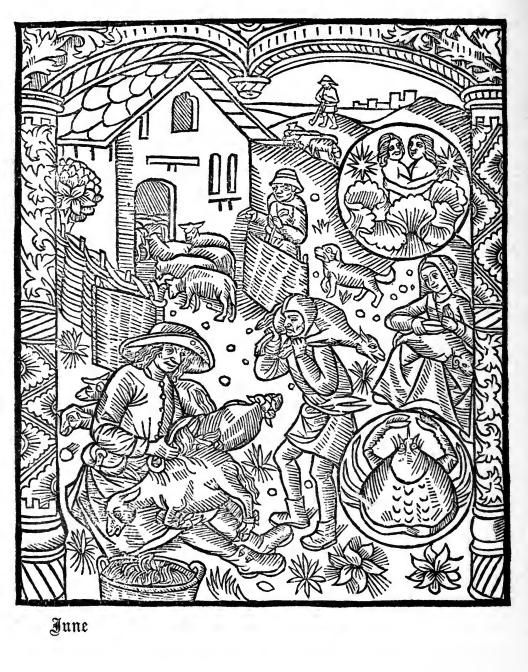
Black and white engraving for June from Kalendar of Shepherds.
Kalendar of Shepherds. Title page for June

The picture above is from the Kalendar of Shepherds, with its 15th Century French Illustration. It shows shearing as the main occupation for the month but set within a flowery summer scene. In the roundels are the Gemini twins and the Cancer Crab, the star signs of June.

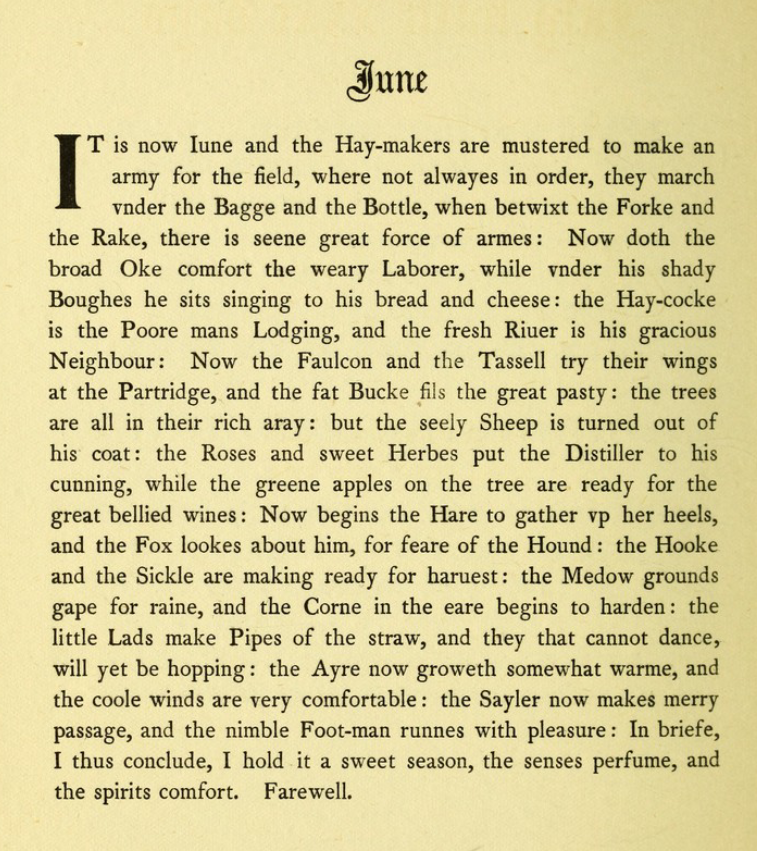
The text of the Kalendar of Shepherds gives a lyrical view of the joys of June:

From Kalendar of Shepherds, 17th Century Text Wellcome Library

June might come, not from Juno’s name, but from an Indo-European word for youth or vital energy. Ovid in Fasti, his poem about the Roman Year, lets Juno make her own case:

O poet, singer of the Roman year,
Who dares to tell great things in slender measures,
You’ve won the right to view a celestial power,
By choosing to celebrate the festivals in your verse.
But so you’re not ignorant or led astray by error.
June in fact takes its name from mine.
It’s something to have wed Jove, and to be Jove’s sister:
I’m not sure if I’m prouder of brother or husband.
If you consider lineage, I was first to call Saturn
Father, I was the first child fate granted to him.
Rome was once named Saturnia, after my father:
This was the first place he came to, exiled from heaven.
If the marriage bed counts at all, I’m called the
Thunderer’s Wife, and my shrine’s joined to that of Tarpeian Jove.
If his mistress could give her name to the month of May,
Shall a similar honour be begrudged to me?
Or why am I called queen and chief of goddesses?
Why did they place a golden sceptre in my hand?’

Translated by A. S. Kline © Copyright 2004 All Rights Reserved

In the previous Book (on May), Ovid told another story that June was named for young men.

‘So I deduce that the elders gave their own title
To the month of May: and looked after their own interests.
Numitor too may have said: ‘Romulus, grant this month
To the old men’ and his grandson may have yielded.
The following month, June, named for young men’
Gives no slight proof of the honour intended.’

The Latin for ‘Young men’ comes from the Latin iuvenis, “youth”)

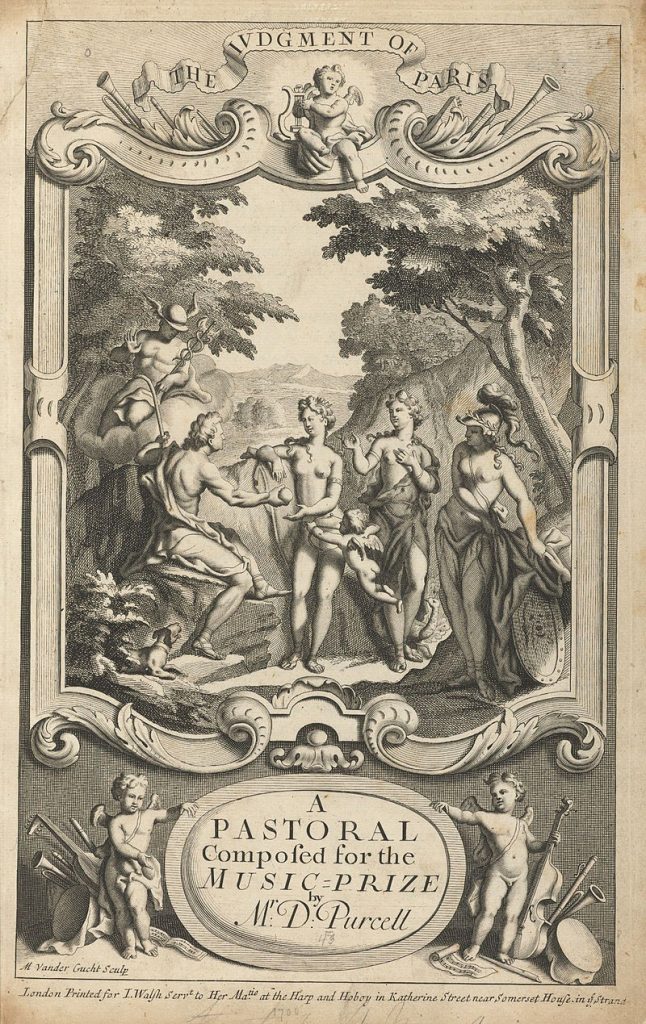
But let’s not go into Indo-European roots, and let’s simply accept the most wonderful month is named after Juno, the Queen of Goddesses, the deity of marriage and women. Probably most famous for hating the Trojans – she had a grudge against Paris, as he ruled against her in that famous divine beauty competition. And more seriously, what other reaction can the Deity of Marriage, have to the man who showed such disregard for the sanctity of marriage that he ran away with the already spoken for Helen?

The Judgment of Paris 1700 by Daniel Purcell. Houghton Museum (Paris, Venus, Juno, Minerva)

‘A sweet season, the senses perfume and the spirits comfort.’

First Written in June 2023 and revised June 2024, 2025

May & June: Dandelions, Hinder Fallings and Bed Wetting

This post sprang from something that my grandson said to  in the middle of the park. He was curious as to why I was concerned that the park toilets were out of action. He told me I could, like him, just pull down my trousers and wee, right here, right then, up against the tree in the park. My attempt at explanation drew a perplexed, ‘What?’ ‘What?’ is his new word. After an explanation, his next word is invariable another ‘What?’.Hopefully the relevance of this will become apparent.

May and June are the most prolific months for dandelions, which used to be known as ‘piss-a-beds’. They are diuretic and were often eaten, and so might well have consequences for the young trainee child.

John Hollybush in his 1561 ‘The Homish Apothecary’ says:

‘When a young body does piss in his bed either oft or seldom: if ye will help him take the bladder of a goat and dry it to powder, and get him to drink with wine, or else take the beans or hinder fallings of a goat, and give him of the powder in his meat morning and evening, a quarter ounce at every time.’

(quoted in ‘The Perpetual Almanac by Charles Kightley)

Hinder fallings are what falls out of the hind-quarters of a goat. I’m not sure even an indulgent Grandparent is allowed to give droppings and wine to the little ones. Nor can I find any mention of goat products in modern medical recommendations. So I won’t be recommending this as a practical aid.

Medically, dandelions were very well regarded. Mrs Grieve’s ‘Modern Herbal’ reports that it are diuretic and a general stimulant to the system but particularly the urinary system. They were good for liver and kidney complaints; gall-stones; and piles. They were considered excellent to eat and drink. Particularly, dandelion sandwiches using young leaves, with salt, pepper, and lemon juice. They were also taken in salads, teas, and beers.

We used to blow the seeds from the dandelion seed head saying ‘She loves me. She loves me not’ at each blow, until the truth was revealed.

First written in June 2023, revised june 2024,2025.  Rewritten 2025

Cotswolds Olimpicks May 30th

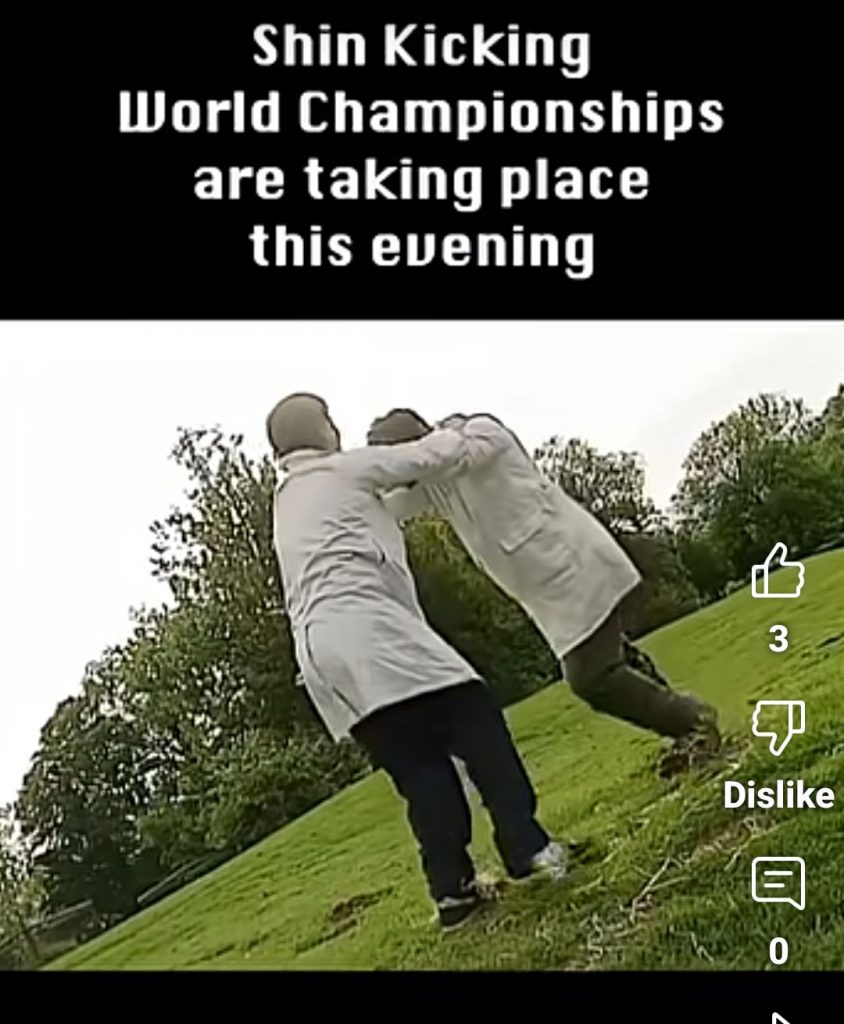
screen shot from https://youtube.com/shorts/wBOPAZ2131Y?si=UEED_F8QjSb_wW6Z

I’m in Ferrara, in the Po Valley near Bologna.  Hence, falling behind on posts!  I am on holiday but attending a reunion of Archaeologists who excavated here in the 1980’s.  It was a collaboration between Italian and UK archaeologists.  The British contingent was mostly from the Museum of London.  More to follow over the next few days.

But on the 30th May I planned to tell you about the Cotswolds’ Olimpicks.  This was set up by Robert Dover on a hill near Chipping Camden, in the early 17th Century.

Inspired by the Greek Olympics, he felt the modern world could do with an infusion of the original spirit.

The Olimpicks has a collection of tradition sports such as the sack race, and the tug of war.  But the one that receives the most attention is shin-kicking.  Two contestants try to knock each other over by kicking each other in the shins!  They are not supposed to pull or push their opponent over. Or use Judo style throws.  Protective gear is supplied in the form of straw or hay packed down the socks.

For other Cotswolds content look at my posts

coopers-hill-cheese-rolling-may-26th/

campden-house-fire-sunday-march-23rd-1862/

chipping-campden-murder-august-16th-1660/

First published 1 June 2025

Oak apple day May 29th

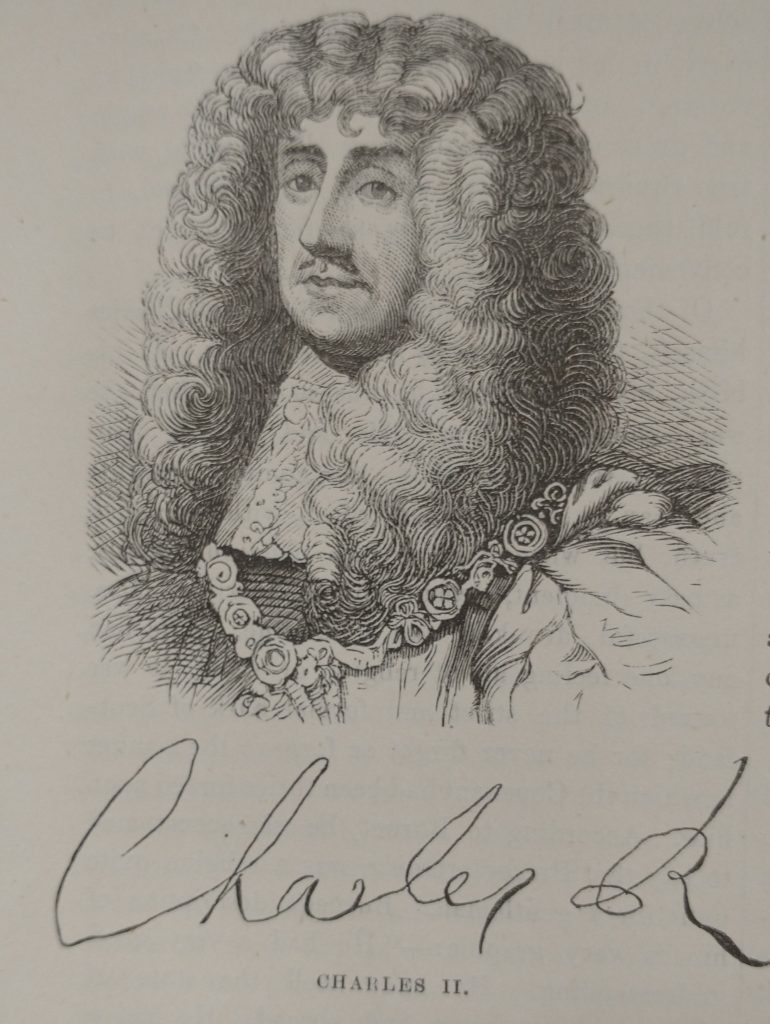
Charles II from an old illustration

Oak Apple Day was set up by Parliament in 1660 as “An Act for a Perpetual Anniversary of Thanksgiving”.  They were celebrating the restoration of Charles II to the throne in May of 1660. The Day was abolished in 1859, but a few places continue to celebrate the day.

The Oak was chosen partly as a symbol of England but particularly because after Cromwell’s Parliamentary Army defeated the Royalists at the Battle of Worcester (September 3rd 1651), Charles hid in an Oak Tree near Boscobel House in Shropshire on his epic journey to the South Coast and the safety of France.

People wore oak apples (or shick-shacks) which are a type of ‘plant-gall‘. This is an abnormal growth from a point of irritation on a plant. Or they were used sprigs of Oak leaves.

The text of the Parliamentary Bill said:

That in all succeeding ages, the 29th of May be celebrated in every parish Church and Chapel in England and the Dominions thereof, by rendering thanks to God for the Kings (Charles II’s) restoration to actual possession and exercise of his legal authority over his subjects’

Church Services for the Restoration; for the preservation from the Gunpowder Plot and the death of Charles the First were kept up until the year 1859.

You might like to look at my post:

and I posted on John Evelyn’s reaction to the Restoration

The Venerable Bede Died – May 26th 735AD

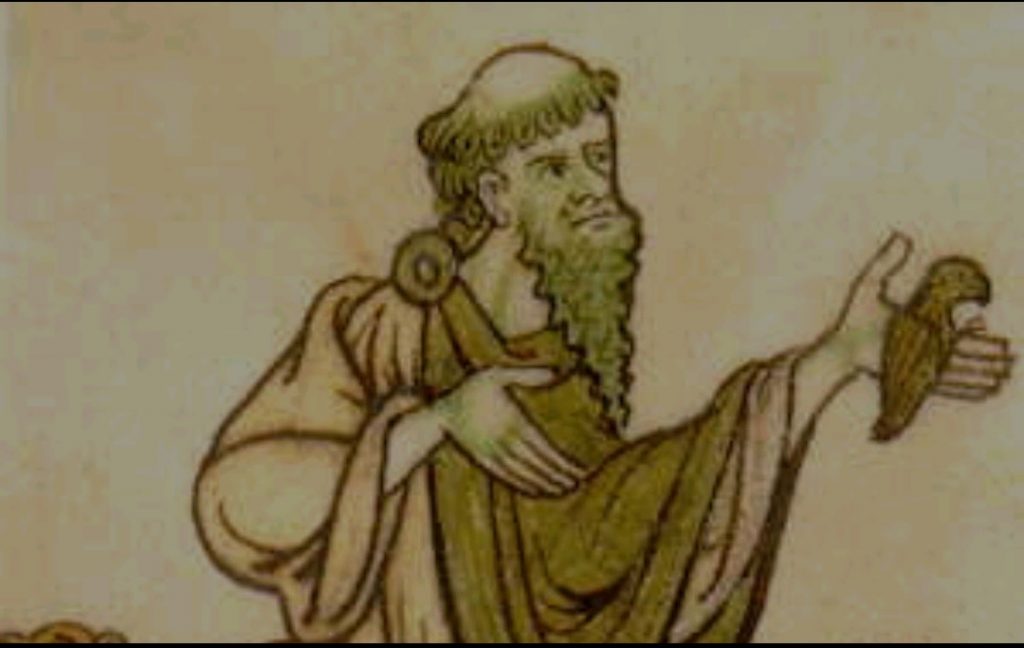
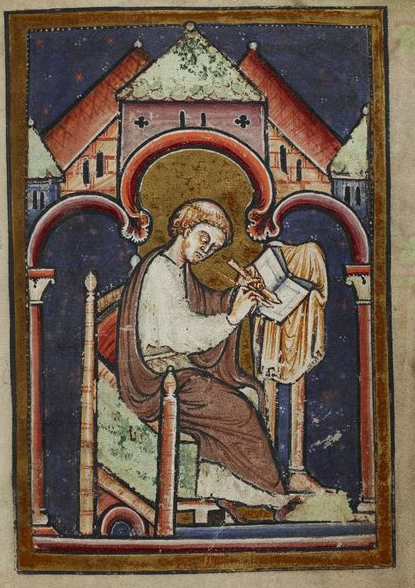
A Scribe – possibly the Venerable Bede. Late 12th Century from Lives of St Cuthbert.

He died on the evening of what we would call the 25th, but in ancient times, the Day changed at dusk. So for his contemporaries, he died on 26th May. But, as he shares his day with St Augustine, some celebrate the Venerable Bede on May 27th!

Called the Father of English History, the Venerable Bede was an excellent historian, who set the tone and standard for many centuries of English Historiography.  He is mostly remembered for the ‘Ecclesiastical History of the English People’ which provides the most trusted account of the events of the Post Roman, Migration, and Anglo-Saxon periods.

So well regarded is he that he is the only Englishman mentioned in Dante’s Paradiso.  This is the third part of the Divine Comedy.  The other parts are about the bad people in Hell and Purgatory.  Bede is with the Angels in Heaven.

He is Venerable not only in the general sense of being wise, old and respected, but also in the technical sense:

(in the Roman Catholic Church) a title given to a deceased person who has attained a certain degree of sanctity but has not been fully beatified or canonized.‘ (Oxford Languages)

In 1899, the Catholic Church honoured him with the title of Doctor of the Church – someone holy who had contributed to the theology of the Church.

He is considered by some to be the best historian in olden times, only equalled by Herodotus (said Thomas Carlyle). Thucydides surely says I! (Note: Herodotus is known as the ‘Father of History’ for his storytelling and breadth of the scope of his attention. While Thucydides didn’t tell tales, he concentrated on empirical evidence and so is known as the Father of Scientific History)

Bede is so good because he checked his sources and had access to a wide range of books. He even had a line to the Vatican so he could check his facts with Vatican records. This in the 8th Century! The Venerable Bede is the polar opposite of Geoffrey of Monmouth, (writing in the 12th Century). If Bede mentions a person or an event then they are accepted as part of the story of the English. By contrast, if Geoffrey of Monmouth mentions a person or event, without further corroboration, then historians tend to consider it a story, myth or simply made up by Geoffrey.

But, the truth is not so straightforward. Bede is not without his biases and his sources were not themselves always reliable, nor above accepting myth, legends and miracles as fact.  Geoffrey also has access to some, probably, oral traditions so that some (but which?) of his many tales of the Kings of Britain may hold considerable historical information.

Bede’s Influence on English History

Bede followed Gildas (A British Monk writing in the 6th Century) in wondering why God allowed the native Christian Britons to be defeated by the foreign Pagan English.  Gildas assumed God was punishing the Britons because of the evil deeds of their so-called Christian Kings.  Bede extends this to argue that God is punishing the Britons for not trying to convert the English to Christianity AND by being generally not a great bunch of Christians. God knows that the English, when converted, will be much better Christians than the Britons.

This starts a histographical trend for the English to think of themselves as the chosen people. By contrast, the Britons (Welsh, Scots and Irish) are feckless Barbarians (they thought).  Bede concentrates on the English and countless generations of Historians have either left out the Britons, or demeaned them in their histories of England and indeed of Britain.

For example, most histories of Kings, deal only with England and start either with William the Conqueror or Alfred the Great and omit any British, Welsh, Scots or Irish Kings. Except for my book on the Kings and Queens of Britain, which starts with the largely legendary Kings of Britain, and includes some Welsh and Scottish Kings.  To buy it, you will find details of it here.

So Bede is a great historian without whom we would have an even less clear idea about what happened in the centuries following the Roman Period.  But also, contributed to an Anglo centric view of history. He was writing in Northumberland at the Monastery of Jarrow, and is more sympathetic to Northumbria than to Wessex, Mercia, and the British Kingdoms.

Bede’s Books

He wrote over 60 books. One was about the theological science of computus. In particular, the dating of Easter. The British Church had one method, the Catholic Church another. This contributed to a series of confrontations between the 2 Churches. And was only finally resolved at the Synod of Whitby in the favour of the Catholic Church.

Bede was instrumental in making Dionysius Exiguus idea of dating from the birth of Christ as the standard AD /BC system. He also thought the Catholic calculation that Jesus was born 5000 years ago was wrong and used the Bible to calculate the more ‘correct’ date was 3952 BC.  Archbishop Ussher in the 17th Century took Bede’s calculation and improved it and suggested the proper date was 4004 BC.

For more about Dionysius Exiguus and the division of time, see my post here.

First Written on May 26th 2025

St Pancras May 12th

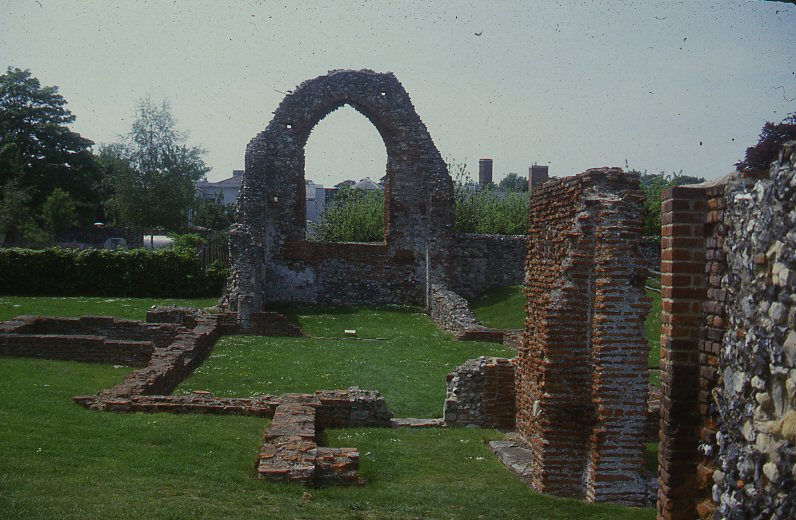
Ruins of St Pancras, Canterbury Photo: K Flude (note the reused Roman Bricks.)

Pancras means ‘all-powerful’ in Greek. St Pancras was a 14 year old who refused to give up his Christian Faith during the persecution of Christians by the Emperor Diocletian. He was beheaded on the Via Aurelia, traditionally, on 12 May 303 AD. His youth makes him the Patron Saint of children, but he is also the patron saint of jobs and health. He is ‘invoked’ against cramps, false witnesses, headaches, and perjury. His body was buried in the Catacombs, but his head is kept in a reliquary in the Church of Saint Pancras in Rome, where he was buried.

Ice Saints

He is also one of the Ice Saints.  These are saints with feast days from May 11th to May 14th.  They are: St. Mamertus, St. Pancras, and St. Servatius (and in some countries, Saint Boniface of Tarsus – Wikipedia). They represent a belief that there was often a cold snap in early May.  Although modern statistics disprove this, it is however true that a late frost can cause havoc with crops.  So  the Ice Saints help persuade farmers to delay sowing.

In England, we have a saving ‘never cast  a clout while may is out’.  Which suggest you keep a coat at hand while the May flowers (Hawthorn) are still out, as it can be cold even in May. For more on the Folklore of Hawthorn -see my post here.

St Pancras in England

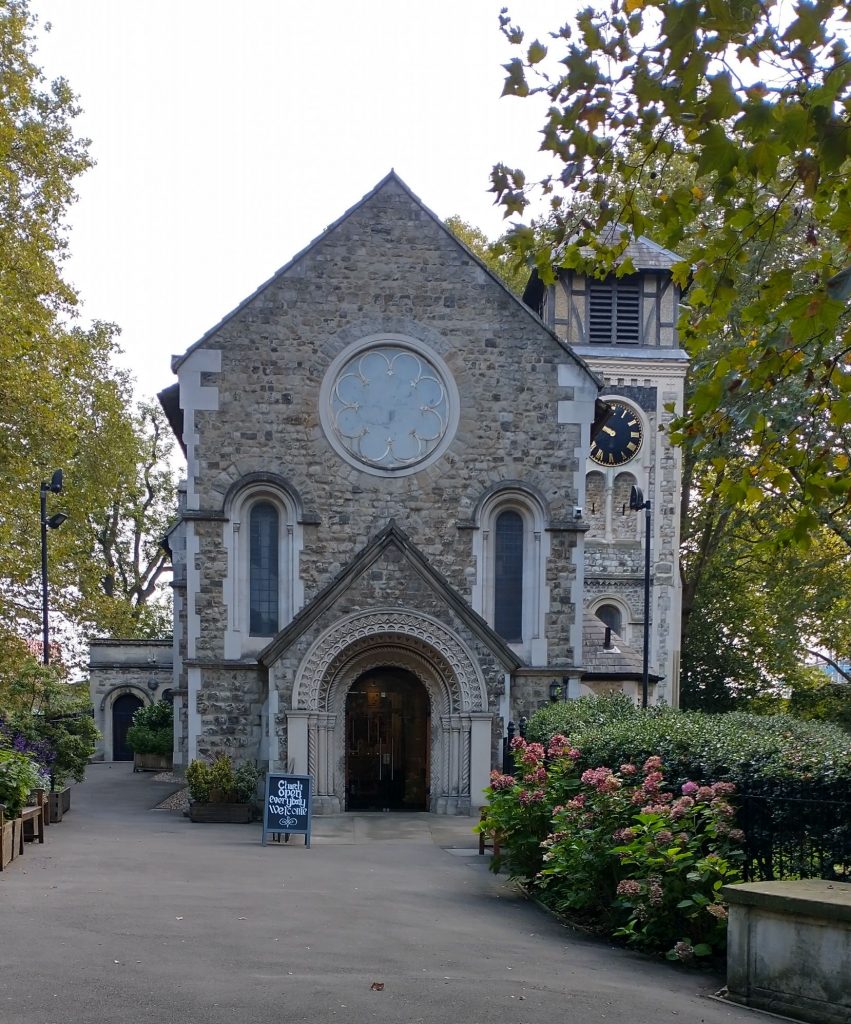
St Pancras, Old Church, London (Photo: Kevin Flude)

Pope Gregory is said to have given St Augustine relics from St Pancras when his mission came to Kent in 597AD. They built a church dedicated to St Pancras. The ruins still survive in the grounds of what is now St Augustine’s, Canterbury (see picture at tope of post).

This story is partly responsible for the claims that St Pancras Old Church, in Camden (pictured above) is a very old foundation. The idea being that there was a late Roman place of worship here. But there is very little solid evidence for this. It is also argued that, if it isn’t late Roman, then it dates to just after 604AD. This is when St Mellitus, sent by St Augustine, established St Pauls Cathedral. It is suggested that he also founded St Pancras Church. St Pancras’ Church was a Prebend of St Pauls Cathedral (a Prebend provides the stipend (pay) to support a Canon of a Cathedral). But this is not evidence it was established as early as the Cathedral was, and there really isn’t any other credible evidence for a 604 date.

When the Church was restored, the architects said it was mostly Tudor work with traces of Norman architecture. However, the suggested finding of a Roman tile or two, reused in the fabric, is used as evidence to keep the legend going.

If you read the Wikipedia page, you will see evidence of two strands to the contributions. One is playing down the legends of its early foundation. The other trying to keep hold of its place as among the ‘earliest sites of Christian worship’. Read the wikipedia page here: https://en.wikipedia.org/wiki/St_Pancras_Old_Church to make up your own mind.

It is a lovely Church, on an impressive site, with links to Thomas Hardy, and Sir John Soane whose tomb is the design inspiration for the iconic Red Telephone Box.

Headaches

As Patron Saint of Headaches, St Pancras Day is a good day to make worms come out of your head. Or so say the Fairfax Household Book of the 17th/18th Century as quoted in Charles Kightly’s ‘The Perpetual Almanac’:

‘To make a worm come out of the head. Take, in May, the marrow of a bull or cow, and put it warm into the ear, and the worm will come forth for sweetness of the marrow.’

Generally, willowbark was used for headaches. We know this would have worked as the bark contains salicin, which is converted by the body into salicylic acid. This is a precursor to aspirin (acetylsalicylic acid). But it is not as effective.

First Published in 2024, revised 2025