The Horned God & Preparing for Guy Fawkes Day November 4th

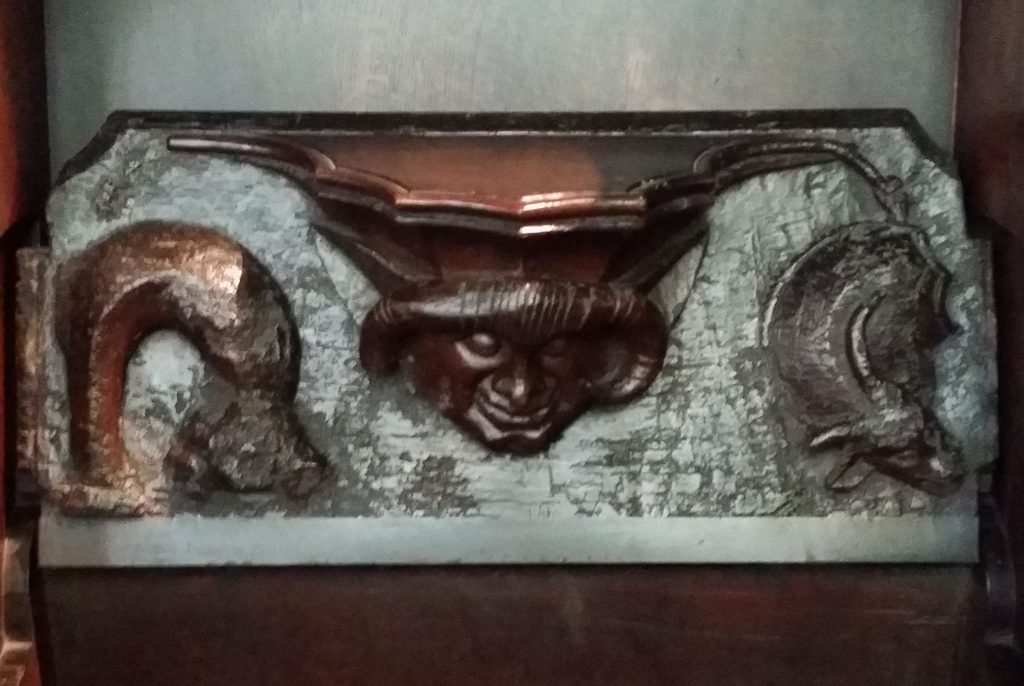
medieval monks seat showing carving of a Horned man (with Ram's Horn) at Stratford on Avon Holy Trinity Church) Photo: K Flude
Horned God (with Ram’s Horn) at Stratford on Avon Holy Trinity Church) Photo: K Flude. Carving of a dolphin to the left (symbol of Christ) a goat to the right (symbol of the damned – as Christ divides the sheep from the goats who are going to hell)

Horned Gods

November 4th is dedicated to hunting gods such as Herne, the Horned God, Cernunnos, The Green Man and Pan.

Herne the Hunter appears in Shakespeare:

There is an old tale goes, that Herne the
Hunter
(sometime a keeper here in Windsor Forest)
Doth all the winter-time, at still midnight
Walk round about an oak, with great ragg’d horns;
And there he blasts the tree, and takes the cattle,
And makes milch-kine yield blood, and shakes a chain
In a most hideous and dreadful manner.
You have heard of such a spirit, and well you know
The superstitious idle-headed eld
Receiv’d, and did deliver to our age
This tale of Herne the Hunter for a truth.

William Shakespeare, The Merry Wives of Windsor, Act 4, scene 4

I have recently seen a brilliant staging of the Merry Wives of Windsor at the Royal Shakespeare Company in Stratford. I saw it three times and think it one of the best Shakespeare productions I have seen. The lead actor, John Hodgkinson, with whom I used to play cricket, was a fantastic Falstaff.

Cernunnos

Cernunnos comes from karnon which means “horn” or “antler”. This may be the source of the name ‘Cerne’. (Please note that the Cerne Abbas Giant has just been redated from the Celtic to the Anglo-Saxon period.) Cerney and Cirencester in Gloucestershire might have similar origins for their names. The Cornovii is the name of three tribes in Britain. Cornwall, Shropshire and Caithness. It seems to mean people of the Horn, and the Horn thought to be stag’s horns. He is most often found in statues in the area around Paris, with an antler on his head, cross-legged and with a snake with him. He may be the god of the celtic underworld.
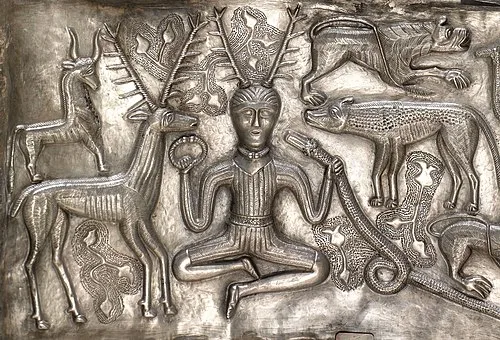
A Cernunnos-type figure on the Gundestrup cauldron (plate A). He sits cross-legged, wielding a torc in one hand and a ram-horned serpent in the other. Public Domain Wikipedia

The National Trust are appealing for funds to buy the Cerne Abbas Giant – click here to see the appeal.

Preparing for Guy Fawkes Day with Ginger Cake

Felicity Cloake The Guardian Parkin

Ginger cake is the traditional accompaniment to a cold night watching the Fireworks. There is a good recipe in Markham’s The English Housewife of 1683. But I’m suggesting you use this recipe from the Guardian for Parkin Cake. ‘Parkin is a gingerbread cake traditionally made with oatmeal and black treacle, which originated in Northern England.’ (Wikipedia).

For my post on November the 5th look here.
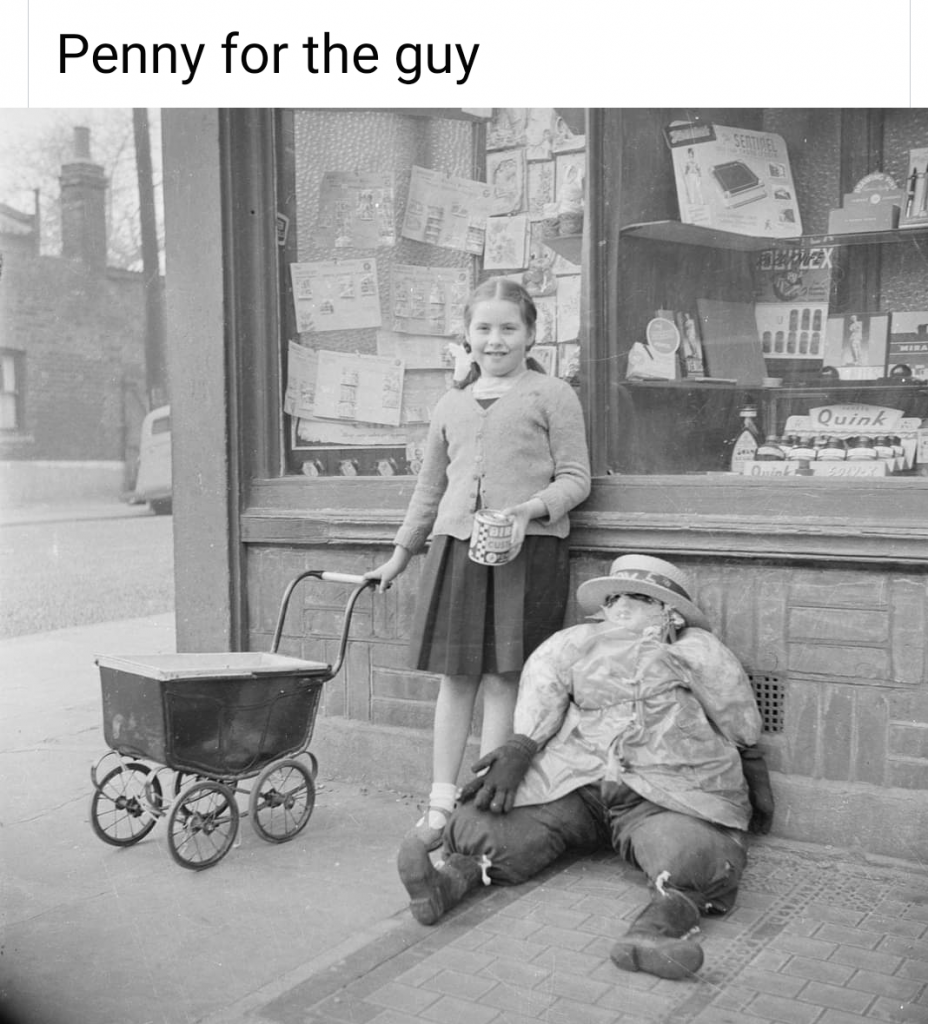
London picture Penny for the Guy on Guy Fawkes Day

I haven’t seen children asking for ‘a penny for the Guy’ for a while. But it was part of my childhood. We would create a ‘Guy’ out of old clothes and take it into the streets to raise money. The Guy is named after Guy Fawkes, who was discovered on 5th November 1605 in a cellar under Parliament. He was by a pile of barrels of gunpowder with a slow match. The plan was to blow up the King and Parliament, on the occasion of the Opening of Parliament on the 5th of November.

Once the plot had been broken and the plotters hanged, drawn and quartered, the King ordered that November 5th should be commemorated throughout the Country. Bonfires were a part of the seasonal celebrations at the time, used at Halloween, but this aspect was transferred to November 5th and continues as a major British event every year.

The money we raised, we spent exclusively on ‘bangers’ loud explosive fireworks not pretty fountains, Roman candles nor rockets. The bangers just made a horrendously loud bang. One stunt we experimented with was to cycle through the streets and to put a lit banger into the handle bars, which would act as a rocket launcher! Don’t try this at home.

Meanwhile, we would collect wood for the village bonfire:

A stick and a stake
For King George’s sake
Will you please to give us a faggot
If you won’t give us one, we’ll steal you two
The better for we and the worse for you.

English Folk Verse (c.1870)

First published 4th November 2021, republished 4th November 2024, 2025

Sliding Ducks & the Equivocation of Prophecy – November 3rd

Ducks in Winter 
Photo by <a href="https://unsplash.com/@timromanov?utm_content=creditCopyText&utm_medium=referral&utm_source=unsplash">Timur Romanov</a> on <a href="https://unsplash.com/photos/ducks-on-water-a5U8v7Pm-yg?utm_content=creditCopyText&utm_medium=referral&utm_source=unsplash">Unsplash</a>
Sliding Ducks? or Swimming Ducks? Timur Romanov, Photo from Unsplash

Folklore is full of ways of predicting the future – mostly about the weather or love. The Perpetual Almanac by Charles Kightly features many of these in rhyme form of the ‘Sky at Night Shepherd’s Delight’ type. Here is a seasonal one.

If ducks do slide at Hallowentide
At Christmas they will swim
If ducks do swim at Hallowentide
At Christmas they will slide

From my experience, in the south of the UK, this is simply not true as we very rarely get ice in early November. Nor do we get snow at Christmas that often. But maybe, the further north you go, the truer this becomes.

Macbeth & Prophecy

But, as far as taking prophecy seriously, it’s good to remember what Macbeth said on seeing the wood moving to Dunsinane.

‘(I) begin to doubt the equivocation of the fiend, that lies like truth.’

He has just realised that prophecy is a double-edged sword which has led him to his doom. He had been told by the Three Witches that he:

‘shall never vanquish’d be until Great Birnam Wood to high Dunsinane Hill shall come against him’

Still, as he heads to the final battle, Macbeth knows he is invincible and that

‘none of woman born shall harm Macbeth’.

But in his savage fight with Macduff, he is told that Macduff was not of woman born, but was:

from his mother’s womb / Untimely ripped’.

So Macbeth is killed.

Google Map showing Birnam (Scotland), top left, and Dunsinane Hillwith red markers in the middle. Note Scone is where Macbeth is Macbeth was crowned

King Macbeth (Mac Bethad mac Findlaích) 1040 – 1057

In reality, Macbeth, was a successful King who reigned for 17 years. He was one of the last Gaelic Kings as Scottish society was changing with contact with England.

This is a draft of the text that (edited) forms part of my best-selling book ‘Divorced, Beheaded, Died’ The Kings and Queens of Britain in Bite-sized Chunks’

Macbeth was nicknamed the Red King. He was a Gaelic speaker, descended from the Kings of Dal Riata. Macbeth’s father, Finlay MacRory, was Mormaer (Grand Steward) of Moray and was was murdered by Gillacomgain. He took MacRory’s title. Gillacomgain was burnt to death with 50 of his followers, probably by Macbeth, who thus not only regained the title as ruler of Moray but married his dead rival’s widow, Gruoch. She was the granddaughter of Kenneth II. Macbeth was also himself descended from the Kings of Scotland via his mother Donada probably daughter of Malcolm II.

His claim to the throne was therefore strong, and following the disasters of King Duncan’s reign, Macbeth seized the opportunity to take the throne for himself.

He ruled well for nearly 2 decades imposing a strong sense of law and order, encouraging Christianity and leading successful raids across the border into England. In 1050 he went on pilgrimage to Rome. Exiled Normans, supporters of Edward the Confessor were settled in Scotland in Macbeth’s reign. There is no evidence that Macbeth was any more evil then the rest of the early Scottish Kings.

In 1057 Macbeth was killed in battle against Duncan I’s son who became Malcolm III. Macbeth is buried on Iona. He and Gruoch had no children but Guoch’s son, Lulach, son of Gillacomgain briefly followed Macbeth as king before being assassinated by Malcolm III

‘Divorced, Beheaded, Died’ The Kings and Queens of Britain in Bite-sized Chunks’ for more details look here.

Prophecy ‘lies like the truth’ a trope that is used in many ancient tales such as Oedipus Rex.

On this Day

Hilaria

The 3rd of November is also the Hilaria, the last day of the festival of Isis/Osiris. This is the day of the rebirth of Osiris. He was ‘the god of fertility, agriculture, the afterlife, the dead, resurrection, life, and vegetation.’ Isis was the wife (and sister) of Osiris God-King of Egypt. Osiris was killed by his brother. Set. Isis restored his body to life for long enough to conceive their son Horus.

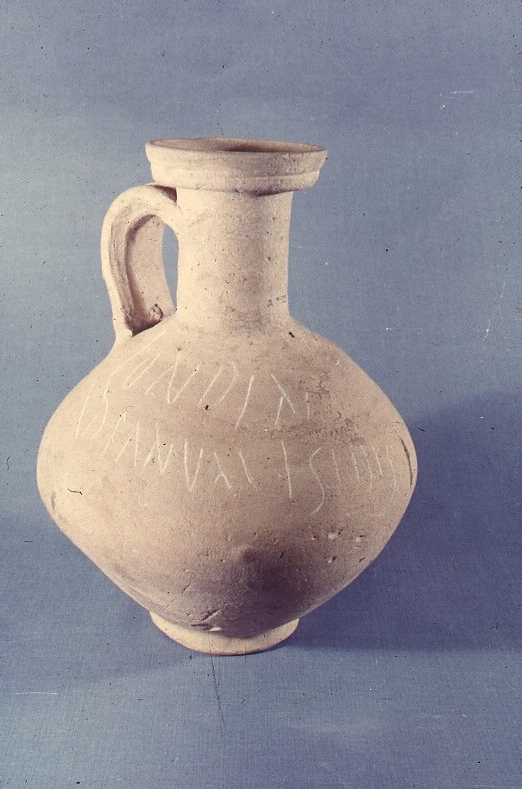
Horus revenged his father, regained the throne, restored Cosmic Order and completed the resurrection of Osiris. Isis is normally shown holding the baby Horus in a pose that may have influenced images of the Virgin Mary. Londinium would have had a celebration on this day as there is a pot found near London Bridge inscribed ‘At London, at the Temple of Isis).

Roman pot with Isis inscription, London

Head Graft and St Winifred

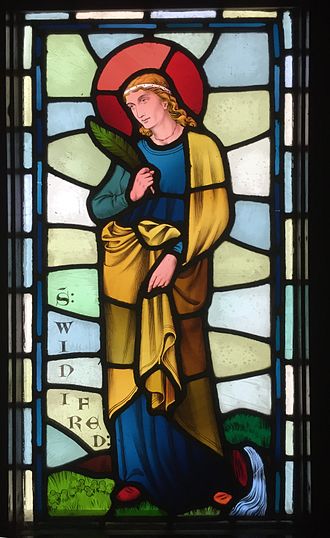
Stained glass depiction of St Winifred, designed by William Burges, at Castell Coch, Cardiff. Wikipedia Hchc2009 – Own work

St Winifred’s Day She was beheaded by Caradog who would not accept her refusal to have him because of her religious views. She was restored to life by St Beuno, or St Bono. Head and all. Where her head fell their slowed a spring. This is on the North Welsh Coast, and called Holywell. It was one of the Seven Wonders of Wales, and called the Lourdes of Wales.

First Posted on 3 November 2021. Revised 3 November 2023 & 2024 & 2025

All Souls Day – November 2nd

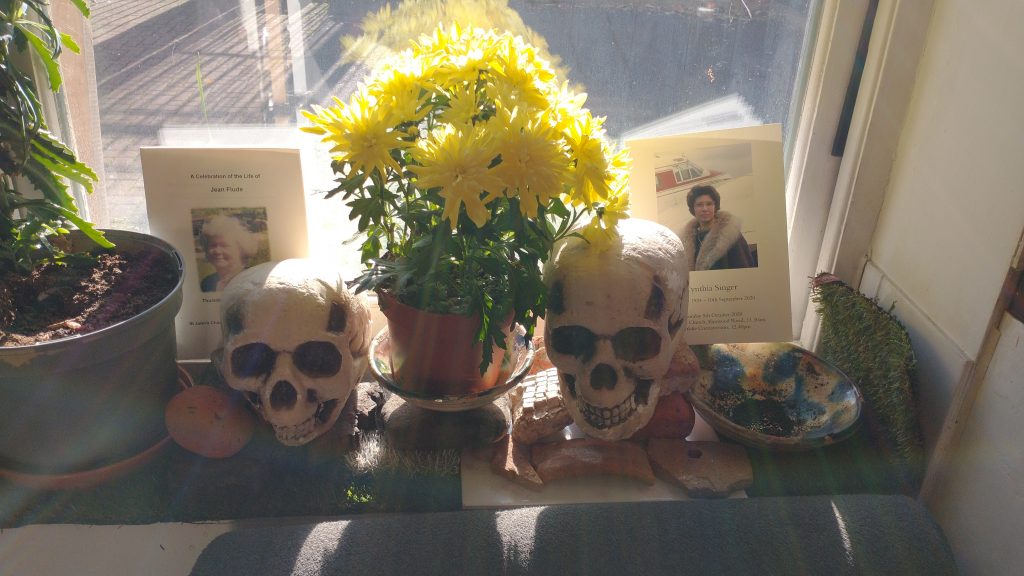
Picture of window sill with skulls, Chrysanthemums  and pictures of remembrance
El Dia de los Muertos – All Souls Day, in Haggerston, London. Photo K Flude.

Today is the Mexican Day of the Dead. In fact, the second day of El Dia de Muertos. Here is a video from Mexico, which you will enjoy for its Latin song and images of the Day of the Dead in Mexico. (It’s on Facebook, so may not work unless you have a login). And here is a YouTube explanation of celebrations in Mexico.

Today is the day to celebrate all those loved ones who have passed away. To keep them in mind, to remind you that you still care about them. It is the third day of the season of Allhallowstide, following All Hallows Evening (Halloween), and All Saint’s Day.

Beata, who comes from Poland, tells me that, November the 1st is the day when relatives visit the cemeteries of the dead. Loved ones bringing chrysanthemums to decorate the graves. It’s a happy day for the dead because they are being remembered and visited. Today, November 2nd, is a more sombre day – a day to stay at home and think of the loved ones. Perhaps looking through albums of photographs?

Souling

In England, it was the time of year in which ‘Souling’ used to take place. Households made soul-cakes. Children or people in need of food come to visit and are given soul cakes in exchange for praying for the dead.

Soul, soul, for a souling cake.
I pray good Missus for a souling cake.
Apple or pear, plum or cherry.
Anything good to make us merry.

Traditional rhyme from Shropshire and Cheshire

Moving on from Purgatory

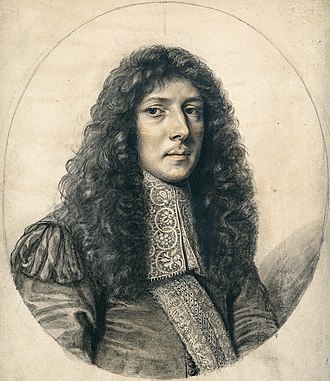
This is based upon the idea of Purgatory, and the belief that intervention on Earth can influence the amount of time an ancestor spends in purgatory for their sins. John Aubrey (1626 – 1697), antiquarian, collector of folklore and writer, mentions a custom in Hereford which shows a variant of the idea.

John Aubrey (Wikipedia)

In the County of Hereford was an old Custom at Funerals, to hire poor people, who were to take upon them all the Sins of the part deceased. One of them I remember (he was a long, lean, lamentable poor rascal). The manner was that when a Corpse was brought out of the house and laid on the Bier; a Loaf of bread was brought out and delivered to the Sin-eater over the corps, as also a Mazer-bowl full of beer, which he was to drink up, and sixpence in money, in consideration whereof he took upon him all the Sins of the Defunct, and freed him (or her) from Walking after they were dead.

John Aubrey, Remains of Gentilism 1688

This belief in the power of action in the Here and Now to lubricate passage through Purgatory to the Ever After was a major part of fund-raising for Catholic Institutions before the Reformation. For example, in the records of St Thomas Hospital, Southwark, a wealthy widow called Alice (de Bregerake – if I remember the spelling correctly) left her wealth to the hospital in return for an annual Rose rent; lifetime accommodation in the Hospital in Southwark, and for the monks and nuns to pray for her soul and the souls of her ancestors.

Purgatory was not a settled thing in Catholic Theology before the 12th Century or so. However, the idea that prayers for the dead could be useful dates back before the Roman period. Catholics took 2 Maccabees as their biblical authority for Purgatory. But Luther demoted Maccabees to “apocrypha“. And today the Anglicans view it as ‘useful’ but not to be used for ‘doctrine.’

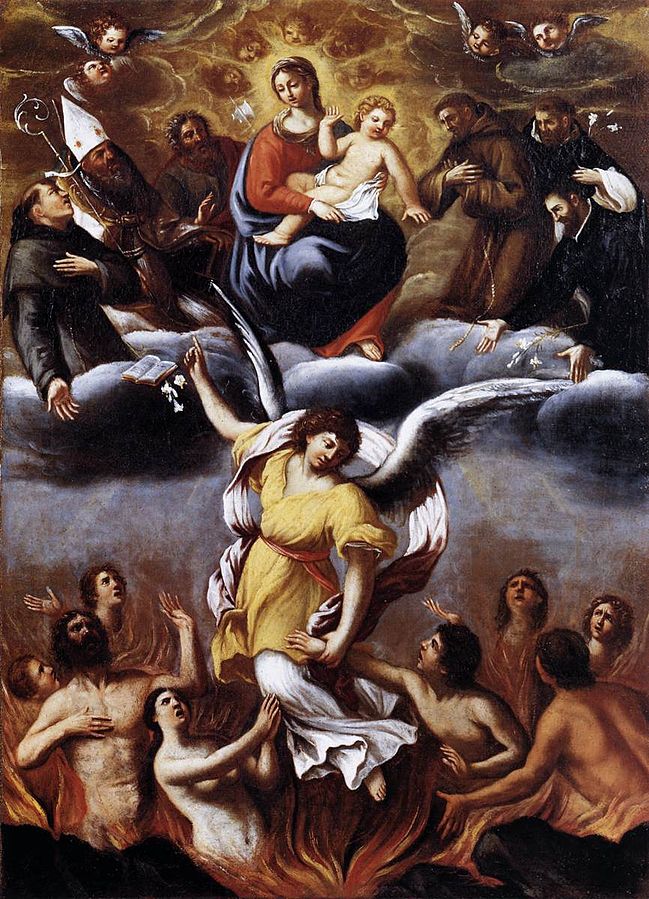
Ludovico Carracci: English: An Angel Frees the Souls of Purgatory (Wikipedia)
Ludovico Carracci: English: An Angel Frees the Souls of Purgatory 1610 (Wikipedia)

All Souls, London

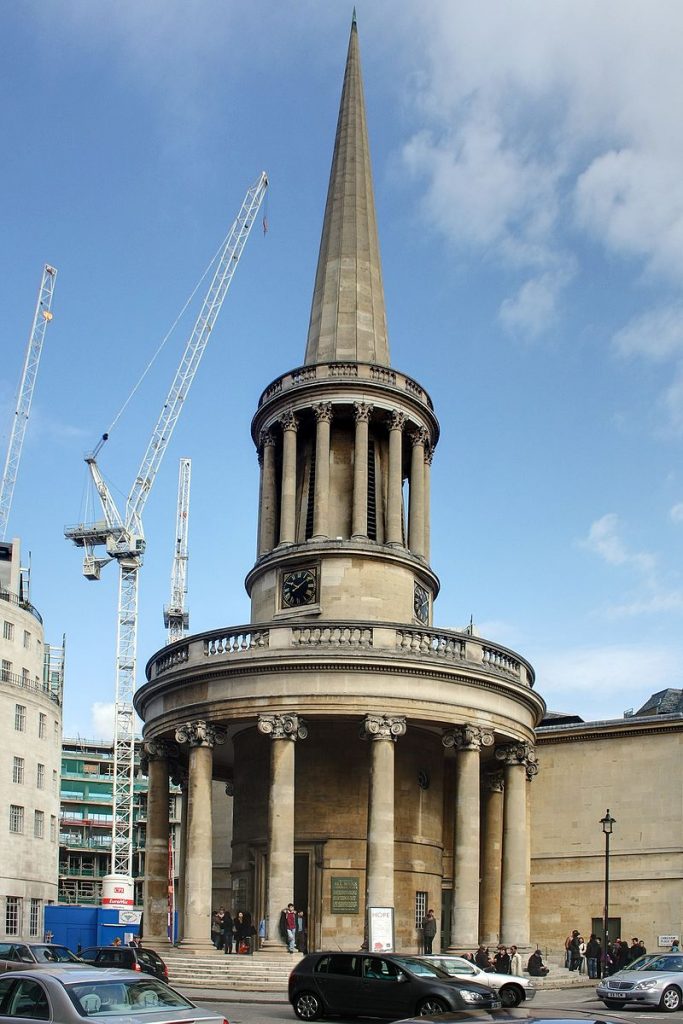
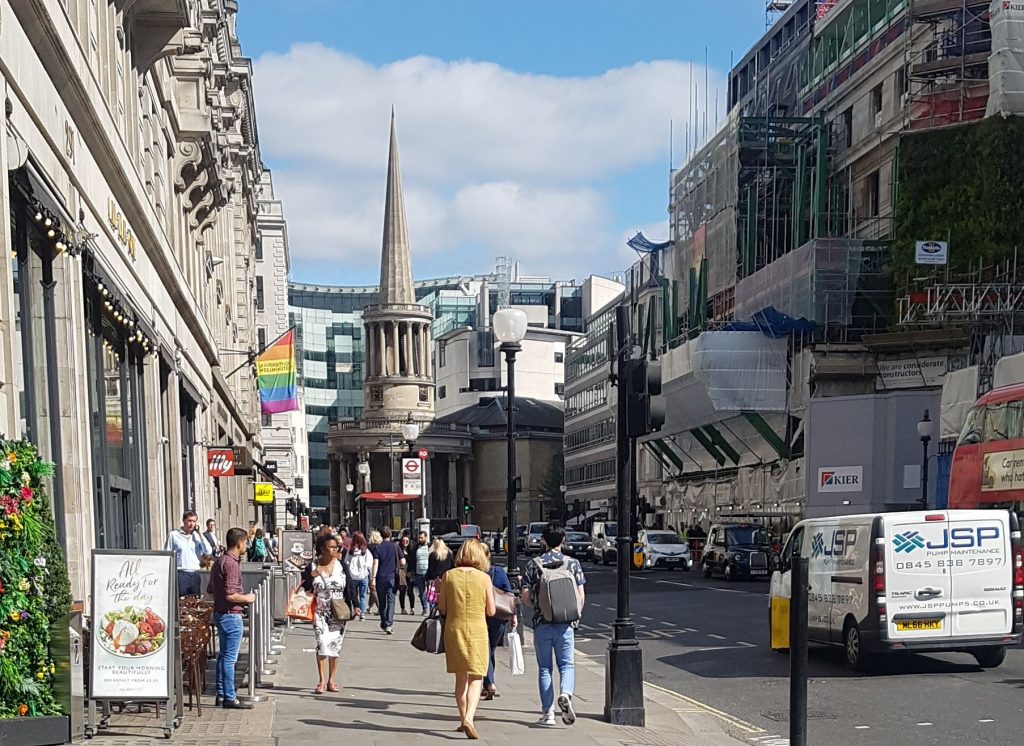
One of London’s most beautiful churches is dedicated to All Souls. It is All Souls, Langham Place. It is just near the BBC HQ and on a wonderful site, as it is on a bend in Regent’s Street. This shows it to great advantage. The architect was John Nash (1824) as part of his transformation of the West End with his boulevard from Regent’s Park south to Westminster. As he could not get all the property owners on the alignment of the road to sell him the land, he disguised this enforced bend with a magnificent Church.

All Souls Langham Place By David Castor (dcastor) – Own work, Public Domain, https://commons.wikimedia.org/w/index.php?curid=6516081
Regent’s Street looking north to All Souls (photo K Flude)

See my posts on Halloween and, and All Hallows Day here

Revised 2nd November 2025, 2024, 2023 and first published 2nd Nov 2021

All Hallows Day – November 1st

 chrysanthemums
Chrysanthemums Flowers for the Dead (the author’s back garden)

How the Celtic festival that marked the beginning of Winter became All Hallows is not clear. Some say the Church set up its own festival independent of the Northern European traditions. But it is as likely that the Church adopted existing pagan festivals, and gave them a Christian spin.

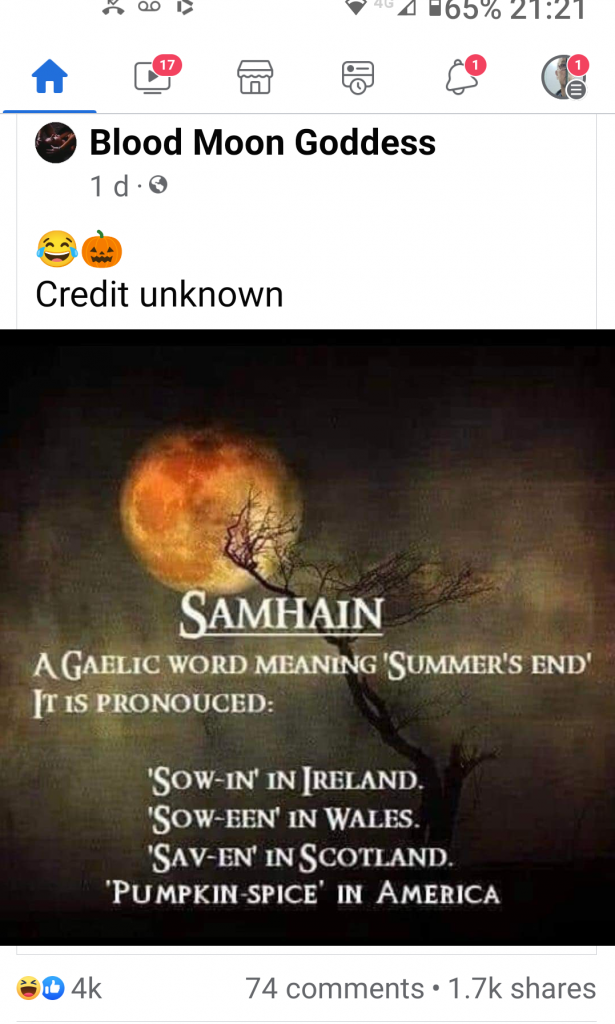
Samhain, on October 31st, was, for Celtic religions, not only the beginning of Winter but also the beginning of the Year. As I noted on my Halloween post the Festivities began in the evening before the day because Celtic and Germanic traditions began their day at Dusk. So Halloween is not, in fact, the evening before, it is the start of the day of the festival.

Facebook Image giving the words for Samhain in Celtic languages

The Church adopted the Roman tradition of the day beginning not at Dusk but at Midnight. So the festival of All Hallows is on November 1st not October 31st. But the Church mimicked the old ways of doing things by celebrating the evening before as the Vigil of All Hallows’ Day. This was called All Hallows Evening or Halloween.

All Hallows by the Tower, London

Engraving of All Hallows Barking

In London, there is a Church called All Hallows, on Tower Hill. It is associated with Barking Abbey, founded in the 9th Century. Therefore, it is known as All Hallows Barking or All Hallows by the Tower. The Church has a prominent position on Tower Hill, which would have been visible from boats coming up the Thames. Also in the Church is the earliest Post-Roman arch in a Church in the City of London. This is made of reused Roman bricks. Moreover, in the crypt are Roman tessellated floors.

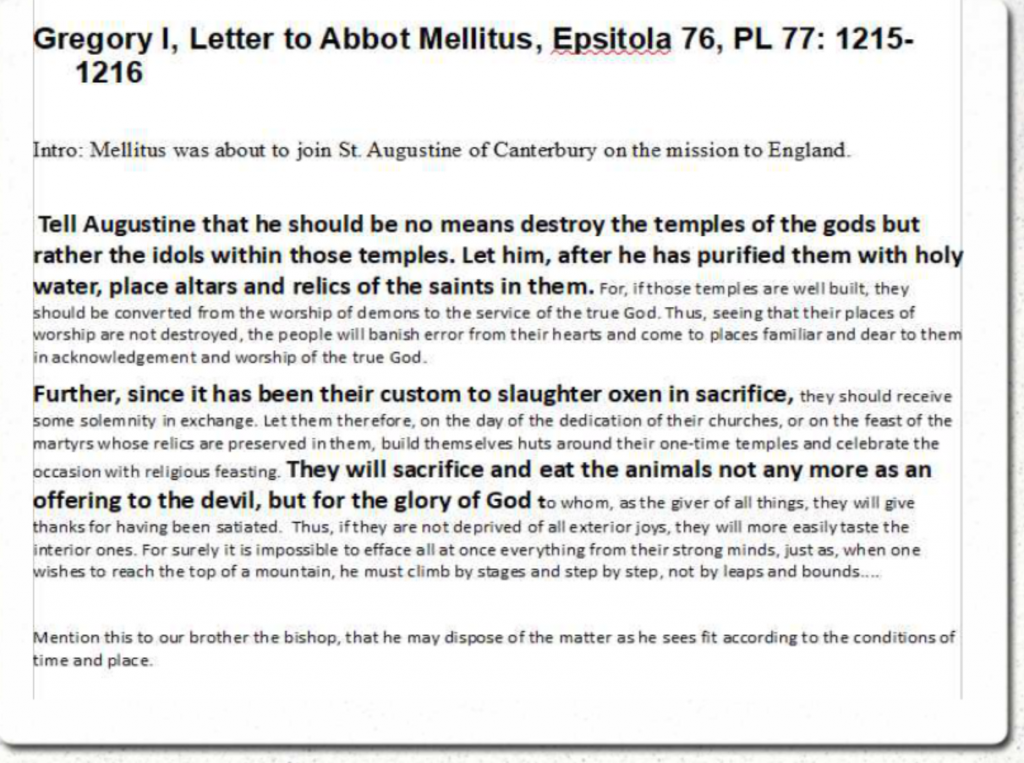
Letter from Pope Gregory to St Augustine

Now, I don’t want to be shot down in flames because there is no evidence that there was a Roman Temple here. Nor indeed a Roman or immediately Post-Roman Church. But it is one of the earliest Churches in the City of London. There must have been Christian Churches in Roman London, and this would be on my list of candidates. It is simply that the attribution to All Hallows provides a possible link to Celtic festivals. So speculation rather than anything else. The letter above, gives a context for the conversion of a pagan Temple to a Christian Place of Worship.

An Uncanny Day to Hallowed Day

For the Celts, Samhain was an uncanny day when all the sprites and spirits are alive and in the world. The Church took that, and span in on its head. So it became a ‘hallowed’ holy day when all Saints are celebrated and alive to us. Celebrated on October 31st and November 1st.

A celebration of All Saints was originally in May in the Church but was changed to the 1st November in the 7th Century by Pope Boniface. Later it was swapped back to May. But fixed again on the 1st November in the 9th Century. It is followed on the 2nd by All Souls’ Day. (see my post on All Souls Day here.

So on the 1st November, those celebrating the pagan festival would be in full swing after a hard night of celebration. The embers of the Fire would be still burning, stones left around the fire would be inspected for the prophecy they told of the future. Each person had a stone, and if it was still intact it was good luck, if it had disappeared the future was not good.

La Toussaint et Dia de Todo Los Santos

In France, All Hallows or All Saints is called La Toussaint, and flowers such as Chrysanthemums, which blossom in late October, were put on the graves. In Spain, it is Dia de Todo Los Santos and is a national holiday upon which people put flowers on the graves of the dead.

In Mexico, Dia de los Muertos celebrates Holy Innocents on the 1st. People create altars to the lost ones, with their favourite flowers, toys, food stuffs,, photographs. People argue about the pre-colombian aspects of the festival as there are similarities to European All Saints Days celebrations. But Quecholli, was a celebration of the dead that honoured Mixcóatl – the god of war. It was celebrated between October 20th and November 8th.

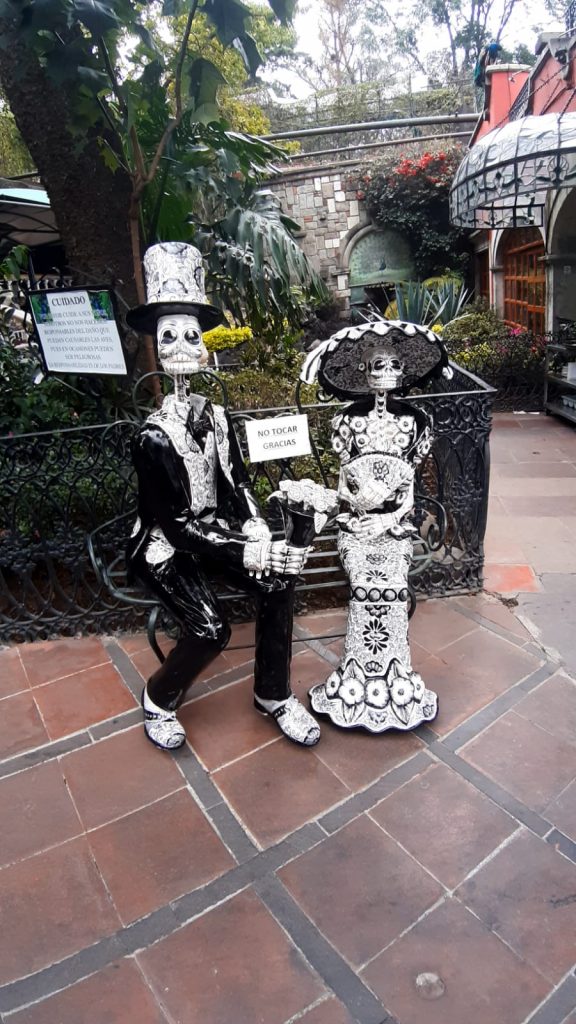
A correspondent in Mexico has sent back these pictures of the festivities in Mexico.

The female figure to the left is La Catrina. This image was popularised by an early 20th Century design by José Guadalupe Posada and developed in a mural by Diego Rivera. For more details click here.

A Day Off for the English

In the Laws of King Alfred the Great, this day was a day off for freemen. See my post on Days off in the Anglo Saxon Calender on August 15th.

First published in 2022, revised in 2023, 2024, 2025
Halloween October 31st

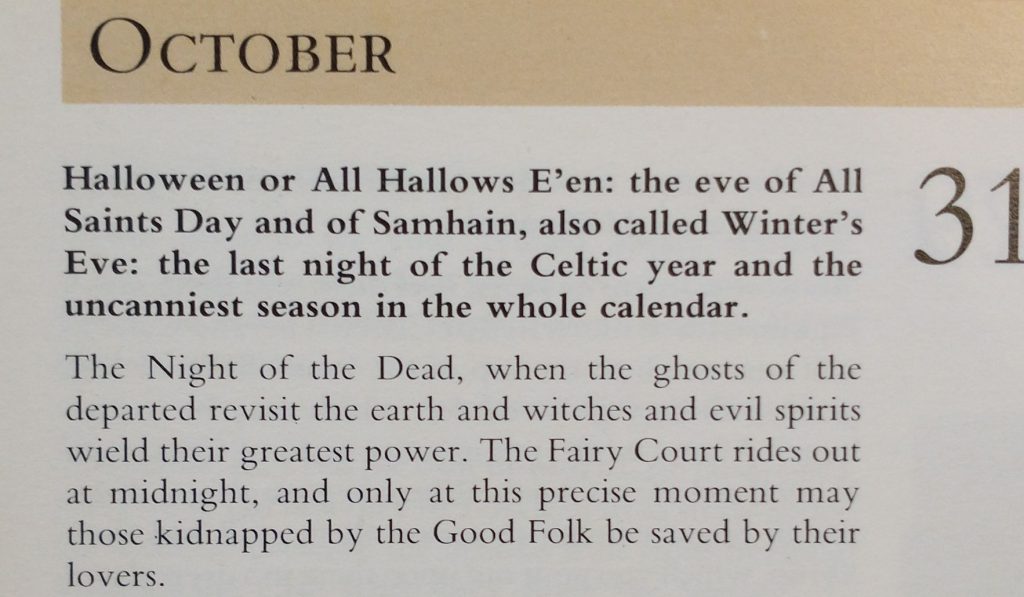
From the Perpetual Almanack of Folklore by Charles Kightly

I began my perpetual Almanac of the Past four years ago on the 31st October 2021. This was the first line:

‘This blog is to celebrate the Year. I will post, hopefully, once a day, so we can follow the seasons, as they happen naturally, and as people in Britain and Ireland have responded to the changes in the year.’

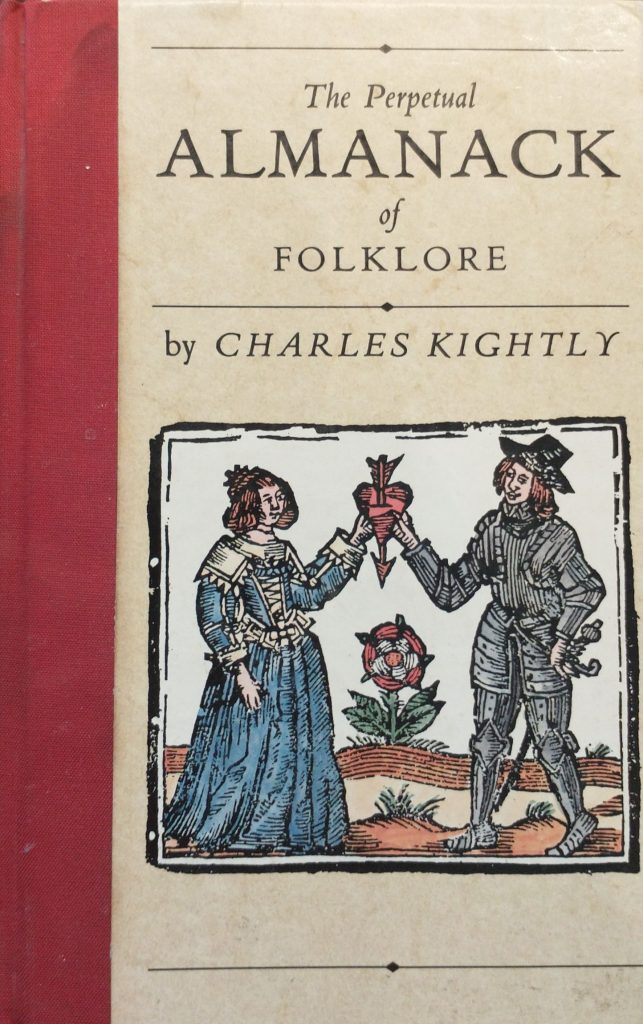
It was inspired by Charles Kightly’s book, which is a pot-pourri of folklore taken mostly from old Almanacs. I haven’t managed, yet to create a post for every day of the year, nearly managed it in the winter but falling behind in the Summer when I take Road Scholar groups around the UK. My plan is to fill in the gaps, improve posts and get rid of typos. Another aim is to add more London-specific content.

Cover of Charles Knightly's Perpetual Almanac
Cover of Charles Kightly’s Perpetual Almanac

I started on Halloween because Samhain (pronounced Sow-in) was the beginning of the year for the Celtic world. It may mean Summer’s End. In Wales, it is Calan Gaeaf (first day of winter) and Kala Goafiv (beginning of November in Brittany).

Why did the Celts start their year at such an unlikely time? A clue is that they began the next day at dusk. The Sun dies at dusk so it is the end of the day, and the next day begins with the death of the old day. 

So the New Year begins with the Death of the Old Year. Now that might suggest the Winter Solstice as the best time to start the year as this celebrates the death of the old Sun. (see my winter solstice post here :) But, the end of October has, perhaps a better claim. The harvest is in, the fruits in the trees and the nuts are harvested, all the growth of the Summer is over and collected.  Plants are mostly dead or dormant, except some evergreens. It is the end of the growing year. The seeds have fallen from the trees and shrubs and are nestling in the soil, ready to begin their cycle again. All is over and all is ready for the new year. Makes sense?

The Celtic way also explains eves; Christmas Eve, New Year’s Eve, May Eve, All Hallow’s Eve.  They are not the night before the day, they are the beginning of the day.  This is when you begin the celebration.

For the Romans, today is the day that Adonis is injured hunting a wild boar. Against his lover’s (Venus)  advice, he descends to the underworld. Nature withers and dies until he returns from the underworld. His blood stains a flower and was transformed into the Crimson Anemone. There is a similar story in Babylon of Ishtar and Tammuz.

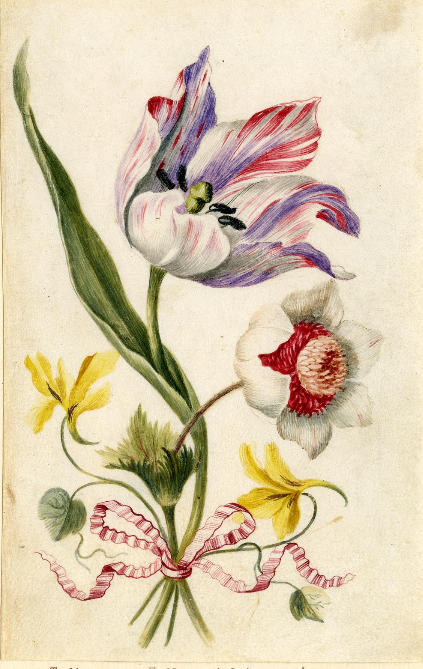
By Alexander Marshall, crimson and other anemones
Binyon 1898-1907 / Catalogue of drawings by British artists, and artists of foreign origin working in Great Britain (5(c))

Adonis comes back on May Day when he meets Venus again, so the world flourishes and is bright and warm.

Julius Caesar says the Gauls venerated the God Dis Pater on this day – an aspect of Pluto, the God of the Underworld, ruler of the Dead. There was a Roman Festival on the Kalends of November dedicated to Pomona, the goddess of the fruit of trees. This may influence the use of Apples, which are prominent in Halloween festivities.

For more about the origins of Halloween, please look at my post on All Hallows Day here:

First written in 2021, and revised 2023, 4 and 5.

Wife-Selling & the bonds of Marriage October 1837

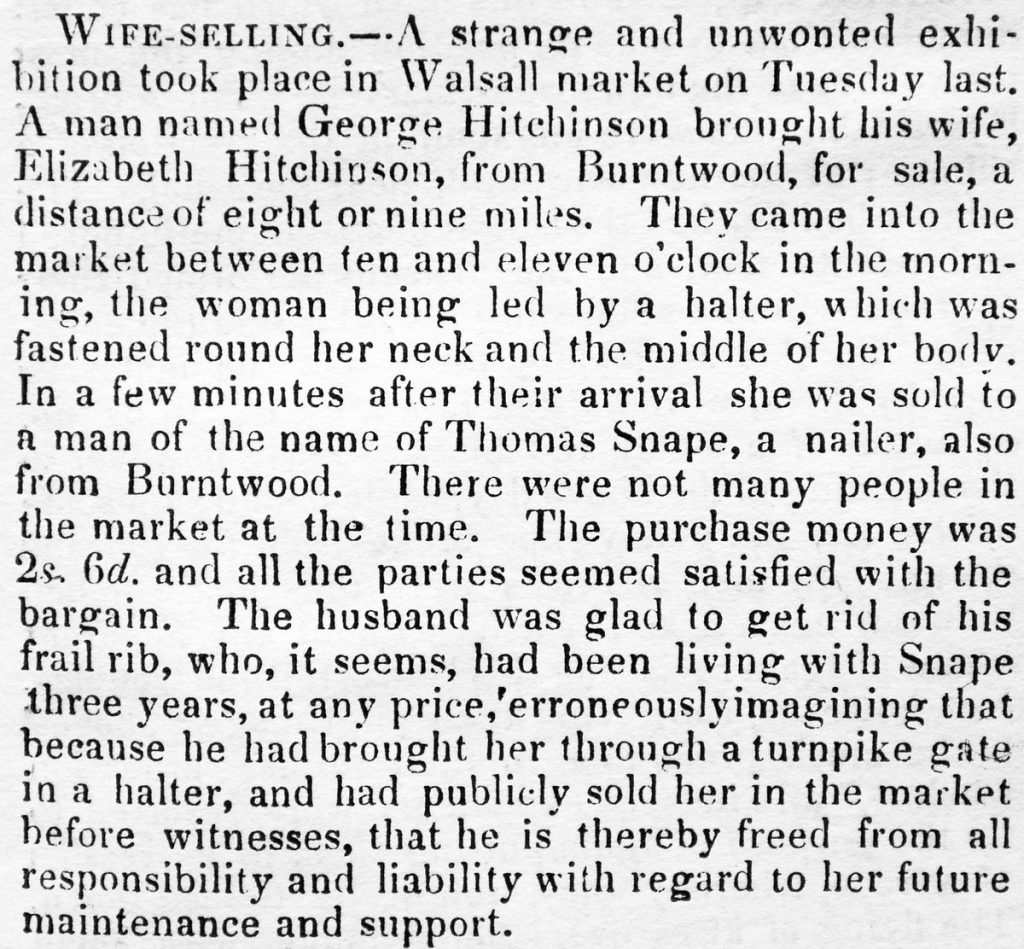
October 1837, Wolverhampton Chronicle. A case of wife-selling

A strange and unwonted exhibition took place in Walsall market on Tuesday last,” the Wolverhampton Chronicle said about a case of wife-selling.

“A man named George Hitchinson brought his wife, Elizabeth Hitchinson, from Burntwood, for sale, a distance of eight or nine miles. They came into the market between ten and eleven o’clock in the morning, the woman being led by a halter, which was fastened round her neck and the middle of her body. “

“In a few minutes after their arrival she was sold to a man of the name of Thomas Snape, a nailer, also from Burntwood. There were not many people in the market at the time. “

“The purchase money was 2s 6d [about 13p today] and all the parties seemed satisfied with the bargain. The husband was glad to get rid of his frail rib, who, it seems, had been living with Snape three years, at any price, erroneously imagining that because he had brought her through a turnpike gate in a halter, and had publicly sold her in the market before witnesses, that he is thereby freed from all responsibility and liability with regard to her future maintenance and support.”

Wife-selling and the Mayor of Casterbridge

Readers will note the similarity of this to the plot of the Mayor of Casterbridge by Thomas Hardy, published in 1886. Michael Henchard, gets drunk on spiked Furmity. This is also known as frumenty – a mixture of Corn, milk, raisins and currents. The Furmity Woman at Weydon-Priors Fair adds Rum. Henchard, in a drunken rage, offers his wife for safe. She is purchased by Richard Newson, a sailor who goes on to have a successful relationship with Henchard’s wife until the sailor is drowned.

A cruel humiliation or a practical solution?

While not exactly legal, records show that wife-selling at markets happened occasionally from the 17th Century onwards. As in the case at Walsall Market, it seems to have been a recognised mechanism to end an unsuccessful marriage. In both factual and fictional cases, the wife accepts the sale to rid herself of a difficult husband. The husband is relieved of his lifelong duty to be financially responsible for his wife, and, for a fee, he passes that duty on to the buyer.

The sale seems to a modern onlooker to be a humiliation. But the public nature of it might be rather a public acknowledgement that the marriage has irrevocably broken down, and that another union has superseded the failed marriage. In the Walsall case, the new husband has, in fact, been living with the wife for some years.

At this time, there was no legal way to divorce except by the means of an expensive private Act of Parliament, far beyond the reach of any but the richest. Marriage itself was also a looser institution than we think. Hand-fasting and common-law marriages were very common in pre-Victorian times. The difficulty of divorce is also a theme in Hardy’s ‘The Woodlanders’.

A recipe for frumenty:

To make a rich frumenty for 10 people. Steep 1 lb of whole grain of wheat in water overnight, and then boil the steeped grains in one pint of milk until the whole be soft. Add thereto raisins and sultanas, honey a nutmeg freshly grated, a little cinnamon, brandy and cream: and serve it forty hot or cold.

Mistress Bartons Cookery book c1680. quoted in Charles Kightly’s Perpetual Almanac of Folklore

You might like to also see my post on the shaming skimmity ride, which also appears in the Mayor of Casterbridge.

On This Day

1415 St Crispin’s Day and the Battle of Agincourt.

This is part of the famous speech by Henry V, put in his mouth by William Shakespeare.


He that outlives this day, and comes safe home,
Will stand a tip-toe when this day is nam’d,
And rouse him at the name of Crispian.
He that shall live this day, and see old age,
Will yearly on the vigil feast his neighbours,
And say “To-morrow is Saint Crispian.”
Then will he strip his sleeve and show his scars,
And say “These wounds I had on Crispin’s day.”
Old men forget; yet all shall be forgot,
But he’ll remember, with advantages,
What feats he did that day. Then shall our names,
Familiar in his mouth as household words—
Harry the King, Bedford and Exeter,
Warwick and Talbot, Salisbury and Gloucester
Be in their flowing cups freshly rememb’red.
This story shall the good man teach his son;
And Crispin Crispian shall ne’er go by,
From this day to the ending of the world,
But we in it shall be rememberèd—
We few, we happy few, we band of brothers;
For he to-day that sheds his blood with me
Shall be my brother; be he ne’er so vile,
This day shall gentle his condition;
And gentlemen in England now a-bed
Shall think themselves accurs’d they were not here,
And hold their manhoods cheap whiles any speaks
That fought with us upon Saint Crispin’s day.

First published in July 2022, revised and reposted October 2024 and 2025

The Miracle of the Testicles October 20th

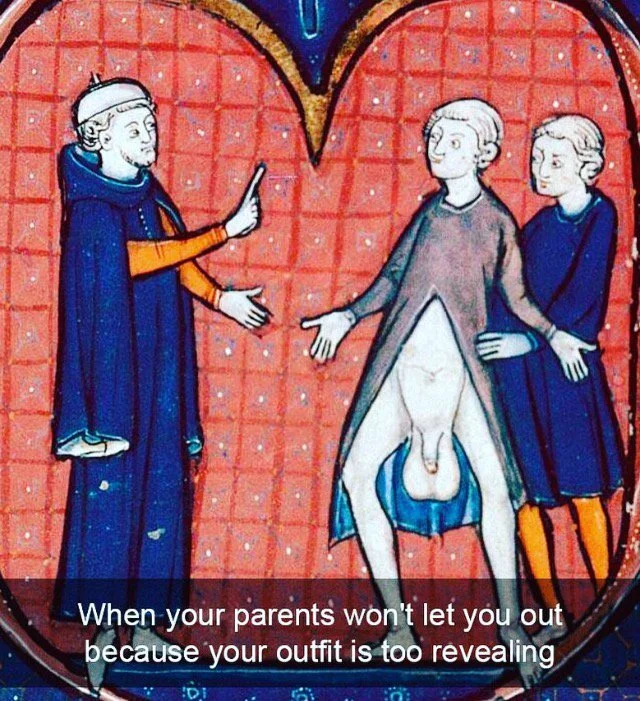
Image from Facebook, illustrating the miracle of the testicles

I’m having technicals problems, as well as being away from home. I posted this a few days ago but it doesn’t seem to have been posted to subscribers. So posting it again.

Today, almost my favourite of many bizarre tales of Saints. St Artemios is the patron saint of male genital disorders, more specifically, hernias and ruptures. His Saint’s Day is October 20th St. Artemios was Governor of Egypt during the reign of Julian the Apostate (331 – 26 June 363). Julian was a philosopher. Nephew to Constantine the Great, who tried to turn the tide and return to traditional Roman religious practices.

Artemios was called to a military meeting with Julian where he witnessed and objected to abuse of Christians. He was tortured with red hot irons, and miraculously cured. Then he was taken to the Amphitheatre where there was a big stone broken in half. He was put on half stone and the other half was raised above him and released, crushing Artemios. He was presumed dead, and left for a day. But he was still alive, broken boned, disembowelled, eyeless and remained unwilling to renounce his religion. Julian ordered his beheading.

A noble woman took his body to Constantinople where his shrine soon started attracting miracles. In the 7th Century, an anonymous author compiled a record of the miracles. St Artemios had become known for healing hernias and genital disorders ‘mostly in men.’ I’m not sure entirely why. Perhaps because of the red-hot pokers? The disembowelling? Maybe the stone that crushed him was round?

I first came across the Saint when I was given a wonderful book called ‘A Medieval Miscellany‘. Tales are selected by Judith Herrin and with an introduction by the great Emmanuel Le Roy Ladurie (see Jan 27th Post to read about Montaillou and Ladurie). It had a colourful spread called ‘The Miracle of the Testicles’. This was the story told by Stephen, a 7th Century deacon of St. Sophia in Constantinople who ‘suffered a rupture, whether from shouting acclamations or from a heavy weight, I cannot say.

To cut a long story short, Stephen was very embarrassed by his condition. He tried many cures but finally undertook surgery. This was successful, but very soon the condition reoccurred which left him to despair.

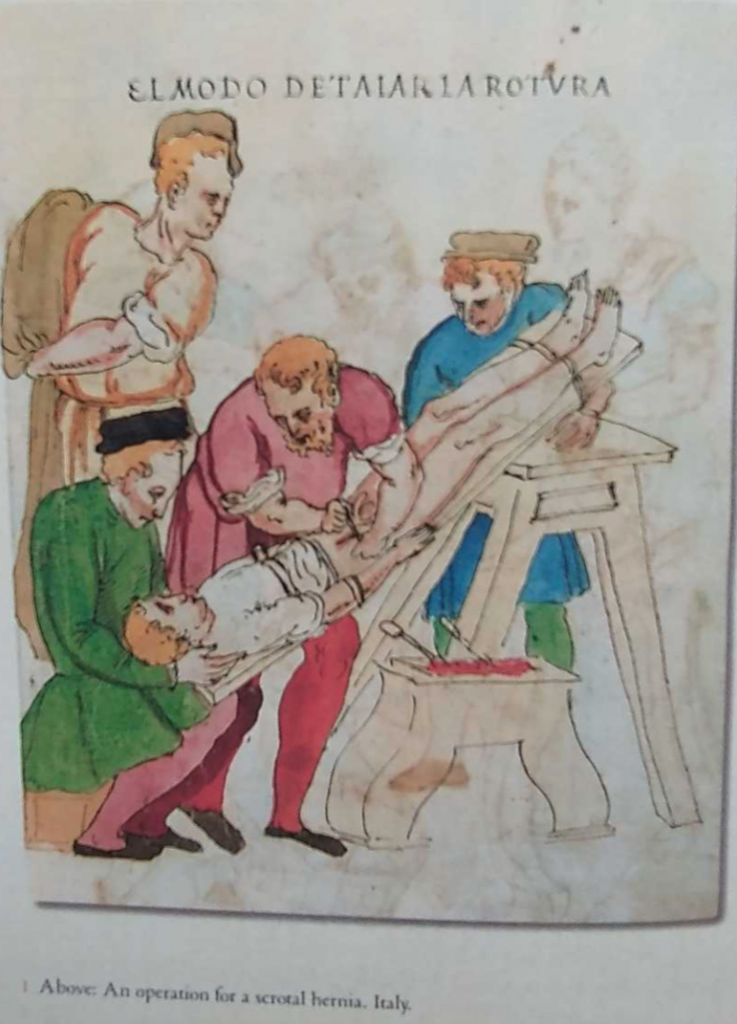
Scrotal Hernia Operation, italy

So he planned to visit the shrine of, Artemios, the great healer of testicles. However, he was too embarrassed to stand in the Church, ashamed to be seen by friends. But passing by one day he nipped into the Tomb, descended to where the relics were and ‘cast’ some of the Saint’s holy oil on his testicles. He then found, much to his surprise, that the doors to the Coffin itself were open. Seeing this as a divine intervention he jumped onto the coffin, straddled it face down, so that the corner of the tomb was rubbing his testicles and prayed:

And with tears, I spoke again to the martyr: “St.Artemios, by God, Who has given you the gift of cures, no doctor on Earth will ever touch me again. So if you please, cure me. But if not, to your everlasting shame I will live thus without cure.

He was not cured immediately. Later he went to the Hot Baths and bathed, and on leaving the baths, thanks be to St Artemios, he was completely cured.

I have transcribed the translation of Stephen’s writings and place it here below as it has many fascinating aspects and remember it is a 7th Century account. But what an extraordinary tale: that it seems reasonable to steal into a tomb, take the holy oil, rub your genitals all over the shrine, and then tell the Saint that it will be to his everlasting shame if he does not make the cure!

For more on the Hospital of Sampson click here. Livanon is one of the Roman Baths in Constantinople and it is interesting that the cure follows bathing in them. The Oxeia is a neighbourhood in Constantinople connected with St Antemios. A cautery is a method to remove or close off a part of the body. It can be hot, cold or chemical.

At long last I disclosed the misfortune to my parents, and after many treatments, (how many!) had been performed on me. Finally, after taking counsel with them, I entrusted myself for surgery to the surgeons in the hospital Sampson, and I reclined in the hospital room near to the entrance to the area devoted to eyes.

After I had been treated all over for three days at night with cold cauteries, surgery was performed on the fourth day. I will omit to what horrible things I experienced while on my back.

To sum up everything, I state that I actually despaired of life itself at the hands of the physicians. After God, entreated by the tears of my parents, restored my life to me, and after the scar from the incision and the cautery had healed, and just as I was believing that I was healthy, a short time later, the same condition recurred and so I reverted to my former state…

I had a plan to approach the holy martyr, as I had heard of his many great miracles. Still, I was unwilling to wait in the venerable church feeling ashamed before friends and acquaintances to be seen by them in such condition. But I frequently used to pass by (for at that time, I was staying in the Oxeia). And so I descended to the holy tomb of his precious relics, and I cast some of his holy blessing, I. e. oil on my testicles, hoping to procure a cure in this manner. And frequently, I entreated him to deliver me from the troublesome condition…

After descending to the holy tomb, I found the doors in front open and I was astounded that they were opened at such an hour. This was the doing of the martyr, in his desire to pity me, Stretching out facedown on the holy coffin, I straddled it, and thus contrived to rub the corner of the same Holy tomb on the spot where I was ailing. And with tears, I spoke again to the martyr: “St.Artemios, by God, Who has given you the gift of cures, no doctor on earth will ever touch me again. So if you please, cure me. But if not, to your everlasting shame I will live thus without cure.’ And after some days I went to the bath in the court of Anthemios, the one called Livanon to bathe by myself at dawn in order not to be seen by anyone . And entering the hot chamber, I noticed that I still had the injury. But upon exiting, I had no injury, and recognising the act of kindness on the part of God and the martyr which is befallen me… in thanksgiving… I do now glorify them proclaiming their deeds of greatness throughout my whole life.

From Medieval Miscellany selected by Judith Herrin Pg 54 the Miracle of the Testicles

First published in 2023, revised 2024 and 2025

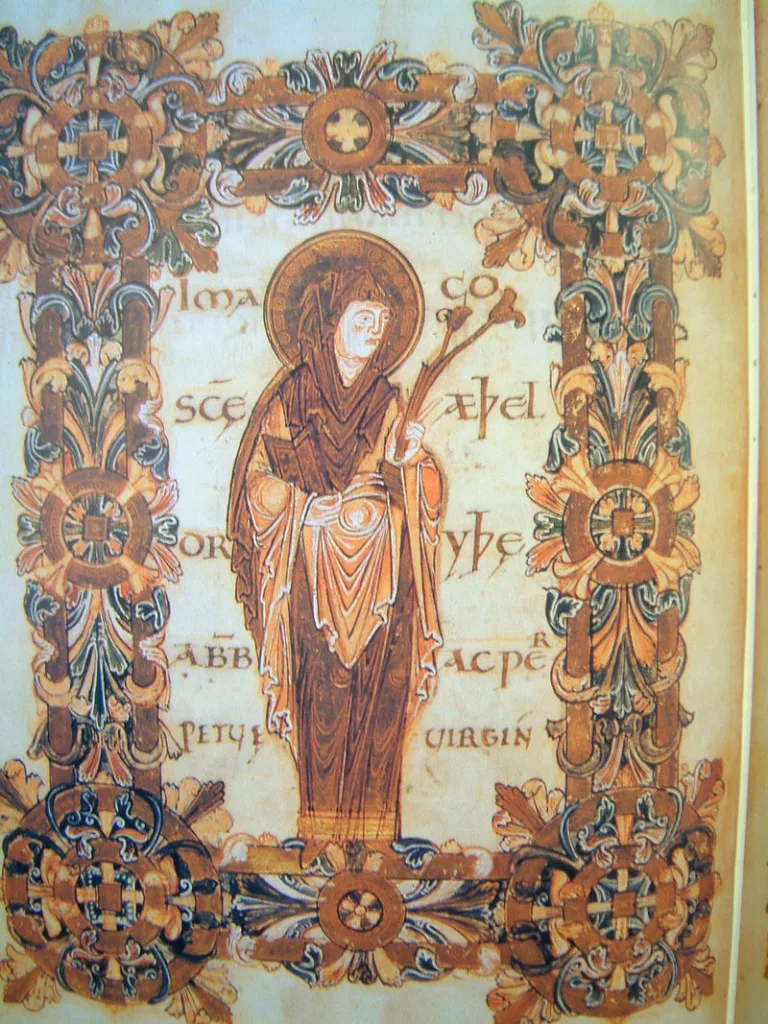
St Etheldreda October 17th 679

St Etheldreda or St Audrey By monk – [1], Public Domain, https://commons.wikimedia.org/w/index.php?curid=32907989

I’m republishing this post as I dated it to February 17th rather than October 17th and a few other egregious typos.

Etheldreda, also known as Audrey or Æthelthryth or Æðelþryð or Æþelðryþe is celebrated on October 17th, (the date her remains were ‘translated’ from her burial place to the Church at Ely) and on 23 June the date she died,

She lived from March 4th 636 to June 23rd 679. She is one of the well-born Saxon Virgin Saints of the 7th Century. This is when many royal Abbeys were founded by female members of the Anglo-Saxon Royal families, in the years following the conversion of the Anglo-Saxons to Christianity. She is the daughter of King Anna of East Anglia, and the sister of Saint Sexburga (widow of King Erconbert of Kent).

Etheldreda is said to be a Virgin despite being married twice. Etheldreda was widowed after three years of her first marriage. Then she married Egfrid, son of King Oswy of Northumbria. Egfrid got fed up with her virgin state. With the support of St Wilfrid, St Etheldreda was released to a Nunnery run by Wilfred’s aunt. In 672 she founded the famous double monastery at Ely, which is where the wondrous Cathedral of Ely still stands.

Here she died, and the many miracles that followed, led to Ely being one of the main destinations for Pilgrimages. St Sesxburga took over as Abbess after her death. By the number of Churches and holy days remembering Etheldreda show she was perhaps the most famous female saint of the era.

Tawrdy Audrey

Etheldreda died of a neck tumour, which she blamed on the heavy jewellery she wore around her neck before she became a nun. So she is a patron of those with neck or throat ailments. Accordingly, on February 3rd St Etheldreda’s Church in London holds the Blessing of the Throats ceremony. St Blaise is also a saint protecting the throat and you might like to read my post about him and throats here.

Pilgrims used to buy cheap, old-fashioned linen from the market at Ely, which they would wear around their neck to protect or cure them of throat illnesses. Puritans satirised the practice by coining the word Tawdry, from St Audrey, which came to represent cheap goods sold to gullible pilgrims.

Mopsa the shepherdess in Shakespeare’s Twelfth night says to her sweetheart:

“Come, you promised me a tawdry-lace and a pair of sweet gloves.

Have a look at this excellent article to read more about Tawdry and St Etheldreda.

However, I thought something was amiss and searched for Tawdry in the excellent website SHAKESPEARE’S WORDS by DAVID CRYSTAL & BEN CRYSTAL (which I use all the time). And indeed Mopsa is not in Twelfth Night but in the Winter’s Tale which I saw recently at the RSC. Mopsa’s man can’t buy it for her as he has been cheated out of his money by the fey Autolycus.

St Etheldreda’s Church in Ely Place London

Church of St Etheldreda., Ely Place London

St Etheldreda’s in London is in Ely Place, near Hatton Garden. There is a lovely old pub there called the ‘Ye Olde Mitre’ (which is a reference to a Bishop’s Mitre). The Church was founded (1250 and 1290) as the London residence of the Bishops of Ely. Inside are memorials to Catholic martyrs executed during the Reformation. (see my post on the Douai Martyrs here).

Ely place was lived in by John of Gaunt following the destruction of his Savoy Palace in the Peasants Revolt. Christopher Hatton rented parts of it in the reign of Queen Elizabeth II. During the Civil War it was used to hold Royalist Prisoners of War. Agnes Wicks fictionally lives at Ely Place. (Agnes is the woman David Copperfield should have married, rather than the ridiculous Dora).

In the 19th Century, the former Chapel was bought by the Catholic Church and restored by George Gilbert Scott.

Etheldreda is remembered in the Church of England with a Lesser Festival on 17 October according to Book of Common Prayer tradition, and alternatively 23 June in the Common Worship calendar of Saints. (Wikipedia.

First Published on October 17th 2025

I went to the Stratford-upon-Avon Mop on October 12th

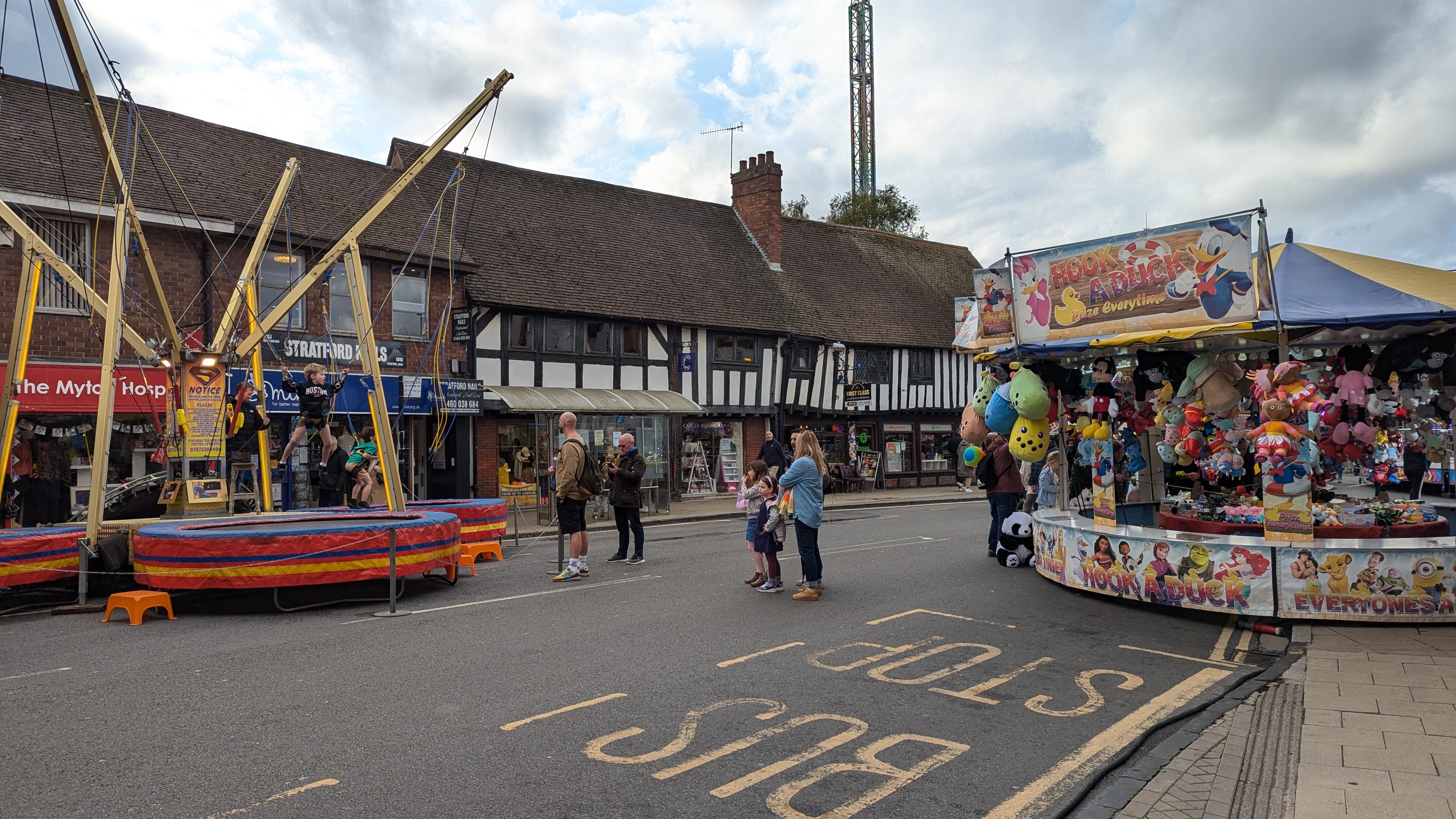
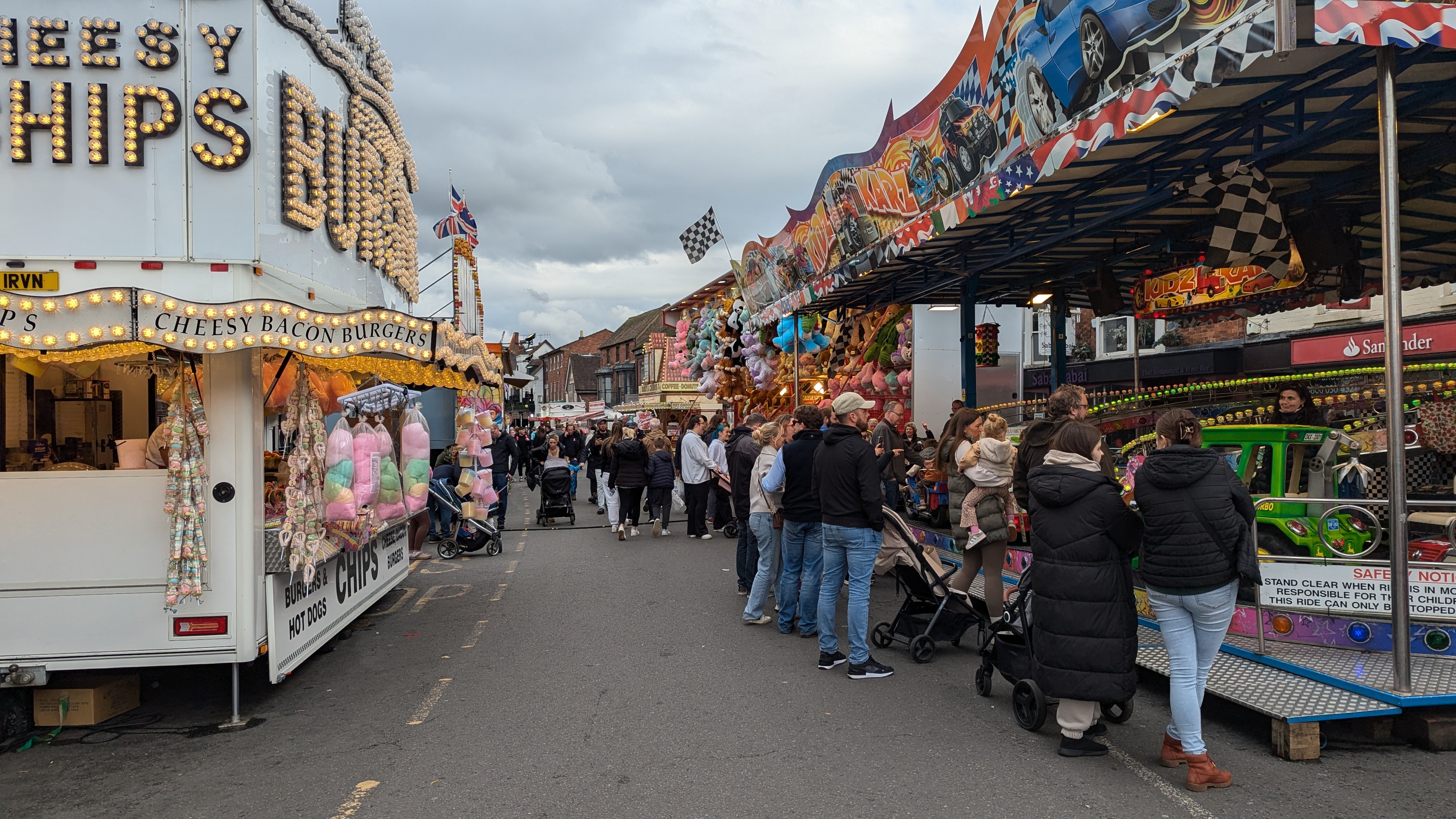
This year the Stratford Mop fair was on the 11th and 12th October, and I was there to see it!As I reposted a long post about the Mop a couple of days ago, I thought I should report back. To recap, the Mop began as a Michaelmas (Old Style) Hiring Fair, and has continued in Stratford ever since. But the modern incarnation is no longer a Hiring Fair and no shepherds were to be seen.

2024 Stratford on Avon Mop. Photo Kevin Flude

The centre of the Town was crowded with a cacophony of shooting galleries, games to win soft toys, stalls selling toffee apples, candy floss, burgers, and all things bad for you. And interspersed with the stalls were all sorts of rides, carousels and all the raucous fun of the fair.

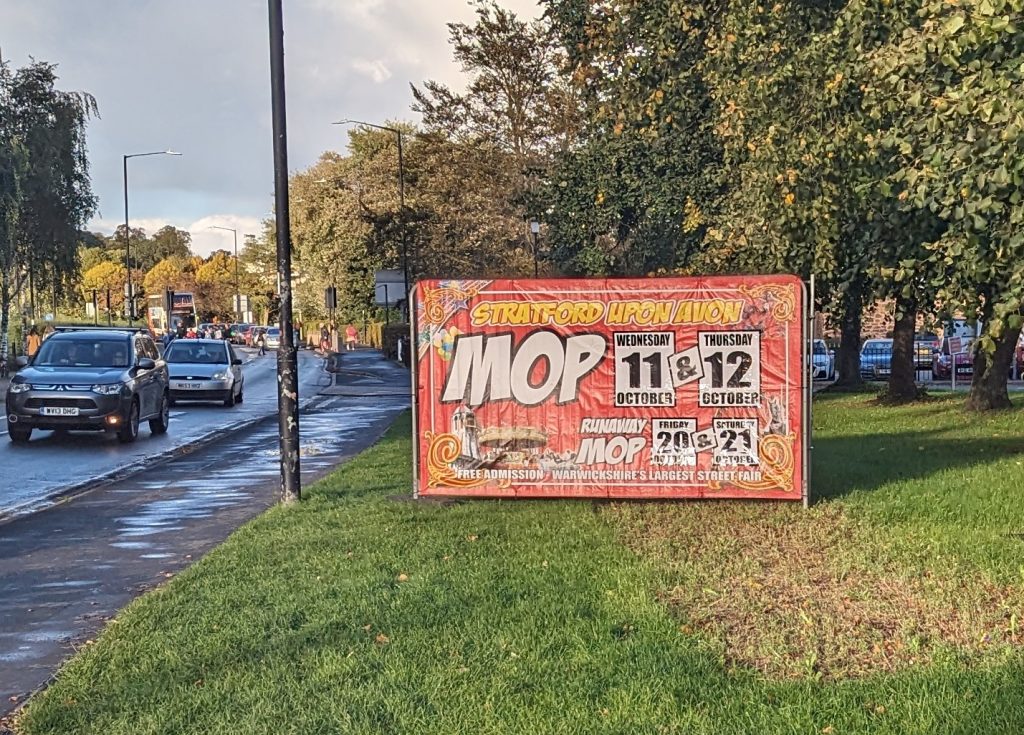
Stratford-upon-Avon Mop Festival (2023 sign)

You might have noticed I have labelled the photographs differently, one Stratford-upon-Avon, the other Stratford-on-Avon. Most prefer the ‘upon’ but I thought this wrong as the Council building in Church Street uses the simpler ‘on’. Having looked it up, I see that the answer is both are correct. Stratford-upon-Avon is used for the Town, and Stratford-on-Avon for the Town and area around the town. Now you know!

Now, I cannot find any reference in Shakespeare to a funfair, and all references to a Mop, are to the thing you mop the floor with. But he does mention St Bartholemew’s Fair obliquely, and certainly knew his friend, Ben Jonson’s Play ‘St Bartholemew’s Fair’. It is a great play based in London, at the annual fair in Smithfield. It was one of the great Wool fairs of England. It was held every year on St Bartholemew’s Day August 24th, and lasting sometimes weeks long. Please read my post on Bartlemas here.

Going to the Mop in Stratford-upon-Avon & Henley-in-Arden 11th & 12th October

The Mop Festival in Stratford-upon-Avon

This year the Stratford mop festival was on the 11th and 12th October. I am in Stratford. The the centre of town is a cacophany of shooting galleries, stalls selling toffee apples, candy floss, burgers and all things bad for you. And a fun fair.Nothing at all sophisticated, or literary or dramatic, or folkloric. Just a good old-fashioned fun fair in the middle of the town. Quite raucous, but they leave Henley Street, and Shakespeare’s’ Birthplace, free of it. Below I tell the story of my discovery of the Mop.

In 2023, I was on my way to Stratford-upon-Avon Railway station, I saw the sign at the top of this page, but had no idea what on earth a Mop was. I put it to the back of my mind as I took the train to Henley-in-Arden. My interest in the town was that Shakespeare was born in Henley St. And his mother was called Mary of Arden. So, naturally, I wanted to find out about Henley-in-Arden. To turn curiosity to action, it took our Tour Coach Driver telling me he lived there and that it was a pretty but small town.

Mary Arden doesn’t live here any more!

I had a free afternoon from my duties as Course Director on the ‘Best of England’ Road Scholar trip. I got on the very slow train to Henley-in-Arden. One of the first stops was Wilmcote, where Mary Arden’s House is. I visited two years ago, when I was astonished to find it was a different building to the one I had visited in the 1990s! In 2000, they discovered they had been showing the wrong building to visitors for years! Mary Arden’s House was, in fact, her neighbour Adam Palmer’s. And her house was Glebe Farm.

On that visit, I walked from Stratford-upon-Avon to Anne Hathaway’s Cottage. Then to Mary Arden’s House and back to Stratford along the Stratford Canal. It is a lovely country walk if you are ever in the area.

The Forest of Arden

The train route to Henley is through what remains of the ancient forest of Arden. The forest features in, or inspired, the woody Arcadian idylls which feature in several of Shakespeare’s plays, particularly the Comedies. ‘As You Like It’, for example, is explicitly set in the Forest of Arden, as this quotation from AYL I.i.107 makes clear:

Oliver:  Where will the old Duke live?

Charles. They say he is already in the Forest of Arden, and a many merry men with him; and there they live like the old Robin Hood of England: they say many young gentlemen flock to him every day, and fleet the time carelessly as they did in the golden world.

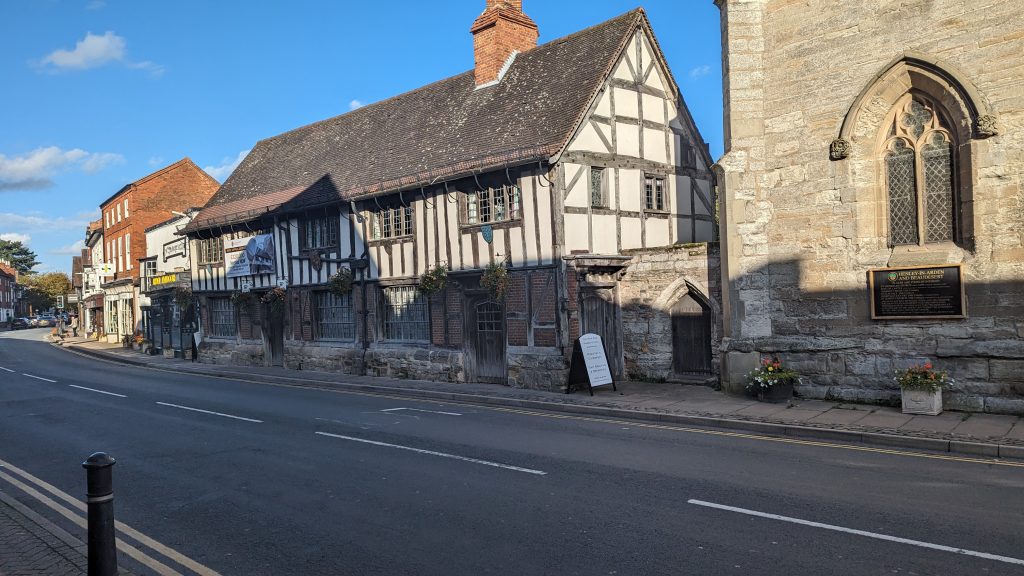
Guildhall, Henley-in-Arden

Henley-in-Arden

Not much remains of the old Forest. It was cut down to make timber-framed buildings and ships for the British Navy – the so-called Wooden Walls. Henley has a beautiful high street. Further down the road is a lovely Heritage Centre full of old-fashioned and DIY Information panels. And that is not a criticism, it provided a very enjoyable visit full of interesting stuff. And gave me a couple of snippets of information I have not seen anywhere else.

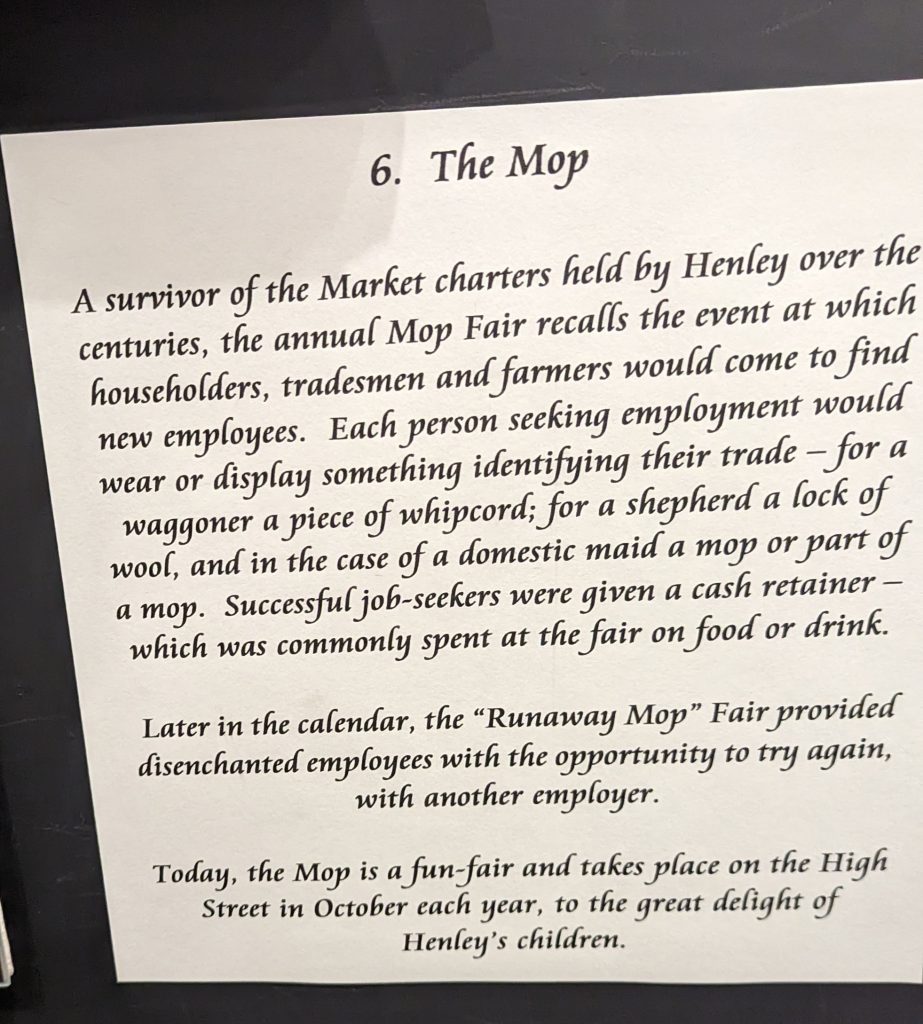
One, was a panel dedicated to the Henley Mop. A mop turns out to be a hiring fair. Think of Gabriel Oak in Hardy’s ‘Far from the Madding Crowd’. His attempt to become an independent farmer destroyed when his sheepdog runs amok. The dog sends his sheep over a cliff to their doom. So he takes his shepherd’s crock to the hiring fair or Mop as they are known in the Midlands. There, potential employers can size up possible employees and strike mutually agreeable terms and conditions. And Gabriel becomes the shepherd for the delightful and wilful Bathsheba Everdene.

So, a shepherd would take his staff, or a loop of wool. A cleaner her mop (hence the name of the fair). A waggoner a piece of whipcord. A shearer their shears etc. Similarly, in the Woodlanders (by Thomas Hardy) the cider-maker, Giles Winterborne, brings an apple tree in a tub to Sherborne, to advertise his wares.

The retainers thus employed would be given an advance and would be engaged, normally, for the year. So there was quite a widespread moving around of working people to new jobs and often new housing. Not quite how we imagine the past?

The perceptive among you will have noted the bottom of the sign in Stratford which advertised the ‘Runaway Mop’. This was held later in the year, so that employers could replace those who ran away from their contracts. And those who ran away could find a better, kinder or more generous boss. See also my post of Gabriel Oak and Pack Rag Day which is another hiring fair which was help on Martinmas Old Style.

Henley Mop – panel from the heritage centre

Court Leets and Barons

Also of interest to me was the panel about Court Leets and Barons. These were the ancient courts which dealt with, respectively, crime and disorder, and property and neighbourhood disputes. Henley still has its ancient manorial systems in use, at least ceremonially. The Centre shows a video of the installation of a new Lord of the Manor at the Guildhall. The title had been purchased by a cigar-smoking Stetson-wearing large rich American.

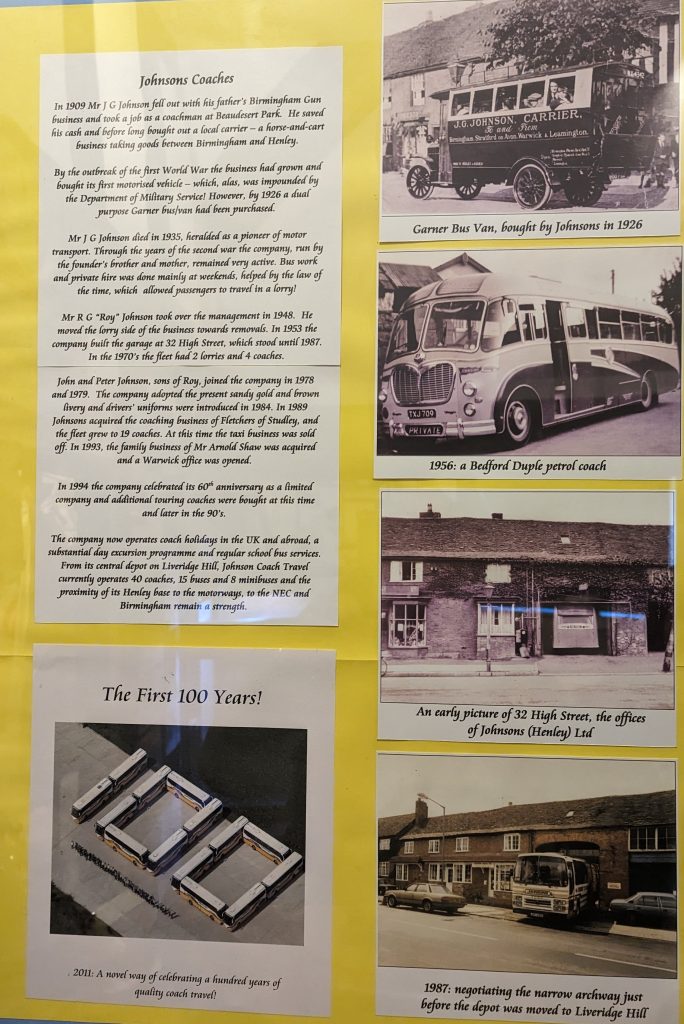
Johnson’s Coaches

Another panel was the story of a Coaching Company. When I lead the Best of England programme we are driven around by Johnson’s Coach Company. It was a delight to discover that it has a history that can be traced back to 1909 in Henley. I conveyed this information to our group on the next day as we toured the Cotswolds. Curtis, our driver, was able to update the panel. He told us that the family were still involved with the firm, which is still operating from the area. He said the two brothers who run the company come in every working day. They do everything they require of their drivers to do; i.e. they drive coaches, clean coaches, sweep the floors and generally treat their staff like part of a big family. I should have asked him whether he got his job at the Mop, while holding a steering wheel in his hands!

Johnson’s Coach Company -Panel from Henley Heritage Centre

Note: It seems that Johnson has now merged with another company. But it keeps its depot in Henley and maintains its connection with the town.

First published in 2023 updated 2024, 2025