Ash Wednesday this year is early and on 18th February. It is the First Day of Lent, the solemn time which runs up to Easter, and is symbolic of Jesus’ 40 days in the wilderness.
In Anglo Saxon the name for the season of Spring was ‘lencthen’. It is thought to derive from the idea of the lengthening days. Days do suddenly seem to have got longer. These are the official times for the evening:
Sunset: 17:21
Dusk (Civil twilight ends) : 17:55
Nightfall (Nautical twilight ends) :18:34
Full Darkness starts (Astronomical twilight ends) : 19:13
So strictly, Lent means Spring. The Romance languages use the term which derives from the Latin ‘Quadragesima’ which means the 40 days of Fast. Spanish (Cuaresma), French (Carême), and Italian Quaresima). For Germans, it is the fasting time: fastenzeit. In England, Lent became a specialised word for the fast period. And Spring took over as the name of the season.
A time of fasting? Time for reflection? Maybe once upon a time. When I was young, it was 40 days when you were supposed to give something up. Smoking, or drinking, or chocolate. An idea taken up by a new generation, as, for example, Dry January? A time of reflection? No, never did that.
Dust to Dust and Stardust
Ash Wednesday is named after the ashes smeared on the heads of worshippers to remind us that we are dust. I’ve never seen this done either. My footballing Vicar friend Andrew missed our Wednesday Game so that he could mark foreheads with ash crosses. The ashes were traditionally made from palms used for Palm Sunday decorations, which is indeed what Andrew did. Look here to see my post on Palm Sunday.
On the subject of dust, here are some spiritual lyrics by Joni Mitchell. Something profound in the true idea that we are all stardust.
We are stardust We are golden And we’ve got to get ourselves Back to the garden
Woodstock by Joni Mitchell
40 Days
We all know that there are 40 days in Lent, except there are not. It’s 46 this year. This was pointed out by Tim Harford who presents a BBC radio programme called ‘More or Less’. It is a programe about statistics, or more widely about Fact Checking statistics in the news. Last year he discussed the 40 days. One answer proposed was to take away Sunday. But, my mathematics tells me this still leaves 42. The answer Tim Harford came up with is that 40 days just means a long time.
It is the length of time of Lent, but also:
The duration of the Great Flood The time Moses was on Mt Sinai The time the Israelites spy on Canaan Goliath trails Saul Elijah Walks Jesus is tempted n the Desert The time from Resurrection to Ascension
In other words, a long time to be doing any one thing. As Hartford says, it’s like our word ‘umpteenth’. As in ‘Kevin this is the umpteenth time I’ve told you to tidy your bedroom’. That’s what my mother said to me as she threw my clothes out of the window.
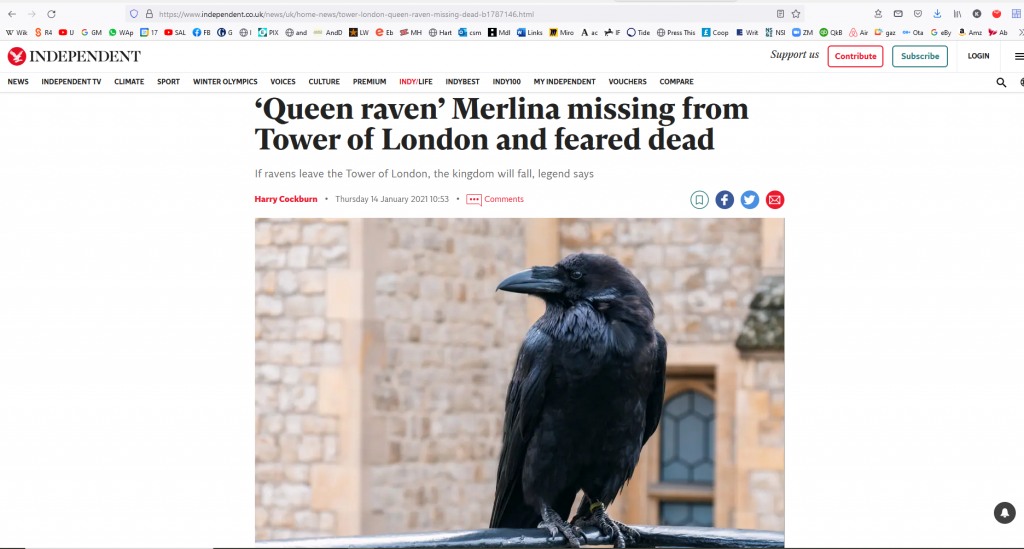
The Independent January 2021 The Raven the Palladium of Britain
The Raven – the Palladium of Britain
Corvus corax is hatching. An early nesting bird, the Raven is the biggest of the Corvids. They were pushed to the west and north by farmers and game keepers but are making a comeback. Ravens are finding towns convenient for their scavenging habits. So they, again, cover most of the UK except the eastern areas. The Raven is one of the Palladiums of Britain.
A Palladium is something that keeps a city or country safe, They are named after a wooden statue of Pallas Athene, which protected Troy. Perceiving this, Odysseus and Diomedes stole the Palladium from Troy shortly before the Trojan Horse episode. Troy fell and the palladium went to Italy (I’m guessing with Diomedes who is said to have founded several cities in Italy). It ended up in Rome.
The Romans claimed to be descendants of Trojan exiles led by Aeneas. So it was back with its rightful owners. It protected Rome until it was transferred to the new Roman capital at Constantinople. It then disappeared, presumably allowing the Ottoman Turks to conquer the City of Caesar? To read of London Stone as a Palladium see my post here.
The Ravens habits (it is said they know where the battlefields are before they are fought) and their black plumage have made them harbingers of death. In poetry, Ravens glut on blood like the warriors whose emblem they are. Here is a very famous quotation from Y Gododdin, a medieval poem but thought to derive from a poem by the great poet Aneirin from the 7th Century.
‘He glutted black ravens on the rampart of the stronghold, though he was no Arthur.’
This is one of the much argued-about references to King Arthur in the ‘Was he a real person’ trope. The point being, it doesn’t make sense to mention Arthur if King Arthur wasn’t a real person. The story at the Tower of London is that the Ravens kept in the Tower, with clipped wings, keep Britain safe from Invasion. (But see below).
Bran’s Head – the original Palladium of Britain?
By Sonny Mauricio from Unsplash
The Raven was also the symbol of the God-King Bran. Bran was one of the legendary Kings of Britain. His sister, Branwen, was married to the King of Ireland. To cut a long story short, Branwen was exiled by her Irish husband to the scullery. She trained a starling to smuggle a message to her brother, to tell of her abuse.
So Bran took an army over the Irish Sea to restore her to her rightful state. But the ships were becalmed. Mighty Bran blew the boats across the sea – he was that much a hero. Bran was mortality wounded in the fighting that followed. This was a problem because he had previously given away his cauldron of immortality. He gave it to the Irish King in recompense for the insults given to the Irish by Bran’s brother, who hated anyone not British.
Bran’s Head Returns to London
So, the dying Bran, told his companions to cut off his own head and take it back to the White Hill in London. His head was as good a companion on the way back as it was on the way out, and the journey home took 90 years.
At last, they got to London, where Bran told his men to bury his head on the White Hill. As long as it stays here, he said, Britain would be safe from foreign invasion. The White Hill is said to be Tower Hill with its summit at Trinity Gardens, although Primrose Hill is sometimes offered as an alternative.
This was one of the Three Fortunate Concealments and is found in ‘the Triads of the Island of Britain.’ The Triads are from medieval manuscripts which preserve fragments of folklore, mythology and history. They are grouped in groups of three.
Arthur and Bran’s Head
But many years later, King Arthur saw no need for anybody or anything other than himself to protect the realm. So he had the head dug up. Calamity followed in the shapes of Sir Lancelot and Mordred which led to the end of the golden age of Camelot and conquest of Britain by the Saxons. This was one of the Three Unfortunate Disclosures.
If we want a rational explanation for the story, there is evidence that Celtic cultures venerated the skull, and palladiums play a part in Celtic Tales.
So what was Arthur doing destroying the palladium that kept Britain safe? Vanity is the answer the story gives. But, perhaps, it’s a memory of Christian rites taking over from pagan rituals? God, Arthur might have thought, would prefer to protect his people himself rather than Christians having to rely on a pagan cult object.
Ravens in the Tower of London
The story of Bran’s head is inevitably linked to the Ravens in the Tower who, it is still said, keep us safe from invasion. As you can see from the photo at the top we still get in a tizz when one goes missing.
Sadly, and I am probably sadder about this than most, the link between the Tower, Bran, and the Ravens cannot be substantiated. Geoffrey Parnell, who is a friend of mine, told me that while working at the Tower of London he searched the records assiduously for the story of the ravens. He found no evidence of the Raven myth & the Tower before the 19th Century, and concluded that it was most likely a Victorian invention. IanVisits has a 2025 story about the Ravens, and also concurs that the Ravens are a recent myth.
The Welsh Triads give a total of two palladiums for Britain, a couple of nationalistic fighting dragons.
The Head of Bran the Blessed, son of Llyr, which was concealed in the White Hill in London, with its face towards France. And as long as it was in the position in which it was put there, no Saxon Oppression would ever come to this Island; The second Fortunate Concealment: the Dragons in Dinas Emrys, which llud son of Beli concealed; And the third: the Bones of Gwerthefyr the Blessed, in the Chief Ports of this Island. And as long as they remained in that concealment, no Saxon Oppression would ever come to this Island.
All good but then came:
The Three Unfortunate Disclosures:
And there were the Three Unfortunate Disclosures when these were disclosed. And Gwrtheyrn the Thin disclosed the bones of Gwerthefyr the Blessed for the love of a woman: that was Ronnwen the pagan woman; And it was he who disclosed the Dragons; And Arthur disclosed the head of Bran the Blessed from the White Hill, because it did not seem right to him that this Island should be defended by the strength of anyone, but by his own.
Gwrtheyrn is Vortigen, the leader of the Britons after the fall of the Roman Empire in Britain, one or two leaders before Arthur. Vortigern, which means something like strong leader in Welsh was a real person in so far as he, unlike Arthur, is mentioned by Gildas a near contemporary source.
The story of the dragons is supposedly from the pre-Roman Iron Age. Every May Day, the Dragons made a terrible noise, causing miscarriages and other misfortunes. So, King Ludd, whom legends says gave his name to London (Ludd’s Dun or Ludd’s walled City), drugged the dragons. He had them buried in a cavern at Dinas Emrys in Eryri (Snowdonia). The Red Dragon represented the Britons (also called the Welsh) and White Dragons the Saxons.
Vortigern, Merlin and Vortimer
Hundreds of years later, (five hundred?) after the Romans had come and gone. Vortigern was trying to build a castle in Eryri at Dinas Emrys. But the walls keep falling down. ‘You need the blood of a boy born not of man’, his necromancers say. They find a boy called Ambrosius aka Merlin whose mother had lain with an incubus. Merlin accused the necromancers of ignorance and explains the wall collapse is caused by two dragons. They find the cavern and let the dragons go. The walls now stand undisturbed. But the Welsh Red Dragon and the Saxon White Dragon can not now be at peace, and the Britons are defeated by the Saxons.
Vortigern betrayed his own people for the lust of Rowena the daughter of Hengist, the Saxon. Hengist was given the province of Kent as his reward, and thus began the Anglo-Saxon take over.
Vortigern’s son is Gwerthefyr (or Vortimer). He was a better man than his dad and fought to keep the Saxons out. After Vortimer’s death his bones were buried at the chief ports on the South Coast. Here they acted as a palladian and they kept the country safe. But they were moved to Billingsgate, in London and put in a Tower. The loss of the palladium allowed the Saxons to land safely on the Kent coast and consolidate their increasing hold over Britain and turning it into England.
Birds in Love
Here is a lovely little medieval poem. It was found in 1931 in the end leaf of a manuscript where someone had been testing their goose quill and scribbled these three lines:
Why it is so wet in the UK at the moment (February 18th)? The answer seems to be that there is a block of cold weather over the States that is moving the Jet Stream south, bringing lots of wet weather. But there is also another block of cold weather over Scandinavia. This means that the low pressures being driven by the Jet Stream, have no where to go and are stopping and dumping their rain all over the UK.
3102 BC – the death of Krishna starts Kali Yuga, the fourth and final yuga of Hinduism.
1478 – George, Duke of Clarence, traitor to his Brother, Edward IV, was executed in private at the Tower of London. It is said he was drowned in a vat of Malmsey Wine.
1678 – First Part of Pilgrim’s Progress by John Bunyan published.
1991 – The IRA plant bombs at Paddington station and Victoria station in London. The IRA gave warnings, and the Victoria bomb went off at 4.20am and caused no casualties. At or just before 7am, the IRA warned that all London Stations were to be bombed in 45 minutes time. The Authorities were slow to clear the stations and at Paddington a bomb went off at 7:40am. 1 person was killed and 38 people were injured. 11 days earlier, the IRA attacked Downing St with a mortar bomb attack.
Written on February 21 revised in February 18th 23, 24, 25, Birds in Love, Wet Weather and On This Day added in 2026
This year, February 17th is Shrove Tuesday, the end of the Carnival. Etymology-on line says the origins of the term Carnival are:
1540s, “time of merrymaking before Lent,” from French carnaval, from Italian carnevale “Shrove Tuesday,” from older Italian forms such as Milanese *carnelevale, Old Pisan carnelevare “to remove meat,” literally “raising flesh,” from Latin caro “flesh” (originally “a piece of flesh,” from PIE root *sker- (1) “to cut”) + levare “lighten, raise, remove” (from PIE root *legwh- “not heavy, having little weight”).
Folk etymology has it from Medieval Latin carne vale ” ‘flesh, farewell!’ ” Attested from 1590s in the figurative sense of “feasting or revelry in general.” The meaning “a circus or amusement fair” is attested by 1926 in American English.Related entries & more
Pancake Day is another name for Shrove Tuesday. It is the day we eat up all our surplus food. Then on Ash Wednesday we must begin our lenten fast and turn our mind to repentance. Pancake Day, in the UK, is celebrated with a simple pancake with lemon and sugar. Here is a recipe from the BBC. On the other hand, Shrove Tuesday can be a day of excess before the 40 days of restraint. Shrovetide was normally three days from the Sunday before Lent to Ash Wednesday, the beginning of Lent. (Here is my post on Ash Wednesday).
Mardi Gras
In France, it’s called Mardi Gras which means Fatty Tuesday, in Italy Martedi Grasso. In New Orleans it stretches from Twelfth Night to Shrove Tuesday. But as we saw, in my post on Fat or Lardy Thursday‘ the Carnival period was more normally a week. In most other places it is one to three days. In Anglo-Saxon times there was ‘Cheese Week’, ‘Butter Week’, ‘Cheesefare Sunday’ and ‘Collop Monday’, preceding Ash Wednesday.
Shrove Tuesday the Day to be Shriven
Shrove Tuesday is the day we should be ‘shriven’ which means to make confession. The Church has been leading up to Easter since Advent – before Christmas. (See more on Advent Sunday here). Easter is the date of the conception and, also, the date of the execution and apotheosis of Jesus Christ. So the pious should confess their sins, then undertake their lenten fast before entering the Holy Week purged and sin-free.
In the Anglo-Saxon Church, there was a custom called ‘locking the Alleluia.’ The Church stopped using the word Alleluia from 70 days before Easter. Alleluia represented the return from exile in Babylon. So, with the approach of the death of Christ it was not felt appropriate to be celebratory.
The sombre nature of this block of time was highlighted by Ælfric of Eynsham (c. 955 – c. 1010).
Now a pure and holy time draws near, in which we should atone for our neglect. Every Christian, therefore, should come to his confession and confess his hidden sins, and make amends according to the guidance of his teachers; and let everyone encourage each other to do good by good example.
Ælfric, Catholic Homilies Text Ed. Peter Clemoes quoted in ‘Winters in the World’ Eleanor Parker
Time for Football!
Shrove Tuesday was the traditional time for football games, in the days before football had any rules to speak of. It was a wild game. Teams tried to get a bladder from one end of town to the other, or one side of a field to the other. In Chester, the Shrove Tuesday football game was held on the Roodee island. It was so rowdy that the Mayor created the Chester Races specifically to provide a more sedate alterative to the violence of the ‘beautiful game.’
Here is a youtube video of Shrovetide Football at Royal Asbourne in Derbyshire. You will notice it seems chaotic but if you look at the participants directed the action you can see how involved they are in it.
Royal Asbourne Shrove Tueday Football
In London, Henry Fitzstephen wrote about Shrove Tuesday Games in London in the late 12th Century:
‘Every year also at Shrove Tuesday, that we may begin with children’s sport, seeing we all have been children, the school boys do bring cocks of the game to their master, and all the forenoon they delight themselves in cockfighting. After dinner all the youths go into the fields to play at the ball. The scholars of every school have their ball, or baston in their hands. The ancient and wealthy men of the City come forth on horseback to see the sport of the young men and to take part of the pleasure in beholding their agility.’
Fitzstephen was the first biographer of Thomas Becket.
Pancake Race
The City of London has an annual pancake race at the Guildhall Yard. It is an inter-livery company competition. The Livery Companies also known as medieval Guilds, have to run across the Guildhall while holding a frying pan and pancake. There is a zone marked out where they have to toss the pancake. Here is a youtube video of the 2023 race.
Pancake Day/Shrove Tuesday Pancake Race
First published on February 21st, 2023 republished on February 13th 2024, and March 4th 2025, February 17th 2026
Fornacalia was a corn festival that took place around February 7th to the 17th. Romans were assigned individual days to celebrate (see below) but the last day, today, was reserved for those fools who did not know their proper day.
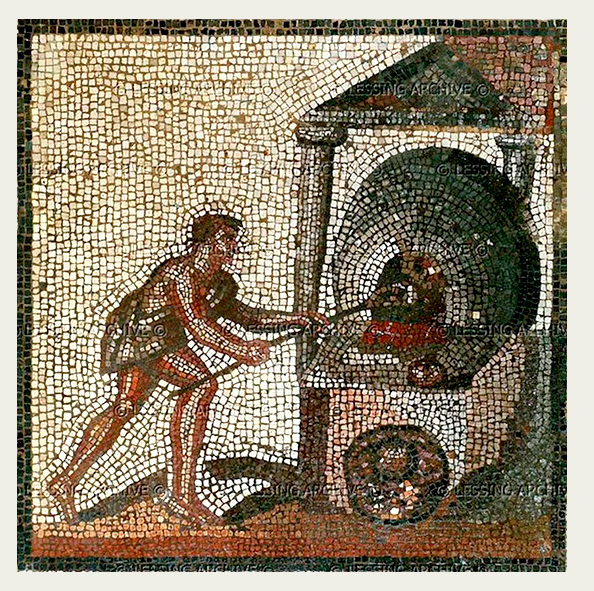
Pliny the Elder says it was King Numa Pompilius (753-673 BC), who established Fornacalia, The Feast of Ovens. Fornacalia celebrated Fornax who was the Goddess of the Oven – specifically the grain oven for drying grain. The word for oven is also Fornax, from which we probably derive our word furnace.
Organising the Fornaclia and the Curio Maximus
The Festivals in Rome were organised by the Curio Maximus who was a priest who supervised the curiae. In Rome the citizens were arranged, originally, into the 3 ancient tribes of Rome (founded in the 8th Century BC). The Tribes were supposed to represent the ancient ethnic groups. These were the Ramnes the Latin population, the Tities the Sabines, and the Luceres the Etruscans. The tribes were then divided into 10 curiae each. So there were 30 curiae.
Each Roman was supposed to be assigned to one of the curiae, which had a religious, social and voting function. The name may come from ‘co-viria – a gathering of men’. The members of the curiae were known as curiales. Each curiae had their own priest, or curio, and assistant priest ‘flamen curialis‘. And they organised the religious ceremonies of the curiae. They met in a meeting place called the curia.
So the Curio Maximus would declare when a festival was to be held, and get the curiae to organise the celebrations at the curia. I hope you are still with me! They would choose a date, for example for the Fornacalia, between about the 7th Feb and the 17th of February. And the citizens would go to their curia where there would be a ceremonial roasting of the grain, and baking into bread which would be in honour of the Goddess Fornax.
Ovid & the Feast of Fools
Ovid, who wrote his almanac poem on the Roman festivals (Fasti), reveals many of these details. This is what he says:
Learn too why this day is called the Feast of Fools. The reason for it is trivial but fitting. The earth of old was farmed by ignorant men: Fierce wars weakened their powerful bodies. There was more glory in the sword than the plough: And the neglected farm brought its owner little return. Yet the ancients sowed corn, corn they reaped, Offering the first fruits of the corn harvest to Ceres. Taught by practice they parched it in the flames, And incurred many losses through their own mistakes. Sometimes they’d sweep up burnt ash and not corn, Sometimes the flames took their huts themselves: The oven was made a goddess, Fornax: the farmers Pleased with her, prayed she’d regulate the grain’s heat. Now the Curio Maximus, in a set form of words, declares The shifting date of the Fornacalia, the Feast of Ovens: And round the Forum hang many tablets, On which every ward displays its particular sign. Foolish people don’t know which is their ward, So they hold the feast on the last possible day.
Book II: February 17 From: Fasti, Book 2. Translated by A.S Kline and available here
I am led to believe that the Roman word for the person who looked after a furnace was the fornicator. And as heat was a ’cause’ of lust, fornicators well, they fornicated.
However, others derive the word from the word Fornix, which is an arch. And arches, it was said, was where the Brothels were, hence fornicator. Not sure that I’m going with the idea that Brothels were always under arches. Below is what the online etymology dictionary’s definition which might help you make up your mind:
from Late Latin fornicationem (nominative fornicatio), noun of action from past-participle stem of fornicari “to fornicate,” from Latin fornix (genitive fornicis) “brothel” (Juvenal, Horace), originally “arch, vaulted chamber, a vaulted opening, a covered way,” probably an extension, based on appearance, from a source akin to fornus “brick oven of arched or domed shape” (from PIE root *gwher- “to heat, warm”). Strictly, “voluntary sex between an unmarried man and an unmarried woman;” extended in the Bible to adultery. The sense extension in Latin is perhaps because Roman prostitutes commonly solicited from under the arches of certain buildings.
As you can see, it’s a big old mix-up of arches, brothels, brick ovens, all quite unconvincing, so I’m sticking with my over-heated stoker theory. To find out more about Ovid and his Almanac look at my post here.
The Annona
Rome had a population of one million people, and keeping them fed was a difficult task. So the celebration of Fornacalia was an important feast designed to protect Rome’s all important grain supply. The Imperial Government took on the responsibility of providing the grain in a system called the Annona. and provided the Citizens with free bread. The Italian Annona brought much of its grain from Egypt.
Londinium & the Annona
Dominic Perring in his recent book on Roman London (Londinium in the Roman Empire) speculates that the fluctuating fortunes of London was dependent upon the routing of a northern Annona through Londinium. When the Emperor was engaged with the North Western Empire London thrived, when he wasn’t interested it declined.
On This Day
1634 – Puritan author William Prynne was sentenced in the Star Chamber for publishing “Histrio-masti”, criticising the theatre (and criticising Bishops). This was one of various trials he faced in the Star Chamber. The Star Chamber was not a normal court, with a Jury but was the instrument of repression by Charles I’s autocratic regime. Prynne had already been imprisoned in the Tower of London for a year. On the 17th February he was sentenced to: imprisonment for life; £5,000 fine; expelled from Lincoln’s Inn (i.e. deprived of the right to practice law); deprived of his Oxford degree; to have his ears cut off; to be pilloried at Westminster and Cheapside in the City of London. Oh and branded on the Cheek with S.L (Seditious Libeller).
1864 – The CSS H. L. Hunley, a Confederate vessel, is the first submarine to sink a warship, the USS Housatonic.
First published February 2023. Revised and republished 17th February 2024, 2025, On This Day added 2026
Today, February 17th, is the Chinese New Year or the Lunar New Year. It falls on the second new moon after the winter solstice. However, not always. The problem with a lunar calendar is the need to keep the lunar and the solar years in some sort of sync. The Chinese manage by adding intercalary months from time to time,. Then, the Chinese New year will fall on the third new moon after the winter solstice.
Chinatown. Soho 2023 Photo K Flude
If you look at the chart, you will see this is the year of the Horse. www.chinahighlights.com tells us that:
‘2026 is the year of the Fire Horse. It is viewed as a year of optimism and opportunity, with strong public and investor confidence pointing towards economic growth, particularly driven by AI advancement.’ The idea being that Horses are dynamic. I’m sure Keir Starmer is hoping this prophecy is true!
The Great Race
According to folktales, the twelve animals were asked to participate in a race. The Ox was winning, but the Rat jumped onto the Ox, onto his head, and jumped across the line. I’m a little surprised that the Ox should have been second, because surely the dragon, or the horse or the tiger would have been in the lead?
Having written that, I have just found a website that gives the whole story. But the long and short of it is that the Jade Emperor set up the race to cross a river. This delayed the tiger. The dragon stopped on the way to help out some villagers. The snake wrapped itself around the horse’s hoof thus delaying him. The Cat and the Rat enlisted the help of the kind-hearted Ox to cross the river. Then the Rat pushed the Cat into the River, jumped onto the Bank and got to the Emperor first. For the entire story visit the Great Race here.
The V&A has a page exploring the chinese animals in more depth here.
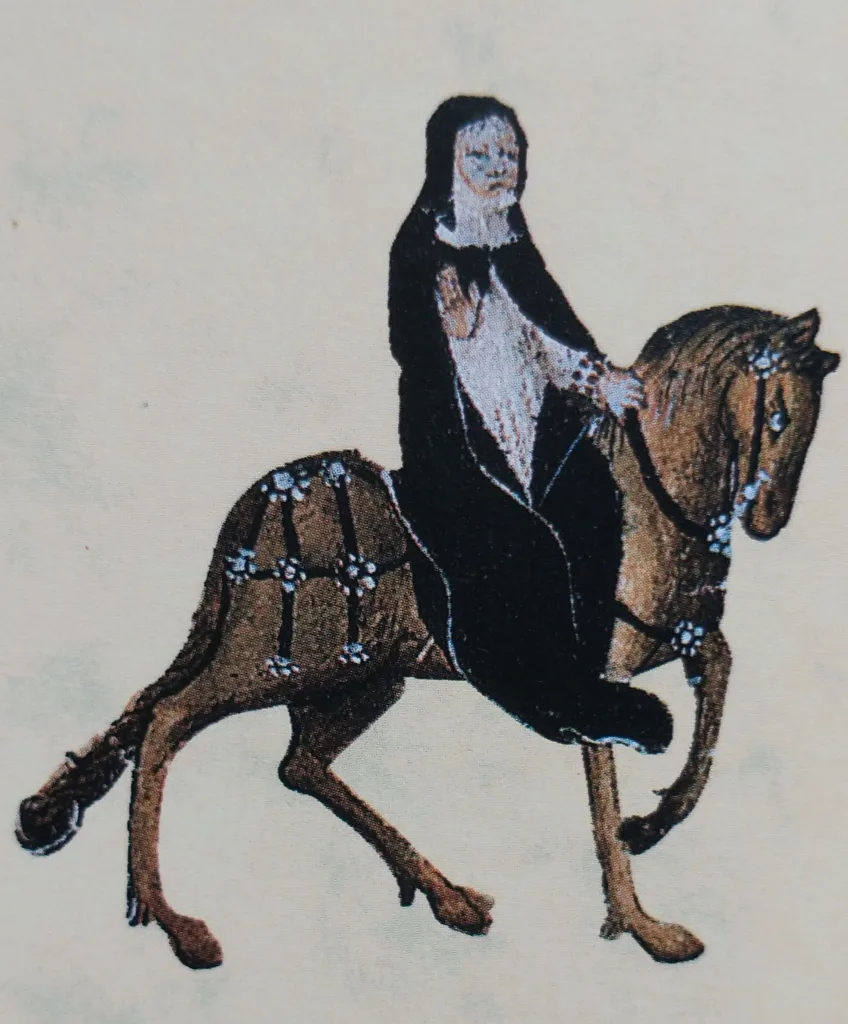
The Prioress from the Canterbury Tales by Geoffrey Chaucer from the Ellesmere manuscript. Her only oath is ‘By St Eloi’
When I read a reference to a Battle at St Eloi, it struck a chord as he is mentioned in the Canterbury Tales. It is an oath sworn by the delicate Prioress:
There was also a nun, a prioress, Who, in her smiling, modest was and coy; Her greatest oath was but “By Saint Eloy!” And she was known as Madam Eglantine. Full well she sang the services divine(5) Intoning through her nose, becomingly; And fair she spoke her French, and fluently. At table she had been well taught withal, And never from her lips let morsels fall, Nor dipped her fingers deep in sauce, but ate(10) With so much care the food upon her plate That never driblet fell upon her breast.
The reason is sticks in my mind is that the Prioress is shown as a cultured, well-mannered, delicate woman. And yet, she tells the most tremendously anti-Semitic tale. I hope that Chaucer meant this contrast. Someone who knows the forms of good behaviour without a clue in her hand that the most important of the Commandments is ‘Love Thy Neighbour like thyself.’ Another irony is that St Eloy was noted for refusing to swear an oath, and yet, the Prioress swears, by St Eloy.
St Eloi
Anyway, St Eloi was a very popular saint in the medieval period. According to legend, he was was having trouble shoeing a horse, which he thought was possessed. So he cut the horse’s leg off, re-shoed the amputated leg and then reattached the leg back on the horse. The horse trotted off, none the worse for the experience.
Properly called St. Eligius he is the patron saint of horses and cattle, farriers, blacksmiths, metalworkers, goldsmiths. The Saint was also responsible for converting Flanders to Christianity in the 7th Century. His Saint’s Day is 1 December. To look at the charge of rape against Chaucer look at my post here.
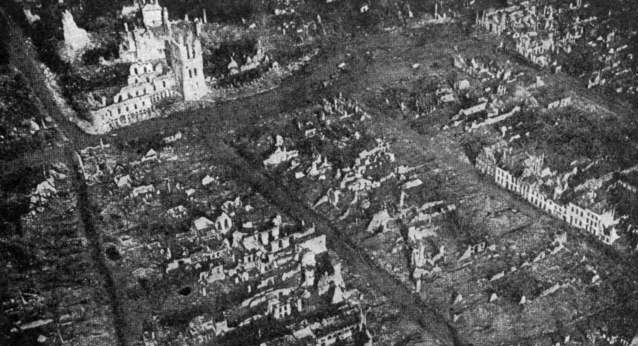
St Eloi is also the patron saint of mechanics in general (including the Royal Electrical and Mechanical Engineers, (forerunners of whom fought at Ypres). This brings me to what happened on this day in 1915, the British retook trenches at St Eloi. St Eloi was just behind the Southern edge of the Ypres Salient, a bulge of allied territory surrounded on three sides by German forces and the site of the five battles of Ypres. St Eloi had a mound which provided a perfect position for machine-guns to dominate the area and so became the focus of fierce fighting from 1914 through into 1918 when the Germans were finally pushed out of the Salient.
World War I destruction in Ypres (wikipedia)
Bravery at St Eloi
Here is a citation from a medal for bravery:
´For gallant behaviour on the morning of the 15th February 1915 at St. Eloi. A party of six stretcher bearers carrying wounded men from the firing line came under a heavy and sustained rifle fire. The bearers left their stretchers and ran to cover leaving Private Wright, D.C.L.I. (shot through the knee) and Private A. Stevenson, D.C.L.I. (shot through stomach) lying in open under heavy fire.
7679 Lance Sergeant T. Spanton, 6170 Rifleman E. Largen, and 1126 Company Sergeant Major S.M. Clay [together with Captain Brady] rushed some 50 yards across the exposed fire zone and carried in to cover the stretcher bearing Private Wright, whilst under heavy rifle fire. Private Stevenson, who was lying beside Wright, was found to be dead, and so was not carried in until dark. Lance Sergeant Spanton, Company Sergeant Major Clay, and Rifleman Largen have on several occasions done noticeably good work, showing fearlessness, resource, and devotion to duty.´
Fighting continued here from 1914 through into 1918 when the Germans were finally pushed out of the Salient.
War in Winter
I wanted to find something about the winter as experienced in World War 1. Why? Because I watched a very moving film about World War 1 by Derek Jarman called ‘War Requiem’. It put images to the requiem by Benjamin Britten. I also listened to a radio piece on ‘Spring Offensives’ to give a long view on what was happening in Ukraine.
I found this war poem which vividly sets a winter war scene:
Searchlight F. S. Flint
There has been no sound of guns, No roar of exploding bombs; But the darkness has an edge That grits the nerves of the sleeper.
He awakens; Nothing disturbs the stillness, Save perhaps the light, slow flap, Once only, of the curtain Dim in the darkness.
Yet there is something else That drags him from his bed; And he stands in the darkness With his feet cold against the floor And the cold air round his ankles. He does not know why, But he goes to the window and sees A beam of light, miles high, Dividing the night into two before him, Still, stark and throbbing.
The houses and gardens beneath Lie under the snow Quiet and tinged with purple.
There has been no sound of guns, No roar of exploding bombs; Only that watchfulness hidden among the snow-covered houses, And that great beam thrusting back into heaven The light taken from it.
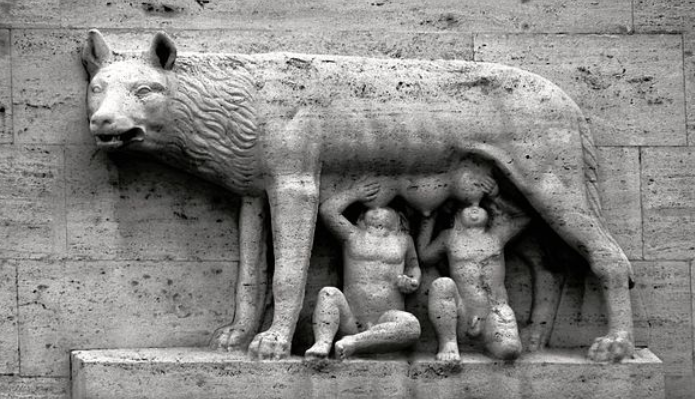
Romulus and Remus suckling from a wolf. The event was celebrated by the festival of Lupercalia
Lupercalia was a Roman feast of purification. It was dedicated to the she-wolf who saved Romulus and Remus, the traditional founders of the City of Rome. The centre of the festivities in Rome was a cave called the Lupercal. This was, supposedly, where the wolf suckled the twin brothers until they were rescued by Faustulus, a shepherd.
The Lupercalia was also called dies Februatus. The word seems to be derived from proto-italic word februum for purification by making an offering. The purification instruments were called februa. This is the basis for the Roman month named Februarius and our February. For more about February see my post here.
We are also in the middle of the Parentalia, which began on the 13th February and lasted nine days. It honoured parents and family ancestors. People would visit the family tombs found along the roadsides outside of the City. Here they would honour the ancestors by making offerings.
Goddesses of the Family Heath
There would be a family banquet and offerings made to the Lares – the household deities. Romans had a household altar for their worship. The Greek Goddess Hestia was the Goddess of the Hearth – the centre of any household, and Vestal was the Roman equivalent. Dickens borrowed the concept of the Household Gods in his Christmas book ‘the Chimes’.
According to Wikipedia the Codex-Calendar of 354, shows that 13 February had become the holiday Virgo Vestalis parentat. This was a public holiday which by then appears to have replaced the older Parentalia.
29 – The Day that Christ overcame the devil. February 15th was the date chosen for this festival, which was called Sarum Rite. But it is long obsolete in the Church calendars, and no one seems to know what it was about. Although it seems obvious to me, it must be when the Devil tried to tempt Jesus in the Wilderness. I have just found this site which is equally unsure. But feast-of-the-triumph-of-christ-over-the-devil suggests that Jesus was baptised on 6th January and 40 days later takes us to February 15th when the Devil:
‘took him up into the holy city, and set him upon the pinnacle of the temple,
And said to him: If thou be the Son of God, cast thyself down, for it is written: That he hath given his angels charge over thee, and in their hands shall they bear thee up, lest perhaps thou dash thy foot against a stone.
Jesus said to him: It is written again: Thou shalt not tempt the Lord thy God.‘
The story continues, but you get the gist of it. As to the date of AD 29. Dates about Jesus are very uncertain.
898 – In the Laws of King Alfred the Great, February 15th, the day Christ overcame the devil, was a day off for freemen. This is about the date of the first day in Lent. Lent of course varies with the date of Easter. In 2026 Lent starts on February 18th. But the law code says the 15th is the day off. I delve more into Days off in the Anglo Saxon Calender on August 15th.
1748 – Jeremy Bentham was born. He was a utilitarian philosopher, who believed ethics consisted on contributing to the great good of humanity. He was also involved in the foundation of the London University and founded University College, London – London’s first university. Founded in 1826.
Jeremy Bentham’s “Auto-Icon” at University College London. Photo Michael Reeve. Licensed by author under GNU Free Documentation License
My part in his story is that the mother of my children is a textile conservator and one of her first projects was to sort Jeremy Bentham out. He was an atheist and did not believe humans survive death. In order to encourage free thought, he ordered that his body should be publicly dissected (after his death!). His skeleton was then dressed in a suit, stuffed with straw, adorned with a cast of his head, Hat put on, and seated on a chair. Then placed in a cupboard, only to be brought out on ceremonial occasions. He’d got a bit dusty over the years, and a little frayed at the edges. So his clothes were repaired and cleaned, and restuffed with acid-free stuffing. Then put back in the cupboard, where you can still see him.
For this was St. Valentine’s Day When every bird came there to chose their mate. Of every type, that men think may And that so huge a noise did they make That earth and sea and tree and every lake So full was, that hardly was there space For to stand so full was the place.
St Valentine’s Patronage
This is the first reference to St Valentine’s as a romantic day. And some people charge Chaucer with making the whole thing up! St Valentine, is supposed to have been martyred in the 3rd Century (290AD) on the Via Flaminia on February 14. He refused to stop marrying people in the Christian rites. Therefore, he is the patron Saint of lovers. Valentine is also the patron Saint of epileptics, fainting and beekeepers. According to legend, he taught a young blind girl how to look after Bees, and, sometime later, her eyesight was restored. He also is said to have treated a young man of epilepsy. Epilepsy was sometimes called the Falling Sickness, and so he is also the Saint of Fainting.
But until Chaucer, there was no particular link with romance. In fact, there are at least three Saint Valentines who were martyred in the Roman period. Their relics are scattered around Europe (have a look at this National Geographic article for the full S.P.). These include bones in Glasgow and his heart in Dublin. There are in total 11 Saints called Valentine in the list of Catholic Saints.
Another theory is that St Valentine has taken over the aspect of the God Cupid, as a Christian attempt to create a holy festival to replace the Lupercalia. See my post on the Lupercalia here.
St Valentine’s Day and Birds
Chaucer’s poem suggests one possible route to the link with romance. Early February is about the time when birds pair off. If they want to have their chicks at the optimal time, then they need to get going before spring has really sprung.
When I think of love, I don’t think of birds. Maybe, this is because I live by a Canal. Outside my garden, I frequently see and hear a Coot chasing his pair across the water before violently mounting her. But then they are fiercely monogamous and defend their nest, fearlessly, against much bigger birds. And swans glide by in beautiful family groups. But Magpies are my favourite lovebird because you see one, and then look around, and you very often see the partner. I have adopted an old tradition that you are supposed to say:
‘Hello, Mr Magpie! Where’s Mrs Magpie?’
And look for the mate. It is good luck if you see her and bad luck if you don’t. (Please feel free to assign your own favourite gender!)
‘One for Sorrow’ is a well-known nursery rhyme found in many variations, and is an example of ‘ornithomancy superstition’ whereby the number of Magpies you see determines some aspect of your future. Magpies normally mate for life, and are not gregarious during the nesting season, but thereafter, they ‘join together in large wintering flocks of more than 20 or so birds.‘. So, perhaps we need at least another seven lines for the rhyme? So, far I have never seen a flock of them. If you have a photo of a flock, please send it to me!
One for sorrow, Two for joy, Three for a girl, Four for a boy, Five for silver, Six for gold, Seven for a secret, Never to be told. Eight for a wish, Nine for a kiss, Ten a surprise you should be careful not to miss, Eleven for health, Twelve for wealth, Thirteen beware it’s the devil himself.
As to the likelihood of seeing thirteen magpies together – well I have seen them often in pairs, occasionally in threes and often alone.
Here is another, more dangerous version of the rhyme (you are more likely to see the Devil)
One for sorrow, Two for mirth Three for a funeral, Four for birth Five for heaven Six for hell Seven for the devil, his own self
For details of the history of versions of this poem, click here:
Bad Birds
Magpies don’t have a good reputation, traditionally being regarded as thieves and scavengers with untidy nests and eating habits. They are supposed to be attracted to shiny things, but Exeter University did some research which found that they have the normal Corvid’s curiosity for objects. But they are as happy to snatch a dull object as a shiny one. So, we can see they are very intelligent as well as faithful lovers. For me, a good-omened bird (as long as I see the two of them).
44BC – Julius Caesar was appointed dictator in perpetuum. Or perpetual dictator of the Roman Republic. Coins were issued with the phrase DICT PERPETVO.
1400 -Richard II died shortly after Epiphany Rising, a failed plot to restore him to the throne. Some think he was starved to death in captivity in Pontefract Castle. Or he starved himself. His body was taken to London and put on display in St Paul’s Cathedral on 17 February. His remains were taken to one of his favourite palaces at King’s Langley Priory on 6 March. Henry V had his remains ‘translated’ to Westminster Abbey. King’s Langley was a Royal Palace lived in by Eleanor of Aquitaine and Edward II, as well as Richard II. It is near Slough.
‘The accepted tale of the king’s death is that in despair and grief at the death of his friends, King Richard refused to eat or drink, although a few say he was purposely starved to ensure he died as if from a natural death. Another rumour is that when an esquire mentioned the words ‘King Henry’ while he was eating dinner, Richard struck him with the knife he was using. Guards charged in and the king, pushing the table away, took a bill out of one man’s hand and managed to slay four of them but one leapt onto the chair he had vacated and felled him with a stroke of his poleaxe.’
1876 – Alexander Graham Bell applies for a patent for the telephone
1895 – The Importance of Being Earnest, first produced at the St James’s Theatre, London
1918 – Russia finally adopts the Gregorian calendar. see my post here.
First Published in February 2023, revised and updated in February 2024, 2025 On This Day added 2026
Photo by Polina M on Unsplash illustrating Friday the Thirteenth
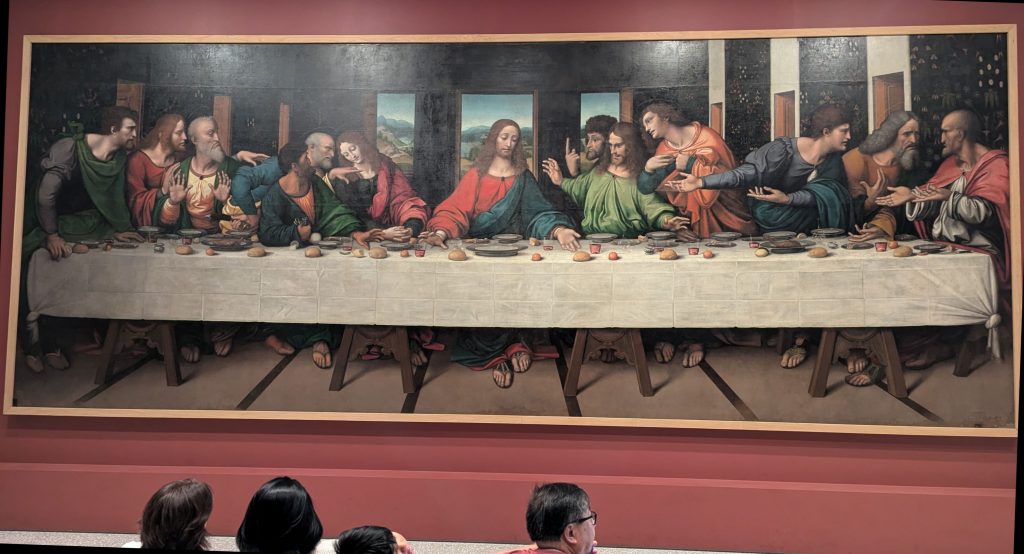
On the other hand, ‘Thank God It’s Friday!’. In fact, the belief that Friday the Thirteenth is a very bad luck days is not that old. Researchers can only trace it back to the 19th Century in France. Have a look at this BBC site for details. However, 13 has long been an ill-omened number. Judas Iscariot was the 13th to arrive at the Last Supper, And that didn’t turn out well. 13 was an unlucky day for the Romans too.
Copy of the Last Supper at the Royal Academy showing 13 participlants
Baldur and Loki
In Norse Mythology, Baldur, the son of Odin who was a bright and cheerful God, was having premonitions of doom. Odin sought the advice of a dead seer who told him, Baldur was doomed. Baldur’s mother, the Goddess Frigg, was determined to save him. So got every entity in the cosmos live or dead to swear they would not harm Baldur.
Thereafter, the Gods enjoyed themselves at banquets by throwing missiles at Baldur who was now immune to all threats. The mischievous God, Loki, saw an opportunity for his evil skills. He spoke, in disguise, to Frigg asking if she had really got every single entity to swear? She said yes except the Mistletoe as it was so innocuous. So, ofcourse, Loki went to make a spear out of the mistletoe.
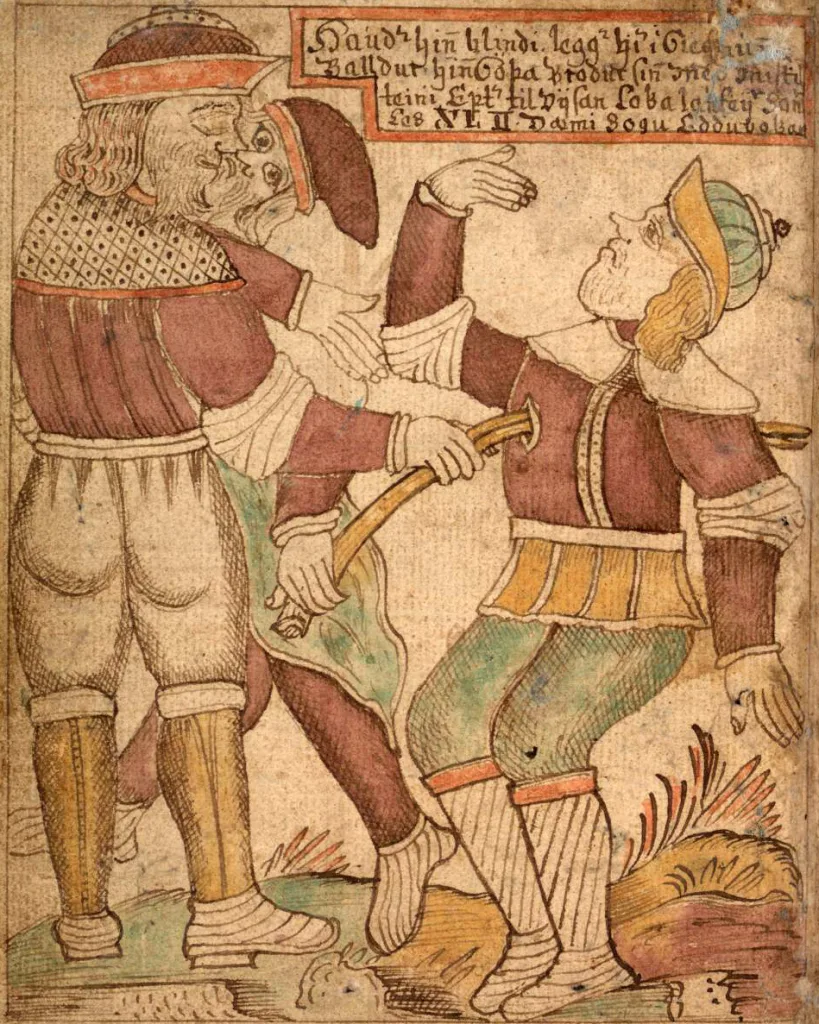
With the weapon, Loki attended a Banquet of twelve gods to which he was not invited, being therefore the 13th. When the Gods began their now customary game of throwing things at Baldur, Loki asked the slayer God Hodr to throw the mistletoe spear. It killed Baldur, and despite many attempts the Gods could not get Baldur out of Hell, Much of the joy of the world died with him. For more detail see norse-mythology.org.
By Jakob Sigurðsson[2] – SÁM 66, 75v. Digitized version available from http://sagnanet.is/saganet/?MIval=/SinglePage&Manuscript=1109&Page=150&language=english. Image processing (crop, rotate, color-levels) by Skadinaujo (talk · contribs)ou Jakob Sigurðsson. The Death of Baldr. From: Reykjavik: Stofnun Árna Magnússonar í íslenskum fræðum. SÁM 66. 1765. 75v. Hand copied paper manuscript. MyNDIR: My Norse Digital Image Repository. Ed. P. A. Baer. 2023. Edition 2.5.1. Victoria, B. C.: Humanities Computing and Media Centre, University of Victoria. 2023., Public Domain, https://commons.wikimedia.org/w/index.php?curid=6029049
Unlucky Friday?
Friday was often an unlucky day in the Bible. In particular, it was the day Adam and Eve ate of the Tree of Knowledge. Below you can see the human-headed snake beguiling Eve who hands the fruit of knowledge to Adam.
Detail from The Creation and Fall of Man by Mariotto Albertinelli Courtauld Institute photo by KFlude
It was the day when Noah’s premonition was proven correct. In the Canterbury Tales, Chaucer writes that “And on a Friday fell all this mischance. O Venus, sweet goddess of love’s chance”. (Nun’s Priest’s Tale). And Friday was the normal Hangman’s Day in England.
But no one seems to have put the two together until the 19th Century. In 1834 a French play had a line
“I was born on a Friday, December 13th, 1813 from which come all of my misfortunes.”
There is one Friday 13th a year, and often three. They insist on appearing only in a month that starts on a Sunday. The compound word for fear of Friday 13th is paraskevidekatriaphobia.
On This Day (Friday 13th)
1307 – On Friday 13 October, King Philip IV of France arrested leading members of the Knight’s Templars. One of the most powerful monastic orders in Europe to whom many of the leading Knights belonged. They had basically become the bankers to the Royalty of Europe, But they had become too powerful, and were destroyed very violently.
First Published on Friday the 13th of February 2026